25
Morpheus: A Neural Network for Jointly Learning Contextual
Lemmatization and Morphological Tagging
Eray Yildiz Faculty of Computer and
Informatics Engineering Istanbul Technical University
A. Cuneyd Tantug Faculty of Computer and
Informatics Engineering Istanbul Technical University
Abstract
In this study, we present Morpheus, a joint contextual lemmatizer and morphological tag-ger.Morpheusis based on a neural sequential architecture where inputs are the characters of the surface words in a sentence and the out-puts are the minimum edit operations between surface words and their lemmata as well as the morphological tags assigned to the words. The experiments on the datasets in nearly 100 lan-guages provided by SigMorphon 2019 Shared Task 2 organizers show that the performance ofMorpheusis comparable to the state-of-the-art system in terms of lemmatization. In mor-phological tagging, on the other hand, Mor-pheus significantly outperforms the SigMor-phon baseline. In our experiments, we also show that the neural encoder-decoder architec-ture trained to predict the minimum edit op-erations can produce considerably better re-sults than the architecture trained to predict the characters in lemmata directly as in previous studies. According to the SigMorphon 2019 Shared Task 2 results, Morpheus has placed
3rdin lemmatization and reached the9thplace in morphological tagging among all partici-pant teams.
1 Introduction
Lemmatization is the process of reducing an in-flected word into its dictionary form known as the lemma. Morphological tagging, on the other hand, is the process of marking up words with their mor-phological information and part of speech (POS) tags. Lemmatization and morphological tagging are essential tasks in natural language processing since they usually represent initial steps of sub-sequent tasks such as dependency parsing (Chen and Manning,2014;McDonald and Pereira,2006) and semantic role labeling (Haghighi et al.,2005). Morphological information of words is utilized in various tasks including statistical machine
trans-lation (Huck et al., 2017), neural machine trans-lation (Conforti et al., 2018) and named entity recognition (Güngör et al., 2019) to improve the performance. Morphological tagging and lemma-tization is crucial especially in morphologically rich languages such as Turkish and Finnish since inflected and derived words carry a substantial amount of information such as number, person, case, tense and aspect. Moreover, lexical ambigu-ities can occur in highly inflectional and deriva-tional languages such as Turkish. The correct lemma and morphological tags may differ accord-ing to the context in which words appear. As shown in table 1, the Turkish word“dolar”may have different lemma and morphological proper-ties according to the context it is used.
an-Table 1: Different lemmata and morphological properties of Turkish word “dolar” according to the context
Turkish Sentence English Translation Lemma of the word “dolar” Morhoplogical Properties of the word “dolar”
atkıyı boynunadolar She/hewrapsthe scarf around his/her neck dola(Eng. wrap) Verb, Third Person Singular, Present Tense su kovayadolar The waterfillsthe bucket dol(Eng. fill) Verb, Third Person Singular, Present Tense
dolaryine yükseldi Thedollarincreased again dolar(Eng. dollar) Noun, Nominative, Singular
notated corpora (mostly on UniMorph dataset1 (Kirov et al., 2018)) have been proposed to per-form joint morphological tagging and lemmatiza-tion. One of the early studies,Morfette(Chrupała et al., 2008) utilized a Maximum Entropy Clas-sifier to find lemmata and morphological tags of each word in a sentence. Two separate classifiers are employed in their architecture: one for assign-ing morphological tags to the words and one for predicting the shortest edit script between the sur-face word and its lemma. Shortest edit script is the shortest sequence of instructions (insertions, dele-tions, and replacements) which transforms a string into another one. In this way, the system is able to apply lemmatization to out of vocabulary words by predicting the transformation which should be applied to the surface word to obtain the lemma
of the word. More recent work, namely
Lem-ming(Müller et al.,2015) has out-performed Mor-fetteby using a Conditional Random Field classi-fier to classify each candidate sequences of lem-mata and morphological tags jointly. The feature space ofLemming differs fromMorfette as Lem-mingalso uses external lexical features such as the occurrences of a candidate lemma in a dictionary. As deep neural networks gain popularity and lead state-of-the-art results in various natural language processing tasks, sequential neural networks have been successfully employed for lemmatization and morphological tagging in recent studies ( Bergma-nis and Goldwater, 2018; Malaviya et al., 2019; Dayanık et al., 2018; Chakrabarty et al., 2017). Promising results are obtained through standard encoder-decoder neural architectures where inputs are the character sequences of the words and out-puts are the character sequences of lemmata and morphological tags (Bergmanis and Goldwater, 2018;Dayanık et al.,2018). Neural architectures which are designed to predict the edit operations between surface words and lemmata are also pro-posed in recent works (Chakrabarty et al.,2017). The current state of the art is held by Malaviya et al. (2019) using a neural hard attention mecha-nism to align the characters of surface words and
1https://unimorph.github.io/
lemmata. Morphological tagging and lemmatiza-tion are jointly modeled in their architecture and a dynamic programming approach is used to maxi-mize both morphological tagging and lemmatiza-tion scores.
In SigMorphon 2019 workshop, a shared task about morphological tagging and contextual lemmatization in nearly 100 distinct languages is organized (McCarthy et al., 2019). In this study, we propose a neural network architecture,
namely Morpheus for SigMorphon 2019 Shared
Task 2. Our architecture is inspired by Mor-phNet(Dayanık et al.,2018), which has produced promising results in Turkish using an encoder-decoder neural architecture. In MorphNet, all characters are represented with a vector, and word vectors are generated by using long short term memories (LSTM) over character vectors. An-other bidirectional LSTM is applied over word vectors to obtain context-aware representations of each word in a sentence. An LSTM based de-coder inputs context-aware word representations and produces lemmata and morphological tags, respectively. Our architecture differs from Mor-phNetas we use two separate decoders for gener-ating lemmata and morphological tags. Another difference of our architecture is that we follow the minimum edit script prediction approach consid-ering the promising performance outputs of prior work (Chrupała et al., 2008; Müller et al., 2015; Chakrabarty et al.,2017). The lemma decoder of our network is optimized to predict the minimum edit operations between surface words and lem-mata instead of predicting the character sequences of the lemmata as inMorphNetandLematus.
[image:2.595.69.527.85.130.2]make publicly available2.
2 Method
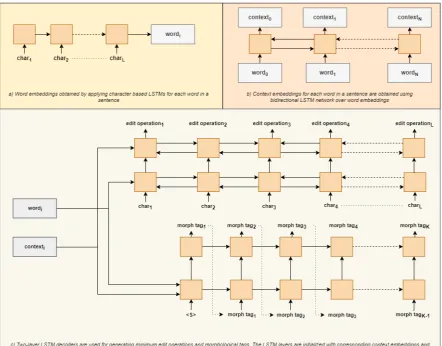
The input of our neural network based model is a sentence containing surface form words and the outputs are edit operations between surface words and their lemmata and morphological tags assigned to the words. The problem can be de-fined as we are searching a function whose in-puts are surface words of a sentencef([wo, .., wn]) and whose output is the set of (oi, mi) tuples [(o0, m0), ..,(on, mn)]whereoi is the set of edit operations to generate the lemma of the surface form wi andmi is the set of morphological tags assigned to the surface form wi. The overall ar-chitecture of the system is illustrated in Figure1. The system comprises 3 neural components that are running sequentially:
• The first component generates word vectors using LSTMs over the vector representations of its characters.
• The second component generates context-aware word vectors applying bidirectional LSTMs over word vectors
• Two separate LSTM decoders accept the
same context-aware word vectors. The first decoder generates edit operations between surface words and lemmata while the second decoder generates morphological tags
In the final step, lemmata are generated by apply-ing predicted edit operations to the surface words.
2.1 Generating minimum edit operations
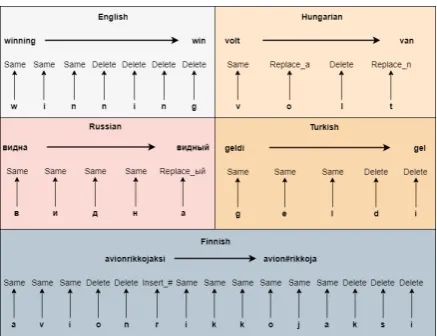
The proposed model is designed to predict min-imum edit operations to obtain the lemma from a surface word. The fundamental edit operations areSame,Delete,Replace, andInsertoperations. To find minimum edit operations between surface word and its lemma, we use a dynamic program-ming approach3 which is based on Levenshtein distance. Some sample edit operations between surface words and lemmata are given in Figure 2 for several languages. As seen in Figure 2, SameandDeleteoperations have only one version whereasReplaceandInsertoperations have mul-tiple versions combined with the character to be
2
https://github.com/erayyildiz/Morpheus/
3https://github.com/faircloth-lab/python-levenshtein
replaced or inserted. So the actual number of ele-ments in the edit operations set are determined for each language separately by processing the train-ing data.
Generally, the length of a lemma is shorter than or equals to the length of the corresponding sur-face form and consequently, the number of edit operations are usually the same as the length of the surface form. However, for some languages, lem-mata longer than the corresponding surface forms are observed. Since our minimum edit prediction decoder predicts an edit operation label for each character in the surface (see Section2.4.1for de-tails), it fails in generating lemmata longer than the surface forms. Thus we make some modifica-tions over the base operamodifica-tions generated by stan-dardLevenshteindistance based algorithm. To en-sure the length of the operation labels is the same as the length of the surface words, we merge con-secutive Insert labels in the same position into oneInsertlabel with multiple characters. We also combine theReplacelabels and the following con-sequentInsertlabels in the same position into one Replacelabel with multiple characters. For exam-ple, the minimum edit operations for the Russian surface-lemma pair"видна"-"видный"have four Same operation labels and one Replace_ый la-bel, respectively. Note that the last character in the surface word"a"is replaced with the character "ы"and then the character й is inserted into the end. The base labels Replace_ы andInsert_й are merged into one labelReplace_ыйto ensure that edit operations and surface words have the same length (Figure2).
2.2 Word representations
The first component of our network inputs char-acter sequences of each word in a sentence and generates vector representations of the words us-ing an LSTM network. Let wi represents theith word withLi characters in a sentence andwij is jth character in wi. In our model, each charac-terwij is represented by a vectoraij ∈ IRda and we calculate the vector representation ofithword
ei ∈ IRde by applying an LSTM over the vector representations of its constituent characters from left to right as shown in eq. (1). The last hidden state vector of the LSTMhLi ∈IR
de is considered
as the vector representation of the wordwi.
Figure 1: The illustration of the proposed neural network architecture which consists of 3 components: (a) word vector generator (b) context vector generator (c) decoders to generate minimum edit operations for lemmatization and morphological tags. (Nindicates the number of words in the sentence.Lindicates both the number of charac-ters in the word and the number of edit operations between the word and the lemma. Krepresents the number of morphological tags assigned to the word)
2.3 Context-aware word representations
The context of the words have a substantial impact on morphological tagging and lemmatization in most languages (Shen et al.,2016;Malaviya et al., 2019). In order to take into account the context of the words we employ another LSTM which is bidi-rectional and inputs vector representationsei and outputs context-aware representations ci ∈ IRdc for each surface word in the context as shown in eqs. (2) to (4)
c→i =LST M(ei, c→i−1) (2)
c←i =LST M(ei, c←i+1) (3)
ci = [c→i , c←i ] (4)
The final output is context-aware vector repre-sentationci for each wordwiin the sentence.
2.4 Decoding Components
One of the important differences of the proposed network from previous studies (Bergmanis and Goldwater, 2018;Dayanık et al., 2018) is that it has two separate decoders for lemmatization and morphological tagging. The parameters of the de-coders are not shared. However, they are both fed with the same word vectorsei and context-aware word vectorscithat are generated in the encoding step.
2.4.1 Minimum edit prediction decoder
Figure 2: Minimum edit operations between surface words and their lemmata
vectoruij ∈IRdu. Forward LSTM network inputs previous hidden statesg→j−11, g→j−21 ∈IRdg and
out-puts current hidden statesgj→1,gj→2and an output vectoryj→ ∈IRdy. Backward LSTM network, on
the other hand, applies the same operations in op-posite direction and outputsgj←1, gj←2 ∈IRdg and
yj←. Softmaxfunction is then applied to the mul-tiplication of trainable matrixWo ∈IRdy×|o|with the concatenation vector of output vectorsy→j and
yj←where|o|represents the number of distinct edit operations observed in the dataset. The output of softmaxoperation is the probabilities of each min-imum edit operation p(oij) corresponding to the characterwij as shown in eqs. (5) to (7).
y→j , g→j 1, gj→2 =LST M(uij, g→j−11, g
→2 j−1) (5)
y←j , g←j 1, gj←2 =LST M(uij, g←j+11, g
←2 j+1) (6)
p(oij) =sof tmax(Wo×[yj→, y
←
j ]) (7)
The first hidden states of both forward and back-ward LSTMs are initialized with the word vector
ei (see section2.2) and a linear transformation of the context-aware word vector:Wc×ciwhereWc is a matrix in IRdc×de (see section 2.3),
respec-tively (see eq. (11)).
g→0 1 =ei (8)
g0→2 =Wc×ci (9)
g←Li1 =ei (10)
gL←i1 =Wc×ci (11)
2.4.2 Morphological tagging decoder
The morphological tagging decoder component is another LSTM decoder which is able to gener-ate morphological tags without length restriction. Each wordwihasKimorphological tags and each morphological tagmil is represented by a one di-mensional vectorvil ∈ IRdv. A two layer LSTM network which is unidirectional is initialized same as in minimum edit prediction component. An LSTM cell inputs the vector representationvi(l−1) of previously predicted tagm0il and previous hid-den statesql1−1, ql2−1∈IRdq in each step. The
out-puts of the LSTM cell are current hidden states
ql1, ql2 and an output vector zij ∈ IRdz. Soft-max function is then applied to multiplication of the output vectorzij and trainable matrixWm ∈ IRdz×|m|wheremequals to the number of distinct
morphological tags in the dataset. The first input to the decoder is the vector representation of a spe-cial start symbol vstart ∈ IRdv. In this way the probabilities of each morphological tags p(mil) in given position i, l are calculated as shown in eqs. (5), (12) and (13).
z1, q11, q21 =LST M(vstart,ei,Wc×ci) (12)
zl, ql1, q2l =LST M(vi(l−1), q1l−1, ql2−1) (13)
p(mil) =sof tmax(Wm×zl) (14)
2.5 Character prediction decoder
The character prediction decoder component which sequentially predicts the characters occur in lemmata is not employed in the proposed archi-tecture. However, we build an alternative model in which the character prediction decoder compo-nent is used instead of a minimum edit prediction decoder. In this way, we aim to evaluate the impact of predicting minimum edit operations instead of characters in lemmata. The character prediction decoder used in the experiments has the same ar-chitecture and parameter set with the morphologi-cal tagging decoder.
2.6 Training objective
Method Lemmatization Accuracy (%)
Morphological Tagging F1 Score (%)
[image:6.595.87.290.225.360.2]Turku NLP(Kanerva et al.,2018) 92.18 86.7 UPPSALA Uni.(Moor,2018) 58.5 88.32 SigMorphon 2019 Baseline(Malaviya et al.,2019) 93.95 68.72 Morpheus (Character Prediction) 88.03 88.94 Morpheus (Edit Operation Prediction) 94.15 90.52
Table 2: Average lemmatization and morphological tagging performances of the systems onUniMorphdataset
phase by minimizing the sum of two cross entropy losses as follow:
Llemma =− 1
N N
X
i 1
Li Li X
j
logp(oij) (15)
Lmorph=−1 N
N
X
i 1
Ki Ki X
j
logp(mij) (16)
Ltotal=Llemma+Lmorph (17)
The loss for lemmatization is calculated by tak-ing cross entropy over predicted minimum edit operations p(oij) as in eq. (15) where N stands for the number of words in the sentence and Li stands for the number of characters in the word
wi. The loss for morphological tagging is cross entropy over predicted tag probabilitiesp(mil)as in eq. (16) whereKistands for the number of mor-phological tags assigned to the wordwi. The total loss to minimize is the sum of the lemmatization loss and morphological tagging loss (see eq. (17)).
3 Experiments
In our experiments, we train and evaluate the pro-posed architecture onUniMorphdataset collection (Kirov et al.,2018) for each language. Same archi-tecture with the same hyper-parameters is used for all the languages. To investigate the impact of the minimum edit prediction component on the per-formance, we also train the network in which the character prediction decoder component is used instead of a minimum edit prediction component. The results of the experiments are provided in sec-tion3.3and table2
3.1 Dataset
UniMorph dataset collection, which includes a various number of sentences consist of surface words with annotated lemmata and morphological
[image:6.595.308.525.351.531.2]tags in 97 different languages are provided in Sig-Morphon 2019 shared task 2. The dataset for each language is split into train and validation sets, and the size of the dataset differs in each language. In our experiments, we train our architecture on train sets and evaluate the performances on validation sets. The experimental results presented in sec-tion3.3 are obtained on the validation sets. Note that final results which are presented in SigMor-phon paper (McCarthy et al.,2019) are calculated over the test sets which were not available to the systems before the final submission stage.
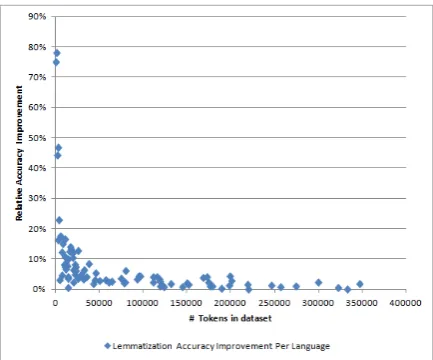
Figure 3: Relative lemmatization accuracy improve-ment vs dataset size per language
3.2 Experimental Setup
Lemmatization Accuracy (%)
Morph. Tagging F1 (%)
Language DatasetSize CharacterPred. Pred.Edit CharacterPred. Pred.Edit
[image:7.595.72.295.61.727.2]North-Sami-Giella 29K 87.53 91.90 88.89 92.83 French-GSD 360K 97.06 98.47 97.58 97.99 Japanese-Modern 14K 85.39 93.88 93.06 92.44 Swedish-PUD 18K 82.79 93.05 89.23 92.09 Arabic-PADT 256K 94.39 95.18 95.01 95.40 Basque-BDT 119K 95.42 96.49 93.06 94.47 Urdu-UDTB 123K 95.20 96.02 90.79 91.20 Irish-IDT 21K 85.07 89.23 80.60 71.52 Bambara-CRB 14K 88.24 88.85 93.47 93.56 Dutch-Alpino 200K 94.97 97.81 95.63 96.45 Czech-FicTree 175K 97.39 98.49 94.15 96.39 Danish-DDT 94K 93.16 97.26 94.17 95.62 Latin-ITTB 332K 98.65 98.75 96.84 97.34 French-Sequoia 64K 95.54 98.17 95.96 96.82 Italian-PoSTWITA 115K 92.71 96.61 94.43 95.62 Polish-SZ 93K 93.59 96.86 90.23 93.26 Czech-CLTT 32K 92.11 98.03 89.03 93.82 Cantonese-HK 7K 90.05 94.17 85.41 86.14 Galician-TreeGal 23K 89.68 95.19 89.78 90.72 Slovenian-SSJ 131K 95.25 96.94 93.47 95.79 French-ParTUT 25K 92.67 96.10 93.09 94.55 Lithuanian-HSE 5K 70.60 83.05 43.37 70.70 French-Spoken 35K 94.47 98.48 95.46 96.66 Russian-Taiga 22K 83.59 90.57 76.62 83.80 Latvian-LVTB 150K 94.29 96.22 93.51 95.87 Czech-PDT 1515K 84.86 98.41 87.65 95.27 Japanese-GSD 168K 95.21 98.91 95.35 95.61 Indonesian-GSD 111K 97.06 99.49 92.69 93.11 Gothic-PROIEL 62K 96.60 96.58 93.04 95.12 Latin-PROIEL 219K 96.31 96.37 93.75 95.05 Czech-PUD 19K 83.55 93.57 81.30 86.70 Dutch-LassySmall 96K 93.44 97.58 94.51 95.47 Romanian-RRT 198K 96.54 97.88 96.81 97.44 Korean-Kaist 346K 93.31 95.07 95.70 95.46 Amharic-ATT 11K 93.80 100.00 91.02 91.39 English-GUM 79K 95.58 97.85 93.92 95.48 Estonian-EDT 421K 93.10 96.27 95.64 96.70 Chinese-GSD 111K 95.22 99.15 89.25 90.78 Korean-GSD 80K 87.55 92.89 93.43 94.16 Marathi-UFAL 4K 74.59 76.94 68.26 69.26 Akkadian 2K 42.22 60.89 78.13 66.52 Faroese-OFT 13K 83.56 89.97 88.08 89.49 English-EWT 246K 96.78 98.11 95.61 95.95 Sanskrit-UFAL 3K 53.61 65.98 52.59 55.36 Turkish-IMST 60K 94.13 96.43 91.67 93.72 English-PUD 20K 89.40 95.22 88.88 89.89 Korean-PUD 18K 87.19 98.86 91.42 92.75 Finnish-PUD 16K 77.72 87.55 85.49 92.05 Russian-SynTag 1036K 95.31 97.76 94.99 95.13 Croatian-SET 179K 94.91 96.01 94.31 95.47 Tagalog-TRG 406 48.00 84.00 74.23 71.74 Slovenian-SST 31K 91.83 94.97 85.34 89.23 Finnish-FTB 172K 90.70 94.46 94.13 95.85 Polish-LFG 174K 93.85 96.09 92.93 95.35 Portuguese-Bosque 218K 96.43 97.86 96.07 96.59 Coptic-Scriptorium 20K 93.47 95.68 95.17 94.76 Chinese-CFL 7K 82.55 92.66 81.51 83.76 Spanish-AnCora 497K 98.32 98.92 98.29 98.46 Greek-GDT 57K 93.73 96.65 94.71 96.12 Serbian-SET 78K 94.82 97.06 94.36 96.06 Naija-NSC 14K 95.80 99.84 91.15 92.02 Vietnamese-VTB 42K 98.17 99.95 89.45 89.71 Yoruba-YTB 2K 83.60 97.20 80.49 70.67 Italian-PUD 22K 89.51 96.11 92.63 94.22 Finnish-TDT 198K 91.37 95.38 95.67 96.76 English-ParTUT 44K 94.87 97.85 92.32 93.46 Upper-Sorbian-U. 11K 77.79 90.74 69.47 77.46 Norwegian-Ny. 14K 93.89 97.42 90.45 92.20 Galician-CTG 121K 97.18 98.69 97.29 97.30 Old-Church-Slv. 66K 96.48 95.66 93.33 94.91 Russian-GSD 92K 92.90 91.51 91.98 93.91 Kurmanji-MG 10K 85.66 92.69 85.99 85.22 Norwegian-Bk. 299K 96.65 98.94 96.75 97.41 Italian-ISDT 273K 96.90 97.90 97.34 97.89 Komi-Zyrian-IKDP 1K 38.55 68.67 45.50 36.89 Hebrew-HTB 144K 96.49 97.35 95.35 95.70 Tamil-TTB 10K 86.77 96.10 83.07 88.50 Buryat-BDT 10K 83.33 89.61 78.24 82.30 Breton-KEB 12K 85.61 92.81 88.65 90.12 Latin-Perseus 29K 87.30 86.26 79.21 82.88 Romanian-Nonstd 189K 96.10 96.37 95.52 96.36 Italian-ParTUT 50K 94.65 97.44 94.83 96.30 Catalan-AnCora 481K 98.17 98.92 98.42 98.65 Arabic-PUD 22K 81.31 80.90 87.23 88.00 Komi-Zyrian-L. 2K 52.75 77.47 55.79 57.02 Japanese-PUD 25K 86.30 97.32 93.46 94.02 Slovak-SNK 119K 94.52 96.95 91.88 94.55 Ukrainian-IU 118K 93.63 96.80 91.24 93.68 Turkish-PUD 17K 78.20 89.19 86.71 91.28 Bulgarian-BTB 152K 95.98 97.58 97.16 97.83 Russian-PUD 19K 83.78 92.54 81.73 87.79 Belarusian-HSE 8K 78.06 89.87 69.39 71.95 Hindi-HDTB 322K 98.15 98.82 96.12 96.60 Czech-CAC 474K 98.01 98.86 96.52 97.54 Hungarian-Szeged 38K 87.89 95.26 89.63 91.65 Swedish-LinES 74K 93.52 96.82 93.25 94.88 Afrikaans-Af.B. 45K 93.75 98.74 95.08 95.96 English-LinES 77K 96.19 98.27 94.57 95.43
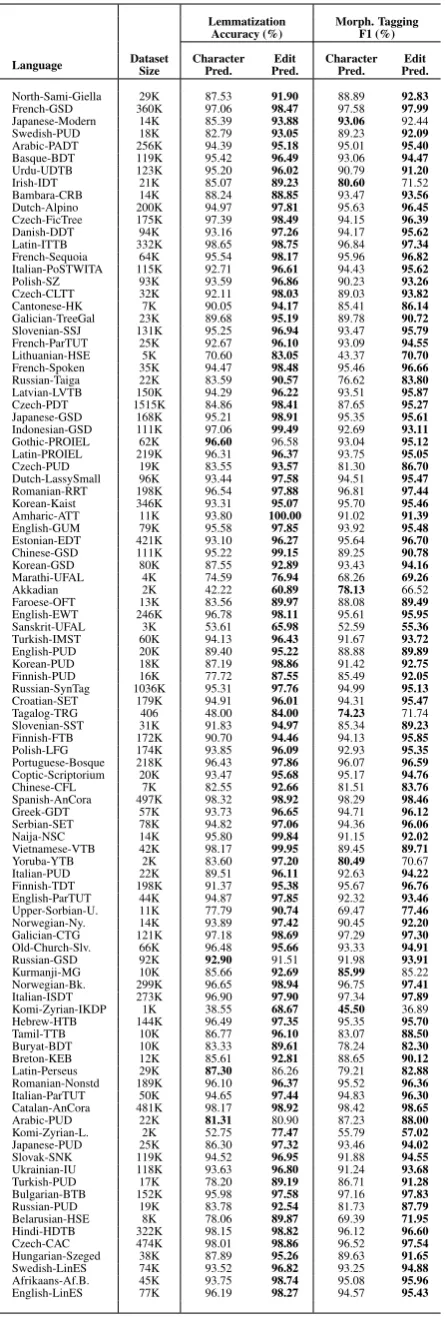
Table 3: Lemmatization and Morphological Tagging performances of minimum edit prediction model and character prediction model on development sets
function.Dropoutrate 0.4 is applied to all connec-tions during model training for regularization. All the weights are initialized with Xavier initializa-tion method (Glorot and Bengio,2010). We use an early stop mechanism which stops the training af-ter four consecutive epochs without improvement on validation set.
3.3 Results
Table 2 presents the lemmatization and morpho-logical performances of the proposed method on UniMorph dataset collection. The lemmatization accuracy on a dataset is the proportion of the num-ber of correctly found lemmata over the total lem-mata count. The lemmatization accuracy given in table 2 is the average of the accuracies obtained over the validation sets of all languages. The performance of morphological tagging is mea-sured by the F1 score calculated over the pre-dicted and actual individual morphological tags. In addition to the performance of the proposed ar-chitecture with minimum edit prediction decoder, the performance of the architecture with charac-ter prediction decoder is also given. The per-formances of SigMorphon 2019 neural baseline, Turku NLPsystem (Kanerva et al.,2018) which is the best lemmatization performer in CONLL 2018 Shared Task (Zeman and Hajiˇc,2018) and UPP-SALA Uni system which is the best morpholog-ical tagging performer in CONLL 2018 are also given. Although the dataset provided in CONLL 2018 share the same basis with the dataset pro-vided in SigMorphon, important differences exist between them. Hence the performances ofTurku NLP andUPPSALA Uni are not directly compa-rable to our systems and SigMorphon baselines. However, we present the performances of those systems averaged on the same languages in Sig-Morphon dataset to provide an idea of how much improvement is achieved over a year.
im-pressive result is that the performance of morpho-logical tagging is also enhanced by employing the minimum edit prediction decoder.
Table 3shows the lemmatization and morpho-logical performances of both character prediction and minimum edit prediction models for each
lan-guage. The performance of the minimum edit
prediction model is better than the character pre-diction model in almost all languages. Figure 3 shows that there is a correlation between the size of the training data and the improvement on the performance when the minimum edit predic-tion decoder is employed. For instance, the rel-ative lemmatization improvement is extreme in languages with relatively small dataset such as Tagalog-TRG (400 tokens/0.75 relative improve-ments), Komi-Zyrian (1.1K tokens/0.78 relative improvement) and Akkadian (1.7 tokens/0.44 rel-ative improvement). On the other hand, in lan-guages with large size dataset such as Spanish-AnCora (496K tokens), Catalan-Spanish-AnCora (480K tokens) and French-GSD (359K tokens), the im-provement is relatively low (0.006, 0.007 and 0.01, respectively). Although improvement magnitude is highly correlated with the training dataset size, there must be other factors specific to the proper-ties of the language. For instance, the dataset size of the language Marathi-UFAL is small (4.1K to-kens). However, the improvement degree is also small (0.03 relative improvement).
Language Surfaceword
Edit pred. based model
output
Char. pred. based model
output
Thurlow Thurlow Throughlough
English Cosmic Cosmic Comsic
sorrows sorrow sorw
Vietnam Vietnam Vietman
YPK Ypk YYk
Turkish kokainle kokain koki
Islık ıslık sılık
Table 4: Some examples of the errors made by charac-ter prediction model and corrected by the edit predic-tion based model
To investigate in which cases the edit predic-tion model performs better, we explore the outputs of the models for English and Turkish languages. A significant portion of the errors in the charac-ter prediction model is observed in unseen words and proper nouns. Some of the errors made by the character prediction based model and corrected by the edit prediction based model are shown in Table 4. A possible reason is that the lemmatization of
a singular nominative noun which is rarely seen in the training data is easier to edit prediction model since all of the edit operations are Same and the model should only produce a sequence of Same labels. Character prediction based model, on the other hand, have to learn to reproduce the word from scratch. Additionally, we observe a signifi-cant amount of samples in which the edit predic-tion model produced morphological tags and lem-mata more appropriate to the context than the out-puts of the character prediction model. As a re-sult, further research is needed to understand in which cases the edit prediction decoder helps to better learning of morphological properties of a language.
4 Conclusion
In this study, we propose a neural architecture, namely Morpheus, which is based on sequen-tial neural encoder-decoders. The input words are encoded in context-aware vector representa-tions using two-level LSTM network and the de-coders initialized with context-aware word vec-tors generates both morphological tags assigned to the words and minimum edit operations be-tween surface words and their lemmata. We per-form experiments to evaluate the perper-formance of MorpheusonUniMorphdataset collection (Kirov et al., 2018), which comprised nearly 100 lan-guage datasets. The experiments show that the lemmatization performance of the Morpheus is comparable to the SigMorphon neural baseline system (Malaviya et al., 2019), which has ob-tained current state-of-the-art results onUniMorph dataset collection. Regarding morphological tag-ging performance, Morpheus outperforms Sig-Morphon morphological tagger baseline signifi-cantly ( 0.3 relative improvement). In lemmati-zation, Morpheus has placed 3rd in the SigMor-phon 2019 Shared Task 2, and it has reached the 9thplace in morphological tagging. In our experi-ments, we also show that predicting the minimum edit operations between surface words and their lemmata instead of directly predicting the charac-ters improves the performances of the system sig-nificantly especially when the dataset is small.
Acknowledgments
[image:8.595.84.279.483.585.2]References
Toms Bergmanis and Sharon Goldwater. 2018. Con-text sensitive neural lemmatization with lematus. In
Proceedings of the 2018 Conference of the North American Chapter of the Association for Computa-tional Linguistics: Human Language Technologies, Volume 1 (Long Papers), pages 1391–1400.
Abhisek Chakrabarty, Onkar Arun Pandit, and Utpal Garain. 2017. Context sensitive lemmatization us-ing two successive bidirectional gated recurrent net-works. In Proceedings of the 55th Annual Meet-ing of the Association for Computational LMeet-inguistics (Volume 1: Long Papers), pages 1481–1491.
Danqi Chen and Christopher Manning. 2014. A fast and accurate dependency parser using neural net-works. In Proceedings of the 2014 conference on empirical methods in natural language processing (EMNLP), pages 740–750.
Grzegorz Chrupała, Georgiana Dinu, and Josef Van Genabith. 2008. Learning morphology with morfette.
Costanza Conforti, Matthias Huck, and Alexander Fraser. 2018. Neural morphological tagging of lemma sequences for machine translation. In Pro-ceedings of the 13th Conference of the Association for Machine Translation in the Americas (Volume 1: Research Papers), volume 1, pages 39–53.
Erenay Dayanık, Ekin Akyürek, and Deniz Yuret. 2018. Morphnet: A sequence-to-sequence model that combines morphological analysis and disam-biguation. arXiv preprint arXiv:1805.07946.
Xavier Glorot and Yoshua Bengio. 2010. Understand-ing the difficulty of trainUnderstand-ing deep feedforward neu-ral networks. In Proceedings of the thirteenth in-ternational conference on artificial intelligence and statistics, pages 249–256.
Onur Güngör, Tunga Güngör, and Suzan Üsküdarli. 2019. The effect of morphology in named entity recognition with sequence tagging. Natural Lan-guage Engineering, 25(1):147–169.
Aria Haghighi, Kristina Toutanova, and Christopher D Manning. 2005. A joint model for semantic role la-beling. InProceedings of the Ninth Conference on Computational Natural Language Learning, pages 173–176. Association for Computational Linguis-tics.
Matthias Huck, Aleš Tamchyna, Ondˇrej Bojar, and Alexander Fraser. 2017. Producing unseen morpho-logical variants in statistical machine translation. In
Proceedings of the 15th Conference of the European Chapter of the Association for Computational Lin-guistics: Volume 2, Short Papers, pages 369–375.
Jenna Kanerva, Filip Ginter, Niko Miekka, Akseli Leino, and Tapio Salakoski. 2018. Turku neural parser pipeline: An end-to-end system for the conll
2018 shared task. In Proceedings of the CoNLL 2018 Shared Task: Multilingual Parsing from Raw Text to Universal Dependencies, pages 133–142.
Lauri Karttunen, Ronald M Kaplan, and Annie Zae-nen. 1992. Two-level morphology with composi-tion. In COLING 1992 Volume 1: The 15th Inter-national Conference on Computational Linguistics, volume 1.
Diederik P Kingma and Jimmy Ba. 2014. Adam: A method for stochastic optimization. arXiv preprint arXiv:1412.6980.
Christo Kirov, Ryan Cotterell, John Sylak-Glassman, Géraldine Walther, Ekaterina Vylomova, Patrick Xia, Manaal Faruqui, Sebastian J. Mielke, Arya Mc-Carthy, Sandra Kübler, David Yarowsky, Jason Eis-ner, and Mans Hulden. 2018. UniMorph 2.0: Uni-versal Morphology. In Proceedings of the 11th Language Resources and Evaluation Conference, Miyazaki, Japan. European Language Resource As-sociation.
Chaitanya Malaviya, Shijie Wu, and Ryan Cot-terell. 2019. A simple joint model for improved contextual neural lemmatization. arXiv preprint arXiv:1904.02306.
Arya D. McCarthy, Ekaterina Vylomova, Shijie Wu, Chaitanya Malaviya, Lawrence Wolf-Sonkin, Gar-rett Nicolai, Christo Kirov, Miikka Silfverberg, Se-bastian Mielke, Jeffrey Heinz, Ryan Cotterell, and Mans Hulden. 2019. The SIGMORPHON 2019 shared task: Crosslinguality and context in
morphol-ogy. In Proceedings of the 16th SIGMORPHON
Workshop on Computational Research in Phonetics, Phonology, and Morphology, Florence, Italy. Asso-ciation for Computational Linguistics.
Ryan T McDonald and Fernando CN Pereira. 2006. Online learning of approximate dependency parsing algorithms. InEACL, pages 81–88.
Christophe Moor. 2018. Multilingual Dependency Parsing from Raw Text to Universal Dependen-cies: The CLCL entry. Ph.D. thesis, University of Geneva.
Thomas Müller, Ryan Cotterell, Alexander Fraser, and Hinrich Schütze. 2015. Joint lemmatization and morphological tagging with lemming. In Proceed-ings of the 2015 Conference on Empirical Methods in Natural Language Processing, pages 2268–2274.
Kemal Oflazer. 1993. Two-level description of turk-ish morphology. In Proceedings of the Sixth Con-ference on European Chapter of the Association for Computational Linguistics, EACL ’93, pages 472– 472, Stroudsburg, PA, USA. Association for Com-putational Linguistics.
Eray Yildiz, Caglar Tirkaz, Bahadir Sahin, Mustafa Tolga Eren, and Ozan Sonmez. 2016. A morphology-aware network for morphological disambiguation.