Proceedings of the Fourteenth Workshop on Innovative Use of NLP for Building Educational Applications, pages 159–167 159
The LAIX Systems in the BEA-2019 GEC Shared Task
Ruobing Li† Chuan Wang Yefei Zha Yonghong Yu Shiman Guo Qiang Wang Yang Liu† Hui Lin†
LAIX Inc.
†{ruobing.li, yang.liu, hui.lin}@liulishuo.com
Abstract
In this paper, we describe two systems we de-veloped for the three tracks we have partic-ipated in the BEA-2019 GEC Shared Task. We investigate competitive classification mod-els with bi-directional recurrent neural net-works (Bi-RNN) and neural machine transla-tion (NMT) models. For different tracks, we use ensemble systems to selectively combine the NMT models, the classification models, and some rules, and demonstrate that an en-semble solution can effectively improve GEC performance over single systems. Our GEC systems ranked the first in the Unrestricted Track, and the third in both the Restricted Track and the Low Resource Track.
1 Introduction
Grammatical error correction (GEC) is the task of automatically correcting grammatical errors in text. With the increasing number of language learners, GEC has gained more and more atten-tion from educaatten-tionists and researchers in the past decade. The following is a GEC example: I [fall
→ fell] asleep at 11 p.m. last [nigh → night]. Here fall needs to be corrected to its past tense form andnighis a spelling mistake.
GEC is considered as a mapping task from in-correct sentences to in-correct sentences. Inin-correct sentences can be seen as being produced by adding noises to correct sentences. The added noise does not happen randomly, but occurs when people learn or use the language according to a certain er-ror distribution and language usage bias. Initially, people used rule-based approaches to solve GEC problems (Naber and Miłkowski,2005). Rules are relatively easy to make but with poor generaliza-tion. Later researchers began to treat GEC as a classification task. According to the grammati-cal information around the target word, classifiers
can be constructed to predict the true grammati-cal role of the target word. One drawback of the classification methods for GEC is that training dif-ferent classifiers for difdif-ferent error types may be resource-intensive and inefficient since there are many grammatical error types. Recently, transla-tion methods have become the focus of research, and there is a clear trend that state-of-the-art GEC systems are being shifted from traditional NLP methods to NMT based methods.
In recent years, GEC performance has seen sig-nificant improvement in some public GEC test sets (Ge et al.,2018). In CoNLL-2013 (Ng et al.,
2013) and CoNLL-2014 (Ng et al., 2014) GEC Shared Task, machine learning based GEC meth-ods emerged with relatively good performance. Classification methods achieved the best result in CoNLL-2013 (Rozovskaya et al., 2013). After that, statistical machine translation (SMT) meth-ods began to show better performance in CoNLL-2014 (Felice et al., 2014). (Chollampatt et al.,
2016) was the first study to obtain the state-of-the-art result with neural networks. Then af-ter (Junczys-Dowmunt and Grundkiewicz,2016), machine translation methods became the main-stream in GEC solutions. In addition, an RNN-based context model achieved better results than previous traditional classification models (Wang et al., 2017). Using a CNN-based sequence-to-sequence architecture (Gehring et al., 2017), (Chollampatt and Ng, 2018) proposed the first end-to-end NMT model and reported the state-of-the-art result. As Transformer (Vaswani et al.,
2017) plays an increasingly important role in se-quence modeling, Transformer-based end-to-end NMT models began to lead the current GEC re-search (Junczys-Dowmunt et al., 2018; Grund-kiewicz and Junczys-Dowmunt, 2018; Ge et al.,
ed-its history corpus, which is huge but noisy, and gained a result very close to the state-of-the-art result. Learning a GEC translation model from noisy data is a worthy future direction as the GEC parallel corpus is expensive to obtain.
This paper describes our two systems for the three tracks in the BEA-2019 GEC Shared Task (Bryant et al., 2019). We use two popular NMT models and two improved versions of neu-ral classification models to train the basic models. Ensemble strategies are then used to combine out-comes from different models. Our two systems for the three tracks are described in next section. In Section 3, we evaluate the systems on the devel-opment data and show the final results on the test data. Section 4 concludes the paper and summa-rizes the future work.
2 System Overview
2.1 Restricted and Unrestricted Track
We submitted the same system output for the Re-stricted and UnreRe-stricted tasks. The system uses several ensemble methods to combine the CNN-based and Transformer-CNN-based translation models, described in details below.
2.1.1 CNN-based translation ensemble systems
We found that CNN-based systems obtained the best results for some error types, likely due to some characteristics derived from CNN. We trained four CNN-based ensemble systems, using the model architecture in (Chollampatt and Ng,
2018), but without reranking. Four best combina-tions to build the ensemble systems were selected. Unlike (Chollampatt and Ng, 2018), we did not use fastText (Bojanowski et al., 2017) to initial-ize word embeddings because we found no im-provement on the development set by doing that. We tuned parameters for the system, such as batch size, word embedding dimension, etc.
2.1.2 Transformer-based translation systems
Transformer is currently considered to be one of the most powerful models for sequence model-ing. For GEC, some of the best recent results re-ported on CoNLL-2014 test set are obtained by Transformer-based translation models. We trained eight Transformer-based translation models in a low resource translation paradigm ( Junczys-Dowmunt et al.,2018). We tuned parameters for
domain and error adaptation. We also compared the results using 2 GPUs and 4 GPUs as the au-thors reported the difference in their Github repos-itory1.
2.1.3 Ensemble methods
We expect to combine these models trained above into a more powerful system through effective en-semble methods. Our enen-semble work mainly fo-cuses on rule-based solutions. We will introduce two main modules first.
Confidence TableWe can obtain the precision and F0.5 metric on each error type through sen-tence alignment and error type classification by Errant (Bryant et al.,2017). Errant provides per-formance statistics based on 55 error types and is also the tool used to evaluate this GEC shared task, thus we use the result ofoperation and error type span-level(Bryant et al.,2017) for a model or sys-tem as the confidence table.
Conflict SolverWe often encounter GEC error conflicts when combining multiple models or sys-tems. For example, We love played soccer. One system corrects playedto playing, while another system may correctplayedtoto play. When two different corrections occur in the same place, we need to consider which one to choose.
We solve this problem in a unified pipeline, which can also be seen as an ensemble way:
(1) We sort each group of conflicting correc-tions proposed by all the systems in a reverse order of location index and confidence.
(2) We apply three sub-strategies:
• When combining outcomes from different systems, we treat the precision in a confi-dence table as the conficonfi-dence. Each correc-tion has its confidence obtained by looking up the precision of the corresponding type of the correction in the table. If two conflict-ing corrections are the same, we merge them and addαto the confidence of the correction; otherwise, the correction with a lower confi-dence will be discarded.
• After combining outcomes, if the confidence of a correction is lower thanβ, the correction is discarded.
• γ is used to distinguish when it is more im-portant to focus on the precision or F0.5 of
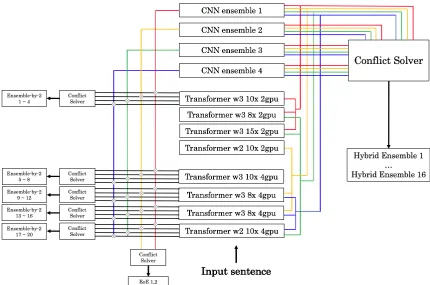
Figure 1: The architecture of the ensemble system in Restricted and Unrestricted Tracks.
a correction. When we move to the final ensemble with confidence tables of existing systems, if the confidence is larger thanγ, we select the correction proposed by the system that has the bestF0.5 on the type of this cor-rection. Otherwise, the correction by a sys-tem with the best precision is selected.
In Figure 1, ⊗means the outcome is obtained by combining two systems represented by inter-secting lines of two different colours. If there are multiple ⊗ on a line, it means the ensemble is over all of these⊗on this line. Figure1displays three types of ensemble methods based on all of the CNN-based and Transformer-based translation models.
• Combine each CNN-based ensemble model with each of the selected five of the Transformer-based models. This is noted as ‘ensemble-by-2’.
• Perform ensemble over all of the ensemble models relating to either CNN ensemble 1 or CNN ensemble 2, noted as EoE (Ensemble over Ensemble) 1 and 2.
• Ensemble each CNN ensemble model with some selected combinations of
Transformer-based models to produce 16 strong ensemble system outcomes, represented as ‘Hybrid En-semble’ in Figure1. It is where multiple lines of the same color are merged into one line in Figure1.
After getting all of the ensemble outcomes, we will do the final ensemble step: select the best con-fidence for each type from each single or ensem-ble system to form the strongest final outcome. In this ensemble step, we use the last aforementioned sub-strategy, and discard the error types with very low confidence to boost the final performance.
2.2 Low Resource Track
sim-ple ensemble method to combine all of the classi-fiers, rules, spelling checker and translation mod-els. Note that for the Restricted and Unrestricted tracks, we did not observe any gain from the clas-sification models or the rule-based methods, there-fore only the translation systems were used for those tracks.
2.2.1 Classification model
After an analysis of the development sets, we de-cided to build classifiers for eight common error types. Based on (Wang et al., 2017), we devel-oped two classification model structures for the eight error types.
(A) Bi-GRU context model
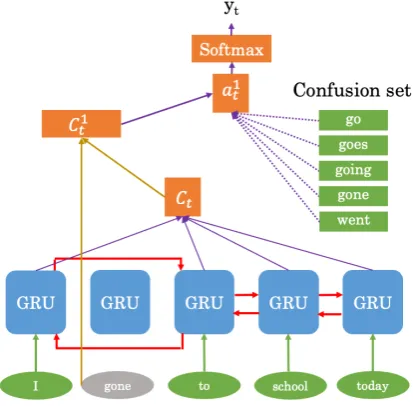
Figure2shows the bi-directional GRU context model we use to determine the right grammatical category for a target word. The concatenated left and right source states of the target word form the contextual semantic vector representation. This is used as a query to calculate the attention weight at. An attention vector Ct is then computed as
the weighted average, according toat, over all the
source states. Ct is then fed through a fully
con-nected layer and softmax layer to produce the pre-dictive distribution.
Figure 2: Bi-GRU Context model structure.
We use this to train models for the following er-ror types: Subject-verb agreement, Article, Plural or singular noun, Verb form, Preposition tution, Missing comma and Period comma substi-tution. Labels for each task were extracted auto-matically from the native corpus through part-of-speech tagging tools.
(B) Pointer context model
The classifiers above use the same classification labels for different target words. We also need a classification model to deal with the problem as in the Word form task, where each word has a dif-ferent set of predictive labels (as shown for word ‘gone’ in Figure 3). Inspired by the Pointer net-work model (Vinyals et al., 2015), we proposed the pointer context model. Figure 3 shows the pointer context model that takes the target word’s confusion set as the label candidates. The compu-tation path is the same as the Bi-GRU model struc-ture. We concatenate the target word’s char-based embedding and Ct to obtainCt1, and then use it
as the query to compute dot producta1
t with each
[image:4.595.313.520.347.550.2]of the word embeddings in the confusion set. a1t is then fed through a softmax layer to produce the predictive distribution. This model is very effec-tive at dealing with varying number of candidates as seen in the Word form task.
Figure 3: Pointer Context model structure.
2.2.2 NMT model
We use the same Transformer-based translation model mentioned in Subsection 3.2.2. Due to the limitation of the corpus, we leverage the Wiked (Grundkiewicz and Junczys-Dowmunt,
2014) as our training corpus for the NMT model.
2.2.3 Rules and spell checker
We have implemented the following GEC rules. (1)‘a’ and ‘an’ substitution. For this problem, we made rules based on the first phoneme of the following word.
[image:4.595.84.281.432.635.2]Track FCE Lang-8 NUCLE W&I+ LOCNESS
Common
Crawl Wiked
Wiki dumps
Restricted Track Yes Yes Yes Yes Yes -
-Unrestricted Track Yes Yes Yes Yes Yes -
[image:5.595.92.509.62.128.2]-Low Resource Track - - - - Yes Yes Yes
Table 1: Corpus used for training in corresponding track.
Seed Batch size Word embedding dimension
Number of input channels
Number of output channels
Number
of layers F0.5
5001 32 128 256 256 7 0.3370
5002 32 128 256 256 7 0.3219
5003 32 128 256 256 7 0.3370
5004 32 128 256 256 7 0.3411
5005 32 128 256 256 7 0.3449
5012 32 256 512 512 10 0.3339
5102 32 128 512 512 7 0.3329
7011 16 256 512 512 7 0.3328
7205 32 256 512 512 14 0.3328
Table 2: Results of tuned single CNN-based translation models on the development set.
phrase at the beginning of a sentence, we add a comma. For example,“Despite our differences we collaborate well.”A comma should be added after Despite our differences.
(3) Orthography mistakes. We obtain statis-tics of named entities that require initial capital-ization and make a white list using the Wikipedia corpus. If a word is on the white list, we will force the conversion to the initial capitalization form.
In addition, we use Pyenchant as our spell checker (Kelly, 2006). The top candidate is con-sidered to be the correction.
2.2.4 Ensemble
We use the conflict solver described above to do the ensemble for all of the outputs of the classi-fiers, rules, spell checker and NMT model.
3 Experiments
3.1 Data Sets
Table1lists the data sets used inRestricted Track
and Unrestricted Track, including FCE ( Yan-nakoudakis et al., 2011), Lang-82 (Mizumoto et al., 2012), NUCLE (Ng et al., 2014), W&I+LOCNESS (Bryant et al.,2019) and Com-mon Crawl. We use ComCom-mon Crawl to pretrain the decoder parameters for the Transformer-based translation model. FCE, Lang-8, NUCLE and W&I are used to train all of the translation models.
2https://lang-8.com
It is worth noting that we did data augmentation for W&I to train all of the translation models. The data sets used in Low Resource Track include Wiked, Wikipedia Dumps and Common Crawl. All of the classifiers are trained on Wikipedia Dumps and the translation model is trained on Wiked corpus. For Wiked corpus, we did some data cleaning work. We discarded some noisy sen-tences that include error types such asU:OTHER, R:OTHER, R:NOUN, etc. The development set from W&I+LOCNESS are used in all the tracks. Following the data pre-processing pipeline used to generate the data provided by the shared task, we tokenize all of the data using spaCy3.
3.2 Restricted and Unrestricted Track
3.2.1 CNN-based translation ensemble models
We added the W&I corpus eight times to the train-ing corpus for domain adaptation. Table2shows the performance of the single CNN-based trans-lation models. All the parameters in Table 2are tuned over the W&I+LOCNESS development set. Table3shows the results of the four CNN-based ensemble systems. We use ensembles in the same way as (Chollampatt and Ng, 2018). The above results prove that the ensemble method has yielded a very large improvement in this task.
Ensemble index Combination Precision Recall F0.5
[image:6.595.148.454.62.126.2]1 5012,5102,7011,7205 0.5076 0.2195 0.4021 2 5001,5002,5003,5004 0.5003 0.1951 0.3811 3 5005,5012,5102,7205 0.5156 0.2150 0.4029 4 5005,5012,7011,7205 0.5152 0.2159 0.4034
Table 3: Results of CNN-based ensemble systems on the development set.
Model index Error weight Copy number of W&I trainset
GPU
number Precision Recall F0.5
1 3 10 2 0.4585 0.3525 0.4325
2 3 10 4 0.4602 0.3514 0.4333
3 3 8 2 0.4592 0.3575 0.4345
4 3 8 4 0.4641 0.3548 0.4372
5 3 15 2 0.4494 0.3479 0.4247
6 3 15 4 0.4648 0.3467 0.4352
7 2 10 2 0.4715 0.3303 0.4343
8 2 10 4 0.4868 0.3412 0.4485
Table 4: Results of Transformer-based translation models on the development set.
3.2.2 Transformer-based translation models
We trained eight Transformer-based translation models in different combinations of error adapta-tion, domain adaptaadapta-tion, and GPU set.
In Table4, we notice that a smaller error weight yields higher precision and a slight decrease in re-call. We set the copy number as 8, 10 and 15, and find that domain adaptation has no significant effect on the results. 4 GPU is obviously better than 2 GPU sets, which is probably because of the larger batch size accumulation for gradient calcu-lation.
3.2.3 Ensemble methods
As described in Section 2.1.3, we need to ensem-ble all of the CNN-based and Transformer-based translation models. We have already introduced the configuration of the single models in Section
3.2.1and Section 3.2.2. Next we will describe the configuration of the ensemble system.
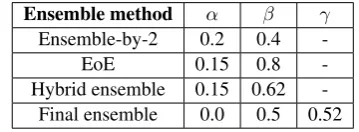
For the three ensemble types: Ensemble-by-2, EoE and Hybrid Ensemble, as shown in Figure1, we used different parameters in the conflict solver. We did a small-scale grid search for the param-eters in Table5. When combining two models that are not strong, we expect a higher recall soβwas not high. For EoE and hybrid ensemble, we expect a higher precision so that they can provide high quality single type performance. Corrections pro-posed by multiple models are given higher weights (controlled byα). If the confidence of a correction
Ensemble method α β γ
Ensemble-by-2 0.2 0.4
-EoE 0.15 0.8
-Hybrid ensemble 0.15 0.62 -Final ensemble 0.0 0.5 0.52
Table 5: Parameters in the conflict solver for the ensemble methods in Restricted and Unrestricted Track.
finally reaches β, the correction will be adopted. In the final ensemble, we select the best perfor-mance on each type from each single system or ensemble system and discard the corrections with low precision (controlled by β). To get higher F0.5, in the case where the precision is greater than a predefined threshold (controlled by γ), we will choose the model with the highestF0.5for the cor-responding error type. The final outcome of the data set is then fed through the translation models and ensemble systems again to do a second pass correction.
3.2.4 Results
[image:6.595.326.506.336.402.2]Step Precision Recall F0.5
Best CNN-based ensemble model 0.5152 0.2159 0.4034 Best Transformer-based translation model 0.4868 0.3412 0.4485 Best ensemble-by-2 0.5281 0.3434 0.4768 Best hybrid ensemble 0.5885 0.3278 0.5078 + Combine best performance 0.6283 0.3269 0.5305
+ Second pass 0.6272 0.3412 0.5372
[image:7.595.137.465.60.178.2]Submission system (+ Post-processing, Dev set) 0.6243 0.3457 0.5376 Submission system (Test set) 0.7317 0.4950 0.6678
Table 6: Results ofRestricted and Unrestricted Track.
Ensemble method α β γ
[image:7.595.316.520.221.499.2]Ensemble for all 0.15 0.3 -Final ensemble 0.0 0.25 0.3
Table 7: Parameters for the ensemble method inLow Resource Track.
Table6also shows that there is a big gap between the performance on the development set and test set, partly because the final test set uses a combi-nation of five annotators.
3.3 Low Resource Track
3.3.1 Classification models
We trained classifiers for seven error types: Subject-verb agreement, Article, Plural or singular noun, Verb form, Preposition substitution, Miss-ing comma and Period comma substitution and Word form. As mentioned in Subsection 2.2.1, Word form model is trained using the Pointer Con-text model. The other error types are trained using Bi-GRU Context model.
3.3.2 NMT model
A Transformer-based translation model is trained on the filtered Wiked corpus. The model archi-tecture follows that in (Junczys-Dowmunt et al.,
2018). Although the performance of the NMT model is not strong, it provides good performance equivalent to the classifiers for some error types.
3.3.3 Ensemble
We use one conflict solver to combine the outputs from all of the systems in this task. Parameters for this ensemble system are shown in Table7.
3.3.4 Results
Table 8 shows results for different systems (for classification models, different error type classi-fiers) on the development set, and the overall
re-Model Precision Recall F0.5
Rule 0.4497 0.0216 0.0905 Spelling 0.3188 0.0363 0.1248 Article 0.4367 0.0134 0.0597 Missing comma 0.4729 0.0503 0.1763
Period comma
substitution 0.4561 0.0070 0.0328 Plural or
singular noun 0.3203 0.0121 0.0524 Preposition
substitution 0.3713 0.0101 0.0454 Subject-verb
agreement 0.3981 0.0115 0.0517 Verb form 0.4135 0.0074 0.0344 Word form 0.4506 0.0294 0.1164 NMT 0.1279 0.1480 0.1315 Submission
system (Dev set)
0.4970 0.1686 0.3577
Submission system (Test
set)
0.6201 0.3125 0.5181
Table 8: Results ofLow Resource Track.
sults on the test set. We can see that the base sys-tems are not very strong, and the ensemble system significantly improves the performance. The dif-ference between the development set and test set can still be observed in this task.
4 Conclusions and Future Work
[image:7.595.98.267.222.261.2]mod-els to maximize the overall system performance. Finally we reached the result of F0.5=0.6678 on the official test set inRestricted Trackand Unre-stricted Track, ranking the third in the Restricted track4. It is worth noting that there is a huge gap between the results on the development set and the test set, which suggests that there might be an unneglectable mismatch between the development set and the test set. Indeed, the development set is annotated by one annotator, while the test set is annotated by five, as announced officially.
For Low Resource Track, there is a lack of parallel learner corpus, and thus we rely less on the translation models. We have built eight classi-fiers trained on Wikipedia dumps according to dif-ferent error types and an NMT model trained on the Wikipedia edits history corpus. By a simple ensemble method, we reachedF0.5=0.5181, plac-ing our system in the third place inLow Resource Track.
Although GEC has reached the human level per-formance on some GEC test sets, there is still room for improvement. In a low resource setup, how to deal with the huge but noisy data is worth exploring. (Lichtarge et al., 2019) gave a good solution on this topic, but more work needs to be done. Second, we will investigate methods such as the reinforcement learning based method (Wu et al.,2018) to address the mismatch between the training objectives and evaluation methods in GEC.
References
Piotr Bojanowski, Edouard Grave, Armand Joulin, and Tomas Mikolov. 2017. Enriching word vectors with subword information. Transactions of the Associa-tion for ComputaAssocia-tional Linguistics.
Christopher Bryant, Mariano Felice, and Ted Briscoe. 2017. Automatic annotation and evaluation of error types for grammatical error correction.
Christopher Bryant, Mariano Felice, Øistein E. Ander-sen, and Ted Briscoe. 2019. The BEA-2019 Shared Task on Grammatical Error Correction. In Proceed-ings of the 14th Workshop on Innovative Use of NLP for Building Educational Applications. Association for Computational Linguistics.
Shamil Chollampatt and Hwee Tou Ng. 2018. A multi-layer convolutional encoder-decoder neural network for grammatical error correction. In Proceedings of the 32nd AAAI Conference on Artificial Intelligence.
4https://www.cl.cam.ac.uk/research/nl/ bea2019st/#results
Shamil Chollampatt, Kaveh Taghipour, and Hwee Tou Ng. 2016. Neural network translation models for grammatical error correction. In Proceedings of the 25th International Joint Conference on Artifcial In-telligence.
Mariano Felice, Zheng Yuan, Øistein E. Andersen, He-len Yannakoudakis, and Ekaterina Kochmar. 2014. Grammatical error correction using hybrid systems and type filtering. Eighteenth Conference on Com-putational Natural Language Learning.
Tao Ge, Furu Wei, and Ming Zhou. 2018. Reaching human-level performance in automatic grammatical error correction: An empirical study. Microsoft Re-search Technical Report.
Jonas Gehring, Michael Auli, David Grangier, Denis Yarats, and Yann N. Dauphin. 2017. Convolutional sequence to sequence learning. Proceedings of the 34th International Conference on Machine Learn-ing.
Roman Grundkiewicz and Marcin Junczys-Dowmunt. 2014. The wiked error corpus: A corpus of correc-tive wikipedia edits and its application to grammat-ical error correction. InAdvances in Natural Lan-guage Processing – Lecture Notes in Computer Sci-ence, volume 8686, pages 478–490. Springer.
Roman Grundkiewicz and Marcin Junczys-Dowmunt. 2018. Near human-level performance in grammati-cal error correction with hybrid machine translation.
Proceedings of the 2018 Conference of the North American Chapter of the Association for Computa-tional Linguistics.
Marcin Junczys-Dowmunt and Roman Grundkiewicz. 2016. Phrase-based machine translation is state-of-the-art for automatic grammatical error correction.
The 2016 Conference on Empirical Methods on Nat-ural Language Processing.
Marcin Junczys-Dowmunt, Roman Grundkiewicz, Shubha Guha, and Kenneth Heafield. 2018. Ap-proaching neural grammatical error correction as a low-resource machine translation task. Proceed-ings of the 2018 Conference of the North American Chapter of the Association for Computational Lin-guistics.
Ryan Kelly. 2006. Pyenchant.
Jared Lichtarge, Christopher Alberti, Shankar Kumar, Noam Shazeer, and Niki Parmar. 2019. Weakly su-pervised grammatical error correction using iterative decoding.
Tomoya Mizumoto, Yuta Hayashibe, Mamoru Ko-machi, Masaaki Nagata, and Yu Matsumoto. 2012. The effect of learner corpus size in grammatical er-ror correction of esl writings. In Proceedings of COLING 2012.
Hwee Tou Ng, Siew Mei Wu, Ted Briscoe, Christian Hadiwinoto, Raymond Hendy Susanto, and Christo-pher Bryant. 2014. The conll-2014 shared task on grammatical error correction. Eighteenth Confer-ence on Computational Natural Language Learning.
Hwee Tou Ng, Siew Mei Wu, Yuanbin Wu, Christian Hadiwinoto, and Joel Tetreault. 2013. The conll-2013 shared task on grammatical error correction.
Seventeenth Conference on Computational Natural Language Learning.
Alla Rozovskaya, Kai-Wei Chang, Mark Sammons, and Dan Roth. 2013. The university of illinois sys-tem in the conll-2013 shared task.Seventeenth Con-ference on Computational Natural Language Learn-ing.
Ashish Vaswani, Noam Shazeer, Niki Parmar, Jakob Uszkoreit, Llion Jones, Aidan N. Gomez, Lukasz Kaiser, and Illia Polosukhin. 2017. Attention is all you need. 31st Conference on Neural Information Processing Systems.
Oriol Vinyals, Meire Fortunato, and Navdeep Jaitly. 2015.Pointer networks.Proceedings of the 28th In-ternational Conference on Neural Information Pro-cessing Systems.
Chuan Wang, RuoBing Li, and Hui Lin. 2017. Deep context model for grammatical error correction.
Proceedings of the Seventh ISCA workshop on Speech and Language Technology in Education 2017.
Lijun Wu, Fei Tian, Tao Qin, Jianhuang Lai, and Tie-Yan Liu. 2018. A study of reinforcement learning for neural machine translation. Proceedings of the 2018 Conference on Empirical Methods in Natural Language Processing.
Helen Yannakoudakis, Ted Briscoe, and Ben Medlock. 2011. A new dataset and method for automatically grading esol texts. In Proceedings of the 49th An-nual Meeting of the Association for Computational Linguistics: Human Language Technologies.