Stability Control of Stretch-Twist-Fold Flow by Using
Numerical Methods
Shahab Ud-Din Khan1, Yonglu Shu1, Salah Ud-Din Khan2 1Department of Mathematics and Statistics, ChongqingUniversity, Chongqing, China
2Sustainable Energy Technologies Center, King Saud University, Riyadh, KSA
Email: [email protected]
Received September 21, 2012; revised October 24, 2012; accepted November 5,2012
ABSTRACT
In this study, the multistep method is applied to the STF system. This method has been tested on the STF system, which is a three-dimensional system of ODE with quadratic nonlinearities. A computer based Matlab program has been de-veloped in order to solve the STF system. Stable and unstable position of the system has been analyzed graphically and finally a comparison as well as accuracy between two-step sizes with detail. Newton’s method has been applied to show the best convergence of this system.
Keywords: STF System; Chaos; Modified Method; Fixed Point Iteration Method; Newton’s Method
1. Introduction
The distinction between slow and fast dynamos was first drawn by Vainshtein & Zeldovich (1972) in this research; we describe the stretch-twist-fold (STF) fast dynamo, which is the archetype of the elementary models of the process. Basically, stretch-twist-fold is applied in fluid mechanics in aerospace. In space, any fluid can be D- Tracked easily so a magnetic field is required to compel the fluid to be in the same orbit and this method is called STF system. In this paper, we will investigate the accu-racy of numerical method. The Multistep method was first introduced by Goldstine, Herman H. in the begin-ning of 1977’s. This iterative method has proven rather successful in dealing with various scientific problems [1-4] since it provides analytical solutions, which is a standard numerical method. This method has also been applied to solve nonlinear systems of ordinary differen-tial equations. For example, H. B. Keller [5] presented an extensive comparative study on the accuracy of the multistep method and C. Lubich [6] studied the effects of time steps on the stiff problem. J. O. Fatokun and I. K. O. Ajibola [7] studied multistep method for integrating or-dinary differential equations on manifolds. Differential equations are used to model problems in science and en-gineering that involve the change of some variables with respect to another. Most of their problems require the solution to an initial-value problem that is the solution to a differential equation that satisfies a given initial condi-tion. In most real-life situations the differential equation that models the problem is too complicated to solve ex- actly and one of two approaches is taken to approximate
the solution. The first approach is to simplify the differ-ential equation to one that can be solved exactly and then use the solution of the simplified equation to approxi-mate the solution to the original equation. The other ap-proach, which we will examine in this paper, uses meth-ods for approximating the solution of the original prob-lem. This is the approach that is most commonly taken, since the approximation methods give more accurate results and realistic error information. The objective of this research is to solve STF system and test nonlinear behavior with different time steps. This modified method is able to find a stable and unstable position of STF sys-tem. This method can also give the exact values after iteration results. Newton’s method is able to show the best convergence than fixed point iteration method.
2. Stretch-Twist-Fold Flow (STF)
The STF flow is defined as
2 2 2
8 ,
11 3 3,
2 ,
x t z xy
y t x y z xz
z t x yz xy
(1)
where α = 0.1, β = 1 are positive real parameters and re-lated to the ratios of intensities of the stretch, twist and fold ingredients of the flow.
3. Description of Methods
certain specified and often equally spaced points. Some method of interpolation is used if intermediate values are needed. We need some definitions and results from the theory of ordinary differential equations before consid-ering methods for approximating the solutions to ini-tial-value problems.
Definition 3.1: A function f x y
, is said to satisfy a Lipschtiz condition in the variable y on a set
, ,
D x y a x b y
If a constant L0 exists with the property that
,
,
f x y f x y L y y
x y, , ,
x y
D
This first part of this section is concerned with ap-proximation the solution y x
to a problem of the form
d
, , for d
y
f x y a x b
x
Subject to an initial conditions y a
y0.Lemma 3.1: Suppose that f x y
, is continuous on D if f satisfies a Lipschitz condition on D in the variable y,Then the initial-value problem
0d , , for d
y f x y a x b x
y a y
has a unique solution y x
for a x b .The methods of Euler and Runge-kutta are called one- step methods because the approximation for the mesh point xi1 involves information from only one of the previous mesh points xi although these methods can use functional evaluation information at points between
i
x and xi1, they do not retain that information for direct use in future approximations. All the information used by these methods is obtained within the subinterval over which the solution is being approximated. Since the approximate solution is available at each of the mesh points x x0, , ,1 xi before the approximation at xi1
is obtained and because the error yi1y x
i1 tends to increase with I, it seems reasonable to develop meth-ods that these more accurate previous data when ap-proximation the solution at xi1.Methods using the approximation at more than one previous mesh point to determine the approximation at the next point are called multistep methods.
Definition 3.2: An m-step multistep method for solv-ing the initial-value problem (3.1) is one whose differ-ence equation for finding the approximation yi1.
At the mesh point xi1 can be represented by the following equation,
where p is an integer greater than 0
1 0 1 1 1 1 1 1 1
0 1 1
1 1
1
0 1
,
, ,
i i m i m i i
i i m i m i m
m m
j i j i j
j j
y a y a y a y h b f x y b f x y b f x y
a y h b f
(A)
When b–1 = 0 then the method is called explicit or open. Since Equation (A) then gives yi1 explicitly in terms of previously determine values. When b10 then the method is called implicit or closed. Since yi1 occurs on both sides of Equation (A) and is specified only implicitly.
To begin the derivation of the multistep methods, note that the solution to the initial-value problem (3.1), if in-tegrated over the interval
x xi, i1
has the property that
1
1 , d
i
i
x
i i x
y x y x
f x y x x (B)Since we cannot integrate f x y x
,
without know- ing y x
the solution to the problem, we instead inte-grate an interpolating L x
to f x y x
,
that is de-termined by some of the previously obtained data points
x y0, 0
, x y1, 1
, ,
x yi, i
Equation (B) becomes
1
d
i
i
x i i x
y x y L x x
3.1. Modified Method
Use the modified APC method to solve STF system. This method is derived from ABF-Explicit m-step technique and AM-Implicit m-step technique. The simulation done of this paper is for the time range t
0,1 with two time steps t 0.01 and t 0.001.Represented formula:
1 1 1 2 2 3 3 4 4
n n
y y h b g b g b g b g
1 4 5 5 1 6 2 7 3
n n
y y h b g b g b g b g
where,
1 2 3 4
5 6 7
55, 59, 37, 9 19, 5, 1.
b b b b
b b b
1 2 1 3 2
4 3 5 1
, , ,
, .
n n n
n n
g f g f g f
g f g y
3.2. Unstable Position
When α = 1, β = 0.1 and h = 0.01 then we can determine the unstable position of the system that is shown in Ta-ble 1 and easily analyzed by the Figure 1.
3.3. Stable Position
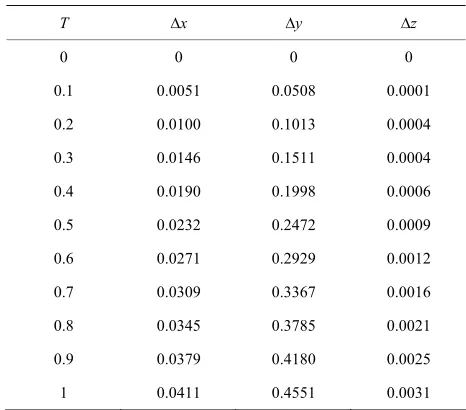
When α = 0.1, β = 1 and h = 0.001 then we can determine the stable position of the system that is shown in Table 2
Table 1. X, Y, Z-Direction for β = 0.1.
T ∆x ∆y ∆z
0 0 0 0 0.1 0.0533 0.5102 0.0081 0.2 0.0801 0.8065 0.0210 0.3 0.0947 0.8007 0.0386 0.4 0.1035 0.7961 0.0605 0.5 0.1097 0.7909 0.0863 0.6 0.1147 0.7854 0.1155 0.7 0.1191 0.7796 0.1473 0.8 0.1233 0.7734 0.1811 0.9 0.1275 0.7670 0.2158 1 0.1319 0.7602 0.2507
0 0.1 0.2 0.3 0.4 0.5 0.6 0.7 0.8 0.9 1
-0.8 -0.6 -0.4 -0.2 0 0.2 0.4 0.6 0.8 1
t
f(
[image:3.595.54.289.94.483.2]t)
Figure 1. The unstable position of the system when α = 1, β = 0.1 and h = 0.01.
Table 2. X, Y, Z-Direction for β = 1.
T ∆x ∆y ∆z
0 0 0 0 0.1 0.0051 0.0508 0.0001 0.2 0.0100 0.1013 0.0004 0.3 0.0146 0.1511 0.0004 0.4 0.0190 0.1998 0.0006 0.5 0.0232 0.2472 0.0009 0.6 0.0271 0.2929 0.0012 0.7 0.0309 0.3367 0.0016 0.8 0.0345 0.3785 0.0021 0.9 0.0379 0.4180 0.0025 1 0.0411 0.4551 0.0031
0 0.1 0.2 0.3 0.4 0.5 0.6 0.7 0.8 0.9 1 -0.5
-0.4 -0.3 -0.2 -0.1 0 0.1 0.2 0.3 0.4 0.5
t
f(
t)
Figure 2. The stable position of the system when α = 0.1, β = 1 and h = 0.001.
4. Fixed Points for Function of Several
Variables
In this section, we will discuss about fixed point iteration method and Newton’s method.
A system of nonlinear equations has the form
1 1 2
2 1 2
1 2
, , , 0
, , , 0
, , , 0
n
n
m n
f x x x
f x x x
f x x x
Here each function fi can be thought of as mapping a
vector x
x x1, , ,2 xn
Tof n-dimensional space Rn intothe real line R.
The system of n nonlinear equations in n unknowns can alternatively be represented by defining a function f, mapping Rn into Rn by
T1, , ,2 n .
f f f f
Then we have
0f x
In an iterative process for solving an equation
0f x was developed by transforming the equation into one of the form xg x
. The function g is defined to have fixed points precisely at solutions to the original equation. A similar procedure will be investigated for function from Rn to Rn.Definition 4.1: A function g from DRn into Rn
has a fixed point at xD if g x
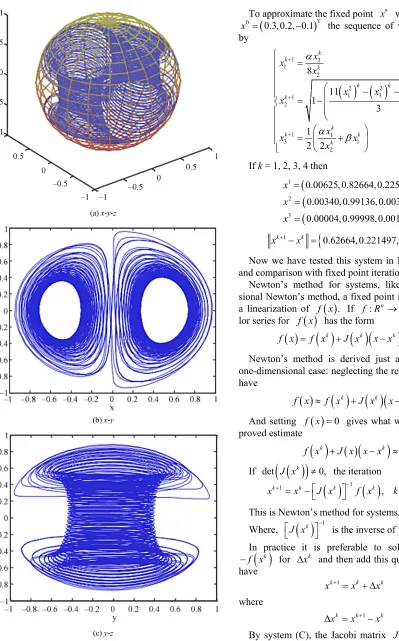
x. Consider the STF system (see Figure 3):3 1
2
2 2
1 3 1 3
2
1
3 1
2
8 11 1
3 1
2 2
x x
x
x x x x
x
x
x x
x
[image:3.595.56.289.94.475.2] [image:3.595.54.287.531.736.2](a) x-y-z
(b) x-y
[image:4.595.69.468.78.719.2](c) y-z
Figure 3. Portrait and x, y, z direction of STF system.
To approximate the fixed point x we choose
T0 0.3,0.2, 0.1
x the sequence of vectors generated by
1 3
1 2
2 2
1 3 1 3
1 2
1 1
3 1
2 8
11 1
3
1 2 2
k k
k
k k k k
k
k
k k
k x x
x
x x x x
x
x
x x
x
If k = 1, 2, 3, 4 then
T 1
T 2
T 3
0.00625,0.82664,0.22500 0.00340,0.99136,0.003503 0.00004,0.99998,0.00187
x x x
1 0.62664,0.221497,8.6 103
k k
x x
Now we have tested this system in Newton’s method and comparison with fixed point iteration results.
Newton’s method for systems, like the one-dimen- sional Newton’s method, a fixed point iteration based on a linearization of f x
. If f R: n R then the Tay-lor series for f x
has the form
k k k
f x f x J x x x E x
Newton’s method is derived just as it was for the one-dimensional case: neglecting the remainder term, we have
k k k
f x f x J x x x
And setting f x
0 gives what we hope is an im-proved estimate
k
k
0 f x J x x x If det
J x
k
0, the iteration
1
1 , 0,1, 2,
k k k k
x x J x f x k
This is Newton’s method for systems. Where, J x
k 1 is the inverse of J x
.In practice it is preferable to solve J x
k xk
kf x
for xk and then add this quantity to xk we
have
1
k k k
x x x
where
1
k k k
x x x
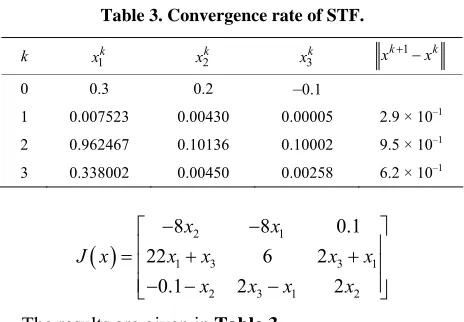
Table 3. Convergence rate of STF.
k x1k
2k
x x3k xk1xk
0 0.3 0.2 –0.1
1 0.007523 0.00430 0.00005 2.9 × 10⁻¹
2 0.962467 0.10136 0.10002 9.5 × 10⁻¹
3 0.338002 0.00450 0.00258 6.2 × 10⁻¹
1 2 3 1 3 12 3 1 2
8 8 0.1
22 6 2
0.1 2 2
x x
J x x x x x
x x x x
The results are given in Table 3.
According to previous examples, we can easily ana-lyze that Newton’s method is more accurate than fixed point iteration method.
5. Conclusion
In this paper, MATLAB programming has been used to solve the STF system with variable time steps (∆t = 0.01, 0.001). We have obtained good results by using two methods applied to the STF system concerning the sys-tem is stable and unstable state. The modified method was computed by developing simple algorithm without perturbation techniques i.e. linearization or discretization. In all the considered cases, it has been proved that the modified multistep method appears to be the best method to approximate this solution based on its accuracy and Newton’s method is a good example to solve root finding problem in STF system. Newton’s method is able to show the best convergence than fixed point iteration method.
6. Acknowledgements
The first author is very thankful to all of his co-authors
and especially to Professor Shu Yonglu for advising and giving me the opportunity to conduct this research and also very much thankful to Sustainable Energy Tech-nologies Centre, King Saud University for funding the research.
REFERENCES
[1] C. Baker and E. Buckwar, “Numerical Analysis of Ex-plicit One-Step Methods for Stochastic Delay Differential Equations,” LMS Journal of Computation and Mathe-matics, Vol. 3, No. 3, 2000, pp. 315-335.
[2] R. H. Bokor, “On Two-Step Methods for Stochastic Dif-ferential Equations,” Acta Cybernetica, Vol. 13, No. 1, 1997, pp. 197-207.
[3] L. Brugnano, K. Burrage and P. Burrage, “Adams-Type Methods for the Numerical Solution of Stochastic Ordi-nary Differential Equations,” BIT Numerical Mathematics, Vol. 40, No. 3, 2000, pp. 451-470.
[4] E. Buckwar and R. Winkler, “On Two-Step Schemes for SDEs with Small Noise,” Proceedings in Applied Mathe-matics and Mechanics, Vol. 4, No. 1, 2004, pp. 15-18.
[5] H. B. Keller, “Approximation Method for Nonlinear Problem with Application to Two Point Value Boundary Problem,” Mathematics of Computation, Vol. 29, No. 130, 1975, pp. 464-474.
[6]
for Nonlinear Stiff Differential Equations , Vol. 61, No. 1, 1992, pp. 277-279.