Migrated Exploding Reflectors in Evaluation of Finite
Difference Solution for Inhomogeneous Seismic Models
Maryam Nejati1, Hosein Hashemi2 1
R&D Department, Dana Geophysics Co., Tehran, Iran 2
Institute of Geophysics, University of Tehran, Tehran, Iran Email: [email protected], [email protected]
Received August 15,2012; revised September 24, 2012; accepted October 4, 2012
ABSTRACT
Earth is inhomogeneous, which means its elastic characteristics change with depth. The seismic method employs the propagation of waves throughout the earth to locate different structures and stratigraphy. Understanding the wave propagation is an important matter in exploration seismology; therefore modeling of seismic wave is an important tool. To validate the interpreted earth model out of the seismic data, seismic synthetic seismograms should be generated in a process named “seismic forward modeling”. Finite difference method is used as one of the most common numerical modeling techniques. In this paper the accuracy of finite difference method in seismic section modeling is explored on different modeled data set of heterogeneous earth. It is shown that finite difference method completes with migration to reposition the events in their correct location. Two different migration methods are used and various velocities are also tested to determine an appropriate migration velocity. Finally the validly of finite difference modeling is examined us- ing a 2D structural similarity index technique.
Keywords: Finite Difference Method; Seismic Modeling; Migration; Exploding Reflector; Structural Similarity Index
1. Introduction
The seismic method employs the propagation of waves throughout the earth to locate deposits such as hydrocar- bons, reservoirs, ores and etc. Earth is inhomogeneous, which means its elastic properties varies with depth and changes from a region to the nearby one. Although the variation may be gradual, there are distinct discontinui- ties that separate media with different densities and elas- tic coefficients producing reflection boundaries. In pro- pagation of seismic waves from one medium to another with different properties, some part of energy is reflected back to the first medium and the other portion is trans- mitted into the second one. The strength of reflection depends on the acoustic impedance contrast of two me- diums, whereas acoustic impedance is the product of medium velocity and density. Relationship between the stress and displacement vectors of two sides of the inter- face is a deterministic factor in portioning of energy. This was first developed and formulated by Zoeppritz [1] in the form of amplitudes and Knott [2] as the potential functions.
One of the basic techniques to validate the interpreted earth model out of the seismic data is to generate seismic synthetic seismograms. This is mainly named as the for- ward modeling procedure. Since understanding the wave propagation is a fundamental issue in exploration seis-
mology, modeling of seismic wave would be a valuable tool. Seismic wave equations, used to describe seismic wave propagation in the subsurface, are typically partial differential equations containing spatial and temporal derivatives. There are different numerical methods of seismic modeling such as ray tracing methods and wave equation methods including Kirchhoff integration, finite difference (FD), finite element (FE) and etc. Wave equa- tion numerical method can extract the information of both travel time and amplitude of seismic wave and can explain wave propagation in complicated medium. Finite difference method is one of the most common modeling methods [3-6]. This method is theoretically based on a Taylor series representation of the wave field resulting in a formulation for numerical estimation of the derivatives appearing in the wave equation.
M. NEJATI, H. HASHEMI 951
In this paper, the accuracy of solving seismic wave in different heterogeneous model using finite difference scheme is studied and the validly of modeling is investi-gated using a 2D similarity evaluation technique.
2. Finite Difference Solver for Seismic Wave
Equation
Scalar 2D seismic wave equation in Cartesian coordinate system is defined by,
2
2
, , , , ,
x z t V x z x z t
(1)
Here is devoted for seismic wavefield in three dimensions, is the seismic velocity in 2D heteroge- neous earth model. Using second-order time derivatives, one can predict the value of
V
in the next samples without analytically solving Equation (1) as,
2 2
2
, , 2 , , ,
x z t t t V x z x z t
(2)
The main idea behind the FD method is to compute the wave field at a discrete set of closely-spac- ed grid points
, , , u x y z t
xl ym z, , ,
0,1, 2, 3, 4, n tq 5, ,
, with
by approximating the deri- vatives occurring in the equation of motion with finite difference formulas, and recursively solving the resulting difference equation. Different orders are defined for solv- ing Equation (2) based on the length of forward and backward filter.
, , , l m n q
3. Exploding Reflector Model
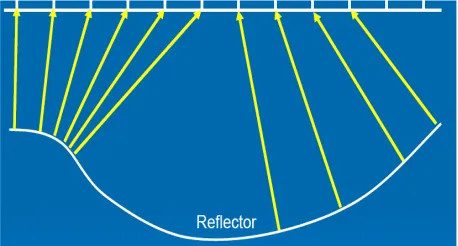
[image:2.595.58.287.585.708.2]In surface seismic acquisition both receivers and source points are placed on the earth. This mimics the meaning of two-way travel time. Unlike this practical way, one numerical simplification when post-stack velocity files are accessed is to assume that sources are placed on the reflection boundaries. At time zero, the reflectors all ex- plode with strength proportional to their normal-inci- dence reflection coefficients. The resulting wave field, at the instant of zero time morphologically identical to the reflectors and time, will propagate along normal inci- dence ray paths. Figure 1 shows a schematic view of
Figure 1. An exploding reflector model, theoretically sources are placed on the reflector.
exploding reflector shooting in a programming environ- ment. The essence of this technique together with im- plementing this method in Matlab is discussed [7-9].
4. Seismic Synthetic Modeling
To examine the effect of finite difference method in seismic forward modeling, four different velocity models are generated. They are mainly a channel, an anticline, a thrust and a known model named Marmusi respectively. To explore the functionality of finite difference method in modeling seismic responses of complex geological structures, exploding reflectors concept is used.
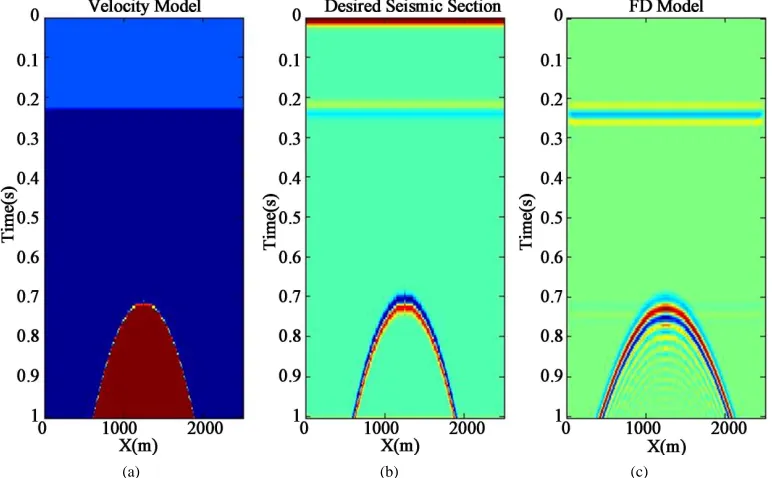
Figure 2(a) shows the velocity model of a small-bur- ied channel in a layered medium. The width and depth of the channel are 20 m and 50 m respectively. Survey de- sign parameters are consisting of some important factors like receiver interval (RI), number of time samples and central frequency of the wavelet (f). To generate a seis- mic section of this model, RI is chosen as 5 meters (i.e. the channel is 4 samples in X and 10 samples in time) and a zero phase wavelet with the f = 30 Hz was convolved with the velocity-time model. Prior to this, the velocity matrix shall be converted from depth to time by using the relationship between depth and vertical travel time. This is the model described as the input to the convolutional model theory (Figure 2(b)). It states that a given reflec- tivity is the convolution result of acoustic impedance (velocity when densities are constant) and used wavelet.
The modeling will be completed using finite difference operator based on exploding reflector theory, which as- sumes that shot points are placed on the reflectors. Input parameters in the module are the temporal and spatial sample sizes, the maximum record time, the velocity matrix, the receiver positions, the wavelet and the desired Laplacian (forth order). Figure 2(c) shows the “FD model” relevant to the velocity section using the forth order Laplacian operator. The 30 Hz frequency wavelet is designed to remove some of the effects of the artificial grid dispersion.
(a) (b) (c)
Figure 2. (a) Velocity model of a buried channel (dark blue); (b) Desired seismic section; (c) FD model before migration.
Kirchhoff, finite difference, frequency-domain and phase- shift methods [10]. The Kirchhoff method migrates the data by searching for diffractions and moving all energy along the diffraction curve to its apex so it was used in channel model to remove diffractions. An important point that should be considered is that the migration ve- locity is the velocity required to best migrate the seismic data related to the true interval velocity and is not the stacking velocity. For assessing the effect of selecting correct velocity in migration, 3 different velocity ma- trixes selected to be used for migration as shown in Fig- ure 3. In Figure 3(a), the velocity matrix is exactly the same used in the FD model, while in Figures 3(b) and 3(c) it is 0.7 of the velocity matrix and 1.1 of the velocity matrix respectively. It is obvious that the Figure 3(b) has the best result in migration and all the diffraction patterns are removed perfectly and energy is collapsed to the chan- nel location.
As a slightly more complicated example, the response of an anticline beneath a layer as shown in Figure 4(a) was explored that will be useful in examining in seismic response modeling. In Figure 4(b) the seismic section of this model obtained from convolution of a 30 Hz zero phase wavelet with the velocity-time section is shown. The fourth-order Laplacian exploding reflector seismo- gram is shown in Figure 4(c) that was created with a spatial grid size of 5 m.
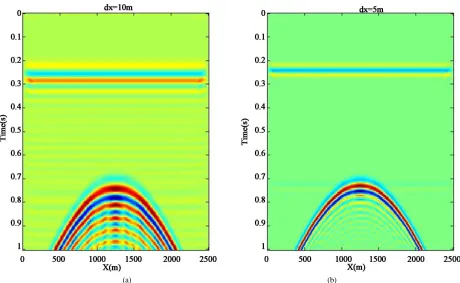
While working with finite difference method for seis- mic modeling, it should be considered how to choose the parameters to increase the precision. For example, as shown in Figure 5(a), selecting the spatial grid size of 10 m will cause series of reverberations following the pri- mary response but with recreating the model with a finer spatial grid size (5 m) the reverberations will be disap-
peared (Figure 2(b)). Therefore for an accurate modeling with finite difference method optimizing different pa- rameters is needed and hence the computation time will increase. Comparing Figures 4(b) and 4(c), the anticline appears broader than its true shape. In fact in an unmi- grated section, dipping reflections have apparent dips less than the dip of the reflectors and apparent lengths greater than the actual lengths of the reflectors. So anticline seems wider.
To counteract this problem Kirchhoff migration me- thod was used with three different velocities including the interval velocity matrix used in the FD model, 0.5 of the velocity matrix and 0.8 of the velocity matrix respect- tively as shown in Figure 6. Clearly the best outcome is related to the Figure 6(b) that the anticline looks smaller than the unmigrated section (Figure 6(c)) similar to the desired section (Figure 6(b)).
M. NEJATI, H. HASHEMI 953
(a) (b) (c)
Figure 3. (a) Migrated section using 100% of interval velocity of a buried channel; (b) Migrated section using 70% of interval velocity of a buried channel; (c) Migrated section using 110% of interval velocity of a buried channel.
(a) (b) (c)
Figure 4. (a) Velocity model of an anticline (dark red); (b) Desired seismic section; (c) FD model before migration.
To examining finite difference method in seismic mo- deling, a complicated model named Marmousi is studied as the last model (Figure 8). The Institute Français du Pétrole (IFP) created the Marmousi model in 1988. The geometry of this model is based on a profile through the North Quenguela trough in the Cuanza basin. The ge- ometry and velocity model were created to produce com- plex seismic data, which has come be a sort of industry
standard and almost classic dataset. The Marmousi mo- del contains 158 horizontally layered horizons.
The model sits under approximately 32 m of water and is 9.2 km in length and 3 km in depth.
[image:4.595.106.492.85.330.2] [image:4.595.105.491.371.610.2](a) (b)
Figure 5. (a) FD model of an anticline with grid size of 10 m; (b) FD model of an anticline with grid size of 5 m. Undesired reverberation is visible in larger grid size model due to numerical errors.
(a) (b) (c)
[image:5.595.68.528.85.368.2]M. NEJATI, H. HASHEMI 955
(a) (b) (c) (d)
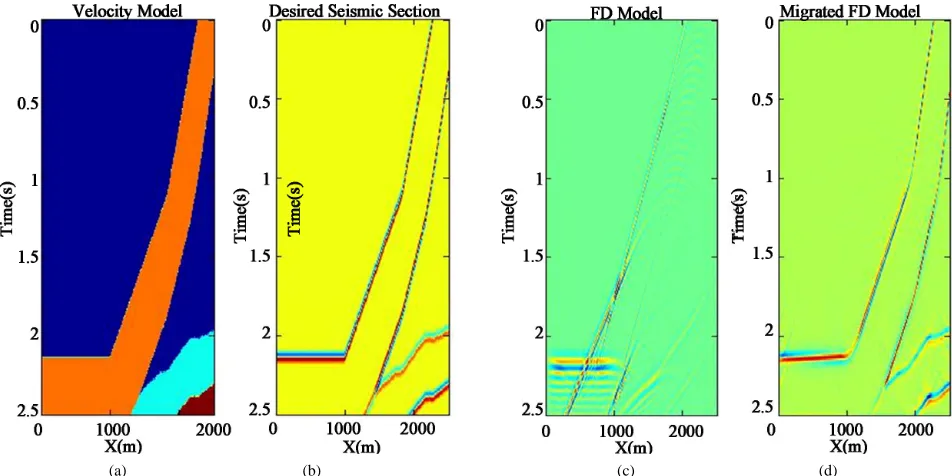
[image:6.595.61.537.86.324.2]Figure 7. (a) Velocity model of a thrust; (b) Desired seismic section; (c) FD model before migration; (d) Migrated section us- ing 50% of interval velocity of thrust.
Figure 8. Marmousi velocity model.
wavelet. The forth order Laplacian finite difference equa- tion of Marmousi model is displayed in Figure 9(c) and the migrated FD section using phase-shift migration me- thod can be seen in Figure 9 (d).
To estimate how accurately the finite difference equa- tion can model the seismic section the structural similar- ity (SSIM) index between the migrated finite difference model and desired seismic section is computed for all
four geological structures in this paper (Table 1). SSIM [11] is a method for measuring the similarity between two images. If two images are exactly the same then SSIM will be reported as one.
5. Discussion and Conclusion
(a) (b)
(c) (d)
[image:7.595.67.279.86.592.2]Figure 9. (a) Marmousi velocity model; (b) Desired seismic section; (c) FD model before migration; (d) Migrated sec- tion using 50% of Interval velocity of thrust.
Table 1. Structural similarity index showing degree of co- herency between desired output and FD model after migra- tion. Larger values are relevant to better jobs of FD + mi-gration. Velocity Model Channel Model Anticline Model Thrust Model Marmousi Model SSIM
0.81 0.86 0.76 0.69
ing finite difference method for exploding reflectors, it was seen that the FD equation can model the seismic section suitably. It should be noted that choosing pa- rameters for the finite difference modeling is an impor- tant issue that affects the results. Additionally, migration is necessary after finite difference to position the events in their true location. Since migration velocity is different from stacking velocity, determining the appropriate ve- locity, is very important for true migration. Furthermore, there are different methods for migration that each of them has its own advantages depending on the seismic data features such as dip of events and signal to noise ratio. It is even found for a very complex model (Mar- mousi) that a classic post-stack migration does not yield to a high SSIM. This amplifies need to have pre-stack depth migration algorithm that consequently limits the use of the proposed scheme for very complicated areas. When degree of model inhomogeneity increases, finite difference or any other numerical methods shall be run on pre-stack domain. Considering these issues this for- ward modeling problem can act as a foundation for un- derstanding seismic wave propagation and it can be used as a tool for the seismic imaging and inversion problems.
REFERENCES
[1] K. Zoeppritz, “Erdbebenwellen VII. VIIb. Über Reflexion
und Durchgang Seismischer Wellen durch Unstetigkeits- flächen. Nachrichten von der Königlichen Gesellschaft der Wissenschaften zu Göttingen,” Mathematisch-Physi- kalische Klasse, 1919, pp. 66-84.
[2] R. E. Sheriff and L. P. Geldart, “Exploration Seismology,” 2nd Edition, Cambridge University Press, Cambridge,
1995. doi:10.1017/CBO9781139168359
[3] M. Zaitian, “Seismic Imaging Technology: The Finite
Difference Migration,” China Petroleum Industry Press, Beijing, 1989.
[4] J. E. Vidale, “Finite-Difference Calculation of Travel-
times in Three Dimensions,” Geophysics, Vol. 55, No. 5,
1990, pp. 521-526. doi:10.1190/1.1442863
[5] R. T. Coates and M. Schoenberg, “Finite-Difference Mo-
deling of Faults and Fractures,” Geophysics, Vol. 60,
1995, pp. 1514-1526. doi:10.1190/1.1443884
[6] A. Pitarka, “3D Elastic Finite-Difference Modeling of
Seismic Motion Using Staggered Grids with Nonuniform Spacing,” Bulletin of the Seismological Society of Amer-ica, Vol. 89, 1999, pp. 54-68.
[7] C. F. Youzwishen and G. F. Margrave, “Finite Difference
Modelling of Acoustic Waves in Matlab,” Crewes Report,
Vol. 11, 1999, pp. 1-19.
[8] J. M. Carcione, G. Böhm and A. Marchetti, “Simulation
of a CMP Seismic Section,” Journal of Seismic Explora-
tion, Vol. 3, 1994, pp. 381-396.
[9] D. Loewenthal, L. Lu, R. Roberson and J. W. C. Sher-
M. NEJATI, H. HASHEMI 957
physical Prospecting, Vol. 24, 1976, pp. 380-399.
[10] J. F. Claerbout, “Basic Earth Imaging: Stanford Explora-
tion Project,” Preliminary, 1993.
http://sepwww.stanford.edu/sep/prof/index.html
[11] Z. Wang, A. C. Bovik, H. R. Sheikh and E. P. Simoncelli,
“Image Quality Assessment: From Error Visibility to Struc-
tural Similarity,” IEEE Transactions on Image Process-