Logical Inference on Dependency-based Compositional Semantics
Ran Tian Yusuke Miyao Takuya Matsuzaki National Institute of Informatics, Japan
{tianran,yusuke,takuya-matsuzaki}@nii.ac.jp
Abstract
Dependency-based Compositional Se-mantics (DCS) is a framework of natural language semantics with easy-to-process structures as well as strict semantics. In this paper, we equip the DCS framework with logical inference, by defining ab-stract denotations as an abstraction of the computing process of denotations in original DCS. An inference engine is built to achieve inference on abstract denota-tions. Furthermore, we propose a way to generate on-the-fly knowledge in logical inference, by combining our framework with the idea of tree transformation. Experiments on FraCaS and PASCAL RTE datasets show promising results. 1 Introduction
Dependency-based Compositional Semantics (DCS) provides an intuitive way to model seman-tics of questions, by using simple dependency-like trees (Liang et al., 2011). It is expressive enough to represent complex natural language queries on a relational database, yet simple enough to be latently learned from question-answer pairs. In this paper, we equip DCS withlogical inference, which, in one point of view, is “the best way of testing an NLP system’s semantic capacity” (Cooper et al., 1996).
It should be noted that, however, a framework primarily designed for question answering is not readily suited for logical inference. Because, an-swers returned by a query depend on the specific database, but implication is independent of any databases. For example, answers to the question “What books are read by students?”, should al-ways be a subset of answers to “What books are ever read by anyone?”, no matter how we store the data of students and how many records of books are there in our database.
Thus, our first step is to fix a notation which ab-stracts the calculation process of DCS trees, so as to clarify its meaning without the aid of any exist-ing database. The idea is to borrow a minimal set of operators from relational algebra (Codd, 1970), which is already able to formulate the calculation in DCS and define abstract denotation, which is an abstraction of the computationof denotations guided by DCS trees. Meanings of sentences then can be represented by primary relations among abstract denotations. This formulation keeps the simpleness and computability of DCS trees mostly unaffected; for example, our semantic calculation for DCS trees is parallel to the denotation compu-tation in original DCS.
An inference engine is built to handle inference on abstract denotations. Moreover, to compensate the lack of background knowledge in practical in-ference, we combine our framework with the idea of tree transformation (Bar-Haim et al., 2007), to propose a way of generating knowledge in logical representation from entailment rules (Szpektor et al., 2007), which are by now typically considered as syntactic rewriting rules.
We test our system on FraCaS (Cooper et al., 1996) and PASCAL RTE datasets (Dagan et al., 2006). The experiments show: (i) a competi-tive performance on FraCaS dataset; (ii) a big impact of our automatically generated on-the-fly knowledge in achieving high recall for a logic-based RTE system; and (iii) a result that outper-forms state-of-the-art RTE system on RTE5 data. Our whole system is publicly released and can be downloaded fromhttp://kmcs.nii.ac. jp/tianran/tifmo/.
2 The Idea
In this section we describe the idea of represent-ing natural language semantics by DCS trees, and achieving inference by computing logical relations among the corresponding abstract denotations.
SUBJread
student book
OBJ
[image:2.595.338.490.65.125.2]ARG ARG
Figure 1: The DCS tree of “students read books”
student
ARG Mark John Emily
...
book
ARG A Tale of Two Cities
Ulysses ...
read
SUBJ OBJ
Mark New York Times Mary A Tale of Two Cities
John Ulysses
... ...
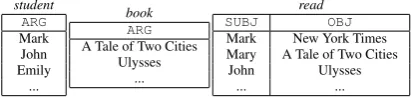
Table 1: Databases ofstudent,book, andread
2.1 DCS trees
DCS trees has been proposed to represent natu-ral language semantics with a structure similar to dependency trees (Liang et al., 2011) (Figure 1). For the sentence “students read books”, imagine a database consists of three tables, namely, a set of students, a set of books, and a set of “reading” events (Table 1). The DCS tree in Figure 1 is in-terpreted as a command for querying these tables, obtaining “reading” entries whose “SUBJ” field is studentand whose “OBJ” field is book. The result is a set {John reads Ulysses, . . .}, which is called adenotation.
DCS trees can be extended to represent linguis-tic phenomena such as quantification and coref-erence, with additional markers introducing addi-tional operations on tables. Figure 2 shows an ex-ample with a quantifier “every”, which is marked as “⊂” on the edge(love)OBJ-ARG(dog)and in-terpreted as adivision operator qOBJ
⊂ (§2.2).
Op-timistically, we believe DCS can provide a frame-work of semantic representation with sufficiently wide coverage for real-world texts.
The strict semantics of DCS trees brings us the idea of applying DCS to logical inference. This is not trivial, however, because DCS works under the assumption that databases are explicitly available. Obviously this is unrealistic for logical inference on unrestricted texts, because we cannot prepare a database for everything in the world. This fact fairly restricts the applicable tasks of DCS.
Our solution is to redefine DCS trees without the aid of any databases, by considering each node of a DCS tree as a content word in a sentence (but may no longer be a table in a specific database), while each edge represents semantic relations be-tween two words. The labels on both ends of an edge, such as SUBJ (subject) and OBJ (ob-ject), are considered assemantic rolesof the
cor-SUBJhave
Tom animal
OBJ
ARG ARG
love
ARG OBJ SUBJlove
Mary dog
OBJ
ARG ARG
Tom
SUBJhave
dog
OBJ
ARG ARG
Mary
SUBJ ARG
T: H:
[image:2.595.78.284.130.179.2]⊂
Figure 2: DCS trees of “Mary loves every dog” (Left-Up), “Tom has a dog” (Left-Down), and “Tom has an animal that Mary loves” (Right).
responding words1. To formulate the database
querying process defined by a DCS tree, we pro-vide formal semantics to DCS trees by employing
relational algebra (Codd, 1970) for representing the query. As described below, we represent mean-ings of sentences with abstract denotations, and logical relations among sentences are computed as relations among their abstract denotations. In this way, we can perform inference over formulas of relational algebra, without computing database entries explicitly.
2.2 Abstract denotations
Abstract denotations are formulas constructed
from a minimal set of relational algebra (Codd, 1970) operators, which is already able to formu-late the database queries defined by DCS trees.
For example, the semantics of “students read books” is given by the abstract denotation:
F1 =read∩(studentSUBJ×bookOBJ),
whereread, studentandbookdenote sets repre-sented by these words respectively, andwr repre-sents the set w considered as the domain of the semantic roler(e.g. bookOBJis the set of books
considered as objects). The operators∩and× rep-resent intersection and Cartesian product respec-tively, both borrowed from relational algebra. It is not hard to see the abstract denotation denotes the intersection of the “reading” set (as illustrated by the “read” table in Table 1) with the product of “student” set and “book” set, which results in the same denotation as computed by the DCS tree in Figure 1, i.e.{John reads Ulysses, . . .}. However, the point is thatF1 itself is an algebraic formula that does not depend on any concrete databases.
Formally, we introduce the followingconstants:
• W: a universal set containing all entities.
1The semantic roleARGis specifically defined for
example phrase abstract denotation / statement compound noun pet fish pet∩fish
modification nice day day∩(WARG×niceMOD) temporal relationboys study at night study∩(boySUBJ×nightTIME) relative clause books that book∩πOBJ(read
students read ∩(studentSUBJ×WOBJ)) quantification all men die man⊂πSUBJ(die) hypernym dog⊂animal
derivation all criminals commit criminal⊂πSUBJ(commit∩
a crime (WSUBJ×crimeOBJ)) antonym risekfall
[image:3.595.79.286.60.160.2]negation no dogs are hurt dogkπOBJ(hurt)
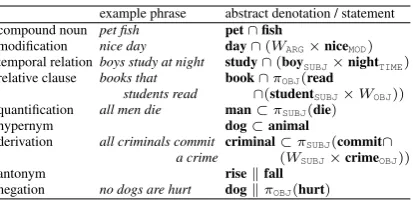
Table 2: Abstract denotations and statements
• Content words: a content word (e.g. read) defines a set representing the word (e.g.
read={(x, y)|read(x, y)}).
In addition we introduce followingfunctions:
• ×: the Cartesian product of two sets.
• ∩: the intersection of two sets.
• πr: projection onto domain of semantic role r (e.g. πOBJ(read) ={y | ∃x;read(x, y)}).
Generally we admit projections onto multiple semantics roles, denoted byπRwhereRis a
set of semantic roles.
• ιr: relabeling (e.g. ιOBJ(book) =bookOBJ). • qr
⊂: the division operator, whereq⊂r(A, B)is
defined as the largest set X which satisfies
Br×X ⊂A.2This is used to formulate
uni-versal quantifiers, such as “Mary loves every dog” and “books read by all students”. Anabstract denotationis then defined as finite ap-plications of functions on either constants or other abstract denotations.
2.3 Statements
As the semantics of DCS trees is formulated by abstract denotations, the meanings of declarative sentences are represented by statements on ab-stract denotations. Statements are declarations of some relations among abstract denotations, for which we consider the following set relations:
Non-emptinessA6=∅: the setAis not empty.
SubsumptionA⊂B: setAis subsumed byB.3
Roughly speaking, the relations correspond to the logical conceptssatisfiabilityandentailment.
2IfAandBhas the same dimension,q
⊂(A, B)is either
∅or{∗}(0-dimension point set), depending on ifA⊂B.
3Using division operator, subsumption can be represented
by non-emptiness, since for setsA,Bof the same dimension, q⊂(A, B)6=∅ ⇔A⊂B.
Abstract denotations and statements are conve-nient for representing semantics of various types of expressions and linguistic knowledge. Some examples are shown in Table 2.4
2.4 Logical inference on DCS
Based on abstract denotations, we briefly describe our process to apply DCS to textual inference.
2.4.1 Natural language to DCS trees
To obtain DCS trees from natural language, we use Stanford CoreNLP5 for dependency parsing
(Socher et al., 2013), and convert Stanford depen-dencies to DCS trees by pattern matching on POS tags and dependency labels.6 Currently we use
the following semantic roles: ARG, SUBJ, OBJ, IOBJ, TIME and MOD. The semantic role MOD is used for any restrictive modifiers. Determiners such as “all”, “every” and “each” trigger quanti-fiers, as shown in Figure 2.
2.4.2 DCS trees to statements
A DCS treeT = (N,E)is defined as a rooted tree, where each nodeσ ∈ N is labeled with a content word w(σ) and each edge (σ, σ0) ∈ E ⊂ N ×
N is labeled with a pair of semantic roles(r, r0)7.
Hereσis the node nearer to the root. Furthermore, for each edge (σ, σ0) we can optionally assign a
quantification marker.
Abstract denotation of a DCS tree can be cal-culated in a bottom-up manner. For example, the abstract denotation ofHin Figure 2 is calculated from the leaf nodeMary, and then:
Nodelove(Mary loves):
F2 =love∩(MarySUBJ×WOBJ)
Nodeanimal(Animal that Mary loves):
F3 =animal∩πOBJ(F2)
Nodehave(Tom has an animal that Mary loves):
F4 =have∩(TomSUBJ×(F3)OBJ).
Formally, suppose the rootσof a DCS treeT has childrenτ1, . . . , τn, and edges(σ, τ1), . . . ,(σ, τn)
labeled by(r1, r0
1), . . . ,(rn, r0n), respectively. The
abstract denotation ofT is defined as:
[[T]]=w(σ)∩(\n
i=1
ιri(πr0i([[Tτi]]))×WRσ\ri),
4Negation and disjointness (“k”) are explained in§2.5. 5http://nlp.stanford.edu/software/
corenlp.shtml
6In (Liang et al., 2011) DCS trees are learned from QA
pairs and database entries. We obtain DCS trees from depen-dency trees, to bypass the need of a concrete database.
7The definition differs slightly from the original Liang et
πOBJ(F4) =F3∩F7
πOBJ(F6) =dog∩F7 T
F66=∅ Axiom 4 dog∩F76=∅
T
dog⊂πOBJ(F2) dog⊂animal Axiom 8 dog⊂F3
dog∩F7⊂F3∩F7 Axiom 6
F3∩F76=∅ Axiom 4
[image:4.595.88.526.67.121.2]F46=∅
Figure 3: An example of proof using abstract denotations
1.W6=∅
2.A∩B⊂A
3.Br×qr⊂(A, B)⊂A
4.πR(A)6=∅ ⇔A6=∅
5.(A⊂B&B⊂C)⇒A⊂C
6.(A⊂B&A6=∅)⇒B6=∅
7.A⊂B⇒πR(A)⊂πR(B) 8.(C⊂A&C⊂B)⇒C⊂A∩B
Table 3: An excerpt of axioms
where Tτi is the subtree of T rooted at τi, and Rσ is the set of possible semantic roles for con-tent wordw(σ)(e.g. Rlove ={SUBJ,OBJ}), and
WRσ\riis the product ofW which has dimension
Rσ\ri(e.g.W{SUBJ,OBJ}\SUBJ=WOBJ).
When universal quantifiers are involved, we need to add division operators to the formula. If (σ, τi) is assigned by a quantification marker “⊂”8, then the abstract denotation is9
[[T]]=qri
⊂(πRσ\{r1,...,ri−1}([[T0]]), πri0([[Tτi]])),
where T0 is the same tree as T except that the
edge (σ, τi) is removed. For example, the
ab-stract denotation of the first sentence ofTin Fig-ure 2 (Mary loves every dog) is calculated fromF2
(Mary loves) as
F5 =qOBJ⊂ (πOBJ(F2),dog).
After the abstract denotation [[T]] is calcu-lated, the statement representing the meaning of the sentence is defined as [[T]] 6= ∅. For ex-ample, the statement of “students read books” is read ∩ (studentSUBJ × bookOBJ) 6= ∅, and
the statement of “Mary loves every dog” is
qOBJ
⊂ (πOBJ(F2),dog) 6= ∅, which is logically
equivalent todog⊂πOBJ(F2).10 2.4.3 Logical inference
Since meanings of sentences are represented by statements on abstract denotations, logical infer-ence among sentinfer-ences is reduced to deriving new relations among abstract denotations. This is done by applying axioms to known statements, and ap-proximately 30 axioms are implemented (Table 3).
8Multiple quantifiers can be processed similarly. 9The result of[[T]]depends on the order of the children
τ1, . . . , τn. Different orders correspond to readings of
differ-ent quantifier scopes.
10See Footnote 2,3.
These are algebraic properties of abstract denota-tions, among which we choose a set of axioms that can be handled efficiently and enable most com-mon types of inference seen in natural language.
For the example in Figure 2, by constructing the following abstract denotations:
Tom has a dog:
F6 =have∩(TomSUBJ×dogOBJ)
Objectsthat Tom has:
F7 =πOBJ(have∩(TomSUBJ×WOBJ)),
we can use the lexical knowledgedog ⊂animal, the statements of T (i.e. dog ⊂ πOBJ(F2) and F6 6= ∅), and the axioms in Table 3,11 to prove
the statement ofH(i.e. F4 6=∅) (Figure 3).
We built an inference engine to perform logical inference on abstract denotations as above. In this logical system, we treat abstract denotations as
terms and statements as atomic sentences, which are far more easier to handle than first order pred-icate logic (FOL) formulas. Furthermore, all im-plemented axioms are horn clauses, hence we can employ forward-chaining, which is very efficient.
2.5 Extensions
Further extensions of our framework are made to deal with additional linguistic phenomena, as briefly explained below.
Negation To deal with negation in our forward-chaining inference engine, we introduce one more relation on abstract denotations, namely disjoint-ness A k B, meaning that A and B are dis-joint sets. Using disdis-jointness we implemented two types of negations: (i) atomic negation, for each content wordwwe allow negationw¯of that word, characterized by the propertywkw¯; and (ii) root negation, for a DCS treeT and its denotation[[T]], the negation ofT is represented byT k T, mean-ing thatT =∅in its effect.
Selection Selection operators in relational alge-bra select a subset from a set to satisfy some
spe-11Algebraic identities, such asπ
OBJ(F4) =F3∩F7 and
cific properties. This can be employed to rep-resent linguistic phenomena such as downward monotonicity and generalized quantifiers. In the current system, we implement (i) superlatives, e.g.shighest(mountain∩(WARG×AsiaMOD))(the
highest mountain in Asia) and (ii) numerics, e.g.
stwo(pet∩fish) (two pet fish), wheresf is a
se-lection marker. Sese-lection operators are imple-mented as markers assigned to abstract denota-tions, with specially designed axioms. For ex-ample superlatives satisfy the following property:
A ⊂ B & shighest(B) ⊂ A ⇒ shighest(B) =
shighest(A). New rules can be added if necessary.
Coreference We use Stanford CoreNLP to
re-solve coreferences (Raghunathan et al., 2010), whereas coreference is implemented as a special type of selection. If a nodeσ in a DCS treeT be-longs to a mention clusterm, we take the abstract denotation [[Tσ]] and make a selection sm([[Tσ]]),
which is regarded as the abstract denotation of that mention. Then all selections of the same mention cluster are declared to be equal.
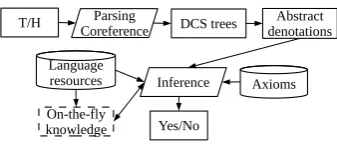
3 Generating On-the-fly Knowledge Recognizing textual entailment (RTE) is the task of determining whether a given textual statement
H can be inferred by a text passage T. For this, our primary textual inference system operates as:
1. For a T-H pair, apply dependency parsing and coreference resolution.
2. Perform rule-based conversion from depen-dency parses to DCS trees, which are trans-lated to statements on abstract denotations. 3. Use statements ofTand linguistic knowledge
as premises, and try to prove statements ofH
by our inference engine.
However, this method does not work for real-world datasets such as PASCAL RTE (Dagan et al., 2006), because of the knowledge bottleneck: it is often the case that the lack of sufficient lin-guistic knowledge causes failure of inference, thus the system outputs “no entailment” for almost all pairs (Bos and Markert, 2005).
The transparent syntax-to-semantics interface of DCS enables us to back off to NLP techniques during inference for catching up the lack of knowl-edge. We extract fragments of DCS trees as para-phrase candidates, translate them back to
linguis-T/H CoreferenceParsing DCS trees denotationsAbstract
Inference
Yes/No On-the-fly
knowledge
Axioms Language
[image:5.595.332.501.61.134.2]resources
Figure 4: RTE system
tic expressions, and apply distributional similar-ity to judge their validsimilar-ity. In this way, our frame-work combines distributional and logical seman-tics, which is also the main subject of Lewis and Steedman (2013) and Beltagy et al. (2013).
As follows, our full system (Figure 4) addition-ally invokes linguistic knowledge on-the-fly:
4. IfHis not proven, compare DCS trees ofT
andH, and generate path alignments.
5. Aligned paths are evaluated by a similar-ity score to estimate their likelihood of be-ing paraphrases. Path alignments with scores higher than a threshold are accepted.
6. Convert accepted path alignments into state-ments on abstract denotations, use them in logical inference as new knowledge, and try to proveHagain.
3.1 Generating path alignments
On-the-fly knowledge is generated by aligning paths in DCS trees. A path is considered as joining twogermsin a DCS tree, where agermis defined as a specific semantic role of a node. For example, Figure 5 shows DCS trees of the following sen-tences (a simplified pair from RTE2-dev):
T:Tropical storm Debby is blamed for deaths. H:A storm has caused loss of life.
The germ OBJ(blame) and germARG(death) in DCS tree ofTare joined by the underscored path. Two paths are aligned if the joined germs are aligned, and we impose constraints on aligned germs to inhibit meaningless alignments, as de-scribed below.
3.2 Aligning germs by logical clues
storm
T : H :
ARG blame
death DebbyARG OBJ ARG
stormARG ARG
IOBJ
tropicalARG MOD
cause loss
life ARG SUBJ
[image:6.595.312.517.60.139.2]ARG MOD OBJ
Figure 5: Aligned paths (underscored by the solid lines) and aligned germs (joined by the dotted line)
To formulate this properly, we define the ab-stract denotation of a germ, which, intuitively, rep-resents the meaning of the germ in the specific sen-tence. The abstract denotation of a germ is defined in a top-down manner: for the root node ρ of a DCS treeT, we define its denotation[[ρ]]T as the
denotation of the entire tree [[T]]; for a non-root nodeτ and its parent nodeσ, let the edge(σ, τ)be labeled by semantic roles(r, r0), then define
[[τ]]T = [[Tτ]]∩(ιr0(πr([[σ]]T))×WRτ\r0).
Now for a germr(σ), the denotation is defined as the projection of the denotation of nodeσonto the specific semantic roler:[[r(σ)]]T =πr([[σ]]T).
For example, the abstract denotation of germ ARG(book)in Figure 1 is defined asπARG(book∩ πOBJ(read∩(studentSUBJ×bookOBJ))), meaning
“books read by students”. Similarly, denotation of germ OBJ(blame) in T of Figure 5 indicates the object of “blame” as in the sentence “ Tropi-cal storm Debby is blamed for death”, which is atropical storm, is Debby, etc. Technically, each germ in a DCS tree indicates a variable when the DCS tree is translated to a FOL formula, and the abstract denotation of the germ corresponds to the set ofconsistent values(Liang et al., 2011) of that variable.
The logical clue to align germs is: if there exists an abstract denotation, other thanW, that is a su-perset of both abstract denotations of two germs, then the two germs can be aligned. A simple ex-ample is that ARG(storm) in T can be aligned to ARG(storm) in H, because their denotations have a common superset other than W, namely
πARG(storm). A more complicated example is that
OBJ(blame) and SUBJ(cause) can be aligned, because inference can induce [[OBJ(blame)]]T =
[[ARG(Debby)]]T = [[ARG(storm)]]T, as well as
[[SUBJ(cause)]]H=[[ARG(storm)]]H, so they also have the common superset πARG(storm).
How-ever, for example, logical clues can avoid align-ingARG(storm)toARG(loss), which is obviously
T : T' :
What is tropical storm, Debby, and is blamed for death]]
[[ What is tropical storm, Debby, and cause loss of life]]
[[ ⊂
blame death DebbyARG OBJ ARG
stormARG
ARG
IOBJ
tropicalARG
MOD
cause loss
life
ARG SUBJ
ARG MOD OBJ
DebbyARG
stormARG
ARG
tropicalARG
[image:6.595.82.285.67.125.2]MOD
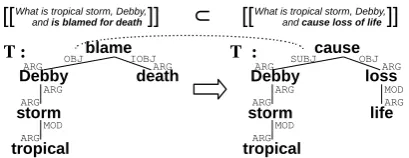
Figure 6: Tree transformation and generated on-the-fly knowledge (subsumption of denotations shown above the trees)
meaningless.
3.3 Scoring path alignments by similarity
Aligned paths are evaluated by a similarity score, for which we use distributional similarity of the words that appear in the paths (§4.1). Only path alignments with high similarity scores can be ac-cepted. Also, we only accept paths of length≤5, to prevent too long paths to be aligned.
3.4 Applying path alignments
Accepted aligned paths are converted into state-ments, which are used as new knowledge. The conversion is done by first performing a DCS tree transformation according to the aligned paths, and then declare a subsumption relation between the denotations of aligned germs. For example, to ap-ply the aligned path pair generated in Figure 5, we use it to transformTinto a new treeT’ (Fig-ure 6), and then the aligned germs, OBJ(blame) in T and SUBJ(cause) in T’, will generate the on-the-fly knowledge: [[OBJ(blame)]]T ⊂ [[SUBJ(cause)]]T’.
Similar to the tree transformation based ap-proach to RTE (Bar-Haim et al., 2007), this pro-cess can also utilize lexical-syntactic entailment rules (Szpektor et al., 2007). Furthermore, since the on-the-fly knowledge is generated by trans-formed pairs of DCS trees, all contexts are pre-served: in Figure 6, though the tree transformation can be seen as generated from the entailment rule “X is blamed for death→X causes loss of life”, the generated on-the-fly knowledge, as shown above the trees, only fires with the additional condition thatX is a tropical stormand is Debby. Hence, the process can also be used to generate knowl-edge from context sensitive rules (Melamud et al., 2013), which are known to have higher quality (Pantel et al., 2007; Clark and Harrison, 2009).
task. For example, the FOL formula of the rule “X is blamed for death→X causes loss of life” is:
∀x; (∃a;blame(x, a) &death(a))→ (∃b, c;cause(x, b) &loss(b, c) &life(c)),
which is not a horn clause. The FOL formula for the context-preserved rule in Figure 6 is even more involved. Still, it can be efficiently treated by our inference engine because as a statement, the for-mula[[OBJ(blame)]]T ⊂[[SUBJ(cause)]]T’ is an atomic sentence, more than a horn clause.
4 Experiments
In this section, we evaluate our system on FraCaS (§4.2) and PASCAL RTE datasets (§4.3).
4.1 Language Resources
The lexical knowledge we use are synonyms, hy-pernyms and antonyms extracted from WordNet12.
We also add axioms on named entities, stopwords, numerics and superlatives. For example, named entities are singletons, so we add axioms such as
∀x; (x⊂Tom&x6=∅)→Tom⊂x.
To calculate the similarity scores of path align-ments, we use the sum of word vectors of the words from each path, and calculate the cosine similarity. For example, the similarity score of the path alignment “OBJ(blame)IOBJ-ARG(death)
≈SUBJ(cause)OBJ-ARG(loss)MOD-ARG(life)” is calculated as the cosine similarity of vectors
blame+death and cause+loss+life. Other struc-tures in the paths, such as semantic roles, are ig-nored in the calculation. The word vectors we use are from Mikolov et al. (2013)13(Mikolov13),
and additional results are also shown using Turian et al. (2010)14 (Turian10). The threshold for
ac-cepted path alignments is set to0.4, based on pre-experiments on RTE development sets.
4.2 Experiments on FraCaS
The FraCaS test suite contains 346 inference prob-lems divided into 9 sections, each focused on a cat-egory of semantic phenomena. We use the data by MacCartney and Manning (2007), and experiment on the first section, Quantifiers, following Lewis and Steedman (2013). This section has 44 single premise and 30 multi premise problems. Most of
12http://wordnet.princeton.edu/ 13http://code.google.com/p/word2vec/ 14http://metaoptimize.com/projects/
wordreprs/
Single Prem. Multi Prem.
Lewis13 70 50
MacCartney07 84.1
-MacCartney08 97.7
[image:7.595.329.501.61.114.2]-Our Sys. 79.5 80.0
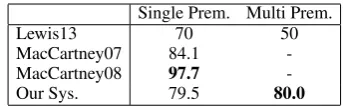
Table 4: Accuracy (%) on FraCaS
the problems do not require lexical knowledge, so we use our primary textual inference system with-out on-the-fly knowledge nor WordNet, to test the performance of the DCS framework as formal se-mantics. To obtain the three-valued output (i.e.
yes, no, and unknown), we output “yes” if H is proven, or try to prove the negation ofH ifHis not proven. To negateH, we use the root negation as described in§2.5. If the negation ofHis proven, we output “no”, otherwise we output “unknown”.
The result is shown in Table 4. Since our sys-tem uses an off-the-shelf dependency parser, and semantic representations are obtained from sim-ple rule-based conversion from dependency trees, there will be only one (right or wrong) interpre-tation in face of ambiguous sentences. Still, our system outperforms Lewis and Steedman (2013)’s probabilistic CCG-parser. Compared to MacCart-ney and Manning (2007) and MacCartMacCart-ney and Manning (2008), our system does not need a pre-trained alignment model, and it improves by mak-ing multi-sentence inferences. To sum up, the re-sult shows that DCS is good at handling universal quantifiers and negations.
Most errors are due to wrongly generated DCS trees (e.g. wrongly assigned semantic roles) or unimplemented quantifier triggers (e.g. “neither”) or generalized quantifiers (e.g. “at least a few”). These could be addressed by future work.
4.3 Experiments on PASCAL RTE datasets
On PASCAL RTE datasets, strict logical inference is known to have very low recall (Bos and Markert, 2005), so on-the-fly knowledge is crucial in this setting. We test the effect of on-the-fly knowledge on RTE2, RTE3, RTE4 and RTE5 datasets, and compare our system with other approaches.
4.3.1 Impact of on-the-fly knowledge
RTE2 RTE3 RTE4 RTE5 Prec. Rec. Acc. Prec. Rec. Acc. Prec. Rec. Acc. Prec. Rec. Acc. Primary 70.9 9.8 52.9 73.2 7.3 51.1 89.7 5.2 52.3 82.6 6.3 52.5 +On-the-fly 57.6 66.5 58.8 63.7 64.6 63.0 60.0 57.4 59.6 69.9 55.7 65.8
Table 5: Impact of on-the-fly knowledge
RTE2 RTE3 RTE4 RTE5
Bos06 60.6 - -
-MacCartney08 - 59.4 -
-Clark08 - - 56.5
-Wang10 63.0 61.1 -
-Stern11 61.6 67.1 - 63.5
Stern12 - - - 64.0
[image:8.595.93.270.143.227.2]Our Sys. 58.8 63.0 59.6 65.8
Table 6: Comparison with other systems
4.3.2 Comparison to other RTE systems
A comparison between our system and other RTE systems is shown in Table 6. Bos06 (Bos and Markert, 2006) is a hybrid system combining deep features from a theorem prover and a model builder, together with shallow features such as lex-ical overlap and text length. MacCartney08 (Mac-Cartney and Manning, 2008) uses natural logic to calculate inference relations between two superfi-cially aligned sentences. Clark08 (Clark and Har-rison, 2008) is a logic-based system utilizing vari-ous resources including WordNet and DIRT para-phrases (Lin and Pantel, 2001), and is tolerant to partially unproven H sentences in some degree. All of the three systems pursue a logical approach, while combining various techniques to achieve ro-bustness. The result shows that our system has comparable performance. On the other hand, Wang10 (Wang and Manning, 2010) learns a tree-edit model from training data, and captures entail-ment relation by tree edit distance. Stern11 (Stern and Dagan, 2011) and Stern12 (Stern et al., 2012) extend this framework to utilize entailment rules as tree transformations. These are more tailored systems using machine learning with many hand-crafted features. Still, our unsupervised system outperforms the state-of-the-art on RTE5 dataset.
4.3.3 Analysis
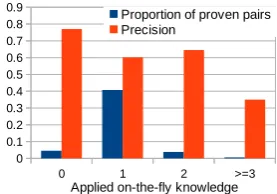
Summing up test data from RTE2 to RTE5, Fig-ure 7 shows the proportion of all proven pairs and their precision. Less than 5% pairs can be proven primarily, with a precision of 77%. Over 40% pairs can be proven by one piece of on-the-fly knowledge, yet pairs do exist in which more than 2 pieces are necessary. The precisions of 1 and 2 pieces on-the-fly knowledge application are over
0 1 2 >=3
0 0.1 0.2 0.3 0.4 0.5 0.6 0.7 0.8
0.9 Proportion of proven pairs
Precision
Applied on-the-fly knowledge
Figure 7: Proportion of proven pairs and their pre-cision, w.r.t. pieces of on-the-fly knowledge.
60%, which is fairly high, given our rough estima-tion of the similarity score. As a comparison, Dinu and Wang (2009) studied the proportion of proven pairs and precision by applying DIRT rules to tree skeletons in RTE2 and RTE3 data. The proportion is 8% with precision 65% on RTE2, and propor-tion 6% with precision 72% on RTE3. Applied by our logical system, the noisy on-the-fly knowl-edge can achieve a precision comparable to higher quality resources such as DIRT.
A major type of error is caused by the igno-rance of semantic roles in calculation of simi-larity scores. For example, though “Italy beats Kazakhstan” is not primarily proven from “Italy
is defeated by Kazakhstan”, our system does
produce the path alignment “SUBJ(beat)OBJ ≈
OBJ(defeat)SUBJ” with a high similarity score. The impact of such errors depends on the data making methodology, though. It lowers precisions in RTE2 and RTE3 data, particularly in “IE” sub-task (where precisions drop under 0.5). On the other hand, it occurs less often in “IR” subtask.
[image:8.595.341.480.153.250.2]0 0.1 0.2 0.3 0.4 0.5 0.6 0.7 0.5
0.55 0.6 0.65 0.7 0.75 0.8 0.85
Mikolov13 Turian10
Recall
P
re
ci
si
[image:9.595.86.267.67.157.2]on
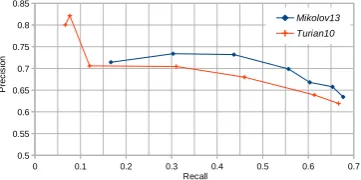
Figure 8: Precision-Recall curve.
has a corresponding path of length≤5inTwith a similarity score>0.4.
5 Conclusion and Discussion
We have presented a method of deriving abstract denotation from DCS trees, which enables logi-cal inference on DCS, and we developed a textual inference system based on the framework. Exper-imental results have shown the power of the rep-resentation that allows both strict inference as on FraCaS data and robust reasoning as on RTE data. Exploration of an appropriate meaning repre-sentation for querying and reasoning on knowl-edge bases has a long history. Description logic, being less expressive than FOL but featuring more efficient reasoning, is used as a theory base for Se-mantic Web (W3C, 2012). Ideas similar to our framework, including the use of sets in a repre-sentation that benefits efficient reasoning, are also found in description logic and knowledge repre-sentation community (Baader et al., 2003; Sowa, 2000; Sukkarieh, 2003). To our knowledge, how-ever, their applications to logical inference beyond the use for database querying have not been much explored in the context of NLP.
The pursue of a logic more suitable for natural language inference is not new. For instance, Mac-Cartney and Manning (2008) has implemented a model of natural logic (Lakoff, 1970). While being computationally efficient, various inference patterns are out of the scope of their system.
Much work has been done in mapping natu-ral language into database queries (Cai and Yates, 2013; Kwiatkowski et al., 2013; Poon, 2013). Among these, the (λ-)DCS (Liang et al., 2011; Berant et al., 2013) framework defines algorithms that transparently map a labeled tree to a database querying procedure. Essentially, this is because DCS trees restrict the querying process to a very limited subset of possible operations. Our main contribution, the abstract denotation of DCS trees,
can thus be considered as an attempt to charac-terize a fragment of FOL that is suited for both natural language inferenceandtransparent syntax-semantics mapping, through the choice of opera-tions and relaopera-tions on sets.
We have demonstrated the utility of logical in-ference on DCS through the RTE task. A wide variety of strategies tackling the RTE task have been investigated (Androutsopoulos and Malaka-siotis, 2010), including the comparison of surface strings (Jijkoun and De Rijke, 2005), syntactic and semantic structures (Haghighi et al., 2005; Snow et al., 2006; Zanzotto et al., 2009; Burchardt et al., 2009; Heilman and Smith, 2010; Wang and Manning, 2010), semantic vectors (Erk and Pad´o, 2009) and logical representations (Bos and Mark-ert, 2005; Raina et al., 2005; Tatu and Moldovan, 2005). Acquisition of basic knowledge for RTE is also a huge stream of research (Lin and Pantel, 2001; Shinyama et al., 2002; Sudo et al., 2003; Szpektor et al., 2004; Fujita et al., 2012; Weis-man et al., 2012; Yan et al., 2013). These previ-ous works include variprevi-ous techniques for acquir-ing and incorporatacquir-ing different kinds of lacquir-inguistic and world knowledge, and further fight against the knowledge bottleneck problem, e.g. by back-off to shallower representations.
Logic-based RTE systems employ various ap-proaches to bridge knowledge gaps. Bos and Markert (2005) proposes features from a model builder; Raina et al. (2005) proposes an abduction process; Tatu and Moldovan (2006) shows hand-crafted rules could drastically improve the perfor-mance of a logic-based RTE system.
As such, our current RTE system is at a proof-of-concept stage, in that many of the above tech-niques are yet to be implemented. Nonetheless, we would like to emphasize that it already shows performance competitive to state-of-the-art sys-tems on one data set (RTE5). Other directions of our future work include further exploitation of the new semantic representation. For example, since abstract denotations are readily suited for data querying, they can be used to verify newly gen-erated assumptions by fact search in a database. This may open a way towards a hybrid approach to RTE wherein logical inference is intermingled with large scale database querying.
References
Ion Androutsopoulos and Prodromos Malakasiotis. 2010. A survey of paraphrasing and textual entail-ment methods. J. Artif. Int. Res., 38(1).
Franz Baader, Diego Calvanese, Deborah L. McGuin-ness, Daniele Nardi, and Peter F. Patel-Schneider, editors. 2003. The Description Logic Handbook: Theory, Implementation, and Applications. Cam-bridge University Press, New York, NY, USA.
Roy Bar-Haim, Ido Dagan, Iddo Greental, and Eyal Shnarch. 2007. Semantic inference at the lexical-syntactic level. InProceedings of AAAI 2007.
Islam Beltagy, Cuong Chau, Gemma Boleda, Dan Gar-rette, Katrin Erk, and Raymond Mooney. 2013. Montague meets markov: Deep semantics with probabilistic logical form. In Second Joint Con-ference on Lexical and Computational Semantics (*SEM).
Jonathan Berant, Andrew Chou, Roy Frostig, and Percy Liang. 2013. Semantic parsing on Freebase from question-answer pairs. In Proceedings of EMNLP 2013.
Johan Bos and Katja Markert. 2005. Recognising tex-tual entailment with logical inference. In Proceed-ings of EMNLP 2005.
Johan Bos and Katja Markert. 2006. When logical inference helps determining textual entailment (and when it doesnt). InProceedings of the 2nd PASCAL RTE Challenge Workshop.
Aljoscha Burchardt, Marco Pennacchiotti, Stefan Thater, and Manfred Pinkal. 2009. Assessing the impact of frame semantics on textual entailment.
Nat. Lang. Eng., 15(4).
Qingqing Cai and Alexander Yates. 2013. Large-scale semantic parsing via schema matching and lexicon extension. InProceedings of ACL 2013.
Peter Clark and Phil Harrison. 2008. Recognizing tex-tual entailment with logical inference. In Proceed-ings of 2008 Text Analysis Conference (TAC’08).
Peter Clark and Phil Harrison. 2009. Large-scale ex-traction and use of knowledge from text. In Pro-ceedings of the Fifth International Conference on Knowledge Capture (K-CAP’09).
E. F. Codd. 1970. A relational model of data for large shared data banks. Commun. ACM, 13(6).
Robin Cooper, Dick Crouch, Jan Van Eijck, Chris Fox, Johan Van Genabith, Jan Jaspars, Hans Kamp, David Milward, Manfred Pinkal, Massimo Poesio, and et al. 1996. Using the framework. FraCaS De-liverable D, 16.
Ido Dagan, O. Glickman, and B. Magnini. 2006. The pascal recognising textual entailment challenge. In
Machine Learning Challenges. Evaluating Predic-tive Uncertainty, Visual Object Classification, and Recognising Tectual Entailment.
Georgiana Dinu and Rui Wang. 2009. Inference rules and their application to recognizing textual entail-ment. InProceedings of EACL 2009.
Katrin Erk and Sebastian Pad´o. 2009. Paraphrase as-sessment in structured vector space: Exploring pa-rameters and datasets. InProceedings of the Work-shop on Geometrical Models of Natural Language Semantics.
Atsushi Fujita, Pierre Isabelle, and Roland Kuhn. 2012. Enlarging paraphrase collections through generalization and instantiation. In Proceedings of EMNLP 2012.
Aria Haghighi, Andrew Ng, and Christopher Manning. 2005. Robust textual inference via graph matching. InProceedings of EMNLP 2005.
Michael Heilman and Noah A. Smith. 2010. Tree edit models for recognizing textual entailments, para-phrases, and answers to questions. InProceedings of NAACL 2010.
Valentin Jijkoun and Maarten De Rijke. 2005. Rec-ognizing textual entailment: Is word similarity enough? In Machine Learning Challenge Work-shop, volume 3944 of LNCS, Springer.
Tom Kwiatkowski, Eunsol Choi, Yoav Artzi, and Luke Zettlemoyer. 2013. Scaling semantic parsers with on-the-fly ontology matching. In Proceedings of EMNLP 2013.
George Lakoff. 1970. Linguistics and natural logic.
Synthese, 22(1-2).
Mike Lewis and Mark Steedman. 2013. Combined distributional and logical semantics. Transactions of ACL, 1.
Percy Liang, Michael Jordan, and Dan Klein. 2011. Learning dependency-based compositional seman-tics. InProceedings of ACL 2011.
Dekang Lin and Patrick Pantel. 2001. Discovery of inference rules for question-answering. Nat. Lang. Eng., 7(4).
Bill MacCartney and Christopher D. Manning. 2007. Natural logic for textual inference. InProceedings of the ACL-PASCAL Workshop on Textual Entail-ment and Paraphrasing.
Oren Melamud, Jonathan Berant, Ido Dagan, Jacob Goldberger, and Idan Szpektor. 2013. A two level model for context sensitive inference rules. In Pro-ceedings of ACL 2013.
Tomas Mikolov, Wen-tau Yih, and Geoffrey Zweig. 2013. Linguistic regularities in continuous space word representations. In Proceedings of NAACL 2013.
Patrick Pantel, Rahul Bhagat, Bonaventura Coppola, Timothy Chklovski, and Eduard Hovy. 2007. ISP: Learning inferential selectional preferences. In Pro-ceedings of NAACL 2007.
Hoifung Poon. 2013. Grounded unsupervised seman-tic parsing. InProceedings of ACL 2013.
Karthik Raghunathan, Heeyoung Lee, Sudarshan Ran-garajan, Nate Chambers, Mihai Surdeanu, Dan Ju-rafsky, and Christopher Manning. 2010. A multi-pass sieve for coreference resolution. In Proceed-ings of EMNLP 2010.
Rajat Raina, Andrew Y. Ng, and Christopher D. Man-ning. 2005. Robust textual inference via learning and abductive reasoning. In Proceedings of AAAI 2005.
Yusuke Shinyama, Satoshi Sekine, and Kiyoshi Sudo. 2002. Automatic paraphrase acquisition from news articles. InProceedings of HLT 2002.
Rion Snow, Lucy Vanderwende, and Arul Menezes. 2006. Effectively using syntax for recognizing false entailment. InProceedings of NAACL 2006. Richard Socher, John Bauer, Christopher D. Manning,
and Ng Andrew Y. 2013. Parsing with compo-sitional vector grammars. In Proceedings of ACL 2013.
John F. Sowa. 2000. Knowledge Representation: Logical, Philosophical and Computational Founda-tions. Brooks/Cole Publishing Co., Pacific Grove, CA, USA.
Asher Stern and Ido Dagan. 2011. A confidence model for syntactically-motivated entailment proofs. In
Proceedings of RANLP 2011.
Asher Stern, Roni Stern, Ido Dagan, and Ariel Felner. 2012. Efficient search for transformation-based in-ference. InProceedings of ACL 2012.
Kiyoshi Sudo, Satoshi Sekine, and Ralph Grishman. 2003. An improved extraction pattern representa-tion model for automatic ie pattern acquisirepresenta-tion. In
Proceedings of ACL 2003.
JanaZ. Sukkarieh. 2003. An expressive efficient rep-resentation: Bridging a gap between nlp and kr. In Vasile Palade, RobertJ. Howlett, and Lakhmi Jain, editors,Knowledge-Based Intelligent Informa-tion and Engineering Systems. Springer Berlin Hei-delberg.
Idan Szpektor, Hristo Tanev, Ido Dagan, and Bonaven-tura Coppola. 2004. Scaling web-based acquisition of entailment relations. InProceedings of EMNLP 2004.
Idan Szpektor, Eyal Shnarch, and Ido Dagan. 2007. Instance-based evaluation of entailment rule acqui-sition. InProceedings of ACL 2007.
Marta Tatu and Dan Moldovan. 2005. A semantic ap-proach to recognizing textual entailment. In Pro-ceedings of EMNLP 2005.
Marta Tatu and Dan Moldovan. 2006. A logic-based semantic approach to recognizing textual en-tailment. InProceedings of the COLING/ACL 2006. Joseph Turian, Lev-Arie Ratinov, and Yoshua Bengio. 2010. Word representations: A simple and general method for semi-supervised learning. In Proceed-ings of ACL 2010.
W3C. 2012. Owl 2 web ontology language document overview (second edition). www.w3.org/TR/owl2-overview/.
Mengqiu Wang and Christopher Manning. 2010. Probabilistic tree-edit models with structured latent variables for textual entailment and question answer-ing. InProceedings of Coling 2010.
Hila Weisman, Jonathan Berant, Idan Szpektor, and Ido Dagan. 2012. Learning verb inference rules from linguistically-motivated evidence. InProceedings of EMNLP 2012.
Yulan Yan, Chikara Hashimoto, Kentaro Torisawa, Takao Kawai, Jun’ichi Kazama, and Stijn De Saeger. 2013. Minimally supervised method for multilin-gual paraphrase extraction from definition sentences on the web. InProceedings of NAACL 2013. Fabio massimo Zanzotto, Marco Pennacchiotti, and