Speech Act Modeling of Written Asynchronous Conversations with
Task-Specific Embeddings and Conditional Structured Models
Shafiq Joty and Enamul Hoque
ALT Research Group
Qatar Computing Research Institute — HBKU, Qatar Foundation
{sjoty, mprince}@qf.org.qa
Abstract
This paper addresses the problem of speech act recognition in written
asyn-chronous conversations (e.g., fora,
emails). We propose a class of conditional structured models defined over arbitrary graph structures to capture the conversa-tional dependencies between sentences. Our models use sentence representations encoded by a long short term memory (LSTM) recurrent neural model. Empir-ical evaluation shows the effectiveness of our approach over existing ones: (i) LSTMs provide better task-specific representations, and (ii) the global joint model improves over local models. 1 Introduction
Asynchronous conversations, where participants communicate with each other at different times (e.g., fora, emails), have become very common for discussing events, issues, queries and life experi-ences. In doing so, participants interact with each other in complex ways, performing certain com-municative acts like asking questions, requesting information or suggesting something. These are calledspeech acts(Austin, 1962).
For example, consider the excerpt of a forum conversation from our corpus in Figure 1. The participant who posted the first commentC1,
de-scribes his situation by the first two sentences and then asks a question in the third sentence. Other participants respond to the query by suggesting
something oraskingfor clarification. In this pro-cess, the participants get into a conversation by taking turns, each of which consists of one or more speech acts. The two-part structures across posts like ‘question-answer’ and ‘request-grant’ are calledadjacency pairs(Schegloff, 1968).
C1: My son wish to do his bachelor degree in Mechanical Engineering in an affordable Canadian university.
Human: st, Local: st, Global: st
The info. available in the net and the people who wish to offer services are too many and some are misleading.
Human: st, Local: st, Global: st
The preliminary preparations,eligibility,the require funds etc., are some of the issues which I wish to know from any panel members of this forum .. (truncated)
Human: ques, Local:st, Global:st
C3 (truncated)...take a list of canadian universities and then create a table and insert all the relevant information by reading each and every program info on the web.
Human: sug, Local: sug, Global: sug
Without doing a research my advice would be to apply to UVIC .. for the following reasons .. (truncated)
Human: sug, Local: sug, Global: sug
UBC is good too... but it is expensive particularly for international students due to tuition .. (truncated)
Human: sug, Local: sug, Global: sug
most of them accept on-line or email application.
Human: st, Local: st, Global: st
Good luck !!
Human: pol, Local: pol, Global: pol
C4 snakyy21: UVIC is a short form of? I have already started researching for my brother and found “College of North Atlantic” and .. (truncated)
Human: ques, Local:st, Global: ques
but not sure about the reputation..
Human: st, Local:res, Global: st
C5 thank you for sharing useful tips will follow your advise.
Human: pol, Local: pol, Global: pol
Figure 1: Example conversation withHuman an-notations and automatic predictions by a Local
classifier and a Global classifier. The labels st,
ques,sug, andpolrefers toStatement,Question,
Suggestion, andPolitespeech acts, respectively.
Identification of speech acts is an important step towards deep conversation analysis in these media (Bangalore et al., 2006), and has been shown to be useful in many downstream applications including summarization (McKeown et al., 2007) and ques-tion answering (Hong and Davison, 2009).
Previous attempts to automatic (sentence-level)
speech act recognition in asynchronous conversa-tion (Qadir and Riloff, 2011; Jeong et al., 2009; Tavafi et al., 2013; Oya and Carenini, 2014) suffer from at least one of the two major flaws.
Firstly, they use bag-of-word (BOW) represen-tation(e.g., unigram, bigram) to encode lexical in-formation in a sentence. However, consider the
suggestionsentences in the example. Arguably, a model needs to consider the structure (e.g., word order) and the compositionality of phrases to iden-tify the right speech act. Furthermore, BOW rep-resentation could be quite sparse and may not gen-eralize well when used in classification models.
Secondly, existing approaches mostly disregard conversational dependencies between sentences. For instance, consider the example again, where we tag the sentences with the human annotations (‘Human’) and with the predictions of a local (‘Local’) classifier that considers word order for sentence representation but classifies each sen-tence separately. Prediction errors are underlined and highlighted in red. Notice the first and second sentences of comment4, which are tagged mistak-enly as statement and response, respectively, by our best local classifier. We hypothesize that some of the errors made by the local classifier could be corrected by employing a global joint model that performs a collective classification taking into account the conversational dependencies between sentences (e.g., adjacency relations).
However, unlike synchronous conversations (e.g., phone, meeting), modeling conversational dependencies between sentences in asynchronous conversation is challenging, especially in those where explicit thread structure (reply-to relations) is missing, which is also our case. The conver-sational flow often lacks sequential dependencies in its temporal order. For example, if we arrange the sentences as they arrive in the conversation, it becomes hard to capture any dependency between the act types because the two components of the adjacency pairs can be far apart in the sequence. This leaves us with one open research question: how to model the dependencies between sentences in a single comment and between sentences across different comments? In this paper, we attempt to address this question by designing and exper-imenting with conditional structured models over arbitrary graph structure of the conversation.
More concretely, we make the following contri-butions. Firstly, we propose to use Recurrent
Neu-ral Network (RNN) with Long Short Term Mem-ory (LSTM) hidden layer to perform composition of phrases and to represent sentences using dis-tributed condensed vectors (i.e., embeddings). We experiment with both unidirectional and bidirec-tional RNNs. Secondly, we propose condibidirec-tional structured models in the form of pairwise Con-ditional Random Field (Murphy, 2012) over ar-bitrary conversational structures. We experiment with different variations of this model to capture different types of interactions between sentences inside the comments and across the comments. These models use the LSTM encoded vectors as feature vectors for performing the classification task jointly. As a secondary contribution, we also present and release a forum dataset annotated with a standard speech act tagset.
We train our models on different settings us-ing synchronous and asynchronous corpora, and evaluate on two forum datasets. Our main find-ings are: (i) LSTM RNNs provide better repre-sentation than BOW; (ii) Bidirectional LSTMs, which encode a sentence using two vectors pro-vide better representation than the unidirectional ones; and (iii) Global joint models improve over local models given that it considers the right graph structure. The source code and the new
dataset are available at http://alt.qcri.
org/tools/speech-act/
2 Our Approach Letsn
mdenote them-th sentence of commentnin a conversation. Our framework works in two steps as demonstrated in Figure 2. First, we use a recur-rent neural network (RNN) to compose sentence representations semantically from their words and to represent them with distributed condensed vec-torszn
m, i.e., sentence embeddings (Figure 2a). In the second step, a multivariate (graphical) model, which operates on the sentence embeddings, cap-tures conversational dependencies between sen-tences in the conversation (Figure 2b). In the fol-lowing, we describe the two steps in detail.
2.1 Sentence Representation
(a) Bidirectional LSTM-based RNN model (b) Fully connected CRF model
Figure 2: Our two-step framework for speech act recognition in asynchronous conversation: (a) a bidi-rectional LSTM encodes each sentencesn
minto a condensed vectorznmand classifies them separately; (b) a fully-connected CRF that takes the encoded vectors as input and performs joint learning and inference.
[image:3.595.75.517.62.174.2]the current input with the previous hidden state. Figure 4b demonstrates the process for three sen-tences. Each word in the vocabularyV is repre-sented by aDdimensional vector in a shared look-up table L ∈ R|V|×D. L is considered a model parameter to be learned. We can initializeL ran-domly or by pretrained word embedding vectors like word2vec (Mikolov et al., 2013a).
Given an input sentences= (w1,· · · , wT), we first transform it into a feature sequence by map-ping each tokenwt∈sto an index inL. The look-up layer then creates an input vector xt ∈ RD for each token wt. The input vectors are then passed to the LSTM recurrent layer, which com-putes a compositional representation−→ht at every time step t by performing nonlinear transforma-tions of the current inputxtand the output of the previous time step−→ht−1. Specifically, the
recur-rent layer in a LSTM RNN is constituted with hid-den units calledmemory blocks. A memory block is composed of four elements: (i) a memory cellc (a neuron) with a self-connection, (ii) an input gate ito control the flow of input signal into the neu-ron, (iii) an output gateoto control the effect of the neuron activation on other neurons, and (iv) a for-get gatef to allow the neuron to adaptively reset its current state through the self-connection. The following sequence of equations describe how the memory blocks are updated at every time stept:
it = sigh(Uiht−1+Vixt+bi) (1)
ft = sigh(Ufht−1+Vfxt+bf) (2)
ct = ittanh(Ucht−1+Vcxt) +ftct−1 (3)
ot = sigh(Uoht−1+Voxt+bo) (4)
ht = ottanh(ct) (5)
whereUkandVkare the weight matrices between two consecutive hidden layers, and between the
in-put and the hidden layers, respectively, which are associated with gate k (input, output, forget and cell); and andbkis the corresponding bias vector. The symbols sighandtanhdenote hard sigmoid and hard tan, respectively, and the symbol de-notes a element-wise product of two vectors.
LSTM by means of its specifically designed gates (as opposed to simple RNNs) is capable of capturing long range dependencies. We can in-terprethtas an intermediate representation sum-marizing the past. The output of the last time step −→
hT =zthus represents the sentence, which can be fed to the output layer of the neural network (Fig. 4b) or to other models (e.g, a fully-connected CRF in Fig. 2b) for classification. The output layer
of our LSTM-RNN uses a softmax for
multi-class multi-classification. Formally, the probability of k-th class for classification intoK classes is
p(y=k|s, θ) = Pexp(wTkz) K
k=1exp(wTkz) (6)
whereware the output layer weights.
where−→hT and←−hT are the encoded vectors summa-rizing the past and the future, respectively.
2.2 Conditional Structured Model
Given the vector representation of the sentences in an asynchronous conversation, we explore two dif-ferent approaches to learn classification functions. The first and the traditional approach is to learn a local classifier ignoring the structure in the out-put and to use it for predicting the label of each sentence separately. This is the approach we took above when we fed the output layer of the LSTM RNN with the sentence-level embeddings. How-ever, this approach does not model the conversa-tional dependency (e.g., adjacency relations be-tween question-answer and request-accept pairs).
The second approach, which we adopt in this paper, is to model the dependencies between the output variables (labels) while learning the clas-sification functions jointly by optimizing a global performance criterion. We represent each conver-sation by a graph G=(V, E). Each nodei∈V is associated with an input vector zi = znm, repre-senting the features of the sentencesn
m, and an out-put variable yi∈{1,2,· · · , K}, representing the class label. Similarly, each edge (i, j)∈E is as-sociated with an input feature vectorφ(zi,zj), de-rived from the node-level features, and an output variableyi,j∈{1,2,· · ·, L}, representing the state transitions for the pair of nodes. We define the fol-lowing conditional joint distribution:
p(y|v,w,z) = 1
Z(v,w,z)
Y
i∈V
ψn(yi|z,v)
Y
(i,j)∈E
ψe(yi,j|z,w) (7)
where ψn andψe are node and the edge factors, andZ(.)is the global normalization constant that ensures a valid probability distribution. We use a log-linear representation for the factors:
ψn(yi|z,v) = exp(vTφ(yi,z)) (8) ψe(yi,j|z,w) = exp(wTφ(yi,j,z)) (9)
whereφ(.)is a feature vector derived from the in-puts and the labels. This model is essentially a pairwise conditional random field or PCRF (Mur-phy, 2012). The global normalization allows CRFs to surmount the so-calledlabel biasproblem (Laf-ferty et al., 2001), allowing them to take long-range interactions into account. The log likelihood for one data point(z,y)(i.e., a conversation) is:
f(θ) =X i∈V
vTφ(yi,z) + X
(i,j)∈E
wTφ(yi,j,z)
−logZ(v,w,z) (10)
This objective is convex, so we can use gradient-based methods to find the global optimum. The gradients have the following form:
f0(v) = X i∈V
φ(yi,z)−E[φ(yi,z)] (11)
f0(w) = X
(i,j)∈E
φ(yi,j,z)−E[φ(yi,j,z)] (12)
whereE[φ(.)]denote the expected feature vector.
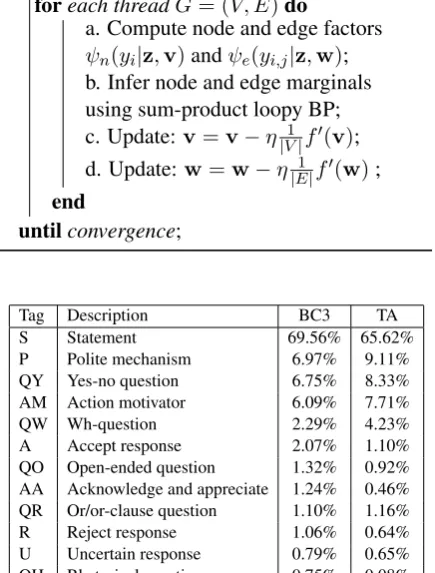
Training and Inference Traditionally, CRFs have been trained using offline methods like limited-memory BFGS (Murphy, 2012). Online training of CRFs using stochastic gradient de-scent (SGD) was proposed by Vishwanathan et al. (2006). Since RNNs are trained with online meth-ods, to compare our two methmeth-ods, we use SGD to train our CRFs. Algorithm 1 in the Appendix gives a pseudocode of the training procedure.
We use Belief Propagation or BP (Pearl, 1988) for inference in our graphical models. BP is guar-anteed to converge to an exact solution if the graph is a tree. However, exact inference is intractable for graphs with loops. Despite this, it has been ad-vocated by Pearl (1988) to use BP in loopy graphs as an approximation; see also (Murphy, 2012), page 768. The algorithm is then called “loopy” BP, or LBP. Although LBP gives approximate so-lutions for general graphs, it often works well in practice (Murphy et al., 1999), outperforming other methods such as mean field (Weiss, 2001).
Variations of Graph Structures One of the main advantages of our pairwise CRF is that we can define this model over arbitrary graph structures, which allows us to capture conver-sational dependencies at various levels. We distinguish between two types of dependencies: (i) intra-comment, which defines how the labels of the sentences in a comment are connected; and (ii)across-comment, which defines how the labels of the sentences across comments are connected.
Table 1 summarizes the connection types that we have explored in our models. Each configu-ration of intra- and across- connections yields a different pairwise CRF model. Figure 3 shows four such CRFs with three comments — C1
Tag Connection type Applicable to NO No connection between nodes intra & across LC Linear chain connection intra & across FC Fully connected intra & across FC1 Fully connected with first comment only across
[image:5.595.323.510.61.119.2]LC1 Linear chain with first comment only across
Table 1: Connection types in CRF models.
(a) NO-NO (MaxEnt) (b) LC-LC
(c) LC-LC1 (d) LC-FC1
[image:5.595.77.291.62.128.2]Figure 3: CRFs over different graph structures.
Figure 3a shows the structure forNO-NO con-figuration, where there is no link between nodes of both intra- and across- comments. In this setting, the CRF model is equivalent to MaxEnt. Figure 3b shows the structure for LC-LC, where there are linear chain relations between nodes of both intra- and across- comments. The linear chain across comments refers to the structure, where the last sentence of each comment is connected to the first sentence of the comment that comes next in the temporal order (i.e., posting time). Fig-ures 3c shows the CRF for LC-LC1, where
sen-tences inside a comment have linear chain connec-tions, and the last sentence of the first comment is connected to the first sentence of the other com-ments. Similarly, Figure 3d shows the graph struc-ture for LC-FC1 configuration, where sentences
inside comments have linear chain connections, and sentences of the first comment are fully con-nected with the sentences of the other comments.
3 Corpora
There exist large corpora of utterances annotated with speech acts in synchronous spoken domains, e.g., Switchboard-DAMSL or SWBD (Jurafsky et al., 1997) and Meeting Recorder Dialog Act or MRDA (Dhillon et al., 2004). However, such large corpus does not exist in asynchronous domains. Some prior work (Cohen et al., 2004; Ravi and Kim, 2007; Feng et al., 2006; Bhatia et al., 2014) tackles the task at the comment level, and uses
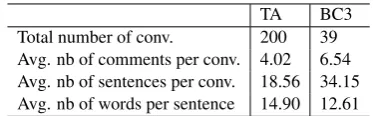
TA BC3
Total number of conv. 200 39 Avg. nb of comments per conv. 4.02 6.54 Avg. nb of sentences per conv. 18.56 34.15 Avg. nb of words per sentence 14.90 12.61
Table 2: Statistics about TA and BC3 corpora.
[image:5.595.323.513.159.229.2]Tag Description TA BC3 MRDA SU Suggestion 7.71% 5.48% 5.97% R Response 2.4% 3.75% 15.63% Q Question 14.71% 8.41% 8.62% P Polite 9.57% 8.63% 3.77% ST Statement 65.62% 73.72% 66.00%
Table 3: Distribution of speech acts in our corpora.
task-specific tagsets. In contrast, in this work we are interested in identifying speech acts at the sen-tence level, and also using a standard tagset like the ones defined in SWBD and MRDA.
More recent studies attempt to solve the task at the sentence level. Jeong et al. (2009) first created a dataset of TripAdvisor (TA) forum conversations annotated with the standard12act types defined in MRDA. They also remapped the BC3 email cor-pus (Ulrich et al., 2008) according to this tagset. Table 10 in the Appendix presents the tags and their relative frequency in the two datasets. Subse-quent studies (Joty et al., 2011; Tavafi et al., 2013; Oya and Carenini, 2014) use these datasets. We also use these datasets in our work. Table 2 shows some basic statistics about these datasets. On aver-age, BC3 conversations are longer than TA in both number of comments and number of sentences.
Since these datasets are relatively small in size, we group the 12 acts into 5 coarser classes to learn a reasonable classifier.1 More specifically,
all the question types are grouped into one gen-eral class Question, all response types into Re-sponse, and appreciation and polite mechanisms into Polite class. Also since deep neural models like LSTM RNNs require a lot of training data, we also utilize the MRDA meeting corpus. Ta-ble 3 shows the label distribution of the resultant datasets. Statement is the most dominant class, followed by Question, Polite and Suggestion.
QC3 Conversational Corpus Since both TA and BC3 are quite small to make a general com-ment about model performance in asynchronous
[image:5.595.75.287.170.295.2]Speech Act Distribution κ Suggestion 17.38% 0.86 Response 5.24% 0.43 Question 12.59% 0.87
Polite 6.13% 0.75
[image:6.595.115.251.61.133.2]Statement 58.66% 0.78
Table 4: Corpus statistics for QC3.
conversation, we have created a new dataset called Qatar Computing Conversational Corpus or QC3. We selected 50 conversations from a popular community question answering site named Qatar Living2 for our annotation. We used 3
conversa-tions for our pilot study and used the remaining47
for the actual study. The resultant corpus on aver-age contains13.32comments and33.28sentences per conversation, and19.78words per sentence.
Two native speakers of English annotated each conversation using a web-based annotation frame-work. They were asked to annotate each sentence with the most appropriate speech act tag from the list of 5 speech act types. Since this task is not always obvious, we gave them detailed annota-tion guidelines with real examples. We use Co-hens Kappaκto measure the agreement between the annotators. Table 4 presents the distribution of the speech acts and their respectiveκvalues.After Statement, Suggestion is the most frequent class, followed by Question and Polite. The κ varies from0.43(for Response) to0.87(for Question).
Finally, in order to create a consolidated dataset, we collected the disagreements and employed a third annotator to resolve those cases.
4 Experiments and Analysis
In this section we present our experimental set-tings, results and analysis. We evaluate our mod-els on the two forum corpora QC3 and TA. For performance comparison, we use both accuracy
andmacro-averagedF1score. Accuracy gives the
overall performance of a classifier but could be bi-ased to most populated ones. Macro-averagedF1
weights equally every class and is not influenced by class imbalance. Statistical significance tests are done using anapproximate randomizationtest based on the accuracy.3 We used SIGF V.2 (Pad´o,
2006) with 10,000 iterations.
2http://www.qatarliving.com/
3Significance tests operate on individual instances rather than individual classes; thus not applicable for macroF1.
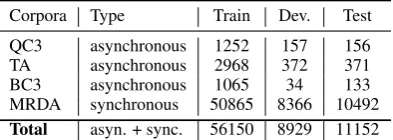
Corpora Type Train Dev. Test QC3 asynchronous 1252 157 156 TA asynchronous 2968 372 371 BC3 asynchronous 1065 34 133 MRDA synchronous 50865 8366 10492
[image:6.595.319.516.63.133.2]Total asyn. + sync. 56150 8929 11152
Table 5: Number of sentences in train, develop-ment and test sets for different datasets.
Because of the noise and informal nature of conversational texts, we performed a series of pre-processing steps. We normalize all characters to their lower-cased forms, truncate elongations to two characters, spell out every digit and URL. We further tokenized the texts using the CMU TweetNLP tool (Gimpel et al., 2011).
In the following, we first demonstrate the effec-tiveness of LSTM RNNs for learning representa-tions of sentences automatically to identify their speech acts. Then in subsection 4.2, we show the usefulness of pairwise CRFs for capturing conver-sational dependencies in speech act recognition.
4.1 Effectiveness of LSTM RNNs
To show the effectiveness of LSTMs for learn-ing sentence representations, we split each of our asynchronous corpora randomly into 70% sen-tences for training, 10% for development, and
20% for testing. For MRDA, we use the same
train-test-dev split as Jeong et al. (2009). Table 5 summarizes the resultant datasets.
We compare the performance of LSTMs with that of MaxEnt (ME) and Multi-layer Perceptron (MLP) with one hidden layer.4Both ME and MLP
were fed with the bag-of-word (BOW) represen-tations of the sentence, i.e., vectors containing bi-nary values indicating the presence or absence of a word in the training set vocabulary.
We train the models by optimizing the cross en-tropy using the gradient-based online learning
al-gorithm ADAM (Kingma and Ba, 2014).5 The
learning rate and other parameters were set to the values as suggested by the authors. To avoid over-fitting, we use dropout (Srivastava et al., 2014) of hidden units and early stopping based on the loss on the development set.6 Maximum number of
epochs was set to 25 for RNNs and 100for ME and MLP. We experimented with {0.0,0.2,0.4}
4More hidden layers worsened the performance. 5Other algorithms (SGD, Adagrad) gave similar results. 6l
dropout rates, {16,32,64} minibatch sizes, and {100,150,200}hidden layer units in MLP and in LSTMs. The vocabulary (V) in LSTMs was lim-ited to the most frequentP%(P ∈ {85,90,95}) words in the training corpus. We initialize the word vectors in the loop-up tableLin one of two ways: (i) by sampling randomly from the small uniform distribution U(−0.05,0.05), and (ii) by using pretrained 300 dimensional Google word embeddings from Mikolov et al. (2013b). The di-mension for random initialization was set to128.
We experimented with four LSTM variations: (i) U-LSTMr, referring to unidirectional with ran-dom initialization; (ii) U-LSTMp, referring to uni-directional with pretrained initialization; (iii) B-LSTMr, referring to bidirectional with random initialization; and (iv) B-LSTMp, referring to bidi-rectional with pretrained initialization.
Table 6 shows the results for different models for the data splits in Table 5. The first two rows show the best results reported so far on the MRDA corpus from (Jeong et al., 2009) for classifying into 12act types. The first row shows the results of the model that uses n-grams and the second row shows the results using all the features in-cluding speaker, part-of-speech, and dependency structure. Our LSTM RNNs and their n-gram model therefore use the same word sequence in-formation. To compare our results with the state of the art, we ran our models on MRDA for both 5-class and 12-class classification tasks. The re-sults are shown at the right most part of Table 6.
Notice that all of our LSTMs achieve state of the art results and B-LSTMpachieves even signifi-cantly better with99%confidence level. This is re-markable since our LSTMs learn the sentence rep-resentation automatically from the word sequence and do not use any hand-engineered features.
Now consider the asynchronous domains QC3 and TA, where we show the results of our models based on5-fold cross validation, in addition to the random (20%) testset. The 5-fold setting allows us to get more general performance of the models on a particular corpus. The comparison between our LSTMs shows that: (i) pretrained Google vec-tors provide better initialization to LSTMs than the random ones; (ii) bidirectional LSTMs outperform their unidirectional counterparts. When we com-pare these results with those of our baselines, the results are disappointing; the ME and MLP us-ing BOW outperform LSTMs by a good margin.
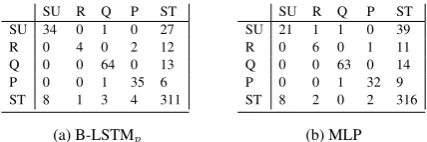
SU R Q P ST
SU 34 0 1 0 27
R 0 4 0 2 12
Q 0 0 64 0 13
P 0 0 1 35 6
ST 8 1 3 4 311
(a) B-LSTMp
SU R Q P ST
SU 21 1 1 0 39
R 0 6 0 1 11
Q 0 0 63 0 14
P 0 0 1 32 9
ST 8 2 0 2 316
[image:7.595.309.523.61.132.2](b) MLP
Figure 4: Confusion matrices for (a) B-LSTMp and (b) MLP on the testsets of QC3 and TA.
However, this is not surprising since deep neural networks like LSTMs have a lot of parameters, for which they require a lot of data to learn from.
To validate our claim, we create another train-ing setting CAT by merging the training and
de-velopment sets of the four corpora in Table 5 (see the Train and Dev. columns in the last row); the testset for each dataset however remains the same. Table 7 shows the results of the baselines and the B-LSTMp on the QC3 and TA testsets. In both
datasets, B-LSTMp outperforms ME and MLP
significantly. When we compare these results with those in Table 6, we notice that B-LSTMp, by virtue of its distributed and condensed represen-tation, generalizes well across different domains. In contrast, ME and MLP, because of their BOW representation, suffer from data diversity of differ-ent domains. These results also confirm that B-LSTMp gives better sentence representation than BOW, when it is given enough data.
To analyze further the cases where B-LSTMp makes a difference, Figure 4 shows the corre-sponding confusion matrices for B-LSTMp and MLP on the concatenated testsets of QC3 and TA. It is noticeable that B-LSTMp is less affected by class imbalance and it can detect moresuggestions
than MLP. This indicates that LSTM RNNs can model the grammar of the sentence when compos-ing the words into phrases sequentially.
4.2 Effectiveness of CRFs
To demonstrate the effectiveness of CRFs for cap-turing inter-sentence dependencies in an asyn-chronous conversation, we create another dataset setting called CON, in which the random splits
are done at the conversation(as opposed to sen-tence) level for the asynchronous corpora. This is required because our CRF models perform joint learning and inference based on a full conversa-tion. As presented in Table 8, this setting contains
devel-QC3 TA MRDA
Testset 5 folds Testset 5 folds 5 classes 12 classes
Jeong et al. (ng) - - - 57.53 (83.30)
Jeong et al. (All) - - - 59.04 (83.49)
ME 55.12 (75.64) 50.23 (71.37) 61.4 (85.44) 59.23 (84.85) 65.25 (83.95) 57.79 (82.84) MLP 61.30(74.36) 54.57 (71.63) 68.17 (85.98) 62.41 (85.02) 68.12 (84.24) 58.19 (83.24) U-LSTMr 51.57 (73.55) 48.64 (65.94) 56.54 (83.24) 56.39 (83.83) 71.29 (85.38) 58.72 (83.34)
U-LSTMp 49.41 (70.97) 50.26 (65.62) 63.12(83.78) 59.10 (83.13) 72.32 (85.19) 59.05 (84.06)
B-LSTMr 50.75 (72.26) 48.41 (66.19) 58.88 (82.97) 56.23 (83.34) 71.69 (85.62) 58.33 (83.49)
[image:8.595.88.509.65.188.2]B-LSTMp 53.22 (71.61) 51.59 (68.50) 60.73 (82.97) 59.68 (84.07) 72.02 (85.33) 60.12 (84.46*)
Table 6: Macro-averagedF1 and raw accuracy (in parenthesis) for baselines and LSTM variants on the
testset and 5-fold splits of different corpora. For MRDA, we use the same train-test-dev split as (Jeong et al., 2009). Accuracy significantly superior to state-of-the-art is marked with *.
[image:8.595.322.510.260.361.2]QC3 (Testset) TA (Testset) ME 50.64 (71.15) 72.49 (84.10) MLP 58.60 (74.36) 73.07 (86.29) B-LSTMp 66.40 (80.65*) 73.14 (87.01*)
Table 7: Results on CATdataset.
Train Dev Test QC3 38 (1332) 4 (111) 5 (122) TA 160 (2957) 20 (310) 20 (444) Total 197 (4289) 24 (421) 25 (566)
Table 8: Setting for CONdataset. The numbers
in-side parentheses indicate the number of sentences.
opment, respectively.7 The testsets contain5and
20conversations for QC3 and TA, respectively. As baselines, we use three models: (i) MEb, a MaxEnt using BOW representation; (ii) B-LSTMp, which is now trained on the concatenated set of sentences from MRDA and CON training
sets; and (iii)MEe, a MaxEnt using sentence em-beddings extracted from the B-LSTMp, i.e., the sentence embeddings are used as feature vectors.
We experiment with the CRF variants in Table 1. The CRFs are trained on the CONtraining set
using the sentence embeddings that are extracted by applying the B-LSTMp model, as was done with MEe. Table 9 shows our results. We notice that CRFs generally outperform MEs in accuracy. This indicates that there are conversational depen-dencies between the sentences in a conversation.
When we compare between CRF variants, we notice that the model that does not consider any link across comments perform the worst; see CRF
(LC-NO). A simple linear chain connection
be-tween sentences in their temporal order does not
7We use the concatenated sets as train and dev. sets.
QC3 TA
MEb 56.67 (67.21) 63.29 (84.23)
B-LSTMp 65.15 (77.87) 66.93 (85.13)
MEe 59.94 (77.05) 59.55 (85.14)
CRF(LC-NO) 62.20 (77.87) 60.30 (85.81)
CRF(LC-LC) 62.35 (78.69) 60.30 (85.81) CRF(LC-LC1) 65.94 (80.33*) 61.58 (86.54) CRF(LC-FC1) 61.18 (77.87) 60.00 (85.36) CRF(FC-FC) 64.54 (79.51*) 61.64 (86.81*)
Table 9: Results of CRFs on CONdataset.
improve much (CRF (LC-LC)), which indicates
that the widely used linear chain CRF (Lafferty et al., 2001) is not the most appropriate model for capturing conversational dependencies in these conversations. The CRF (LC-LC1) is one of the
best performing models and perform significantly (with 99% confidence) better than B-LSTMp.8
This model considers linear chain connections be-tween sentences inside comments and only to the first comment. Note that both QC3 and TA are forum sites, where participants in a conversation interact mostly with the person who posts the first comment asking for some information. This is in-teresting that our model can capture this aspect.
Another interesting observation is that when we change the above model to consider relations with every sentence in the first comment (CRF (LC -FC1)), this degrades the performance. This could
be due to the fact that the information seeking per-son first explains her situation, and then asks for the information. Others tend to respond to the re-quested information rather than to her situation. The CRF (FC-FC) also yields as good results as
CRF(LC-LC1). This could be attributed to the
ro-bustness of the fully-connected CRF, which learns
[image:8.595.94.268.260.393.2] [image:8.595.98.261.344.390.2]from all possible relations.
To see some real examples in which CRF by means of its global learning and inference makes a difference, let us consider the example in Figure 1 again. We notice that the two sentences in com-mentC4 were mistakenly identified as Statement
and Response, respectively, by the B-LSTMplocal model. However, by considering these two sen-tences together with others in the conversation, the global CRF(FC-FC) model could correct them. 5 Related Work
Three lines of research are related to our work: (i) semantic compositionality with LSTM RNNs, (ii) conditional structured models, and (iii) speech act recognition in asynchronous conversations.
LSTM RNNs for composition Li et al. (2015) compare recurrent neural models with recursive (syntax-based) models for several NLP tasks and conclude that recurrent models perform on par with the recursive for most tasks (or even bet-ter). For example, recurrent models outperform recursive on sentence level sentiment classifica-tion. This finding motivated us to use recurrent models rather than recursive. The application of LSTM RNNs to speech act recognition is novel to the best of our knowledge. LSTM RNNs have also been applied to sequence tagging in opinion min-ing (Irsoy and Cardie, 2014; Liu et al., 2015).
Conditional structured models There has been an explosion of interest in CRFs for solving struc-tured output problems in NLP; see (Smith, 2011) for an overview. Linear chain (for sequence label-ing) and tree structured CRFs (for parslabel-ing) are the common ones in NLP. However, speech act recog-nition in asynchronous conversation posits a dif-ferent problem, where the challenge is to model ar-bitrary conversational structures. In this work we propose a general class of models based on pair-wise CRFs that work on arbitrary graph structures.
Speech act recognition in asynchronous conver-sation Jeong et al. (2009) use semi-supervised boosting to tag the sentences in email and forum discussions with speech acts by adapting knowl-edge from spoken conversations. Other sentence-level approaches use supervised classifiers and se-quence taggers (Qadir and Riloff, 2011; Tavafi et al., 2013; Oya and Carenini, 2014).
Cohen et al. (2004) first use the term email speech act for classifying emails based on their
acts (deliver, meeting). Their classifiers do not capture any contextual dependencies between the acts. To model contextual dependencies, Carvalho and Cohen (2005) use a collective classification approach with two different classifiers, one for content and one for context, in an iterative algo-rithm. Our approach is similar in spirit to their ap-proach with three crucial differences: (i) our CRFs are globally normalized to surmount thelabel bias
problem, where their classifiers are normalized lo-cally; (ii) the graph structure of the conversation is given in their case, which is not the case with ours; and (iii) their approach works at the com-ment level, where we work at the sentence level.
6 Conclusions and Future Work
We have presented a two-step framework for speech act recognition in asynchronous conversa-tion. A LSTM RNN first composes sentences into vector representations by considering the word or-der. Then a pairwise CRF jointly models the inter-sentence dependencies in the conversation. We ex-perimented with different LSTM variants (uni- vs. bi-directional, random vs. pretrained initializa-tion), and different CRF variants depending on the underlying graph structure. We trained our models on many different settings using synchronous and asynchronous corpora and evaluated on two forum datasets, one of which is presented in this work.
Our results show that LSTM RNNs provide bet-ter representations but requires more data, and global joint models improve over local models given that it considers the right graph structure.
In the future, we would like to combine CRFs with LSTMs for doing the two steps jointly, so that the LSTMs can learn the embeddings using the global thread-level feedback. This would require the backpropagation algorithm to take error sig-nals from the loopy BP inference. We would also like to apply our models to conversations, where the graph structure is extractable using the meta data or other clues, e.g., the fragment quotation graphs for email threads (Carenini et al., 2008).
Acknowledgments
References
John Langshaw Austin. 1962. How to do things with words. Harvard University Press.
Srinivas Bangalore, Giuseppe Di Fabbrizio, and Amanda Stent. 2006. Learning the structure of task-driven human-human dialogs. InProceedings of the 44nd Annual Meeting on Association for Computa-tional Linguistics, ACL’06, pages 201–208. ACL. Sumit Bhatia, Prakhar Biyani, and Prasenjit Mitra.
2014. Summarizing online forum discussions – can dialog acts of individual messages help? In Pro-ceedings of the 2014 Conference on Empirical Meth-ods in Natural Language Processing (EMNLP), pages 2127–2131, Doha, Qatar, October. ACL.
Giuseppe Carenini, Raymond T. Ng, and Xiaodong Zhou. 2008. Summarizing emails with conversa-tional cohesion and subjectivity. InProceedings of the 46nd Annual Meeting on Association for Com-putational Linguistics, ACL’08, pages 353–361, OH. ACL.
Vitor R. Carvalho and William W. Cohen. 2005. On the collective classification of email ”speech acts”. InSIGIR ’05: Proceedings of the 28th annual inter-national ACM SIGIR conference on Research and development in information retrieval, pages 345– 352, New York, NY, USA. ACM Press.
William W. Cohen, Vitor R. Carvalho, and Tom M. Mitchell. 2004. Learning to classify email into “speech acts”. In Proceedings of the 2004 Con-ference on Empirical Methods in Natural Language Processing (EMNLP), pages 309–316.
Rajdip Dhillon, Sonali Bhagat, Hannah Carvey, and Elizabeth Shriberg. 2004. Meeting Recorder Project: Dialog Act Labeling Guide. Technical re-port, ICSI Tech. Report.
Donghui Feng, Erin Shaw, Jihie Kim, and Eduard Hovy. 2006. Learning to detect conversation focus of threaded discussions. InProceedings of the Main Conference on Human Language Technology Con-ference of the North American Chapter of the Asso-ciation of Computational Linguistics, HLT-NAACL ’06, pages 208–215, Stroudsburg, PA, USA. Associ-ation for ComputAssoci-ational Linguistics.
Kevin Gimpel, Nathan Schneider, Brendan O’Connor, Dipanjan Das, Daniel Mills, Jacob Eisenstein, Michael Heilman, Dani Yogatama, Jeffrey Flani-gan, and Noah A Smith. 2011. Part-of-speech tag-ging for twitter: Annotation, features, and experi-ments. In Proceedings of the 49th Annual Meet-ing of the Association for Computational LMeet-inguis- Linguis-tics: Human Language Technologies: short papers-Volume 2, pages 42–47. ACL.
Sepp Hochreiter and J¨urgen Schmidhuber. 1997. Long short-term memory. Neural computation, 9(8):1735–1780.
Liangjie Hong and Brian D. Davison. 2009. A classification-based approach to question answering in discussion boards. In32nd Annual International ACM SIGIR Conference on Research and Devel-opment on Information Retrieval, pages 171–178, Boston, USA. ACM Press.
Ozan Irsoy and Claire Cardie. 2014. Opinion mining with deep recurrent neural networks. In Proceed-ings of the 2014 Conference on Empirical Methods in Natural Language Processing (EMNLP), pages 720–728, Doha, Qatar. ACL.
Minwoo Jeong, Chin-Yew Lin, and Gary Geunbae Lee. 2009. Semi-supervised speech act recognition in emails and forums. InProceedings of the 2009 Con-ference on Empirical Methods in Natural Language Processing (EMNLP), pages 1250–1259, Singapore. ACL.
Shafiq Joty, Giuseppe Carenini, and Chin-Yew Lin. 2011. Unsupervised Modeling of Dialog Acts in Asynchronous Conversations. In Proceedings of the twenty second International Joint Conference on Artificial Intelligence, IJCAI’11, pages 1–130, Barcelona.
Dan Jurafsky, Liz Shriberg, and Debra Biasca. 1997. Switchboard SWBD-DAMSL Shallow-Discourse-Function Annotation Coders Manual, Draft 13. Technical report, University of Colorado at Boulder & +SRI International.
Diederik P. Kingma and Jimmy Ba. 2014. Adam: A method for stochastic optimization. CoRR, abs/1412.6980.
John Lafferty, Andrew McCallum, and Fernando Pereira. 2001. Conditional random fields: Prob-abilistic models for segmenting and labeling se-quence data. In Proceedings of the Eighteenth International Conference on Machine Learning, ICML ’01, pages 282–289, San Francisco, CA. Jiwei Li, Thang Luong, Dan Jurafsky, and Eduard
Hovy. 2015. When are tree structures necessary for deep learning of representations? InProceedings of the 2015 Conference on Empirical Methods in Nat-ural Language Processing (EMNLP), pages 2304– 2314, Lisbon, Portugal, September. ACL.
Pengfei Liu, Shafiq Joty, and Helen Meng. 2015. Fine-grained opinion mining with recurrent neural net-works and word embeddings. InProceedings of the 2015 Conference on Empirical Methods in Natural Language Processing (EMNLP), pages 1433–1443, Lisbon, Portugal, September. ACL.
Kathleen McKeown, Lokesh Shrestha, and Owen Ram-bow. 2007. Using question-answer pairs in extrac-tive summarization of email conversations. In CI-CLing, pages 542–550.
Tomas Mikolov, Ilya Sutskever, Kai Chen, Greg S Cor-rado, and Jeff Dean. 2013b. Distributed representa-tions of words and phrases and their compositional-ity. InAdvances in Neural Information Processing Systems, pages 3111–3119.
Kevin P. Murphy, Yair Weiss, and Michael I. Jordan. 1999. Loopy belief propagation for approximate inference: An empirical study. In Proceedings of the Fifteenth Conference on Uncertainty in Artificial Intelligence, UAI’99, pages 467–475, Stockholm, Sweden. Morgan Kaufmann Publishers Inc.
Kevin Murphy. 2012.Machine Learning A Probabilis-tic Perspective. The MIT Press.
Tatsuro Oya and Giuseppe Carenini. 2014. Extrac-tive summarization and dialogue act modeling on email threads: An integrated probabilistic approach. In Proceedings of the 15th Annual Meeting of the Special Interest Group on Discourse and Dialogue (SIGDIAL), page 133–140, Philadelphia, PA, U.S.A. ACL.
Sebastian Pad´o, 2006. User’s guide tosigf: Signifi-cance testing by approximate randomisation. Judea Pearl. 1988. Probabilistic Reasoning in
In-telligent Systems: Networks of Plausible Inference. Morgan Kaufmann Publishers Inc., San Francisco, CA, USA.
Ashequl Qadir and Ellen Riloff. 2011. Classifying sentences as speech acts in message board posts. In Proceedings of the 2011 Conference on Empiri-cal Methods in Natural Language Processing, pages 748–758, Edinburgh, Scotland, UK. Association for Computational Linguistics.
Sujith Ravi and Jihie Kim. 2007. Profiling Student In-teractions in Threaded Discussions with Speech Act Classifiers. InProceedings of AI in Education Con-ference (AIED 2007).
Emanuel A. Schegloff. 1968. Sequencing in con-versational openings. American Anthropologist, 70(6):1075–1095.
Mike Schuster and Kuldip K Paliwal. 1997. Bidirec-tional recurrent neural networks. IEEE Transactions on Signal Processing, 45(11):2673–2681.
Noah A. Smith. 2011. Linguistic Structure Prediction. Synthesis Lectures on Human Language Technolo-gies. Morgan and Claypool, May.
Nitish Srivastava, Geoffrey Hinton, Alex Krizhevsky, Ilya Sutskever, and Ruslan Salakhutdinov. 2014. Dropout: A simple way to prevent neural networks from overfitting. Journal of Machine Learning Re-search, 15:1929–1958.
Maryam Tavafi, Yashar Mehdad, Shafiq Joty, Giuseppe Carenini, and Raymond Ng. 2013. Dialogue act recognition in synchronous and asynchronous con-versations. InProceedings of the 14th Annual Meet-ing of the Special Interest Group on Discourse and
Dialogue (SIGDIAL), page 117–121, Metz, France. ACL.
Jan Ulrich, Gabriel Murray, and Giuseppe Carenini. 2008. A publicly available annotated corpus for su-pervised email summarization. InAAAI’08 EMAIL Workshop, Chicago, USA. AAAI.
S. V. N. Vishwanathan, Nicol N. Schraudolph, Mark W. Schmidt, and Kevin P. Murphy. 2006. Accelerated training of conditional random fields with stochastic gradient methods. InProceedings of the 23rd Inter-national Conference on Machine Learning, ICML ’06, pages 969–976, Pittsburgh, USA. ACM. Yair Weiss. 2001. Comparing the mean field method
and belief propaga- tion for approximate inference in mrfs. In Advanced Mean Field Methods. MIT Press.
A Appendix
Algorithm 1: Online learning algorithm for conditional random fields
1. Initialize the model parametersvandw; 2. repeat
foreach threadG= (V, E)do
a. Compute node and edge factors ψn(yi|z,v)andψe(yi,j|z,w); b. Infer node and edge marginals using sum-product loopy BP; c. Update:v=v−η|V1|f0(v);
d. Update:w=w−η 1
|E|f0(w); end
untilconvergence;
Tag Description BC3 TA
S Statement 69.56% 65.62%
P Polite mechanism 6.97% 9.11% QY Yes-no question 6.75% 8.33% AM Action motivator 6.09% 7.71%
QW Wh-question 2.29% 4.23%
A Accept response 2.07% 1.10%
QO Open-ended question 1.32% 0.92% AA Acknowledge and appreciate 1.24% 0.46% QR Or/or-clause question 1.10% 1.16%
R Reject response 1.06% 0.64%
[image:11.595.309.527.371.658.2]U Uncertain response 0.79% 0.65% QH Rhetorical question 0.75% 0.08%