TABLE OF CONTENTS: Vol. 47, No. 3, May 1994
ARTICLES Improvements
178 Harvest date and fertilizer effects on native and interseeded wetland meadows by P.E. Reece, J.T. Nichols, J.E. Brummer, R.K. Engel, and KM. Eskridge
Plant Ecology
184 Sixty-one years of secondary succession on rangelands of the Wyoming High Piains by Marilyn J. Samuel and Richard H. Hart
Planr Physiology
192 Indications of associative nitrogen fixation in eastern gamagrass by John J. Brejda, Robert J. Kremer, and James R. Brown
196 Drying and storage effects on germination of primed grass seeds by Stuart P. Hardegree
200 Sites, mowing, 2,4-D, and seasons affect bitterbrush twig morphology by Vincent M. Kituku, Jeff Powell, and Richard A. Olson
Reclamation
206 Plant responses to gypsum amendment of sodic bentonite mine spoil by G.E. Schuman, E.J. DePuit, and K.M. Roadifer
Grazing Management 210
215 220
226
A comparison of frontal, continuous, and rotation grazing systems by J.D. Volesky, F. De Achaval O’Farrell, W.C. Ellis, MM. Kothmann, F.P.
Horn, W.A. Phillips, and S.W. Coleman
Tiller defoiiation patterns under frontai, continuous, and rotation grazing by Jerry D. Volesky
Little bluestem tiller defoliation patterns under continuous and rotatiomd grasing by Justin D. Derner, Robert L. Gillen, F. Ted McCollum, and Kenneth W. Tate
Potential forage value of some eastern Canadian sedges (Cyperaceae:
Carex) by P.M. Catling, A.R. McElroy, and K.W. Spicer
Measurement Sampling
231 Predicting big sagebrush winter forage by subspecies and browse form class by C.L. Wambolt, W.H. Creamer, and R.J. Rossi
Published bimonthly-January, March, May, July, September, November Copyright 1994 by the Society for Range Management
INDIVIDUAL SUBSCRIPTION is by membership in the Society for Range Management.
LIBRARY or other INSTITUTIONAL SUBSCRIP- TIONS on a calendar year basis are $56.00 for the United States postpaid and $66.00 for other coun- tries, postpaid. Payment from outside the United States should be remitted in US dollars by interna- tional money order or draft on a New York bank.
BUSINESS CORRESPONDENCE, concerning sub- scriptions, advertising, reprints, back issues, and related matters, should be addressed to the Manag- ing Editor, 1639 York Street, Denver, Colorado 60206.
EDITORIAL CORRESPONDENCE, concerning manu- scriptsorothereditorial matters, should beaddressed to the Editor, Gary Frasier, 1300 Wheatridge Ct., Loveland, Colorado 60537. Page proofs should be returned to the Production Editor, 1839York Street, Denver, Colorado 60206.
INSTRUCTIONS FOR AUTHORS appear on the inside back cover of most issues. A Style Manual is also available from the Society for Range Manage- ment at the above address @$4.00 for single copies.
THE JOURNAL OF RANGE MANAGEMENT (ISSN 0022-409X) is published bimonthly for $56.00 per year by the Society for Range Management, 1639 York Street, Denver, Colorado 60206. SECOND CLASS POSTAGE paid at Denver, Colorado, and additional offices.
POSTMASTER: Return entlre journal wlth addreer change-RETURN POSTAGE GUARANTEED-to Society for Range Management, 1639 York Street, Denver, Colorado 80206.
Plant Animal
235 Vegetation characteristics influencing site selection by male white-tailed deer in Texas by Matthew T. Pollock, Donald G. Whittaker, Stephen Demarais, and Robert E. Zaiglin
240 Nutrient quality of bluebunch wheatgrass regrowth on elk winter range in relation to defoliation by K.J. Westenskow-Wall, W.C. Krueger, L.D.
Bryant, and D.R. Thomas
245 Diet selection and utilization by llama and sheep in a high altitude-arid rangeland of Bolivia by Didier Genin, Zenobio Villca, and Percy Abasto
TECHNICAL NOTES
249 Inexpensive rain gauges constructed from recyclable 24ter plastic soft drink bottles by Keith J. Wrage, F. Robert Gartner, and Jack L. Butler 251 Mechanical harvesting of plains pricklypear for control and feeding by
D.M. Mueller, M.C. Shoop, and W.A. Laycock BOOK REVIEWS
255 The Biology of Deer edited by Robert D. Brown; Wilderness Issue in the Arid Lands of the Western United States edited by Samuel I. Zeveloff and Cyrus M. McKell
PRINTED IN USA
Managing Edltor
CHARLES B. (BUD) RUMBURG 1839 York Street
Denver, Colorado 60206 Editor
GARY FRASIER 1300 Wheatridge Ct.
Loveland, Colorado 80537 Production Editor PATRICIA M. PEREZ
Society for Range Management 1839 York Street
Denver, Colorado 80206 (303) 3557070
Book Review Editor DAVID L. SCARNECCHIA
Department of Natural Resource Sci.
Washington State University Pullman, Washington 99164-6410
ASSOCIATE EDITORS DON ADAMS
West Central Res. B Ext. Center Route 4
Box 46A
North Platte, Nebraska 69101 JOHN A. CRAWFORD
Dept. of Fisheries and Wildlife Nash 104
Oregon State University DAVID ENGLE
Agronomy Department Oklahoma State University Stillwater, Oklahoma 74078
G. FRED GIFFORD
Environmental and Resource Sciences/l88
1000 Valley Road University of Nevada Rena, Nevada 89512-0013
MARSHALL HAFERKAMP USDA-ARS
Livestock & Range Res. Station Route 1
Box 2021
Miles City, Montana 59301 STUART P. HARDEGEE
USDA-ARS
Northwest Watershed Res. Center 800 Park Blvd Plaza IV #105 Boise, Idaho 83712 KRIS HAVSTAD
USDA-At%, Dept. 3JER Box 3003, NMSU
Las Cruces, New Mexico 88003 HERMAN S. MAYEUX, JR.
USDA-ARS
808 E. Blackland Road Temple, Texas 76502
RICHARD F. MILLER Squaw Butte Exp. Sta.
Highway 205 Burns, Oregon 97720 JAMES A. PFISTER
USDA-ARS 1150 East 1400 North Logan, Utah 84321 GERALD E. SCHUMAN
USDA-ARS
High Plains Grasslands Research 8408 Hildreth Road
Cheyenne, Wyoming 82009 JOHN A. TANAKA
P.O. Box 1702
La Grande, Oregon 97850
J. Range Manage.
47~17s183, May 1994
Harvest date and fertilizer effects on native and interseeded wetland meadows
P.E. REECE, J.T. NICHOLS, J.E. BRUMMER, R.K. ENGEL, AND K.M. ESKRIDGE
P.E. Reece, Dept. of Agronomy, Univ. of Nebraska Panhandle Research and Extension Center, 4502 Avenue I, Scottsbluff 69361; J. T. Nichols, J. E. Brummer, and R. K. Engel, Dept. of Agronomy, Univ. of Nebraska West Central Research and Extension Center, Route 4, Box 46A. North Platte 69101; and K.M. Eskridge, Dept. of Biometry, Univ.
of Nebraska, 103 Miller Hall, Lincoln 68583.
Abstract
Studies of harvest date by fertilizer interactions on hay meadows are rare and none have been published for prairie meadows. Our objective was to evaluate the effects of initial harvest date (15 June, 15 July, and 15 August) and spring-applied N (0,45,90, and 135 kg ha-‘) on first cutting and regrowth dry matter yield and forage quality from native and interseeded wetland meadow sites.
Regrowth was harvested on all plots in late September. ‘Garrison’
creeping foxtail (A lopecurus arundinuceus Poir.) was interseeded on plots 4 years prior to application of treatments. Native vegeta- tion was dominated by sedges (Carex spp.). Interseeded plots were dominated by Garrison creeping foxtail.
Yield and quality on different dates and response to N were similar for vegetation types despite differences in duration of spring flooding between years. Harvest date by fertilizer interac- tions occurred for first cutting yield and crude protein concentra- tion. Yield response to applied N ranged from 8.5 to 31.2 kg ha“
kg-’ N. Fertilizer had no effect on digestibility and increased crude protein concentration only in herbage harvested on 15 June.
Within levels of N, first cutting yield was about 60% of peak standing crop on 15 June and 90% on 15 July compared with 15 August. Greater plant growth rates and response to N after pro- longed spring flooding compensated for initial differences between years by 15 July. Regrowth dry matter yield was not affected by spring-applied N and increased by about 43 kg ha-‘day-’ after initial harvest in both years. Sedge-dominated, prairie meadows are productive and provide predictable forage and wildlife habitat management alternatives.
Key Words: Alopecurusarundinaceus, Carexnebraskensis, Carex spp., nitrogen fertilizer, herbage yield and quality, regression models
Published information on yield and quality of herbage from sedge (Carex spp.) dominated wetland meadows is limited to high elevation locations (Taylor et al. 1985). Most prairie wetland mea- dows provide critical sources of herbage for beef cattle and wildlife.
Wetlands have become a focal point of state and federal govern- ments (Chantey et al. 1990). Information on combinations of management practices is needed to provide a better foundation for pending legislation on wetlands. Knowledge of harvest date by N fertilizer interactions is needed to improve hay production eff- ciency and to enhance wildlife habitat management Additionally,
‘Garrison’ creeping foxtail (Alopecurus arundinaceus Poir.) has been widely recommended for seeding on wetlands in the Northern and Central Great Plains for increased dry matter yield (Stroh et al.
Published as Paper #10X57, Journal Series, University of Nebraska Agricultural Research Division.
The authors wish to thank Gordon D. Moeller for technical assistance and Sharon Holman for manuscript preparation.
Manuscript accepted 18 Dec. 1993.
178
1978, Fairbourn 1982, Dodds and Vasey 1985, Anderson et al.
1990), but comparative yield and quality studies of interseeded Garrison creeping foxtail and native vegetation on sedge domi- nated wetland meadows have not been reported.
Harvest dates on wetland meadows in the Nebraska Sandhills depend upon a seasonally variable water table. Equipment access and drying conditions for hay occur after the water table has dropped 10 cm or more below the soil surface. Water tables are 20 to 60 cm closer to the soil surface during much of the growing season on wetland meadows compared with subirrigated meadows in the Sandhills. Natural spring flooding occurs for 30 to 60 days on wetland meadows. Flooding is uncommon on subirrigated meadows and lasts 2 weeks or less. Normal harvest dates for wetland meadows range from mid-June to mid-August. Regrowth after haying provides a valuable source of high quality forage for livestock and many wildlife species. This study was conducted to quantify dry matter yield and forage quality on a prairie wetland meadow over a range of harvest dates and levels of spring-applied N. First cutting and regrowth herbage was harvested from sedge dominated native vegetation and plots interseeded with Garrison creeping foxtail in 1987 and 1988. Herbaceous species encountered in this study are common to wetland meadows and are widely distributed in Canadian provinces and temperate environments in the U.S. (GPFA 1986).
Materials and Methods Site
The study was conducted over a range of soil organic matter content and depth to water table conditions on a wetland located at the University of Nebraska, Gudmundsen Sandhills Laboratory,
11 km northeast of Whitman, Nebr. Soil at the study location was classified as a Gannett-Loup fine sandy loam (coarse-loamy, mixed mesic Typic Haplaquolls) derived from eolian sand parent material. Selected soil properties at the study site are presented in Table 1.
Table 1. Soil characteristics (O-15 cm) at the Gudmundscn Sandhills Laboratory, Laboratory, Whitman, Nebr. in 1987.’
Organic
Block2 PH matter P(Bray-1) K NOs-N so4s (%)
1 6.4 17.6
__;i________(ppm)____________
6:0
128 2.1 6.5
:
6.4 23.8 112 3.1 10.9
6.8 31.0 3.1 141 2.5 14.7
1Values are the means of 6 soil cores from each block.
*Depth to water table declined from block 1 to block 3.
JOURNAL OF RANGE MANAGEMENT 47(3), May 1994
Soil water was not a limiting factor during the study because of natural subirrigation. Soils were water-saturated at the surface when plants initiated growth in the spring. The water table was within the rooting zone throughout the growing season. Average annual precipitation is 54.9 cm with 70% occurring from April through July. The average frost free period is 130 days and eleva- tion is 1,050 m (NOAA 1988).
Design and Treatments
A split-split plot experimental design was used with the whole plots randomly set out into 3 complete blocks. The criterion for blocking was slope position within the wetland basin. Degree of soil wetness, duration of flooding, and proximity to the water table increased downslope. Plot dimensions were 4.9 X 36.6 m, 4.9 X 12.2 m, and 4.9 X 2.4 m for main, split, and split-split plots, respectively. Main plots were contiguous vegetation types consist- ing of native vegetation or interseeded to creeping foxtail. Split plots were initial harvest dates including 15 June, 15 July, or 15 August. Regrowth was harvested in a second cutting on all plots at the end of the growing season on 22 September in both years of the study. Split-split plots were fertilizer treatments including control with no fertilizer, and 0,45,90, or 135 kg N ha-’ each with 45 kg PzOs ha-’ and 23 kg S ha-‘. Uniform application of P and S with all levels of N was based upon prior research results on a subirrigated meadow (Nichols et al. 1990). Fertilizer was broadcast on the same plots (2.4 X 4.9 m) in May 1987 and 1988 when the water table dropped below the soil surface. Fertilizer sources were ammonium nitrate (34-O-O), triple super phosphate (O-46-0), and granulated sulfur (90% S).
Four years before this experiment began, main plots were sprayed with glyphosate [N-(phosphonomethyl) glycine] at 2.8 kg ha-’ on 9 September 1983. Garrison creeping foxtail was then interseeded with a John Deere 1550 Power-till drill’ at 3.4 kg pure live seed ha-’ on 15 September 1983. All plots were hayed with adjacent wetland and subirrigated sites in early August 1984-1986.
Fertilizer was not applied to the research sites until the initiation of treatments in 1987.
Vegetation Types
Basal area of plant species was measured on all native and interseeded plots 9-11 June 1987 with a IO-point frame at 10 random locations within each main plot. Total plant basal area was similar for native and interseeded plots. Plant stem bases covered about 59% of the soil surface. Native vegetation was dominated by sedges whereas interseeded plots were dominated by Garrison creeping foxtail (Table 2). Five sedge species occurred in the native vegetation: Bebb sedge [ Carex bebbii (Bailey) Fern.], Crawe sedge (C. cruwei Dew.), Hayden sedge (C. haydenii Dew.), Nebraska sedge (C. nebruskensis Dew.), and slender sedge (C. pruegracilis W. Boott.) Sedges produced 70% or more of the herbage harvested from native plots.
Herbicide treatment in 1983 before interseeding eliminated Nebraska sedge and reduced the relative abundance of the remain- ing sedge species. Sedge species accounted for 22% of basal cover on interseeded plots. Collectively, common rush (Juncus effusus L.) and compressed spikerush (Eleochuris compressa Sulliv.) composed 19% of the total plant basal area on both vegetation types. Garrison creeping foxtail composed 42% of the basal area on interseeded plots and produced 60% or more of the herbage har- vested at a 5cm cutting height. Basal area composition for other species was similar for vegetation types except for bluejoint reed- grass [ Culumugrosris cunadensis (Michx.) Beauv.], which was 6%
on native but less than 1% on interseeded plots.
The use of trade names in this article does not imply endorsement by the Nebraska Agr. Res. Div. of the products named, nor criticism of similar ones not mentioned.
Table 2. Mean percent of total plant basal area for species on native nod interseeded wetland meadow plots 10 June 1987 at the Gudmundsen Sandhills Laboratory, Whitman, Neb.
Species’ Native Interseeded
_-- Alopecurus arundinaceus Poir.
Carex nebraskensis Dew.
Carex bebbii (Bailey) Fern, C. crawei Dew., C. haydenii Dew., and C. praegracilis W.
Boott.
Juncus effusus L., and Eleocharis compressa Sulliv.
Agrostis srolonifera L.
Poa prarensis
Calamagrostis canadensis (Michx.) Beauv.
Sparfina pectinata Link.
Phleum prarense L.
Trifolium pratense L.
Miscellaneous forbs
_____(%)________
0 42
I3 0
41 22
19 19
10 8
6 4
6 T2
1 1
1 T
T 1
3 3
‘Nomenclature of plants follows the Great Plains Flora Association (1986).
*Recorded at less than 1%.
Sampling
Standing crop weight from each treatment was obtained by harvesting an area 0.9 X 4.5 m at a 5-cm cutting height. Subsamples were obtained from the harvested material, oven dried at 60°C to a constant weight and used to convert yield values to a dry matter (DM) basis. Subsamples were analyzed for total N concentration using the Kjeldahl method (AOAC 1975) and for in vitro dry matter digestibility (IVDMD) according to procedures outlined by Marten and Barnes (1980). Crude protein (CP) was estimated as the product of Kjeldahl-N multiplied by 6.25.
Apparent uptake of applied N was estimated by dividing the product of DM yield and CP concentration by 6.25, less estimated N uptake on 0 kg N ha-’ plots. Yield responses to N fertilizer on initial harvest dates were expressed as marginal yield responses and estimated by subtracting mean DM yield at 0 kg N ha“ from mean yields for each level of N and dividing by the respective application rate.
Analysis
Data were analyzed as a split-split-split plot in time over years for dry matter yield, protein concentration, and digestibility. The level of significance selected for treatment effects was P10.05.
Initial analysis of variance included all 5 fertilizer treatments.
Contrasts were used to determine if P and S had a measurable effect on DM yield and quality by comparing control and (no fertilizer) with 0 kg N ha-‘, which included P and S. Phosphorus and S had little or no effect on yield or quality of herbage harvested from this wetland meadow. The analysis of variance presented here includes only the 4 levels of N fertilizer (0,45,90, and 135 kg N ha-‘) to which P and S were uniformly applied. Single degree of freedom contrasts were used to test for significant linear and quadratic responses to initial harvest date and linear, quadratic and cubic responses to N level (Snedecor and Cochran 1967). When initial harvest date by year or N by year interactions occurred, single degree of freedom contrasts were used to test for significant differ- ences in coefficients of regression equations between years. Dry matter yield, CP concentrations, and IVDMD models were based on the analysis of variance. Mean response values for treatments within each of the 3 blocks were used to calculate regression equations.
Results and Discussion
Wetland sites occur on the lowest benches of hay meadows in the
JOURNAL OF RANGE MANAGEMENT 47(3), May 1994 179
Table 3. Regression equations for initial harvest date(D), N fertilizer (N), and year(Y) interaction effects on DM yield and CP concentration on a wetland meadow at the Cudmundsen Sandhills Laboratory, Whitman, Neb.
Date/Year DM Yield CP Concentration
I5 Jun
First Cutting
R* DXN (Fig. I b)
-I% Y q 7.46 + 0.0122 N DXN (Fig. la)
Y = 3874 + 17.4 N - 0.066 N*
R2 .7l
I5 Jul Y = 5524 + 31.9 N - 0.104 N* .74 Y = 5.78 + 0.0008 N + 0.00003 N* .70
I5 Aug Y = 6092 + 37.4 N - 0.139 N* .8l Y q 5.62 - 0.0061 N + 0.00006 N* .27
First Cutting
DXY (Fig. 2x1) R* DXY (Fig. 2b) R*
1987 Y = 5301 + 91.6 D - 0.984 D* .83 Y=7.24-0.0716D+0.0007D2 .94
1988 Y = 3851 + 121.0 D - 0.860 D* .93 Y = 9.33 - 0.1440 D + 0.0014 D* .98
Regrowth
DXY (Fig. 3a) R* . DXY (Fig. 3b) Rz
1987 Y = 2791 - 39.20 D .99 Y = 8.05 + 0.0254 D + 0.0010 D2 99
1988 Y=3006-46.75D .93 Y q 8.08 + 0.0051 D + 0.0019 D* 99
First Cutting
NXY (Fig. 4) R*
1987 Y=5651+24.3N-O.l02N* .73
1988 Y=4675+33.5N-0.105N2 .65
‘Mean DM yield and CP concentration values for initial harvest date or levels of N fertilizer in each of 3 blocks were used to calculate regression equations.
Sandhills. About 20.8 cm of precipitation occurred during the first 2 weeks of May 1988 compared with a long-term average of 8.9 cm for the entire month of May. Thus the water table was above the soil surface about 2 weeks longer in 1988 than 1987 and plant maturity was delayed in 1988. Cumulative precipitation from June through September was similar to the long-term average in both years.
10,000
Vegetation Types
‘; 9,000
2
UJ 8.WO 25 Sedge-dominated vegetation and plots interseeded to Garrison creeping foxtail were not statistically different in dry matter yield or forage quality. Comparison of vegetation types in this study involved limited degrees of freedom with vegetation as main plots.
However, evaluation of initial harvest dates, N fertilizer, and inter- action effects with vegetation types involved progressively larger degree of freedom. Differences in yield and forage quality among initial harvest dates, response to applied N, and interaction effects were consistent over both vegetation types. Similar yield response to fertilizer at both vegetation types in our study from 45 to 135 kg N ha-’ concurred with a summary of 39 high elevation, intermoun- tain meadow trials by Taylor et al. (1985).
p 7.000 .-
>
z 6.000 5 cp 5.000 I
e 4.006 n
3.000 L, I I
0 45 90 135
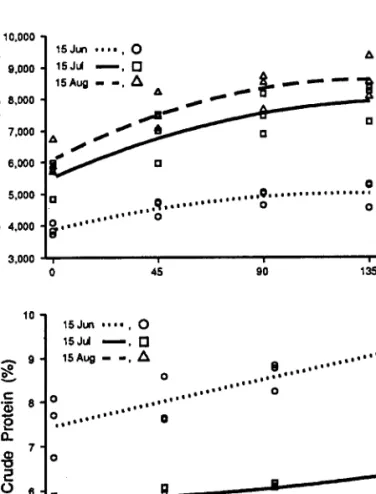
Mean unfertilized, first-cutting DM yield in our study ranged from 3,870 kg ha-’ on 15 June to 6,090 kg ha-’ on 15 August (Table 3, Fig. la). Dry matter yields in our study were high compared with a range in average yield of 1,500 to 3,400 kg ha-’ reported for unfertilized wetland meadows (Gomm 1978, Welty et al. 1981, Laughlin et al. 1984, Taylor et al. 1985). Relatively low yields.
reported for wetland meadows may be associated with differences in the length of growing season and species composition because most sites discussed in the literature are high elevation meadows.
Flooding characteristics can also affect the composition and rela- tive productivity of wetland plant species. Rumburg and Sawyer (1965) reported that yield of rushes (Juncus spp.) increased and yield of sedges (Curex spp.) and grasses decreased with increased depth and duration of flooding. Slender sedge (Carexpraegracilis W. Boott.) yield was greater in moist compared to saturated soils while reed canarygrass (Phaluri.s arundinaceu L.) was most pro- ductive in saturated soils (Gomm 1978). Garrison creeping foxtail is adapted to a wide range of habitats including sites favorable for reed canarygrass (Stroh et al. 1978). Garrison creeping foxtail may be more productive than native vegetation on sites with deeper
10
1 15J1.m 15Jti @“*, -. 0 0 0
A
I I
45 90
Nitrogen Fertilizer (kg ha -1)
Fig. 1. Initial harvest date by N fertilizer effects on first cutting DM yield (a) sod CP concentration (b).
180 JOURNAL OF RANGE MANAGEMENT 47(3), May 1994
floods or longer flood periods, typical of sites dominated by rushes.
Harvest Date X Fertilizer
Differences in herbage production from mid-June to mid- August increased as the level of applied N increased (Fig. la).
However, within fertilizer levels, dry matter yield was about 60% of peak standing crop on 15 June and about 90% on 15 July relative to the yield response on 15 August (Fig. la). At 0 kg N ha-’ the difference in yield between I5 June and 15 July was about 1,640 kg ha-’ compared with 2,930 kg ha-’ at 135 kg N ha-‘. Differences in yield between mid-July and mid-August were relatively small compared with the preceding 30-day period (Fig. la). Main effects associated with initial harvest date accounted for 55 to 77% af the total variance in the forage quality and yield of first cutting herbage and 34 to 91% of total variance in regrowth herbage. Dry matter yield response to N on 15 July was comparable to fertilizer effects on subirrigated sites reported by Nichols et al. (1990).
Relative to 15 August, 84 to 90% of the apparent uptake of applied N in herbage occurred by 15 June, but only 46% of the marginal dry matter yield response to fertilizer occurred by 15 June (Table 4). Percent of apparent N uptake on 15 July was 97 to 100%
Table 5. Regression models for IVDMD over a range of initial harvest dates (D=days after 15 June) for first cutting and regrowth herbap.
First Cutting Y = 56.78 - 0.2293 D, Rz = .97 Regrowth Y = 52.59 + 0.0963 D, R* = .76
regardless of fertilizer (Table 5). Crude protein concentration in herbage harvested on 15 June increased linearly from 7.5% at 0 kg N ha-’ to 9.1% at 135 kg N ha-’ (Fig. 1 b). In contrast, application of N had little effect on first cutting CP concentration on 15 July or 15 August (Fig. 1 b). Nichols et al. (1990) reported similar N effects on herbage from subirrigated meadow sites harvested from mid-July to early August. Use of N fertilizer to increase protein concentra- tion in mid- to late June herbage could be efficient even though half of the marginal yield responses to N had not occurred. Near maximum apparent uptake of applied N in herbage occurred by 15 June, first cutting dry matter yields were generally greater than 4,000 kg ha-‘, and regrowth produced twice as much yield after an initial harvest on 15 June comnared with 15 July. Early harvest Table 4. Estimated first cutting marginal DM yield response to N fertilizer would also provide forage with higher digestibility (Table 5).
on 15 June, 15 July, and 15 August on a wetland meadow at the
S pringapplied N had no effect on forage quality or yield of Gudmundsen Sandhills Laboratory, Whitman, Nebr. regrowth. Total yield from first cutting and regrowth herbage on unfertilized nlots was not different among initial harvest dates Initial harvest date
because of the relatively constant rate at which DM was produced after initial harvest.
N 15 Jun 15 Jul 15 Aug
Harvest Date X Year ---___---_-_(kghz“kg-‘N) ____________
45 14.4 27.1 31.2
First cutting dry matter yield increased from mid-June to mid- 90 11.5 22.4 24.9 August in both years, but the rate of increase was more rapid in
135 8.5 17.8 18.6 9,000 - (a) 0
relative to 15 August and ranged from 202 to 266 g kg-’ N at 135 -i 8 ooo and 45 N ha-‘, respectively. The average amount of apparent N r ’ uptake in herbage harvested from wetland meadow sites in this CJ, study on 15 July was about 13% greater than estimated uptake on Z 7,000 subirrigated sites reported by Nichols et al. (1990). Under dryland
conditions, N uptake in perennial grass herbage at the end of the p 5 6000 growing season generally accounts for less than 30% of the applied
;&+4
fertilizer N (Power 1988). Relatively large quantities of applied N g 5,000 - ra are often immobilized in root biomass on grasslands soon after
fertilization (Power 1986). A highly labile soil pool, probably r” / l<66
00
including microbial biomass, can also mineralize 50 to 100 kg N
%
4,000 - * ha-’ in a short period of time (Power 1988). Fate of N fertilizer has 0
not been reported for wetland meadows. 3,000 - I
Marginal yield responses ranged from 8.5 to 31.2 kg DM ha-’ 15 Jun 15 Jul 15Aug
kg-’ N over initial harvest dates and levels of applied N (Table 4). 10.0 - o(b) Clearly harvest date by fertilizer interactions have a measurable
effect on profitability of fertilization. The importance of this inter-
action on yield and quality has not been addressed in the economic ‘ii‘ 9.0 -
& g\
- assessment of meadow fertilization (Taylor et al. 1985, Clark et al.
1991). Mean marginal yield responses from a summary of high -5 6.0 elevation meadow trials reported by Taylor et al. (1985) were 5 similar to responses on 15 July at 45 kg N ha.‘, but progressively less as rates increased to 135 kg N ha-‘. Sedge dominated, prairie
n 7.0 meadows appear to be more responsive to high rates of N fertilizer $ ..::k-_
$ compared to high elevation meadows. Marginal yield responses to 45 kg N ha-’ for pure stands of Garrison creeping foxtail reported
~
by Power (1985) were intermediate between responses observed in 5.0 1
our study on 15 July and 15 August. 15 Jun 15 Jul
In contrast to reduced IVDMD on subirrigated sites in the same
15Aug
location (Nichols et al. 1990), N fertilizer had no effect on digesti- (0) (30) (00)
bility of herbage from wetland sites in this study. Percent IVDMD Initial Harvest (Days after 15 June) of first cutth3 herbage declined by about .24 Percentage Points
day-’ from about 57% on 15 June to 43% on 15 August each year,
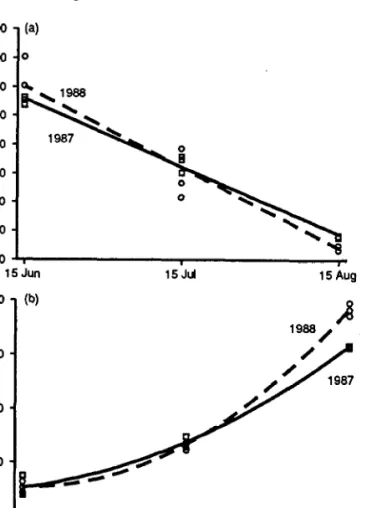
Fig. 2. Initial harvest date by year effects on first ~uttit~g DM yield (a) and CP concentration (b). The independent variable (D) Is the number of days after 15 June.
JOURNAL OF RANGE MANAGEMENT 47(3), May 1994 161
1988 than in 1987 (Fig. 2a). A prolonged period of high DM production in 1988 compensated for the spring delay in plant growth. While crude protein concentration declined more rapidly in 1988 than in 1987, relative differences between years decreased as the initial harvest date was delayed (Fig. 2b). Rumburg and Sawyer (1965) reported an increase in nitrogen content in early July harvested herbage with increasing depth and length of flood- ing. Based upon regression equations (Table 3) yield in 1988 increased to levels similar to 15 June 1987, on about 29 June and CP concentration declined to levels similar to I5 June 1987 on about 2 July (Fig. 2).
Initial harvest date by year interactions occurred in yield and protein concentration of regrowth herbage, but the relative magni- tude of these interactions was small. Regrowth DM yield decreased by about 39 kg in 1987 and 47 kg in 1988 for each day initial harvest was delayed from 15 June (Fig. 3a). Crude protein concentration in regrowth herbage increased as initial harvest date was delayed (Fig. 3b). Mean regrowth CP concentrations for 1987 and 1988
4,000 (a)
,^ 1
.I rm 3,500 9 3,000 - 2! 2,500 2 2,000 5 1,500 t:
cd 1,000 z
P 500 n
0
15 Jun 15Aug
15.0
7 b 13.0
.- ii 22 11.0 p.
3 2 9.0 0
7.0 J I
15Jun 15Jti 15Aug
(0) (30) (W
Initial Harvest (Days after 15 June)
Fig. 3. Initial harvest date by year effects on regrowth DM yield (a) and CP concentration (b) harvested in a second cutting on 22 September. The independent variable (D) is the number of days after 15 June.
were within 0.1 percentage point after initial harvests on 15 June and 15 July (Fig. 3b). Given the small amount of dry matter produced after an initial harvest of 15 August, differences in rela- tively high mid-August protein concentrations between years may be of little practical concern. Changes in regrowth protein concen- tration corresponded to visual differences in plant maturity.
Digestibility was not affected by differences in duration of spring flooding between years. First cutting IVDMD declined by about 2.0 percentage points for each 10 days delay in initial harvest from 15 June in both years (Table 5). Digestibility of regrowth herbage
increased by about 1.0 percentage point for each 10 days delay in initial harvest. The greater rate of change in first cutting IVDMD compared with regrowth IVDMD may have been caused by a greater range in plant maturity in first cutting herbage.
Fertilizer X Year
First cutting dry matter yields increased at a diminished rate as level of applied N increased in both years. However, marginal DM yield response to N was greater in 1988 with progressively larger relative increases for each 45 kg N ha-’ increment compared with 1987 (Fig. 4). It is unlikely that year by N interactions were caused
8.500 -
‘; - 8,000 - 0
2 7,500 2 7.000 f :fl%$#j&?
5 5.500 - 0
rm 5.000 - /
a 0
1987 -, q
6 i
4 4.500 8
1988 - -, 0
4,000 ’ 1 0
I
45 90
Nitrogen Fertilizer (kg ha -1)
Fig. 4. Nitrogen fertilizer by year effects on first cutting DM yield. The independent variable (N) is the rate of spring-applied N (kg N hi*).
by fertilizer carryover because spring-applied N had no effect on second cutting yield or forage quality in either year. The rate of DM production was greater in 1988 than in 1987 during the first and second 30day periods from mid-June to mid-August (Fig. 2a).
Thus, the greater rate of yield response to N in 1988 appears to have been associated with delayed plant maturity. Soil or air tempera- tures may have also been more favorable in I988 than 1987 (Siemer et al. 1972).
Conclusions
Forage quality, dry matter yield, and response to spring-applied N were similar for native wetland meadow vegetation and inter- seeded areas over a range of harvest dates. The primary difference in species composition between native and interseeded plots in our study was the dominance of sedges, a composite of 5 species, and the dominance of Garrison creeping foxtail. Sedge-dominated, prairie wetland meadow sites in this study were more productive than wetland meadows previously discussed in the literature.
Unfertilized dry matter yield and marginal yield responses to fertil- izer N were higher compared to high elevation wetland meadows.
Chemical suppression of sedge-dominated, native vegetation and interseeding Garrison creeping foxtail could not be economically justified under the conditions of this study.
Regression equations in this text can be used to select efficient combinations of initial harvest date and applied N, including no fertilizer, for wetland meadows similar to this study. Clearly, all possible combinations involve compromises in forage quality or yield. Harvest date by fertilizer interactions have a measurable effect on the profitability of fertilization. Crude protein concentra- tion and IVDMD data from this study provide important informa- tion for economic assessment. Forage quality and yield of regrowth herbage are also important economic considerations.
Harvest date decisions have the greatest potental to affect dry matter yield and protein concentrations of herbage between mid-
182 JOURNAL OF RANGE MANAGEMENT 47(3), May 1994
June and mid-July. Decisions during this 30-day period appear to be more economically important as the level of fertilizer N and/ or duration of spring flooding increase. Initially low levels of dry matter yield associated with prolonged spring flooding were com- pensated for by (1) delayed plant maturity, (2) rapid plant growth, and (3) increased marginal rate of yield response to fertilizer N.
Decisions for hay production should be based on nutritional requirements of livestock enterprises, total hay costs, and supple- mentation costs. Wildlife habitat requirements may involve visual obstruction, nutritional quality of forage, and time of availability.
Protein supplementation would be required to meet nutritional requirements of most classes of beef cattle when using first cutting hay harvested in mid-July or later from prairie wetland meadows similar to this study (NRC 1984). First cutting hay harvested by mid-June and fall grazed regrowth produced on meadows after a mid-June harvest date would generally meet maintenance and gestation requirements of dry cows. Regrowth after an initial harvest in mid-July or later would meet nutritional requirements of most classes of livestock, but provide half or less as much dry matter compared to regrowth after an initial harvest on 15 June.
Literature Cited
Anderson, B.E., K. Hladek, and R. Kanable. 1990. Certified perennial grass varieties recommended for Nebraska. Univ. Nebraska Coop. Ext.
Serv. EC90-120.
Association of Official Analytical Chemists. 1975. Official methods of analysis (12th ed.). AOAC, Washington, D.C.
Chantey, E., W. Elmore, and W.S. Platts. 1990. Livestock grazing on western riparian areas. US Gov. Print. Off. 775-443/21,661 Region 8.
Clark, R.T., J.T. Nichols, and K.M. Eskridge. 1991. Economic optimum fertilization rates for subirrigated meadow hay production, including values for hay quality. J. Prod. Agr. 4233-240.
Dodds, D.L., and E. Vasey. 1985. Forages for salt-affected soils. North Dakota State Univ. Coop. Ext. Serv. R-584 Rev.
Fairboum, M.L. 1982. Water use by forage species. Agron. J. 74:62-66.
Gomm, F.B. 1978. Growth and development of meadow plants as affected by environmental variables. Agron. J. 70:1061-1065.
Great Plains Flora Association. 1986. Flora of the Great Plains. T.M.
Barkley (ed.). Univ. Press of Kansas. Lawrence.
Laughlin, W.M., G.R. Smith, and M.A. Peters. 1984. Influence of N, P, and K fertilization on yield and mineral composition of native bluejoint grass on the lower Kenai Peninsula, Alaska. Agron. J. 76:389-397.
Marten, G.C., and R.F. Barnes. 1980. Prediction of energy digestibility of forages with in vitro rumen fermentation and fungal enzyme systems. p.
61-7 1. In: W.D. Pigden et al. (eds.) Standardization of analytical metho- dology for feeds. Int. Devel. Res. Cent., Ottawa, Can.
National Oceanic and Atmospheric Administration. 1988. Climatological data (Nebraska). Asheville, NC.
National Research Council. 1984. Nutrient requirements of domestic animals. No. 4. Nutrient requirements of beef cattle. 6th rev. ed. Nat.
Acad. Press, Washington, D.C.
Nichols, J.T., P.E. Reece, G.W. Hergert, and L.E. Moser. 1998. Yield and quality response of subirrigated meadow vegetation to nitrogen, phos- phorus, and sulfur fertilizer. Agron. J. 82:47-52.
Power, J.F. 1985. Nitrogen- and water-use efficiency of several cool-season grasses receiving ammonium nitrate for 9 years. Agron. J. 77: 189-192.
Power, J.F. 1986. Nitrogen cycling in seven cool-season perennial grass species. Agron. J. 78:681-687.
Power, J.F. 1988. Seasonal changes in smooth bromegrass top and root growth and fate of fertilizer nitrogen. Agron. J. 80~740-745.
Rumburg, C.B., and W.A. Sawyer. 1965. Response of wet-meadow vegeta- tion to length and depth of surface water from wild-flood irrigation.
Agron. J. 57~245-247.
Siemer, E.G., G.O. Boatwright, and C.B. Rumburg. 1972. Forage yield and forage quality on scattered mountain meadows. Colorado State Univ.
Exp. Sta. PR 72-15.
Snedecor, G.W., and W.G. Cochran. 1967. Statistical methods (6”h ed.).
Iowa State Univ. Press, Ames.
Stroh, J.R., J.L. MeWilliams, and A.A. Thomburg. 1978.‘Garrison’crccp- ing foxtail. SCS USDA, SCS-TP-156.
Taylor, D.T., W.J. Seamands, D.J. Menkhaus, J.J. Jacobs, and R.H.
Delaney. 1985. An economic analysis of N fertilization on intermountain hav meadows. Anron. J. 77: 17-20.
Welty, L.E., R.L. Anderson, R.H. Delaney, and P.F. Hensleigh. 1981.
Glyphosate timing effects on establishment of sod-seeded legumes and grasses. Agron. J. 73:813-817.
JOURNAL OF RANGE MANAGEMENT 47(3), May 1994 183
J. Range Manage.
47:184-191, May 1994
Sixty-one years of secondary succession on rangelands of the Wyoming High Plains
MARILYN J. SAMUEL AND RICHARD H. HART
Aurhors are former botanist and range scientist, USDA-ARS, 8408 Hildreth Road, Cheyenne, Wyo. 82009.
Samuel's present address is 1203 3rd Street E, Lehigh Acres, Flu. 33936. Send reprint request to Hart.
Abstract
The slow and uncertain rate of recovery of plant communities after severe disturbance is a major problem on rangelands. Earlier studies sketched the outline of secondary succession on mixed- grass prairie, but were based on 1 or 2 years of observation on different areas disturbed at different times in the past, or several years of observation of a single area. To provide a more complete picture of succession over decades, we began observations in 1977 on 4 areas disturbed from 1 to 51 years previously, and on undis- turbed areas of the same 2 soil types with and without grazing.
Observations continued for 11 years. Secondary succession pro- ceeded through the usual stages: annual forbs, perennial forbs and annual grasses, short-lived perennial grasses, and long-lived grasses.
Western wheatgrass [PascopyrumsmitAii(Rydb.) A Love] was an exception because it appeared much earlier and in much greater abundance than other long-lived perennial grasses. Blue grama [Bouteloua gradis (H.B.K.) Lag ex. Steud.] may be another exception; total recovery of this grass may require centuries. Time of appearance in succession seemed to be related to availability of propagules and ease of establishment; persistence of species was related to competitive ability. Abundance of many species fluctu- ated widely from year to year, but fluctuations did not appear to be related to precipitation. After 61 years, secondary succession had not returned plant communities to the climax state.
Key Words: competition, disturbed land, mixed-grass prairie, plant communities, revegetation, vegetation structure
Haug and VanDyne (1968) and Laycock (1991) reviewed studies of secondary succession on disturbed rangelands in the western US, but found few detailed studies of secondary succession on mixed-grass prairie similar to that on the Wyoming High Plains.
Judd and Jackson (1939) and Judd (1940) identified 4 stages of secondary succession on abandoned fields in Nebraska and Mon- tana: an annual weed stage, from 1 to 3 or more years after abandonment; a mixed annual-perennial stage on fields aban- doned 2 to 4 years; and a perennial grass and forb stage after 3 to 8 years preceded the fourth or climax stage, occurring as early as 8 years but usually requiring IO to 15 years. As length of cultivation increased, the time to reach each stage also increased. Small and narrow fields recovered more rapidly than large fields and fields adjacent to undisturbed prairie recovered more rapidly than those at some distance. Moderate grazing seemed to hasten recovery, while close grazing had the opposite effect.
Tolstead (I 94 I) identified similar stages in secondary succession on old fields in South Dakota’. In southern Alberta, on range
Manuscript accepted 9 Nov. 1993.
‘Nomenclature on older studies is sometimes outdated; our nomenclature follows Britton and Brown (1913), Hallsten et al. (1987) and Lackschewitz (1991).
184
where undisturbed vegetation was similar to that on Wyoming mixed grass prairie, cover of blue grama [Bouteloua gracilis (H.B.K.) Lag ex. Steud.] was less on abandoned and naturally revegetated sites than on comparable undisturbed sites, even after 56 years of secondary succession (Dormaar and Smoliak 1985).
On the shortgrass prairies of northeastern Colorado, Costello (1944) and Shantz (1917) identified 5 and 6 stages, respectively, in recovery of abandoned land. They concluded that the climax mixed prairie association may appear 20-25 years after abandon- ment but may require 40-50 years. Shantz (1917) studied narrow roads; sources of propagules were never more than a few meters away, and some propagules may have been present in the road when it was abandoned. Costello (1944) studied large fields, where propagules likely were destroyed by years of cultivation and sour- ces of new propagules were some distance away, depending on the size of the fields. Coffin and Lauenroth (1988), Glenn and Collins
(1992), and Samuel and Hart (1992) noted the importance of gap size and distance to seed sources in revegetation of disturbances on rangeland.
Reichhardt (1982) found that blue grama was the dominant species by 20 years after disturbance of shortgrass, and buffalo- grass [ Buchloe ductyloides (Nutt.) Engelm.] was co-dominant by 40 years after disturbance. Reichhardt considers that these grasses survived all through the years in which the fields were cultivated, and agrees with Costello (1944) and Hyder et al. (1971, 1975) that establishment of blue grama from seed under the present climatic conditions on shortgrass prairie is highly unlikely, for reasons presented by Briske and Wilson (1978) and Wilson and Briske (1979).
Most of the previous studies on mixed-grass and shortgrass prairie involved single observations of different fields disturbed at different times in the past, or repeated observations of a single field or of several fields all disturbed at approximately the same time. In 1976, Current (1978) identified 4 areas on the High Plains Grass- lands Research Station, northwest of Cheyenne, Wyo., from which vegetation had been removed at different dates in the past. These areas provided a unique opportunity to study secondary succession on land denuded from 0 to 50 years in the past. We followed secondary succession on these areas for 11 years, and linked the data from the 4 areas to compile a 61-year history of revegetation with gaps of only a few years. The technique is similar to that used in dendrochronology, in which many series of tree rings, each providing a record of growth response to climate for a few years or decades, are linked to provide a centuries-long climatic record (Bannister 1970). We also compared the vegetation under secon- dary succession to undisturbed and ungrazed vegetation on the same 2 soil types, and to undisturbed and grazed vegetation on one soil.
JOURNAL OF RANGE MANAGEMENT 47(3), May 1994