Munich Personal RePEc Archive
On the effects of static and
autoregressive conditional higher order
moments on dynamic optimal hedging
Hou, Yang and Holmes, Mark
School of Accounting, Economics and Finance Waikato Management
School University of Waikato, School of Accounting, Economics and
Finance Waikato Management School University of Waikato
17 October 2017
Online at
https://mpra.ub.uni-muenchen.de/82000/
On the effects of static and autoregressive conditional higher order
moments on dynamic optimal hedging
Yang (Greg) Hou
School of Accounting, Economics and Finance
Waikato Management School
University of Waikato
Private Bag 3105, Hamilton, 3240, New Zealand
Email-address: [email protected]
Telephone number: +64-7-8379402
and
Mark Holmes*
School of Accounting, Economics and Finance
Waikato Management School
University of Waikato
Private Bag 3105, Hamilton, 3240, New Zealand
Email-address: [email protected]
2
On the effects of static and autoregressive conditional higher order
moments on dynamic optimal hedging
Abstract
While dynamic optimal hedging is of major interest, it remains unclear as to whether incorporating higher moments of a return distribution leads to better hedging decisions. We examine the effects of introducing a bivariate skew-Student density function with static and autoregressive conditional skewness and kurtosis on dynamic minimum-variance hedging strategies. Static higher order moments improve reductions in variance and value at risk of hedged portfolios. The inclusion of dynamics through an autoregressive component extends these improvements further. These benefits avail for short and long hedging horizons, which is highlighted in the global financial crisis. The static and conditional higher order moments enhance the notion that the size and smoothness of hedge ratios positively relate to hedging effectiveness while volatility does the reverse. Improved effectiveness can be explained given an upgrade of size and smoothness and a downgrade of volatility of hedge ratios attributed to the dynamics of higher order moments.
1
The effects of static and autoregressive conditional higher order moments
on dynamic optimal hedging
1. Introduction
A departure from the normality of financial return distributions is widely acknowledged in
the literature, see for example Harvey (1995), Agarwal and Naik (2004), Brooks and Kat
(2002), Harvey and Siddique (2000), and Christie-David and Chaudhry (2001), among others.
Investors exhibit a preference for information on higher order moments, other than the mean
and variance of asset returns (Scott and Horvarth, 1980; Brook et al., 2012). Such a
preference is incorporated via pricing of systematic risk related to skewness (Kraus and
Litzenberger, 1976, 1983; Harvey and Siddique, 2000)1 and optimal asset allocation impacted
by kurtosis (Kallberg and Ziemba, 1983; Jondeau and Rockinger, 2006). A consensus has
almost been reached insofar as ignoring the effects of higher order moments on asset pricing
and portfolio management may lead to sub-optimal investment decisions (Brook et al., 2012).
The effect of higher order moments above the variance on hedging decisions has drawn
attention in the recent finance literature. The conventional determination of the optimal hedge
ratio (OHR), which is the optimal amount of futures contracts to employ per unit of the cash
asset to be hedged (Ederington, 1979), assumes that investors have a two-moment utility
function or that the distribution of asset returns is normal. Such an assumption is criticised
since return distributions are not normal and investors have additional aversions to negative
skewness and positive excess kurtosis (Levy 1969; Brooks et al., 2012). Hence hedging
strategies ignoring these facts might lead to sub-optimal hedging decisions (Brooks et al.,
2012).
1 Attempts on the incorporation of skewness are also made with respect to investment decisions (Hong et al.,
2
There is a small group of studies that incorporate the impact of higher order moments
into the optimal hedging. The focus thus far has been on minimum variance or maximum
utility hedging strategies that generate static OHRs. The effects of skewness and kurtosis of
returns of the hedged portfolio with volatility minimised have been taken into account by
Harris and Shen (2006) and Cao et al. (2009) where the OHRs comprising the hedged
portfolio are derived by a minimisation of value at risk (VaR) and conditional VaR (CVaR)
of the hedged portfolio. The effect of the third moment is addressed in minimum variance
hedging by Lien and Shrestha (2010) with a skew-normal distribution and Fu (2014) with a
multi-objective hedging model. In addition to this, Gilbert et al. (2006) focuses on a partial
equilibrium model allowing for skewness only in the hedger’s utility function to determine
OHRs. Brook et al. (2012) propose a more generalised utility-based framework that accounts
for all the moments of return distribution. The general message from these studies is that
using information based on moments higher than the variance lead to the better hedging
decisions involving the use of static OHRs.
A drawback associated with the static hedging strategy that it leads to sub-optimal
decisions in periods of high basis volatility. The reason is that the derivation of the static
OHRs ignores the dynamics between the cash and futures returns that are conditional on the
past information set. Hence one intuitively expects the OHRs to be time varying, which has
been extensively modelled for the minimum-variance hedging strategies by the multivariate
generalised autoregressive conditionally heteroscedastic (MGARCH) family of models (see,
e.g. Kroner and Sultan, 1993; Bera et al., 1997; Brooks et al., 2002; Baillie et al., 2007; Park
and Jei, 2010; Park and Kim, 2016). The derivation of the conditional OHRs substantially
depends on the multivariate probability density functions (PDF) of return distributions, the
logarithmic likelihood of which is maximised to obtain estimates of the MGARCH model. A
3
related to the dynamic optimal hedging since the multivariate return distributions are
non-normal (Engle and Gonzalez-Rivera, 1991; Bollerslev, 1987; Baillie and Bollerslev, 1989;
Susmel and Engle, 1994; Bauwens and Laurents, 2005). However, to our best knowledge,
there is little in the way of studies that have systematically explored this issue2.
In addition to this, it has been noted that higher moments above the variance can vary
over time (Nelson, 1996; Harvey and Siddique, 1999, 2000). When the time-varying feature
of skewness and kurtosis is modelled in an autoregressive manner, which is analogous to
heteroscedasticity, significant evidence is found for a variety of univariate non-normal
financial time series (Hansen, 1994; Harvey and Siddique, 1999; Jondeau and Rockinger,
2003; Brooks et al., 2005; Bali et al., 2008). Hence one would argue that neglecting the latent
effects of autoregressive conditional higher order moments on the optimal hedging might
result in sub-optimal hedging decisions. This issue, however, has not been tested in the
literature.
This paper provides a first study into the effects of the static and autoregressive
conditional third and fourth moments on the dynamic optimal hedging3. Data obtained for the
Standard & Poor (S&P) 500 cash and futures indexes are employed.
A key contribution of this paper is that it assesses whether incorporating the bivariate
skew-Student (SKST) return distributions with the static and conditional skewness and
kurtosis parameters into the dynamic minimum variance hedging strategies provides higher
hedging effectiveness than the same strategies under the assumption of normality. The SKST
density is chosen since it can simultaneously capture asymmetry and thickness of tails of a
joint distribution (Bauwens and Laurents, 2005). The dynamic hedging strategies proposed in
2 Park and Jei (2010) assess the hedging performance of several bivariate GARCH hedging strategies under
non-normality against the static ordinary least squares (OLS) hedging strategy. They find that the former can provide modest improvements over the latter.
3 This paper focuses on a short hedge. That is, a long position is taken using futures contracts to hedge against
4
this study are based on the estimation of the bivariate GARCH models specified as the
constant-conditional-correlation (CCC), dynamic-conditional-correlation (DCC), asymmetric
generalised dynamic-conditional-correlation (AGDCC) and BEKK models, which widely
estimated GARCH models. The hedging effectiveness of each strategy in light of variance
reduction (VR) and value at risk (VaR) reduction is computed and compared on a
horizon-by-horizon basis across the densities of normal, SKST, and SKST with autoregressive
conditional higher order moments distributions. This analysis is conducted for both a normal
time period and the period of the global financial crisis (GFC).
A second key contribution is that this study investigates how the dynamic OHRs are
affected by the static and autoregressive conditional higher order moments. On one hand, the
literature has found that a larger size and smaller volatility of dynamic OHRs contribute to
higher hedging effectiveness (e.g. Lien and Shrestha, 2007; Lai and Sheu, 2010; Park and Jei,
2010; Lien, 2010; Kim and Park, 2016). This study finds that taking into account the SKST
conditional densities with the static and autoregressive conditional higher order moments for
the dynamic hedging enhances this characteristic. Also, new evidence is provided where
those densities that support that the smoothness of OHRs positively relate to hedging
effectiveness4. This result enriches the knowledge on the relationship between hedge ratio
and hedging effectiveness. It is also found that the magnitude, volatility and smoothness of
the dynamic OHRs are significantly affected by the higher order moments. Both static and
conditional skewness and kurtosis contribute to an upper level of magnitude and smoothness
while at a lower level of volatility. This fact is firstly unveiled in the literature, serving as a
rationale for the improvements brought about by the higher order moments and their
time-varying feature given the relations between those properties of OHRs and hedging
effectiveness.
4 In this paper, smoothness of a time series is measured by the standard deviation of the first derivatives of this
5
The rest of the paper is organised as follows. Section 2 describes the methodology.
Section 3 describes the data and reports on the results. Concluding remarks are offered in
Section 4.
2. Methodology
2.1. Time-varying hedge ratios
The concept of minimum-variance hedging strategy is based on reducing the fluctuations
in the value of an unhedged position by utilising futures contracts. A portfolio comprised of
positions in cash asset and futures contracts is constructed with its variance minimised.
Suppose a portfolio consists of Cs units of a long cash position and Cf units of a short futures
position. Let St and Ft be the natural logarithms of cash and futures prices at the end of date t,
respectively. Then the return on the hedged portfolio over one day is shown as
Δ𝑉𝐻,𝑡 = 𝐶𝑠Δ𝑆𝑡− 𝐶𝑓Δ𝐹𝑡. (1)
where Δ𝑆𝑡 = 𝑆𝑡− 𝑆𝑡−1 and Δ𝐹𝑡= 𝐹𝑡− 𝐹𝑡−1 are the cash and futures returns at date t,
respectively.
The optimal hedge ratio (OHR) that minimises the variance of Δ𝑉𝐻,𝑡 is given by
ℎ∗ = 𝐶𝑓
𝐶𝑠 =
𝐶𝑜𝑣(Δ𝑆𝑡,Δ𝐹𝑡 |𝐼)
𝑉𝑎𝑟(Δ𝐹𝑡|𝐼) . (2)
where 𝐶𝑜𝑣(. ) is denote the unconditional covariance and 𝑉𝑎𝑟(. ) denotes the unconditional
variance. I is the available information set (Lien and Shrestha, 2007; Hou and Li, 2013). ℎ∗ is
referred to as the minimum-variance (hereafter referred to as MV) hedge ratio5.
5 The MV hedge ratio is for a short hedge. A long hedge with a portfolio consisting of C
s units of a short cash
position and Cf units of a long futures position has the same hedge ratio as a short one. The ratio for a short
6
It is well known that the second moment of financial data could be conditioned on the
past information set, which is extensively specified in an autoregressive conditional
heteroscedasticity (ARCH) or a generalised ARCH (GARCH) model (Engle, 1982;
Bollerslev, 1986). The GARCH family of models explain the phenomenon of volatility
clustering of financial returns where large and small observations are respectively influenced
by their lagged values. Analogously, the unconditional MV hedge ratio given by Eq. (2)
cannot remain static over time since it is estimated through variance and covariance of cash
and futures returns. Henceforth we have the time varying optimal hedge ratio as follows
𝛽𝑡 = 𝐶𝑜𝑣(𝛥𝑆𝑡,𝛥𝐹𝑡|𝐼𝑡−1)
𝑉𝑎𝑟(𝛥𝐹𝑡|𝐼𝑡−1) . (3)
where 𝐼𝑡−1 is the available information set up to date t-1. 𝛽𝑡 is conditioned on the information
set, 𝐼𝑡−1, which is determined by the conditional second moments of cash and futures returns.
Hence the MV hedge ratio can be time-varying.
The conditional mean of the cash and future returns is specified in a bivariate vector error
correction (VECM) model given the cash and future prices are potentially cointegrated. The
error terms of VECM follow the distribution as below
𝜀𝑡|𝐼𝑡−1~𝐹(0, 𝐻𝑡). (4)
where 𝐹 denotes a bivariate conditional distribution. 𝜀𝑡 is a 2×1 vector of the error terms. 𝐻𝑡
is a 2×2 conditional covariance matrix of innovations.
The conditional covariance matrix 𝐻𝑡 needs to be forecasted in order to obtain 𝛽𝑡. This
paper employs four specifications on bivariate GARCH models to predict the time varying
covariance matrix. The conditional variance and covariance series are forecasted in a
recursive process using the GARCH model estimates. In particular, the conditional variance,
7
correlation (CCC) (Bollerslev, 1990), dynamic conditional correlation (DCC) (Engle, 2002),
asymmetric generalised dynamic conditional correlation (AGDCC) (Cappiello, Engle, and
Sheppard, 2006), and BEKK (Engle and Kroner, 1995). The conditional optimal hedge ratios
are respectively obtained for these models. The CCC, DCC and AGDCC have EGARCH
variance processes that specify the conditional variance to be a non-linear function of the past
shocks and lagged own values. The positivity of the conditional variances is inherently
guaranteed due to the logarithmic setting. Hence no restrictions need to be imposed for
estimation of parameters. Meanwhile, given the EGARCH model for the individual
conditional variances, the positive definiteness of 𝐻𝑡 is assured. An appropriate alternative
may be the DCC model that models the correlation to be conditioned on the past. 𝐻𝑡. The
AGDCC model extends the DCC by capturing asymmetry in the conditional correlation, all
else being the same. A diagonal version of the AGDCC is used since it sufficiently reduces
the number of parameters that convey little information and thus alleviate the computation
burden of estimation process. The BEKK model specifies the conditional covariance matrix
of innovations in a way different from the CCC, DCC, and AGDCC models. It can guarantee
the positive definiteness of 𝐻𝑡 with very few restrictions on the model parameters. The
positivity of the conditional variances is inherently secured.
2.2. Flexible multivariate conditional distributions
This paper employs three multivariate probability density functions (PDFs) for the error
terms by which four bivariate GARCH models are estimated via the maximum likelihood
estimation (MLE). The innovations are henceforth assumed to respectively follow a bivariate
conditional normal distribution, a bivariate conditional skewed-Student (SKST) distribution
and a bivariate conditional skewed-Student (SKST) distribution with autoregressive
8
2.2.1. Conditional normal distribution
The logarithm of the PDF for 𝜀𝑡 following a bivariate conditional normal distribution is
shown as
𝑙𝑡(Θ) = −0.5{log(|𝐻𝑡|) + 𝜀′𝑡𝐻𝑡−1𝜀𝑡+ 2log (2𝜋)}. (5)
where 𝑙𝑡 denotes the contribution of observation t to the log-likelihood. 𝐻𝑡 is a conditional
covariance matrix of 𝜀𝑡, which is specified by the bivariate GARCH models. Θ is a vector of
parameters of the bivariate GARCH models.
Estimates of the parameter vector Θ are obtained by maximising the following
log-likelihood over the sample path
𝐿(Θ) = ∑𝑇𝑡=1𝑙𝑡(Θ). (6)
where T is the sample size.
2.2.2. Conditional skew-Student distribution
Although the bivariate normality of conditional distribution is widely applied to the
estimation of the bivariate GARCH models, sticking to it can lead to a large efficiency loss of
the estimator when the underlying conditional distribution is non-normal (Engle and
Gonzalez-Rivera, 1991; Park and Jei, 2010). This efficiency loss may impact the accuracy of
estimation results, thus affecting the forecasting ability of the bivariate GARCH models.
Indeed, the financial data series have been found to follow non-normal conditional
distributions where excess kurtosis and non-zero skewness exist. Returns distributions with
fat tails, corresponding to excess kurtosis, are widely observed in the literature (Bollerslev,
1987; Baillie and Bollerslev, 1989). Moreover, the distributions are often skewed and thus it
is necessary to take it into account for the estimation process (Park and Jei, 2010). Therefore,
9
is expected to escalate the predictive power of the bivariate GARCH models, thus improving
the estimation accuracy of the optimal hedge ratios (Susmel and Engle, 1994; Tse, 1999;
Bauwens and Laurents, 2005). It’s intuitive to believe that higher accuracy would lead to
higher hedging effectiveness.
We adopt the Bauwens and Laurents (2005) multivariate skew-Student (SKST) density for
the standardized innovations 𝜖𝑡, which applies the Fernandez and Steel (1998) skew filter to a
multivariate Student’s t distribution. The contribution of each observation at time t to the
log-likelihood of a standardized bivariate SKST density can be expressed in general term as
𝑙𝑡(Θ) = log(𝜋4) + ∑ log (1+ξ𝜉𝑖𝑠𝑖
𝑖 2)
2
𝑖=1 + log {Γ (𝑣+22 ) (Γ (⁄ 𝑣2) (𝑣 − 2))} − (1 2)⁄ (𝑣 +
2) log[1 + (𝜅𝑡𝑇𝜅𝑡) (𝑣 − 2)⁄ ], (7)
and
𝜅𝑡 = (𝜅1𝑡, 𝜅2𝑡)𝑇
𝜅𝑖𝑡 = (𝑠𝑖𝜖∗𝑖𝑡+ 𝑚𝑖)𝜉𝑖−𝐼𝑖
𝑚𝑖 =
Γ (𝑣 − 12 ) √𝑣 − 2 √𝜋Γ (𝑣2) (𝜉𝑖 −
1 𝜉𝑖)
𝑠𝑖2 = (𝜉𝑖2+𝜉1
𝑖2− 1) − 𝑚𝑖 2
𝐼𝑖 = {
1 if 𝜖∗
𝑖𝑡 ≥ −𝑚𝑠𝑖
𝑖
−1 if 𝜖∗
𝑖𝑡 < −𝑚𝑠𝑖𝑖
.
where i = 1, 2. The covariance matrix of 𝜖∗𝑖𝑡 (𝑖 = 1,2) is an identity matrix. Γ(. ) is the
gamma function. v is the degree of freedom controlling the thickness of tails of the
10
excess kurtosis. v is restricted to be larger than 2 in order that the covariance matrix exists. If
v goes to infinity, the Student t distribution approaches normality.
𝑚𝑖(𝜉𝑖, 𝑣) and 𝑠𝑖(𝜉𝑖, 𝑣) are the mean and standard deviation of the non-standardized
marginal skewed-t density of Fernandez and Steel (1998). 𝜉𝑖 is the skewness parameter of the
non-standardized marginal density where the sign of the logarithmic 𝜉𝑖 indicates the sign of
the skewness. When 𝑙𝑛𝜉𝑖 > 0 (< 0), the skewness is positive (negative) and density is
skewed to the right (left). And 𝜉𝑖2 is a measure of skewness of the marginal density.
Estimates of parameter vector Θ are obtained by maximizing Eqs. (6) and (7).
2.2.3. Conditional skew-Student distribution with autoregressive conditional skewness and kurtosis
The skewness and kurtosis parameters of the univariate conditional density for financial
returns are conditioned on the past. This feature has been modelled via an autoregressive
process by the literature and significant empirical results have been found (see, e.g., Hansen,
1994; Harvey and Siddique, 1999, 2000; Jondeau and Rockinger, 2003; Brooks et al., 2005;
Bali et al., 2008). In the spirit of Hansen (1994), Jondeau and Rockinger (2003), and Bali et
al. (2008), we model the conditional skewness of marginal densities and joint kurtosis of the
standardised bivariate SKST density as follows:
𝜉̃𝑖,𝑡 = 𝜉0𝑖+ 𝜉1𝑖𝜖𝑖,𝑡−1+ 𝜉2𝑖𝜉̃𝑖,𝑡−1. (8)
𝑣̃𝑡 = 𝑣0+ 𝑣1𝜖1,𝑡−1+ 𝑣2𝜖2,𝑡−1+ 𝑣3𝑣̃𝑡−1. (9)
where i = 1,2. Recall 𝜖𝑖𝑡 = 𝜀𝑖𝑡
√ℎ𝑖𝑖,𝑡 (𝑖 = 1,2) where 𝜀𝑖𝑡 is the error term and ℎ𝑖𝑖,𝑡 is the
conditional heteroscedastic process. 𝜉̃𝑖𝑡 is the unrestricted skewness parameter and 𝑣̃𝑡 is the
11
skewness parameter to be positive and the degrees of freedom to exceed 2, we impose the
following logistic transformation in the estimation procedure:
𝜉𝑖𝑡 = exp (𝜉̃𝑖𝑡),
𝑣𝑡 = exp(𝑣̃𝑡) + 2.
where exp(.) denotes the exponential function. Hence the parameters in the Eqs. (8) and (9)
are estimated without constraints.
Estimates of the parameter vector Θ that contains the coefficients of the bivariate
GARCH models and those of Eqs. (8) and (9) are obtained by the maximization procedure
applied to Eqs.(6) and (7). Since the SKST density with autoregressive conditional skewness
and kurtosis parameters is more generalized than the other two, it is expected to improve the
estimation accuracy of the time varying MV hedge ratios and thus yield higher hedging
effectiveness.
2.3. Measurement of hedging effectiveness
We employ two methods to measure hedging effectiveness. The first one is based on
variance reduction (VR) which is extensively applied in the literature. VR is a ratio of the
difference between the variances of returns of an unhedged position and a hedge portfolio
over the variance of returns of the unhedged position. Denoting Δ𝑆𝑡 as returns of an
unhedged position and Δ𝑉𝐻,𝑡 as returns of a hedge portfolio, VR can be calculated as
𝐻𝐸𝑉𝑎𝑟𝑖𝑎𝑛𝑐𝑒 = 1 −𝑉𝑎𝑟(∆𝑉𝐻,𝑡)
𝑉𝑎𝑟(∆𝑆𝑡) . (10)
where Var(.) denotes variance. 𝐻𝐸𝑉𝑎𝑟𝑖𝑎𝑛𝑐𝑒 refers to hedging effectiveness in terms of variance reduction.
This paper assumes a continuous hedging strategy for a hedger. A hedger starts to hedge
12
stops at date t+k. Then the hedger can then start another round of hedging at date t+k. The
second round ends at date t+2k. Then a third round may begin and so on. Multiple rounds of
the hedge continue until the date t+mk where m is a positive integer if the hedger does not
stop his/her strategy. The continuous hedging strategy makes sense for a hedger in the market
since one has to stick to one particular hedged position till the horizon ends. Note that the
setting of a continuous hedging strategy requires k-day non-overlapping differencing to
obtain returns of unhedged and hedged positions. The non-overlapping differencing would
result in a small sample size when k takes large values. Hence the choice of k, i.e., the length
of a hedging horizon, depends on the sample size of the sample period used to calculate the
hedging effectiveness6.
We calculate hedging effectiveness of the time varying hedge ratios forecasted by the four
bivariate GARCH models under each conditional probability density for multiple hedging
horizons. Note since the conditional hedge ratio is updated daily based upon the information
of the previous day, its behaviour is independent of the length of hedging horizon. Denoting
the conditional hedge ratio as 𝛽𝑡−1 at date t-1 when a hedge portfolio is constructed, the
portfolio returns at date t can be written as
Δ𝑉𝐻,𝑡 = Δ𝑆𝑡− 𝛽𝑡−1Δ𝐹𝑡. (11)
Then the returns over a k-day hedging horizon are expressed as
∆𝑘𝑉𝐻,𝑡+𝑘 = ∑𝑘𝑛=1∆𝑉𝐻,𝑡+𝑛. (12)
where ∆𝑘𝑉𝐻,𝑡+𝑘 denotes the returns over k days of a hedge portfolio starting from date t. The
variance reduction for a k-day hedging horizon is calculated by
𝐻𝐸𝑣𝑎𝑟𝑖𝑎𝑛𝑐𝑒,𝑘 = 1 −𝑉𝑎𝑟(∆𝑘𝑉𝐻,𝑡+𝑘 )
𝑉𝑎𝑟(∆𝑘𝑆𝑡+𝑘 ) . (13)
13
where Δ𝑘𝑆𝑡+𝑘 = 𝑆𝑡+𝑘− 𝑆𝑡 is k-day returns of the unhedged position.
The variance reduction examines the effect of hedging on the second moments of returns
distribution. It is also interesting to investigate how a hedging strategy affects the third and
fourth moments of returns distribution. The effect reflects to what extent the hedging reduces
risks attributed to the tail behaviour. We use value at risk (VaR), which estimates the
maximum portfolio loss over a given time span at a given confidence level (Harris and Shen,
2006; Cotter and Hanley, 2006; Lai and Sheu, 2010; Conlon and Cotter, 2012). The VaR at
confidence level α is
𝑉𝑎𝑅𝛼 = −𝑞𝛼. (14)
where 𝑞𝛼 is the negative of the αth percentile of the realisations on returns. The effectiveness
in terms of VaR reduction for a k-day hedging horizon is then calculated as
𝐻𝐸𝑉𝑎𝑅,𝑘 = 1 −𝑉𝑎𝑅𝛼(∆𝑘𝑉𝐻,𝑡)
𝑉𝑎𝑅𝛼(∆𝑘𝑆𝑡) . (15)
where 𝑉𝑎𝑅𝛼(∆𝑘𝑉𝐻,𝑡) and 𝑉𝑎𝑅𝛼(∆𝑘𝑆𝑡) are the VaR of the k-day returns of the hedge portfolio and unhedged position at confidence level α, respectively.
The effect of the higher moments of a joint return distribution on a MV hedging strategy is
attributed to the fact that the third and fourth moments of the hedged portfolio are a function
of the optimal hedge ratio constructing that portfolio7. Hence, it is expected that the higher
accuracy of estimating the optimal hedge ratio by a model results in the higher accuracy of
capturing the skewness and kurtosis of the hedge portfolio returns. And thus the higher VaR
reduction can be realised by that model.
Since a hedging strategy has to be implemented ex-ante, this paper calculates the
out-of-sample hedging effectiveness for the time-varying MV hedge ratios. The in-out-of-sample model
14
estimates on the bivariate GARCH models are obtained first. These estimates are used to
forecast the out-of-sample conditional covariance matrix of innovations following a recursive
procedure. The conditional hedge ratios are derived based upon the forecasted conditional
variance and covariance. The returns of hedge portfolio are computed using the forecasted
series of conditional hedge ratios. Finally the hedging effectiveness for different hedging
horizons is calculated.
3. Empirical results
3.1. Data and preliminary tests
This paper conducts an empirical analysis of the S&P 500 index futures contracts traded
on the Chicago Mercantile Exchange (CME). These series represent highly liquid cash and
futures markets and possess a long returns history. The daily closing (settlement) prices of the
cash (futures) are collected from Datastream. The sample period runs from July 1, 1982 to
March 31, 2009, which covers the period of global finance crisis (GFC)8. In order to obtain a
continuous price series of the most liquid futures contracts, contracts at the nearest month are
selected. Trading volumes of the nearest and the second nearest contracts are compared at the
contract month. The nearest contract is switched to the next nearest when the volume of the
former is exceeded. After matching the data of cash and futures prices, we end up with 6979
observations for the whole sample.
The out-of-sample hedging effectiveness is examined for two subsample periods. To
examine hedging effectiveness for a tranquil period, the subsample path before the GFC from
July 1, 1982 to September 28, 2007 is chosen where the in-sample estimation period is from
July 1, 1982 to June 30, 1997 (with 3913 observations) and the out-of-sample forecasting
period is from July 1, 1997 to September 28, 2007 (with 2674 observations). We refer to
15
these two subsamples as Period I and Period II respectively. To examine hedging
effectiveness during the crisis, the full sample path is used where the in-sample estimation
uses the subsample from July 1, 1982 to September 28, 2007 (with 6587 observations) and
the out-of-sample forecasting is done for the subsample from October 1, 2007 and March 31,
2009 (with 392 observations). We refer to these two subsamples as Period III and Period IV
respectively.
Given the sample sizes of Periods II and IV, the numbers of hedging horizons are
chosen to be 9 and 6 days for the calculation of the out-of-sample hedging effectiveness for
the time varying optimal hedge ratios. That is, there are 9 horizons for the analysis on Periods
I and II and 6 horizons for the analysis on Periods III and IV. The reason is that the chosen
number of horizons assures enough observations to compute the out-of-sample hedging
effectiveness for the hedge ratios under question. Henceforth, we have 9 k-day hedging
horizons associated with Periods I and II where k = 1, 2, 4, 8, 16, 32, 64, 128, 256,
respectively. Meanwhile, 6 k-day (k = 1, 2, 4, 8, 16, 32) hedging horizons associate with
Periods III and IV given the small sample size of Period IV. The choice on values of k
enables us to examine the hedging effectiveness as the length of horizon doubles. By doing
this, the effectiveness of short horizons (when k = 1, 2, 4, 8, and 16) and long horizons (when
k = 32, 64, 128 and 256) is simultaneously shown.
As mentioned earlier, we obtain model estimates using samples of Periods I and III and
forecast the ratio series using samples of Periods II and IV. The effectiveness of those ratio
series is computed for 9 horizons corresponding to Period II and 6 horizons corresponding to
Period IV. Cash and futures daily prices are in natural logarithm form. Daily returns are
calculated as the first differences of log prices. The k-day non-overlapping differencing is
used to calculate k-day returns for cash and hedged portfolio for k-day hedging horizons. This
16
[Insert Table 1 about here]
The descriptive statistics of daily returns is shown in Table 1. While the means and
standard deviations of cash and futures returns are similar across the tranquil sub-periods, the
GFC period differs where the mean is negative and standard deviation almost double. This
confirms a market downturn and increased volatility during the GFC. Cash and futures
returns are left-skewed in all the tranquil sub-periods. The exception is that the futures returns
are right-skewed during the GFC reflecting a large probability of negative extreme values of
futures returns during this period. An excess kurtosis is revealed for both cash and futures
returns for all the sub-periods, revealing the fat-tailed nature of returns distributions.
Asymmetries and a large thickness of tails are non-negligible for returns distributions given
that all the skewness and kurtosis coefficients are statistically significant (except skewness of
cash returns in the GFC). The JB test results confirm the non-normality of asset returns,
which will be taken into account by the SKST density function. Moreover, autocorrelation
and heteroscedasticity characteristics of asset returns are verified by the Ljung-Box test given
the significant Q test statistics. These are explored further through estimation of a bivariate
VECM-GARCH model9.
3.2. Static and conditional skewness and kurtosis
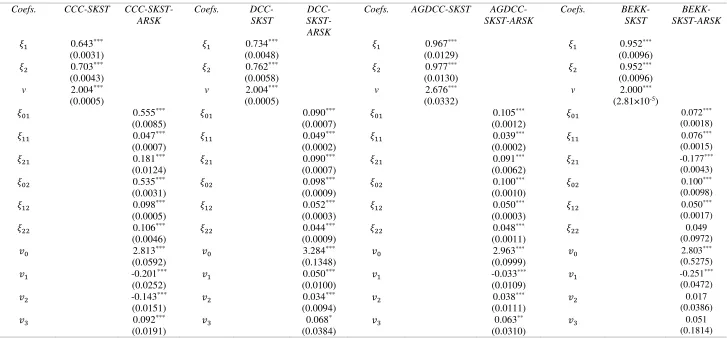
Estimates of static parameters for skewness and joint kurtosis in a bivariate SKST
density are reported in Table 210. All the estimates are statistically significant across the
GARCH models, verifying the asymmetry and fat-tailed nature of joint distribution of cash
and futures returns. The logs of skewness parameters 𝜉1 and 𝜉2 are both negative, aligning
with the result in Table 1 that the cash and futures returns of Period I are both negatively
9
ADF and PP confirmed that the log index cash and log futures prices are first difference stationary for all the subsamples. Johansen cointegration testing confirmed that the cash and futures prices are cointegrated for the same sub-periods.
10 In the interests of brevity, results on the CCC, DCC, AGDCC and BEKK GARCH models are not reported
17
skewed. The degree of freedom approaches 2, suggesting a large extent of thickness of tails.
It is consistent with the high measure of the fourth moments of cash and futures returns in
Table 1.
[Insert Table 2 about here]
In terms of the autoregressive processes associated with the skewness of marginal
densities and joint kurtosis, the estimates of 𝜉11, 𝜉21, 𝜉12 and 𝜉22 are all significant across the
GARCH models except 𝜉22 by the BEKK model. The skewness of cash (futures) returns is
conditioned on the past shocks and its own lagged values. The result confirms the
autoregressive behaviour of degree of asymmetry. Moreover, the signs of 𝜉11, 𝜉21, 𝜉12 and
𝜉22 are positive, which is also the case with the CCC, DCC, and AGDCC models. Also, 𝜉11
and 𝜉12 are positive for the BEKK model. The positive autocorrelation of third moment of the
S&P 500 cash market is qualitatively consistent with the findings by Jondeau and Rockinger
(2003) with regard to the same market, and with Bali et al. (2008) on the CRSP
value-weighted index. An exception is the negative 𝜉21 attached with the BEKK, suggesting a
negative autocorrelation of cash skewness. The result differs from Jondeau and Rockinger
(2003) and Bali et al. (2008); however, it follows the finding by Harvey and Siddique (1999).
The dynamics of the degree of freedom parameter is revealed by significance of 𝑣1, 𝑣2
and 𝑣3 despite insignificant estimates of 𝑣2 and 𝑣3 under the BEKK model. The result
suggests the thickness of tails of the joint distribution of cash and futures markets hinges not
only on the past shocks arising from the two markets but on its lagged own behaviour. Most
of the estimated models agree that the joint kurtosis negatively relates to the past cash shocks
but positively relates to the past futures shocks as well as its lagged own values. A significant
positive autocorrelation of the joint kurtosis consists with the previous findings on the
18
2005; Bali et al., 2008). Overall, Table 2 reveals the existence of conditional autoregressive
processes for skewness and kurtosis parameters in a bivariate density of asset returns11.
3.3. A comparison of hedging effectiveness
We examine two aspects of the effects of the static and conditional higher order moments
on hedging effectiveness of the conditional optimal hedge ratios. First, we examine how
hedging effectiveness differs across densities under each GARCH model. Second, the
question how the best-performed GARCH model varies across densities is addressed. The
out-of-sample hedging effectiveness of the conditional optimal hedge ratios for a normal
period (i.e. Period II) and a crisis period (i.e. Period IV) is shown horizon-by-horizon in
Table 3 and Table 4, respectively. Note that Period IV is a period of global finance crisis
(GFC).
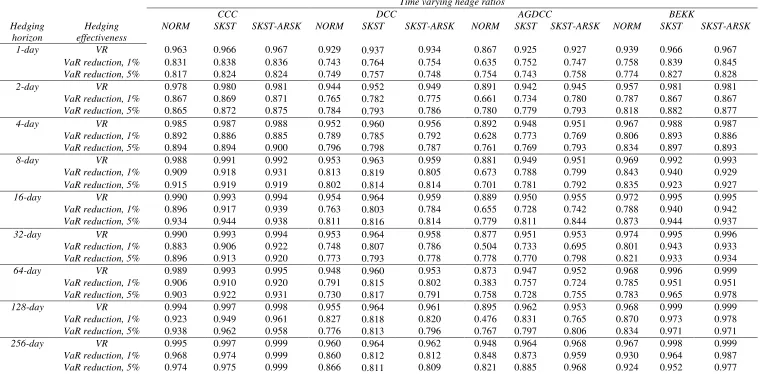
[Insert Table 3 about here]
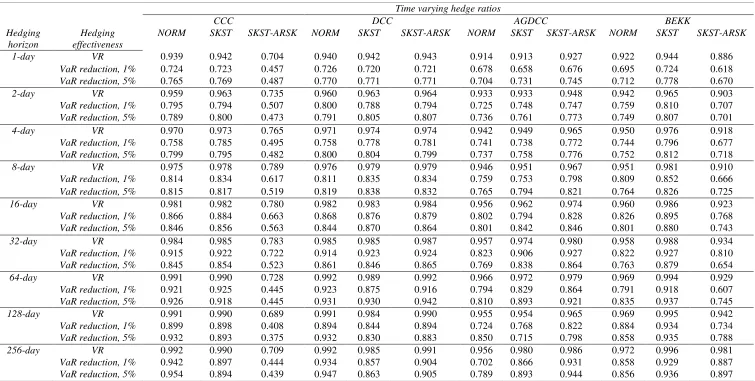
In Table 3 under the CCC GARCH model, the SKST density provides the best variance
reduction in 6 out of 9 horizons most of which have short length. Regarding the reduction in
tail risk, the SKST density still performs better than the other two, providing the highest VaR
reduction in 5 out of 9 horizons at both 1% and 5% confidence levels. However, we do not
find evidence that the SKST density with autoregressive skewness and kurtosis parameters
provides benefit for hedging effectiveness under the CCC model. The result from the BEKK
model is similar to that for the CCC. The SKST density performs best in terms of both
variance reduction and VaR reduction in all the horizons. It also can be seen that the SKST
density with autoregressive skewness and kurtosis parameters beats the normal counterpart
for the longest hedging horizon in terms of both variance reduction and VaR reduction.
11 The results from Period III are qualitatively similar to those of Period I. To save space, those results are not
19
Evidence is found under the DCC and AGDCC models in Table 3 that the SKST density
with autoregressive skewness and kurtosis parameters benefits hedging effectiveness for the
conditional optimal hedge ratios. Under the DCC model, the SKST density with
autoregressive skewness and kurtosis parameters performs best in 6 out of 9 horizons in terms
of variance reduction. The performance of the same density in terms of VaR reduction is best
for 3 horizons at 1% and 4 horizons at 5% confidence levels, respectively. An increasing
trend of hedging effectiveness is found for 6 out of 9 horizons across the densities of normal,
SKST, and SKST with autoregressive higher order moments. Most of those horizons are
short ones, ranging from 1-day to 32-days.
The result from the AGDCC model provides stronger evidence. The SKST density with
autoregressive skewness and kurtosis parameters produces the best variance reduction in all
the horizons. It provides the best VaR reduction for 8 horizons at both 1% and 5% confidence
levels. Those horizons range from short to long periods. For all the horizons, hedging
effectiveness increases across the densities of normal, SKST and SKST with autoregressive
asymmetry and thickness of tails.
On average, compared with the normal density, the SKST density increases variance
reduction by around 0.84%. It also increases VaR reduction at 1% and 5% confidence levels
by 2.24% and 2.09%, respectively. The SKST density with autoregressive skewness and
kurtosis parameters further increases variance reduction by 0.68% than the SKST density.
The former increases VaR reduction at 1% and 5% confidence levels by 2.53% and 2.08%
than the latter, respectively.
If we examine how the best-performing model varies across the different densities, the
DCC model performs best for most of hedging horizons under the normal density. When we
20
is true for almost all the horizons. However, when the autoregressive asymmetry and
thickness of tails are taken into account, the DCC model performs best again for all the
horizons. The result implies that the DCC models are seemingly the optimal choice for the
dynamic minimum-variance hedging. It should be cautious that the result is not stable as the
best-performed model varies across different assumptions on the shape behaviour of returns
distribution.
[Insert Table 4 about here]
Regarding the effects of higher order moments on the conditional optimal hedge ratios,
the results for the GFC period are shown in Table 4. A monotonic growth of both variance
and VaR reductions is evident across the different density functions using the CCC, DCC,
and AGDCC models, and is the case for most of the hedging horizons. Under each GARCH
model, the normal density is dominated by the other two density functions for most hedging
horizons. Under the BEKK model, an increase of hedging effectiveness is valid only for 2
horizons. However, the SKST density still performs best, which is evidenced in 4 out of 6
hedging horizons. In addition, the SKST density with autoregressive skewness and kurtosis
parameters outperforms normality for all the horizons.
On average, it is found that the SKST density function can improve variance reduction
by around 3.11% than the Normal counterpart. The former also increases VaR reduction by
6.99% and 6.10% at the 1% and 5% confidence levels over the Normal, respectively.
Compared with the static higher order moments, the autoregressive cases further increase
variance reduction by 0.80%, VaR reduction at 1% level by 2.69% and VaR reduction at 5%
level by 2.46%, respectively. This result indicates the benefit of incorporating the
autoregressive behaviour of higher order moments on hedging performance of dynamic
21
period. Hence the conditional higher moments are helpful for improving the quality of risk
management in light of volatility minimisation and tail risk reduction, especially during a
crisis period.
Table 4 reports a different result for the variation of the best-performing model across
densities than that reported in Table 3. The best model under normality is the CCC in terms
of both variance and VaR reductions for all the horizons. BEKK performs best when the
SKST density is employed. The best performance of the BEKK model is evident for most of
horizons. However, when allowing the higher order moments to be autoregressive, we find
DCC performs best for relatively short horizons (1-day, 2-day, 4-day, and 8-day) whereas
BEKK performs best for relatively long ones (16-day and 32-day). Thus, the variation of the
best-performed model across densities during GFC is more substantial than during a normal
period. Our result suggests that the BEKK and DCC models might be rational choices on the
dynamic minimum-variance hedging strategies during a crisis period. However, it should be
kept in mind that the pattern of returns distribution has an impact on those choices. Such
impact is valid irrespective of when the hedging activities take place.
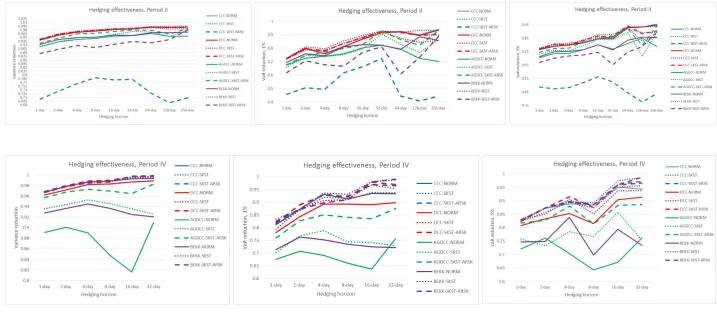
[Insert Figure 1 about here]
Figure 1 indicates that when the hedging horizon increases, most hedge ratio series
exhibit a growing trend of hedging effectiveness which is roughly monotonic. The growth of
hedging effectiveness along with an increase of hedging horizon in length is witnessed for
both normal and crisis periods, which is consistent with previous studies (e.g. Ederington,
1979; Geppert, 1995; Chen et al., 2004; Lien and Shrestha, 2007; Lai and Sheu, 2010).
Moreover, we can consistently observe from the figure that the conditional hedging ratios
derived from the densities with the static and conditional higher order moments possess lines
22
3.4. Relations between hedge ratio and hedging effectiveness
In this subsection we examine how the relations between several statistical properties of
the conditional hedge ratios and hedging effectiveness differ across different conditional
densities. The statistical properties of the conditional hedge ratios under question include the
mean, standard deviation, smoothness of ratio series and smoothness of standard deviation.
Note the latter three properties contribute towards explaining the stability of series of
conditional hedge ratios. The smoothness of ratio series is measured by the standard deviation
of the partial first derivatives of hedge ratios over time. Likewise, we use the standard
deviation of the partial first derivatives of hedge ratios’ standard deviation over time as a
proxy for the smoothness of ratio standard deviation12. Note that the standard deviation of the
partial first derivatives measures the average dispersion of changes of the time series over
time. If the standard deviation equals zero, the change is fixed and the series is a linear
function of time. Hence one intuitively expects that the lower the standard deviation, the
higher the series’ smoothness. The properties of the conditional hedge ratios for both Period
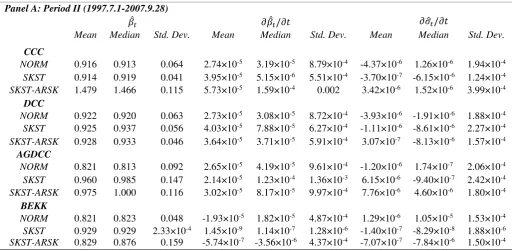
II and Period IV are summarised in Table 5.
[Insert Table 5 about here]
We examine whether the conditional hedge ratios derived by the best
(worst)-performed hedging model under each density possess the shortest (longest) distance of the
mean to unity, the smallest (largest) standard deviation, the highest (lowest) ratio smoothness
and the highest (lowest) smoothness of ratio standard deviation. Evidence is revealed for
Period II and Period IV, respectively.
12 The partial first derivative over time is an estimate of coefficient of the time trend in a regression model
23
We find from Period II that the best model under normality, i.e. the DCC model, yields
ratios the mean of which is closest to unity. However, they have the second smallest standard
deviation and second highest smoothness of ratios and standard deviation. The situation gets
better when moving to the SKST density where the ratios generated by the best model under
that density (BEKK model) possess the smallest standard deviation and highest smoothness
of ratios and standard deviation. However, the SKST density with autoregressive higher order
moments only confirms that the best model produces the least volatile ratio series. The
argument that the ratios that are closest to unity have the best performance is not supported
by the densities with static and conditional higher order moments.
The results concerning the properties of ratios derived by the worst models are clearer.
Staying with Period II, the worst model under normality (CCC model) produces the ratios
with the longest distance of mean to unity, smallest standard deviation and lowest smoothness
of ratio and standard deviation series. The finding is confirmed by the densities with static
and conditional higher order moments. Thus, results from Period II reveal that the SKST
density reinforces the fact of a positive relation between stability of hedge ratios and hedging
effectiveness than the normal counterpart.
The results from Period IV reinforce these findings. Results based on all the density
functions concur that the ratio series with its mean closest to unity has the best effectiveness.
Only the SKST density function finds that the worst performance relates to the longest
distance of the mean from unity. The Normal and SKST density function with autoregressive
higher order moments supports the case that the least (most) volatile ratios with highest
(lowest) smoothness are best (worst) performing. The SKST density function with
autoregressive higher order moments further finds that the highest (lowest) smoothness of
standard deviation of ratios series contributes to the best (worst) hedging effectiveness. In
24
higher stability of hedge ratios leads to better hedging effectiveness. The result enhances the
findings by the previous studies on the relationship between conditional hedge ratio and
hedging effectiveness (e.g. Park and Jei, 2010; Lien, 2010; Hou and Li, 2013; Kim and Park,
2016).
[Insert Figure 2 about here]
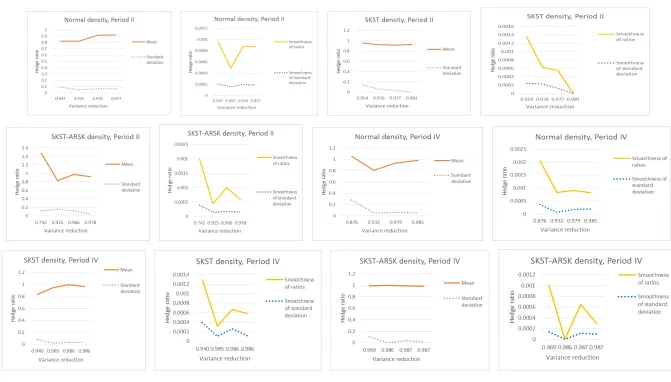
The relations between different statistical properties of hedge ratios and average hedging
effectiveness over all the hedging horizons are plotted in Figure 213. The figure shows how
those properties change with average hedging effectiveness across the GARCH models under
each density function. As can be seen from the figure, the average hedging effectiveness
increases as the hedge ratio means approach unity. This is for all densities in both Period II
and Period IV. The volatility of ratio series appears negatively related to hedging
effectiveness where the lower the volatility, the better the effectiveness. In addition, there are
rough downward trends for the standard deviations of the partial first derivatives of the ratios
series and their standard deviations over time, and the average hedging effectiveness. The
downward trends indicate a positive relationship between the smoothness of ratio series and
volatility and hedging effectiveness. We find those trends are more highlighted under the
SKST densities with static and autoregressive higher order moments despite some of them
not being monotonic. Indeed, so is the negative relation between volatility and hedging
effectiveness. The result based on the analysis of the average hedging effectiveness is
consistent with that based upon the best (worst) performed hedging models.
3.5. Hedge ratio and higher order moments
The effects of higher order moments on the statistical properties of conditional hedge
ratios are further explored in this subsection. Those effects are qualitatively described by
13 The properties are plotted against variance reduction in the figure. The plots with VaR reduction on the X axis
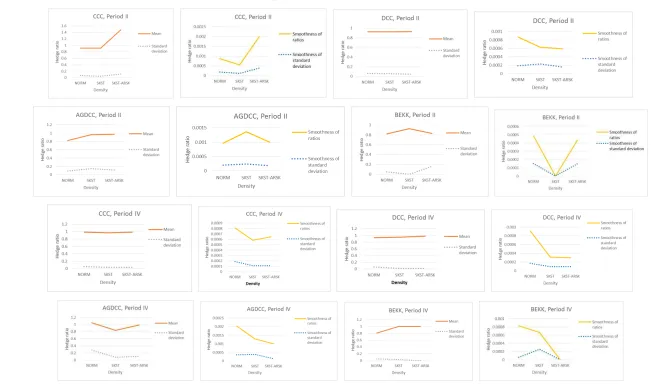
25
Figure 3. This figure depicts how the mean, standard deviation, smoothness of ratio series
and their standard deviations vary across different densities under each GARCH model. As
mentioned earlier, smoothness is measured by the standard deviation of the partial first
derivatives of time series over time.
[Insert Figure 3 about here]
As can be seen from the figure, there is an upward trend in the mean for 6 out of 8 plots.
The mean normally converges to unity. It suggests that taking into account the static and
conditional higher order moments may monotonically increase the mean of hedge ratios when
it is below 1. The standard deviation of ratios moves continuously downward when the
densities with the static and conditional higher order moments are chosen. It is confirmed in 5
out of 8 plots. Moreover, a monotonic downward trend of standard deviations of the partial
first derivatives of ratios and their standard deviations over time is respectively detected by 5
and 6 out of 8 plots when moving across the X axis from left to right. It suggests smoothness
of series may be consistently enhanced by higher order moments and their autoregressive
feature.
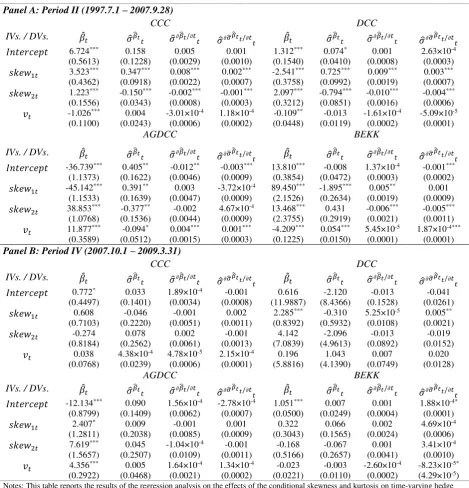
To explore the quantified effects, we estimate the following equations:
𝛽̂𝑡 = 𝑖𝑛𝑡𝑒𝑟𝑐𝑒𝑝𝑡 + 𝛼1𝑠𝑘𝑒𝑤1𝑡 + 𝛼2𝑠𝑘𝑒𝑤2𝑡 + 𝛼3𝑣𝑡+ 𝑒𝑡,
𝜎̂𝛽̂𝑡𝑡= 𝑖𝑛𝑡𝑒𝑟𝑐𝑒𝑝𝑡 + 𝛽1𝑠𝑘𝑒𝑤1𝑡 + 𝛽2𝑠𝑘𝑒𝑤2𝑡 + 𝛽3𝑣𝑡+ 𝑒𝑡,
𝜎̂𝜕𝛽̂𝑡/𝜕𝑡𝑡= 𝑖𝑛𝑡𝑒𝑟𝑐𝑒𝑝𝑡 + 𝛾1𝑠𝑘𝑒𝑤1𝑡 + 𝛾2𝑠𝑘𝑒𝑤2𝑡 + 𝛾3𝑣𝑡+ 𝑒𝑡,
𝜎̂𝜕𝜎̂𝛽̂𝑡𝑡/𝜕𝑡𝑡 = 𝑖𝑛𝑡𝑒𝑟𝑐𝑒𝑝𝑡 + 𝛿1𝑠𝑘𝑒𝑤1𝑡 + 𝛿2𝑠𝑘𝑒𝑤2𝑡 + 𝛿3𝑣𝑡+ 𝑒𝑡. (16)
where 𝛽̂𝑡 denotes the estimated conditional optimal hedge ratios; 𝜎̂𝛽̂𝑡𝑡 represents the series of
26
deviations of 𝜕𝛽̂𝑡/𝜕𝑡 and 𝜕𝜎̂𝛽̂𝑡𝑡/𝜕𝑡, respectively. 𝜕𝛽̂𝑡/𝜕𝑡 and 𝜕𝜎̂𝛽̂𝑡𝑡/𝜕𝑡 are the partial first
derivatives of 𝛽̂𝑡 and 𝜎̂𝛽̂𝑡𝑡 over time, respectively. Time variation of 𝜎̂𝜕𝛽̂𝑡/𝜕𝑡𝑡 and 𝜎̂𝜕𝜎̂𝛽̂𝑡𝑡/𝜕𝑡𝑡
is obtained by the rolling window mechanism with window size 100 observations and step
size 1 observation. 𝑠𝑘𝑒𝑤1𝑡 and 𝑠𝑘𝑒𝑤2𝑡 are the conditional skewness measures for marginal
densities of cash and futures returns in a bivariate SKST distribution, respectively.
𝑠𝑘𝑒𝑤𝑖𝑡 = 𝜉2𝑖𝑡(𝑖 = 1,2 ) and 𝜉 𝑖𝑡 is an autoregressive skewness parameter that is an
exponential function of 𝜉̃𝑖,𝑡 defined as in Eq. (8). The sign of 𝑠𝑘𝑒𝑤𝑖𝑡 is determined by
𝑙𝑛 (𝜉 𝑖𝑡) where 𝑠𝑘𝑒𝑤𝑖𝑡 is positive (negative) when 𝑙𝑛(𝜉 𝑖𝑡) > 0 (< 0) . 𝑣𝑡 is the
conditional degree of freedom of the bivariate SKST density. 𝑣𝑡 is an exponential function of
𝑣̃𝑡 defined as in Eq. (9). Data of Period II and IV are employed for estimating Eq. (16),
respectively. Estimation results are separately obtained for the CCC, DCC, AGDCC and
BEKK GARCH models for each period, which are shown in Table 6.
[Insert Table 6 about here]
As can be seen from the table, the marginal skewness of futures returns promotes the
size of hedge ratio, which is indicated by all the positive significant estimates. The same
effect is also rendered by the marginal skewness of cash returns, which is suggested by 4 out
of 6 positive significant estimates. The effect from the joint kurtosis is negative given that 3
out of 5 estimates are significant negative. However, the joint effect of skewness and
kurtosis on the size of hedge ratio is positive, suggesting that higher order moments of a
bivariate distribution escalate the conditional hedge ratios.
Significant effects of higher order moments on the volatility of conditional hedge ratios
are found only for Period II. The marginal skewness of futures market decreases the volatility
whereas that of cash market does in a reverse way. The argument is supported by most of
27
estimate is positive while the other is negative. However, an agreement can be achieved that
the joint effect of skewness and kurtosis is negative if the individual effects are summed. The
supporting evidence is found in the estimation under the DCC, AGDCC and BEKK models.
The result implies that taking into account the higher order moments helps to gauge less
volatile hedge ratio series.
Lastly, the marginal skewness of cash returns downgrades the smoothness of hedge ratio
and its volatility whereas that of futures returns elevates it. This is supported by the
estimation results under the CCC, DCC and BEKK models. Meanwhile, the joint kurtosis
decreases the smoothness of relevant series, suggested by the results under the AGDCC and
BEKK models. However, the aggregate effect suggests that the smoothness of both ratio and
volatility series is enhanced when both skewness and kurtosis are taken into account.
The finding is useful in explaining why the SKST density with the static and
autoregressive skewness and kurtosis parameters improves hedging effectiveness of
conditional optimal hedge ratios than the normality. The reasoning is that the higher order
moments produce hedge ratios with larger size and higher stability and consequently those
ratios possess higher hedging effectiveness. Likewise, the autoregressive higher order
moments generate higher effectiveness than the static ones since the hedge ratios estimated
by the former possess larger size and higher stability.
3.6. Robustness check on hedging effectiveness
We examine whether the effects of the static and autoregressive higher order moments on
hedging effectiveness during a post-GFC period are similar to those of pre- and during-GFC
periods14. In doing this, we collect a sample of daily closing (settlement) prices of the S&P
14 A robustness check was also conducted on the effects of the higher order moments on the relations between
28
500 cash (futures) from April 1, 2009 to March 30, 2017. We end up with 2087 observations
for the sample. Following the analysis on the pre-GFC period, the out-of-sample hedging
effectiveness of the CCC, DCC, AGDCC, and BEKK GARCH hedge ratios is assessed for 9
hedging horizons15. The results are shown in Table 7.
[Insert Table 7 about here]
On one hand, the table shows a monotonic increase in variance reduction when moving
across the densities of normality, SKST, and SKST with autoregressive skewness and
kurtosis parameters. Such increase is evidenced by all the hedging horizons of the CCC
hedge ratios and 8 out of 9 horizons of the AGDCC and BEKK ratios. Likewise, a monotonic
growth of VaR reduction exists, which is agreed by 9 horizons of the CCC, 8 horizons of the
BEKK, and 6 horizons of the AGDCC. Although the DCC hedge ratios do not witness the
superiority of the autoregressive higher order moments in hedging effectiveness, they
strongly support that the static higher order moments yield higher effectiveness than the
normality for most of hedging horizons. On average, compared to the normality, the static
higher order moments increase variance reduction by around 2.52%, VaR reduction at the 1%
level by around 9.45%, and VaR reduction at the 5% level by around 3.97%. The
autoregressive counterparts further increase variance reduction by around 0.57%, VaR
reduction at the 1% level by around 2.50%, and VaR reduction at the 5% level by around
3.45%. The post-GFC results are similar to those of the other periods reported in this paper.
On the other hand, it is found the evidence that the static and autoregressive higher order
moments affect the choice on the best-performed hedging model. The CCC GARCH model
keeps performing best across all the hedging horizons under normality. This situation varies
when turning to the SKST density where the BEKK model is the best for all the horizons.
This choice rarely changes when the skewness and kurtosis are time varying. Hence the
29
GFC evidence consists with that of the pre- and during-GFC periods given that taking into
account the static and autoregressive higher order moments impacts the decision on the
dynamic hedging model. The result also points to a change of the best-performed model from
pre- to post-GFC periods. That is, the DCC model might be the best before the crisis while
the BEKK takes the lead after that.
4. Concluding remarks
Although dynamic minimum-variance futures hedging has been widely investigated in
the literature, the effects of non-standard tail behaviour of asset returns on conditional hedge
ratio remain unclear. This paper explores three aspects important aspects of this issue: (i)
whether the bivariate skew-Student density functions with the static and autoregressive third
and fourth moments improves hedging effectiveness over the Normal distribution; (ii)
whether the density functions matters in terms of the relationship between hedge ratio and
hedging effectiveness; and (iii) whether the density functions impact on the time varying
features of ratio series.
Compared to the Normal density, there is evidence that the density functions with the
static higher order moments increases both variance and VaR reduction. Compared to the
static counterpart, the autoregressive higher moments can further increase the same metrics.
A monotonic increase in hedging effectiveness from the normal to the non-normal densities is
evidenced by at short and long hedging horizons. These findings are obtained for both
tranquil and GFC periods. Those improvements imply that taking into account the static and
conditional higher order moments of asset returns benefits risk management. Moreover, this
paper reveals that the best-performing hedging model varies across different densities. An
30
decision on the choice of a best dynamic hedging strategy. The results of the effects of higher
order moments on hedging effectiveness are robust in a post-GFC period.
The relations between conditional hedge ratio and hedging effectiveness are revealed that
higher magnitude and stability of ratio series lead to better effectiveness. The stability is
reflected by volatility and smoothness of ratio and volatility series. This finding is enhanced
by the static and autoregressive higher order moments. Furthermore, significant evidence
suggests that the static and conditional higher order moments contribute to the size and
stability of conditional hedge ratios. This can thus serve as a reason behind on the
31
Appendix 1 Proofs of a quantitative relationship between the higher moments of a minimum variance hedge portfolio and the optimal hedge ratio
The proof that the third moment of a minimum variance hedge portfolio is a function of the optimal hedge ratio is given by Fu (2014, pp 214).
The proof for the fourth moment stems from Fu (2014). Suppose a minimum variance hedge
portfolio is constructed by
𝑅ℎ = 𝑅𝑠 − ℎ 𝑅𝑓. (A1.1)
where 𝑅ℎ, 𝑅𝑠 and 𝑅𝑓 are returns of hedge portfolio, unhedged position and futures,
respectively. ℎ is the minimum variance hedge ratio. From Eq.(A1.1), the fourth moment of
𝑅ℎis derived by
𝑢4(𝑅ℎ) = 𝐸[𝑅ℎ− 𝐸(𝑅ℎ)]4
= 𝐸{𝑅𝑠− 𝐸(𝑅𝑠) − ℎ [𝑅𝑓− 𝐸(𝑅𝑓)]}4
= 𝐸[𝑅𝑠− 𝐸(𝑅𝑠)]4− 2ℎ𝐸{[𝑅𝑠− 𝐸(𝑅𝑠)]3[𝑅𝑓− 𝐸(𝑅𝑓)]} + 2ℎ2𝐸 {[𝑅𝑠−
𝐸(𝑅𝑠)]2[𝑅𝑓− 𝐸(𝑅𝑓)]2} − 2ℎ3𝐸 {[𝑅𝑠− 𝐸(𝑅𝑠)] [𝑅𝑓− 𝐸(𝑅𝑓)]3} +
ℎ4𝐸[𝑅
𝑓− 𝐸(𝑅𝑓)]4.
where the fourth and co-fourth moments of the cash and futures returns are defined by
𝑢4(𝑅𝑠) = 𝐸[𝑅𝑠− 𝐸(𝑅𝑠)]4,
𝑢4(𝑅𝑓) = 𝐸[𝑅𝑓− 𝐸(𝑅𝑓)]4,
𝑢3,1 = 𝐸{[𝑅𝑠− 𝐸(𝑅𝑠)]3[𝑅𝑓− 𝐸(𝑅𝑓)]},
𝑢2,2 = 𝐸 {[𝑅𝑠− 𝐸(𝑅𝑠)]2[𝑅𝑓− 𝐸(𝑅𝑓)]2},
𝑢1,3 = 𝐸 {[𝑅𝑠 − 𝐸(𝑅𝑠)] [𝑅𝑓− 𝐸(𝑅𝑓)]3}.
Then we have
𝑢4(𝑅ℎ) = 𝑢4(𝑅𝑠) − 2ℎ𝑢3,1+ 2ℎ2𝑢2,2− 2ℎ3𝑢1,3+ ℎ4𝑢4(𝑅𝑓). (A1.2)
Eq.(A1.2) clearly shows that 𝑢4(𝑅ℎ) is a function of ℎ, the fourth moments and the co-fourth