Is joy an emotional function of age and
gender?
Alvi, Mohsin and Mirza, Mohammad Haris and Ikram,
Midra and Khoso, Ameer Bux and Mukhtar, Amber
Department of Public Administration, University of Karachi,
Pakistan, Department of Business Administration, Federal Urdu
University of Arts, Science and Technology, Department of Research,
Pakistan Institute of Living and Learning, Pakistan, Department of
Computer Science, Dadabhoy Institute of Higher Education,
Pakistan, Department of Psychology, University of Karachi
25 September 2017
Online at
https://mpra.ub.uni-muenchen.de/87367/
Published in…
RA Journal of Applied Research – Volume 3, Issue 10, Pg.1091-99 ISSN(e): 2394-6709 – DOI: 10.18535/rajar/v3i10.06
Website: www.rajournals.in
IS JOY AN EMOTIONAL FUNCTION OF AGE AND GENDER?
Mohsin Hassan Alvi1,2,3,4, Mohammad Haris Mirza1,2, Midra Ikram5, Ameer Bux Khoso3,
Amber Mukhtar5
1Department of Public Administration, University of Karachi, Pakistan
2 Department of Business Administration, Federal Urdu University of Arts, Science and Technology, Pakistan
3Department of Research, Pakistan Institute of Living and Learning, Pakistan 4Department of Computer Science, Dadabhoy Institute of Higher Education, Pakistan
5Department of Psychology, University of Karachi
Abstract: Historically, psychological researches on emotion were focused more on negative emotions. Recently, researchers have directed their attention towards positive emotion because of positive emotions is in crises throughout the globe (Fredrickson et al, 2003). So, it is an emerging field of study, many areas of which are under developed. The present research is aimed at exploring two of such areas: gender and age differences in positive emotions. Because of the suggested importance of studying discrete units of positive emotion, only one emotion i.e. joy was selected for the study. Dispositional Positive Emotion Scale-Joy sub scale was administered on 479 participants (331 men, 148 women), age ranging between 20 and 49. Following two hypotheses were generated: first, women feel lesser joy than men; and second, intensity of joy feeling varies with age. The results were consistent with the first hypothesis. For the second hypothesis, no significant differences are found in the feeling of joy among people belonging to different age groups.
Keywords: Dispositional Positive Emotion Scale (DPES), Gender, Age, Independent Sample T-test, Anova
1. Introduction
Every society is believed to contain an emotion culture (Cancian, 1987; Gordon, 1981; Hoch child, 1975) which tells us how people belonging to different gender, age and ethnic group feel and react to different emotions. However, in the past, psychological research on emotion has mainly focused on negative emotions. Recently the quest for understanding the positive emotions has emerged. So, it is a relatively new field of study many areas of which are under-developed. The present research is addressing two of the issues: gender and age difference in positive emotion. Because of the suggested importance of studying discrete units of positive emotion (PE), we have focused our attention to only one unit of PE i.e. joy.
Positive Emotions
“Basic emotions” are classified into two main domains: positive and negative (Carlson and Hatfield, 1992; Fischer, Shaver, and Carnochan, 1990). Where there are 12 negative emotions, the list of positive emotions is limited to 3: joy, love, and sexual excitement. (Sprecher ,1985). However, some researchers extended the list up to 8 (Ellsworth and Smith, 1988).
Historically psychological researches on emotion were focused more on negative emotions as compared to the positive (Ellsworth and Smith, 1988; Fredrickson, 1998). Nevertheless, the quest of understanding positive emotions has emerged in the recent years. Even, it is also suggested that positive and negative emotions are not two opposites on a continuum rather they are two different things (Stone, A., Schwartz, J., et al. 2010). So it is an emerging field of psychological research many regions of which are underdeveloped.
Barbara Fredrickson’s research (1998) truly popularized the importance of positive emotion. Her broaden and built theory has created a great deal of interest in studying positive emotions. According to the theory, positive emotions are adaptive in broaden our attention, action tendencies, and cognitions and build psychological, social, and physical resources (Fredrickson, 2004, Cohn et al., 2009). Empirical research has supported both, broaden and build function of the theory (Adler, E. L., 2013).
Gender and Emotion
Gender differences in emotion have generally been accounted in terms of the social and cultural context; especially as a result of gender stereotypic socialization (Brody and Hall, 1993; Jansz, 2000; Shields, 2002).The two sociological theories that provide a ground for differences in emotions on gender basis are Hochschild’s normative theory (1975) and Kemper’s structural theory (1978). According to the former, the feelings and expressions of individuals are under the influence of cultural beliefs about emotion which provide norms of what should (and of course should not) be expressed. These cultural beliefs are evident through empirical research as well (e.g., Robinson and Johnson 1997), even preschool age children tend to have such beliefs (Birnbaum 1983). The later theory describes emotional expressions and responses as a function of structural factors such as a person’s social position in relevance to the others. According to Kemper the two fundamental dimension of this social positioning are status and power; people having more status and power will experience more positive and lesser negative emotions.
The difference in emotion on gender basis is more evident with respect to negative emotions. (Brody and Hall, 2008; McLean and Anderson, 2009). Researches demonstrate women tend to acquire higher scores on personality trait of neuroticism–a closely related trait to negative emotionality (Schmitt et al., 2008). Another research demonstrated that women tend to feel more shame and more guilt (Else-Quest et al., 2012). Similar results were found in a recent meta-analysis of children’s emotions (Chaplin and Aldao, 2013).
negative emotions when their partners demand more intimacy (Brody et al., 2002). Similarly another research reported that female experience more positive emotions when feel affiliated while the opposite is true for males (Wong and Csikszentmihalyi, 1991).
Age and Emotion
Another attempt on negative emotions showed a decrement of negative emotion with age (Diener, Sandvik, and Larsen, 1985), the pattern of difference in positive emotion related to age is not much clear. Where many cross-cultural studies have found consistent decreases in positive affect with age (Diener and Suh, 1998; Lucas and Gohm, 2000), other demonstrate a slight increase in positive emotion with age (Gross et al., 1997).Also, there are researches in which no significant difference in positive emotion related to age was observed (Barrick et al., 1989; Vaux and Meddin, 1987). Overall, the findings for positive emotion are less consistent than those for negative emotion. For the most part, few age differences exist, and when differences have been found, some suggest greater positive affect e.g. (Mroczek and Kolarz, 1998) and others a slight decrease in positive affect with age (Diener and Suh, 1998; Stacey and Gatz, 1991). Neurobiological studies also figure out difference in processing of emotions of different age groups. Greater amygdala activation for positive as compared to negative pictures has been observed in older adults as compared to the young (Mather et al., 2004). Many responses of physiological system are also found to indicate lesser arousal towards negative stimuli among older adults. (Lau et al., 2001; Kunzmann et al., 2005; Levenson et al., 1994; Tsai et al., 2000). However, there are some other researches as well that show no significant age difference in physiological responses (Tsai et al., 2000; Smith et al., 2005). Social Cognitive perspective also account for age differences in emotion. Greater numbers of dimensions are found in the emotional reports of older adults which suggest them to have a more differentiated emotional experience (Tsai et al., 2000). Older adults show a more complex understanding of their emotions (Labouvie-Vief et al., 1989). Moreover, older adults are also found to have greater emotional control (Lawton et al., 1992).
2. Methodology
3. Results
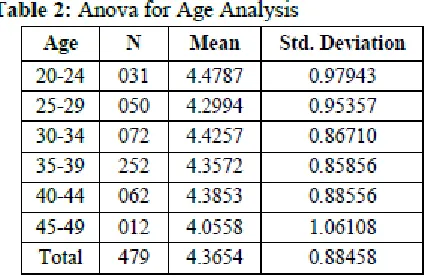
The following illustrations revealed the significant findings in terms of positive emotion. The gender difference in feeling of joy was analyzed using independent sample t-test and the age differences were analyzed through one-way analysis of variance (ANOVA).
By above chart, as far as gender is concern, so male feel more joy than female in life comparatively. Although the findings reported no significance difference in gender but inconsequential changes in magnitude was noted i.e. Male (M=4.4180, S.D=0.87568), Female (M=4.2478, S.D=0.89600). The chances for the deviation of mean were reported low regardless of the number of respondents were not equally distributed in both categories because of random selection of participants. The same statistical technique has been used before in order to analyze the smoking pattern in the same context of Pakistan (Alvi et al., 2016).
Table 2 showed no vital results in terms of analyzing the age of respondents for feeling joy in life. As it was mentioned earlier that six age groups were formed that almost show the similar outcomes among all categories. Hence, it has revealed that there is no significant difference among ages for feeling joy in life. By collectively finding, it can be said that younger people feel more joy in life than older to some extend but difference in magnitude was very minimal so findings were not noteworthy.
4. Discussion
The present research was aimed at exploring if there exist any differences in the feeling of joy on the basis of gender and age. Two hypotheses were formulated as follows: first, women feel lesser joy than men; and second, intensity of joy feeling varies with age. The results were consistent with the first hypothesis. For the second hypothesis, no significant differences are found in the feeling of joy among people belonging to different age groups. Below is discussed the possible expiation of the results obtained.
[image:5.612.79.293.331.470.2]social relationships that elicit specific emotions during social interaction when relational power and status are maintained or changed. He claims that persons with more status and power in a relationship experience positive emotions such as happiness and security, whereas those with less power and status experience negative emotions such as fear, sadness, and anger. Although Kemper focuses on relational status and power between persons in interaction episodes, an implication of his theory is that persons with higher status and power in society experience more positive feelings, whereas persons with lower status and power experience more negative feelings since women tend to have lower status and power than men in our country, they feel lesser joy than men. Many researches demonstrate women’s tilt towards being more negative and less positive than men. For instance in a study, Kring and Gordon (1998) found that women react with more sadness to sad films than men do and women react with more fear-disgust to fearful-disgusting films than men do . In contrast, men reacted with greater happiness to happy films. Moreover, women are also found to score higher on personality trait of neuroticism (Schmitt et al., 2008). It means, women tend to see negativity more often in the happenings which undermines their happiness. In the exploration of age differences in the feeling of joy, we found that it does not vary with age. Researches in the past also could not always produce age related differences in emotions e.g. (Barrick et al., 1989; Vaux and Meddin, 1987). Researches also demonstrate that age is not the sole affecting factor but works in combination with other factors to produce the age related changes in emotion. For instance in one cross sectional study including people from 25 to 74 years old decrease in negative emotions was found only among men who were married while among the unmarried men no such difference were observed (Mroczek and Kolarz, 1998). Furthermore, the relationship between age and emotion is also subjected to be influenced by other factors. For example, personality traits hold predictive power that varies for positive and negative affect (DeNeve and Cooper, 1998; Diener, 1996). Neuroticism is predictive of depression (Costa and McCrae, 1990), and extraversion correlates with positive affect. Both of these variables have been shown to influence the relationship between age and emotion (Mroczek and Kolarz, 1998).
5. Conclusion
On the basis of results obtained following two conclusions are drawn: first, women feel lesser joy as compared to men; second, feeling of joy does not vary with age. One may feel equal level of joy at all points in his or her life.
6. Acknowledgments
We would like to thank to all the reviewers of initial draft, students who helped in collection of data, participants whose gave their responses for the research. We also want to express our gratitude in completion of the study.
References
1. Adler, E.L. (2013). Sex Differences in Positive Emotions within Appraisal Theory. Thesis completed in partial fulfillment of the Honors Program in the Psychological Sciences, 0(0),
2. Retrieved 2 February, 2016, from
3. Alvi, M.H., Naz, F., Khan, M.M.Q., Mirza, M.H., Ikram, M. & Bux, A. (2016). Analyzing the Pattern of Smoker in Karachi. Imperial Journal of Interdisciplinary Research, 2(7), 387-389
4. Alvi, M.H., Surani, M. & Hirani, S. (2015). The Effect of Performance Evaluation on Employee’s Job Satisfaction in Pakistan International Airlines Corporation (2013). International Journal of Management Science, 5(5), 340-353
5. Ashraf, S. (2004). Development and validation of the emotional empathy scale (EES) and the dispositional predictor and potential outcomes of emotional empathy (Doctoral dissertation, Quaid-i- Azam University, Islamabad).
6. Barrick, A. L., Hutchinson, R. L., & Deckers, L. H. (1989). Age effects on positive and negative emotions. Journal of Social Behavior and Personality, 4, 421- 429.
7. Birnbaum, D. (1983). Preschoolers’ Stereotypes about Sex Differences in Emotionality: A Reaffirmation. Journal of Genetic Psychology 143:139–40.
8. Bodas, J., & Ollendick, T. H. (2005). Test anxiety: A cross-cultural perspective. Clinical Child and Family Psychology Review, 8, 65-88.
9. Brody, L. R., & Hall, J. (1993). Gender and emotion. In M. Lewis & J. Haviland (Eds.),
Handbook of emotions (447–461). New York: Guilford Press.
10. Brody, L. R., & Hall, J. A. (2008). Gender and emotion in context. Handbook of emotions
(pp. 395-408).
11. Brody, L. R., Muderrisoglu, S., & Nakash-Eisikovits, O. (2002). Emotions, defenses, and gender. In R. F. Bornstein & J. M. Masling (Eds.), The psychodynamics of gender and gender role (pp. 203–249). Washington, DC: American Psychological Association.
12. Caballo, V. E., Salazar, I. C., Irurtia, M. J., Arias, B., Hofmann, S. G., & CISO-A ResearchTeam. (2014). Differences in social anxiety between men and women across 18 countries. Personality and Individual Differences, 64, 35-40.
13. Cancian, Francesca M. 1987. Love in America: Gender and Self-Development. Cambridge: Cambridge University Press.
14. Carlson, J. G. & Hatfield, E. (1992). Psychology of emotion. New York: Harcourt, Brace, Jovanovich.
15. Carstensen L.L. (1995). Evidence for a life-span theory of socioemotional selectivity. Curr. Dir. Psychol. Sci., 4, 151–155.
17. Charles, S. .T, Reynolds, C. .A & Gatz, M. (2001). Age-Related Differences and Change in Positive and Negative Affect Over 23 Years. Journal of Personality and Social Psychology, 80(1), 136-151. Retrieved 2 February, 2016, from https://www.apa.org/pubs/journals/release s/psp801136.pdf
18. Cohn, M. A., Fredrickson, B. L., Brown, S. L., Mikels, J. A., & Conway, A. M.
(2009). Happiness upacked: Positive emotions increase life satisfaction by building resilience.
Emotion 9(3). 361-368.
19. Costa, P. T., & McCrae, R. R. (1990). Personality disorders and the five-factor model of personality. Journal of Personality Disorders, 4,362-371.
20. DeNeve, K. M., & Cooper, H. (1998). The happy personality: A metaanalysis of 137 personality traits and subjective wellbeing. Psychological Bulletin, 124, 197-229.
21. Diener, E. (1996). Traits can be powerful, but are not enough: Lesson from subjective well-being. Journal of Research in Personality, 30, 389-399.
22. Diener, E., & Sun, M. E. (1998). Subjective well-being and age: An international analysis. In K. W. Schaie & M. P. Lawton (Eds.), Annual review of gerontology and geriatrics: Vol. 17. Focus on emotion and adult development (pp. 304-324). New York: Springer.
23. Diener, E., & Sun, M. E. (1998). Subjective well-being and age: An international analysis. In K. W. Schaie & M. P. Lawton (Eds.), Annual review of gerontology and geriatrics: Vol. 17. Focus on emotion and adult development (pp.304-324). New York: Springer.
24. Diener, E., Sandvik, E., & Larsen, R. J. (1985). Age and sex differences for emotional intensity. Developmental Psychology, 21, 542-546.
25. Domes, G., Schulze, L., Bottger, M., Grossmann, A., Hauenstein, K., Wirtz, P.H. & Herpertz, S. C. (2010). The neural correlates of sex differences in emotional reactivity and emotion regulation. Human Brain Mapping, 31, 758-769.
26. Ellsworth, P. C., & Smith, C. A. (1988b). Shades of joy: Patterns of appraisal differentiating pleasant emotions. Cognition and Emotion, 2, 301–331
27. Else-Quest, N. M., Higgins, A., Allison, C., & Morton, L. C. (2012). Gender differences in self-conscious emotional experience: A meta-analysis. Psychological Bulletin, 138, 947-982.
28. Fischer, A. H. (2004). Gender and Culture Differences in Emotion. Emotion, 4(1), 87–94.
Retrieved 2 February, 2016, from
http://psych.cf.ac.uk/home2/manstead/2004_F,%20RM,%20vV,%20M,%202004,%20Emotion, %204,%20p87.pdf
30. Fredrickson, B. L., Tugade, M. M., Waugh, C. E., & Larkin, G. R. (2003). What good are positive emotions in crisis? A prospective study of resilience and emotions following the terrorist attacks on the United States on September 11th, 2001. Journal of personality and social psychology, 84(2), 365
31. Fredrickson, B. (1998). What Good Are Positive Emotions? Review of General Psychology, 2, 300-319
32. Fredrickson, B. (2004). The Broaden-and build theory of positive emotions. The Philosophical Transaction of Royal Society. 1367-1377
33. Frey, W. H. (1985). Crying: The mystery of tears. Minneapolis, MN: Winston Press. 34. Gordon, Steven L. 1981. “The Sociology of Sentiment and Affect.” Pp. 562–92 in Social Psychology: Sociological Perspectives, edited by Morris Rosenberg and Ralph H. Turner. New York: Basic Books.
35. Gross, J. J., Carstensen, L. L., Pasupathi, M., Tsai, J., Skorpen, C. G., & Hsu, A. Y. C. (1997). Emotion and aging: Experience, expression, and control. Psychology and Aging, 12, 590-599.
36. Hatfield, E, Rapson, R.L & Le, Y. .C. .L. (2009). Ethnic and Gender Differences in Emotional Ideology, Experience, and Expression. University of Hawaii. Retrieved2 February, 2016, from https://interpersonaabpri.files.wordpress.com/2010/12/paper-3_ethnic-and-genderdifferences-in-emotional-ideology1.pdf
37. Hochschild, Arlie R. 1975. “The Sociology of Feeling and Emotion: Selected Possibilities.” Pp. 208–307 in Another Voice: Feminist Perspectives on Social Life and Social Science, edited by M. Millman and R. M. Kantor. New York: Anchor Books.
38. Jansz, J. (2000). Masculine identity and restrictive emotionality. In A. H. Fischer (Ed.),
Gender and emotion: Social psychological perspectives (pp. 166–188). Cambridge, England: Cambridge University Press.
39. Kemper, Theodore D. 1978. A Social Interactional Theory of Emotions. New York:Wiley.
40. Kring, A. M., & Gordon, A. H. (1998). Sex differences in emotion: expression, experience, and physiology. Journal of Personality and Social Psychology, 74, 686-703.
41. Kunzmann, U., Kupperbusch, C.S., & Levenson, R.W. (2005). Behavioral inhibition and amplification during emotional arousal: a comparison of two age groups. Psychol. Aging.,
20(1):144–158.
43. Lau, A.W., Edelstein, B.A., Larkin, K.T. (2001). Psychophysiological arousal in older adults: a critical review. Clin. Psychol. Rev., 21(4):609–630.
44. Lawton, M.P., Kleban, M.H., Rajagopal, D., & Dean, J. (1992). Dimensions of affective experience in three age groups. Psychol. Aging., 7(2), 171–184.
45. Levenson, R.W., Carstensen, L.L., & Gottman, J.M. (1994). The influence of age and gender on affect, physiology, and their interrelations: a study of long-term marriages. J. Pers. Soc. Psychol., 67(1):56–68.
46. Lucas, R. E., & Gohm, C. (2000). Age and sex differences in subjective well-being across cultures. In E. Diener & E. M. Suh (Eds.), Subjective well-being across nations and cultures
(291-317). Cambridge, MA: MIT Press.
47. Mather, M., Canli, T., English, T., Whitfield, S., Wais, P., Ochsner, K., Gabrieli, J.D., & Carstensen, L.L. (2004) Amygdala responses to emotionally valenced stimuli in older and younger adults. Psychol. Sci., 15(4):259–263
48. McLean, C. P., & Anderson, E. R. (2009). Brave men and timid women? A review of the gender differences in fear and anxiety. Clinical Psychology Review, 29, 496-505
49. McRae, K., Ochsner, K. N., Mauss, I. B., Gabrieli, J. J., & Gross, J. J. (2008). Gender differences in emotion regulation: An fMRI study of cognitive reappraisal. Group Processes & Intergroup Relations, 11, 143-162.
50. Mroczek, D. K., & Kolarz, C. M. (1998). The effect of age on positive and negative affect: A developmental perspective on happiness. Journal of Personality and Social Psychology, 75,
1333-1349.
51. Neiss et al.. (2009). Age differences in perception and awareness of emotion. Neurobiol Aging, 30(8), Retrieved 2 February, 2016, from http://www.ncbi.nlm.nih.gov/pmc/articles/
PMC2733236/
52. Robinson, M.D. & Johnson, J.T. (1997). Is It Emotion or Is It Stress? Gender Stereotypes and the Perception of Subjective Experience. Sex Roles 36:235–58.
53. Schmitt, D.P. (2015, 10th April). Are Women More Emotional Than Men?. [Weblog].
Retrieved 2 February 2016, from https://www.psychologytoday.com/blog/sexual-personalities/201504/are-womenmore
54. Schmitt, D. P., Realo, A., Voracek, M., & Allik, J. (2008). Why can’t a man be more like a woman? Sex differences in Big Five personality traits across 55 cultures. Journal of Personality and Social Psychology, 94, 168–182
56. Simon, R.W. & Nath, L. E. (2004). Gender and Emotion in the United States: Do Men and Women Differ in Self-Reports of Feelings and Expressive Behavior?.American Journal of
Sociology, 109(5), 1137–76. Retrieved 2 February, 2016, from
http://users.wfu.edu/simonr/pdfs/Simon%20&%20Nath%20AJS%202004.pdf
57. Smith, D.P., Hillman, C.H., & Duley, A.R. (2005). Influences of age on emotional reactivity during picture processing. J. Gerontol. B Psychol. Sci. Soc. Sci, 60(1):P49–56
58. Sprecher, S. (1985). Emotions in close relationships. Unpublished Ph. D. Dissertation (Sociology). University of Wisconsin, Madison, WI.
59. Stacey, C. A., & Gatz, M. (1991). Cross sectional age differences and longitudinal change on the Bradburn Affect Balance Scale. Journal of Gerontology: Psychological Sciences, 46, 76-78.
60. Stone, A., Schwartz, J., Broderick, J., & Deaton, A. (2010). A snapshot of the age distribution of psychological well-being in the United States Proceedings of the National Academy of Sciences, 107 (22), 9985-9990 (DOI: 10.1073/pnas.1003744107).
Retrieved from: http://the-mousetrap.com/2010/06/09/positive-emotionsincrease-with-old-age-while-negativeemotions-decline/
61. Tsai, J.L., Levenson, R.W., & Carstensen, L.L. (2000). Autonomic, subjective, and expressive responses to emotional films in older and younger Chinese Americans and European Americans. Psychol. Aging, 15(4):684–693.
62. Vaux, A., & Meddin, J. (1987). Positive and negative life change and positive and negative affect among the rural elderly. Journal of Community Psychology, 15,447-458.
63. Vingerhoets, A. J. J. M., Cornelius, R. R., Van Heck, G. L., & Becht, M. C. (2000). Adult crying: A model and review of the literature. Review of General Psychology,4, 354–377.