Proceedings of the 56th Annual Meeting of the Association for Computational Linguistics (Long Papers), pages 373–385 373
Multitask Parsing Across Semantic Representations
Daniel Hershcovich1,2 Omri Abend2
1The Edmond and Lily Safra Center for Brain Sciences
2School of Computer Science and Engineering
Hebrew University of Jerusalem
{danielh,oabend,arir}@cs.huji.ac.il
Ari Rappoport2
Abstract
The ability to consolidate information of different types is at the core of intelli-gence, and has tremendous practical value in allowing learning for one task to benefit from generalizations learned for others. In this paper we tackle the challenging task of improving semantic parsing performance, taking UCCA parsing as a test case, and AMR, SDP and Universal Dependencies (UD) parsing as auxiliary tasks. We ex-periment on three languages, using a uni-form transition-based system and learning architecture for all parsing tasks. Despite notable conceptual, formal and domain differences, we show that multitask learn-ing significantly improves UCCA parslearn-ing in both in-domain and out-of-domain
set-tings. Our code is publicly available.1
1 Introduction
Semantic parsing has arguably yet to reach its full potential in terms of its contribution to down-stream linguistic tasks, partially due to the limited amount of semantically annotated training data. This shortage is more pronounced in languages other than English, and less researched domains.
Indeed, recent work in semantic parsing has tar-geted, among others, Abstract Meaning
Represen-tation (AMR;Banarescu et al.,2013), bilexical
Se-mantic Dependencies (SDP; Oepen et al., 2016)
and Universal Conceptual Cognitive Annotation
(UCCA; Abend and Rappoport, 2013). While
these schemes are formally different and focus on different distinctions, much of their semantic
con-tent is shared (Abend and Rappoport,2017).
Multitask learning (MTL; Caruana, 1997)
al-lows exploiting the overlap between tasks to
ef-1http://github.com/danielhers/tupa
fectively extend the training data, and has greatly advanced with neural networks and representation
learning (see §2). We build on these ideas and
pro-pose a general transition-based DAG parser, able
to parse UCCA, AMR, SDP and UD (Nivre et al.,
2016). We train the parser using MTL to obtain
significant improvements on UCCA parsing over single-task training in (1) in-domain and (2) out-of-domain settings in English; (3) an in-domain setting in German; and (4) an in-domain setting in French, where training data is scarce.
The novelty of this work is in proposing a gen-eral parsing and learning architecture, able to ac-commodate such widely different parsing tasks, and in leveraging it to show benefits from learn-ing them jointly.
2 Related Work
MTL has been used over the years for NLP tasks with varying degrees of similarity, examples in-cluding joint classification of different arguments
in semantic role labeling (Toutanova et al.,2005),
and joint parsing and named entity recognition (Finkel and Manning, 2009). Similar ideas, of parameter sharing across models trained with dif-ferent datasets, can be found in studies of
do-main adaptation (Blitzer et al., 2006;Daume III,
2007; Ziser and Reichart, 2017). For parsing, domain adaptation has been applied successfully
in parser combination and co-training (McClosky
et al.,2010;Baucom et al.,2013).
Neural MTL has mostly been effective in
tack-ling formally similar tasks (Søgaard and
Gold-berg, 2016), including multilingual syntactic
de-pendency parsing (Ammar et al.,2016;Guo et al.,
2016), as well as multilingual (Duong et al.,2017),
and cross-domain semantic parsing (Herzig and
Berant,2017;Fan et al.,2017).
shown great benefit for transition-based syntactic parsing, when jointly training with POS tagging (Bohnet and Nivre,2012;Zhang and Weiss,2016),
and with lexical analysis (Constant and Nivre,
2016; More, 2016). Recent work has achieved
state-of-the-art results in multiple NLP tasks by jointly learning the tasks forming the NLP
stan-dard pipeline using a single neural model (
Col-lobert et al.,2011;Hashimoto et al.,2017), thereby avoiding cascading errors, common in pipelines.
Much effort has been devoted to joint learn-ing of syntactic and semantic parslearn-ing, includlearn-ing
two CoNLL shared tasks (Surdeanu et al., 2008;
Hajiˇc et al., 2009). Despite their conceptual and practical appeal, such joint models rarely
outper-form the pipeline approach (Llu´ıs and M`arquez,
2008;Henderson et al., 2013;Lewis et al.,2015;
Swayamdipta et al.,2016,2017).
Peng et al. (2017a) performed MTL for SDP in a closely related setting to ours. They tackled three tasks, annotated over the same text and shar-ing the same formal structures (bilexical DAGs), with considerable edge overlap, but differing in
target representations (see §3). For all tasks, they
reported an increase of 0.5-1 labeled F1 points.
Recently,Peng et al. (2018) applied a similar
ap-proach to joint frame-semantic parsing and seman-tic dependency parsing, using disjoint datasets, and reported further improvements.
3 Tackled Parsing Tasks
In this section, we outline the parsing tasks we ad-dress. We focus on representations that produce full-sentence analyses, i.e., produce a graph cov-ering all (content) words in the text, or the lexical concepts they evoke. This contrasts with “shal-low” semantic parsing, primarily semantic role
la-beling (SRL; Gildea and Jurafsky, 2002;Palmer
et al.,2005), which targets argument structure phe-nomena using flat structures. We consider four formalisms: UCCA, AMR, SDP and Universal
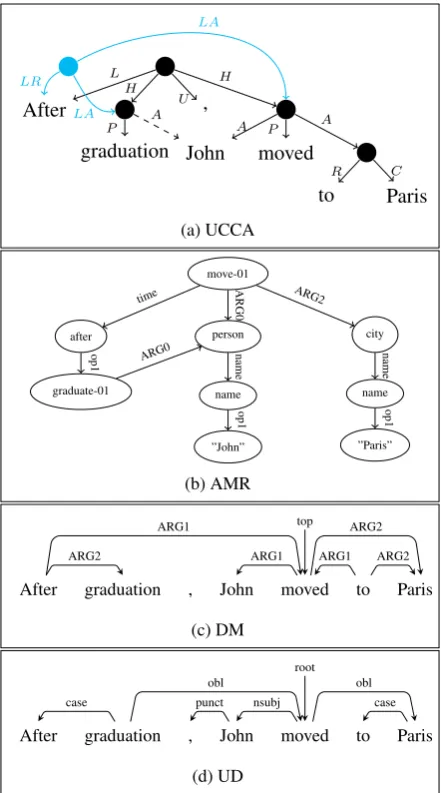
Dependencies. Figure1presents one sentence
an-notated in each scheme.
Universal Conceptual Cognitive Annotation.
UCCA (Abend and Rappoport,2013) is a
seman-tic representation whose main design principles are ease of annotation, cross-linguistic applicabil-ity, and a modular architecture. UCCA represents the semantics of linguistic utterances as directed acyclic graphs (DAGs), where terminal (childless) nodes correspond to the text tokens, and
non-After
L
graduation
P H
,
U
John
A
moved
P
to
R
Paris
C A
H
A
LR
LA
LA
(a) UCCA
move-01
after
graduate-01
op1
time
person
name
”John”
op1
name
ARG0
city
name
”Paris”
op1
name
ARG2
ARG0
(b) AMR
After graduation , John moved to Paris
ARG2 ARG1
ARG1 top ARG2
ARG1 ARG2
(c) DM
After graduation , John moved to Paris
case punct nsubj obl
case root
obl
[image:2.595.307.528.61.458.2](d) UD
Figure 1: Example graph for each task. Figure1apresents a UCCA graph. The dashed edge is remote, while the blue node and its outgoing edges represent inter-Scene linkage. Pre-terminal nodes and edges are omitted for brevity. Fig-ure1bpresents an AMR graph. Text tokens are not part of the graph, and must be matched to concepts and constants by alignment. Variables are represented by their concepts. Fig-ure1cpresents a DM semantic dependency graph, containing multiple roots: “After”, “moved” and “to”, of which “moved” is marked astop. Punctuation tokens are excluded from SDP graphs. Figure1dpresents a UD tree. Edge labels express syntactic relations.
terminal nodes to semantic units that participate in some super-ordinate relation. Edges are labeled, indicating the role of a child in the relation the par-ent represpar-ents. Nodes and edges belong to one of
severallayers, each corresponding to a “module”
of semantic distinctions. UCCA’s foundational
layer(the only layer for which annotated data ex-ists) mostly covers predicate-argument structure, semantic heads and inter-Scene relations.
UCCA distinguishes primary edges,
(appear dashed in Figure1a) that allow for a unit to participate in several super-ordinate relations. Primary edges form a tree in each layer, whereas remote edges enable reentrancy, forming a DAG.
Abstract Meaning Representation. AMR ( Ba-narescu et al.,2013) is a semantic representation that encodes information about named entities, ar-gument structure, semantic roles, word sense and co-reference. AMRs are rooted directed graphs, in which both nodes and edges are labeled. Most AMRs are DAGs, although cycles are permitted.
AMR differs from the other schemes we con-sider in that it does not anchor its graphs in the
words of the sentence (Figure1b). Instead, AMR
graphs connect variables, concepts (from a pre-defined set) and constants (which may be strings or numbers). Still, most AMR nodes are alignable to text tokens, a tendency used by AMR parsers, which align a subset of the graph nodes to a subset of the text tokens (concept identification). In this work, we use pre-aligned AMR graphs.
Despite the brief period since its inception, AMR has been targeted by a number of works,
notably in two SemEval shared tasks (May,2016;
May and Priyadarshi, 2017). To tackle its vari-ety of distinctions and unrestricted graph struc-ture, AMR parsers often use specialized
meth-ods. Graph-based parsers construct AMRs by
identifying concepts and scoring edges between
them, either in a pipeline fashion (Flanigan et al.,
2014;Artzi et al.,2015;Pust et al.,2015;Foland and Martin, 2017), or jointly (Zhou et al.,2016). Another line of work trains machine translation models to convert strings into linearized AMRs (Barzdins and Gosko, 2016; Peng et al., 2017b;
Konstas et al.,2017;Buys and Blunsom,2017b). Transition-based AMR parsers either use depen-dency trees as pre-processing, then mapping them
into AMRs (Wang et al.,2015a,b,2016;Goodman
et al.,2016), or use a transition system tailored to
AMR parsing (Damonte et al., 2017; Ballesteros
and Al-Onaizan,2017). We differ from the above approaches in addressing AMR parsing using the same general DAG parser used for other schemes.
Semantic Dependency Parsing. SDP uses a set of related representations, targeted in two recent
SemEval shared tasks (Oepen et al.,2014,2015),
and extended by Oepen et al. (2016). They
cor-respond to four semantic representation schemes, referred to as DM, PAS, PSD and CCD,
represent-ing predicate-argument relations between content words in a sentence. All are based on semantic for-malisms converted into bilexical dependencies— directed graphs whose nodes are text tokens. Edges are labeled, encoding semantic relations be-tween the tokens. Non-content tokens, such as punctuation, are left out of the analysis (see
Fig-ure 1c). Graphs containing cycles have been
re-moved from the SDP datasets.
We use one of the representations from the SemEval shared tasks: DM (DELPH-IN MRS),
converted from DeepBank (Flickinger et al.,
2012), a corpus of hand-corrected parses from
LinGO ERG (Copestake and Flickinger,2000), an
HPSG (Pollard and Sag,1994) using Minimal
Re-cursion Semantics (Copestake et al.,2005).
Universal Dependencies. UD (Nivre et al.,
2016,2017) has quickly become the dominant
de-pendency scheme for syntactic annotation in many languages, aiming for cross-linguistically consis-tent and coarse-grained treebank annotation. For-mally, UD uses bilexical trees, with edge labels representing syntactic relations between words.
We use UD as an auxiliary task, inspired by pre-vious work on joint syntactic and semantic parsing
(see §2). In order to reach comparable analyses
cross-linguistically, UD often ends up in annota-tion that is similar to the common practice in se-mantic treebanks, such as linking content words to content words wherever possible. Using UD fur-ther allows conducting experiments on languages other than English, for which AMR and SDP
an-notated data is not available (§7).
In addition to basic UD trees, we use the
en-hanced++UD graphs available for English, which are generated by the Stanford CoreNLP
convert-ers (Schuster and Manning,2016).2These include
additional and augmented relations between con-tent words, partially overlapping with the notion of remote edges in UCCA: in the case of control verbs, for example, a direct relation is added in enhanced++ UD between the subordinated verb and its controller, which is similar to the seman-tic schemes’ treatment of this construction.
4 General Transition-based DAG Parser
All schemes considered in this work exhibit reen-trancy and discontinuity (or non-projectivity), to varying degrees. In addition, UCCA and AMR
contain non-terminal nodes. To parse these
graphs, we extend TUPA (Hershcovich et al.,
2017), a transition-based parser originally
devel-oped for UCCA, as it supports all these structural properties. TUPA’s transition system can yield any labeled DAG whose terminals are anchored in the text tokens. To support parsing into AMR, which uses graphs that are not anchored in the tokens, we take advantage of existing alignments of the
graphs with the text tokens during training (§5).
First used for projective syntactic
depen-dency tree parsing (Nivre,2003), transition-based
parsers have since been generalized to parse into many other graph families, such as
(dis-continuous) constituency trees (e.g., Zhang and
Clark,2009;Maier and Lichte,2016), and DAGs
(e.g., Sagae and Tsujii, 2008; Du et al., 2015).
Transition-based parsers apply transitions
incre-mentally to an internal state defined by a bufferB
of remaining tokens and nodes, a stackSof
unre-solved nodes, and a labeled graphGof constructed
nodes and edges. When a terminal state is reached,
the graphGis the final output. A classifier is used
at each step to select the next transition, based on features that encode the current state.
4.1 TUPA’s Transition Set
Given a sequence of tokens w1, . . . , wn, we
pre-dict a rooted graphGwhose terminals are the
to-kens. Parsing starts with the root node on the
stack, and the input tokens in the buffer.
The TUPA transition set includes the standard
SHIFTand REDUCE operations, NODEX for
cre-ating a new non-terminal node and an X-labeled
edge, LEFT-EDGEX and RIGHT-EDGEX to create
a new primaryX-labeled edge, LEFT-REMOTEX
and RIGHT-REMOTEX to create a new remote
X-labeled edge, SWAP to handle discontinuous
nodes, and FINISHto mark the state as terminal.
Although UCCA contains nodes without any
text tokens as descendants (called implicit units),
these nodes are infrequent and only cover 0.5% of non-terminal nodes. For this reason we follow
pre-vious work (Hershcovich et al.,2017) and discard
implicit units from the training and evaluation, and so do not include transitions for creating them.
In AMR, implicit units are considerably more common, as any unaligned concept with no aligned descendents is implicit (about 6% of the nodes). Implicit AMR nodes usually result from alignment errors, or from abstract concepts which
Parser state
S
,
B
John moved to Paris .
G
After L
graduation P H
Classifier
BiLSTM
Embeddings
After graduation . . . to Paris MLP
[image:4.595.306.526.68.302.2]transition softmax
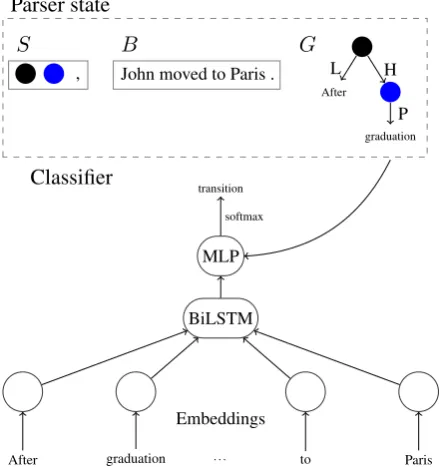
Figure 2: Illustration of the TUPA model, adapted from Her-shcovich et al.(2017). Top: parser state. Bottom: BiLTSM architecture.
have no explicit realization in the text (Buys and
Blunsom,2017a). We ignore implicit nodes when training on AMR as well. TUPA also does not sup-port node labels, which are ubiquitous in AMR but absent in UCCA structures (only edges are labeled in UCCA). We therefore only produce edge labels and not node labels when training on AMR.
4.2 Transition Classifier
To predict the next transition at each step, we use a BiLSTM with embeddings as inputs, followed by an MLP and a softmax layer for classification (Kiperwasser and Goldberg, 2016). The model
is illustrated in Figure 2. Inference is performed
greedily, and training is done with an oracle that yields the set of all optimal transitions at a given state (those that lead to a state from which the gold graph is still reachable). Out of this set, the ac-tual transition performed in training is the one with the highest score given by the classifier, which is trained to maximize the sum of log-likelihoods of all optimal transitions at each step.
After
L
graduation
P H
,
U
John
A
moved
P
to
R
Paris
C A H
A
(a) UCCA
moved
After
graduation
op
time
John
name
ARG0
Paris
name
ARG2
ARG0
(b) AMR
Afterggraduation ,
root
gJohn
ARG1
movedg head
tog Parisg root
top
head ARG2
ARG1
ARG1
head ARG2
ARG2
(c) DM
Afterg case
graduation
head obl
,g Johng movedgtog case
Parisg head obl
punct
nsubj head
[image:5.595.72.292.60.500.2](d) UD
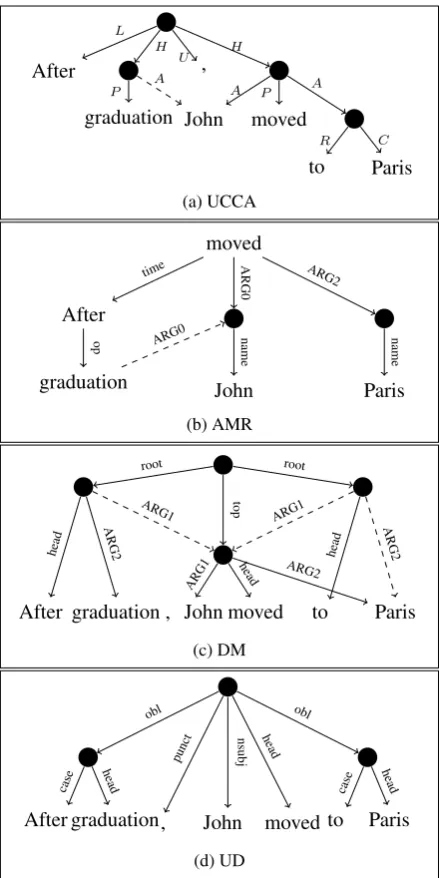
Figure 3: Graphs from Figure1, after conversion to the uni-fied DAG format (with pre-terminals omitted: each terminal drawn in place of its parent). Figure3apresents a converted UCCA graph. Linkage nodes and edges are removed, but the original graph is otherwise preserved. Figure3bpresents a converted AMR graph, with text tokens added according to the alignments. Numeric suffixes ofoprelations are re-moved, and names collapsed. Figure3cpresents a converted SDP graph (in the DM representation), with intermediate non-terminalheadnodes introduced. In case of reentrancy, an arbitrary reentrant edge is marked as remote. Figure3d presents a converted UD graph. As in SDP, intermediate non-terminals andhead edges are introduced. While converted UD graphs form trees, enhanced++ UD graphs may not.
features, e.g., “Xxxx”), and named entity type,3
all provided by spaCy (Honnibal and Montani,
2018).4 To the learned word vectors, we
concate-nate the 250K most frequent word vectors from
3
See Supplementary Material for a full listing of features. 4http://spacy.io
fastText (Bojanowski et al., 2017),5 pre-trained
over Wikipedia and updated during training.
Constraints. As each annotation scheme has different constraints on the allowed graph struc-tures, we apply these constraints separately for each task. During training and parsing, the rele-vant constraint set rules out some of the transitions according to the parser state. Some constraints are task-specific, others are generic. For exam-ple, in UCCA, a terminal may only have one par-ent. In AMR, a concept corresponding to a Prop-Bank frame may only have the core arguments de-fined for the frame as children. An example of a generic constraint is that stack nodes that have
been swapped should not be swapped again.6
5 Unified DAG Format
To apply our parser to the four target tasks (§3), we
convert them into a unified DAG format, which is inclusive enough to allow representing any of the
schemes with very little loss of information.7
The format consists of a rooted DAG, where the tokens are the terminal nodes. As in the UCCA format, edges are labeled (but not nodes), and are
divided intoprimaryandremoteedges, where the
primary edges form a tree (all nodes have at most one primary parent, and the root has none). Re-mote edges enable reentrancy, and thus together
with primary edges form a DAG. Figure3shows
examples for converted graphs. Converting UCCA into the unified format consists simply of
remov-ing linkage nodes and edges (see Figure3a), which
were also discarded byHershcovich et al.(2017).
Converting bilexical dependencies. To convert DM and UD into the unified DAG format, we add a terminal for each token, and attach the pre-terminals according to the original dependency edges: traversing the tree from the root down, for each head token we create a non-terminal parent
with the edge labelhead, and add the node’s
de-pendents as children of the created non-terminal
node (see Figures3c and3d). Since DM allows
multiple roots, we form a single root node, whose
5
http://fasttext.cc
6To implement this constraint, we define a
swap indexfor each node, assigned when the node is created. At initializa-tion, only the root node and terminals exist. We assign the root a swap index of 0, and for each terminal, its position in the text (starting at 1). Whenever a node is created as a result of a NODEtransition, its swap index is the arithmetic mean of the swap indices of the stack top and buffer head.
Parser state
. . .
Classifier
Task-specific BiLSTM Shared BiLSTM
Shared embeddings
After graduation . . . to Paris Task-specific MLP
transition
[image:6.595.70.294.66.248.2]softmax
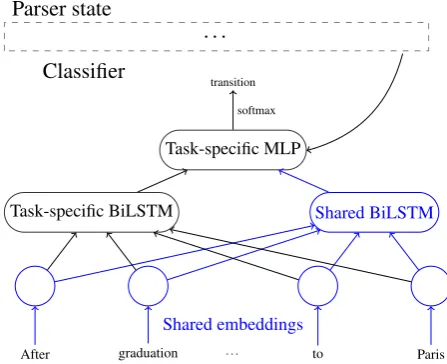
Figure 4: MTL model. Token representations are computed both by a task-specific and a shared BiLSTM. Their outputs are concatenated with the parser state embedding, identical to Figure2, and fed into the task-specific MLP for selecting the next transition. Shared parameters are shown in blue.
children are the original roots. The added edges
are labeled root, where top nodes are labeledtop
instead. In case of reentrancy, an arbitrary parent is marked as primary, and the rest as remote
(de-noted as dashed edges in Figure3).
Converting AMR. In the conversion from AMR, node labels are dropped. Since alignments
are not part of the AMR graph (see Figure3b), we
use automatic alignments (see §7), and attach each
node with an edge to each of its aligned terminals. Named entities in AMR are represented as a
subgraph, whosename-labeled root has a child for
each token in the name (see the twonamenodes in
Figure1b). We collapse this subgraph into a single
node whose children are the name tokens.
6 Multitask Transition-based Parsing
Now that the same model can be applied to dif-ferent tasks, we can train it in a multitask setting. The fairly small training set available for UCCA
(see §7) makes MTL particularly appealing, and
we focus on it in this paper, treating AMR, DM and UD parsing as auxiliary tasks.
Following previous work, we share only some
of the parameters (Klerke et al.,2016;Søgaard and
Goldberg, 2016; Bollmann and Søgaard, 2016;
Plank,2016;Braud et al.,2016;Mart´ınez Alonso and Plank,2017;Peng et al.,2017a,2018), leaving task-specific sub-networks as well. Concretely, we keep the BiLSTM used by TUPA for the main task (UCCA parsing), add a BiLSTM that is shared
across all tasks, and replicate the MLP (feedfor-ward sub-network) for each task. The BiLSTM outputs (concatenated for the main task) are fed
into the task-specific MLP (see Figure4). Feature
embeddings are shared across tasks.
Unlabeled parsing for auxiliary tasks. To sim-plify the auxiliary tasks and facilitate
generaliza-tion (Bingel and Søgaard,2017), we perform
un-labeled parsing for AMR, DM and UD, while still predicting edge labels in UCCA parsing. To sup-port unlabeled parsing, we simply remove all
la-bels from the EDGE, REMOTE and NODE
tran-sitions output by the oracle. This results in a
much smaller number of transitions the classifier has to select from (no more than 10, as opposed to 45 in labeled UCCA parsing), allowing us to use no BiLSTMs and fewer dimensions and layers
for task-specific MLPs of auxiliary tasks (see §7).
This limited capacity forces the network to use the shared parameters for all tasks, increasing
gener-alization (Mart´ınez Alonso and Plank,2017).
7 Experimental Setup
We here detail a range of experiments to assess the value of MTL to UCCA parsing, training the parser in single-task and multitask settings, and evaluating its performance on the UCCA test sets in both in-domain and out-of-domain settings.
Data. For UCCA, we use v1.2 of the English
Wikipedia corpus (Wiki; Abend and Rappoport,
2013), with the standard train/dev/test split (see
Table1), and theTwenty Thousand Leagues Under
the Seacorpora (20K;Sulem et al.,2015),
anno-tated in English, French and German.8 For English
and French we use 20K v1.0, a small parallel cor-pus comprising the first five chapters of the book.
As in previous work (Hershcovich et al., 2017),
we use the English part only as an out-of-domain test set. We train and test on the French part using the standard split, as well as the German corpus (v0.9), which is a pre-release and still contains a considerable amount of noisy annotation. Tuning is performed on the respective development sets.
For AMR, we use LDC2017T10, identical to
the dataset targeted in SemEval 2017 (May and
Priyadarshi, 2017).9 For SDP, we use the DM
representation from the SDP 2016 dataset (Oepen
8
http://github.com/huji-nlp/ucca-corpora
English French German
# tokens # sentences # tokens # sentences # tokens # sentences train dev test train dev test train dev test train dev test train dev test train dev test UCCA
Wiki 128444 14676 15313 4268 454 503
20K 12339 506 10047 1558 1324 413 67 67 79894 10059 42366 3429 561 2164
AMR 648950 36521
DM 765025 33964
[image:7.595.78.522.60.153.2]UD 458277 17062 899163 32347 268145 13814
Table 1: Number of tokens and sentences in the training, development and test sets we use for each corpus and language.
et al., 2016).10 For Universal Dependencies, we use all English, French and German
tree-banks from UD v2.1 (Nivre et al., 2017).11 We
use the enhanced++ UD representation (Schuster
and Manning, 2016) in our English experiments,
henceforth referred to as UD++. We use only the
AMR, DM and UD training sets from standard splits.
While UCCA is annotated over Wikipedia and over a literary corpus, the domains for AMR, DM and UD are blogs, news, emails, reviews, and Q&A. This domain difference between training
and test is particularly challenging (see §9).
Un-fortunately, none of the other schemes have avail-able annotation over Wikipedia text.
Settings. We explore the following settings: (1) in-domain setting in English, training and test-ing on Wiki; (2) out-of-domain setttest-ing in English, training on Wiki and testing on 20K; (3) French in-domain setting, where available training dataset is small, training and testing on 20K; (4) German in-domain setting on 20K, with somewhat noisy an-notation. For MTL experiments, we use unlabeled
AMR, DM and UD++parsing as auxiliary tasks in
English, and unlabeled UD parsing in French and
German.12We also report baseline results training
only the UCCA training sets.
Training. We create a unified corpus for each setting, shuffling all sentences from relevant datasets together, but using only the UCCA
devel-opment setF1score as the early stopping criterion.
In each training epoch, we use the same number of examples from each task—the UCCA training set size. Since training sets differ in size, we sample this many sentences from each one. The model is
implemented using DyNet (Neubig et al.,2017).13
10http://sdp.delph-in.net/osdp-12.tgz 11http://hdl.handle.net/11234/1-2515 12
We did not use AMR, DM or UD++in French and Ger-man, as these are only available in English.
13http://dynet.io
Multitask Hyperparameter Single Main Aux Shared
Pre-trained word dim. 300 300 Learned word dim. 200 200
POS tag dim. 20 20
Dependency relation dim. 10 10 Named entity dim. 3 3
Punctuation dim. 1 1
Action dim. 3 3
Edge label dim. 20 20
MLP layers 2 2 1
MLP dimensions 50 50 50
BiLSTM layers 2 2 2
BiLSTM dimensions 500 300 300
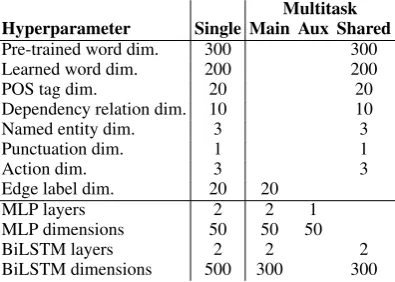
Table 2: Hyperparameter settings. Middle column shows hy-perparameters used for the single-task architecture, described in §4.2, and right column for the multitask architecture, de-scribed in §6.Mainrefers to parameters specific to the main task—UCCA parsing (task-specific MLP and BiLSTM, and edge label embedding),Auxto parameters specific to each auxiliary task (task-specific MLP, but no edge label embed-ding since the tasks are unlabeled), andSharedto parameters shared among all tasks (shared BiLSTM and embeddings).
Hyperparameters. We initialize embeddings
randomly. We use dropout (Srivastava et al.,2014)
between MLP layers, and recurrent dropout (Gal
and Ghahramani,2016) between BiLSTM layers,
both withp = 0.4. We also use word (α = 0.2),
tag (α = 0.2) and dependency relation (α = 0.5)
dropout (Kiperwasser and Goldberg,2016).14 In
addition, we use a novel form of dropout, node
dropout: with a probability of 0.1 at each step, all features associated with a single node in the parser state are replaced with zero vectors. For op-timization we use a minibatch size of 100,
decay-ing all weights by10−5 at each update, and train
with stochastic gradient descent for N epochs
with a learning rate of 0.1, followed by
AMS-Grad (Sashank J. Reddi,2018) forN epochs with
α = 0.001, β1 = 0.9 andβ2 = 0.999. We use
N = 50for English and German, and N = 400
for French. We found this training strategy better than using only one of the optimization methods,
14
[image:7.595.318.516.193.334.2]Primary Remote
LP LR LF LP LR LF
English (in-domain)
HAR17 74.4 72.7 73.5 47.4 51.6 49.4 Single 74.4 72.9 73.6 53 50 51.5 AMR 74.7 72.8 73.7 48.7? 51.1 49.9 DM 75.7? 73.9? 74.8? 54.9 53 53.9
[image:8.595.76.285.62.185.2]UD++ 75? 73.2 74.1? 49 52.7 50.8 AMR + DM 75.6? 73.9? 74.7? 49.9 53 51.4 AMR + UD++ 74.9 72.7 73.8 47.1 50 48.5 DM + UD++ 75.9? 73.9? 74.9? 48 54.8 51.2 All 75.6? 73.1 74.4? 50.9 53.2 52
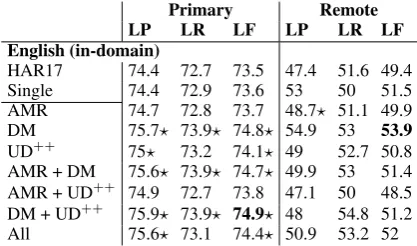
Table 3: Labeled precision, recall andF1(in %) for primary and remote edges, on theWikitest set. ?indicates signifi-cantly better thanSingle. HAR17:Hershcovich et al.(2017).
Primary Remote
LP LR LF LP LR LF
English (out-of-domain)
HAR17 68.7 68.5 68.6 38.6 18.8 25.3 Single 69 69 69 41.2 19.8 26.7 AMR 69.5 69.5 69.5 42.9 20.2 27.5 DM 70.7? 70.7? 70.7? 42.7 18.6 25.9 UD++ 69.6 69.8? 69.7 41.4 22 28.7 AMR + DM 70.7? 70.2? 70.5? 45.8 19.4 27.3 AMR + UD++ 70.2? 69.9? 70? 45.1 21.8 29.4 DM + UD++ 70.8? 70.3? 70.6? 41.6 21.6 28.4 All 71.2? 70.9? 71? 45.1 22 29.6 French (in-domain)
Single 68.2 67 67.6 26 9.4 13.9 UD 70.3 70? 70.1? 43.8 13.2 20.3
German (in-domain)
Single 73.3 71.7 72.5 57.1 17.7 27.1 UD 73.7? 72.6? 73.2? 61.8 24.9? 35.5?
Table 4: Labeled precision, recall andF1(in %) for primary and remote edges, on the20Ktest sets. ?indicates signifi-cantly better thanSingle. HAR17:Hershcovich et al.(2017).
similar to findings by Keskar and Socher(2017).
We select the epoch with the best average labeled
F1 score on the UCCA development set. Other
hyperparameter settings are listed in Table2.
Evaluation. We evaluate on UCCA using
la-beled precision, recall and F1 on primary and
remote edges, following previous work (
Hersh-covich et al., 2017). Edges in predicted and gold graphs are matched by terminal yield and label. Significance testing of improvements over the single-task model is done by the bootstrap test (Berg-Kirkpatrick et al.,2012), withp < 0.05.
8 Results
Table 3 presents our results on the English
in-domain Wiki test set. MTL with all auxiliary tasks
and their combinations improves the primary F1
score over the single task baseline. In most set-tings the improvement is statistically significant. Using all auxiliary tasks contributed less than just
DM and UD++, the combination of which yielded
the best scores yet in in-domain UCCA parsing,
with 74.9% F1 on primary edges. RemoteF1 is
improved in some settings, but due to the rela-tively small number of remote edges (about 2% of all edges), none of the differences is significant.
Note that our baseline single-task model (Single)
is slightly better than the current state-of-the-art
(HAR17;Hershcovich et al.,2017), due to the
in-corporation of additional features (see §4.2).
Table4presents our experimental results on the
20K corpora in the three languages. For English out-of-domain, improvements from using MTL are even more marked. Moreover, the improve-ment is largely additive: the best model, using all
three auxiliary tasks (All), yields an error
reduc-tion of 2.9%. Again, the single-task baseline is slightly better than HAR17.
The contribution of MTL is also apparent in French and German in-domain parsing: 3.7% er-ror reduction in French (having less than 10% as much UCCA training data as English) and 1% in German, where the training set is com-parable in size to the English one, but is noisier
(see §7). The best MTL models are significantly
better than single-task models, demonstrating that even a small training set for the main task may suffice, given enough auxiliary training data (as in French).
9 Discussion
Quantifying the similarity between tasks.
Task similarity is an important factor in MTL
suc-cess (Bingel and Søgaard,2017;Mart´ınez Alonso
and Plank,2017). In our case, the main and auxil-iary tasks are annotated on different corpora from
different domains (§7), and the target
representa-tions vary both in form and in content.
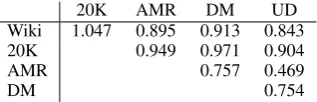
To quantify the domain differences, we follow
Plank and van Noord (2011) and measure the L1 distance between word distributions in the English
training sets and 20K test set (Table5). All
aux-iliary training sets are more similar to 20K than Wiki is, which may contribute to the benefits ob-served on the English 20K test set.
As a measure of the formal similarity of the
dif-ferent schemes to UCCA, we use unlabeled F1
[image:8.595.75.288.236.420.2]Anno-20K AMR DM UD Wiki 1.047 0.895 0.913 0.843 20K 0.949 0.971 0.904
AMR 0.757 0.469
[image:9.595.103.262.62.113.2]DM 0.754
Table 5: L1 distance between dataset word distributions, quantifying domain differences in English (low is similar).
Primary Remote
UP UR UF UP UR UF
AMR 53.8 15.6 24.2 7.3 5.5 6.3 DM 65 49.2 56 7.4 65.9 13.3 UD++ 82.7 84.6 83.6 12.5 12.7 12.6
Table 6: UnlabeledF1scores between the representations of the same English sentences (from PTB WSJ), converted to the unified DAG format, and annotated UCCA graphs.
tation was carried out by a single expert UCCA
annotator, and is publicly available.15 These
sen-tences had already been annotated by the AMR,
DM and PTB schemes,16and we convert their
an-notation to the unified DAG format.
UnlabeledF1scores between the UCCA graphs
and those converted from AMR, DM and UD++
are presented in Table 6. UD++ is highly
over-lapping with UCCA, while DM less so, and AMR
even less (cf. Figure3).
Comparing the average improvements resulting
from adding each of the tasks as auxiliary (see §8),
we find AMR the least beneficial, UD++second,
and DM the most beneficial, in both in-domain and out-of-domain settings. This trend is weakly correlated with the formal similarity between the
tasks (as expressed in Table 6), but weakly
neg-atively correlated with the word distribution
simi-larity scores (Table5). We conclude that other
fac-tors should be taken into account to fully explain this effect, and propose to address this in future work through controlled experiments, where cor-pora of the same domain are annotated with the various formalisms and used as training data for MTL.
AMR, SDP and UD parsing. Evaluating the
full MTL model (All) on the unlabeled auxiliary
tasks yielded 64.7% unlabeled SmatchF1(Cai and
Knight,2013) on the AMR development set, when using oracle concept identification (since the aux-iliary model does not predict node labels), 27.2%
unlabeled F1 on the DM development set, and
15
http://github.com/danielhers/wsj
16We convert the PTB format to UD++ v1 using
Stan-ford CoreNLP, and then to UD v2 using Udapi: http: //github.com/udapi/udapi-python.
4.9% UAS on the UD development set. These poor results reflect the fact that model selection was based on the score on the UCCA development set, and that the model parameters dedicated to auxiliary tasks were very limited (to encourage us-ing the shared parameters). However, preliminary experiments using our approach produced promis-ing results on each of the tasks’ respective English development sets, when treated as a single task:
67.1% labeled SmatchF1on AMR (adding a
tran-sition for implicit nodes and classifier for node
la-bels), 79.1% labeledF1 on DM, and 80.1% LAS
F1 on UD. For comparison, the best results on
these datasets are 70.7%, 91.2% and 82.2%,
re-spectively (Foland and Martin, 2017;Peng et al.,
2018;Dozat et al.,2017).
10 Conclusion
We demonstrate that semantic parsers can leverage a range of semantically and syntactically anno-tated data, to improve their performance. Our ex-periments show that MTL improves UCCA pars-ing, using AMR, DM and UD parsing as auxil-iaries. We propose a unified DAG representation, construct protocols for converting these schemes into the unified format, and generalize a transition-based DAG parser to support all these tasks, allow-ing it to be jointly trained on them.
While we focus on UCCA in this work, our parser is capable of parsing any scheme that can be represented in the unified DAG format, and pre-liminary results on AMR, DM and UD are
promis-ing (see §9). Future work will investigate whether
a single algorithm and architecture can be com-petitive on all of these parsing tasks, an important step towards a joint many-task model for semantic parsing.
Acknowledgments
[image:9.595.81.282.156.207.2]References
Omri Abend and Ari Rappoport. 2013.Universal Con-ceptual Cognitive Annotation (UCCA). InProc. of ACL, pages 228–238.
Omri Abend and Ari Rappoport. 2017. The state of the art in semantic representation. InProc. of ACL, pages 77–89.
Waleed Ammar, George Mulcaire, Miguel Ballesteros, Chris Dyer, and Noah Smith. 2016. Many lan-guages, one parser.TACL, 4:431–444.
Yoav Artzi, Kenton Lee, and Luke Zettlemoyer. 2015.
Broad-coverage CCG semantic parsing with AMR. InProc. of EMNLP, pages 1699–1710.
Miguel Ballesteros and Yaser Al-Onaizan. 2017.AMR parsing using stack-LSTMs. InProc. of EMNLP, pages 1269–1275.
Laura Banarescu, Claire Bonial, Shu Cai, Madalina Georgescu, Kira Griffitt, Ulf Hermjakob, Kevin Knight, Martha Palmer, and Nathan Schneider. 2013. Abstract Meaning Representation for sem-banking. In Proc. of the Linguistic Annotation Workshop.
Guntis Barzdins and Didzis Gosko. 2016. RIGA at SemEval-2016 task 8: Impact of Smatch ex-tensions and character-level neural translation on AMR parsing accuracy. InProc. of SemEval, pages 1143–1147.
Eric Baucom, Levi King, and Sandra K¨ubler. 2013.
Domain adaptation for parsing. InProc. of RANLP, pages 56–64.
Taylor Berg-Kirkpatrick, David Burkett, and Dan Klein. 2012.An empirical investigation of statistical significance in NLP. InProc. of EMNLP-CoNLL, pages 995–1005.
Joachim Bingel and Anders Søgaard. 2017. Identify-ing beneficial task relations for multi-task learnIdentify-ing in deep neural networks. In Proc. of EACL, pages 164–169.
John Blitzer, Ryan McDonald, and Fernando Pereira. 2006.Domain adaptation with structural correspon-dence learning. InProc. of EMNLP, pages 120–128.
Bernd Bohnet and Joakim Nivre. 2012. A transition-based system for joint part-of-speech tagging and la-beled non-projective dependency parsing. InProc. of EMNLP-CoNLL, pages 1455–1465.
Piotr Bojanowski, Edouard Grave, Armand Joulin, and Tomas Mikolov. 2017. Enriching word vectors with subword information.TACL, 5:135–146.
Marcel Bollmann and Anders Søgaard. 2016. Im-proving historical spelling normalization with bi-directional lstms and multi-task learning. InProc. of COLING, pages 131–139.
Chlo´e Braud, Barbara Plank, and Anders Søgaard. 2016. Multi-view and multi-task training of RST discourse parsers. In Proc. of COLING, pages 1903–1913.
Jan Buys and Phil Blunsom. 2017a. Oxford at SemEval-2017 task 9: Neural AMR parsing with pointer-augmented attention. InProc. of SemEval, pages 914–919.
Jan Buys and Phil Blunsom. 2017b. Robust incremen-tal neural semantic graph parsing. InProc. of ACL, pages 1215–1226.
Shu Cai and Kevin Knight. 2013. Smatch: an evalua-tion metric for semantic feature structures. InProc. of ACL, pages 748–752.
Rich Caruana. 1997. Multitask Learning. Machine Learning, 28(1):41–75.
Ronan Collobert, Jason Weston, L´eon Bottou, Michael Karlen, Koray Kavukcuoglu, and Pavel Kuksa. 2011. Natural language processing (almost) from scratch.J. Mach. Learn. Res., 12:2493–2537.
Matthieu Constant and Joakim Nivre. 2016. A transition-based system for joint lexical and syntac-tic analysis. InProc. of ACL, pages 161–171.
Ann Copestake and Dan Flickinger. 2000. An open source grammar development environment and broad-coverage English grammar using HPSG. In
Proc. of LREC, pages 591–600.
Ann Copestake, Dan Flickinger, Carl Pollard, and Ivan A. Sag. 2005. Minimal recursion semantics: An introduction. Research on Language and Com-putation, 3(2):281–332.
Marco Damonte, Shay B. Cohen, and Giorgio Satta. 2017. An incremental parser for Abstract Meaning Representation. InProc. of EACL.
Hal Daume III. 2007. Frustratingly easy domain adap-tation. InProc. of ACL, pages 256–263.
Timothy Dozat, Peng Qi, and Christopher D. Manning. 2017. Stanford’s graph-based neural dependency parser at the conll 2017 shared task. In Proc. of CoNLL, pages 20–30.
Yantao Du, Fan Zhang, Xun Zhang, Weiwei Sun, and Xiaojun Wan. 2015. Peking: Building semantic de-pendency graphs with a hybrid parser. InProc. of SemEval, pages 927–931.
Long Duong, Hadi Afshar, Dominique Estival, Glen Pink, Philip Cohen, and Mark Johnson. 2017. Mul-tilingual semantic parsing and code-switching. In
Proc. of CoNLL, pages 379–389.
Jenny Rose Finkel and Christopher D. Manning. 2009.
Joint parsing and named entity recognition. InProc. of NAACL-HLT, pages 326–334.
Jeffrey Flanigan, Sam Thomson, Jaime Carbonell, Chris Dyer, and Noah A. Smith. 2014. A discrim-inative graph-based parser for the Abstract Meaning Representation. InProc. of ACL, pages 1426–1436.
Daniel Flickinger, Yi Zhang, and Valia Kordoni. 2012.
DeepBank: A dynamically annotated treebank of the Wall Street Journal. InProc. of Workshop on Tree-banks and Linguistic Theories, pages 85–96.
William Foland and James H. Martin. 2017. Abstract Meaning Representation parsing using LSTM re-current neural networks. In Proc. of ACL, pages 463–472.
Yarin Gal and Zoubin Ghahramani. 2016. A Theoreti-cally Grounded Application of Dropout in Recurrent Neural Networks. In D D Lee, M Sugiyama, U V Luxburg, I Guyon, and R Garnett, editors,Advances in Neural Information Processing Systems 29, pages 1019–1027. Curran Associates, Inc.
Daniel Gildea and Daniel Jurafsky. 2002. Automatic labeling of semantic roles. Computational Linguis-tics, 28(3).
James Goodman, Andreas Vlachos, and Jason Narad-owsky. 2016. Noise reduction and targeted explo-ration in imitation learning for Abstract Meaning Representation parsing. In Proc. of ACL, pages 1–11.
Jiang Guo, Wanxiang Che, Haifeng Wang, and Ting Liu. 2016. Exploiting multi-typed treebanks for parsing with deep multi-task learning. CoRR, abs/1606.01161.
Jan Hajiˇc, Massimiliano Ciaramita, Richard Johans-son, Daisuke Kawahara, Maria Ant`onia Mart´ı, Llu´ıs M`arquez, Adam Meyers, Joakim Nivre, Sebastian Pad´o, Jan ˇStep´anek, Pavel Straˇn´ak, Mihai Surdeanu, Nianwen Xue, and Yi Zhang. 2009. The CoNLL-2009 shared task: Syntactic and semantic depen-dencies in multiple languages. InProc. of CoNLL, pages 1–18.
Kazuma Hashimoto, caiming xiong, Yoshimasa Tsu-ruoka, and Richard Socher. 2017.A joint many-task model: Growing a neural network for multiple NLP tasks. InProc. of EMNLP, pages 1923–1933.
James Henderson, Paola Merlo, Ivan Titov, and Gabriele Musillo. 2013. Multilingual joint pars-ing of syntactic and semantic dependencies with a latent variable model. Computational Linguistics, 39(4):949–998.
Daniel Hershcovich, Omri Abend, and Ari Rap-poport. 2017. A transition-based directed acyclic graph parser for UCCA. InProc. of ACL, pages 1127–1138.
Jonathan Herzig and Jonathan Berant. 2017. Neural semantic parsing over multiple knowledge-bases. In
Proc. of ACL, pages 623–628.
Matthew Honnibal and Ines Montani. 2018. spaCy 2: Natural language understanding with Bloom embed-dings, convolutional neural networks and incremen-tal parsing. To appear.
Nitish Shirish Keskar and Richard Socher. 2017. Im-proving generalization performance by switching from Adam to SGD.CoRR, abs/1712.07628.
Eliyahu Kiperwasser and Yoav Goldberg. 2016. Sim-ple and accurate dependency parsing using bidi-rectional LSTM feature representations. TACL, 4:313–327.
Sigrid Klerke, Yoav Goldberg, and Anders Søgaard. 2016. Improving sentence compression by learn-ing to predict gaze. InProc. of NAACL-HLT, pages 1528–1533.
Ioannis Konstas, Srinivasan Iyer, Mark Yatskar, Yejin Choi, and Luke Zettlemoyer. 2017. Neural AMR: Sequence-to-sequence models for parsing and gen-eration. InProc. of ACL, pages 146–157.
Mike Lewis, Luheng He, and Luke Zettlemoyer. 2015.
Joint A* CCG parsing and semantic role labelling. InProc. of EMNLP, pages 1444–1454.
Xavier Llu´ıs and Llu´ıs M`arquez. 2008. A joint model for parsing syntactic and semantic dependencies. In
Proc. of CoNLL, pages 188–192.
Wolfgang Maier and Timm Lichte. 2016. Discontinu-ous parsing with continuDiscontinu-ous trees. InProc. of Work-shop on Discontinuous Structures in NLP, pages 47–57.
H´ector Mart´ınez Alonso and Barbara Plank. 2017.
When is multitask learning effective? Semantic se-quence prediction under varying data conditions. In
Proc. of EACL, pages 44–53.
Jonathan May. 2016. SemEval-2016 task 8: Meaning representation parsing. InProc. of SemEval, pages 1063–1073.
Jonathan May and Jay Priyadarshi. 2017. SemEval-2017 task 9: Abstract Meaning Representation pars-ing and generation. In Proc. of SemEval, pages 536–545.
David McClosky, Eugene Charniak, and Mark John-son. 2010. Automatic domain adaptation for pars-ing. InProc. of NAACL-HLT, pages 28–36.
Graham Neubig, Chris Dyer, Yoav Goldberg, Austin Matthews, Waleed Ammar, Antonios Anastasopou-los, Miguel Ballesteros, David Chiang, Daniel Clothiaux, Trevor Cohn, Kevin Duh, Manaal Faruqui, Cynthia Gan, Dan Garrette, Yangfeng Ji, Lingpeng Kong, Adhiguna Kuncoro, Gaurav Ku-mar, Chaitanya Malaviya, Paul Michel, Yusuke Oda, Matthew Richardson, Naomi Saphra, Swabha Swayamdipta, and Pengcheng Yin. 2017. DyNet: The dynamic neural network toolkit. CoRR, abs/1701.03980.
Joakim Nivre. 2003.An efficient algorithm for projec-tive dependency parsing. InProc. of IWPT, pages 149–160.
Joakim Nivre, ˇZeljko Agi´c, Lars Ahrenberg, Lene Antonsen, Maria Jesus Aranzabe, Masayuki Asa-hara, Luma Ateyah, Mohammed Attia, Aitziber Atutxa, Liesbeth Augustinus, Elena Badmaeva, Miguel Ballesteros, Esha Banerjee, Sebastian Bank, Verginica Barbu Mititelu, John Bauer, Kepa Ben-goetxea, Riyaz Ahmad Bhat, Eckhard Bick, Victo-ria Bobicev, Carl B¨orstell, Cristina Bosco, Gosse Bouma, Sam Bowman, Aljoscha Burchardt, Marie Candito, Gauthier Caron, G¨uls¸en Cebirolu Ery-iit, Giuseppe G. A. Celano, Savas Cetin, Fabri-cio Chalub, Jinho Choi, Silvie Cinkov´a, C¸ ar C¸ ¨oltekin, Miriam Connor, Elizabeth Davidson, Marie-Catherine de Marneffe, Valeria de Paiva, Arantza Diaz de Ilarraza, Peter Dirix, Kaja Do-brovoljc, Timothy Dozat, Kira Droganova, Puneet Dwivedi, Marhaba Eli, Ali Elkahky, Tomaˇz Erjavec, Rich´ard Farkas, Hector Fernandez Alcalde, Jennifer Foster, Cl´audia Freitas, Katar´ına Gajdoˇsov´a, Daniel Galbraith, Marcos Garcia, Moa G¨ardenfors, Kim Gerdes, Filip Ginter, Iakes Goenaga, Koldo Go-jenola, Memduh G¨okrmak, Yoav Goldberg, Xavier G´omez Guinovart, Berta Gonz´ales Saavedra, Ma-tias Grioni, Normunds Gr¯uz¯itis, Bruno Guillaume, Nizar Habash, Jan Hajiˇc, Jan Hajiˇc jr., Linh H`a M, Kim Harris, Dag Haug, Barbora Hladk´a, Jaroslava Hlav´aˇcov´a, Florinel Hociung, Petter Hohle, Radu Ion, Elena Irimia, Tom´aˇs Jel´ınek, Anders Jo-hannsen, Fredrik Jørgensen, H¨uner Kas¸kara, Hi-roshi Kanayama, Jenna Kanerva, Tolga Kayade-len, V´aclava Kettnerov´a, Jesse Kirchner, Na-talia Kotsyba, Simon Krek, Veronika Laippala, Lorenzo Lambertino, Tatiana Lando, John Lee, Phng Lˆe Hng, Alessandro Lenci, Saran Lertpra-dit, Herman Leung, Cheuk Ying Li, Josie Li, Key-ing Li, Nikola Ljubeˇsi´c, Olga Loginova, Olga Lya-shevskaya, Teresa Lynn, Vivien Macketanz, Aibek Makazhanov, Michael Mandl, Christopher Man-ning, C˘at˘alina M˘ar˘anduc, David Mareˇcek, Katrin Marheinecke, H´ector Mart´ınez Alonso, Andr´e Mar-tins, Jan Maˇsek, Yuji Matsumoto, Ryan McDon-ald, Gustavo Mendonc¸a, Niko Miekka, Anna Mis-sil¨a, C˘at˘alin Mititelu, Yusuke Miyao, Simonetta Montemagni, Amir More, Laura Moreno Romero, Shinsuke Mori, Bohdan Moskalevskyi, Kadri Muischnek, Kaili M¨u¨urisep, Pinkey Nainwani, Anna Nedoluzhko, Gunta Neˇspore-B¯erzkalne, Lng Nguyn Th, Huyn Nguyn Th Minh, Vitaly
Niko-laev, Hanna Nurmi, Stina Ojala, Petya Osen-ova, Robert ¨Ostling, Lilja Øvrelid, Elena Pascual, Marco Passarotti, Cenel-Augusto Perez, Guy Per-rier, Slav Petrov, Jussi Piitulainen, Emily Pitler, Barbara Plank, Martin Popel, Lauma Pretkalnia, Prokopis Prokopidis, Tiina Puolakainen, Sampo Pyysalo, Alexandre Rademaker, Loganathan Ra-masamy, Taraka Rama, Vinit Ravishankar, Livy Real, Siva Reddy, Georg Rehm, Larissa Rinaldi, Laura Rituma, Mykhailo Romanenko, Rudolf Rosa, Davide Rovati, Benoˆıt Sagot, Shadi Saleh, Tanja Samardˇzi´c, Manuela Sanguinetti, Baiba Saul¯ite, Se-bastian Schuster, Djam´e Seddah, Wolfgang Seeker, Mojgan Seraji, Mo Shen, Atsuko Shimada, Dmitry Sichinava, Natalia Silveira, Maria Simi, Radu Simionescu, Katalin Simk´o, M´aria ˇSimkov´a, Kiril Simov, Aaron Smith, Antonio Stella, Milan Straka, Jana Strnadov´a, Alane Suhr, Umut Sulubacak, Zsolt Sz´ant´o, Dima Taji, Takaaki Tanaka, Trond Trosterud, Anna Trukhina, Reut Tsarfaty, Francis Tyers, Sumire Uematsu, Zdeˇnka Ureˇsov´a, Larraitz Uria, Hans Uszkoreit, Sowmya Vajjala, Daniel van Niekerk, Gertjan van Noord, Viktor Varga, Eric Villemonte de la Clergerie, Veronika Vincze, Lars Wallin, Jonathan North Washington, Mats Wir´en, Tak-sum Wong, Zhuoran Yu, Zdenˇek ˇZabokrtsk´y, Amir Zeldes, Daniel Zeman, and Hanzhi Zhu. 2017.
Universal dependencies 2.1. LINDAT/CLARIN digital library at the Institute of Formal and Ap-plied Linguistics ( ´UFAL), Faculty of Mathematics and Physics, Charles University.
Joakim Nivre, Marie-Catherine de Marneffe, Filip Gin-ter, Yoav Goldberg, Jan Hajic, Christopher D. Man-ning, Ryan McDonald, Slav Petrov, Sampo Pyysalo, Natalia Silveira, Reut Tsarfaty, and Daniel Zeman. 2016. Universal dependencies v1: A multilingual treebank collection. InProc. of LREC.
Stephan Oepen, Marco Kuhlmann, Yusuke Miyao, Daniel Zeman, Silvie Cinkova, Dan Flickinger, Jan Hajic, Angelina Ivanova, and Zdenka Uresova. 2016. Towards comparability of linguistic graph banks for semantic parsing. InProc. of LREC.
Stephan Oepen, Marco Kuhlmann, Yusuke Miyao, Daniel Zeman, Silvie Cinkov´a, Dan Flickinger, Jan Hajiˇc, and Zdeˇnka Ureˇsov´a. 2015. SemEval 2015 task 18: Broad-coverage semantic dependency pars-ing. InProc. of SemEval, pages 915–926.
Stephan Oepen, Marco Kuhlmann, Yusuke Miyao, Daniel Zeman, Dan Flickinger, Jan Hajiˇc, Angelina Ivanova, and Yi Zhang. 2014. SemEval 2014 task 8: Broad-coverage semantic dependency parsing. In
Proc. of SemEval, pages 63–72.
Martha Palmer, Daniel Gildea, and Paul Kingsbury. 2005. The proposition bank: An annotated corpus of semantic roles.Computational Linguistics, 31(1).
Hao Peng, Sam Thomson, and Noah A. Smith. 2017a.
Hao Peng, Sam Thomson, Swabha Swayamdipta, and Noah A. Smith. 2018. Learning joint semantic parsers from disjoint data. InProc. of NAACL-HLT.
Xiaochang Peng, Chuan Wang, Daniel Gildea, and Ni-anwen Xue. 2017b. Addressing the data sparsity is-sue in neural AMR parsing. InProc. of EACL, pages 366–375.
Barbara Plank. 2016. Keystroke dynamics as signal for shallow syntactic parsing. InProc. of COLING, pages 609–619.
Barbara Plank and Gertjan van Noord. 2011. Effective measures of domain similarity for parsing. InProc. of ACL-HLT, pages 1566–1576.
Carl Pollard and Ivan A Sag. 1994. Head-driven phrase structure grammar. University of Chicago Press.
Michael Pust, Ulf Hermjakob, Kevin Knight, Daniel Marcu, and Jonathan May. 2015. Parsing English into Abstract Meaning Representation using syntax-based machine translation. In Proc. of EMNLP, pages 1143–1154.
Kenji Sagae and Jun’ichi Tsujii. 2008.Shift-reduce de-pendency DAG parsing. InProc. of COLING, pages 753–760.
Sanjiv Kumar Sashank J. Reddi, Satyen Kale. 2018.
On the convergence of Adam and beyond.ICLR.
Sebastian Schuster and Christopher D. Manning. 2016.
Enhanced English Universal Dependencies: An im-proved representation for natural language under-standing tasks. InProc. of LREC. ELRA.
Anders Søgaard and Yoav Goldberg. 2016. Deep multi-task learning with low level tasks supervised at lower layers. InProc. of ACL, pages 231–235.
Nitish Srivastava, Geoffrey Hinton, Alex Krizhevsky, Ilya Sutskever, and Ruslan Salakhutdinov. 2014.
Dropout: A simple way to prevent neural networks from overfitting. Journal of Machine Learning Re-search, 15:1929–1958.
Elior Sulem, Omri Abend, and Ari Rappoport. 2015.
Conceptual annotations preserve structure across translations: A French-English case study. InProc. of S2MT, pages 11–22.
Mihai Surdeanu, Richard Johansson, Adam Meyers, Llu´ıs M`arquez, and Joakim Nivre. 2008. The CoNLL 2008 shared task on joint parsing of syntac-tic and semansyntac-tic dependencies. InProc. of CoNLL, pages 159–177.
Swabha Swayamdipta, Miguel Ballesteros, Chris Dyer, and Noah A. Smith. 2016. Greedy, joint syntactic-semantic parsing with stack LSTMs. In Proc. of CoNLL, pages 187–197.
Swabha Swayamdipta, Sam Thomson, Chris Dyer, and Noah A. Smith. 2017. Frame-semantic parsing with softmax-margin segmental rnns and a syntactic scaf-fold.CoRR, abs/1706.09528.
Kristina Toutanova, Aria Haghighi, and Christopher Manning. 2005. Joint learning improves semantic role labeling. InProc. of ACL, pages 589–596.
Chuan Wang, Sameer Pradhan, Xiaoman Pan, Heng Ji, and Nianwen Xue. 2016. CAMR at SemEval-2016 task 8: An extended transition-based AMR parser. InProc. of SemEval, pages 1173–1178.
Chuan Wang, Nianwen Xue, and Sameer Pradhan. 2015a. Boosting transition-based AMR parsing with refined actions and auxiliary analyzers. In
Proc. of ACL, pages 857–862.
Chuan Wang, Nianwen Xue, and Sameer Pradhan. 2015b. A transition-based algorithm for AMR pars-ing. InProc. of NAACL, pages 366–375.
Yuan Zhang and David Weiss. 2016. Stack-propagation: Improved representation learning for syntax. InProc. of ACL, pages 1557–1566.
Yue Zhang and Stephen Clark. 2009. Transition-based parsing of the Chinese treebank using a global discriminative model. In Proc. of IWPT, pages 162–171.
Junsheng Zhou, Feiyu Xu, Hans Uszkoreit, Weiguang Qu, Ran Li, and Yanhui Gu. 2016. AMR pars-ing with an incremental joint model. In Proc. of EMNLP, pages 680–689.
Yftah Ziser and Roi Reichart. 2017. Neural structural correspondence learning for domain adaptation. In