2363
Multi-Input Attention for Unsupervised OCR Correction
Rui Dong David A. Smith College of Computer Information and Science
Northeastern University
{dongrui, dasmith}@ccs.neu.edu
Abstract
We propose a novel approach to OCR post-correction that exploits repeated texts in large corpora both as a source of noisy target outputs for unsupervised training and as a source of evidence when decod-ing. A sequence-to-sequence model with attention is applied for single-input correc-tion, and a new decoder with multi-input attention averaging is developed to search for consensus among multiple sequences. We design two ways of training the cor-rection model without human annotation, either training to match noisily observed textual variants or bootstrapping from a uniform error model. On two corpora of historical newspapers and books, we show that these unsupervised techniques cut the character and word error rates nearly in half on single inputs and, with the addi-tion of multi-input decoding, can rival su-pervised methods.
1 Introduction
Optical character recognition (OCR) software has made vast quantities of printed material available for retrieval and analysis, but severe recognition errors in corpora with low quality of printing and scanning or physical deterioration often hamper accessibility (Chiron et al.,2017). Many digitiza-tion projects have employed manual proofreading to further correct OCR output (Holley,2009), but this is time consuming and depends on fostering a community of volunteer workers. These prob-lems with OCR are exacerbated in library-scale digitization by commercial (e.g., Google Books, Newspapers.com), government (e.g., Library of Congress, Biblioth`eque nationale de France), and nonprofit (e.g., Internet Archive) organizations.
The scale of these projects not only makes it dif-ficult to adapt OCR models to their diverse lay-outs and typefaces but also makes it impractical to present any OCR output other than a single-best transcript.
Existing methods for automatic OCR post-correction are mostly supervised methods that cor-rect recognition errors in a single OCR output ( Ko-lak and Resnik, 2002;Kolak et al.,2003; Yama-zoe et al.,2011). Those systems are not scalable since human annotations are expensive to acquire, and they are not capable of utilizing complemen-tary sources of information. Another line of work is ensemble methods (Lund et al., 2013, 2014) combining OCR results from multiple scans of the same document. Most of these ensemble meth-ods, however, require aligning multiple OCR out-puts (Lund and Ringger,2009;Lund et al.,2011), which is intractable in general and might introduce noise into the later correction stage. Furthermore, voting-based ensemble methods (Lund and Ring-ger,2009;Wemhoener et al.,2013;Xu and Smith,
ex-ample,inis recognized asmin the first output and
ais recognized asuin the third output, while the second output is correctly recognized. Therefore, duplicated texts with diverse errors could serve as complementary information sources for each other.
OCR eor**y that I have been slamin battle, for1 Output sorry that I have been slain in battle, for I
sorry tha’I have been suin in battle, f r I Original
sorry that I have been slain in battle, for I Text
Table 1:Example duplicate texts in OCR’d digital corpora
In this paper, we aim to train an unsupervised correction model via utilizing the duplication in OCR output. We propose to map each erroneous OCR’d text unit to either its high-quality dupli-cation or a consensus correction among its du-plications via bootstrapping from an uniform er-ror model. The baseline correction system is a sequence-to-sequence model with attention ( Bah-danau et al.,2015), which has been shown to be ef-fective in text correction tasks (Chollampatt et al.,
2016;Xie et al.,2016).
We also seek to improve the correction perfor-mance for duplicated texts by integrating
multi-ple inputs. Previous work on combining
mul-tiple inputs in neural translation deal with data from different domains, e.g., multilingual (Zoph and Knight,2016) or multimodal (Libovick´y and Helcl, 2017) data. Therefore, their models need to be trained on multiple inputs to learn parame-ters to combine inputs from each domain. Given that the inputs of our task are all from the same domain, our model is trained on a single input and introduces multi-input attention to generate a consensus result merely for decoding. It does not require learning extra parameters for atten-tion combinaatten-tion and thus is more efficient to train. Furthermore, average attention combina-tion, a simple multi-input attention mechanism, is proposed to improve both the effectiveness and ef-ficiency of multi-input combination on the OCR post-correction task.
We experiment with both supervised and un-supervised trainingand withsingle- and multi-input decodingon data from two manually tran-scribed collections in English with diverse type-faces, genres, and time periods: newspaper arti-cles from the Richmond (Virginia) Daily Dispatch (RDD) from 1860–1865 and books from 1500–
1800 from the Text Creation Partnership (TCP). For both collections, which were manually tran-scribed by other researchers and are in the pub-lic domain, we aligned the one-best output of an OCR system to the manual transcripts. We also aligned the OCR in the training and evaluation sets to other public-domain newspaper issues (from the Library of Congress) and books (from the Inter-net Archive) to find multiple duplicates as “wit-nesses”, where available, for each line. Experi-mental results on both datasets show that our pro-posed averarge attention combination mechanism is more effective than existing methods in integrat-ing multiple inputs. Moreover, our noisy error cor-rection model achieves comparable performance with the supervised model via multiple-input de-coding on duplicated texts.
In summary, our contributions are: (1) a scal-able framework needing no supervision from hu-man annotations to train the correction model; (2) a multi-input attention mechanism incorporating aligning, correcting, and voting on multiple se-quences simultaneously for consensus decoding, which is more efficient and effective than exist-ing ensemble methods; and (3) a method that cor-rects text either with or without duplicated ver-sions, while most existing methods can only deal with one of these cases.
2 Data Collection
We perform experiments on one-best OCR out-put from two sources: two million issues from the Chronicling America collection of historic U.S. newspapers, which is the largest public-domain full-text collection in the Library of Congress;1 and three million public-domain books in the In-ternet Archive.2
For supervised training and for evaluation, we aligned manually transcribed texts to these one-best OCR transcripts: 1384 issues of the Rich-mond (Virginia) Daily Dispatch from 1860–1865 (RDD)3and 934 books from 1500–1800 from the
1
chroniclingamerica.loc.gov: Historical newspapers also constitute the largest digitized text col-lections in the Australian National Library (Trove) and the Europeana consortium.
2https://archive.org/details/texts.
Google Books and the Hathi Trust consortium also hold many in-copyright books and require licensing agreements to access public-domain materials.
3dlxs.richmond.edu/d/ddr/: the transcription
Text Creation Partnership (TCP).4 Both of these manually transcribed collections, which were pro-duced independently from the current authors, are in the public domain and in English, although both Chronicling America and the Internet Archive also contain much non-English text.
To get more evidence for the correct reading of an OCR’d line, we aligned each OCR’d RDD is-sue tootherissues of the RDD and other newspa-pers from Chronicling America and aligned each OCR’d TCP page to other pre-1800 books in the Internet Archive. To perform these alignments be-tween noisy OCR transcripts efficiently, we used methods from our earlier work on text-reuse anal-ysis (Smith et al., 2014;Wilkerson et al., 2015). An inverted index of hashes of word 5-grams was produced, and then all pairs from different pages in the same posting list were extracted. Pairs of pages with more than five shared hashed 5-grams were aligned with the Smith-Waterman algorithm with equal costs for insertion, deletion, and stitution, which returns a maximally aligned sub-sequence in each pair of pages (Smith and Water-man, 1981). Aligned passages that were at least five lines long in the target RDD or TCP text were output. For each target OCR line—i.e., each line in the training or test set—there are thus, in addi-tion to the ground-truth manual transcript, zero or morewitnessesfrom similar texts, to use the term from textual criticism.
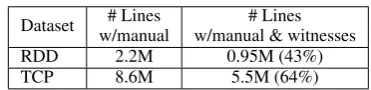
In our experiments on OCR correction, each training and test example is a line of text follow-ing the layout of the scanned image documents5. The average number of characters per line is 42.4 for the RDD newspapers and 53.2 for the TCP books. Table 2 lists statistics for the number of OCR’d text lines with manual transcriptions and additional witnesses. 43% of the manually tran-scribed lines have witnesses in the RDD newspa-pers, and 64% of them have witnesses in the TCP books. In the full Chronicling America data, 44% of lines align to at least one other witness. Al-though not all OCR collections will have this level of repetition, it is notable that these collections, which are some of the largest public-domain dig-ital libraries, do exhibit this kind of reprinting. Similarly, at least 25% of the pages in Google’s web crawls are duplicates (Henzinger,2006). Al-though we exploit text reuse, where available, to
4
www.textcreationpartnership.org
5The datasets can be downloaded fromhttp://www.
ccs.neu.edu/home/dongrui/ocr.html
improve decoding and unsupervised training, we also show (Table 5) significant improvements to OCR accuracy with only a single transcript.
Dataset # Lines # Lines
w/manual w/manual & witnesses
RDD 2.2M 0.95M (43%)
[image:3.595.322.508.105.150.2]TCP 8.6M 5.5M (64%)
Table 2:Statistics for the number of OCR’d lines in million (M) from the Richmond Dispatch and TCP Books with man-ual transcriptions (Column 1) or with both transcriptions and multiple witnesses (Column 2).
3 Methods
In this section, we first define our problem in §3.1, followed by model description. In gen-eral, we train an OCR error correction model via an attention-based RNN encoder-decoder, which takes a single erroneous OCR’d line as input and outputs the corrected text (§3.2). At decoding time, multi-input attention combination strategies are introduced to allow the decoder to integrate in-formation from multiple inputs (§3.3). Finally, we discuss several unsupervised settings for training the correction model in§3.4.
3.1 Problem Definition
Given a line of OCR’d textx, comprising the se-quence of characters[x1,· · ·, xTS], our goal is to map it to an error-free texty = [y1,· · ·, yTT]via modelingp(y|x). Givenp(y|x), we also seek to modelp(y|X)to search for consensus among du-plicated textsX, whereX= [x1,· · ·,xN]are
du-plicated lines of OCR’d text.
3.2 Attention-based Seq2Seq Model
Similar to previous work (Bahdanau et al.,2015), the encoder is a bidrectional RNN (Schuster and Paliwal,1997) that converts source sequencex = [x1,· · ·, xTS]into a sequence of RNN statesh =
[h1,· · ·, hTS], wherehi = [ − →
hi,
←−
hi]is a
concate-nation of both forward and backward hidden states at time stepi(1≤i≤TS). We have
− →
hi=f(xi,
− →
hi−1);
←−
hi=f(xi,
←−
hi+1), (1)
here f is the dynamic function, e.g., LSTM
(Hochreiter and Schmidhuber, 1997) or GRU (Cho et al.,2014).
The decoder RNN predicts the output sequence
y = [y1,· · ·, yTT], through the following dynam-ics and prediction model:
p(yt|y<t,x) =g(yt−1, st, ct), (3)
where st is the RNN state and ct is the context
vector at timet. yt is the predicted symbol from
the target vocabulary at timetvia prediction func-tion g(·). The context vector is given as a linear combination of the encoder hidden states:
ct= TS X
i=1
αt,ihi; αt,i =
eη(st−1,hi) P
τeη(st−1,hτ)
(4)
where αt,i is the weight for each hidden statehi
andηis the function that computes the strength of each encoder hidden state according to current de-coder hidden state. The loss function is the cross-entropy loss per time step summed over the output sequence y:
L(x,y) =−
TS X
t=1
logp(yt|x, y<t) (5)
3.3 Multi-input Attention
Given a trained Seq2Seq model p(y|x), our goal is to combine multiple input sequencesXto gen-erate the target sequence y, i.e., to utilize infor-mation from multiple sources at decoding time.
Assume that N relevant source sequences X =
[x1,· · ·,xN]are observed, where each sequence
xl = [xl,1,· · ·, xl,Tl](1 ≤ l ≤ N) and Tl is the length of the lth sequence. Then, a sequence of hidden stateshl = [hl,1,· · ·, hl,Tl]is generated by the encoder network for each input sequence xl.
At each decoding time stept, the decoder searches through encoder hidden statesH= [h1,· · ·,hN]
to compute a global context vector ct. Different
strategies to combine attention from multiple en-coders are described as follows.
Flat Attention Combination.Flat attention com-bination assigns a weight αt,l,i to each encoder
hidden statehl,ifor each input sequencexlas:
αt,l,i=
eη(st−1,hl,i)
PN l0=1P
Tl0
τ=1e
η(st−1,hl0,τ)
. (6)
Therefore, the global context vector is given by
ct= N
X
l=1
Tl X
i=1
αt,l,ihl,i. (7)
Flat attention combination is similar to single-input decoding in that it concatenates all single-inputs into a long sequence, except that the encoder hid-den states are computed indepenhid-dently for each in-put.
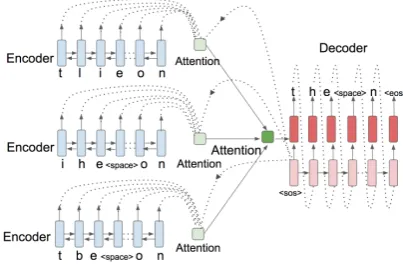
Hierarchical Attention Combination.The struc-ture of hierarchical attention combination is pre-sented in Figure 1. We first compute a context vector for each input as:
ct,l= Tl X
i=1
αt,l,ihl,i; αt,l,i=
eη(st−1,hl,i) PTl
τ=1eη(st−1,hl,τ)
.
(8) Then a global context vectorct is computed as a
weighted sum of all the context vectors:
ct= N
X
i=1
βt,lct,l, (9)
whereβt,l is the weight assigned to each context
vectorct,land computed in different ways as
fol-lows:
(a) Weighted Attention Combination. In weighted attention combination, the weight for each context vector is given by its dot product with the decoder state in the transformed common space:
βt,l=
eη(st−1,ct,l) PN
l0=1eη(st−1,ct,l0)
. (10)
(b) Average Attention Combination. In aver-age attention combination, each input sequence is treated as equally weighted. Thus βt,l = N1 for
each input sequencexl. It is more efficient than
[image:4.595.310.512.500.632.2]the weighted attention combination in that it does not need to compute a weight for each input.
Figure 1: Hierarchical attention combination.
These attention-combination methods do not have parameters trained on multiple inputs and are only introduced at decoding time. In contrast, Li-bovick´y and Helcl (2017) and Zoph and Knight
3.4 Training Settings
In this section, we introduce different settings for training our correction model, a single-input attention-based Seq2Seq model (§3.2), which transforms each OCR’d text line into a corrected version generated via different mechanisms.
Supervised Training. In this setting, the correc-tion model is trained to map each OCR’d line into the corresponding manual transcription, i.e., the human annotation. We call the correction model trained in this setting Seq2Seq-Super.
Unsupervised Training.In the absence of ground truth transcriptions, we can use different meth-ods to generate a noisy corrected version for each OCR’d line.
(a) Noisy Training. In this setting, the correc-tion model is trained to transform each OCR’d text line to a selected high-quality witness. The quality of the witnesses is measured by a 5-gram charac-ter language model built on the New York Time Corpus (Sandhaus, 2008) with KenLM toolkit (Heafield,2011). For each OCR’d line with mul-tiple witnesses, a score is assigned to each witness by the language model, divided by the number of characters in it to reduce the effect of the length of a witness. Then a witness with the highest score is chosen as the noisy ground truth for each line. Those lines with low score for all witnesses are removed. We call the correction model trained in this setting Seq2Seq-Noisy.
(b) Synthetic Training. In this setting, the er-ror correction model is trained to recover a man-ually corrupted out-of-domain corpus. We con-struct the synthetic dataset by injecting uniformly distributed insertion, deletion and substitution er-rors into the New York Times corpus. Firstly, the news articles are split into lines with random length between[1,70]following a Gaussian distri-butionN(45,5), which is similar to that of the real world dataset. Then, a certain number of lines are randomly selected and injected with equal num-ber of insertion, deletion and substitution errors. The correction model is then trained to recover the original line from each corrupted line. We call this model Seq2Seq-Syn.
(c) Synthetic Training with Bootstrapping. In this setting, we propose to further improve the per-formance of synthetic training via bootstrapping. The correction model trained on synthetic dataset does not perform well when correcting a given in-put from real world dataset, due to their difference
in error distributions. But it achieves compara-ble performance with the supervised model when decoding lines with multiple witnesses, since the model could further benefit from jointly aligning and voting among multiple inputs. Thus, with the multi-input attention mechanism introduced in §3.3, we first generate a high-quality consen-sus correction for each OCR’d line with witnesses via the correction model trained on synthetic data. Then, the a bootstrapped model is trained to trans-form those lines into their consensus correction re-sults. We call the correction model trained in this setting Seq2Seq-Bootstrap.
4 Experiments
In this section, we first introduce the details of our experimental setup (§4.1). Then, the results of preliminary experiments comparing the perfor-mance of different options for the single-input Seq2Seq model and the multi-input attention com-bination strategies are presented in§4.2. The main experimental results for evaluating the correction model trained in different training settings and de-coded with/without multi-input attention are re-ported and explained in§4.3. Further discussions of our model are described in§4.4.
4.1 Experimental Setup
We begin by describing the data split, training de-tails, baseline systems, and evaluation metrics.
4.1.1 Training Details
For both RDD newspapers and TCP books, we randomly split the OCR’d lines into 80% training and 20% test either by the date of the newspaper or by the name of the books. For the RDD newspa-pers, we have 1.7M training lines and 0.44M test lines. For the TCP books, 2.8M lines are randomly sampled from the whole training set for different training settings to conduct a fair comparison with noisy training, and about 1.6M lines are used for testing.
4.1.2 Baselines and Comparisons
In preliminary experiments, we first compare the neural translation model (§3.2) with a commonly used Seq2Seq model, pruned conditional random fields (PCRF) (Schnober et al., 2016) on the single-input correction task. CRF models have been shown to be very competitve on tasks such as OCR post-correction, spelling correction, and lemmatization. After that, we compare the differ-ent multi-input attdiffer-ention strategies introduced in §3.3 on multi-input correction task to choose the best strategy for the main experiments.
In the main experiment, we compare the per-formance of correction models trained in differ-ent training settings and decode with and with-out multiple witnesses. Two ensembles methods, language model ranking (LMR) and majority vote (Xu and Smith,2017), are also considered as un-supervised baseline methods. LMR chooses a sin-gle high-quality witness for each OCR’d line by a language model as the correction for that line. Majority vote first aligns multiple input sequences using a greedy pairwise algorithm (since multiple sequence alignment is intractable) and then votes on each position in the alignment, with a slight ad-vantage given to the original OCR output in case of ties. We also tried to use an exact unsupervised method for consensus decoding based on dual de-composition (Paul and Eisner,2012). Their imple-mentation, unfortunately, turned out not to return a certificate of completion on most lines in our data even after thousands of iterations.
4.1.3 Evaluation Metrics
Word error rate (WER) and character error rate (CER) are used to compare the performance of each method. Case is ignored. Lattice word er-ror rate (LWER) and lattice character erer-ror rate (LCER) are also computed as the oracle perfor-mance for each method, which could reveal the capability of each model to be applied to down-stream tasks taking lattices as input, e.g., re-ranking or retrieval of the correction hypothe-ses (Taghva et al.,1996;Lam-Adesina and Jones,
2006). We compute the macro average for each type of error rate, which allows us to use a paired permutation significance test.
4.2 Preliminary Experiments
In this section, we conduct two preliminary ex-periments to study different options for both the
single-input correction models and the multi-input attention combination strategies.
4.2.1 Single Input Correction Model
Model CER WER
None 0.18133 0.41780
PCRF(order=5,w=4) 0.11403 0.25116
PCRF(order=5,w=6) 0.11535 0.25617
[image:6.595.329.498.116.173.2]Attn 0.11028* 0.23405*
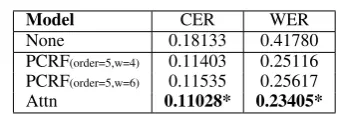
Table 3: CER and WER on single-input correction for PCRF and Attn-Seq2Seq on RDD newspapers. Results from Attn-Seq2Seq that are significantly better than the PCRF are highlighted with *(p < 0.05, paired permutation test). The best result for each column is inbold.
We first compare the attention-based Seq2Seq (Attn-Seq2Seq) model, with a traditional Seq2Seq model, PCRF, on single input correction task. As the PCRF implementation of Schnober et al.
(2016) is highly memory and time consuming for training on long sequences, we compare it with Attn-Seq2Seq model on a smaller dataset with 100K lines randomly sampled from RDD news-papers training set. The trained correction model is then applied to correct the full test set. CER and WER of the correction results from both mod-els are listed in Table 3. We can find that the Attn-Seq2Seq neural translation model works sig-nificantly better than the PCRF when trained on a dataset of the same size. The performance of the Attn-Seq2seq model could be further improved by including more training data or by multi-input de-coding for duplicated texts, while the PCRF could only be trained on limited data and is not able to work on multiple inputs. Thus, we choose Attn-Seq2Seq as our error correction model.
4.2.2 Multi-input Attention Combination
We also compare different attention combination strategies on a multi-input decoding task. The re-sults from Table 4 reveal that average attention combination performs best among all the decod-ing strategies on RDD newspapers and TCP books datasets. It reduces the CER of single input de-coding by 41.5% for OCR’d lines in RDD
news-papers and 9.76% for TCP books. The
Decode RDD Newspapers TCP Books
CER LCER WER LWER CER LCER WER LWER
[image:7.595.91.507.62.135.2]None 0.15149 0.04717 0.37111 0.13799 0.10590 0.07666 0.30549 0.23495 Single 0.07199 0.03300 0.14906 0.06948 0.04508 0.01407 0.11283 0.03392 Flat 0.07238 0.02904* 0.15818 0.06241* 0.05554 0.01727 0.13487 0.04079 Weighted 0.06882* 0.02145* 0.15221 0.05375 0.05516 0.01392* 0.1330 0.03669 Average 0.04210* 0.01399 * 0.09397 0.02863* 0.04072* 0.01021* 0.09786* 0.02092*
Table 4: Results of correcting lines in the RDD newspapers and TCP books with multiple witnesses when decoding with different strategies using the same supervised model. Attention combination strategies that statistically significantly outperform single-input decoding are highlighted with * (p <0.05, paired-permutation test). Best result for each column is inbold.
of both CER and WER.
4.3 Main Results
We now present results on the full training and test sets for the Richmond Daily Dispatch news-papers and Text Creation Partnership books. All results are on the same test set. The multi-input de-coding experiments have access to additional wit-nesses for each line, where available, but fall back to single-input decoding when no additional wit-nesses are present for a given line.
Table 5 presents the results for our model trained in different training settings as well as the baseline language model reranking (LMR) and majority vote methods. Multiple input decoding performs better than single input decoding for ev-ery training setting, and the model trained in su-pervised mode with multi-input decoding achieves the best performance. The majority vote base-line, which works only on more than two in-puts, performs worst on both the TCP books
and RDD newspapers. Our proposed
unsuper-vised framework Noisy and Seq2Seq-Boots achieves performance comparable with the supervised model via multi-input decoding on the
RDD newspaper dataset. The performance of
Seq2Seq-Noisy is worse on the TCP Books than the RDD newspapers, since those old books con-tain the character longs6, which is formerly used where s occurred in the middle or at the begin-ning of a word. These characters are recognized asfin all the witnesses because of similar shape. Thus, the model trained on noisy data are unable to correct them intos. Nonetheless, by removing the factor of longs, i.e., replacing the longsin the ground truth withf, Seq2Seq-Noisy could achieve a CER of 0.062 for single-input decoding and 0.058 for multi-input decoding on the TCP books. Both Seq2Seq-Syn and Seq2Seq-Boots work bet-ter on the RDD newspapers than the TCP books
6https://en.wikipedia.org/wiki/Long_s
dataset. We conjecture that it is because the syn-thetic dataset is trained on (modern) newspapers, which are more similar to the nineteenth-century RDD newspapers. The longsproblem also makes it more difficult for the model trained on synthetic data to work on the TCP books.
4.4 Discussion
In this section, we provide further analysis on dif-ferent aspects of our method.
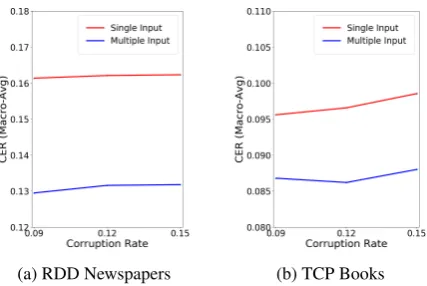
Does Corruption Rate Affect Synthetic Train-ing? We first examine how the corruption rate of the synthetic dataset would affect the performance of the correction model. Figure 2 presents the results of single-input correction and multi-input correction tasks on the RDD newspapers and TCP books when trained on synthetic data corrupted with different error rate: 0.9, 0.12, 0.15. For both tasks, the character error rate increases a little bit when the correction model is trained to recover the synthetic date with higher corruption rate. How-ever, the performance is more stable on the RDD newspapers than the TCP books when more errors are introduced.
[image:7.595.310.524.535.678.2](a) RDD Newspapers (b) TCP Books
Figure 2: Performance of Seq2Seq-Syn trained on syn-thetic data with different corruption rates.
Decode Model RDD Newspapers TCP Books
CER LCER WER LWER CER LCER WER LWER
None 0.18133 0.13552 0.41780 0.31544 0.10670 0.08800 0.31734 0.27227
Single
Seq2Seq-Super 0.09044 0.04469 0.17812 0.09063 0.04944 0.01498 0.12186 0.03500 Seq2Seq-Noisy 0.10524 0.05565 0.20600 0.11416 0.08704 0.05889 0.25994 0.15725 Seq2Seq-Syn 0.16136 0.11986 0.35802 0.26547 0.09551 0.06160 0.27845 0.18221 Seq2Seq-Boots 0.11037 0.06149 0.22750 0.13123 0.07196 0.03684 0.21711 0.11233
Multi
LMR 0.15507 0.13552 0.34653 0.31544 0.10862 0.08800 0.33983 0.27227 Majority Vote 0.16285 0.13552 0.40063 0.31544 0.11096 0.08800 0.34151 0.27227 Seq2Seq-Super 0.07731 0.03634 0.15393 0.07269 0.04668 0.01252 0.11236 0.02667 Seq2Seq-Noisy 0.09203* 0.04554* 0.17940 0.09269 0.08317 0.05588 0.24824 0.14885
[image:8.595.73.531.57.191.2]Seq2Seq-Syn 0.12948 0.09112 0.28901 0.19977 0.08506 0.05002 0.24942 0.15169 Seq2Seq-Boots 0.09435 0.04976 0.19681 0.10604 0.06824* 0.03343* 0.20325* 0.09995*
Table 5: Results from model trained under different settings on single-input decoding and multiple-input decoding for both the RDD newspapers and TCP books. All training is unsupervised except for supervised results initalics. Unsupervised training settings with multi-input decoding that are significantly better than other unsupervised counterparts are highlighted with * (p <0.05, paired-permutation test). Best result amongunsupervisedtraining in each column is inbold.
(a) RDD Newspapers (b) TCP Books
Figure 3:Performance of different models on multiple decoding of lines with different number of witnesses.
the performance of multiple-input decoding. The test set is divided into subgroups with varying size according to their number of witnesses. Fig-ure3presents the performance of multi-input cor-rection on subgroups with different number of witnesses. We can see that supervised training achieves the best performance on each subgroup for both datasets. On the RDD newspapers, the performance of each training setting is signifi-cantly improved when the number of witnesses in-creases from 0 to 2, then the error rate tends to be flat when more witnesses are observed. For the TCP books, the character error rate for both Seq2Seq-Syn and Seq2Seq-Boots decreases with small fluctuation when the number of witnesses increases. Seq2Seq-Noisy performs the worst al-most on all subgroups on the TCP books since all the witnesses suffers from the longsproblem.
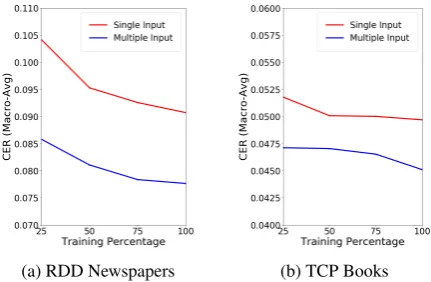
Can More Training Data Benefit Learning?
Figure4 shows the test results for our correction model trained on datasets of different size. As
the size of the training set increases, the CER of our model decreases consistently for both single and multiple input correction on the RDD newspa-pers. However, the performance curve of correc-tion model on TCP books dataset is flatter since it is larger overall than RDD newspapers.
[image:8.595.84.522.263.433.2](a) RDD Newspapers (b) TCP Books
[image:8.595.308.524.567.708.2]5 Related Work
Multi-Input OCR Correction. Ensemble meth-ods have been shown to be effective in OCR post-correction by combining OCR output from mul-tiple scans of the same document (Lopresti and Zhou,1997;Klein and Kopel, 2002;Cecotti and Bela¨ıd,2005;Lund et al.,2013). Existing methods aim at generating consensus results by aligning multiple inputs, followed by supervised methods such as classification (Boschetti et al.,2009;Lund et al., 2011;Al Azawi et al., 2015), or unsuper-vised methods such as dictionary-based selection (Lund and Ringger,2009) and voting (Wemhoener et al., 2013;Xu and Smith,2017). While super-vised ensemble methods require human annota-tion for training, unsupervised selecannota-tion methods work only when the correct word or character ex-ists in one of the inputs. Furthermore, those meth-ods could not correct single inputs.
Multi-Input Attention. Multi-input attention has already been explored in tasks such as machine translation (Zoph and Knight, 2016; Libovick´y and Helcl, 2017) and summarization (Wang and Ling, 2016). Wang and Ling (2016) propose to concatenate multiple inputs to generate a sum-mary; this flat attention combination model might be affected by the order of input sequences. Zoph and Knight (2016) aims at developing a multi-source translation model on a trilingual corpus where the encoder for each language is combined to pass to the decoder; however, it requires the same number of inputs at training and decoding time since the parameters depend on the number of inputs.Libovick´y and Helcl(2017) explore dif-ferent attention combination strategies for multi-ple information sources such as image and text. In contrast, our method does not require multi-ple inputs for training, and the attention combina-tion strategies are used to integrate multiple inputs when decoding.
6 Conclusions
We have proposed an unsupervised framework for OCR error correction, which can handle both single-input and multi-input correction tasks. An attention-based sequence-to-sequence model is applied for single-input correction, based on which a strategy of multi-input attention combi-nation is designed to correct multiple input se-quences simultaneously. The proposed strategy naturally incorporates aligning, correcting, and
voting among multiple sequences, and is thus ef-fective in improving the correction performance for corpora containing duplicated text. We pro-pose two ways of training the correction model without human annotation by exploiting the dupli-cation in the corpus. Experimental results on his-torical books and newspapers show that these un-supervised approaches significantly improve OCR accuracy and, when multiple inputs are avail-able, achieve performance comparable to super-vised methods.
Acknowledgements
This work was supported by NIH grant
2R01DC009834-06A1, the Andrew W. Mel-lon Foundation’s Scholarly Communications and Information Technology program, and a Google Faculty Research Award. Any views, findings, conclusions, or recommendations expressed do not necessarily reflect those of the NIH, Mellon, or Google. We would like to thank the anonymous reviewers for their valuable comments.
References
Mayce Al Azawi, Marcus Liwicki, and Thomas M. Breuel. 2015. Combination of multiple aligned recognition outputs using WFST and LSTM. In IC-DAR, pages 31–35.
Dzmitry Bahdanau, Kyunghyun Cho, and Yoshua Ben-gio. 2015. Neural machine translation by jointly learning to align and translate. InICLR.
Federico Boschetti, Matteo Romanello, Alison Babeu, David Bamman, and Gregory Crane. 2009. Improv-ing OCR accuracy for classical critical editions. In JCDL, pages 156–167.
Hubert Cecotti and Abdel Bela¨ıd. 2005. Hybrid OCR combination approach complemented by a special-ized ICR applied on ancient documents. InICDAR, pages 1045–1049.
Guillaume Chiron, Antoine Doucet, Mickael Coustaty, Muriel Visani, and Jean-Philippe Moreux. 2017. Impact of OCR errors on the use of digital libraries: Towards a better access to information. InJCDL.
Kyunghyun Cho, Bart Van Merri¨enboer, Caglar Gul-cehre, Dzmitry Bahdanau, Fethi Bougares, Holger Schwenk, and Yoshua Bengio. 2014. Learning phrase representations using RNN encoder-decoder for statistical machine translation. InEMNLP.
Kenneth Heafield. 2011. KenLM: Faster and smaller language model queries. InProc. Workshop on Sta-tistical Machine Translation, pages 187–197.
Monika Henzinger. 2006. Finding near-duplicate web pages: A large-scale evaluation of algorithms. In SIGIR, pages 284–291.
Sepp Hochreiter and J¨urgen Schmidhuber. 1997. Long short-term memory. Neural Computation, 9(8):1735–1780.
Rose Holley. 2009. Many hands make light work: Pub-lic collaborative OCR text correction in Australian historic newspapers. Technical report, National Li-brary of Australia.
Shmuel T. Klein and Miri Kopel. 2002. A voting sys-tem for automatic OCR correction. InProc. SIGIR Workshop on Information Retrieval and OCR.
Okan Kolak, William Byrne, and Philip Resnik. 2003. A generative probabilistic OCR model for NLP ap-plications. InHLT-NAACL, pages 55–62.
Okan Kolak and Philip Resnik. 2002. OCR error cor-rection using a noisy channel model. InHLT, pages 257–262.
Adenike M. Lam-Adesina and Gareth J. F. Jones. 2006. Examining and improving the effectiveness of rel-evance feedback for retrieval of scanned text doc-uments. Information Processing & Management, 42(3):633–649.
Jindˇrich Libovick´y and Jindˇrich Helcl. 2017. Attention strategies for multi-source sequence-to-sequence learning. InACL.
Daniel Lopresti and Jiangying Zhou. 1997. Using con-sensus sequence voting to correct OCR errors. Com-puter Vision and Image Understanding, 67(1):39– 47.
William B. Lund, Douglas J. Kennard, and Eric K. Ringger. 2013. Combining multiple thresholding bi-narization values to improve OCR output. InProc. Document Recognition and Retrieval (DRR).
William B. Lund and Eric K. Ringger. 2009. Improv-ing optical character recognition through efficient multiple system alignment. In JCDL, pages 231– 240.
William B Lund, Eric K Ringger, and Daniel D Walker. 2014. How well does multiple OCR error correction generalize? InProc. Document Recognition and Re-trieval (DRR).
William B. Lund, Daniel D. Walker, and Eric K. Ring-ger. 2011. Progressive alignment and discriminative error correction for multiple OCR engines. In IC-DAR, pages 764–768.
Michael J. Paul and Jason Eisner. 2012. Implicitly in-tersecting weighted automata using dual decompo-sition. InNAACL, pages 232–242.
Evan Sandhaus. 2008. The New York Times annotated corpus.Linguistic Data Consortium, 6(12):e26752.
Carsten Schnober, Steffen Eger, Erik-Lˆan Do Dinh, and Iryna Gurevych. 2016. Still not there? comparing traditional sequence-to-sequence models to encoder-decoder neural networks on monotone string trans-lation tasks. InCOLING.
Mike Schuster and Kuldip K. Paliwal. 1997. Bidirec-tional recurrent neural networks. IEEE Transactions on Signal Processing, 45(11):2673–2681.
David A. Smith, Ryan Cordell, Elizabeth Maddock Dillon, Nick Stramp, and John Wilkerson. 2014. Detecting and modeling local text reuse. InJCDL.
T. F. Smith and M. S. Waterman. 1981. Identifica-tion of common molecular subsequences. Journal of Molecular Biology, 147(1):195–197.
Kazem Taghva, Julie Borsack, and Allen Condit. 1996. Effects of ocr errors on ranking and feedback using the vector space model. Information Processing & Management, 32(3):317–327.
Lu Wang and Wang Ling. 2016. Neural network-based abstract generation for opinions and arguments. In NAACL, pages 47–57.
David Wemhoener, Ismet Zeki Yalniz, and R. Man-matha. 2013. Creating an improved version using noisy OCR from multiple editions. InICDAR, pages 160–164.
John Wilkerson, David A. Smith, and Nick Stramp. 2015. Tracing the flow of policy ideas on legisla-tures: A text reuse approach. American Journal of Political Science.
Ziang Xie, Anand Avati, Naveen Arivazhagan, Dan Ju-rafsky, and Andrew Y Ng. 2016. Neural language correction with character-based attention. arXiv preprint arXiv:1603.09727.
Shaobin Xu and David A. Smith. 2017. Retrieving and combining repeated passages to improve OCR. In JCDL.
Takafumi Yamazoe, Minoru Etoh, Takeshi Yoshimura, and Kousuke Tsujino. 2011. Hypothesis preser-vation approach to scene text recognition with weighted finite-state transducer. In ICDAR, pages 359–363.