Proceedings of the 55th Annual Meeting of the Association for Computational Linguistics, pages 56–68 Vancouver, Canada, July 30 - August 4, 2017. c2017 Association for Computational Linguistics Proceedings of the 55th Annual Meeting of the Association for Computational Linguistics, pages 56–68
Vancouver, Canada, July 30 - August 4, 2017. c2017 Association for Computational Linguistics
Morph-fitting: Fine-Tuning Word Vector Spaces
with Simple Language-Specific Rules
Ivan Vuli´c1 , Nikola Mrkši´c1, Roi Reichart2
Diarmuid Ó Séaghdha3, Steve Young1 , Anna Korhonen1
1 University of Cambridge 2 Technion, Israel Institute of Technology 3 Apple Inc.
{iv250,nm480,sjy11,alk23}@cam.ac.uk
[email protected] [email protected]
Abstract
Morphologically rich languages accentu-ate two properties of distributional vec-tor space models: 1) the difficulty of in-ducing accurate representations for low-frequency word forms; and 2) insensitivity to distinct lexical relations that have simi-lar distributional signatures. These effects are detrimental for language understanding systems, which may infer thatinexpensive
is a rephrasing forexpensiveor may not as-sociateacquirewithacquires. In this work, we propose a novelmorph-fittingprocedure which moves past the use of curated seman-tic lexicons for improving distributional vector spaces. Instead, our method injects morphological constraints generated using simple language-specific rules, pulling in-flectionalforms of the same word close to-gether and pushingderivational antonyms
far apart. In intrinsic evaluation over four languages, we show that our approach:1)
improves low-frequency word estimates; and2)boosts the semantic quality of the entire word vector collection. Finally, we show that morph-fitted vectors yield large gains in the downstream task ofdialogue state tracking, highlighting the importance of morphology for tackling long-tail phe-nomena in language understanding tasks.
1 Introduction
Word representation learning has become a re-search area of central importance in natural lan-guage processing (NLP), with its usefulness demon-strated across many application areas such as pars-ing (Chen and Manning, 2014;Johannsen et al., 2015), machine translation (Zou et al.,2013), and many others (Turian et al.,2010;Collobert et al.,
2011). Most prominent word representation tech-niques are grounded in thedistributional hypothe-sis(Harris,1954), relying on word co-occurrence information in large textual corpora (Curran,2004; Turney and Pantel, 2010; Mikolov et al., 2013; Mnih and Kavukcuoglu,2013;Levy and Goldberg, 2014;Schwartz et al.,2015, i.a.).
Morphologically rich languages, in which “sub-stantial grammatical information. . . is expressed at word level” (Tsarfaty et al.,2010), pose specific challenges for NLP. This is not always considered when techniques are evaluated on languages such as English or Chinese, which do not have rich mor-phology. In the case of distributional vector space models, morphological complexity brings two chal-lenges to the fore:
1. Estimating Rare Words: A single lemma can have many different surface realisations. Naively treating each realisation as a separate word leads to sparsity problems and a failure to exploit their shared semantics. On the other hand, lemma-tising the entire corpus can obfuscate the differ-ences that exist between different word forms even though they share some aspects of meaning.
2. Embedded Semantics:Morphology can en-code semantic relations such as antonymy (e.g. lit-erateandilliterate,expensiveandinexpensive) or (near-)synonymy (north,northern,northerly).
In this work, we tackle the two challenges jointly by introducing aresource-lightvector space fine-tuning procedure termed morph-fitting. The pro-posed method does not require curated knowledge bases or gold lexicons. Instead, it makes use of the observation that morphology implicitly encodes semantic signals pertaining to synonymy (e.g., German word inflections katalanisch, katalanis-chem, katalanischerdenote the same semantic con-cept in different grammatical roles), and antonymy (e.g., mature vs. immature), capitalising on the
en_expensive de_teure it_costoso en_slow de_langsam it_lento en_book de_buch it_libro
costly teuren dispendioso fast allmählich lentissimo books sachbuch romanzo costlier kostspielige remunerativo slowness rasch lenta memoir buches racconto cheaper aufwändige redditizio slower gemächlich inesorabile novel romandebüt volumetto prohibitively kostenintensive rischioso slowed schnell rapidissimo storybooks büchlein saggio
pricey aufwendige costosa slowing explosionsartig graduale blurb pamphlet ecclesiaste expensiveness teures costosa slowing langsamer lenti booked bücher libri
costly teuren costose slowed langsames lente rebook büch libra
[image:2.595.78.522.63.158.2]costlier teurem costosi slowness langsame lenta booking büche librare ruinously teurer dispendioso slows langsamem veloce rebooked büches libre unaffordable teurerer dispendiose idle langsamen rapido books büchen librano
Table 1: The nearest neighbours of three example words (expensive,slowandbook) in English, German and Italian before (top) and after (bottom) morph-fitting.
proliferation of word forms in morphologically rich languages. Formalised as an instance of the post-processingsemantic specialisationparadigm (Faruqui et al.,2015;Mrkši´c et al.,2016), morph-fitting is steered by a set of linguistic constraints derived from simple language-specific rules which describe (a subset of) morphological processes in a language. The constraints emphasise similarity on one side (e.g., by extractingmorphological syn-onyms), and antonymy on the other (by extracting
morphologicalantonyms), see Fig.1and Tab.2. The key idea of the fine-tuning process is to pull synonymous examples described by the constraints closer together in the transformed vector space, while at the same time pushing antonymous exam-ples away from each other. The explicit post-hoc injection of morphological constraints enables:a)
the estimation of more accurate vectors for low-frequency words which are linked to their high-frequency forms by the constructed constraints;1 this tackles the data sparsity problem; andb) spe-cialising the distributional space to distinguish be-tween similarity and relatedness (Kiela et al.,2015), thus supporting language understanding applica-tions such asdialogue state tracking(DST).2
As a post-processor, morph-fitting allows the integration of morphological rules with any distri-butional vector space in any language: it treats an input distributional word vector space as a black box and fine-tunes it so that the transformed space reflects the knowledge coded in the input morpho-logical constraints (e.g., Italian words rispettoso
and irrispetosa should be far apart in the
trans-1For instance, the vector for the wordkatalanischemwhich occurs only 9 times in the German Wikipedia will be pulled closer to the more reliable vectors forkatalanischand kata-lanischer, with frequencies of 2097 and 1383 respectively.
2Representation models that do not distinguish between synonyms and antonyms may have grave implications in down-stream language understanding applications such as spoken dialogue systems: a user looking for‘an affordable Chinese restaurant in west Cambridge’does not want a recommenda-tion for‘an expensive Thai place in east Oxford’.
rispettoso rispettosa
rispettosi
irrispettoso irrispettosa
irrispettosi
Figure 1:Morph-fittingin Italian. Representations forrispettoso,rispettosa,rispettosi(EN:respectful), are pulled closer together in the vector space (solid lines; ATTRACT constraints). At the same time, the model pushes them away from their antonyms (dashed lines; REPELconstraints)irrispettoso,
ir-rispettosa,irrispettosi(EN:disrespectful), obtained through morphological affix transformation cap-tured by language-specific rules (e.g., adding the prefixir-typically negates the base word in Italian)
formed vector space, see Fig.1). Tab.1illustrates the effects of morph-fitting by qualitative exam-ples in three languages: the vast majority of nearest neighbours are “morphological” synonyms.
We demonstrate the efficacy of morph-fitting in four languages (English, German, Italian, Rus-sian), yielding large and consistent improvements on benchmarking word similarity evaluation sets such as SimLex-999 (Hill et al.,2015), its multilin-gual extension (Leviant and Reichart,2015), and SimVerb-3500 (Gerz et al.,2016). The improve-ments are reported for all four languages, and with a variety of input distributional spaces, verifying the robustness of the approach.
We then show that incorporating morph-fitted vectors into a state-of-the-art neural-network DST model results in improved tracking performance, especially for morphologically rich languages. We report an improvement of 4% on Italian, and 6% on German when usingmorph-fittedvectors instead of the distributional ones, setting a new state-of-the-art DST performance for the two datasets.3
[image:2.595.309.527.207.268.2]2 Morph-fitting: Methodology
Preliminaries In this work, we focus on four lan-guages with varying levels of morphological com-plexity: English (EN), German (DE), Italian (IT), and Russian (RU). These correspond to languages in the Multilingual SimLex-999 dataset. Vocabu-lariesWen,Wde,Wit,Wruare compiled by
retain-ing all word forms from the four Wikipedias with word frequency over 10, see Tab.3. We then extract sets of linguistic constraints from these (large) vo-cabularies using a set of simple language-specific
if-then-else rules, see Tab.2.4 These constraints (Sect. 2.2) are used as input for the vector space post-processing ATTRACT-REPELalgorithm (out-lined in Sect.2.1).
2.1 The ATTRACT-REPELModel
The ATTRACT-REPELmodel, proposed byMrkši´c
et al.(2017b), is an extension of the PARAGRAM procedure proposed by Wieting et al.(2015). It provides a generic framework for incorporating
similarity(e.g.successfulandaccomplished) and
antonymyconstraints (e.g.nimbleandclumsy) into pre-trained word vectors. Given the initial vector space and collections of ATTRACTand REPEL con-straintsAandR, the model gradually modifies the
space to bring the designated word vectors closer together or further apart. The method’s cost func-tion consists of three terms. The first term pulls the ATTRACTexamples(xl, xr) ∈Acloser together.
IfBAdenotes the current mini-batch of ATTRACT
examples, this term can be expressed as:
A(BA) =
X
(xl,xr)∈BA
(ReLU(δatt+xltl−xlxr)
+ ReLU(δatt+xrtr−xlxr)) where δatt is the similarity margin which
de-termines how much closer synonymous vectors should be to each other than to each of their respec-tive negarespec-tive examples.ReLU(x) = max(0, x)is the standard rectified linear unit (Nair and Hinton, 2010). The ‘negative’ example ti for each word
xi in any ATTRACTpair is the word vector
clos-esttoxiamong the examples in the current
mini-batch (distinct from its target synonym andxi
it-self). This means that this term forces synonymous
4A native speaker can easily come up with these sets of morphological rules (or at least with a reasonable subset of them) without any linguistic training. What is more, the rules forDE,IT, andRUwere created by non-native, non-fluent
speakers with a limited knowledge of the three languages, exemplifying the simplicity and portability of the approach.
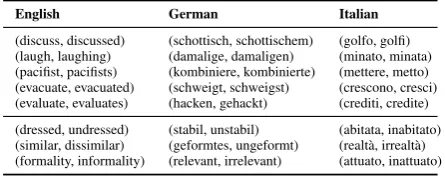
English German Italian
[image:3.595.306.529.63.151.2](discuss, discussed) (schottisch, schottischem) (golfo, golfi) (laugh, laughing) (damalige, damaligen) (minato, minata) (pacifist, pacifists) (kombiniere, kombinierte) (mettere, metto) (evacuate, evacuated) (schweigt, schweigst) (crescono, cresci) (evaluate, evaluates) (hacken, gehackt) (crediti, credite) (dressed, undressed) (stabil, unstabil) (abitata, inabitato) (similar, dissimilar) (geformtes, ungeformt) (realtà, irrealtà) (formality, informality) (relevant, irrelevant) (attuato, inattuato)
Table 2: Example synonymous (inflectional; top) and antonymous (derivational; bottom) constraints.
words from the in-batch ATTRACTconstraints to be closer to one another than to any other word in the current mini-batch.
The second term pushes antonyms away from each other. If(xl, xr) ∈ BR is the current
mini-batch of REPEL constraints, this term can be ex-pressed as follows:
R(BR) =
X
(xl,xr)∈BR
(ReLU(δrpl+xlxr−xltr)
+ ReLU(δrpl+xlxr−xrtr)) In this case, each word’s ‘negative’ example is the (in-batch) word vector furthest away from it (and distinct from the word’s target antonym). The intu-ition is that we want antonymous words from the input REPELconstraints to befurther awayfrom each other than from any other word in the current mini-batch;δrplis now therepelmargin.
The final term of the cost function serves to retain the abundance of semantic information en-coded in the starting distributional space. Ifxiniti is
the initial distributional vector andV(B)is the set of all vectors present in the given mini-batch, this term (per mini-batch) is expressed as follows:
R(BA,BR) =
X
xi∈V(BA∪BR)
λreg
xiniti −xi
2
whereλregis the L2 regularisation constant.5This
term effectivelypullsword vectors towards their initial (distributional) values, ensuring that rela-tions encoded in initial vectors persist as long as they do not contradict the newly injected ones.
2.2 Language-Specific Rules and Constraints Semantic Specialisation with Constraints The fine-tuning ATTRACT-REPELprocedure is entirely driven by the input ATTRACTand REPELsets of
5We use hyperparameter valuesδ
|W| |A| |R|
[image:4.595.74.287.64.120.2]English 1,368,891 231,448 45,964 German 1,216,161 648,344 54,644 Italian 541,779 278,974 21,400 Russian 950,783 408,400 32,174
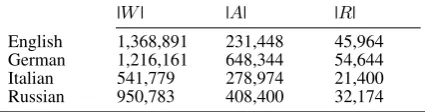
Table 3: Vocabulary sizes and counts of ATTRACT (A) and REPEL(R) constraints.
constraints. These can be extracted from a variety of semantic databases such as WordNet (Fellbaum, 1998), the Paraphrase Database (Ganitkevitch et al., 2013;Pavlick et al.,2015), or BabelNet (Navigli and Ponzetto,2012;Ehrmann et al.,2014) as done in prior work (Faruqui et al.,2015;Wieting et al., 2015;Mrkši´c et al.,2016, i.a.). In this work, we investigate another option: extracting constraints
withoutcurated knowledge bases in a spectrum of languages by exploiting inherent language-specific properties related to linguistic morphology. This relaxation ensures a wider portability of ATTRACT -REPELto languages and domains without readily available or adequate resources.
Extracting ATTRACTPairs The core difference betweeninflectionalandderivational morphology
can be summarised in a few lines as follows: the for-mer refers to a set of processes through which the word form expresses meaningful syntactic infor-mation, e.g., verb tense, without any change to the semantics of the word. On the other hand, the latter refers to the formation of new words with seman-tic shifts in meaning (Schone and Jurafsky,2001; Haspelmath and Sims,2013;Lazaridou et al.,2013; Zeller et al.,2013;Cotterell and Schütze,2017).
For the ATTRACTconstraints, we focus on
in-flectionalrather than onderivational morphology
rules as the former preserve the full meaning of a word, modifying it only to reflect grammatical roles such as verb tense or case markers (e.g.,(en_read, en_reads) or(de_katalanisch, de_katalanischer)). This choice is guided by our intent to fine-tune the original vector space in order to improve the embedded semantic relations.
We define two rules for English, widely recog-nised as morphologically simple (Avramidis and Koehn,2008;Cotterell et al.,2016b). These are:
(R1)if w1, w2∈Wen, wherew2=w1+ing/ed/s,
thenadd(w1, w2)and (w2, w1)to the set of AT -TRACTconstraintsA. This rule yields pairs such as
(look, looks), (look, looking), (look, looked). If w[: −1] is a function which strips the last character from word w, the second rule is: (R2)
if w1 ends with the lettere and w1 ∈ Wen and
w2 ∈ Wen, wherew2 =w1[: −1]+ing/ed,then
add(w1, w2)and(w2, w1)toA. This creates pairs
such as(create, creating)and(create, created). Nat-urally, introducing more sophisticated rules is pos-sible in order to cover for other special cases and morphological irregularities (e.g.,sweep / swept), but in all our ENexperiments,A is based on the
two simpleENrules R1 and R2.
The other three languages, with more compli-cated morphology, yield a larger number of rules. In Italian, we rely on the sets of rules spanning: (1) regular formation of plural (libro / libri); (2) regular verb conjugation (aspettare / aspettiamo); (3) regular formation of past participle (aspettare / aspettato); and (4) rules regarding grammatical gender (bianco / bianca). Besides these, another set of rules is used for German and Russian: (5) regular declension (e.g.,asiatisch / asiatischem).
Extracting REPELPairs As another source of implicit semantic signals,W also contains words
which representderivational antonyms: e.g., two words that denote concepts with opposite meanings, generated through a derivational process. We use a standard set ofEN“antonymy” prefixes:APen =
{dis, il, un, in, im, ir, mis, non, anti}(Fromkin et al., 2013).If w1, w2 ∈ Wen, where w2 is generated
by adding a prefix fromAPentow1,then(w1, w2)
and(w2, w1) are added to the set of REPEL con-straintsR. This rule generates pairs such as
(ad-vantage, disadvantage)and(regular, irregular). An additional rule replaces the suffix-ful with-less, extracting antonyms such as(careful, careless).
Following the same principle, we useAPde =
{un, nicht, anti, ir, in, miss}, APit = {in, ir, im,
anti}, andAPru ={не,анти}. For instance, this
generates anITpair(rispettoso, irrispettoso)(see Fig.1). ForDE, we use another rule targeting suffix replacement:-vollis replaced by-los.
We further expand the set of REPELconstraints by transitively combining antonymy pairs from the previous step with inflectional ATTRACTpairs. This step yields additional constraints such as
(rispettosa, irrispettosi)(see Fig.1). The finalA
andRconstraint counts are given in Tab.3. The full
sets of rules are available as supplemental material.
3 Experimental Setup
on the latest Wikipedia dump of each language. We induce 300-dimensional word vectors, with the frequency cut-off set to 10. The vocabulary sizes
|W|for each language are provided in Tab.3.6We label these collections of vectorsSGNS-LARGE. Other Starting Distributional Vectors We also analyse the impact ofmorph-fittingon other col-lections of well-known EN word vectors. These vectors have varying vocabulary coverage and are trained with different architectures. We test stan-dard distributional models: Common-Crawl GloVe (Pennington et al.,2014), SGNS vectors (Mikolov et al.,2013) with various contexts (BOW = bag-of-words; DEPS= dependency contexts), and train-ing data (PW= Polyglot Wikipedia fromAl-Rfou et al.(2013);8B= 8 billion tokenword2vec cor-pus), following (Levy and Goldberg, 2014) and (Schwartz et al.,2015). We also test the symmetric-pattern based vectors of Schwartz et al. (2016) (SymPat-Emb), count-based PMI-weighted vectors reduced by SVD (Baroni et al.,2014) (Count-SVD), a model which replaces the context modelling func-tion from CBOW with bidirecfunc-tional LSTMs ( Mela-mud et al.,2016) (Context2Vec), and two sets of ENvectors trained by injecting multilingual infor-mation:BiSkip(Luong et al.,2015) andMultiCCA
(Faruqui and Dyer,2014).
We also experiment with standard well-known distributional spaces in other languages (IT and DE), available from prior work (Dinu et al.,2015;
Luong et al.,2015;Vuli´c and Korhonen,2016a).
Morph-fixed Vectors A baseline which utilises an equal amount of knowledge as morph-fitting, termedmorph-fixing, fixes the vector of each word to the distributional vector of its most frequent inflectional synonym, tying the vectors of low-frequency words to their more frequent inflections. For each wordw1, we construct a set of M + 1 words Ww1 = {w1, w10, . . . , wM0 } consisting of
the word w1 itself and all M words which
co-occur with w1 in the ATTRACT constraints. We then choose the wordw0maxfrom the setWw1 with
the maximum frequency in the training data, and fix all other word vectors inWw1 to its word
vec-tor. The morph-fixed vectors (MFIX) serve as our primary baseline, as they outperformed another straightforward baseline based onstemmingacross
6Other SGNS parameters were set to standard values (
Ba-roni et al.,2014;Vuli´c and Korhonen,2016b):15epochs,15
negative samples, global learning rate:.025, subsampling rate: 1e−4. Similar trends in results persist withd= 100,500.
all of our intrinsic and extrinsic experiments.
Morph-fitting Variants We analyse two vari-ants of morph-fitting: (1) using ATTRACT con-straints only (MFIT-A), and (2) using both AT -TRACTand REPELconstraints (MFIT-AR).
4 Intrinsic Evaluation: Word Similarity
Evaluation Setup and Datasets The first set of experiments intrinsically evaluates morph-fitted
vector spaces on word similarity benchmarks, using Spearman’s rank correlation as the evaluation met-ric. First, we use the SimLex-999 dataset, as well as SimVerb-3500, a recentENverb pair similarity dataset providing similarity ratings for 3,500 verb pairs.7SimLex-999 was translated toDE,IT, and RUbyLeviant and Reichart(2015), and they crowd-sourced similarity scores from native speakers. We use this dataset for our multilingual evaluation.8
Morph-fittingENWord Vectors As the first
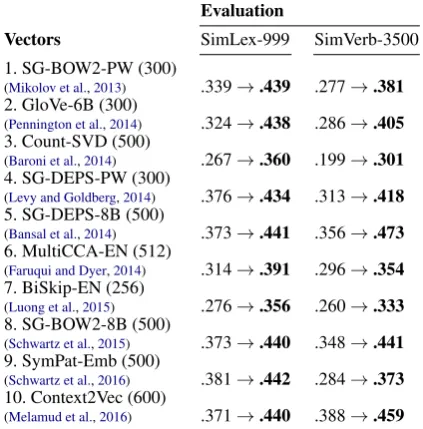
ex-periment, we morph-fit a wide spectrum ofEN dis-tributional vectors induced by various architectures (see Sect.3). The results on SimLex and SimVerb are summarised in Tab. 4. The results with EN SGNS-LARGEvectors are shown in Fig.3a. Morph-fitted vectors bring consistent improvement across all experiments, regardless of the quality of the ini-tial distributional space. This finding confirms that the method is robust: its effectiveness does not de-pend on the architecture used to construct the initial space. To illustrate the improvements, note that the best score on SimVerb for a model trained on run-ning text is achieved byContext2vec(ρ= 0.388); injecting morphological constraints into this vector space results in a gain of7.1ρpoints.
Experiments on Other Languages We next ex-tend our experiments to other languages, testing both morph-fitting variants. The results are sum-marised in Tab.5, while Fig.3a-3dshow results for the morph-fittedSGNS-LARGEvectors. These scores confirm the effectiveness and robustness of morph-fitting across languages, suggesting that the idea of fitting to morphological constraints is in-deed agnostic, given the set of language-specific rule-based constraints. Fig.3also
demon-7Unlike other gold standard resources such as WordSim-353 (Finkelstein et al.,2002) or MEN (Bruni et al.,2014), SimLex and SimVerb provided explicit guidelines to discern between semantic similarity and association, so that related but non-similar words (e.g.cupandcoffee) have a low rating. 8SinceLeviant and Reichart(2015) re-scored the original
Evaluation
Vectors SimLex-999 SimVerb-3500
1. SG-BOW2-PW (300)
(Mikolov et al.,2013) .339→.439 .277→.381
2. GloVe-6B (300)
(Pennington et al.,2014) .324→.438 .286→.405 3. Count-SVD (500)
(Baroni et al.,2014) .267→.360 .199→.301
4. SG-DEPS-PW (300)
(Levy and Goldberg,2014) .376→.434 .313→.418 5. SG-DEPS-8B (500)
(Bansal et al.,2014) .373→.441 .356→.473
6. MultiCCA-EN (512)
(Faruqui and Dyer,2014) .314→.391 .296→.354 7. BiSkip-EN (256)
(Luong et al.,2015) .276→.356 .260→.333
8. SG-BOW2-8B (500)
(Schwartz et al.,2015) .373→.440 .348→.441 9. SymPat-Emb (500)
(Schwartz et al.,2016) .381→.442 .284→.373
10. Context2Vec (600)
[image:6.595.76.288.65.280.2](Melamud et al.,2016) .371→.440 .388→.459 Table 4: The impact of morph-fitting (MFIT-AR used) on a representative set of ENvector space models. All results show the Spearman’sρ
corre-lation before and after morph-fitting. The numbers in parentheses refer to the vector dimensionality.
Vectors Distrib. MFIT-A MFIT-AR
EN: GloVe-6B (300) .324 .376 .438 EN: SG-BOW2-PW (300) .339 .385 .439 DE: SG-DEPS-PW (300)
(Vuli´c and Korhonen,2016a) .267 .318 .325 DE: BiSkip-DE (256)
(Luong et al.,2015) .354 .414 .421
IT: SG-DEPS-PW (300)
(Vuli´c and Korhonen,2016a) .237 .351 .391 IT: CBOW5-Wacky (300)
(Dinu et al.,2015) .363 .417 .446
Table 5: Results on multilingual SimLex-999 (EN, DE, andIT) with two morph-fitting variants.
strates that the morph-fitted vector spaces consis-tently outperform the morph-fixed ones.
The comparison between MFIT-A and MFIT -AR indicates that both sets of constraints are im-portant for the fine-tuning process. MFIT-A yields consistent gains over the initial spaces, and (con-sistent) further improvements are achieved by also incorporating the antonymous REPELconstraints. This demonstrates that both types of constraints are useful for semantic specialisation.
Comparison to Other Specialisation Methods
We also tried using other post-processing spe-cialisation models from the literature in lieu of ATTRACT-REPELusing the same set of “morpho-logical” synonymy and antonymy constraints. We compare ATTRACT-REPELto the retrofitting model
en:GloVe en:BOW2 de:DEPS de:BiSkip it:DEPS it:CBOW5 Word Vector Space
0.20 0.25 0.30 0.35 0.40 0.45
Sp
ea
rm
an
’s
ρ
co
rr
el
at
io
n
sc
or
e DistribRF
[image:6.595.311.523.67.197.2]CF MFit-AR
Figure 2: A comparison of morph-fitting (the MFIT -AR variant) with two other standard specialisation approaches using the same set of morphological constraints: Retrofitting (RF) (Faruqui et al.,2015) and Counter-fitting (CF) (Mrkši´c et al., 2016). Spearman’sρcorrelation scores on the multilingual
SimLex-999 dataset for the same six distributional spaces from Tab.5.
of (Faruqui et al.,2015) and counter-fitting (Mrkši´c et al.,2017a). The two baselines were trained for 20 iterations using suggested settings. The results forEN,DE, andITare summarised in Fig.2. They clearly indicate that MFIT-AR outperforms the two other post-processors for each language. We hy-pothesise that the difference in performance mainly stems from context-sensitive vector space updates performed by ATTRACT-REPEL. Conversely, the other two models perform pairwise updates which do not consider what effect each update has on the example pair’s relation to other word vectors (for a detailed comparison, see (Mrkši´c et al.,2017b)).
Besides their lower performance, the two other specialisation models have additional disadvan-tages compared to the proposed morph-fitting model. First, retrofitting is able to incorporate only synonymy/ATTRACT pairs, while our re-sults demonstrate the usefulness of both types of constraints, both for intrinsic evaluation (Tab. 5) and downstream tasks (see later Fig.3). Second, counter-fitting is computationally intractable with SGNS-LARGEvectors, as its regularisation term in-volves the computation of all pairwise distances between words in the vocabulary.
[image:6.595.71.289.368.490.2]fur-ther refine extracted sets of constraints. We also plan to conduct experiments with gold standard morphological lexicons on languages for which such resources exist (Sylak-Glassman et al.,2015; Cotterell et al.,2016b), and investigate approaches which learn morphological inflections and deriva-tions in different languages automatically as an-other potential source of morphological constraints (Soricut and Och, 2015; Cotterell et al., 2016a; Faruqui et al., 2016;Kann et al.,2017;Aharoni and Goldberg,2017, i.a.).
5 Downstream Task: Dialogue State Tracking (DST)
Goal-oriented dialogue systems provide conversa-tional interfaces for tasks such as booking flights or finding restaurants. Inslot-based systems, ap-plication domains are specified usingontologies
that define the search constraints which users can express. An ontology consists of a number ofslots
and their assortedslot values. In arestaurant search
domain, sets of slot-values could includePRICE= [cheap, expensive] orFOOD= [Thai, Indian, ...].
The DST model is the first component of mod-ern dialogue pipelines (Young,2010). It serves to capture the intents expressed by the user at each dialogue turn and update thebelief state. This prob-ability distribution over the possible dialogue states (defined by the domain ontology) is the system’s internal estimate of the user’s goals. It is used by the downstreamdialogue managercomponent to choose the subsequent system response (Su et al., 2016). The following example shows the true dia-logue state in a multi-turn diadia-logue:
User:What’s good in the southern part of town?
inform(area=south)
System:Vedanta is the top-rated Indian place.
User:How about something cheaper?
inform(area=south, price=cheap)
System:Seven Days is very popular. Great hot pot.
User:What’s the address?
inform(area=south, price=cheap); request(address)
System:Seven Days is at 66 Regent Street.
The Dialogue State Tracking Challenge (DSTC) shared task series formalised the evaluation and provided labelled DST datasets (Henderson et al., 2014a,b;Williams et al.,2016). While a plethora of DST models are available based on, e.g., hand-crafted rules (Wang et al., 2014) or conditional random fields (Lee and Eskenazi,2013), the recent DST methodology has seen a shift towards
neural-network architectures (Henderson et al.,2014c,d; Zilka and Jurcicek,2015;Mrkši´c et al.,2015;Perez and Liu,2017;Liu and Perez,2017;Vodolán et al., 2017;Mrkši´c et al.,2017a, i.a.).
Model: Neural Belief Tracker To detect intents in user utterances, most existing models rely on ei-ther (or both):1)Spoken Language Understanding models which require large amounts of annotated training data; or2)hand-crafted, domain-specific lexicons which try to capture lexical and morpho-logical variation. The Neural Belief Tracker (NBT) is a novel DST model which overcomes both issues by reasoning purely over pre-trained word vectors (Mrkši´c et al.,2017a). The NBT learns to compose these vectors into intermediate utterance and con-text representations. These are then used to decide which of the ontology-defined intents (goals) have been expressed by the user. The NBT model keeps word vectorsfixedduring training, so that unseen, yet related words can be mapped to the right intent at test time (e.g.northerntonorth).
Data: Multilingual WOZ 2.0 Dataset Our DST evaluation is based on the WOZ dataset, released byWen et al.(2017). In this Wizard-of-Oz setup, two Amazon Mechanical Turk workers assumed the role of the user and the system asking/providing information about restaurants in Cambridge (oper-ating over the same ontology and database used for DSTC2 (Henderson et al.,2014a)). Users typed instead of speaking, removing the need to deal with noisy speech recognition. In DSTC datasets, users would quickly adapt to the system’s inability to deal with complex queries. Conversely, the WOZ setup allowed them to use sophisticated language. The WOZ 2.0 release expanded the dataset to 1,200 dialogues (Mrkši´c et al.,2017a). In this work, we use translations of this dataset to Italian and Ger-man, released byMrkši´c et al.(2017b).
Evaluation Setup The principal metric we use to measure DST performance is thejoint goal ac-curacy, which represents the proportion of test set dialogue turns where all user goals expressed up to that point of the dialogue were decoded correctly (Henderson et al., 2014a). The NBT models for EN,DEandITare trained using four variants of the SGNS-LARGEvectors:1)the initial distributional vectors;2)morph-fixedvectors;3)and4)the two variants ofmorph-fittedvectors (see Sect.3).
ben-Distrib MFix MFit-A MFit-AR 0.15 0.20 0.25 0.30 0.35 0.40 0.45 Si m L ex (S pe ar m an ’s ρ ) 0.60 0.65 0.70 0.75 0.80 0.85 D ST Pe rfo rm an ce (Jo in t) (a) English
Distrib MFix MFit-A MFit-AR 0.15 0.20 0.25 0.30 0.35 0.40 0.45 Si m L ex (S pe ar m an ’s ρ ) SimLex 0.60 0.65 0.70 0.75 0.80 0.85 D ST Pe rfo rm an ce (Jo in t) DST (b) German
Distrib MFix MFit-A MFit-AR 0.15 0.20 0.25 0.30 0.35 0.40 0.45 Si m L ex (S pe ar m an ’s ρ ) 0.60 0.65 0.70 0.75 0.80 0.85 D ST Pe rfo rm an ce (Jo in t) (c) Italian
Distrib MFix MFit-A MFit-AR RU Word Vector Space
[image:8.595.101.495.67.340.2]0.15 0.20 0.25 0.30 0.35 0.40 0.45 Si m L ex (S pe ar m an ’s ρ ) SimLex (d) Russian
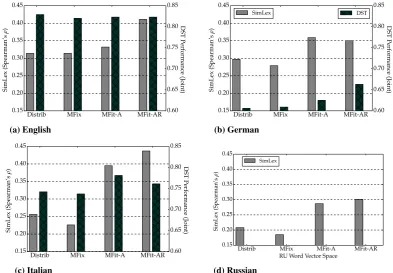
Figure 3: An overview of the results (Spearman’sρcorrelation) for four languages on SimLex-999 (grey
bars, leftyaxis) and the downstream DST performance (dark bars, rightyaxis) usingSGNS-LARGEvectors (d= 300), see Tab.3and Sect.3. The leftyaxis measures the intrinsic word similarity performance,
while the rightyaxis provides the scale for the DST performance (there are no DST datasets for Russian).
efits DST performance across all three languages. However, large gains on SimLex-999 do not al-ways induce correspondingly large gains in down-stream performance. In our experiments, we inves-tigate the extent to whichmorph-fittingimproves DST performance, and whether these gains exhibit stronger correlation with intrinsic performance.
Results and Discussion The dark bars (against the right axes) in Fig. 3 show the DST perfor-mance of NBT models making use of the four vector collections. IT and DE benefit from both kinds ofmorph-fitting:IT performance increases from74.1→78.1(MFIT-A) andDEperformance rises even more:60.6→66.3(MFIT-AR), setting a new state-of-the-art score for both datasets. The
morph-fixedvectors do not enhance DST
perfor-mance, probably because fixing word vectors to their highest frequency inflectional form eliminates useful semantic content encoded in the original vectors. On the other hand, morph-fitting makes use of this information, supplementing it with se-mantic relations between different morphological forms. These conclusions are in line with the Sim-Lex gains, where morph-fitting outperforms both distributional andmorph-fixedvectors.
spaces for extrinsic tasks such as DST.
6 Related Work
Semantic Specialisation A standard approach to incorporating external information into vector spaces is to pull the representations of similar words closer together. Some models integrate such constraints into the training procedure, modify-ing the prior or the regularisation (Yu and Dredze, 2014;Xu et al.,2014;Bian et al.,2014;Kiela et al., 2015), or using a variant of the SGNS-style objec-tive (Liu et al.,2015;Osborne et al.,2016). Another class of models, popularly termedretrofitting, in-jects lexical knowledge from available semantic databases (e.g., WordNet, PPDB) into pre-trained word vectors (Faruqui et al., 2015;Jauhar et al., 2015;Wieting et al., 2015;Nguyen et al., 2016; Mrkši´c et al.,2016). Morph-fitting falls into the latter category. However, instead of resorting to cu-rated knowledge bases, and experimenting solely with English, we show that themorphological rich-nessof any language can be exploited as a source of inexpensive supervision for fine-tuning vector spaces, at the same time specialising them to better reflect true semantic similarity, and learning more accurate representations for low-frequency words.
Word Vectors and Morphology The use of mor-phological resources to improve the representations of morphemes and words is an active area of re-search. The majority of proposed architectures en-code morphological information, provided either as gold standard morphological resources ( Sylak-Glassman et al., 2015) such as CELEX (Baayen et al., 1995) or as an external analyser such as Morfessor (Creutz and Lagus, 2007), along with distributional information jointly attrainingtime in the language modelling (LM) objective (Luong et al.,2013;Botha and Blunsom,2014;Qiu et al., 2014;Cotterell and Schütze,2015;Bhatia et al., 2016, i.a.). The key idea is to learn a morphologi-cal composition function (Lazaridou et al.,2013; Cotterell and Schütze,2017) which synthesises the representation of a word given the representations of its constituent morphemes. Contrary to our work, these models typically coalesce all lexical relations. Another class of models, operating at the charac-ter level, shares a similar methodology: such mod-els compose token-level representations from sub-component embeddings (subwords, morphemes, or characters) (dos Santos and Zadrozny,2014;Ling et al.,2015;Cao and Rei,2016;Kim et al.,2016;
Wieting et al.,2016;Verwimp et al.,2017, i.a.). In contrast to prior work, our modeldecouples
the use of morphological information, now pro-vided in the form of inflectional and derivational rules transformed into constraints, from the actual training. This pipelined approach results in a pler, more portable model. In spirit, our work is sim-ilar toCotterell et al.(2016b), who formulate the idea of post-training specialisation in a generative Bayesian framework. Their work uses gold mor-phological lexicons; we show that competitive per-formance can be achieved using a non-exhaustive set of simple rules. Our framework facilitates the inclusion ofantonymsat no extra cost and natu-rally extends to constraints from other sources (e.g., WordNet) in future work. Another practical differ-ence is that we focus on similarity and evaluate morph-fitting in a well-defined downstream task where the artefacts of the distributional hypothesis are known to prompt statistical system failures.
7 Conclusion and Future Work
We have presented a novelmorph-fittingmethod which injects morphological knowledge in the form of linguistic constraints into word vector spaces. The method makes use of implicit semantic signals encoded in inflectional and derivational rules which describe the morphological processes in a language. The results in intrinsic word similarity tasks show thatmorph-fittingimproves vector spaces induced by distributional models across four languages. Fi-nally, we have shown that the use ofmorph-fitted
vectors boosts the performance of downstream lan-guage understanding models which rely on word representations as features, especially for morpho-logically rich languages such as German.
Future work will focus on other potential sources of morphological knowledge, porting the frame-work to other morphologically rich languages and downstream tasks, and on further refinements of the post-processing specialisation algorithm and the constraint selection.
Acknowledgments
References
Roee Aharoni and Yoav Goldberg. 2017.
Mor-phological inflection generation with hard
monotonic attention. In Proceedings of ACL.
https://arxiv.org/abs/1611.01487.
Rami Al-Rfou, Bryan Perozzi, and Steven Skiena.
2013.Polyglot: Distributed word representations for
multilingual NLP. InProceedings of CoNLL. pages
183–192.
http://www.aclweb.org/anthology/W13-3520.
Eleftherios Avramidis and Philipp Koehn.
2008. Enriching morphologically poor
lan-guages for statistical machine translation.
In Proceedings of ACL. pages 763–770.
http://www.aclweb.org/anthology/P/P08/P08-1087.
Harald R. Baayen, Richard Piepenbrock, and Hedderik van Rijn. 1995. The CELEX lexical data base on CD-ROM .
Mohit Bansal, Kevin Gimpel, and Karen Livescu. 2014.
Tailoring continuous word representations for
depen-dency parsing. InProceedings of ACL. pages 809–
815. http://www.aclweb.org/anthology/P14-2131.
Marco Baroni, Georgiana Dinu, and
Ger-mán Kruszewski. 2014. Don’t count,
pre-dict! A systematic comparison of context-counting vs. context-predicting semantic vec-tors. In Proceedings of ACL. pages 238–247.
http://www.aclweb.org/anthology/P14-1023.
Parminder Bhatia, Robert Guthrie, and Jacob
Eisenstein. 2016. Morphological priors for
probabilistic neural word embeddings. In
Proceedings of EMNLP. pages 490–500.
https://aclweb.org/anthology/D16-1047.
Jiang Bian, Bin Gao, and Tie-Yan Liu. 2014.
Knowledge-powered deep learning for word embed-ding. InProceedings of ECML-PKDD. pages 132–
148. https://doi.org/10.1007/978-3-662-44848-9_9.
Jan A. Botha and Phil Blunsom. 2014.
Com-positional morphology for word
repre-sentations and language modelling. In
Proceedings of ICML. pages 1899–1907.
http://jmlr.org/proceedings/papers/v32/botha14.html.
Elia Bruni, Nam-Khanh Tran, and Marco Baroni.
2014. Multimodal distributional semantics.
Jour-nal of Artificial Intelligence Research 49:1–47.
https://doi.org/10.1613/jair.4135.
Kris Cao and Marek Rei. 2016. A joint model
for word embedding and word morphology.
In Proceedings of the 1st Workshop on Rep-resentation Learning for NLP. pages 18–26.
http://aclweb.org/anthology/W/W16/W16-1603.
Danqi Chen and Christopher D. Manning. 2014. A
fast and accurate dependency parser using neural
net-works. InProceedings of EMNLP. pages 740–750.
http://www.aclweb.org/anthology/D14-1082.
Ronan Collobert, Jason Weston, Léon Bottou,
Michael Karlen, Koray Kavukcuoglu, and
Pavel P. Kuksa. 2011. Natural language
pro-cessing (almost) from scratch. Journal of
Machine Learning Research 12:2493–2537.
http://dl.acm.org/citation.cfm?id=1953048.2078186.
Ryan Cotterell, Christo Kirov, John Sylak-Glassman, David Yarowsky, Jason Eisner, and Mans Hulden.
2016a. The sigmorphon 2016 shared task -
morpho-logical reinflection. InProceedings of the 14th
SIG-MORPHON Workshop on Computational Research in Phonetics, Phonology, and Morphology. pages
10–22. http://anthology.aclweb.org/W16-2002.
Ryan Cotterell and Hinrich Schütze. 2015.
Morphological word-embeddings. In
Pro-ceedings of NAACL-HLT. pages 1287–1292.
http://www.aclweb.org/anthology/N15-1140.
Ryan Cotterell and Hinrich Schütze. 2017. Joint
semantic synthesis and morphological analysis of
the derived word. Transactions of the ACL
https://arxiv.org/abs/1701.00946.
Ryan Cotterell, Hinrich Schütze, and Jason Eisner.
2016b. Morphological smoothing and extrapolation
of word embeddings. InProceedings of ACL. pages
1651–1660.
http://www.aclweb.org/anthology/P16-1156.
Mathias Creutz and Krista Lagus. 2007.
Un-supervised models for morpheme segmentation
and morphology learning. TSLP 4(1):3:1–3:34.
http://doi.acm.org/10.1145/1217098.1217101.
James Curran. 2004. From Distributional to
Semantic Similarity. Ph.D. thesis, School
of Informatics, University of Edinburgh.
http://hdl.handle.net/1842/563.
Georgiana Dinu, Angeliki Lazaridou, and Marco
Ba-roni. 2015. Improving zero-shot learning by
mitigat-ing the hubness problem. In Proceedings of ICLR
(Workshop Papers).http://arxiv.org/abs/1412.6568.
Cícero Nogueira dos Santos and Bianca
Zadrozny. 2014. Learning character-level
representations for part-of-speech tagging.
In Proceedings of ICML. pages 1818–1826.
http://jmlr.org/proceedings/papers/v32/santos14.html.
John C. Duchi, Elad Hazan, and Yoram Singer.
2011. Adaptive subgradient methods for
on-line learning and stochastic optimization.
Jour-nal of Machine Learning Research 12:2121–2159.
http://dl.acm.org/citation.cfm?id=2021068.
Maud Ehrmann, Francesco Cecconi, Daniele Vannella, John Philip Mccrae, Philipp Cimiano, and Roberto
Navigli. 2014. Representing multilingual data as
linked data: The case of BabelNet 2.0. In
Proceed-ings of LREC. pages 401–408.
Manaal Faruqui, Jesse Dodge, Sujay Kumar Jauhar, Chris Dyer, Eduard Hovy, and Noah A. Smith.
2015. Retrofitting word vectors to semantic
lexi-cons. InProceedings of NAACL-HLT. pages 1606–
1615.http://www.aclweb.org/anthology/N15-1184.
Manaal Faruqui and Chris Dyer. 2014. Improving
vec-tor space word representations using multilingual
correlation. In Proceedings of EACL. pages 462–
471.http://www.aclweb.org/anthology/E14-1049.
Manaal Faruqui, Yulia Tsvetkov, Graham Neubig, and
Chris Dyer. 2016. Morphological inflection
gener-ation using character sequence to sequence learn-ing. InProceedings of NAACL-HLT. pages 634–643.
http://www.aclweb.org/anthology/N16-1077.
Christiane Fellbaum. 1998. WordNet.
https://mitpress.mit.edu/books/wordnet.
Lev Finkelstein, Evgeniy Gabrilovich, Yossi Ma-tias, Ehud Rivlin, Zach Solan, Gadi Wolfman,
and Eytan Ruppin. 2002. Placing search in
context: The concept revisited. ACM
Trans-actions on Information Systems 20(1):116–131.
https://doi.org/10.1145/503104.503110.
Victoria Fromkin, Robert Rodman, and Nina Hyams.
2013.An Introduction to Language, 10th Edition.
Juri Ganitkevitch, Benjamin Van Durme, and Chris
Callison-Burch. 2013. PPDB: The Paraphrase
Database. In Proceedings of NAACL-HLT. pages
758–764.
http://www.aclweb.org/anthology/N13-1092.
Daniela Gerz, Ivan Vuli´c, Felix Hill, Roi
Re-ichart, and Anna Korhonen. 2016.
SimVerb-3500: A large-scale evaluation set of verb similar-ity. In Proceedings of EMNLP. pages 2173–2182.
https://aclweb.org/anthology/D16-1235.
Zellig S. Harris. 1954. Distributional structure. Word
10(23):146–162.
Martin Haspelmath and Andrea Sims. 2013.
Under-standing morphology.
Matthew Henderson, Blaise Thomson, and Jason D.
Wiliams. 2014a. The Second Dialog State Tracking
Challenge. InProceedings of SIGDIAL. pages 263–
272.
http://aclweb.org/anthology/W/W14/W14-4337.pdf.
Matthew Henderson, Blaise Thomson, and Jason D.
Wiliams. 2014b. The Third Dialog State Tracking
Challenge. InProceedings of IEEE SLT. pages 324–
329. https://doi.org/10.1109/SLT.2014.7078595.
Matthew Henderson, Blaise Thomson, and Steve Young. 2014c. Robust dialog state tracking using delexicalised recurrent neural networks and
unsu-pervised adaptation. In Proceedings of IEEE SLT.
pages 360–365.
Matthew Henderson, Blaise Thomson, and Steve
Young. 2014d. Word-based dialog state
tracking with recurrent neural networks. In
Proceedings of SIGDIAL. pages 292–299.
http://aclweb.org/anthology/W/W14/W14-4340.pdf.
Felix Hill, Roi Reichart, and Anna Korhonen.
2015. SimLex-999: Evaluating semantic
models with (genuine) similarity estimation.
Computational Linguistics 41(4):665–695.
https://doi.org/10.1162/COLI_a_00237.
Sujay Kumar Jauhar, Chris Dyer, and Eduard H. Hovy.
2015. Ontologically grounded multi-sense
repre-sentation learning for semantic vector space mod-els. In Proceedings of NAACL. pages 683–693.
http://www.aclweb.org/anthology/N15-1070.
Anders Johannsen, Héctor Martínez Alonso, and
An-ders Søgaard. 2015. Any-language frame-semantic
parsing. In Proceedings of EMNLP. pages 2062–
2066.http://aclweb.org/anthology/D15-1245.
Katharina Kann, Ryan Cotterell, and Hinrich Schütze.
2017. Neural multi-source morphological
reinflec-tion. In Proceedings of EACL. pages 514–524.
http://www.aclweb.org/anthology/E17-1049.
Douwe Kiela, Felix Hill, and Stephen Clark. 2015.
Specializing word embeddings for similarity or
re-latedness. InProceedings of EMNLP. pages 2044–
2048.http://aclweb.org/anthology/D15-1242.
Yoon Kim, Yacine Jernite, David Sontag, and Alexan-der M. Rush. 2016. Character-aware neural
lan-guage models. InProceedings of AAAI. pages 2741–
2749.
Angeliki Lazaridou, Marco Marelli, Roberto
Zam-parelli, and Marco Baroni. 2013.
Compositional-ly derived representations of morphologicalCompositional-ly
complex words in distributional semantics.
In Proceedings of ACL. pages 1517–1526.
http://www.aclweb.org/anthology/P13-1149.
Sungjin Lee and Maxine Eskenazi. 2013. Recipe
for building robust spoken dialog state trackers: Dialog State Tracking Challenge system descrip-tion. In Proceedings of SIGDIAL. pages 414–
422.
http://aclweb.org/anthology/W/W13/W13-4066.pdf.
Ira Leviant and Roi Reichart. 2015. Separated by
an un-common language: Towards judgment
lan-guage informed vector space modeling. CoRR
abs/1508.00106.http://arxiv.org/abs/1508.00106.
Omer Levy and Yoav Goldberg. 2014.
Dependency-based word embeddings. In
Proceedings of ACL. pages 302–308.
http://www.aclweb.org/anthology/P14-2050.
Wang Ling, Chris Dyer, Alan W. Black, Isabel Tran-coso, Ramon Fermandez, Silvio Amir, Luis Marujo,
Compositional character models for open
vocabu-lary word representation. InProceedings of EMNLP.
pages 1520–1530.
http://aclweb.org/anthology/D15-1176.
Fei Liu and Julien Perez. 2017.Gated end-to-end
mem-ory networks. InProceedings of EACL. pages 1–10.
http://www.aclweb.org/anthology/E17-1001.
Quan Liu, Hui Jiang, Si Wei, Zhen-Hua Ling,
and Yu Hu. 2015. Learning semantic word
embeddings based on ordinal knowledge
con-straints. InProceedings of ACL. pages 1501–1511.
http://www.aclweb.org/anthology/P15-1145.
Thang Luong, Hieu Pham, and Christopher D.
Man-ning. 2015. Bilingual word representations with
monolingual quality in mind. In Proceedings
of the 1st Workshop on Vector Space Modeling for Natural Language Processing. pages 151–159.
http://www.aclweb.org/anthology/W15-1521.
Thang Luong, Richard Socher, and Christopher
Manning. 2013. Better word representations
with recursive neural networks for morphol-ogy. In Proceedings of CoNLL. pages 104–113.
http://www.aclweb.org/anthology/W13-3512.
Oren Melamud, Jacob Goldberger, and Ido
Da-gan. 2016. Context2vec: Learning generic
context embedding with bidirectional LSTM.
In Proceedings of CoNLL. pages 51–61.
http://aclweb.org/anthology/K/K16/K16-1006.pdf.
Tomas Mikolov, Ilya Sutskever, Kai Chen, Gregory S. Corrado, and Jeffrey Dean. 2013. Distributed repre-sentations of words and phrases and their
composi-tionality. InProceedings of NIPS. pages 3111–3119.
Andriy Mnih and Koray Kavukcuoglu. 2013. Learning word embeddings efficiently with noise-contrastive
estimation. In Proceedings of NIPS. pages 2265–
2273.
Nikola Mrkši´c, Diarmuid Ó Séaghdha, Blaise Thom-son, Milica Gaši´c, Pei-Hao Su, David Vandyke,
Tsung-Hsien Wen, and Steve Young. 2015.
Multi-domain dialog state tracking using recurrent neural
networks. In Proceedings of ACL. pages 794–799.
http://aclweb.org/anthology/P/P15/P15-2130.pdf.
Nikola Mrkši´c, Diarmuid Ó Séaghdha, Blaise Thomson, Tsung-Hsien Wen, and Steve Young.
2017a. Neural Belief Tracker: Data-driven
di-alogue state tracking. In Proceedings of ACL.
http://arxiv.org/abs/1606.03777.
Nikola Mrkši´c, Diarmuid Ó Séaghdha, Blaise Thom-son, Milica Gaši´c, Lina Maria Rojas-Barahona, Pei-Hao Su, David Vandyke, Tsung-Hsien Wen, and
Steve Young. 2016. Counter-fitting word vectors
to linguistic constraints. InProceedings of
NAACL-HLT.
http://aclweb.org/anthology/N/N16/N16-1018.pdf.
Nikola Mrkši´c, Ivan Vuli´c, Diarmuid Ó Séaghdha, Roi Reichart, Milica Gaši´c, Anna Korhonen, and Steve Young. 2017b. Semantic Specialisation of Distribu-tional Word Vector Spaces using Monolingual and Cross-Lingual Constraints. arXiv.
Vinod Nair and Geoffrey E. Hinton. 2010.
Recti-fied linear units improve restricted Boltzmann
ma-chines. In Proceedings of ICML. pages 807–814.
http://www.icml2010.org/papers/432.pdf.
Roberto Navigli and Simone Paolo Ponzetto. 2012.
Ba-belNet: The automatic construction, evaluation and application of a wide-coverage multilingual
seman-tic network. Artificial Intelligence 193:217–250.
https://doi.org/10.1016/j.artint.2012.07.001.
Kim Anh Nguyen, Sabine Schulte im Walde, and
Ngoc Thang Vu. 2016. Integrating distributional
lexical contrast into word embeddings for
antonym-synonym distinction. InProceedings of ACL. pages
454–459.http://anthology.aclweb.org/P16-2074.
Dominique Osborne, Shashi Narayan, and Shay Cohen.
2016. Encoding prior knowledge with eigenword
embeddings. Transactions of the ACL4:417–430.
https://arxiv.org/abs/1509.01007.
Ellie Pavlick, Pushpendre Rastogi, Juri Ganitkevitch, Benjamin Van Durme, and Chris Callison-Burch.
2015. PPDB 2.0: Better paraphrase ranking,
fine-grained entailment relations, word embeddings, and
style classification. In Proceedings of ACL. pages
425–430.
http://www.aclweb.org/anthology/P15-2070.
Jeffrey Pennington, Richard Socher, and Christopher
Manning. 2014. Glove: Global vectors for word
rep-resentation. InProceedings of EMNLP. pages 1532–
1543.http://www.aclweb.org/anthology/D14-1162.
Julien Perez and Fei Liu. 2017. Dialog state
track-ing, a machine reading approach using Memory Net-work. In Proceedings of EACL. pages 305–314.
http://www.aclweb.org/anthology/E17-1029.
Siyu Qiu, Qing Cui, Jiang Bian, Bin Gao, and
Tie-Yan Liu. 2014. Co-learning of word
rep-resentations and morpheme representations.
In Proceedings of COLING. pages 141–150.
http://www.aclweb.org/anthology/C14-1015.
Patrick Schone and Daniel Jurafsky. 2001.
Knowledge-free induction of inflectional
morphologies. In Proceedings of NAACL.
http://aclweb.org/anthology/N/N01/N01-1024.
Roy Schwartz, Roi Reichart, and Ari Rappoport.
2015. Symmetric pattern based word
em-beddings for improved word similarity predic-tion. In Proceedings of CoNLL. pages 258–267.
http://www.aclweb.org/anthology/K15-1026.
Roy Schwartz, Roi Reichart, and Ari Rappoport. 2016.
Symmetric patterns and coordinations: Fast and
In Proceedings of NAACL-HLT. pages 499–505.
http://www.aclweb.org/anthology/N16-1060.
Radu Soricut and Franz Och. 2015. Unsupervised
morphology induction using word embeddings. In
Proceedings of NAACL-HLT. pages 1627–1637.
http://www.aclweb.org/anthology/N15-1186.
Pei-Hao Su, Milica Gaši´c, Nikola Mrkši´c, Lina Rojas-Barahona, Stefan Ultes, David Vandyke, Tsung-Hsien Wen, and Steve Young. ???? Continuously learning neural dialogue management.
Pei-Hao Su, Milica Gaši´c, Nikola Mrkši´c, Lina Rojas-Barahona, Stefan Ultes, David Vandyke,
Tsung-Hsien Wen, and Steve Young. 2016. On-line active
reward learning for policy optimisation in spoken
dialogue systems. In Proceedings of ACL. pages
2431–2441.
http://www.aclweb.org/anthology/P16-1230.
John Sylak-Glassman, Christo Kirov, David
Yarowsky, and Roger Que. 2015. A
language-independent feature schema for inflectional
mor-phology. In Proceedings of ACL. pages 674–680.
http://www.aclweb.org/anthology/P15-2111.
Reut Tsarfaty, Djamé Seddah, Yoav Goldberg, Sandra Kuebler, Yannick Versley, Marie Candito, Jennifer
Foster, Ines Rehbein, and Lamia Tounsi. 2010.
Sta-tistical parsing of morphologically rich languages
(SPMRL) What, how and whither. In
Proceed-ings of the NAACL Workshop on Statistical Pars-ing of Morphologically-Rich Languages. pages 1–
12.http://www.aclweb.org/anthology/W10-1401.
Joseph P. Turian, Lev-Arie Ratinov, and Yoshua
Bengio. 2010. Word representations: A
sim-ple and general method for semi-supervised learn-ing. In Proceedings of ACL. pages 384–394.
http://www.aclweb.org/anthology/P10-1040.
Peter D. Turney and Patrick Pantel. 2010. From
frequency to meaning: vector space models of
se-mantics. Journal of Artifical Intelligence Research
37(1):141–188.https://doi.org/10.1613/jair.2934.
Lyan Verwimp, Joris Pelemans, Hugo Van hamme, and
Patrick Wambacq. 2017. Character-word LSTM
lan-guage models. InProceedings of EACL. pages 417–
427.http://www.aclweb.org/anthology/E17-1040.
Miroslav Vodolán, Rudolf Kadlec, and Jan
Kleindi-enst. 2017. Hybrid dialog state tracker with ASR
features. InProceedings of EACL. pages 205–210.
http://www.aclweb.org/anthology/E17-2033.
Ivan Vuli´c and Anna Korhonen. 2016a. Is "universal
syntax" universally useful for learning distributed
word representations?InProceedings of ACL. pages
518–524. http://anthology.aclweb.org/P16-2084.
Ivan Vuli´c and Anna Korhonen. 2016b. On the role
of seed lexicons in learning bilingual word
embed-dings. In Proceedings of ACL. pages 247–257.
http://www.aclweb.org/anthology/P16-1024.
Zhen Wang, Jianwen Zhang, Jianlin Feng, and Zheng Chen. 2014. Knowledge graph embedding by
trans-lating on hyperplanes. In Proceedings of AAAI.
pages 1112–1119.
Tsung-Hsien Wen, David Vandyke, Nikola Mrkši´c, Milica Gaši´c, Lina M. Rojas-Barahona, Pei-Hao
Su, Stefan Ultes, and Steve Young. 2017. A
network-based end-to-end trainable task-oriented
dialogue system. In Proceedings of EACL.
http://www.aclweb.org/anthology/E17-1042.
John Wieting, Mohit Bansal, Kevin Gimpel, and Karen Livescu. 2015. From paraphrase database to
compo-sitional paraphrase model and back.Transactions of
the ACL3:345–358.
John Wieting, Mohit Bansal, Kevin Gimpel, and
Karen Livescu. 2016. Charagram:
Embed-ding words and sentences via character n-grams.
In Proceedings of EMNLP. pages 1504–1515.
https://aclweb.org/anthology/D16-1157.
Jason D. Williams, Antoine Raux, and Matthew
Henderson. 2016. The Dialog State
Track-ing Challenge series: A review. Dialogue
& Discourse 7(3):4–33.
http://dad.uni-bielefeld.de/index.php/dad/article/view/3685.
Chang Xu, Yalong Bai, Jiang Bian, Bin Gao, Gang Wang, Xiaoguang Liu, and Tie-Yan Liu.
2014. RC-NET: A general framework for
incorporating knowledge into word
representa-tions. In Proceedings of CIKM. pages 1219–1228.
https://doi.org/10.1145/2661829.2662038.
Steve Young. 2010. Cognitive User Interfaces. IEEE
Signal Processing Magazine.
Mo Yu and Mark Dredze. 2014. Improving
lexical embeddings with semantic
knowl-edge. In Proceedings of ACL. pages 545–550.
http://www.aclweb.org/anthology/P14-2089.
Britta Zeller, Jan Šnajder, and Sebastian Padó.
2013. DErivBase: Inducing and evaluating
a derivational morphology resource for Ger-man. In Proceedings of ACL. pages 1201–1211.
http://www.aclweb.org/anthology/P13-1118.
Lukas Zilka and Filip Jurcicek. 2015. Incremental
LSTM-based dialog state tracker. InProceedings of
ASRU.
Will Y. Zou, Richard Socher, Daniel Cer, and
Christopher D. Manning. 2013. Bilingual word
embeddings for phrase-based machine translation.
In Proceedings of EMNLP. pages 1393–1398.