Proceedings of the 55th Annual Meeting of the Association for Computational Linguistics, pages 541–551 Vancouver, Canada, July 30 - August 4, 2017. c2017 Association for Computational Linguistics Proceedings of the 55th Annual Meeting of the Association for Computational Linguistics, pages 541–551
Vancouver, Canada, July 30 - August 4, 2017. c2017 Association for Computational Linguistics
Predicting Native Language from Gaze
Yevgeni Berzak MIT CSAIL
Chie Nakamura MIT Linguistics
Suzanne Flynn MIT Linguistics
Boris Katz MIT CSAIL
Abstract
A fundamental question in language learn-ing concerns the role of a speaker’s first language in second language acqui-sition. We present a novel methodol-ogy for studying this question: analysis of eye-movement patterns in second lan-guage reading of free-form text. Using this methodology, we demonstrate for the first time that the native language of English learners can be predicted from their gaze fixations when reading English. We pro-vide analysis of classifier uncertainty and learned features, which indicates that dif-ferences in English reading are likely to be rooted in linguistic divergences across native languages. The presented frame-work complements production studies and offers new ground for advancing research on multilingualism.1
1 Introduction
The influence of a speaker’s native language on learning and performance in a foreign language, also known as cross-linguistic transfer, has been studied for several decades in linguistics and psy-chology (Odlin,1989;Martohardjono and Flynn, 1995; Jarvis and Pavlenko, 2008; Berkes and Flynn, 2012;Alonso, 2015). The growing avail-ably of learner corpora has also sparked interest in cross-linguistic influence phenomena in NLP, where studies have explored the task of Native Language Identification (NLI) (Tetreault et al., 2013), as well as analysis of textual features in relation to the author’s native language (Jarvis and Crossley,2012;Swanson and Charniak,2013; Malmasi and Dras,2014). Despite these advances, 1The experimental data collected in this study will be made publicly available.
the extent and nature of first language influence in second language processing remains far from be-ing established. Crucially, most prior work on this topic focused on production, while little is cur-rently known about cross-linguistic influence in language comprehension.
In this work, we present a novel framework for studying cross-linguistic influence in language comprehension usingeyetracking for readingand
free-form native English text. We collect and ana-lyze English newswire reading data from 182 par-ticipants, including 145 English as Second Lan-guage (ESL) learners from four different native language backgrounds: Chinese, Japanese, Por-tuguese and Spanish, as well as 37 native English speakers. Each participant reads 156 English sen-tences, half of which are shared across all partic-ipants, and the remaining half are individual to each participant. All the sentences are manually annotated with part-of-speech (POS) tags and syn-tactic dependency trees.
We then introduce the task ofNative Language Identification from Reading (NLIR), which re-quires predicting a subject’s native language from gaze while reading text in a second language. Fo-cusing on ESL participants and using a log-linear classifier with word fixation times normalized for reading speed as features, we obtain 71.03 NLIR accuracy in the shared sentences regime. We fur-ther demonstrate that NLIR can be generalized effectively to the individual sentences regime, in which each subject reads a different set of sen-tences, by grouping fixations according to linguis-tically motivated clustering criteria. In this regime, we obtain an NLIR accuracy of 51.03.
Further on, we provide classification and feature analyses, suggesting that the signal underlying NLIR is likely to be related tolinguistic charac-teristics of the respective native languages. First, drawing on previous work on ESL production, we
observe that classifier uncertainty in NLIR corre-lates with global linguistic similarities across na-tive languages. In other words, the more similar are the languages, the more similar are the read-ing patterns of their native speakers in English. Second, we perform feature analysis across na-tive and non-nana-tive English speakers, and discuss structural and lexical factors that could potentially drive some of the non-native reading patterns in each of our native languages. Taken together, our results provide evidence for a systematic influence of native language properties on reading, and by extension, on online processing and comprehen-sion in a second language.
To summarize, we introduce a novel frame-work for studying cross-linguistic influence in lan-guage learning by using eyetracking for reading free-form English text. We demonstrate the util-ity of this framework in the following ways. First, we obtain the first NLIR results, addressing both the shared and the individual textual input scenar-ios. We further show that reading preserves lin-guistic similarities across native languages of ESL readers, and perform feature analysis, highlight-ing key distinctive readhighlight-ing patterns in each native language. The proposed framework complements and extends production studies, and can inform linguistic inquiry on cross-linguistic influence.
This paper is structured as follows. In sec-tion 2 we present the data and our experimental setup. Section3describes our approach to NLIR and summarizes the classification results. We ana-lyze cross-linguistic influence in reading in section 4. In section4.1 we examine NLIR classification uncertainty in relation to linguistic similarities be-tween native languages. In section4.2we discuss several key fixation features associated with dif-ferent native languages. Section5surveys related work, and section6concludes.
2 Experimental Setup
Participants
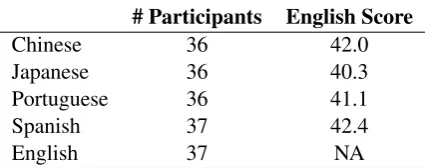
We recruited 182 adult participants. Of those, 37 are native English speakers and 145 are ESL learn-ers from four native language backgrounds: Chi-nese, JapaChi-nese, Portuguese and Spanish. All the participants in the experiment are native speakers of only one language. The ESL speakers were tested for English proficiency using the grammar and listening sections of the Michigan English test (MET), which consist of 50 multiple choice
ques-tions. The English proficiency score was calcu-lated as the number of correctly answered ques-tions on these modules. The majority of the par-ticipants scored in the intermediate-advanced pro-ficiency range. Table1presents the number of par-ticipants and the mean English proficiency score for each native language group. Additionally, we collected metadata on gender, age, level of ed-ucation, duration of English studies and usage, time spent in English speaking countries and pro-ficiency in any additional language spoken.
# Participants English Score
Chinese 36 42.0
Japanese 36 40.3
Portuguese 36 41.1
Spanish 37 42.4
[image:2.595.310.523.222.306.2]English 37 NA
Table 1: Number of participants and mean MET English score by native language group.
Reading Materials
We utilize 14,274 randomly selected sentences from the Wall Street Journal part of the Penn Tree-bank (WSJ-PTB) (Marcus et al., 1993). To sup-port reading convenience and measurement preci-sion, the maximal sentence length was set to 100 characters, leading to an average sentence length of 11.4 words. Word boundaries are defined as whitespaces. From this sentence pool, 78 sen-tences (900 words) were presented to all partic-ipants (henceforth shared sentences) and the re-maining 14,196 sentences were split into 182 in-dividual batches of 78 sentences (henceforth indi-vidualsentences, averaging 880 words per batch). All the sentences include syntactic annotations from the Universal Dependency Treebank project (UDT) (McDonald et al., 2013). The annotations include PTB POS tags (Santorini,1990), Google universal POS tags (Petrov et al.,2012) and depen-dency trees. The dependepen-dency annotations of the UDT are converted automatically from the manual phrase structure tree annotations of the WSJ-PTB.
Gaze Data Collection
sen-tences. The shared and the individual sentences were mixed randomly and presented to all partic-ipants in the same order. The experiment was di-vided into three parts, consisting of 52 sentences each. Participants were allowed to take a short break between experimental parts.
Each sentence was presented on a blank screen as a one-liner. The text appeared in Times font, with font size 23. To encourage attentive reading, upon completion of sentence reading participants answered a simple yes/no question about its con-tent, and were subsequently informed if they an-swered the question correctly. Both the sentences and the questions were triggered by a 300ms gaze on a fixation target (fixation circle for sentences and the letter “Q” for questions) which appeared on a blank screen and was co-located with the be-ginning of the text in the following screen.
Throughout the experiment, participants held a joystick with buttons for indicating completion of sentence reading and answering the comprehen-sion questions. Eye-movement of participants’ dominant eye was recorded using a desktop mount Eyelink 1000 eyetracker, at a sampling rate of 1000Hz. Further details on the experimental setup are provided in appendixA.
3 Native Language Identification from Reading
Our first goal is to determine whether the native language of ESL learners can be decoded from their gaze patterns while reading English text. We address this question in two regimes, correspond-ing to our division of readcorrespond-ing input into shared and individual sentences. In theshared regime, all the participants read the same set of sentences. Nor-malizing over the reading input, this regime facil-itates focusing on differences in reading behavior across readers. In the individual regime, we use the individual batches from our data to address the more challenging variant of the NLIR task in which the reading material given to each partici-pant is different.
3.1 Features
We seek to utilize features that can provide robust, simple and interpretable characterizations of read-ing patterns. To this end, we use speed normalized
fixation durationmeasures over word sequences.
Fixation Measures
We utilize three measures of word fixation dura-tion:
• First Fixation duration (FF)Duration of the first fixation on a word.
• First Pass duration (FP) Time spent from first entering a word to first leaving it (includ-ing re-fixations within the word).
• Total Fixation duration (TF)The sum of all fixation times on a word.
We experiment with fixations over un-igram, bigram and trigram sequences
seqi,k = wi, ..., wi+k−1, k ∈ {1,2,3}, where for
each metric M ∈ {F F, F P, T F} the fixation time for a sequence Mseqi,k is defined as the sum of fixations on individual tokens Mw in the
sequence2.
Mseqi,k =
X
w0∈seqi,k
Mw0 (1)
Importantly, we control for variation in reading speeds across subjects by normalizing each sub-jects’s sequence fixation times. For each metric
Mand sequenceseqi,kwe normalize the sequence
fixation time Mseqi,k relative to the subject’s se-quence fixation times in the textual context of the sequence. The context C is defined as the
sen-tence in which the sequence appears for theWords in Fixed Contextfeature-set and the entire textual input for the Syntactic and Information clusters feature-sets (see definitions of feature-sets below). The normalization termSM,C,kis accordingly
de-fined as the metric’s fixation time per sequence of lengthkin the context:
SM,C,k=
1
|C|
X
seqk∈C
Mseqk (2)
We then obtain a normalized fixation time
M normseqi,k as:
M normseqi,k =
Mseqi,k
SM,C,k (3)
Feature Types
We use the above presented speed normalized fix-ation metrics to extract three feature-sets,Words in Fixed Context (WFC),Syntactic Clusters(SC) and
Information Clusters (IC). WFC is a token-level feature-set that presupposes a fixed textual input for all participants. It is thus applicable only in the shared sentences regime. SC and IC are type-level features which provide abstractions over se-quences of words. Crucially, they can also be ap-plied when participants read different sentences.
• Words in Fixed Context (WFC)The WFC
features capture fixation times on word se-quences in a specific sentence. This feature-set consists of FF, FP and TF times for each of the 900 unigram, 822 bigram, and 744 tri-gram word sequences comprising the shared sentences. The fixation times of each metric are normalized for each participant relative to their fixations on sequences of the same length in the surrounding sentence. As noted above, the WFC feature-set is not applicable in the individual regime, as it requires identi-cal sentences for all participants.
• Syntactic Clusters (SC)CS features are
av-erage globally normalized FF, FP and TF times for word sequences clustered by our three types of syntactic labels: universal POS, PTB POS, and syntactic relation labels. An example of such a feature is the average of speed-normalized TF times spent on the PTB POS bigram sequence DT NN. We take into account labels that appear at least once in the reading input of all participants. On the four non-native languages, considering all three label types, we obtain 104 unigram, 636 bigram and 1,310 trigram SC features per fix-ation metric in the shared regime, and 56 un-igram, 95 bigram and 43 trigram SC features per fixation metric in the individual regime.
• Information Clusters (IC) We also obtain
average FF, FP and TF for words clustered according to theirlength, measured in num-ber of characters. Word length was previ-ously shown to be a strong predictor of infor-mation content(Piantadosi et al.,2011). As such, it provides an alternative abstraction to the syntactic clusters, combining both syntac-tic and lexical information. As with SC fea-tures, we take into account features that
ap-pear at least once in the textual input of all participants. For our set of non-native lan-guages, we obtain for each fixation metric 15 unigram, 21 bigram and 23 trigram IC fea-tures in the shared regime, and 12 unigram, 18 bigram and 18 trigram IC features in the individual regime. Notably, this feature-set is very compact, and differently from the syn-tactic clusters, does not rely on the availabil-ity of external annotations.
In each feature-set, we perform a final prepro-cessing step for each individual feature, in which we derive a zero mean unit variance scaler from the training set feature values, and apply it to trans-form both the training and the test values of the feature to Z scores.
3.2 Model
The experiments are carried out using a log-linear model:
p(y|x;θ) = P exp(θ·f(x, y)) y0∈Y exp(θ·f(x, y0))
(4)
where y is the reader’s native language, x is the
reading input andθare the model parameters. The
classifier is trained with gradient descent using L-BFGS (Byrd et al.,1995).
3.3 Experimental Results
In table 2 we report 10-fold cross-validation re-sults on NLIR in the shared and the individual ex-perimental regimes for native speakers of Chinese, Japanese, Portuguese and Spanish. We introduce two baselines against which we compare the per-formance of our feature-sets. Themajority base-line selects the native language with the largest number of participants. Therandom clusters base-line clusters words into groups randomly, with the number of groups set to the number of syntactic categories in our data.
Shared Sentences Regime Individual Sentences Regime
Majority Class 25.52 25.52
Random Clusters 22.76 22.07
unigrams +bigrams +trigrams unigrams +bigrams +trigrams
Information Clusters (IC) 41.38 44.14 46.21 38.62 32.41 32.41
Syntactic Clusters (SC) 45.52 57.24 58.62 48.97 43.45 48.28
SC+IC 51.72 57.24 60.0 51.03 46.21 49.66
[image:5.595.75.522.62.168.2]Words in Fixed Context (WFC) 64.14 68.28 71.03 NA
Table 2: Native Language Identification from Reading results with 10-fold cross-validation for native speakers of Chinese, Japanese, Portuguese and Spanish. In theSharedregime all the participants read the same 78 sentences. In theIndividualregime each participant reads a different set of 78 sentences.
regime for performing reliable NLIR, and suggest a strong native language signal in non-native read-ing fixation times.
SC features yield accuracies of 45.52 to 58.62 on the shared sentences, while IC features exhibit weaker performance in this regime, with accura-cies of 41.38 to 46.21. Both results are well above chance, but lower than WFC fixations due to the information loss imposed by the clustering step. Crucially, both feature-sets remain effective in the individual input regime, with 43.45 to 48.97 accu-racy for SC features and 32.41 to 38.62 accuaccu-racy for IC features. The strongest result in the individ-ual regime is 51.03, obtained by concatenating IC and SC features over unigrams. We also note that using this setup in a binary classification scheme yields results ranging from chance level 49.31 for Portuguese versus Spanish, to 84.93 on Spanish versus Japanese.
Generally, we observe that adding bigram and trigram fixations in the shared regime leads to per-formance improvements compared to using un-igram features only. This trend does not hold for the individual sentences, presumably due to a combination of feature sparsity and context vari-ation in this regime. We also note that IC and SC features tend to perform better together than in separation, suggesting that the information en-coded using these feature-sets is to some extent complementary.
The generalization power of our cluster based feature-sets has both practical and theoretical con-sequences. Practically, they provide useful ab-stractions for performing NLIR over arbitrary tex-tual input. That is, they enable performing this task using anytextual input during both training and testing phases. Theoretically, the effectiveness of linguistically motivated features in discerning native languages suggests that linguistic factors
play an important role in the ESL reading process. The analysis presented in the following sections will further explore this hypothesis.
4 Analysis of Cross-Linguistic Influence in ESL Reading
As mentioned in the previous section, the ability to perform NLIR in general, and the effectiveness of linguistically motivated features in particular, sug-gest that linguistic factors in the native and sec-ond languages are pertinent to ESL reading. In this section we explore this hypothesis further, by analyzing classifier uncertainty and the features learned in the NLIR task.
4.1 Preservation of Linguistic Similarity
Previous work in NLP suggested a link between textual patterns in ESL production and linguistic similarities of the respective native languages ( Na-gata and Whittaker, 2013;Nagata, 2014; Berzak et al., 2014, 2015). In particular, Berzak et al. (2014) has demonstrated that NLI classification uncertainty correlates with similarities between languages with respect to their typological fea-tures. Here, we extend this framework and exam-ine if preservation of native language similarities in ESL production is paralleled in reading.
Similarly toBerzak et al.(2014) we define the classification uncertainty for a pair of native lan-guages y andy0 in our data collectionD, as the
de-note it as English Reading SimilarityERS.
ERS
y,y0=
P(x,y)∈Dy
p(y0|x;θ)+ P
(x,y0)∈Dy0
p(y|x;θ)
|Dy|+
|
Dy0|
(5) We compare these reading similarities to the lin-guistic similarities between our native languages. To approximate these similarities, we utilize fea-ture vectors from the URIEL Typological Com-pendium (Littel et al., 2016) extracted using the
lang2vec tool (Littell et al., 2017). URIEL ag-gregates, fuses and normalizes typological, phy-logenetic and geographical information about the world’s languages.
We obtain all the 103 available morpho-syntactic features in URIEL, which are derived from the World Atlas of Language Structures (WALS) (Dryer and Haspelmath, 2013), Syntac-tic Structures of the World’s Languages (SSWL) (Collins and Kayne,2009) and Ethnologue (Lewis et al.,2015). Missing feature values are completed with a KNN classifier. We also extract URIEL’s 3,718 language family features derived from Glot-tolog (Hammarström et al.,2015). Each of these features represents membership in a branch of Glottolog’s world language tree. Truncating fea-tures with the same value for all our languages, we remain with 76 features, consisting of 49 syntactic features and 27 family tree features. The linguistic similarityLSbetween a pair of languagesyandy0
is then determined by the cosine similarity of their URIEL feature vectors.
LSy,y0 = vy·vy 0
kvykkvy0k (6)
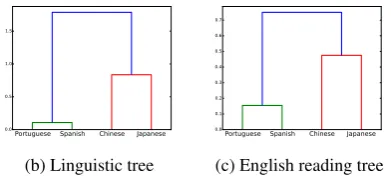
Figure 1 presents the URIEL based linguistic similarities for our set of non-native languages against the average NLIR classification uncertain-ties on the cross-validation test samples. The re-sults presented in this figure are based on the un-igram IC+SC feature-set in the individual sen-tences regime. We also provide a graphical il-lustration of the language similarities for each measure, using the Ward clustering algorithm (Ward Jr, 1963). We observe a correlation be-tween the two measures which is also reflected in similar hierarchies in the two language trees. Thus, linguistically motived features in English re-veal linguistic similarities across native languages. This outcome supports the hypothesis that English
reading differences across native languages are re-lated to linguistic factors.
0.0 0.2 0.4 0.6 0.8 1.0
Linguistic Similarity
0.00 0.05 0.10 0.15 0.20 0.25 0.30 0.35 0.40
NL
IR
Cla
ssi
fic
ati
on
Un
ce
rta
int
y
Chinese Japanese
Chinese Portuguese Chinese Spanish
Japanese Portuguese Japanese Spanish
Portuguese Spanish
(a) Linguistic similarities against mean NLIR classification uncertainty. Error bars denote standard error.
Portuguese Spanish Chinese Japanese
0.0 0.5 1.0 1.5
(b) Linguistic tree
Portuguese Spanish Chinese Japanese
0.0 0.1 0.2 0.3 0.4 0.5 0.6 0.7
(c) English reading tree
Figure 1: (a) Linguistic versus English reading language similarities. The horizontal axis repre-sents typological and phylogenetic similarity be-tween languages, obtained by vectorizing linguis-tic features form URIEL, and measuring their co-sine similarity. The vertical axis represents the av-erage uncertainty of the NLIR classifier in distin-guishing ESL readers of each language pair. (b) Ward hierarchical clustering of linguistic similar-ities between languages. (c) Ward hierarchical clustering of NLIR average pairwise classification uncertainties.
[image:6.595.314.516.118.282.2] [image:6.595.319.515.315.404.2]4.2 Feature Analysis
Our framework enables not only native language classification, but also exploratory analysis of na-tive language specific reading patterns in English. The basic question that we examine in this respect is on which features do readers of different native language groups spend more versus less time. We also discuss several potential relations of the ob-served reading time differences to usage patterns and grammatical errors committed by speakers of our four native languages in production. We obtain this information by extracting grammatical error counts from the CLC FCE corpus (Yannakoudakis et al.,2011), and from the ngram frequency anal-ysis in Nagata and Whittaker (2013).
In order to obtain a common benchmark for reading time comparisons across non-native speakers, in this analysis we also consider our group of native English speakers. In this context, we train four binary classifiers that discern each of the non-native groups from native English speak-ers based on TF times over unigram PTB POS tags in the shared regime. The features with the strongest positive and negative weights learned by these classifiers are presented in table 3. These features serve as a reference point for selecting the case studies discussed below.
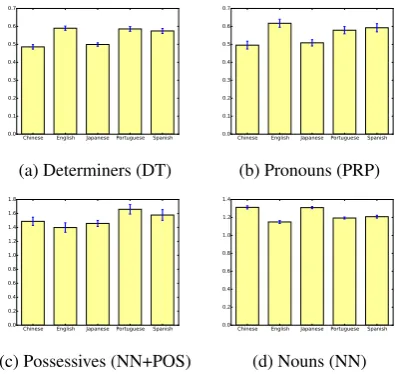
Interestingly, some of the reading features that are most predictive of each native language lend themselves to linguistic interpretation with respect tostructuralfactors. For example, in Japanese and Chinese we observe shorter reading times for de-terminers (DT), which do not exist in these lan-guages. Figure2apresents the mean TF times for determiners in all five native languages, suggest-ing that native speakers of Portuguese and Span-ish, which do have determiners, do not exhibit re-duced reading times on this structure compared to natives. In ESL production, missing determiner errors are the most frequent error for native speak-ers of Japanese and third most common error for native speakers of Chinese.
In figure 2b we present the mean TF read-ing times for pronouns (PRP), where we also see shorter reading times by natives of Japanese and Chinese as compared to English natives. In both languages pronouns can be omitted both in object and subject positions. Portuguese and Spanish, in which pronoun omission is restricted to the subject position present similar albeit weaker tendency.
Negative (Fast) Positive (Slow)
Chinese DT JJR
PRP NN
Japanese DT NN
CD VBD
Portuguese NNS NN-POS
PRP VBZ
Spanish NNS MD
PRP RB
Table 3: PTB POS features with the strongest weights learned in non-native versus native clas-sification for each native language in the shared regime. Feature types presented in figure 2 are highlighted in bold.
Chinese English Japanese PortugueseSpanish 0.0
0.1 0.2 0.3 0.4 0.5 0.6 0.7
(a) Determiners (DT)
Chinese English JapanesePortuguese Spanish 0.0
0.1 0.2 0.3 0.4 0.5 0.6 0.7
(b) Pronouns (PRP)
Chinese English Japanese PortugueseSpanish 0.0
0.2 0.4 0.6 0.8 1.0 1.2 1.4 1.6 1.8
(c) Possessives (NN+POS)
Chinese English JapanesePortuguese Spanish 0.0
0.2 0.4 0.6 0.8 1.0 1.2 1.4
[image:7.595.306.500.63.154.2](d) Nouns (NN)
Figure 2: Mean speed-normalized Total Fixation duration for Determiners (DT), Pronouns (PRP), singular noun possessives (NN+POS), and singu-lar nouns (NN) appearing in the shared sentences. Error bars denote standard error.
In figure 2c we further observe that differ-ently from natives of Chinese and Japanese, native speakers of Portuguese and Spanish spend more time on NN+POS in head final possessives such as “thepublic’sconfidence”. While similar construc-tions exist in Chinese and Japanese, the NN+POS combination is expressed in Portuguese and Span-ish as a head initial NNof NN. This form exists in English (e.g. “the confidence of the public”) and is preferred by speakers of these languages in ESL writing (Nagata and Whittaker,2013). As an ad-ditional baseline for this construction, we provide the TF times for NN in figure2d. There, relative to English natives, we observe longer reading times for Japanese and Chinese and comparable times for Portuguese and Spanish.
[image:7.595.315.513.256.443.2]rise to a second, potentially competing interpreta-tion of differences in ESL reading times, which highlights lexical rather than structural factors. According to this interpretation, increased read-ing times of nouns are the result of substantially smaller lexical sharing with English by Chinese and Japanese as compared to Spanish and Por-tuguese. Given the utilized speed normalization, lexical effects on nouns could in principle account for reduced reading times on determiners and pro-nouns. Conversely, structural influence leading to reduced reading times on determiners and pro-nouns could explain longer dwelling on pro-nouns. A third possibility consistent with the observed read-ing patterns would allow for both structural and lexical effects to impact second language reading. Importantly, in each of these scenarios, ESL read-ing patterns are related to lread-inguistic factors of the reader’s native language.
We note that the presented analysis is prelimi-nary in nature, and warrants further study in future research. In particular, reading times and classi-fier learned features may in some cases differ be-tween the shared and the individual regimes. In the examples presented above, similar results are ob-tained in the individual sentences regime for DT, PRP and NN. The trend for the NN+POS construc-tion, however, diminishes in that setup with simi-lar reading times for all languages. On the other hand, one of the strongest features for predicting Portuguese and Spanish in the individual regime are longer reading times for prepositions (IN), an outcome that holds in the shared regime only rel-ative to Chinese and Japanese, but not relrel-ative to native speakers of English.
Despite these caveats, our results suggest that reading patterns can potentially be related to lin-guistic factors of the reader’s native language. This analysis can be extended in various ways, such as inclusion of additional feature types and fixation metrics, as well as utilization of other comparative methodologies. Combined with ev-idence from language production, this line of in-vestigation can be instrumental for informing lin-guistic theory of cross-linlin-guistic influence.
5 Related Work
Eyetracking and second language reading
Sec-ond language reading has been studied using eye-tracking, with much of the work focusing on processing of syntactic ambiguities and analysis
of specific target word classes such as cognates (Dussias, 2010;Roberts and Siyanova-Chanturia, 2013). In contrast to our work, such studies typ-ically use controlled, rather than free-form sen-tences. Investigation of global metrics in free-form second language reading was introduced only recently by Cop et al. (2015). This study compared ESL and native reading of a novel by native speakers of Dutch, observing longer sen-tence reading times, more fixations and shorter saccades in ESL reading. Differently from this study, our work focuses on comparison of reading patterns between different native languages. We also analyze a related, but different metric, namely speed normalized fixation durations on word se-quences.
Eyetracking for NLP tasks Recent work in
NLP has demonstrated that reading gaze can serve as a valuable supervision signal for standard NLP tasks. Prominent examples of such work include POS tagging (Barrett and Søgaard,2015a;Barrett et al., 2016), syntactic parsing (Barrett and Sø-gaard, 2015b) and sentence compression (Klerke et al., 2016). Our work also tackles a traditional NLP task with free-form text, but differs from this line of research in that it addresses this task only in comprehension. Furthermore, while these stud-ies use gaze recordings of native readers, our work focuses on non-native readers.
NLI in production NLI was first introduced
in Koppel et al. (2005) and has been drawing considerable attention in NLP, including a recent shared-task challenge with 29 participating teams (Tetreault et al.,2013). NLI has also been driving much of the work on identification of native lan-guage related features in writing (Tsur and Rap-poport, 2007; Jarvis and Crossley, 2012;Brooke and Hirst, 2012;Tetreault et al., 2012;Swanson and Charniak, 2013, 2014; Malmasi and Dras, 2014;Bykh and Meurers, 2016). Several studies have also linked usage patterns and grammatical errors in production to linguistic properties of the writer’s native language (Nagata and Whittaker, 2013; Nagata, 2014; Berzak et al., 2014, 2015). Our work departs from NLI in writing and intro-duces NLI and related feature analysis in reading.
6 Conclusion and Outlook
En-glish text. We demonstrate for the first time that this signal can be used to determine a reader’s na-tive language. The effecna-tiveness of linguistically motivated criteria for fixation clustering and our subsequent analysis suggest that the ESL reading process is affected by linguistic factors. Specifi-cally, we show that linguistic similarities between native languages are reflected in similarities in ESL reading. We also identify several key fea-tures that characterize reading in different native languages, and discuss their potential connection to structural and lexical properties of the native langauge. The presented results demonstrate that eyetracking data can be instrumental for develop-ing predictive and explanatory models of second language reading.
While this work is focused on NLIR from fix-ations, our general framework can be used to ad-dress additional aspects of reading, such as anal-ysis of saccades and gaze trajectories. In future work, we also plan to explore the role of native and second language writing system characteris-tics in second language reading. More broadly, our methodology introduces parallels with produc-tion studies in NLP, creating new opportunities for integration of data, methodologies and tasks be-tween production and comprehension. Further-more, it holds promise for formulating language learning theory that is supported by empirical find-ings in naturalistic setups across language process-ing domains.
Acknowledgements
We thank Amelia Smith, Emily Weng, Run Chen and Lila Jansen for contributions to stimuli prepa-ration and data collection. We also thank An-drei Barbu, Guy Ben-Yosef, Yen-Ling Kuo, Roger Levy, Jonathan Malmaud, Karthik Narasimhan and the anonymous reviewers for valuable feed-back on this work. This material is based upon work supported by the Center for Brains, Minds, and Machines (CBMM), funded by NSF STC award CCF-1231216.
References
Rosa Alonso Alonso. 2015. Crosslinguistic Influence in Second Language Acquisition, volume 95. Multi-lingual Matters.
Maria Barrett, Joachim Bingel, Frank Keller, and An-ders Søgaard. 2016. Weakly supervised
part-of-speech tagging using eye-tracking data. InACL. vol-ume 2, pages 579–584.
Maria Barrett and Anders Søgaard. 2015a. Reading behavior predicts syntactic categories. In CoNLL. pages 345–349.
Maria Barrett and Anders Søgaard. 2015b. Using read-ing behavior to predict grammatical functions. In
Proceedings of the Sixth Workshop on Cognitive As-pects of Computational Language Learning. pages 1–5.
Éva Berkes and Suzanne Flynn. 2012. Multilingual-ism: New perspectives on syntactic development.
The Handbook of Bilingualism and Multilingualism, Second Editionpages 137–167.
Yevgeni Berzak, Roi Reichart, and Boris Katz. 2014. Reconstructing native language typology from for-eign language usage. In Eighteenth Confer-ence on Computational Natural Language Learning (CoNLL).
Yevgeni Berzak, Roi Reichart, and Boris Katz. 2015. Contrastive analysis with predictive power: Typol-ogy driven estimation of grammatical error distribu-tions in esl. InConference on Computational Natu-ral Language Learning (CoNLL).
Julian Brooke and Graeme Hirst. 2012. Measuring in-terlanguage: Native language identification with l1-influence metrics. InLREC. pages 779–784.
Serhiy Bykh and Detmar Meurers. 2016. Advanc-ing lAdvanc-inguistic features and insights by label-informed feature grouping: An exploration in the context of native language identification. InCOLING.
Richard H Byrd, Peihuang Lu, Jorge Nocedal, and Ciyou Zhu. 1995. A limited memory algorithm for bound constrained optimization. SIAM Journal on Scientific Computing16(5):1190–1208.
Chris Collins and Richard Kayne. 2009. Syn-tactic Structures of the world’s languages. http://sswl.railsplayground.net.
Uschi Cop, Denis Drieghe, and Wouter Duyck. 2015. Eye movement patterns in natural reading: A com-parison of monolingual and bilingual reading of a novel. PLOS ONE10(8):1–38.
Matthew S. Dryer and Martin Haspelmath, editors. 2013. WALS Online. Max Planck Institute for Evo-lutionary Anthropology, Leipzig. http://wals.info/.
Paola E Dussias. 2010. Uses of eye-tracking data in second language sentence processing research. An-nual Review of Applied Linguistics30:149–166.
Harald Hammarström, Robert Forkel, Martin Haspel-math, and Sebastian Bank. 2015. Glottolog 2.6.
Scott Jarvis and Scott A Crossley. 2012. Approach-ing Language Transfer Through Text Classification: Explorations in the Detection-based Approach, vol-ume 64. Multilingual Matters.
Scott Jarvis and Aneta Pavlenko. 2008. Crosslinguistic influence in language and cognition. Routledge.
Sigrid Klerke, Yoav Goldberg, and Anders Søgaard. 2016. Improving sentence compression by learning to predict gaze.NAACL-HLT.
Moshe Koppel, Jonathan Schler, and Kfir Zigdon. 2005. Determining an author’s native language by mining a text for errors. In Proceedings of the eleventh ACM SIGKDD international conference on Knowledge discovery in data mining. ACM, pages 624–628.
Paul M. Lewis, Gary F. Simons, and Charles D. Fennig, editors. 2015. Ethnologue: Languages of the World. SIL International, Dallas, Texas. http://www.ethnologue.com.
Patrick Littel, David Mortensen, and Lori Levin, editors. 2016. URIEL Typological Database. Pittsburgh: Carnegie Mellon University. http://www.cs.cmu.edu/ dmortens/uriel.html.
Patrick Littell, David Mortensen, Ke Lin, Katherine Kairis, Carlisle Turner, and Lori Levin. 2017. Uriel and lang2vec: Representing languages as typologi-cal, geographitypologi-cal, and phylogenetic vectors. EACL 2017page 8.
Shervin Malmasi and Mark Dras. 2014. Language transfer hypotheses with linear svm weights. In
EMNLP. pages 1385–1390.
Mitchell P Marcus, Mary Ann Marcinkiewicz, and Beatrice Santorini. 1993. Building a large annotated corpus of english: The penn treebank. Computa-tional linguistics19(2):313–330.
Gita Martohardjono and Suzanne Flynn. 1995. Lan-guage transfer: what do we really mean. In L. Eu-bank, L. Selinker, and M. Sharwood Smith, edi-tors, The current state of Interlanguage: studies in honor of William E. Rutherford, John Benjamins: The Netherlands, pages 205–219.
Ryan T McDonald, Joakim Nivre, Yvonne Quirmbach-Brundage, Yoav Goldberg, Dipanjan Das, Kuzman Ganchev, Keith B Hall, Slav Petrov, Hao Zhang, Os-car Täckström, et al. 2013. Universal dependency annotation for multilingual parsing. InACL. pages 92–97.
Ryo Nagata. 2014. Language family relationship pre-served in non-native english. In COLING. pages 1940–1949.
Ryo Nagata and Edward W. D. Whittaker. 2013. Re-constructing an indo-european family tree from non-native english texts. InACL. pages 1137–1147.
Terence Odlin. 1989. Language transfer: Cross-linguistic influence in language learning. Cam-bridge University Press.
Slav Petrov, Dipanjan Das, and Ryan McDonald. 2012. A universal part-of-speech tagset. InLREC.
Steven T Piantadosi, Harry Tily, and Edward Gibson. 2011. Word lengths are optimized for efficient com-munication. Proceedings of the National Academy of Sciences108(9):3526–3529.
Leah Roberts and Anna Siyanova-Chanturia. 2013. Using eye-tracking to investigate topics in l2 acqui-sition and l2 processing. Studies in Second Lan-guage Acquisition35(02):213–235.
Beatrice Santorini. 1990. Part-of-speech tagging guidelines for the penn treebank project (3rd revi-sion).Technical Reports (CIS).
Ben Swanson and Eugene Charniak. 2013. Extracting the native language signal for second language ac-quisition. InHLT-NAACL. pages 85–94.
Ben Swanson and Eugene Charniak. 2014. Data driven language transfer hypotheses. EACLpage 169.
Joel Tetreault, Daniel Blanchard, and Aoife Cahill. 2013. A report on the first native language identi-fication shared task. InProceedings of the Eighth Workshop on Innovative Use of NLP for Building Educational Applications. Citeseer, pages 48–57.
Joel R Tetreault, Daniel Blanchard, Aoife Cahill, and Martin Chodorow. 2012. Native tongues, lost and found: Resources and empirical evaluations in na-tive language identification. In COLING. pages 2585–2602.
Oren Tsur and Ari Rappoport. 2007. Using classifier features for studying the effect of native language on the choice of written second language words. In
Proceedings of the Workshop on Cognitive Aspects of Computational Language Acquisition. Associa-tion for ComputaAssocia-tional Linguistics, pages 9–16.
Joe H Ward Jr. 1963. Hierarchical grouping to opti-mize an objective function. Journal of the American statistical association58(301):236–244.
Helen Yannakoudakis, Ted Briscoe, and Ben Medlock. 2011. A new dataset and method for automatically grading esol texts. InACL. pages 180–189.
A Supplemental Material
Eyetracking Setup We use a 44.5x30cm screen
the forehead bar, and 13cm below it. The eye-tracker camera knob is 65cm away from forehead bar. Throughout the experiment participants hold a joystick with a button for indicating sentence completion, and two buttons for answering yes/no questions. We record gaze of the participant’s dominant eye.
Text ParametersAll the textual material in the
experiment is presented using Times font, normal style, with font size 23. In our setup, this cor-responds to 0.36 degrees (11.3px) average lower case letter width, and 0.49 degrees (15.7px) av-erage upper case letter width. We chose a non-monospace font, as such fonts are generally more common in reading. They are also more com-pact compared to monospace fonts, allowing to substantially increase the upper limit for sentence length.
Calibration We use 3H line calibration with