130
From Fidelity to Fluency:
Natural Language Processing for Translator Training
Oi Yee Kwong Department of Translation The Chinese University of Hong Kong
Abstract
This study explores the use of natural lan-guage processing techniques to enhance bilingual lexical access beyond simple equivalents, to enable translators to nav-igate along a wider cross-lingual lexical space and more examples showing differ-ent translation strategies, which is essen-tial for them to learn to produce not only faithful but also fluent translations.
1 Introduction
Online dictionaries are important computer-aided tools for translators today (Bowker,2015), while parallel corpora, despite their relative scarcity, have become useful resources for translation teaching (Olohan, 2004). The two kinds of ref-erence provide what lexicographers like Atkins and Rundell (2008) would distinguish as context-free and context-sensitive translations respec-tively. The current work, as a prelude to a larger project, discusses the limitations of existing bilin-gual lexical resources and proposes natural lan-guage processing approaches for enhancing their navigational means for better usability in transla-tor training and computer-aided translation.
Consider the translation of the English sen-tence “I still have vivid memories of that evening” into Chinese. The Online Cambridge English-Chinese Dictionary1shows two senses of “vivid”, and quite straightforwardly the word can be dis-ambiguated between the first sense (Vivid descrip-tions, memories, etc. produce very clear, powerful, and detailed images in the mind) and the second sense (very brightly coloured). Hence, notwith-standing the normal associative strengths between words, when “vivid” has been properly disam-biguated, its associations with “colour”, “bright”,
1http://dictionary.cambridge.org
etc. are down-weighted compared with its associa-tions with “recollection”, “memory”, “clear”, etc.
Once the decoding purpose is fulfilled, with the appropriate senses identified (“vivid” as above and “memory” as “something that you remember from the past”), one can then refer to the Chinese “equivalents” provided by the dictionary: 栩栩如 生的, 鮮活的, and 生動的 for “vivid”, and 記 憶 and 回憶 for “memory”. But the encoding purpose is not achieved yet, because none of the combinations between these lexical items could be considered satisfactory. They are only conceptu-ally close to what we need, but not exactly appro-priate for the context. It will only be helpful if we can depart from them and navigate further along their associations. The ability to do so is essen-tially what translator training would need to fore-ground, especially for novice translators to pro-duce not only faithful but also fluent translations.
In the rest of this paper, we will first illustrate, in Section 2, the limitations of existing bilingual re-sources from the cognitive perspective, especially with reference to word associations. We will dis-cuss in Section 3 the implications on the need for enhanced access of those resources to facilitate translator training. Section 4 outlines the natural language processing techniques employed in our ongoing work in this regard.
2 Word Association for Lexical Access
While there are various ways to model dif-ferent associative relations from large corpora (e.g. Church and Hanks, 1990; Wettler and Rapp, 1993; Biemann et al., 2004; Kilgarriff et al., 2004; Hill et al., 2015), certain knots remain to be untied for them to be better utilised in language applica-tions. First, corpus-based modelling of associa-tions often focuses on specific relaassocia-tions (e.g. sim-ilarity, hierarchical relations, collocations, etc.), but in real-life lexical access, a combination of relations is often retrieved, as shown in human word association norms (e.g. Moss and Older, 1996). Moreover, some associations are bound to be more relevant than others in a given context, and they are readily activated regardless of their normal associative strengths. Second, for tasks re-quiring bilingual lexical access, care must be taken especially when onsidering the non-identical con-ceptual and linguistic structures across languages. Given the scarcity of complete equivalence and different linguistic properties, bilingual (or multi-lingual) word associations based entirely on bi- or multi-lingual concept lexicalisations (equivalents) may not be adequate for representing the cross-lingual word association patterns.
Existing bilingual dictionaries nevertheless gen-erally presume the existence of lexical transla-tion equivalents. Analysis of human associatransla-tion responses, as in Kwong (2013; 2016), suggests an alternative view. On the one hand, very dif-ferent association types are found for difdif-ferent word classes (e.g. more taxonomic associations for nouns and more collocational associations for verbs), and across English and Chinese (e.g. more paradigmatic responses for English but clear pref-erence for syntagmatic associations for Chinese). On the other hand, free associations may be mod-elled from large corpora, but the results vary con-siderably for individual words, some even counter-intuitive. Less frequent associations are normally disadvantaged, but humans readily retrieve them when prompted by a certain context. Hence, mod-elling of associations should be task-driven.
In addition, the equivalents given in bilingual lexicons are basically decontextualized, and they often do not appear in the example bilingual sen-tences in the dictionaries. Thus, an association found in the source language may not hold for the equivalents found in a target language. When using word associations in a bilingual context, other than associative strengths, cross-lingual
cor-respondence of the associations is also worth in-vestigation.
One conventional issue in psycholinguistics re-garding models of bilingual lexicon is whether the conceptual stores for two languages are shared or separated (Keatley,1992), and many studies sug-gest that the store is mostly shared (e.g. Kroll and Sunderman, 2003). Another issue is what is shared and what is separated in particular lexical concepts (Jarvis and Pavlenko, 2008). Pavlenko (2009) suggested, in contrast to the conclusions by many, that weaker connections failing to show a semantic priming effect may not necessarily in-dicate the lack of shared meaning, as concep-tual equivalence can range from complete equiva-lence to partial and even non-equivaequiva-lence, and the bilingual mental lexicon undergoes conceptual re-structuring during language learning when cross-linguistic differences are encountered. Such cog-nitive aspects may not have been sufficiently mod-elled in static bilingual linguistic lexicons, espe-cially between two very different languages like English and Chinese.
In the following we will compare the word asso-ciations obtained from various resources, and eval-uate them against the information need in our ear-lier example situated in the translation context.
2.1 Word Association Norms
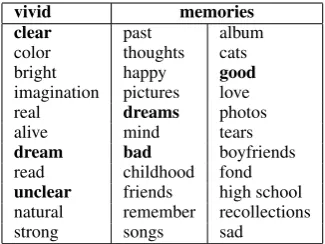
Table 1 shows the non-single responses in de-scending order of frequency in the University of South Florida (USF) Association Norms (Nelson et al., 1998), for the stimuli “vivid” and “memo-ries”. Apparently, should “vivid” and “memories” be associated, they are linked by “dream”. In fact, “memory” was among the 33 single responses for “vivid”, while “vivid” was not among any of the responses for “memories” or “memory”.
vivid memories clear past album color thoughts cats bright happy good imagination pictures love real dreams photos alive mind tears dream bad boyfriends read childhood fond unclear friends high school natural remember recollections strong songs sad
Table 1: Responses from USF Association Norms
[image:2.595.335.498.585.707.2]清 清
清晰晰晰(clear) 印印印象象象(impression) 可見(visible) 深刻(deep)
目標(objective) 印象派(impressionism) 指引(guideline) 良良良好好好(good)
模 模
模糊糊糊(unclear) 差差差(bad) 清
清
清楚楚楚(clear) 人(person)
[image:3.595.87.278.61.145.2]影像(image) 第一印象(first impression) 明白(understand) 派(-ism)
Table 2: Responses from HKC Association Norms
生 動(的)) and for “memory” (記 憶 and 回 憶) are not found in the Hong Kong Chinese (HKC) association norms (Kwong, 2013), so instead we look at the responses for two similar items,清晰 (clear/vivid) and 印象 (impression/memory), re-spectively2. The non-single responses for these stimuli are shown in Table 2. For 清晰, the re-sponses 清楚 (clear) and 模糊 (unclear) can be said to match the English responses for “vivid”, but other than that the response patterns differ con-siderably across languages. The only response re-lated to “memory” is 印象 which appeared only once. Similarly, the stimulus 印象 has its own cluster of associations and the most typical adjec-tive associated with it (深刻) is not one expected in English for “memories”, although more general ones like “good” and “bad” are found in common.
2.2 Dictionary Text
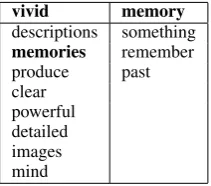
Based on the content words gathered from the def-initions in the Online Cambridge English-Chinese Dictionary (Table 3), it seems that “vivid” and “memories” are closely associated, with the lat-ter appearing in the definition of the former. But as mentioned above, one cannot really take the given Chinese equivalents and combine them for the translation. None of the combinations would sound idiomatic to a native Chinese speaker.
vivid memory descriptions something memories remember produce past clear
powerful detailed images mind
Table 3: Associations from Dictionary Definitions
2The former is among the equivalents for “vivid”
in iCIBA (http://www.iciba.com/) and the latter is a near-synonym for 記 憶 in a Chinese dictionary (http://dict.revised.moe.edu.tw).
2.3 Large Corpora
Making use of the Word Sketch function for se-lected gramrel collocations and the Thesaurus function in the Sketch Engine (Kilgarriff et al.,
2004;Rychl´y and Kilgarriff,2007) on the ukWaC corpus and twWaC corpus, Tables 4 and5 show the top 10 results for our target words.
vivid memory
[image:3.595.311.522.191.314.2]modifies thesaurus modifier thesaurus recollection compelling fond image imagination vibrant loving thought evocation evocative childhood knowledge imagery poignant short-term picture depiction colourful distant feeling memory imaginative vivid sense portrayal striking collective vision dream fascinating episodic experience color dramatic flash character portrait memorable happy idea
Table 4: Associations from ukWaC
清 清
清晰晰晰 回回回憶憶憶 noun right thesaurus adj left thesaurus
影像 清楚 美好 美好
照片 模糊 共同 記憶
概念 完整 老 童年
畫面 生動 許多 回想
聲音 深刻 深刻 時光
條理 流暢 難忘 快樂
輪廓 鮮明 浪漫 故事
認識 明確 永久 感動
文字 簡單 不愉快 往事
方向 呈現 永生 難忘
Table 5: Associations from twWaC
[image:3.595.319.514.369.496.2] [image:3.595.129.235.586.679.2]3 Implications
Realising that Adj-N constructions in English are not necessarily rendered as Adj-(的de)-N in Chi-nese, one must go beyond the context-free equiv-alents given in bilingual dictionaries to look for potential target expressions which may sometimes be found from the context-sensitive translations shown in the example sentences. While one might faithfully combine the bilingual lexicalisations of “vivid” and “memory” to give生動/鮮活/逼真/清 晰的記憶, other more idiomatic and fluent ways of expressing the same meaning in Chinese should be accessible for reference, including word-class shifts like 清楚記得/記得清清楚楚 (remember vividly), use of four-character expressions like記 憶猶新, as well as other appropriate expressions depending on context, such as 印象深刻 and歷 歷在目, to name a few examples.
The process of determining the appropriate target expression from the partial equivalents can sometimes be tricky especially considering the word formation, polysemy, and collocation patterns across the two languages (e.g. even for the same sense, “clear” appropriately cor-responds to 清 晰/清 楚 when collocated with image/explanation respectively, and 清 澈/透 明 with river/glass respectively). The challenge is even more pronounced when no correspondence can be spotted from the examples, or for gen-erally weakly associated words (e.g. strong-endorsement). Thus, natural language processing techniques are adopted to enhance bilingual access beyond lexical equivalents for translators.
4 Work in Progress
It is not simply lexical transfer but a transfer of the whole relevant semantic space that is needed in translation. With this in mind, we are pursu-ing two routes uspursu-ing natural language processpursu-ing approaches to enhance bilingual lexical access be-yond simple translation equivalents, for reference in the translation process.
The first involves chaining up collocation infor-mation in a cross-lingual manner. Many have re-alised that there are often conceptual gaps across languages, but in addition to the bilingual cor-respondences of individual lexicalised concepts, it is necessary to consider the cross-lingual dif-ference in terms of not only conceptual structure but also collocation patterns. As McKeown and Radev (2000) pointed out, a concept expressed by
way of a collocation in one language may not have a corresponding collocation in another language.
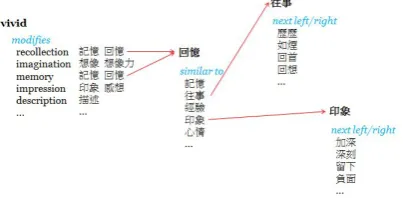
[image:4.595.309.511.306.405.2]Hence, ideally one should be able to start from a certain collocation or cluster of collocation in one language (e.g. vivid-memory) and, through some translation equivalents as seed words (e.g. memory-回憶), extend into the relevant semantic space in the other language (e.g. 往事/歷歷/印 象/深刻) which is otherwise unretrievable from bilingual lexicons alone, as Figure 1 shows. For experiments, the Bilingual Word Sketch function in the Sketch Engine (Baisa et al.,2014) is taken as a starting point, upon which strategic applica-tion of word sense disambiguaapplica-tion, clustering, and word embedding techniques is tested for their ef-fects on prioritising word associations with re-spect to specific collocations for a given context.
Figure 1: A Glimpse of a Cross-lingual Colloca-tion Chain
Acknowledgements
The work described in this paper was fully sup-ported by a grant from the Research Grants Coun-cil of the Hong Kong Special Administrative Re-gion, China (Project No. CUHK 14616317).
References
J. Aitchison. 2003. Words in the Mind: An Introduction to the Mental Lexicon. Blackwell Publishers.
B.T.S. Atkins and M. Rundell. 2008. The Oxford Guide to Practical Lexicography. Oxford University Press.
D. Bahdanau, K. Cho, and Y. Bengio. 2014. Neural machine translation by jointly learning to align and translate. InarXiv e-prints, abs/1409.0473.
V. Baisa, M. Jakub´ıˇcek, A. Kilgarriff, V. Kov´aˇr, and P. Rychl´y. 2014. Bilingual Word Sketches: the translate button. In Proceedings of the 16th EU-RALEX International Congress, pages 505–513, Bolzano, Italy.
C. Biemann, S. Bordag, and U. Quasthoff. 2004. Au-tomatic acquisition of paradigmatic relations using iterated co-occurrences. In Proceedings of 4th In-ternational Conference on Language Resources and Evaluation (LREC 2004), pages 967–970, Lisbon, Portugal.
L. Bowker. 2015. Computer-aided translation: Trans-lator training. In S-W. Chan, editor,The Routledge Encyclopedia of Translation Technology. Routledge.
K.W. Church and P. Hanks. 1990. Word association norms, mutual information, and lexicography. Com-putational Linguistics, 16(1):22–29.
A.M. Collins and E.F. Loftus. 1975. A spreading-activation theory of semantic processing. Psycho-logical Review, 82(6):407–428.
C. Fellbaum. 1998. WordNet: An Electronic Lexical Database. MIT Press.
F. Hill, R. Reichart, and A. Korhonen. 2015. Simlex-999: Evaluating semantic models with (genuine) similarity estimation. Computational Linguistics, 41(4):665–695.
S. Jarvis and A. Pavlenko. 2008. Crosslinguistic Influ-ence in Language and Cognition. Routledge, New York.
C. Keatley. 1992. History of bilingualism research in cognitive psychology. In R. Harris, editor, Cogni-tive Processing in Bilinguals, pages 15–49. North-Holland, Amsterdam.
A. Kilgarriff, P. Rychl´y, P. Smrz, and D.Tugwell. 2004. The Sketch Engine. In Proceedings of EURALEX 2004, Lorient, France.
J. Kroll and G. Sunderman. 2003. Cognitive processes in second language learners and bilinguals: The de-velopment of lexical and conceptual representations. In C. Doughty and M. Long, editors, The Hand-book of Second Language Acquisition, pages 104– 129. Blackwell, Malden, MA.
O.Y. Kwong. 2013. Exploring the Chinese mental lex-icon with word association norms. InProceedings of the 27th Pacific Asia Conference on Language, Information and Computation (PACLIC 27), pages 153–162, Taipei.
O.Y. Kwong. 2016. Strong associations can be weak: Some thoughts on cross-lingual word webs for trans-lation. InProceedings of the 30th Pacific Asia Con-ference on Language, Information and Computation (PACLIC 30), pages 249–257, Seoul, Korea.
K.R. McKeown and D.R. Radev. 2000. Collocations. In R. Dale, H. Moisl, and H. Somers, editors, A Handbook of Natural Language Processing. Marcel Dekker.
H. Moss and L. Older. 1996. Birkbeck Word Associa-tion Norms. Psychology Press, Hove, UK.
R. Navigli and S. Ponzetto. 2012. Babelnet: The au-tomatic construction, evaluation and application of a wide-coverage multilingual semantic network. Arti-ficial Intelligence, 193:217–250.
D.L. Nelson, C.L. McEvoy, and T.A. Schreiber. 1998. The University of South Florida word association, rhyme, and word fragment norms. http://w3.usf.edu/FreeAssociation/.
M. Olohan. 2004. Introducing Corpora in Translation Studies. Routledge.
A. Pavlenko. 2009. Conceptual representation in the bilingual lexicon and second language vocabulary learning. In A. Pavlenko, editor,The Bilingual Men-tal Lexicon: Interdisciplinary Approaches, pages 125–160. Multilingual Matters, Bristol, UK.
P. Rychl´y and A. Kilgarriff. 2007. An efficient al-gorithm for building a distributional thesaurus (and other Sketch Engine developments). InProceedings of the 45th Annual Meeting of the ACL on Interac-tive Poster and Demonstration Sessions, pages 41– 44, Czech Republic.
M. Wettler and R. Rapp. 1993. Computation of word associations based on the co-occurrences of words in large corpora. InProceedings of the 1st Workshop on Very Large Corpora: Academic and Industrial Perspectives, pages 84–93, Columbus, Ohio.