Proceedings of the 55th Annual Meeting of the Association for Computational Linguistics, pages 634–642 Proceedings of the 55th Annual Meeting of the Association for Computational Linguistics, pages 634–642
Affect-LM: A Neural Language Model for Customizable Affective Text
Generation
Sayan Ghosh1, Mathieu Chollet1, Eugene Laksana1, Louis-Philippe Morency2and Stefan Scherer1 1Institute for Creative Technologies, University of Southern California, CA, USA
2Language Technologies Institute, Carnegie Mellon University, PA, USA 1{sghosh,chollet,elaksana,scherer}@ict.usc.edu
Abstract
Human verbal communication includes affective messages which are conveyed through use of emotionally colored words. There has been a lot of research in this direction but the problem of integrat-ing state-of-the-art neural language mod-els with affective information remains an area ripe for exploration. In this paper, we propose an extension to an LSTM (Long Short-Term Memory) lan-guage model for generating conversa-tional text, conditioned on affect cate-gories. Our proposed model, Affect-LM
enables us to customize the degree of emotional content in generated sentences through an additional design parameter. Perception studies conducted using Ama-zon Mechanical Turk show that Affect-LMgenerates naturally looking emotional sentences without sacrificing grammatical correctness. Affect-LM also learns affect-discriminative word representations, and perplexity experiments show that addi-tional affective information in conversa-tional text can improve language model prediction.
1 Introduction
Affect is a term that subsumes emotion and longer term constructs such as mood and personality and refers to the experience of feeling or emo-tion (Scherer et al.,2010).Picard(1997) provides a detailed discussion of the importance of affect analysis in human communication and interaction. Within this context the analysis of human affect from text is an important topic in natural language understanding, examples of which include senti-ment analysis from Twitter (Nakov et al., 2016), affect analysis from poetry (Kao and Jurafsky,
Affect-LM “I feel so …”
Context Words
“… great about this.” “… good about this.”
“… awesome about this.”
Affect Strength
Low High Mid
Affect Category
! " #
$ %
Au
to
ma
ti
c
In
fe
re
n
ce
(o
p
ti
o
n
a
l)
et 1
ct 1
Figure 1:Affect-LMis capable of generating emotionally colored conversational text in five
specific affect categories (et−1) with varying affect strengths (β). Three generated example
sentences forhappyaffect category are shown in three distinct affect strengths.
2012) and studies of correlation between function words and social/psychological processes ( Pen-nebaker,2011). People exchange verbal messages which not only contain syntactic information, but also information conveying their mental and tional states. Examples include the use of emo-tionally colored words (such as furious and joy) and swear words. The automated processing of affect in human verbal communication is of great importance to understanding spoken language sys-tems, particularly for emerging applications such as dialogue systems and conversational agents.
Statistical language modeling is an integral component of speech recognition systems, with other applications such as machine translation and information retrieval. There has been a resur-gence of research effort in recurrent neural net-works for language modeling (Mikolov et al.,
2010), which have yielded performances far supe-rior to baseline language models based on n-gram approaches. However, there has not been much effort in building neural language models of text that leverage affective information. Current liter-ature on deep learning for language understand-ing focuses mainly on representations based on
word semantics (Mikolov et al., 2013), encoder-decoder models for sentence representations (Cho et al., 2015), language modeling integrated with symbolic knowledge (Ahn et al.,2016) and neural caption generation (Vinyals et al.,2015), but to the best of our knowledge there has been no work on augmenting neural language modeling with affec-tive information, or on data-driven approaches to generate emotional text.
Motivated by these advances in neural language modeling and affective analysis of text, in this pa-per we propose a model for representation and generation of emotional text, which we call the
Affect-LM. Our model is trained on conversational speech corpora, common in language modeling for speech recognition applications (Bulyko et al.,
2007). Figure 1 provides an overview of our
Affect-LM and its ability to generate emotionally colored conversational text in a number of affect categories with varying affect strengths. While these parameters can be manually tuned to gener-ate conversational text, the affect cgener-ategory can also be automatically inferred from preceding context words. Specifically for model training, the affect category is derived from features generated using keyword spotting from a dictionary of emotional words, such as the LIWC (Linguistic Inquiry and Word Count) tool (Pennebaker et al.,2001). Our primary research questions in this paper are:
Q1:Can Affect-LM be used to generate affective sentences for a target emotion with varying de-grees of affect strength through a customizable model parameter?
Q2:Are these generated sentences rated as emo-tionally expressive as well as grammatically cor-rect in an extensive crowd-sourced perception ex-periment?
Q3:Does the automatic inference of affect cate-gory from the context words improve language modeling performance of the proposedAffect-LM
over the baseline as measured by perplexity? The remainder of this paper is organized as fol-lows. In Section 2, we discuss prior work in the fields of neural language modeling, and generation of affective conversational text. In Section3 we describe the baseline LSTM model and our pro-posedAffect-LM model. Section4details the ex-perimental setup, and in Section5, we discuss re-sults for customizable emotional text generation, perception studies for each affect category, and perplexity improvements over the baseline model
before concluding the paper in Section6.
2 Related Work
Language modeling is an integral component of spoken language systems, and traditionally n-gram approaches have been used (Stolcke et al.,
2002) with the shortcoming that they are unable to generalize to word sequences which are not in the training set, but are encountered in unseen data.
Bengio et al. (2003) proposed neural language models, which address this shortcoming by gen-eralizing through word representations. Mikolov et al.(2010) andSundermeyer et al.(2012) extend neural language models to a recurrent architecture, where a target word wt is predicted from a
con-text of all preceding wordsw1, w2, ..., wt−1 with an LSTM (Long Short-Term Memory) neural net-work. There also has been recent effort on build-ing language models conditioned on other modali-ties or attributes of the data. For example, Vinyals et al.(2015) introduced the neural image caption generator, where representations learnt from an in-put image by a CNN (Convolutional Neural Net-work) are fed to an LSTM language model to gen-erate image captions. Kiros et al. (2014) used an LBL model (Log-Bilinear language model) for two applications - image retrieval given sentence queries, and image captioning. Lower perplexity was achieved on text conditioned on images rather than language models trained only on text.
for emotional sentence generation. Their gener-ation system is not training on large corpora and they use additional syntactic knowledge of parts of speech to create simple affective sentences. In contrast, our proposed approach builds on state-of-the-art approaches for neural language modeling, utilizes no syntactic prior knowledge, and gener-ates expressive emotional text.
3 Model
3.1 LSTM Language Model
Prior to providing a formulation for our pro-posed model, we briefly describe a LSTM lan-guage model. We have chosen this model as a baseline since it has been reported to achieve state-of-the-art perplexities compared to other ap-proaches, such as n-gram models with Kneser-Ney smoothing (Jozefowicz et al., 2016). Unlike an ordinary recurrent neural network, an LSTM net-work does not suffer from the vanishing gradient problem which is more pronounced for very long sequences (Hochreiter and Schmidhuber, 1997). Formally, by the chain rule of probability, for a sequence of M words w1, w2, ..., wM, the joint
probability of all words is given by:
P(w1, w2, ..., wM) = tY=M
t=1
P(wt|w1, w2, ...., wt−1)
(1) If the vocabulary consists ofV words, the
condi-tional probability of wordwt as a function of its
contextct−1 = (w1, w2, ...., wt−1)is given by:
P(wt=i|ct−1) = exp(Ui Tf(ct
−1) +bi)
PV
j=1exp(UjTf(ct−1) +bj)
(2) f(.) is the output of an LSTM network which
takes in the context wordsw1, w2, ..., wt−1 as in-puts through one-hot representations, U is a ma-trix of word representations which on visualiza-tion we have found to correspond to POS (Part of Speech) information, whilebiis a bias term cap-turing the unigram occurrence of word i.
Equa-tion 2 expresses the word wt as a function of its
context for a LSTM language model which does not utilize any additional affective information.
3.2 Proposed Model:Affect-LM
The proposed modelAffect-LM has an additional energy term in the word prediction, and can be
de-scribed by the following equation:
P(wt=i|ct−1,et−1) =
exp (UiTf(ct−1) +βViTg(et−1) +bi)
PV
j=1exp(UjTf(ct−1) +βVjTg(et−1) +bj)
(3)
et−1 is an input vector which consists of affect category information obtained from the words in the context during training, andg(.)is the output
of a network operating onet−1.Vi is an embed-ding learnt by the model for thei-th word in the
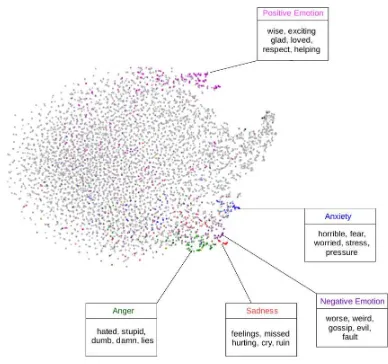
vocabulary and is expected to be discriminative of the affective information conveyed by each word. In Figure4we present a visualization of these af-fective representations.
The parameter β defined in Equation 3, which we call the affect strength defines the influence of the affect category information (frequency of emotionally colored words) on the overall predic-tion of the target wordwt given its context. We
can consider the formulation as an energy based model (EBM), where the additional energy term captures the degree of correlation between the pre-dicted word and the affective input (Bengio et al.,
2003).
3.3 Descriptors for Affect Category Information
Our proposed model learns a generative model of the next wordwtconditioned not only on the
pre-vious words w1, w2, ..., wt−1 but also on the
af-fect category et−1 which is additional informa-tion about emoinforma-tional content. During model train-ing, the affect category is inferred from the con-text data itself. Thus we define a suitable feature extractor which can utilize an affective lexicon to
Corpus Name Conversations Words % Colored Words Content
Fisher 11700 21167581 3.79 Conversations
DAIC 688 677389 5.13 Conversations
SEMAINE 959 23706 6.55 Conversations
[image:4.595.167.435.61.107.2]CMU-MOSI 93 26121 6.54 Monologues
Table 1: Summary of corpora used in this paper. CMU-MOSI and SEMAINE are observed to have higher emotional content than Fisher and DAIC corpora.
presence or absence of a specific emotion, which is obtained by binary thresholding of the features extracted from LIWC. For example, the affective representation of the sentencei will fight in the war
iset−1 ={“sad”:0, “angry”:1, “anxiety”:0, “neg-ative emotion”:1, “positive emotion”:0}.
3.4 Affect-LMfor Emotional Text Generation
Affect-LMcan be used to generate sentences con-ditioned on the input affect category, the affect strengthβ, and the context words. For our
exper-iments, we have chosen the following affect cate-gories -positive emotion, anger, sad, anxiety, and
negative emotion(which is a superclass of anger, sad and anxiety). As described in Section3.2, the affect strengthβ defines the degree of dominance
of the affect-dependent energy term on the word prediction in the language model, consequently af-ter model training we can changeβto control the
degree of how “emotionally colored” a generated utterance is, varying fromβ = 0 (neutral;
base-line model) to β = ∞ (the generated sentences only consist of emotionally colored words, with no grammatical structure).
WhenAffect-LM is used for generation, the af-fect categories could be either (1) inferred from the context using LIWC (this occurs when we provide sentence beginnings which are emotion-ally colored themselves), or (2) set to an input emotion descriptor e (this is obtained by setting e to a binary vector encoding the desired emo-tion and works even for neutral sentence begin-nings). Given an initial starting set of M words w1, w2, ..., wM to complete, affect strength β,
and the number of words N to generate each i
-th generated word is obtained by sampling from
P(wi|w1, w2, ..., wi−1,e;β)fori∈ {M+ 1, M+
2, ..., M +N}.
4 Experimental Setup
In Section 1, we have introduced three primary research questions related to the ability of the proposed Affect-LM model to generate emotion-ally colored conversational text without
sacrific-ing grammatical correctness, and to obtain lower perplexity than a baseline LSTM language model when evaluated on emotionally colored corpora. In this section, we discuss our experimental setup to address these questions, with a description of
Affect-LM’s architecture and the corpora used for training and evaluating the language models.
4.1 Speech Corpora
The Fisher English Training Speech Corpus is the main corpus used for training the proposed model, in addition to which we have chosen three emo-tionally colored conversational corpora. A brief description of each corpus is given below, and in Table1, we report relevant statistics, such as the total number of words, along with the fraction of emotionally colored words (those belonging to the LIWC affective word categories) in each corpus.
Fisher English Training Speech Parts 1 & 2:
The Fisher dataset (Cieri et al.,2004) consists of speech from telephonic conversations of 10 min-utes each, along with their associated transcripts. Each conversation is between two strangers who are requested to speak on a randomly selected topic from a set. Examples of conversation top-ics areMinimum Wage,Time TravelandComedy.
Distress Assessment Interview Corpus (DAIC):
The DAIC corpus introduced by Gratch (2014) consists of 70+ hours of dyadic interviews be-tween a human subject and a virtual human, where the virtual human asks questions designed to di-agnose symptoms of psychological distress in the subject such as depression or PTSD (Post Trau-matic Stress Disorder).
SEMAINE dataset:SEMAINE (McKeown et al.,
2012) is a large audiovisual corpus consisting of interactions between subjects and an operator simulating a SAL (Sensitive Artificial Listener). There are a total of 959 conversations which are approximately 5 minutes each, and are transcribed and annotated with affective dimensions.
Multimodal Opinion-level Sentiment Intensity
Dataset (CMU-MOSI):(Zadeh et al.,2016) This
videos where in each video a speaker expresses his opinion on a commercial product. The cor-pus consist of speech from 93 videos from 89 dis-tinct speakers (41 male and 48 female speakers). This corpus differs from the others since it con-tains monologues rather than conversations.
While we find that all corpora contain spoken language, they have the following characteristics different from the Fisher corpus: (1) More emo-tional content as observed in Table1, since they have been generated through a human subject’s spontaneous replies to questions designed to gen-erate an emotional response, or from conversa-tions on emotion-inducing topics (2) Domain mis-match due to recording environment (for example, the DAIC corpus was created in a mental health setting, while the CMU-MOSI corpus consisted of opinion videos uploaded online). (3) Significantly smaller than the Fisher corpus, which is 25 times the size of the other corpora combined. Thus, we perform training in two separate stages - training of the baseline andAffect-LMmodels on the Fisher corpus, and subsequent adaptation and fine-tuning on each of the emotionally colored corpora.
4.2 Affect-LMNeural Architecture
For our experiments, we have implemented a baseline LSTM language model in Ten-sorflow (Abadi et al., 2016), which follows the non-regularized implementation as described in Zaremba et al. (2014) and to which we have added a separate energy term for the affect cate-gory in implementingAffect-LM. We have used a vocabulary of 10000 words and an LSTM network with 2 hidden layers and 200 neurons per hidden layer. The network is unrolled for 20 time steps, and the size of each minibatch is 20. The affect category et−1 is processed by a multi-layer per-ceptron with a single hidden layer of 100 neurons and sigmoid activation function to yieldg(et−1). We have set the output layer size to 200 for both f(ct−1)andg(et−1). We have kept the network architecture constant throughout for ease of com-parison between the baseline andAffect-LM.
4.3 Language Modeling Experiments
Affect-LM can also be used as a language model where the next predicted word is estimated from the words in the context, along with an affect cate-gory extracted from the context words themselves (instead of being encoded externally as in gener-ation). To evaluate whether additional emotional
information could improve the prediction perfor-mance, we train the corpora detailed in Section4.1
in two stages as described below:
(1) Training and validation of the language
models on Fisher dataset- The Fisher corpus is
split in a 75:15:10 ratio corresponding to the train-ing, validation and evaluation subsets respectively, and following the implementation in Zaremba et al.(2014), we train the language models (both the baseline and Affect-LM) on the training split for 13 epochs, with a learning rate of 1.0 for the first four epochs, and the rate decreasing by a fac-tor of 2 after every subsequent epoch. The learn-ing rate and neural architecture are the same for all models. We validate the model over the affect strength β ∈ [1.0,1.5,1.75,2.0,2.25,2.5,3.0].
The best performing model on the Fisher valida-tion set is chosen and used as a seed for subsequent adaptation on the emotionally colored corpora.
(2) Fine-tuning the seed model on other
cor-pora- Each of the three corpora - CMU-MOSI, DAIC and SEMAINE are split in a 75:15:10 ratio to create individual training, validation and eval-uation subsets. For both the baseline and Affect-LM, the best performing model from Stage 1 (the seed model) is fine-tuned on each of the train-ing corpora, with a learntrain-ing rate of 0.25 which is constant throughout, and a validation grid of
β ∈ [1.0,1.5,1.75,2.0]. For each model adapted on a corpus, we compare the perplexities obtained byAffect-LMand the baseline model when evalu-ated on that corpus.
4.4 Sentence Generation Perception Study
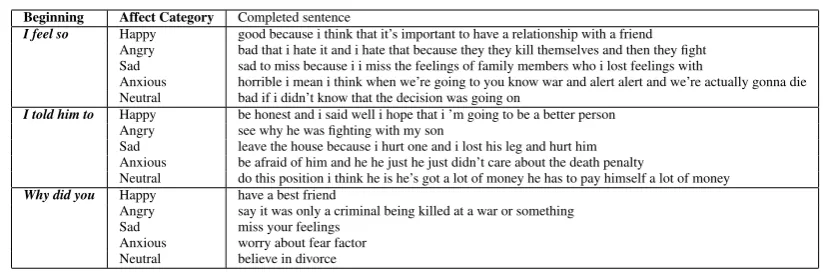
We assess Affect-LM’s ability to generate emo-tionally colored text of varying degrees without severely deteriorating grammatical correctness, by conducting an extensive perception study on Ama-zon’s Mechanical Turk (MTurk) platform. The MTurk platform has been successfully used in the past for a wide range of perception experi-ments and has been shown to be an excellent re-source to collect human ratings for large stud-ies (Buhrmester et al., 2011). Specifically, we generated more than 200 sentences for four sen-tence beginnings (namely the three sensen-tence be-ginnings listed in Table 2 as well as an end of sentence token indicating that the model should generate a new sentence) in five affect categories
happy(positive emotion), angry, sad, anxiety, and
Beginning Affect Category Completed sentence
I feel so Happy good because i think that it’s important to have a relationship with a friend Angry bad that i hate it and i hate that because they they kill themselves and then they fight Sad sad to miss because i i miss the feelings of family members who i lost feelings with
Anxious horrible i mean i think when we’re going to you know war and alert alert and we’re actually gonna die Neutral bad if i didn’t know that the decision was going on
I told him to Happy be honest and i said well i hope that i ’m going to be a better person Angry see why he was fighting with my son
Sad leave the house because i hurt one and i lost his leg and hurt him Anxious be afraid of him and he he just he just didn’t care about the death penalty
Neutral do this position i think he is he’s got a lot of money he has to pay himself a lot of money
Why did you Happy have a best friend
Angry say it was only a criminal being killed at a war or something Sad miss your feelings
[image:6.595.91.503.58.196.2]Anxious worry about fear factor Neutral believe in divorce
Table 2: Example sentences generated by the model conditioned on different affect categories
on the Fisher corpus was used for sentence gen-eration. Each sentence was evaluated by two hu-man raters that have a minimum approval rating of 98% and are located in the United States. The human raters were instructed that the sentences should be considered to be taken from a conver-sational rather than a written context: repetitions and pause fillers (e.g., um, uh) are common and no punctuation is provided. The human raters evaluated each sentence on a seven-point Likert scale for the five affect categories, overall affec-tive valence as well as the sentence’s grammati-cal correctness and were paid 0.05USD per sen-tence. We measured inter-rater agreement using Krippendorffsαand observed considerable
agree-ment between raters across all categories (e.g., for
valenceα = 0.510andgrammatical correctness α= 0.505).
For each target emotion (i.e., intended emo-tion of generated sentences) we conducted an ini-tial MANOVA, with human ratings of affect cat-egories the DVs (dependent variables) and the affect strength parameter β the IV (independent
variable). We then conducted follow-up univariate ANOVAs to identify which DV changes signifi-cantly withβ. In total we conducted 5 MANOVAs
and 30 follow-up ANOVAs, which required us to update the significance level to p<0.001 following
a Bonferroni correction.
5 Results
5.1 Generation of Emotional Text
In Section 3.4 we have described the process of sampling text from the model conditioned on in-put affective information (research questionQ1). Table 2 shows three sentences generated by the model for input sentence beginnings I feel so ...,
Why did you ...andI told him to ... for each of five
affect categories -happy(positive emotion), angry, sad anxiety, and neutral(no emotion). They have been selected from a pool of 20 generated sen-tences for each category and sentence beginning.
5.2 MTurk Perception Experiments
In the following we address research questionQ2
by reporting the main statistical findings of our MTurk study, which are visualized in Figures 2
and3.
Positive Emotion Sentences. The
multi-variate result was significant for positive emo-tion generated sentences (Pillai’s Trace=.327,
F(4,437)=6.44, p<.0001). Follow up ANOVAs
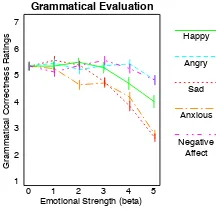
revealed significant results for all DVs except an-gry with p<.0001, indicating that both affective valenceandhappyDVs were successfully manip-ulated withβ, as seen in Figure 2(a). Grammat-ical correctnesswas also significantly influenced by the affect strength parameterβand results show
that the correctness deteriorates with increasingβ
(see Figure 3). However, a post-hoc Tukey test revealed that only the highestβvalue shows a
sig-nificant drop ingrammatical correctnessat p<.05.
Negative Emotion Sentences. The
multi-variate result was significant for negative emo-tion generated sentences (Pillai’s Trace=.130,
F(4,413)=2.30, p<.0005). Follow up ANOVAs
revealed significant results for affective valence
andhappyDVs with p<.0005, indicating that the affective valence DV was successfully manipu-lated with β, as seen in Figure 2(b). Further,
1 2 3 4 5 6 7
(a) Positive Emotion (b) Negative Emotion (c) Angry (d) Sad (e) Anxious
0 1 2 3 4 5 0 1 2 3 4 5 0 1 2 3 4 5 0 1 2 3 4 5 0 1 2 3 4 5 Anxious
Happy Angry Emotional Strength (beta)
Emo
ti
o
n
R
a
ti
n
g
s
[image:7.595.83.515.62.196.2]Sad Affect Valence
Figure 2: Amazon Mechanical Turk study results for generated sentences in the target affect categories
positive emotion, negative emotion, angry, sad, andanxious(a)-(e). The most relevant human rating curve for each generated emotion is highlighted in red, while less relevant rating curves are visualized
in black. Affect categories are coded via different line types and listed in legend below figure.
specific emotions, such asangry, sad, andanxious
(Pennebaker et al.,2001). Grammatical correct-nesswas also significantly influenced by the affect strengthβand results show that the correctness de-teriorates with increasingβ (see Figure3). As for positive emotion, a post-hoc Tukey test revealed that only the highest β value shows a significant drop ingrammatical correctnessat p<.05.
Angry Sentences. The multivariate result was
significant forangrygenerated sentences (Pillai’s Trace=.199, F(4,433)=3.76, p<.0001). Follow
up ANOVAs revealed significant results for affec-tive valence, happy, andangryDVs with p<.0001,
indicating that both affective valence and angry
DVs were successfully manipulated with β, as
seen in Figure2(c).Grammatical correctnesswas not significantly influenced by the affect strength parameterβ, which indicates that angry sentences
are highly stable across a wide range ofβ(see
Fig-ure3). However, it seems that human raters could not successfully distinguish between angry, sad, and anxiousaffect categories, indicating that the generated sentences likely follow a general nega-tive affectdimension.
Sad Sentences. The multivariate result was
significant for sad generated sentences (Pillai’s Trace=.377, F(4,425)=7.33, p<.0001). Follow
up ANOVAs revealed significant results only for the sad DV with p<.0001, indicating that while thesadDV can be successfully manipulated with
β, as seen in Figure2(d). The grammatical cor-rectnessdeteriorates significantly withβ. Specifi-cally, a post-hoc Tukey test revealed that only the two highest β values show a significant drop in grammatical correctnessat p<.05 (see Figure3).
0 1 2 3 4 5 Emotional Strength (beta) 1
2 3 4 5 6 7
G
ra
mma
ti
ca
l
C
o
rre
ct
n
e
ss
R
a
ti
n
g
s
Grammatical Evaluation
Happy
Angry
Sad
Anxious
Negative Affect
Figure 3: Mechanical Turk study results for
grammatical correctnessfor all generated target emotions. Perceivedgrammatical correctnessfor
each affect categories are color-coded.
A post-hoc Tukey test forsadreveals thatβ= 3is
optimal for this DV, since it leads to a significant jump in the perceived sadness scores at p<.005 for β ∈ {0,1,2}.
Anxious Sentences. The multivariate result
was significant for anxious generated sentences (Pillai’s Trace=.289, F(4,421)=6.44, p<.0001).
Follow up ANOVAs revealed significant results foraffective valence, happyandanxiousDVs with p<.0001, indicating that both affective valence
and anxiety DVs were successfully manipulated with β, as seen in Figure 2(e). Grammatical correctness was also significantly influenced by the affect strength parameter β and results show
that the correctness deteriorates with increasingβ.
Similarly forsad, a post-hoc Tukey test revealed that only the two highestβ values show a
signif-icant drop in grammatical correctness at p<.05
(see Figure3). Again, a post-hoc Tukey test for
anxiousreveals thatβ = 3is optimal for this DV,
[image:7.595.361.469.281.386.2]Training (Fisher) Adaptation
Perplexity Baseline Affect-LM Baseline Affect-LM
Fisher 37.97 37.89 -
-DAIC 65.02 64.95 55.86 55.55
SEMAINE 88.18 86.12 57.58 57.26
CMU-MOSI 104.74 101.19 66.72 64.99
[image:8.595.78.286.61.123.2]Average 73.98 72.54 60.05 59.26
Table 3: Evaluation perplexity scores obtained by the baseline andAffect-LMmodels when trained
on Fisher and subsequently adapted on DAIC, SEMAINE and CMU-MOSI corpora
anxiety scores at p<.005 forβ ∈ {0,1,2}.
5.3 Language Modeling Results
In Table 3, we address research question Q3 by presenting the perplexity scores obtained by the baseline model andAffect-LM, when trained on the Fisher corpus and subsequently adapted on three emotional corpora (each adapted model is indi-vidually trained on CMU-MOSI, DAIC and SE-MAINE). The models trained on Fisher are eval-uated on all corpora while each adapted model is evaluated only on it’s respective corpus. For all corpora, we find that Affect-LM achieves lower perplexity on average than the baseline model, im-plying that affect category information obtained from the context words improves language model prediction. The average perplexity improvement is 1.44 (relative improvement 1.94%) for the model trained on Fisher, while it is 0.79 (1.31%) for the adapted models. We note that larger improve-ments in perplexity are observed for corpora with higher content of emotional words. This is sup-ported by the results in Table 3, where Affect-LMobtains a larger reduction in perplexity for the CMU-MOSI and SEMAINE corpora, which re-spectively consist of 2.76% and 2.75% more emo-tional words than the Fisher corpus.
5.4 Word Representations
In Equation 3, Affect-LM learns a weight ma-trixVwhich captures the correlation between the predicted wordwt, and the affect category et−1. Thus, each row of the matrix Vi is an emotion-ally meaningful embedding of thei-th word in the
vocabulary. In Figure 4, we present a t-SNE vi-sualization of these embeddings, where each data point is a separate word, and words which ap-pear in the LIWC dictionary are colored based on which affect category they belong to (we have la-beled only words in categories positive emotion,
negative emotion, anger, sad and anxiety since
Figure 4: Embeddings learnt byAffect-LM
these categories contain the most frequent words). Words colored grey are those not in the LIWC dictionary. In Figure 4, we observe that the em-beddings contain affective information, where the positive emotion is highly separated from the neg-ative emotions (sad, angry, anxiety) which are clustered together.
6 Conclusions and Future Work
In this paper, we have introduced a novel language modelAffect-LM for generating affective conver-sational text conditioned on context words, an af-fective category and an afaf-fective strength parame-ter. MTurk perception studies show that the model can generate expressive text at varying degrees of emotional strength without affecting grammatical correctness. We also evaluateAffect-LM as a lan-guage model and show that it achieves lower per-plexity than a baseline LSTM model when the af-fect category is obtained from the words in the context. For future work, we wish to extend this model by investigating language generation con-ditioned on other modalities such as facial images and speech, and to applications such as dialogue generation for virtual agents.
Acknowledgments
[image:8.595.316.510.63.245.2]References
Sungjin Ahn, Heeyoul Choi, Tanel P¨arnamaa, and Yoshua Bengio. 2016. A neural knowledge lan-guage model.arXiv preprint arXiv:1608.00318. Yoshua Bengio, R´ejean Ducharme, Pascal Vincent, and
Christian Jauvin. 2003. A neural probabilistic lan-guage model.Journal of machine learning research 3(Feb):1137–1155.
Michael Buhrmester, Tracy Kwang, and Samuel D Gosling. 2011. Amazon’s mechanical turk a new source of inexpensive, yet high-quality, data? Per-spectives on psychological science6(1):3–5. Ivan Bulyko, Mari Ostendorf, Manhung Siu, Tim Ng,
Andreas Stolcke, and ¨Ozg¨ur C¸etin. 2007. Web resources for language modeling in conversational speech recognition. ACM Transactions on Speech and Language Processing (TSLP)5(1):1.
Kyunghyun Cho, Aaron Courville, and Yoshua Ben-gio. 2015. Describing multimedia content using attention-based encoder-decoder networks. IEEE Transactions on Multimedia17(11):1875–1886. Christopher Cieri, David Miller, and Kevin Walker.
2004. The fisher corpus: a resource for the next generations of speech-to-text. InLREC. volume 4, pages 69–71.
Mart´ın Abadi et al. 2016. Tensorflow: A system for large-scale machine learning. InProceedings of the 12th USENIX Symposium on Operating Systems De-sign and Implementation (OSDI). Savannah, Geor-gia, USA.
Jonathan et al. Gratch. 2014. The distress analysis in-terview corpus of human and computer inin-terviews. InLREC. Citeseer, pages 3123–3128.
Sepp Hochreiter and J¨urgen Schmidhuber. 1997. Long short-term memory. Neural computation 9(8):1735–1780.
Rafal Jozefowicz, Oriol Vinyals, Mike Schuster, Noam
Shazeer, and Yonghui Wu. 2016. Exploring
the limits of language modeling. arXiv preprint arXiv:1602.02410.
Justine Kao and Dan Jurafsky. 2012. A computational analysis of style, affect, and imagery in contempo-rary poetry.
Fazel Keshtkar and Diana Inkpen. 2011. A pattern-based model for generating text to express emotion. In Affective Computing and Intelligent Interaction, Springer, pages 11–21.
Ryan Kiros, Ruslan Salakhutdinov, and Richard S Zemel. 2014. Multimodal neural language models. Saad Mahamood and Ehud Reiter. 2011. Generating
affective natural language for parents of neonatal in-fants. In Proceedings of the 13th European Work-shop on Natural Language Generation. Association for Computational Linguistics, pages 12–21.
Franc¸ois Mairesse and Marilyn Walker. 2007. Person-age: Personality generation for dialogue.
Gary McKeown, Michel Valstar, Roddy Cowie, Maja Pantic, and Marc Schroder. 2012. The semaine database: Annotated multimodal records of emo-tionally colored conversations between a person and a limited agent. IEEE Transactions on Affective Computing3(1):5–17.
Tomas Mikolov, Martin Karafi´at, Lukas Burget, Jan Cernock`y, and Sanjeev Khudanpur. 2010. Recur-rent neural network based language model. In Inter-speech. volume 2, page 3.
Tomas Mikolov, Ilya Sutskever, Kai Chen, Greg S Cor-rado, and Jeff Dean. 2013. Distributed representa-tions of words and phrases and their compositional-ity. InAdvances in neural information processing systems. pages 3111–3119.
Preslav Nakov, Alan Ritter, Sara Rosenthal, Fabrizio Sebastiani, and Veselin Stoyanov. 2016. Semeval-2016 task 4: Sentiment analysis in twitter. Proceed-ings of SemEvalpages 1–18.
James W Pennebaker. 2011. The secret life of pro-nouns. New Scientist211(2828):42–45.
James W Pennebaker, Martha E Francis, and Roger J Booth. 2001. Linguistic inquiry and word count: Liwc 2001. Mahway: Lawrence Erlbaum Asso-ciates71(2001):2001.
Rosalind Picard. 1997. Affective computing, volume 252. MIT press Cambridge.
Klaus R Scherer, Tanja B¨anziger, and Etienne Roesch. 2010. A Blueprint for Affective Computing: A sourcebook and manual. Oxford University Press.
Andreas Stolcke et al. 2002. Srilm-an extensible lan-guage modeling toolkit. In Interspeech. volume 2002, page 2002.
Martin Sundermeyer, Ralf Schl¨uter, and Hermann Ney. 2012. Lstm neural networks for language modeling. InInterspeech. pages 194–197.
Oriol Vinyals, Alexander Toshev, Samy Bengio, and Dumitru Erhan. 2015. Show and tell: A neural im-age caption generator. InThe IEEE Conference on Computer Vision and Pattern Recognition (CVPR).
Amir Zadeh, Rowan Zellers, Eli Pincus, and Louis-Philippe Morency. 2016. Multimodal sentiment in-tensity analysis in videos: Facial gestures and verbal messages. IEEE Intelligent Systems31(6):82–88.