Proceedings of the 55th Annual Meeting of the Association for Computational Linguistics (Short Papers), pages 141–147 Vancouver, Canada, July 30 - August 4, 2017. c2017 Association for Computational Linguistics
Proceedings of the 55th Annual Meeting of the Association for Computational Linguistics (Short Papers), pages 141–147 Vancouver, Canada, July 30 - August 4, 2017. c2017 Association for Computational Linguistics
Learning Lexico-Functional Patterns for First-Person Affect
Lena Reed, Jiaqi Wu, Shereen Oraby Pranav Anand and Marilyn Walker
University of California Santa Cruz
{lireed,jwu64,soraby,panand,mawalker}@ucsc.edu
Abstract
Informal first-person narratives are a unique resource for computational mod-els of everyday events and people’s affec-tive reactions to them. People blogging about their day tend not to explicitly say
I am happy. Instead they describe situa-tions from which other humans can read-ily infer their affective reactions. However current sentiment dictionaries are missing much of the information needed to make similar inferences. We build on recent work that models affect in terms of lexical predicate functions and affect on the pred-icate’s arguments. We present a method to learn proxies for these functions from first-person narratives. We construct a novel fine-grained test set, and show that the pat-terns we learn improve our ability to pre-dict first-person affective reactions to ev-eryday events, from a Stanford sentiment baseline of .67F to .75F.
1 Introduction
Across social media, thousands of posts daily take the form of informalFIRST-PERSON NARRA -TIVES. These narratives provide a rich resource for computational modeling of how people feel about the events they report on. Being able to re-liably predict the affect a person may feel towards events they encounter has a range of potential ap-plications, including monitoring mood and men-tal health (Isaacs et al.,2013) and getting conver-sational assistants to respond appropriately ( Bow-den et al.,2017). Moreover, as these narratives are told from the perspective of a protagonist, this re-search could be used to understand other types of protagonist-framed narratives, like those in fiction.
We are interested in the opinions that a protag-onist has, not the author per se. This is sometimes referred to as internal sentiment or self reflective sentiment. While in many situations that is over-laid with the author’s opinions, in first-personal narratives, because the author is the protagonist, the two perspectives align. Here, we use the term
affectto reference this protagonist-centered notion of opinion.
A central obstacle to reliable affect prediction is that that people tend not to explicitlyflag their affective state, by sayingI am happy. Large-scale sentiment dictionaries focus on compiling lexical items that bear a consistent affect all on their own (Wilson et al.,2005). But people tend to describe situations, such asMy friend bought me flowers, orI got a parking ticket, from which other humans can readily infer theirimplicitaffective reactions.
One approach to this problem aims to directly learn units larger than a lexical item that reliably bear some marker of polarity or emotion (Vu et al., 2014;Li et al.,2014;Ding and Riloff,2016;Goyal et al.,2010;Russo et al.,2015;Kiritchenko et al., 2014;Reckman et al.,2013).
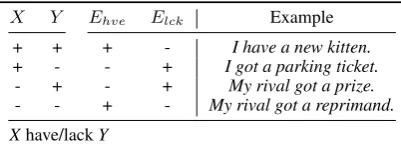
X Y Ehve Elck Example
+ + + - I have a new kitten. + - - + I got a parking ticket.
[image:1.595.314.515.573.646.2]- + - + My rival got a prize. - - + - My rival got a reprimand. Xhave/lackY
Table 1: Functions for verbs of possession.
Another approach aims to model the speaker’s affect to an event compositionally, e.g. Anand and Reschke(2010) (A&R) proposed that the af-fect a lexical predicate communicates should be modeled as an n-ary function, taking as inputs the affect that the speaker bears towards each
pant. Table1contains A&R’s functions for verbs of possession: a state in whichX has YorX lacks Y does not convey a clear affect unless we know what the speaker thinks of bothX andY. If the
speaker has positive affect toward bothX andY
(Row 1), then we infer that her attitude toward the event is positive, but if either is negative, then we infer that the speaker is negative toward the event. Similarly,Rashkin et al.(2016) represent the typ-ical affect communicated by particular predicates via connotation frames. Here we are finding the internal sentiment of the speaker, or, as Rashkin et al. refer to it, the ”mental state” of the speaker.
Inspired by A&R’s framework, our work learns lexico-functional patterns (patterns involving lexi-cal items or pairs of lexilexi-cal items in specific gram-matical relations that we show to capture functor-argument relations in A&R’s sense), about the ef-fects of combining particular arguments with par-ticular verbs (event types) from first-person narra-tives. Our novel observation is that learning these compositional functions is greatly simplified in the case of first-person affect. People bear positive af-fect to themselves, so sentences with first-person elements, e.g. I/we/me, reduce the problem for an approach like A&R’s to learning the polarity that results from composing the verb withonly one
of its arguments, i.e. only Rows 1, 2 in Table 1 need to be learned for first person subjects. First-person narratives are full of such sentences. See Table 2. We show that the learned patterns are often consonant with A&R’s predictions, but are richer, including e.g. many private state descrip-tions (Wiebe et al.,2004;Wiebe,1990).
Positive Sentences
We had a marvelous visit and drank coffee and ate home-made chocolate chip cookies.
Now, I could swim both froggy and free style swimming!! Negative Sentences
But last week, he said that he doesn’t know if he has the same feelings for me anymore.
I didn’t want to lose him.
Table 2: Sentences from the training data
In addition, we demonstrate that these lexico-functional patterns improve the performance of several off-the-shelf sentiment analyzers. We show that Stanford sentiment (Socher et al.,2013) has a best performance of 0.67 macro F on our test set. We then supplement it with our learned pat-terns and demonstrate significant improvements. Our final ensemble achieves 0.75 F on the test set.
We discuss related work in more detail in Sec.5.
2 Bootstrapping a First-Person Sentiment Corpus
We start with a set of first-person narratives (we-blogs) drawn from the Spinn3r corpus, that cover a wide range of topics (Burton et al.,2009;Gordon and Swanson,2009). To reduce noise, we restrict the blogs to those from well-known blogging sites (Ding and Riloff,2016), and select 15,466 stories whose length ranges from 225 to 375 words.
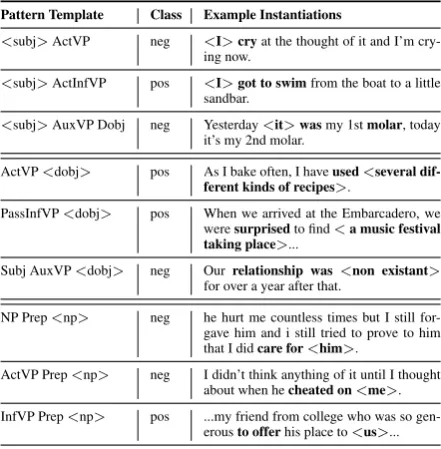
Pattern Template Class Example Instantiations
<subj>ActVP neg <I>cryat the thought of it and I’m cry-ing now.
<subj>ActInfVP pos <I>got to swimfrom the boat to a little sandbar.
<subj>AuxVP Dobj neg Yesterday<it>wasmy 1stmolar, today it’s my 2nd molar.
ActVP<dobj> pos As I bake often, I haveused<several dif-ferent kinds of recipes>.
PassInfVP<dobj> pos When we arrived at the Embarcadero, we weresurprisedto find<a music festival taking place>...
Subj AuxVP<dobj> neg Ourrelationship was <non existant> for over a year after that.
NP Prep<np> neg he hurt me countless times but I still for-gave him and i still tried to prove to him that I didcare for<him>.
ActVP Prep<np> neg I didn’t think anything of it until I thought about when hecheated on<me>. InfVP Prep<np> pos ...my friend from college who was so
gen-erousto offerhis place to<us>...
Table 3: AutoSlog-TS Templates and Example Instantiations
We hand-annotate a set of 477 positive and 440 negative stories, and use these to bootstrap a larger set of 1,420 negative and 2,288 positive stories. To bootstrap, we apply AutoSlog-TS, a weakly su-pervised pattern learner that only requires train-ing sets os stories labeled broadly asPOSITIVEor NEGATIVE(Riloff,1996;Riloff and Wiebe,2003). AutoSlog uses a set of syntactic templates to de-fine different types of linguistic expressions. The left-hand side of Table 3 lists examples of Au-toSlog patterns and the right-hand side illustrates a specific lexical-syntactic pattern that corresponds to each general pattern template, as instantiated in first-person stories.1 When bootstrapping a larger positive and negative story corpus, we use the whole story, not just the first person sentences.
[image:2.595.307.528.223.448.2]of the verbal predicate, which means that these patterns are proxies for one column of verbal func-tion tables like those in Table 1. However, they can also include verb-particle constructions, such as cheated on, or verb-head-of-preposition con-structions. In each case though, because these pat-terns are localized to a verb and only one element, they allow us to learn highly specific patterns that could be incorporated into a dictionary such as +-Effect (Choi and Wiebe,2014). AutoSlog simul-taneously harvests both (syntactically constrained) MWE patterns and more compositionally regular verb-argument groups at the same time.
AutoSlog-TS computes statistics on the strength of association of each pattern with each class, i.e. P(POSITIVE|p) and P(NEGATIVE|p), along with
the pattern’s overall frequency. We define three parameters for each class: θf, the frequency with
which a pattern occurs, θp, the probability with
which a pattern is associated with the given class andθn, the number of patterns that must occur in
the text for it to be labeled. These parameters are tuned on the dev set (Riloff, 1996;Oraby et al., 2015;Riloff and Wiebe,2003).
To bootstrap a larger corpus, we want settings that have lower recall but very high precision. We select θp = 0.7, θf = 10 and θn = 3 for the
positive class andθp = 0.85,θf = 10andθn = 4
for the negative class for bootstrapping.
3 Experimental Setup
Our experimental setup involves first creating a corpus of training and testsentences, then apply-ing AutoSlog-TS a second time to learn lapply-inguistic patterns. We then set up methods for cascading classifiers to explore whether ensemble classifiers improve our results.
Training Set: From the bootstrapped set of sto-ries, we create a corpus of sentences. A critical simplifying assumption of our method is that a multi-sentence story can be labelled as a whole as positive or negative, and that each of its sen-tences inherit this polarity. This means we can learn the polarity of events in such narratives from their (noisy) inherited polarity without labelling individual sentences. Our training set consists of 46,255 positive and 25,069 negative sentences.
Test Set:We create the test set by selecting 4k ran-dom first-person sentences. First-person sentences either contain an explicit first person marker, i.e.
weandmyor start with either a progressive verb or pleonasticit. To collect gold labels, we designed a qualifier and a HIT for Mechanical Turk, and put
these out for annotation by 5 Turkers, who label each instance as positive, negative, or neutral. To ensure the high quality of the test set, we select sentences that were labelled consistently positive or negative by 4 or 5 Turkers. We collected 1,266 positive and 1,440 negative sentences.
Dev Set: We created the dev set using the same method as the test set, having Turkers annotate 2k random first-person sentences. We collected 498 positive and 754 negative sentences. The 4k test and dev sentences available for download at https://nlds.soe.ucsc.edu/first-person-sentiment.
AutoSlog First-Person Sentence Classifier. In order to learn new affect functions, we develop a second sentence-level classifier using AutoSlog-TS. We run AutoSlog over the training corpus, us-ing the dev set to tune the parametersθf,θpandθn
(?), in order to maximize macro F-score. Our best parameters on the dev set for positive is θf=18, θp=0.85 andθn=1 and for negative isθf=1,θp=0.5
andθn=1. We specify that if the sentence is in both
classes we rename it as neutral. We will refer to this classifier as the AutoSlog classifier.
Baseline First-Person Sentence Classifiers. Our goal is to see whether the knowledge we learn us-ing AutoSlog-TS complements existus-ing sentiment classifiers. We thus experiment with a number of baseline classifiers: the default SVM classi-fier from Weka with unigram features (Hall et al., 2005), a version of the NRC-Canada sentiment classifier (Mohammad et al., 2013), provided to us by Qadir and Riloff (2014), and the Stanford Sentiment classifier (Socher et al.,2013).
4 Results and Analysis
We present our experimental results and analyze the results in terms of the lexico-functional lin-guistic patterns we learn.
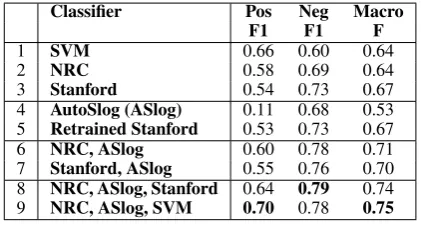
Baseline Classifiers. Rows 1-3 of Table 4show the results for the three baselines, in terms of F-score for each class and the macro F. Stanford out-performs both NRC and SVM, but misses many cases of positive sentiment.
AutoSlog Classifier. Row 4 of Table4shows the results for the AutoSlog classifier. Although Au-toSlog itself does not perform highly, the patterns that it learns represent a different type of knowl-edge than what is contained in many sentiment analysis tools. We therefore hypothesized that a cascading classifier, which supplements one of the baseline sentiment classifiers with the lexico-functional patterns that AutoSlog learns might yield higher performance.
Retrained Stanford.Row 5 of Table4shows the results forRETRAINED STANFORD. The F-scores for RETRAINED STANFORD are almost identical to the standard Stanford classifier. This may be because our data is a small percentage of the en-tire number of phrases used in training Stanford. Although RETRAINED STANFORD prioritizes our phrases, it would not make sense to remove the original training data.
Cascading Classifiers. We implement cascad-ing classifiers to test our hypothesis. The cas-cade classifier has primary and secondary classi-fiers, and we invoke the secondary classifiers only if the primary assigns a prediction ofneutralto a test instance, which reflects the lack of sentiment-bearing lexical items. We also have a cascade clas-sifier with a tertiary clasclas-sifier, which is invoked in the same fashion as the secondary classifier after the primary and secondary classifiers have been run. The cascading classifiers are named in the or-der the classifier is employed, primary, secondary or primary, secondary, tertiary. For our cascad-ing classifiers, we combine our baseline classifiers (NRC and Stanford), with our AutoSlog classifier. We do not use SVM as a primary classifier since it has no neutral label. The results for the cascading experiments are in Rows 6-9 of Table4.
Cascading NRC and AutoSlog provides the best performance, improving both the positive and neg-ative classes, for a macro F of 0.71. This shows that the learned implicit polarity information from AutoSlog improves NRC’s performance.
Since our best two-classifier cascade comes
from combining NRC and AutoSlog, we also test a cascade that adds Stanford or SVM. We achieve our best macro F of 0.75 for the combination with SVM.
Classifier Pos Neg Macro
F1 F1 F
1 SVM 0.66 0.60 0.64
2 NRC 0.58 0.69 0.64
3 Stanford 0.54 0.73 0.67
4 AutoSlog (ASlog) 0.11 0.68 0.53 5 Retrained Stanford 0.53 0.73 0.67
6 NRC, ASlog 0.60 0.78 0.71
7 Stanford, ASlog 0.55 0.76 0.70
8 NRC, ASlog, Stanford 0.64 0.79 0.74
[image:4.595.310.521.125.238.2]9 NRC, ASlog, SVM 0.70 0.78 0.75
Table 4: Test Set Results
Analysis and Discussion. Here we discuss how the patterns we learned from AutoSlog can sup-plement the knowledge encoded in current senti-ment classifiers, and in newly evolving sentisenti-ment resources (Goyal et al., 2010; Choi and Wiebe, 2014;Balahur et al.,2012;Ruppenhofer and Bran-des,2015).
POS PATTERNS Basic Entailment
HAVE FUN property
HAVE PARTY possession
HEADED FOR location
NEG PATTERNS Basic Entailment
HAVE CANCER property
LOST possession
NOT COME HOME location
[image:4.595.317.514.371.463.2]NOT GOING KILL existence
Table 5: Highly predictable AutoSlog extracted case frames and functional description
Tables5and 6illustrate several learned lexico-functional patterns for positive events used in the AutoSlog classifier. The patterns shown in Table5 are predicted by A&R’s framework, some func-tions of which can be seen in Table 1. For ex-ample, we find a range of basic state descriptions (have party,have cancer) whose basic entailment cat-egory is eitherpossessiveorpropertystate. Since
Ehave is positive for a first-person subject only
yield patterns that correspond to the A&R classes, thus validating our suspicion that first-person sen-tences furnish a simplifying test ground for dis-covering functional patterns in the wild.
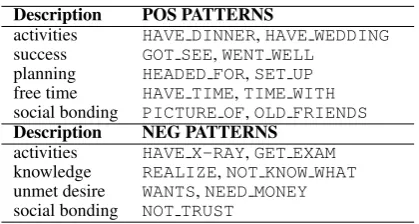
However, many patterns are not covered by A&R’s general classes, see Table6. Looking first at verbs, one major correlation is between positive classes and public events and negative classes and private states. Verbs extracted from the positive class tend to be eventive and agentive describing more dynamic activities and interactions, such as
played,swim, enjoyed, anddanced. Even
many positivehaveuses are light verbs describing an activity such ashave lunch.
Description POS PATTERNS
activities HAVE DINNER,HAVE WEDDING
success GOT SEE,WENT WELL
planning HEADED FOR,SET UP
free time HAVE TIME,TIME WITH
social bonding PICTURE OF,OLD FRIENDS
Description NEG PATTERNS activities HAVE X-RAY,GET EXAM
knowledge REALIZE,NOT KNOW WHAT
unmet desire WANTS,NEED MONEY
[image:5.595.77.287.256.368.2]social bonding NOT TRUST
Table 6: Highly predictable AutoSlog case frames outside A&R’s functional system
Verbs from the negative class are strikingly dif-ferent. They are very often stative, where the author is the experiencer (cognitive subject) of that private state. While this state vs. event dis-tinction is not one existing computational models of sentiment or affect discuss explicitly, it repli-cates a finding that consistently emerges in clin-ical psychology, one that is explicitly argued for in cognitive-behavioral accounts of the mood that particular activities evoke (Lewinsohn et al.,1985; MacPhillamy and Lewinsohn,1982;Russo et al., 2015). In addition, Table 6reveals several novel result state categories. The success, planning, and unmet desire frames are all ultimately about goal-fulfillment (or lack thereof). While the success and unmet desire cases could be understood as having or lacking something, the planning cases indicate steps achieved toward a desired end-state. Previous work on learning affect from eventuality descriptions has largely focused on actions. Our results indicate that private state descriptions are another rich source of evidence.
5 Related Work
Previous work learns phrasal markers of im-plicit polarity via bootstrapping from large-scale text sources, e.g. Vu et al. (2014)
learn emotion-specific event types by extracting
emotion,event pairs on Twitter. Li et al.
(2014) uses Twitter to bootstrap ‘major life events’ and typical replies to those events.
Ding and Riloff (2016) extract subj-verb-obj triples from blog posts. They then apply label propagation to spread polarity from sentences to events. However, the triples they learn do not fo-cus on first-person experiencers. They also filter private states out of the verbs used to learn their triples, whereas we have found that verbs relating to private states such asneed, wantandrealizeare important indicators of first-person affect.
Balahur et al. (2012) use the narratives pro-duced by the ISEAR questionnaire (Scherer et al., 1986) for first-person examples of particular emo-tions and extract sequences of subject-verb-object triples, which they annotate for basic emotions.
Recent work has built on this idea, and devel-oped methods to automatically expand Anand & Reschke’s verb classes to create completely new lexical resources (Balahur et al., 2012;Choi and Wiebe,2014;Deng et al.,2013;Deng and Wiebe, 2014;Ruppenhofer and Brandes, 2015). Choi & Wiebe’s work comes closest to ours in trying to induce (not annotate) lexical functions, but we at-tempt to infer these from stories directly, whereas they use a structured lexical resource.
6 Conclusion
References
Pranav Anand and Kevin Reschke. 2010. Verb classes as evaluativity functor classes. Proceedings of Verb
pages 98–103.
Alexandra Balahur, Jesus M. Hermida, and Andres Montoyo. 2012. Building and exploiting emotinet, a knowledge base for emotion detection based on the
appraisal theory model. IEEE Trans. Affect.
Com-put.3(1):88–101.
Kevin Bowden, Shereen Oraby, Amita Misra, Jiaqu Wu, Stephanie Lukin, and Marilyn Walker. 2017. Data-driven dialogue systems for social agents. In
International Workshop on Spoken Dialogue Sys-tems.
Kevin Burton, Akshay Java, and Ian Soboroff. 2009.
The icwsm 2009 spinn3r dataset. InProceedings of
the Annual Conference on Weblogs and Social Me-dia (ICWSM).
Yoonjung Choi and Janyce Wiebe. 2014.
+/-effectwordnet: Sense-level lexicon acquisition for
opinion inference. InEMNLP.
Lingjia Deng, Yoonjung Choi, and Janyce Wiebe. 2013. Benefactive/malefactive event and writer at-titude annotation. InACL. pages 120–125.
Lingjia Deng and Janyce Wiebe. 2014. Sentiment
propagation via implicature constraints. In EACL.
pages 377–385.
Haibo Ding and Ellen Riloff. 2016. Acquiring knowl-edge of affective events from blogs using label prop-agation. InAAAI.
Andrew Gordon and Reid Swanson. 2009. Identify-ing personal stories in millions of weblog entries. In Third International Conference on Weblogs and Social Media, Data Challenge Workshop, San Jose, CA.
Amit Goyal, Ellen Riloff, and Hal Daum´e III. 2010. Automatically producing plot unit representations for narrative text. InProceedings of the 2010 Con-ference on Empirical Methods in Natural Language Processing. pages 77–86.
M. Hall, F. Eibe, G. Holms, B. Pfahringer, P. Reute-mann, and I. Witten. 2005. The weka data mining
software: An update.SIGKDD Explorations11(1).
Ellen Isaacs, Artie Konrad, Alan Walendowski, Thomas Lennig, Victoria Hollis, and Steve Whit-taker. 2013. Echoes from the past: how technol-ogy mediated reflection improves well-being. In
Proceedings of the SIGCHI Conference on Human Factors in Computing Systems. ACM, pages 1071– 1080.
Svetlana Kiritchenko, Xiaodan Zhu, and Saif M. Mo-hammad. 2014. Sentiment analysis of short infor-mal texts. J. Artif. Int. Res.50(1):723–762.
Peter M Lewinsohn, Robin M Mermelstein, Carolyn Alexander, and Douglas J MacPhillamy. 1985. The unpleasant events schedule: A scale for the
measure-ment of aversive events. Journal of Clinical
Psy-chology41(4):483–498.
Jiwei Li, Xun Wang, and Eduard Hovy. 2014. What
a nasty day: Exploring mood-weather relationship from twitter. In Proceedings of the 23rd ACM International Conference on Conference on Infor-mation and Knowledge Management. ACM, New York, NY, USA, CIKM ’14, pages 1309–1318.
https://doi.org/10.1145/2661829.2662090.
Douglas J MacPhillamy and Peter M Lewinsohn. 1982. The pleasant events schedule: Studies on reliability, validity, and scale intercorrelation. Journal of Con-sulting and Clinical Psychology50(3):363.
Saif M. Mohammad, Svetlana Kiritchenko, and Xiao-dan Zhu. 2013. Nrc-canada: Building the state-of-the-art in sentiment analysis of tweets. In Pro-ceedings of the seventh international workshop on Semantic Evaluation Exercises (SemEval-2013). At-lanta, Georgia, USA.
Shereen Oraby, Lena Reed, Ryan Compton, Ellen Riloff, Marilyn Walker, and Steve Whittaker. 2015. And thats a fact: Distinguishing factual and emo-tional argumentation in online dialogue. In Proceed-ings of the 2nd Workshop on Argumentation Mining. pages 116–126.
Ashequl Qadir and Ellen Riloff. 2014. Learning emo-tion indicators from tweets: Hashtags, hashtag pat-terns, and phrases. InProceedings of the Conference on Empirical Methods in Natural Language Pro-cessing (EMNLP), Association for Computational Linguistics. pages 1203–1209.
Hannah Rashkin, Sameer Singh, and Yejin Choi. 2016.
Connotation frames: A data-driven investigation. In Proceedings of the 54th Annual Meeting of the Association for Computational Linguistics (Vol-ume 1: Long Papers). Association for Computa-tional Linguistics, Berlin, Germany, pages 311–321.
http://www.aclweb.org/anthology/P16-1030.
Hilke Reckman, Cheyanne Baird, Jean Crawford, Richard Crowell, Linnea Micciulla, Saratendu Sethi, and Fruzsina Veress. 2013. teragram: Rule-based detection of sentiment phrases using sas sentiment
analysis. InSemEval@NAACL-HLT.
E. Riloff and J. Wiebe. 2003. Learning extraction pat-terns for subjective expressions. InProceedings of the 2003 conference on Empirical methods in natu-ral language processing-Volume 10. Association for Computational Linguistics, pages 105–112.
Josef Ruppenhofer and Jasper Brandes. 2015. Extend-ing effect annotation with lexical decomposition. In
6th Workshop on Computational Approaches to Sub-jectivity, Sentiment and Social Media Analysis Wass 2015. page 67.
Irene Russo, Tommaso Caselli, and Carlo Strapparava. 2015. Semeval-2015 task 9: Clipeval implicit polar-ity of events. InProceedings of the 9th International Workshop on Semantic Evaluation, SemEval.
Klaus R. Scherer, Harald G. Wallbott, and Angela B. Summerfield. 1986. Experiencing emotion : a cross-cultural study. Cambridge University Press. Richard Socher, Alex Perelygin, Jean Y. Wu, Jason
Chuang, Christopher D. Manning, Andrew Y. Ng, and Christopher Potts. 2013. Recursive deep mod-els for semantic compositionality over a sentiment
treebank. Conference on Empirical Methods in
Nat-ural Language Processing (EMNLP) 2013.
Hoa Trong Vu, Graham Neubig, Sakriani Sakti, Tomoki Toda, and Satoshi Nakamura. 2014.
Acquir-ing a dictionary of emotion-provokAcquir-ing events. EACL
2014page 128.
J. Wiebe, T. Wilson, R. Bruce, M. Bell, and M.
Mar-tin. 2004. Learning subjective language.
Computa-tional linguistics30(3):277–308.
Janyce M Wiebe. 1990. Identifying subjective
charac-ters in narrative. In Proceedings of the 13th
con-ference on Computational linguistics-Volume 2. As-sociation for Computational Linguistics, pages 401– 406.
T. Wilson, P. Hoffmann, S. Somasundaran, J. Kessler, J. Wiebe, Y. Choi, C. Cardie, E. Riloff, and S. Pat-wardhan. 2005. Opinionfinder: A system for
subjec-tivity analysis. InProceedings of HLT/EMNLP on