24
Incorporating Source Syntax into Transformer-Based Neural Machine
Translation
Anna Currey
University of Edinburgh [email protected]
Kenneth Heafield
University of Edinburgh [email protected]
Abstract
Transformer-based neural machine transla-tion (NMT) has recently achieved state-of-the-art performance on many machine trans-lation tasks. However, recent work ( Ra-ganato and Tiedemann, 2018; Tang et al.,
2018; Tran et al., 2018) has indicated that Transformer models may not learn syntac-tic structures as well as their recurrent neu-ral network-based counterparts, particularly in low-resource cases. In this paper, we incor-porate constituency parse information into a Transformer NMT model. We leverage lin-earized parses of the source training sentences in order to inject syntax into the Transformer architecture without modifying it.
We introduce two methods: a multi-task ma-chine translation and parsing model with a sin-gle encoder and decoder, and a mixed encoder model that learns to translate directly from parsed and unparsed source sentences. We evaluate our methods on low-resource trans-lation from English into twenty target lan-guages, showing consistent improvements of 1.3 BLEU on average across diverse target lan-guages for the multi-task technique. We fur-ther evaluate the models on full-scale WMT tasks, finding that the multi-task model aids low- and medium-resource NMT but degener-ates high-resource English→German transla-tion.
1 Introduction
Transformer-based neural machine translation
(NMT) (Vaswani et al., 2017) has recently
out-performed recurrent neural network (RNN)-based
models (Bahdanau et al.,2015;Cho et al.,2014)
in many tasks (Bojar et al.,2018). However, there
is still room for improvement for NMT, partic-ularly for low- and moderate-resource language
pairs. Enriching NMT with syntactic
informa-tion has the potential to improve generalizainforma-tion
in low-resource scenarios, and adding syntax to Transformer-based NMT is currently an underex-plored research area.
Transformer-based NMT may in fact stand to benefit even more from explicit syntactic annota-tions than RNN-based NMT, particularly in low-resource settings. On the one hand, the Trans-former model already learns some syntax with-out explicit supervision in high-resource cases.
Vaswani et al. (2017) visualized a few encoder self-attentions in a trained NMT model and found that they seemed to capture syntactic structure.
This was formalized byRaganato and Tiedemann
(2018), who found that Transformer encoders
trained on high-resource NMT tasks were able to perform reasonably well at part-of-speech tagging, chunking, and other tasks. However, for Trans-formers trained on low-resource NMT, the results on these tasks were not as strong. Additionally,
Tran et al. (2018) found that an RNN language model did better at predicting subject-verb
agree-ment than a Transformer language model; Tang
et al. (2018) saw similar results for Transformer vs. RNN NMT models.
Thus, the goal of this paper is to improve Transformer-based NMT using source-side syn-tactic supervision. We propose two methods that incorporate source-side linearized constituency parses into Transformer-based NMT. The first, multi-task, uses the Transformer to learn to parse and translate the source sentence simultaneously. The second, mixed encoder, learns to translate di-rectly from both parsed and unparsed source sen-tences. This paper makes the following contribu-tions:
• This is one of the first attempts at using
syn-tax to improve Transformer-based NMT
Transformer
<TR>you have not been elected .<TR>
<TR>let me make a comparison .<TR>
<PA>you have not been elected .<PA> . . .
no ha sido elegido .
perm´ıtanme utilizar una comparaci´on .
(ROOT(S(NP) (VP(VP(VP) ) ) ) )
. . .
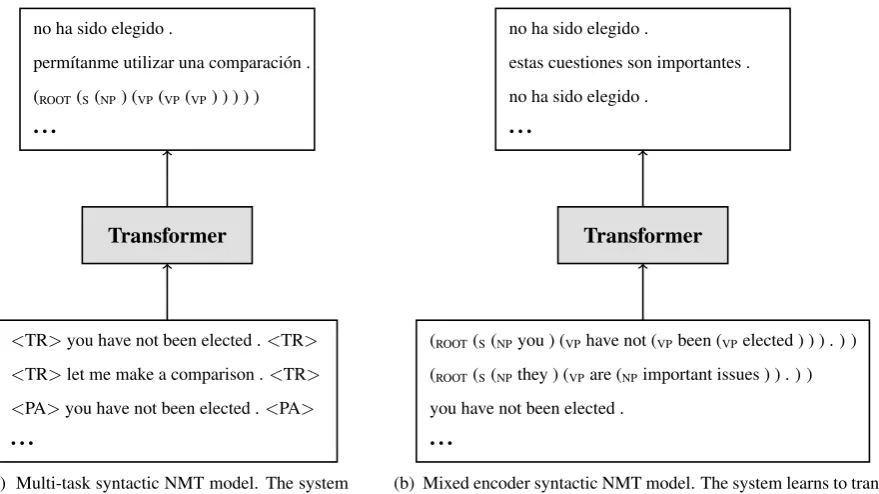
(a) Multi-task syntactic NMT model. The system is trained to translate (<TR>) and parse (<PA>) source sentences using the same architecture.
Transformer
(ROOT(S(NPyou ) (VPhave not (VPbeen (VPelected ) ) ) . ) )
(ROOT(S(NPthey ) (VPare (NPimportant issues ) ) . ) )
you have not been elected .
. . .
no ha sido elegido .
estas cuestiones son importantes .
no ha sido elegido .
. . .
[image:2.595.79.519.59.306.2](b) Mixed encoder syntactic NMT model. The system learns to trans-late directly from both parsed and unparsed source sentences into un-parsed target sentences.
Figure 1: Illustrations of the two proposed syntactic NMT methods.
to NMT that are straightforward to incorpo-rate in practice
• We empirically evaluate both methods on
translation from English into 21 diverse tar-get languages, finding that the multi-task method improves consistently over a non-syntactic baseline
2 Transformer-Based NMT with
Linearized Parses
We propose two models for incorporating lin-earized parses into Transformer-based NMT: a multi-taskmodel and amixed encodermodel.
Fig-ure1summarizes the two proposed methods; they
are discussed in detail in sections2.2and2.3,
re-spectively.
2.1 Linearized Constituency Parses
Both of our proposed methods make use of lin-earized parses of the source sentences to inject source syntax into Transformer-based NMT. Learizing the parses allows us to add syntactic in-formation without modifying the Transformer ar-chitecture. Here, we describe how these parses are created. We generate and format the parsed data as follows:
1. In order to generate syntactically parsed training data, we use the Stanford CoreNLP
constituency parser (Manning et al., 2014)
to parse the source side of the parallel cor-pus. This technique of parsing the parallel data instead of using gold parses is common
in syntactic NMT (Eriguchi et al.,2016) and
in neural parsing (Vinyals et al., 2015). For
the multi-task model, it would be possible to incorporate gold parses into training as well, but we leave this for future work.
2. We linearize the resulting parses similarly to Vinyals et al. (2015) by using a depth-first tree traversal. We tokenize the opening parenthesis of each phrase with its phrase la-bel.
3. Since neural machine translation already
struggles with long sentences (Bahdanau
et al., 2015), and adding the phrase nodes has the potential to make the sentences much longer, we remove part-of-speech tags from
the parses (as was done byAharoni and
Gold-berg,2017).
4. For our multi-task model (section2.2), we
pars-translation <TR>you have not been elected .<TR>→no ha sido elegido .
parsing <PA>you have not been elected .<PA>→(ROOT(S(NP) (VP(VP(VP) ) ) ) )
Table 1: Example of English→Spanish training data for parsing and translation tasks in the multi-task system.
(ROOT(S(NPyou ) (VPhave not (VPbeen (VPelected ) ) ) . ) ) →no ha sido elegido .
you have not been elected . →no ha sido elegido .
Table 2: Example of English→Spanish training data for the mixed encoder system.
ing byVinyals et al.(2015).
5. For our mixed encoder model (section2.3),
we convert the words in the parses into
sub-words using byte pair encoding (Sennrich
et al., 2016). We do not allow the parse la-bels to be broken into subwords.
Tables 1 and 2 give examples of the resulting
parse formats.
2.2 Multi-Task NMT and Parsing with Shared Decoder
Our first method for incorporating source-side syntax into Transformer-based NMT adopts a multi-task framework. The main task is translat-ing the source sentence into the target language; the secondary task is parsing the source sentence. For the parsing task, we employ the same encoder-decoder framework as for NMT, with the sequen-tial source sentence as input and the linearized, unlexicalized parsed source sentence as output. Thus, both tasks are trained using a single model with a shared encoder and decoder. This is similar
to the multi-task framework proposed by Luong
et al.(2016), with three main differences: 1) we do not use separate decoders for each task, 2) we use the same source data for both parsing and transla-tion, and 3) we use a Transformer rather than re-current neural network-based architecture.
We do not directly use gold parses to train the parsing task, nor do we split the training data be-tween the two tasks. The reason for using the same source data for both tasks is that we expect it to be difficult to find a sufficiently large amount of in-domain gold parses for training; additionally, our main goal is to improve NMT, so we do not expect the lower quality of the synthetic parses to matter. In order to generate the training data for this model, we first create linearized parses of the source side of the training corpus as described above. Next, we add a tag at the beginning and end of each source sentence indicating the desired
task, similar to what was done byJohnson et al.
(2017) for multilingual NMT. Table1gives an
ex-ample of the data format. Finally, we shuffle the parsing and translation training data together and train the shared encoder and decoder on both tasks, making no further distinction between the tasks during training. Since we parse all of the train-ing data, each source sentence appears twice: once with a target language sentence and once with a parse of the source sentence. These copies are shuffled separately.
2.3 Mixed Encoder Transformer
Our second method for augmenting the NMT Transformer with syntax is the mixed encoder model. This model learns to translate both from unparsed and parsed source sentences into un-parsed target sentences.
In order to train the mixed encoder model, we create two copies of the training data, one with parsed source sentences and the other with un-parsed source sentences. We then shuffle these training corpora together into a single corpus and train a standard Transformer NMT model on the final data, with a single encoder for both parsed and unparsed source sentences. The training data contains (parsed source, unparsed target) and (un-parsed source, un(un-parsed target) sentence pairs;
Ta-ble2 gives an example of the two types of
train-ing sentence pairs for the mixed encoder method. Since the data is shuffled, these two sentence pairs (with identical target sentences) will not necessar-ily be seen together during training.
Since the mixed encoder model is trained on both parsed and unparsed source sentences, during inference it is able to translate from either source sentence format. Inference on unparsed source sentences is slightly faster (since it does not re-quire parsing of the source sentence) and achieves slightly higher BLEU scores, so we show results using unparsed source sentences for our
3 Experimental Setup
We evaluate our multi-task and mixed encoder models compared to a standard (non-syntactic) Transformer baseline on translation from English
into 21 target languages. Sections4.1and5.1
con-tain detailed information on the target languages and data used. All models are implemented in
Sockeye (Hieber et al., 2017). For
hyperparam-eter settings, we follow the recommendations of
Vaswani et al.(2017).
We preprocess our data for all experiments as follows. First, we tokenize and truecase the data
using the Moses scripts (Koehn et al.,2007). We
then train separate subword vocabularies (
Sen-nrich et al., 2016) for the source and target lan-guages, with 30k merge operations per language.
We use the Stanford CoreNLP parser (Manning
et al., 2014) to generate constituency parses of the source (English) sentences, and linearize and
format the parses as described in section 2.1.
We do not use any monolingual training data; however, our proposed models are amenable to adding monolingual data, and we expect that BLEU scores would strongly increase if monolin-gual training data were used.
4 Small-Scale Cross-Lingual
Experiments
4.1 Data
We use the Europarl Parallel Corpus (Koehn,
2005) as the basis for our small-scale cross-lingual
experiments. We consider translation from En-glish (EN) into each of the twenty remaining target
languages; Table3 contains a full list of the
tar-get languages, as well as their language families or branches. By using this data set, we are able to evaluate the usefulness of syntactic information for several relatively diverse target languages, un-like most previous work on syntactic NMT
(re-viewed in section7). However, all the languages in
our experiments are Indo-European or Uralic due to using Europarl.
In order to facilitate comparison between the
target languages, we followCotterell et al.(2018)
by taking only the intersections of the Europarl training data. This means that the source (EN) data is identical for all experiments, and the targets are all translations of each other in the different tar-get languages. This results in 170k parallel train-ing sentences for each language pair. We reserve a
Family Language Abbrev.
Baltic Latvian LV
Lithuanian LT
Germanic Danish DA
Dutch NL
German DE
Swedish SV
Hellenic Greek EL
Romance French FR
Italian IT
Portuguese PT
Romanian RO
Spanish ES
Slavic Bulgarian BG
Czech CS
Polish PL
Slovak SK
Slovene SL
Uralic Estonian ET
Finnish FI
[image:4.595.333.500.62.352.2]Hungarian HU
Table 3: Target languages used in our experiments, along with their language families or branches and their abbreviations (abbrev.).
random subset of 10k sentences from the original data to use as development data and an additional 10k sentences as test data; these development and test sets are not included in the training data.
4.2 Results
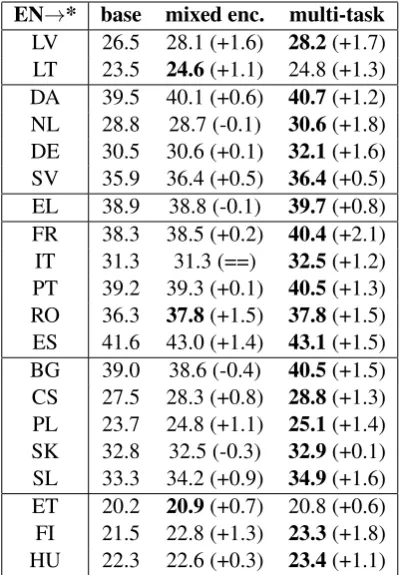
Table 4 displays BLEU scores on the test data
for each target language for the proposed systems. The multi-task system outperforms the baseline for all target languages. In addition, for all but four target languages (SV, EL, SK, and ET), the multi-task system is at least 1 BLEU point better than the baseline. Thus, our proposed multi-task method consistently improves over a non-syntactic base-line across several diverse target languages in low-resource scenarios. Additionally, in all cases but
two (EN→LT and EN→ET), multi-task achieves
the highest BLEU score of all models.
EN→* base mixed enc. multi-task
LV 26.5 28.1 (+1.6) 28.2(+1.7)
LT 23.5 24.6(+1.1) 24.8 (+1.3)
DA 39.5 40.1 (+0.6) 40.7(+1.2)
NL 28.8 28.7 (-0.1) 30.6(+1.8)
DE 30.5 30.6 (+0.1) 32.1(+1.6)
SV 35.9 36.4 (+0.5) 36.4(+0.5)
EL 38.9 38.8 (-0.1) 39.7(+0.8)
FR 38.3 38.5 (+0.2) 40.4(+2.1)
IT 31.3 31.3 (==) 32.5(+1.2)
PT 39.2 39.3 (+0.1) 40.5(+1.3)
RO 36.3 37.8(+1.5) 37.8(+1.5)
ES 41.6 43.0 (+1.4) 43.1(+1.5)
BG 39.0 38.6 (-0.4) 40.5(+1.5)
CS 27.5 28.3 (+0.8) 28.8(+1.3)
PL 23.7 24.8 (+1.1) 25.1(+1.4)
SK 32.8 32.5 (-0.3) 32.9(+0.1)
SL 33.3 34.2 (+0.9) 34.9(+1.6)
ET 20.2 20.9(+0.7) 20.8 (+0.6)
FI 21.5 22.8 (+1.3) 23.3(+1.8)
[image:5.595.81.284.62.350.2]HU 22.3 22.6 (+0.3) 23.4(+1.1)
Table 4: BLEU scores on the test set for small-scale cross-lingual experiments for the baseline (base), mixed encoder (mixed enc.), and multi-task models. Difference with the baseline is shown in parentheses.
and SK), the mixed encoder system does worse than the non-syntactic baseline.
Target language family does not seem to have a noticeable effect on the performance of either the mixed encoder or the multi-task method; this could be due to the fact that the syntactic anno-tations were on the source sentence only. It re-mains to be seen whether certain source languages are particularly amenable to incorporating source syntax in NMT.
5 Full-Scale WMT Experiments
5.1 Data
The main goal of the previous section was to evaluate our proposed syntactic NMT methods on a wide range of target languages and com-pare the effect of target language on performance. In this section, we run additional experiments in order to evaluate the proposed methods on a
standard benchmark. We train our models on
the following tasks: English→Turkish (TR) from
the WMT18 news translation shared task (Bojar
et al.,2018), English→Romanian WMT16 (Bojar et al.,2016), and English→German WMT17 (
Bo-System newstest2017 newstest2018
baseline 9.6 8.8
mixed enc. 9.6 (==) 9.3 (+0.5)
[image:5.595.313.519.63.119.2]multi-task 10.6(+1.0) 10.4(+1.6)
Table 5: BLEU scores (and improvement over the baseline) for EN→TR on the test (newstest2017) and held-out (newstest2018) datasets.
jar et al.,2017).
For each experiment, we use all available par-allel training data from the task, but no monolin-gual data. This gives us 200k parallel training
sen-tences for EN→TR, 600k for EN→RO, and 5.9M
for EN→DE. Note that the EN→RO and EN→DE
training corpora contain some overlaps with the
training data in section 4.1, although the
experi-ments in this section use significantly more
train-ing data. We validate EN→TR on newstest2016,
EN→RO on newsdev2016, and EN→DE on
new-stest2015.
5.2 Results
The results for the EN→TR experiments are
dis-played in Table5. These results mirror what was
seen in the previous experiments: the mixed en-coder method gives modest improvements over the non-syntactic baseline (0–0.5 BLEU), while the multi-task method yields the strongest results, with an improvement of 1.0–1.6 BLEU points over the baseline. Although Turkish is not related to
any of the target languages studied in section 4,
the amount of training data for EN→TR is similar
to what was used in the previous section, which might be one explanation for the similar results.
Table 6 shows performance of each model on
the WMT EN→RO experiments. Here, we see
more modest improvements from adding the syn-tactic data: only 0.5 BLEU over the baseline for both the mixed encoder and multi-task methods. It is interesting to compare this with the results for
the Europarl EN→RO experiments (section4.2);
there, we saw a much larger improvement over the baseline for both multi-task models (1.5 BLEU). This indicates that the effectiveness of these mod-els may depend on amount of data (the WMT models were trained on about three times as much training data) rather than on target language fam-ily.
Finally, we display our WMT EN→DE
re-sults in Table 7. Here, we see that for very
System newstest2016
baseline 21.5
mixed enc. 22.0(+0.5)
[image:6.595.353.480.61.350.2]multi-task 22.0(+0.5)
Table 6: BLEU scores (and improvement over the baseline) for EN→RO on the test set (newstest2016).
System newstest2016 newstest2017
baseline 31.7 25.5
mixed enc. 31.9(+0.2) 26.0(+0.5)
[image:6.595.114.250.62.119.2]multi-task 29.6 (-2.1) 23.4 (-2.1)
Table 7: BLEU scores (and difference with the base-line) for EN→DE on the test (newstest2016) and held-out (newstest2017) datasets.
method does much worse than the baseline (by 2.1 BLEU points). In addition, the mixed encoder method achieves comparable BLEU scores to the baseline (only 0.2–0.5 BLEU higher). Thus, nei-ther proposed technique is particularly successful
for high-resource EN→DE NMT. Again, we can
contrast this with the Europarl EN→DE
experi-ments, where we saw strong improvements from the multi-task model (1.6 BLEU). This lends fur-ther credence to the hypothesis that these NMT models with linearized source parses are helpful cross-linguistically in low-resource scenarios, but not in high-resource setups.
We further investigated the WMT EN→DE
multi-task model to find reasons for the large drop
in performance compared to the baseline. We
found that while the multi-task model was able to generate reasonable (albeit lower-quality) transla-tions, it did not successfully learn to parse. Dur-ing parsDur-ing inference, the model always output the
same parse regardless of the input sentence:(ROOT
(S (NP ) (VP(NP (NP ) (PP (NP (NP ) (PP (NP ) ) ) )
) ) ) ). This was a common parse in the training data (it occurred 12k times in the data). This issue is partially due to the fact that validation is only done on the translation task, not on the parsing task. However, we do not see this issue with the other language pairs and experiments. This failure
to learn to parse indicates that the WMT EN→DE
multi-task model is not able to take advantage of the syntactic annotations.
6 Validity of Parses
The multi-task syntactic NMT models are trained both to translate and to parse the input sentences.
EN→* % Valid Parses
LV 96.8%
LT 99.2%
DA 70.8%
NL 93.3%
DE 87.2%
SV 95.4%
EL 85.2%
FR 92.3%
IT 78.8%
PT 89.4%
RO 96.3%
ES 86.5%
BG 97.5%
CS 95.9%
PL 98.1%
SK 98.5%
SL 97.3%
ET 98.2%
FI 95.1%
[image:6.595.353.479.67.351.2]HU 93.6%
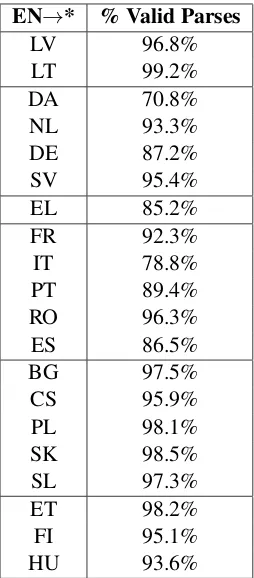
Table 8: Percent of valid parses of the parses generated by the Europarl multi-task systems.
The main goal of these models has been to im-prove translation; those results were reported in
sections4.2 and 5.2. In this section, we analyze
the validity of the parses produced by the multi-task systems. We use a standard parsing
bench-mark, WSJ section 23 of the Penn Treebank (
Mar-cus et al., 1993), as the evaluation dataset in this section. We preprocess this dataset as described in
section3before using it as the source data for the
multi-task systems.
The multi-task models were trained to generate unlexicalized parses. Since we removed part-of-speech tags from the parses during preprocessing, it is not possible to automatically relexicalize the parses. This is because there is no one-to-one cor-respondence between the leaves of the parse tree and the number of words in the sentence. Thus, rather than evaluating the parses directly, we count the number of valid parses (i.e. parses with bal-anced parentheses) per target language.
Table 8 shows the percent of generated parses
that were valid for the Europarl multi-task mod-els. For most target languages, over 90% of the generated parses are valid.
[image:6.595.79.285.164.220.2]EN→* % Valid Parses
TR 86.3%
RO 99.8%
[image:7.595.117.247.62.118.2]DE 100%
Table 9: Percent of valid parses of the parses generated by the WMT multi-task systems.
parsing results. Overall, Romance, Germanic,
and Hellenic target language systems generate the
fewest valid parses. This indicates that Baltic,
Slavic, and Uralic target languages are most help-ful in learning to parse English in a multi-task sys-tem. Thus, from our cross-lingual experiments, it seems that the parsing performance of a multi-task system depends on the target language, whereas we saw in the previous sections that the transla-tion success depends more on the amount of train-ing data. Note, however, some caveats: 1) we did not perform validation on the parsing task (only on the translation task), and 2) we are measuring only parsing validity here, rather than parsing per-formance.
Table9shows the percent of valid parses for the
three WMT multi-task experiments. For EN→DE,
all of the generated parses are valid because they
are all identical (as dicussed in section 5.2). For
EN→RO, nearly all the parses are valid as well.
However, this language pair did not have the same
issue as EN→DE: the parses generated for each
sentence were different, and a manual analysis
in-dicated that the generated EN→RO parses were
reasonable. The EN→TR system generated a
large amount of valid parses, but fewer than the
EN→RO system; it is possible that the EN→TR
system would have done better with more training data.
7 Related Work
The performance of many RNN-based NMT paradigms has been improved by adding explicit syntactic annotations, particularly on the source side; we review some syntactic NMT models here.
This paper is, along with Wu et al. (2018) and
Zhang et al.(2019), among the first to add explicit syntax to Transformer-based NMT.
7.1 Linearized Parses in Neural Networks
In this work, we use linearized parse trees to add
syntax into the Transformer. Vinyals et al.(2015)
andChoe and Charniak(2016) introduced the idea
of linearizing parse trees for neural parsing. Lin-earized parses are advantageous because they can be used anywhere that standard sequences can be
used; in fact, Vaswani et al. (2017) showed that
they can also be used by the Transformer to learn constituency parsing. Here, we leverage this idea by using linearized parses as an additional signal for the Transformer during NMT training.
7.2 Syntactic NMT with Modified Encoder
There have been several recent proposals to incor-porate source-side syntax into RNN-based NMT by modifying the encoder architecture; we
re-view some such models here. Eriguchi et al.
(2016) augmented the RNN encoder with a
tree-LSTM (Tai et al., 2015) to read in source-side
HPSG parses, and combined this with a standard
RNN decoder. Similarly, Bastings et al. (2017)
used a graph convolutional encoder in combina-tion with an RNN decoder to translate from de-pendency parsed source sentences. Although these models improved over non-syntactic RNN-based NMT systems, they relied heavily on parsed data during both training and inference, whereas our models are able to translate unparsed data. In ad-dition, it is not clear how to incorporate such im-provements into the state-of-the-art Transformer architecture.
7.3 Linearized Parses in NMT
This work fits with another line of research that uses linearized parses to incorporate syntax into neural machine translation without requiring a
specific NMT architecture. Luong et al. (2016)
used a single encoder and different decoders to train two tasks: parsing the source sentence and
translating from source to target. Kiperwasser
and Ballesteros (2018) also applied multi-task learning to syntactic NMT; they used a shared RNN decoder for translation, dependency parsing, and part-of-speech tagging and evaluated differ-ent scheduling techniques to combine the tasks. Our multi-task system builds off these two papers by training a joint NMT and parsing model us-ing a sus-ingle encoder and decoder in a Transformer framework, and further evaluates the multi-task framework on several language pairs.
Currey and Heafield (2018) leveraged a multi-source NMT system to learn to translate from both
unparsed and parsed source sentences. Wu et al.
(2018) similarly combined the standard
that encoded the pre-order traversal of the de-pendency parse of the sentence and one that
en-coded the post-order traversal. UnlikeCurrey and
Heafield (2018), they joined the encoders on the word level and used a Transformer architecture. Our mixed encoder model is similar to these but instead uses a single Transformer encoder for both parsed and unparsed source sentences.
The mixed RNN encoder model of Li et al.
(2017) is also similar to our mixed encoder model;
their model used an RNN to encode a linearized parse of a source sentence, but attended only to the words of the parse. Our mixed encoder model is trained on both linearized parses and unparsed sentences, but for the linearized parses we attend
to words and to parse labels. Zhang et al.(2019)
used syntax to augment the word representations in both RNN-based and Transformer-based NMT; this was done by concatenating the hidden states of a dependency parser with the NMT word embed-dings. Their method is complementary to ours and could be used along with our multi-task or mixed encoder models to enhance any NMT architecture. In this work, we have concentrated on source-side syntax, but linearized parses have also been popular for incorporating target syntax into
neu-ral machine translation. Aharoni and Goldberg
(2017) and Nadejde et al. (2017) both trained
RNN-based neural machine translation systems to translate from sequential source sentences into lin-earized parses of target sentences; this could also be done using a Transformer.
8 Conclusions
In this paper, we proposed two methods for in-corporating source-side syntactic annotations into a Transformer-based neural machine translation system. The first, multi-task, used a shared en-coder and deen-coder to train two tasks: transla-tion and constituency parsing. The second, mixed encoder, learned to translate linearized parses of the source sentences as well as unparsed source sentences directly into the target language. We performed experiments from English into twenty target languages in a low-resource setup; the multi-task system improved over the non-syntactic
baseline for all target languages. We further
demonstrated the success of this method on the
EN→TR and EN→RO WMT datasets; however,
for the very high-resource EN→DE WMT setup,
the multi-task model performed poorly, while the
mixed encoder model did only marginally better than the non-syntactic baseline.
In the future, we plan on extending these techniques to incorporate target-side syntax into Transformer-based NMT. In addition, we would like to experiment with different source languages in order to find out whether adding source-side syntax has a greater effect on some source lan-guages than others. It would also be interesting to experiment with a multi-task, multilingual NMT framework with multiple target languages.
References
Roee Aharoni and Yoav Goldberg. 2017. Towards string-to-tree neural machine translation. In Pro-ceedings of the 55th Annual Meeting of the ACL, pages 132–140. Association for Computational Lin-guistics.
Dzmitry Bahdanau, Kyunghyun Cho, and Yoshua Ben-gio. 2015. Neural machine translation by jointly learning to align and translate. In3rd International Conference on Learning Representations.
Joost Bastings, Ivan Titov, Wilker Aziz, Diego Marcheggiani, and Khalil Sima’an. 2017. Graph convolutional encoders for syntax-aware neural ma-chine translation. InProceedings of the 2017 Con-ference on Empirical Methods in Natural Language Processing, pages 1957–1967. Association for Com-putational Linguistics.
Ondˇrej Bojar, Rajen Chatterjee, Christian Federmann, Yvette Graham, Barry Haddow, Shujian Huang, Matthias Huck, Philipp Koehn, Qun Liu, Varvara Logacheva, Christof Monz, Matteo Negri, Matt Post, Raphael Rubino, Lucia Specia, and Marco Turchi. 2017. Findings of the 2017 Conference on Machine Translation (WMT17). InProceedings of the Second Conference on Machine Translation, pages 169–214. Association for Computational Lin-guistics.
Ondˇrej Bojar, Rajen Chatterjee, Christian Federmann, Yvette Graham, Barry Haddow, Matthias Huck, An-tonio Jimeno Yepes, Philipp Koehn, Varvara Lo-gacheva, Christof Monz, Matteo Negri, Aur´elie N´ev´eol, Mariana Neves, Martin Popel, Matt Post, Raphael Rubino, Carolina Scarton, Lucia Spe-cia, Marco Turchi, Karin Verspoor, and Marcos Zampieri. 2016. Findings of the 2016 Conference on Machine Translation. InProceedings of the First Conference on Machine Translation, pages 131– 198. Association for Computational Linguistics.
Trans-lation, pages 272–303. Association for Computa-tional Linguistics.
Kyunghyun Cho, Bart Van Merri¨enboer, Caglar Gul-cehre, Dzmitry Bahdanau, Fethi Bougares, Holger Schwenk, and Yoshua Bengio. 2014. Learning phrase representations using RNN encoder-decoder for statistical machine translation. InProceedings of the 2014 Conference on Empirical Methods in Nat-ural Language Processing, pages 1724–1734. Asso-ciation for Computational Linguistics.
Do Kook Choe and Eugene Charniak. 2016. Pars-ing as language modelPars-ing. In Proceedings of the 2016 Conference on Empirical Methods in Natural Language Processing, pages 2331–2336. Associa-tion for ComputaAssocia-tional Linguistics.
Ryan Cotterell, Sebastian J. Mielke, Jason Eisner, and Brian Roark. 2018. Are all languages equally hard to language-model? In Proceedings of NAACL-HLT, pages 536–541. Association for Computa-tional Linguistics.
Anna Currey and Kenneth Heafield. 2018. Multi-source syntactic neural machine translation. In Pro-ceedings of the 2018 Conference on Empirical Meth-ods in Natural Language Processing, pages 2961– 2966. Association for Computational Linguistics.
Akiko Eriguchi, Kazuma Hashimoto, and Yoshimasa Tsuruoka. 2016. Tree-to-sequence attentional neu-ral machine translation. InProceedings of the 54th Annual Meeting of the ACL, pages 823–833. Asso-ciation for Computational Linguistics.
Felix Hieber, Tobias Domhan, Michael Denkowski, David Vilar, Artem Sokolov, Ann Clifton, and Matt Post. 2017. Sockeye: A toolkit for neural machine translation. arXiv preprint arXiv:1712.05690.
Melvin Johnson, Mike Schuster, Quoc V Le, Maxim Krikun, Yonghui Wu, Zhifeng Chen, Nikhil Thorat, Fernanda Vi´egas, Martin Wattenberg, Greg Corrado, Macduff Hughes, and Jeffrey Dean. 2017. Google’s multilingual neural machine translation system: En-abling zero-shot translation.Transactions of the As-sociation for Computational Linguistics, 5:339–351.
Eliyahu Kiperwasser and Miguel Ballesteros. 2018.
Scheduled multi-task learning: From syntax to translation. Transactions of the Association for Computational Linguistics, 6:225–240.
Philipp Koehn. 2005. Europarl: A parallel corpus for statistical machine translation. In10th Machine Translation Summit, volume 5, pages 79–86.
Philipp Koehn, Hieu Hoang, Alexandra Birch, Chris Callison-Burch, Marcello Federico, Nicola Bertoldi, Brooke Cowan, Wade Shen, Christine Moran, Richard Zens, Chris Dyer, Ondˇrej Bojar, Alexandra Constantin, and Evan Herbst. 2007. Moses: Open source toolkit for statistical machine translation. In Proceedings of the 45th Annual Meeting of the ACL, pages 177–180. Association for Computational Lin-guistics.
Junhui Li, Deyi Xiong, Zhaopeng Tu, Muhua Zhu, Min Zhang, and Guodong Zhou. 2017. Modeling source syntax for neural machine translation. In Proceed-ings of the 55th Annual Meeting of the ACL, pages 688–697. Association for Computational Linguis-tics.
Minh-Thang Luong, Quoc V Le, Ilya Sutskever, Oriol Vinyals, and Lukasz Kaiser. 2016. Multi-task se-quence to sese-quence learning. In 4th International Conference on Learning Representations.
Christopher Manning, Mihai Surdeanu, John Bauer, Jenny Rose Finkel, Steven Bethard, and David Mc-Closky. 2014. The Stanford CoreNLP natural lan-guage processing toolkit. In Proceedings of the 52nd Annual Meeting of the ACL, pages 55–60. As-sociation for Computational Linguistics.
Mitchell P. Marcus, Beatrice Santorini, and Mary Ann Marcinkiewicz. 1993. Building a large annotated corpus of English: The Penn Treebank. Computa-tional Linguistics, 19(2):313–330.
Maria Nadejde, Siva Reddy, Rico Sennrich, Tomasz Dwojak, Marcin Junczys-Dowmunt, Philipp Koehn, and Alexandra Birch. 2017. Predicting target lan-guage CCG supertags improves neural machine translation. In Proceedings of the Second Confer-ence on Machine Translation, pages 68–79. Associ-ation for ComputAssoci-ational Linguistics.
Alessandro Raganato and J¨org Tiedemann. 2018. An analysis of encoder representations in Transformer-based machine translation. In Proceedings of the 2018 EMNLP Workshop BlackboxNLP: Analyzing and Interpreting Neural Networks for NLP, pages 287–297. Association for Computational Linguis-tics.
Rico Sennrich, Barry Haddow, and Alexandra Birch. 2016.Neural machine translation of rare words with subword units. InProceedings of the 54th Annual Meeting of the ACL, pages 1715–1725. Association for Computational Linguistics.
Kai Sheng Tai, Richard Socher, and Christopher Man-ning. 2015. Improved semantic representations from tree-structured long short-term memory net-works. InProceedings of the 53rd Annual Meeting of the ACL and the 7th International Joint Confer-ence on Natural Language Processing, pages 1556– 1566. Association for Computational Linguistics.
Gongbo Tang, Mathias M¨uller, Annette Rios, and Rico Sennrich. 2018. Why self-attention? A targeted evaluation of neural machine translation architec-tures. In Proceedings of the 2018 Conference on Empirical Methods in Natural Language Process-ing, pages 4263–4272. Association for Computa-tional Linguistics.
Ke Tran, Arianna Bisazza, and Christof Monz. 2018.
Conference on Empirical Methods in Natural Lan-guage Processing, pages 4731–4736. Association for Computational Linguistics.
Ashish Vaswani, Noam Shazeer, Niki Parmar, Jakob Uszkoreit, Llion Jones, Aidan N Gomez, Łukasz Kaiser, and Illia Polosukhin. 2017. Attention is all you need. InAdvances in Neural Information Pro-cessing Systems 30, pages 5998–6008.
Oriol Vinyals, Łukasz Kaiser, Terry Koo, Slav Petrov, Ilya Sutskever, and Geoffrey Hinton. 2015. Gram-mar as a foreign language. In Advances in Neu-ral Information Processing Systems 28, pages 2773– 2781.
Shuangzhi Wu, Dongdong Zhang, Zhirui Zhang, Nan Yang, Mu Li, and Ming Zhou. 2018. Dependency-to-dependency neural machine transla-tion. IEEE/ACM Transactions on Audio, Speech, and Language Processing, 26(11):2132–2141.