Proceedings of the Workshop on Machine Reading for Question Answering, pages 31–36 31
Tackling Adversarial Examples in QA via Answer Sentence Selection
Yuanhang Ren1, Ye Du2, Di Wang2,3
1University of Electronic Science and Technology of China 2Southwestern University of Finance and Economics, China
3Vector Lab, JD Finance, Beijing, China
{ryuanhang,henry.duye,albertwang0921}@gmail.com
Abstract
Question answering systems deteriorate dramatically in the presence of adversar-ial sentences in articles. According toJia and Liang(2017), the single BiDAF sys-tem (Seo et al., 2016) only achieves an F1 score of 4.8 on the ADDANY adver-sarial dataset. In this paper, we present a method to tackle this problem via answer sentence selection. Given a paragraph of an article and a corresponding query, in-stead of directly feeding the whole para-graph to the single BiDAF system, a sen-tence that most likely contains the answer to the query is first selected, which is done via a deep neural network based on Tree-LSTM (Tai et al.,2015). Experiments on ADDANY adversarial dataset validate the effectiveness of our method. The F1 score has been improved to 52.3.
1 Introduction
Question answering is an important task in evalu-ating the ability of language understanding of ma-chines. Usually, given a paragraph and a corre-sponding question, a question answering system is supposed to generate the answer of this ques-tion from the paragraph. By comparing the pre-dicted answer with human-approved answers, the performance of the system can be assessed. Re-cently, many systems have achieved great results on this task (Shen et al.,2017b;Wang and Jiang, 2016;Hu et al., 2017). However, Jia and Liang (2017) show that these systems are very vulnera-ble to paragraphs with adversarial sentences. For instance, the single BiDAF system (Seo et al., 2016), which achieves an F1 of 75.5 on Standford Question Answering Dataset (SQuAD), deterio-rates significantly to an F1 of 4.8 on the ADDANY
adversarial dataset. Besides the single BiDAF, the single Match LSTM, the ensemble Match LSTM, and the ensemble BiDAF achieve an F1 of 7.6, 11.7, and 2.7 respectively in question answering on ADDANY adversarial dataset (Jia and Liang, 2017). Therefore, question answering with adver-sarial sentences in paragraphs is a prominent issue and is the focus of this study.
In this paper, we propose a method to improve the performance of the single BiDAF system1 on
ADDANY adversarial dataset. Given a paragraph and a corresponding question, our method works in two steps to generate an answer. In the first step, a deep neural network named the QA Likelihood neural network is deployed to predict the likeli-hood of each sentence in the paragraph to be an
answer sentence, i.e., the sentence that contains the answer. The architecture and the loss of the QA Likelihood neural network follow the neural network for semantic relatedness proposed byTai et al.(2015). Its main ingredient is the Tree-LSTM model. While the neural network for semantic re-latedness is used to predict the similarity between sentenceAandB, the QA Likelihood neural net-work is used to predict if sentenceAcontains the answer to queryB. In the second step, only the sentence with the highest likelihood is paired with the question and passed to the single BiDAF to further output an answer. In summary, compared to the original BiDAF that is an end-to-end ques-tion answering system, our method first selects a sentence that is most likely to be an answer sen-tence. Since adversarial sentences are not sup-posed to contain the answer, they can be screened out. Therefore, the distractions of adversarial sen-tences are reduced. Experiments on ADDANY adversarial dataset demonstrates the effectiveness
1Since all the QA systems tested inJia and Liang(2017)
Figure 1: The Architecture of Our Approach
of our method. The F1 has been significantly im-proved from 4.8 to 52.3.
The contributions of this study are in three folds. First, to the best of our knowledge, it’s the first work that tries to address the problem of Question Answering with Adversarial Exam-ples. Our results show the effectiveness of an-swer sentence selection to tackle adverserial sen-tences in ADDANY dataset. Second, the power of sentence representation of Tree-LSTM has been demonstrated in different NLP tasks, such as se-mantic relatedness computation, machine transla-tion evaluatransla-tion and natural language inference (Tai et al.,2015;Gupta et al.,2015;Chen et al.,2017); meanwhile, multiple methods have been proposed for answer sentence selection (Wang and Nyberg, 2015;Rao et al., 2016;Wang et al., 2017; Shen et al.,2017a;Choi et al.,2017). We are the first to design a framework that illustrates the effective-ness of Tree-LSTM in answer sentence selection. Third, two sampling methods are implemented to build the training set for the QA Likelihood neural network. We show that different sampling meth-ods do influence the performance of question an-swering in this scenario.
2 Methods
Given a paragraph C and a corresponding query
Q, the paragraph is split into a bunch of sen-tences C = {Si|i = 1,2, . . . ,|C|}. By combin-ing each sentence Si with the query Q, a set of sentence pairsPC,Q={(Si,Q)|i= 1,2, . . . ,|C|} is obtained. Then, the dependency parsing (Man-ning et al., 2014) is used to get the tree repre-sentation TSi for Si and TQ for Q. Based on TSi andTQ, two Tree-LSTMs,Tree-LSTMSi and
Tree-LSTMQ, are built respectively (Tai et al., 2015). The inputs to the leafs of both Tree-LSTMs are GloVe word vectors generated byPennington et al. (2014). The output hidden vectors of the
Tree-LSTM forSi andQarehSi andhQ respec-tively. Then, hSi and hQ are concatenated and passed to a feed forward neural network to out-put the likelihood that Si contains the answer to
Q. The architecture and the loss of the feed for-ward neural network follows the neural network for semantic relatedness (Tai et al., 2015). Dur-ing trainDur-ing, the likelihood is supervised by 1 ifSi contains the answer and 0 otherwise. The proce-dure above is summarized as the QA Likelihood neural network that is illustrated in Part 1 of Fig-ure 1. Following that, the sentence that is most likely to be an answer sentence,
S∗ = argmax
Si∈C
LSi,Q,
is selected, whereLstands for the likelihood pre-dicted by the QA Likelihood neural network. Af-ter that, a pair of sentencesS∗andQare passed to the pre-trained single BiDAF(Seo et al.,2016) to generate an answeraˆtoQ. This process is illus-trated in Part 2 of Figure1.
3 Experiments
Dataset for Training. As Figure1shows, the in-put of our system is a pair of sentences. Thus, the training instances for the QA Likelihood neural network are in the form of sentence pairs. They are sampled from the training set of SQuAD v1.1 (Ra-jpurkar et al., 2016) that contains no adversarial sentences. Specifically, there are 87,599 queries of 18,896 paragraphs in the training set of SQuAD v1.1. While each query refers to one paragraph, a paragraph may refer to multiple queries.
For the k-th query Qk, by splitting its corre-sponding paragraphCkinto separate sentences and combining them with the query, a set of sentence pairs is obtained,
whereDk represents the set of sentence pairs for thek-th query, mk is the number of sentences in the paragraphCk,Sk
i is thei-th sentence inCk. A sentence pair(Sik,Qk)is called apositive instance if Sik contains the answer to Qk; otherwise, it is called anegative instance. Then, the union of the setsDkfor all the 87,599 queries in SQuDA is
D=
d
[
k=1
Dk
whered=87,599 is the number of queries. The set
Dcontains 440,135 sentence pairs, among which 87,306 are positive instances and 352,829 are neg-ative instances.
In order to train our model properly and effi-ciently, both downsampling of D and undersam-pling of negative instances must be done. In this paper, we implement two different sampling meth-ods: pair-level sampling and paragraph-level sampling. In pair-level sampling, 45,000 positive instances and 45,000 negative instances are ran-domly selected from D as the training set. By contrast, in paragraph-level sampling, we first ran-domly select a query Qk without replacement, then one positive instance and one negative in-stance are randomly sampled from the set of sen-tence pairsDk. This operation is repeated until we get 45,000 positive instances and 45,000 negative instances. Finally, two different training sets are generated by pair-level sampling and paragraph-level sampling. Each set has 90,000 instances. The validation set with 3,000 instances are sam-pled through these two methods as well.
Dataset for Testing. Our test set isJia and Liang (2017)’s ADDANY adversarial dataset. It in-cludes 1,000 paragraphs and each paragraph refers to only one query, i.e., 1,000 (C,Q) pairs. By splitting and combining, 6,154 sentence pairs are obtained.
Experimental Settings. The dimension of GloVe word vectors (Pennington et al., 2014) is set as 300. The sentence scoring neural network is trained by Adagrad (Duchi et al., 2011) with a learning rate of 0.01 and a batch size of 25. Model parameters are regularized by a 10−4 strength of per-minibatchL2regularization.
4 Results
The performance of question answering is evalu-ated by the Macro-averaged F1 score (Rajpurkar
QA System F1 Precision Recall
QA Likelihood
50.6 51.4 53.0
(pair-level sampling)
QA Likelihood 52.3 53.1 54.9
(paragraph-level sampling)
[image:3.595.327.506.62.111.2]Single BiDAF 4.8 4.8 6.2
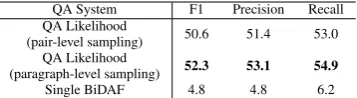
Table 1: Results of QA with Adversarial Examples
QA System F1 Accuracy Precision Recall
QA Likelihood
62.5 87.4 64.8 60.2
(pair-level sampling) QA Likelihood
63.4 87.7 65.8 61.2
(paragraph-level sampling)
Single BiDAF 17.0 72.0 17.6 16.4
Table 2: Results of Answer Sentence Selection
et al.,2016;Jia and Liang,2017). It measures the average overlap between the predicted answer ˆa and real answers on token-level. We also com-pute the Macro-averaged Precision and Recall fol-lowing the same procedure. The results are in Table 1. As it shows, both the systems based on pair-level sampling and paragraph-level sam-pling significantly outperform the single BiDAF system2. The Macro-averaged F1 has been im-proved from 4.8 to 52.3. Besides, the paragraph-level sampling achieves better results than the pair-level sampling.
In order to analyze the source of performance improvements, we further evaluate the perfor-mance of the QA Likelihood neural network and the single BiDAF system on answer sentence se-lection3. Here, we consider the problem as a bi-nary classification problem. In the test set, posi-tive instances are labeled with1and negative ones are labeled with0. A sentence pair selected by a QA system (QA Likelihood neural network or the single BiDAF) has a predicted label1, while the others have a predicted label 0. The results are shown in Table2. It shows that both of our sys-tems outperform the single BiDAF on all of the four metrics in the table.
We further evaluate the performance of the QA Likelihood neural network and the single BiDAF system on answer sentence selection from another perspective. Here, we consider three types of sen-tences: adversarial sentences, answer sentences, and the sentences that include the answers re-turned by the single BiDAF system. Given a QA
2SinceJia and Liang (2017) and we are evaluating the
systems on the same test set, the results of the single BiDAF in our paper are derived from the results published by them on https://worksheets.codalab.org/worksheets/0xc86d3ebe69a34 27d91f9aaa63f7d1e7d/
3The sentences which include the answers generated by
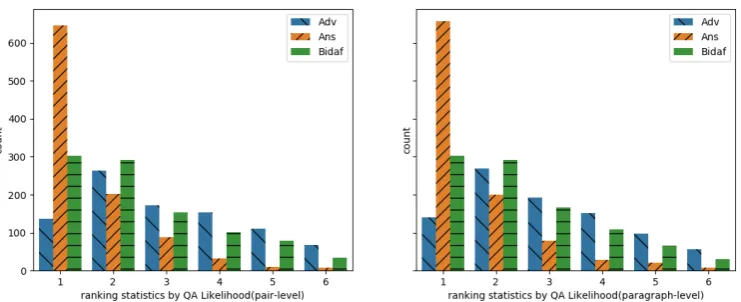
Figure 2: Sentences Ranking Statistics
Likelihood neural network, we draw a histogram in which the x-axis denotes the ranked position for each sentence according to its likelihood score
4, while they-axis is the number of sentences for
each type ranked at this position. The results are presented in Figure 2. It shows that among the 1,000(C,Q)pairs, 647 and 657 answer sentences are selected by the QA Likelihood neural network based on pair-level sampling and paragraph-level sampling respectively, but only 136 and 141 ad-versarial sentences are selected by the QA Likeli-hood neural network. It indicates the effectiveness of the QA Likelihood neural network to reduce the impact of adversarial sentences.
5 Related works
With the help of deep learning, many techniques have been investigated to achieve exciting results on answer sentence selection and QA. Wang and Nyberg (2015) measure the relevance between sentences through a stacked bidirectional LSTM network. They show that these scores are effec-tive in answer sentence selection.He et al.(2015) embed sentences with CNN at multiple levels of granularity to model the similarity between sen-tences. Rao et al. (2016) extend the method of Noise-Contrastive Estimation to questions paired with positive and negative sentences. Based on that, they present a pairwise ranking approach to select an answer from multiple candidate sen-tences. Wang et al. (2017) propose a bilateral multi-perspective matching model which achieves rivaling results in the task of answer sentence se-lection. Shen et al. (2017a) measure the similar-ity between sentences by utilizing the word level
4Thex-axis is truncated to save the space.
similarity matrix. This approach is validated in answer selection. To efficiently tackle question answering for long documents,Choi et al.(2017) propose a method based on answer sentence selec-tion to first narrow down a document and then use RNN to generate an answer.
However, following the idea of adversarial ex-amples in image recognition(Goodfellow et al., 2014;Kurakin et al.,2016;Papernot et al.,2016), Jia and Liang(2017) point out the unreliability of existing question answering models in the pres-ence of adversarial sentpres-ences. In this study, we propose a method to tackle this problem through answer sentence selection. The main compo-nent of our system is Tree-LSTM which is a powerful variant of Tree-RNN. Therefore, studies about Tree-RNN(Pollack,1990;Goller and Kch-ler,1996;Socher et al.,2011,2012,2013;Zhang et al.,2016) are also related.
6 Conclusions
In this paper, we propose a method to address the problem of question answering with adversarial sentences in paragraphs. Specifically, our system via the QA Likelihood neural network based on Tree-LSTMs successfully boost the performance of the single BiDAF on ADDANY adversarial dataset. Experiments show the F1 score has been largely improved from 4.8 to 52.3. To the best of our knowledge, we are the first to apply Tree-LSTMs in answer sentence selection and the first to tackle question answering with adversarial ex-amples on ADDANY adversarial dataset.
answer-ing on this dataset remains unsolved. We leave it as a future work.
7 Acknowledgments
We would like to thank the anonymous review-ers for their valuable comments. This work is supported in part by the National Natural Sci-ence Foundation of China grants 11501464 and 11761141007.
References
Qian Chen, Xiaodan Zhu, Zhen-Hua Ling, Si Wei, Hui Jiang, and Diana Inkpen. 2017. Enhanced lstm for natural language inference. In Proceedings of the 55th Annual Meeting of the Association for Compu-tational Linguistics (Volume 1: Long Papers). vol-ume 1, pages 1657–1668.
Eunsol Choi, Daniel Hewlett, Jakob Uszkoreit, Illia Polosukhin, Alexandre Lacoste, and Jonathan Be-rant. 2017. Coarse-to-fine question answering for long documents. InProceedings of the 55th Annual Meeting of the Association for Computational Linguistics, ACL 2017, Vancouver, Canada, July 30 -August 4, Volume 1: Long Papers. pages 209–220.
https://doi.org/10.18653/v1/P17-1020.
John Duchi, Elad Hazan, and Yoram Singer. 2011. Adaptive subgradient methods for online learning and stochastic optimization. Journal of Machine Learning Research12(Jul):2121–2159.
Christoph Goller and Andreas Kchler. 1996. Learning task-dependent distributed representations by back-propagation through structure. In In Proc. of the ICNN-96. IEEE, pages 347–352.
Ian J Goodfellow, Jonathon Shlens, and Christian Szegedy. 2014. Explaining and harnessing adver-sarial examples. arXiv preprint arXiv:1412.6572.
Rohit Gupta, Constantin Orasan, and Josef van Gen-abith. 2015. Reval: A simple and effective machine translation evaluation metric based on recurrent neu-ral networks. In Proceedings of the 2015 Confer-ence on Empirical Methods in Natural Language Processing. pages 1066–1072.
Hua He, Kevin Gimpel, and Julie Qiaojin Lin. 2015. Multi-perspective sentence similarity modeling with convolutional neural networks. InEMNLP.
Minghao Hu, Yuxing Peng, and Xipeng Qiu. 2017. Re-inforced mnemonic reader for machine comprehen-sion.CoRR, abs/1705.02798.
Robin Jia and Percy Liang. 2017. Adversar-ial examples for evaluating reading comprehen-sion systems. In Proceedings of the 2017 Conference on Empirical Methods in Natural
Language Processing, EMNLP 2017, Copen-hagen, Denmark, September 9-11, 2017. pages 2021–2031. https://aclanthology.info/papers/D17-1215/d17-1215.
Alexey Kurakin, Ian J. Goodfellow, and Samy Bengio. 2016. Adversarial examples in the physical world. CoRR abs/1607.02533.
http://arxiv.org/abs/1607.02533.
Christopher D. Manning, Mihai Surdeanu, John Bauer, Jenny Finkel, Steven J. Bethard, and David McClosky. 2014. The Stanford CoreNLP natural language processing toolkit. In Association for Computational Linguistics (ACL) System Demonstrations. pages 55–60.
http://www.aclweb.org/anthology/P/P14/P14-5010.
Nicolas Papernot, Patrick McDaniel, Ian Goodfel-low, Somesh Jha, Z Berkay Celik, and Ananthram Swami. 2016. Practical black-box attacks against deep learning systems using adversarial examples.
arXiv preprint.
Jeffrey Pennington, Richard Socher, and Christopher Manning. 2014. Glove: Global vectors for word representation. InProceedings of the 2014 confer-ence on empirical methods in natural language pro-cessing (EMNLP). pages 1532–1543.
Jordan B Pollack. 1990. Recursive distributed repre-sentations.Artificial Intelligence46(1-2):77–105.
Pranav Rajpurkar, Jian Zhang, Konstantin Lopyrev, and Percy Liang. 2016. Squad: 100,000+ questions for machine comprehension of text. arXiv preprint arXiv:1606.05250.
Jinfeng Rao, Hua He, and Jimmy Lin. 2016. Noise-contrastive estimation for answer selection with deep neural networks. In Proceedings of the 25th ACM International on Conference on Information and Knowledge Management. ACM, pages 1913– 1916.
Minjoon Seo, Aniruddha Kembhavi, Ali Farhadi, and Hannaneh Hajishirzi. 2016. Bidirectional attention flow for machine comprehension. arXiv preprint arXiv:1611.01603.
Gehui Shen, Yunlun Yang, and Zhi-Hong Deng. 2017a. Inter-weighted alignment network for sentence pair modeling. InProceedings of the 2017 Conference on Empirical Methods in Natural Language Pro-cessing. pages 1179–1189.
Yelong Shen, Po-Sen Huang, Jianfeng Gao, and Weizhu Chen. 2017b. Reasonet: Learning to stop reading in machine comprehension. InProceedings of the 23rd ACM SIGKDD International Conference on Knowledge Discovery and Data Mining. ACM, pages 1047–1055.
methods in natural language processing and compu-tational natural language learning. Association for Computational Linguistics, pages 1201–1211.
Richard Socher, Cliff C Lin, Chris Manning, and An-drew Y Ng. 2011. Parsing natural scenes and natu-ral language with recursive neunatu-ral networks. In Pro-ceedings of the 28th international conference on ma-chine learning (ICML-11). pages 129–136.
Richard Socher, Alex Perelygin, Jean Wu, Jason Chuang, Christopher D Manning, Andrew Ng, and Christopher Potts. 2013. Recursive deep models for semantic compositionality over a sentiment tree-bank. In Proceedings of the 2013 conference on empirical methods in natural language processing. pages 1631–1642.
Kai Sheng Tai, Richard Socher, and Christopher D. Manning. 2015. Improved semantic representa-tions from tree-structured long short-term mem-ory networks. In Proceedings of the 53rd An-nual Meeting of the Association for Computa-tional Linguistics and the 7th InternaComputa-tional Joint Conference on Natural Language Processing of the Asian Federation of Natural Language Pro-cessing, ACL 2015, July 26-31, 2015, Beijing, China, Volume 1: Long Papers. pages 1556–1566.
http://aclweb.org/anthology/P/P15/P15-1150.pdf.
Di Wang and Eric Nyberg. 2015. A long short-term memory model for answer sentence selec-tion in quesselec-tion answering. In Proceedings of the 53rd Annual Meeting of the Association for Computational Linguistics and the 7th International Joint Conference on Natural Language Process-ing of the Asian Federation of Natural Language Processing, ACL 2015, July 26-31, 2015, Beijing, China, Volume 2: Short Papers. pages 707–712.
http://aclweb.org/anthology/P/P15/P15-2116.pdf.
Shuohang Wang and Jing Jiang. 2016. Machine com-prehension using match-lstm and answer pointer.
arXiv preprint arXiv:1608.07905.
Zhiguo Wang, Wael Hamza, and Radu Florian. 2017.
Bilateral multi-perspective matching for natural lan-guage sentences. In Proceedings of the Twenty-Sixth International Joint Conference on Artifi-cial Intelligence, IJCAI 2017, Melbourne, Aus-tralia, August 19-25, 2017. pages 4144–4150.
https://doi.org/10.24963/ijcai.2017/579.
Xingxing Zhang, Liang Lu, and Mirella Lapata. 2016. Top-down tree long short-term memory
net-works. In NAACL HLT 2016, The 2016
Con-ference of the North American Chapter of the Association for Computational Linguistics: Hu-man Language Technologies, San Diego Califor-nia, USA, June 12-17, 2016. pages 310–320.