Practical Issues in Compiling Typed Unification Grammars for Speech
Recognition
John Dowding Beth Ann Hockey
RIACS RIALIST Group
NASA Ames Research Center
Moffett Field, CA 94035
[email protected]
[email protected]
Jean Mark Gawron
Dept. of Linguistics
San Diego State University
San Diego, CA
[email protected]
Christopher Culy
SRI International
333 Ravenswood Avenue
Menlo Park, CA 94025
[email protected]
Abstract
Current alternatives for language mod-eling are statistical techniques based on large amounts of training data, and hand-crafted context-free or finite-state grammars that are difficult to build
and maintain. One way to address
the problems of the grammar-based ap-proach is to compile recognition gram-mars from gramgram-mars written in a more expressive formalism. While theoreti-cally straight-forward, the compilation process can exceed memory and time bounds, and might not always result in accurate and efficient speech recogni-tion. We will describe and evaluate two approaches to this compilation prob-lem. We will also describe and evalu-ate additional techniques to reduce the structural ambiguity of the language model.
1
Introduction
Language models to constrain speech recogni-tion are a crucial component of interactive spo-ken language systems. The more varied the lan-guage that must be recognized, the more critical good language modeling becomes. Research in language modeling has heavily favored statisti-cal approaches (Cohen 1995, Ward 1995, Hu et al. 1996, Iyer and Ostendorf 1997, Bellegarda 1999, Stolcke and Shriberg 1996) while hand-coded finite-state or context-free language models dominate the commercial sector (Nuance 2001,
SpeechWorks 2001, TellMe 2001, BeVocal 2001, HeyAnita 2001, W3C 2001). The difference re-volves around the availability of data. Research systems can achieve impressive performance us-ing statistical language models trained on large amounts of domain-targeted data, but for many domains sufficient data is not available. Data may be unavailable because the domain has not been explored before, the relevant data may be con-fidential, or the system may be designed to do new functions for which there is no human-human analog interaction. The statistical approach is un-workable in such cases for both the commercial developers and for some research systems (Moore et al. 1997, Rayner et al. 2000, Lemon et al.
2001, Gauthron and Colineau 1999). Even in
cases for which there is no impediment to lecting data, the expense and time required to col-lect a corpus can be prohibitive. The existence of the ATIS database (Dahl et al. 1994) is no doubt a factor in the popularity of the travel do-main among the research community for exactly this reason.
A major problem with grammar-based finite-state or context-free language models is that they can be tedious to build and difficult to maintain, as they can become quite large very quickly as the scope of the grammar increases. One way to address this problem is to write the gram-mar in a more expressive formalism and gener-ate an approximation of this grammar in the
for-mat needed by the recognizer. This approach
has been used in several systems, CommandTalk
(Moore et al. 1997), RIALIST PSA
2001), and SETHIVoice (Gauthron and Colin-eau 1999). While theoretically straight-forward, this approach is more demanding in practice, as each of the compilation stages contains the po-tential for a combinatorial explosion that will ex-ceed memory and time bounds. There is also no guarantee that the resulting language model will lead to accurate and efficient speech recognition. We will be interested in this paper in sound
ap-proximations (Pereira and Wright 1991) in which
the language accepted by the approximation is a superset of language accepted by the original grammar. While we conceed that alternative tech-niques that are not sound (Black 1989, (Johnson 1998, Rayner and Carter 1996) may still be useful for many purposes, we prefer sound approxima-tions because there is no chance that the correct hypothesis will be eliminated. Thus, further pro-cessing techniques (for instance, N-best search) will still have an opportunity to find the optimal solution.
We will describe and evaluate two compilation approaches to approximating a typed unification grammar with a context-free grammar. We will also describe and evaluate additional techniques to reduce the size and structural ambiguity of the language model.
2
Typed Unification Grammars
Typed Unification Grammars (TUG), like HPSG (Pollard and Sag 1994) and Gemini (Dowding et
al. 1993) are a more expressive formalism in
which to write formal grammars1. As opposed to
atomic nonterminal symbols in a CFG, each non-terminal in a TUG is a complex feature structure (Shieber 1986) where features with values can be attached. For example, the rule:
s[] np:[num=N] vp:[num=N]
can be considered a shorthand for 2 context free rules (assuming just two values for number):
s np singular vp singular
s np plural vp plural
1
This paper specifically concerns grammars written in the Gemini formalism. However, the basic issues involved in compiling typed unification grammars to context-free gram-mars remain the same across formalisms.
This expressiveness allows us to write grammars with a small number of rules (from dozens to a few hundred) that correspond to grammars with large numbers of CF rules. Note that the approx-imation need not incorporate all of the features from the original grammar in order to provide a sound approximation. In particular, in order to de-rive a finite CF grammar, we will need to consider only those features that have a finite number of possible values, or at least consider only finitely many of the possible values for infinitely valued features. We can use the technique of restriction (Shieber 1985) to remove these features from our feature structures. Removing these features may give us a more permissive language model, but it will still be a sound approximation.
The experimental results reported in this pa-per are based on a grammar under development at RIACS for a spoken dialogue interface to a semi-autonomous robot, the Personal Satellite Assistant (PSA). We consider this grammar to be medium-sized, with 61 grammar rules and 424 lexical entries. While this may sound small, if the grammar were expanded by instantiating vari-ables in all legal permutations, it would contain
over context-free rules.
3
The Compilation Process
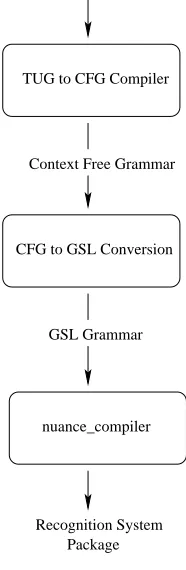
We will be studying the compilation process to convert typed unification grammars expressed in Gemini notation into language models for use with the Nuance speech recognizer (Nuance, 2001). We are using Nuance in part because it supports context-free language models, which is
not yet industry standard.2 Figure 1 illustrates the
stages of processing: a typed unification grammar is first compiled to a context-free grammar. This is in turn converted into a grammar in Nuance’s
Grammar Specification Language (GSL), which
is a form of context-free grammar in a BNF-like notation, with one rule defining each nonterminal, and allowing alternation and Kleene closure on the right-hand-side. Critically, the GSL must not contain any left-recursion, which must be elimi-nated before the GSL representation is produced.
2
Context Free Grammar TUG to CFG Compiler
nuance_compiler GSL Grammar CFG to GSL Conversion
Recognition System Package
[image:3.612.130.223.25.310.2]Typed Unification Grammar (TUG)
Figure 1: Compilation Process
The GSL representation is then compiled into a
Nuance package with the nuance compiler.
This package is the input to the speech recognizer. In our experience, each of the compilation stages, as well as speech recognition itself, has the po-tential to lead to a combinatorial explosion that exceeds practical memory or time bounds.
We will now describe implementations of the first stage, generating a context-free grammar from a typed unification grammar, by two differ-ent algorithms, one defined by Kiefer and Krieger (2000) and one by Moore and Gawron, described in Moore (1998) The critical difficulty for both of these approaches is how to select the set of derived nonterminals that will appear in the final CFG.
3.1 Kiefer&Krieger’s Algorithm
The algorithm of Kiefer&Krieger (K&K) divides this compilation step into two phases: first, the set of context-free nonterminals is determined by iterating a bottom-up search until a least fixed-point is reached; second, this least fixed-fixed-point is used to instantiate the set of context-free
for each l
l
l
! #"%$'& l(
)*+-,/.1032 45.10768:9;8=<?>
,/[email protected]:9;8=<DC
E
localGFIHKJ@
FIHKJ ! F
L
for each r
6
@M
for each tON#P7QRQTS
4UWVX=.10@2ZY[\28=< C
5
t^]_ t
` aFIHKJb!aFcHKJ
"
$
&
t(
`
if GFd!aFcHKJ
then returnaF `)
else return,/[email protected]:9;8=< CcH?e
Table 1: Construction of the fixed-point
tions.
The computation of the fixed-point
,
de-scribed in Table 1, proceeds as follows. First,
is constructed by finding the most-general set of
feature structures that occur in the lexicon (lines
1-4). Each feature structure has the lexical
restric-tor L applied to it before being added to
(line 3) with the" $
operator. This operator maintains the
seta
of most-general feature structures. A new feature structure is added to the set only when it is not subsumed by any current members of the set, and any current members that are subsumed by the new member are removed as the new
el-ement is added. The computation of
proceeds with the call to Iterate (line 6), which adds new feature structures that can be derived bottom-up.
Each call to Iterate generates a new setGFIHKJ
,
in-cluding GF
as its base (line 8). It then adds new feature structures to aFIHKJ
by instantiating every
grammar rule r in 6
, the set of grammar rules. The first step in the instantiation is to unify every combination of daughters with all possible feature
structures fromaF
(FillDaughters, line 10). The rule restrictor is applied to each resulting feature structure (line 11) before it is added toaFIHKJ
using the " $
operator (line 12), similar to the lexical case. If after checking all rule applications bottom up, no new feature structures have been added to
FIHKJ
It-erate is called recursively. See Kiefer and Krieger
(2000) for proof that this terminates, and finds the appropriate fixed-point.
Having computed the least fixed-point
, the next step is to compute the set of corresponding
CF productions. For each r in6
, of the formf
f
J
@@:fhg , instantiate the daughters f
J
@@if\g using
all combinations of unifiable feature structures
from
. Context-free productions jf f
J
@@if
g
will be added, wheref%j
andjfk`lam/knlpoqrksf. 3
3.2 Moore and Gawron’s Algorithm
While K&K uses subsumption to generate the set of most-general nonterminals, the algorithm of Moore and Gawron (M&G), described in Moore (1998) attempts to propagate features values both bottom-up and top-down through the grammar to generate a set of nonterminals that contains no variables. Also unlike K&K, the production of the CF rules and associated nonterminals is inter-leaved. The process consists of a preprocessing stage to eliminate singleton variables, a bottom-up propagation stage, and a top-down propagation stage.
The preprocessing stage rewrites the grammar
to eliminate singleton variables. This step
ef-fective replaces singleton variables with a new unique atomic symbol ’ANY’. The feature struc-ture for each lexical item and grammar rule is rewritten such that singleton variables are uni-fied with a special value ’ANY’, and every non-singleton variable expression is embedded in a val() term. After this transformation, singleton variables will not unify with non-singleton vari-able expressions, only with other singletons. Ad-ditional rules are then introduced to deal with the singleton variable cases. For each daughter in a grammar rule in which a singleton variable ap-pears, new lexical items and grammar rules are introduced which unify with that daughter in the original grammar. As an example, consider the
3
There is a minor bug in K&K where they state that the resultt will always be inu andt?vwt\x[yAyAyzt|{ will be a CF
production in the approximation, but this may not be true if t was removed fromu by}G~ . Instead, the subsuming
nonterminalt should be the new mother.
grammar fragment:
vp:[num=N] v:[num=N] np:[]
np:[num=N] det:[num=N] n:[num=N]
np:[num=pl] n:[num=pl]
Here, the np object of vp is underspecified for num (as English does not generally require num-ber agreement between the verb and its object), so it will be a singleton variable. So, the following rules will be generated:
vp:[num=val(N)]
v:[num=val(N)] np:[num=’ANY’] np:[num=val(N)]
det:[num=val(N)] n:[num=val(N)]
np:[num=val(pl)] n:[num=val(pl)]
np:[num=’ANY’]
det:[num=val(N)] n:[num=val(N)]
np:[num=’ANY’] n:[num=val(pl)]
After preprocessing, any variables remaining in the bodies of grammar rules will be shared variables. Singleton variable elimination by it-self is very effective at shrinking the size of the CF grammar space, reducing the size of the rule
space for the PSA grammar from
@M
rules
to
@M J1
rules.
The bottom-up stage starts from this grammar, and derives a new grammar by propagating fea-ture values up from the lexicon. The process acts like a chart parser, except that indicies are not kept. When a rule transitions from an active edge to an inactive edge, a new rule with those feature instantiations is recorded. As a side-effect of this
compilation, -productions are eliminated.
Top-down processing fires last, and performs a recursive-descent walk of the grammar starting
atthe start symbol , generating a new grammar
that propagates features downward through the grammar. A side-effect of this computation is that
useless-productions (rules not reachable from )
a special value ’ALL’. Since each nonterminal is now ground, it is trivial to assign each nontermi-nal a unique atomic symbol, and rewrite the gram-mar as a CFG.
[image:5.612.319.511.12.115.2]3.3 Comparison
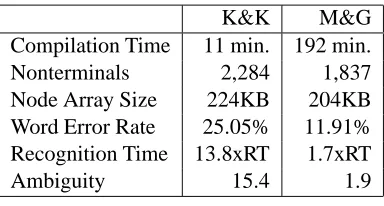
Table 2 contains a summary of some key statistics generated using both techniques. The recognition results were obtained on a test set of 250 utter-ances. Recognition accuracy is measured in word error rate, and recognition speed is measured in multiples of real time (RT), the length of the ut-terance compared with the length of the CPU time
required for the recognition result4. The size of
the resulting language model is measured in terms of the number of nonterminals in the grammar, and the size of the Nuance node array, a binary representation of the recursive transition network it uses to search the grammar. Ambiguity counts the average number of parses per sentence that were allowed by the CF grammar. As can be read-ily seen, the compilation time for the K&K rithm is dramatically lower than the M&G algo-rithm, while producing a similarly lower recog-nition performance, measured in both word error rate and recognition speed.
Given that the two techniques generate gram-mars of roughly similar sizes, the difference in performance is striking. We believe that the use of the
"
$
in K&K is partially responsible. Consider a grammar that contains a lexical item like “deer” that is underspecified for number, and will contain a singleton variable. This will lead to a nontermi-nal feature structure for noun phrase that is also underspecified for number, which will be more general than any noun phrase feature structures that are marked for number. The" $
operator will remove those noun phrases as being less general, effectively removing the number agreement con-straint between subject and verb from the context-free approximation. The use of"%$
allows a single grammar rule or lexical item to have non-local ef-fects on the approximation. As seen in Table 2, the grammar derived from the K&K algorithm is much more ambiguous than the grammar derived the M&G algorithm, and, as is further elaborated
4
All timing results presented in this paper were executed on a Sun Ultra 60 workstation, running at 330MHz with 1.5 GB physical memory and an additional 1GB swap.
K&K M&G
Compilation Time 11 min. 192 min.
Nonterminals 2,284 1,837
Node Array Size 224KB 204KB
Word Error Rate 25.05% 11.91%
Recognition Time 13.8xRT 1.7xRT
Ambiguity 15.4 1.9
Table 2: Comparison Results
in Section 4, we believe that the amount of am-biguity can be a significant factor in recognition performance.
On the other hand, attention must be paid to the amount of time and memory required by the Moore algorithm. On a medium-sized grammar, this compilation step took over 3 hours, and was close to exceeding the memory capacity of our computer, with a process size of over 1GB. The approximation is only valuable if we can succeed in computing it. Finally, it should also be noted
that M&G’s algorithm removes -productions and
useless-productions, while we had to add a sepa-rate postprocessing stage to K&K’s algorithm to get comparable results.
For future work we plan to explore possible in-tegrations of these two algorithms. One possi-bility is to include the singleton-elimination pro-cess as an early stage in the K&K algorithm. This is a relatively fast step, but may lead to a significant increase in the size of the grammar. Another possibility is to embed a variant of the K&K algorithm, and its clean separation of gen-erating nonterminals from gengen-erating CF produc-tions, in place of the bottom-up processing stage in M&G’s algorithm.
4
Reducing Structural Ambiguity
poten-tially increasing word error rate. This observation appears to be supported in practice. The original form of the PSA grammar allows an average of 1.4 parses per sentence, and while both the K&K and M&G algorigthm increase the level of ambi-guity, the K&K algorithm increases much more dramatically.
We are investigating techniques to transform a CFG into one weakly equivalent but with less am-biguity. While it is not possible in general to re-move all ambiguity (Hopcroft and Ullman 1979) we hope that reducing the amount of ambiguity in the resulting grammar will result in improved recognition performance.
4.1 Grammar Compactor
The first technique is actually a combination of three related transformations:
Duplicate Nonterminal Elimination – If two
nonterminals A and B have exactly the same set of productions
J
@@
g
J
@@
g
then remove the productions for B, and rewrite B as A everywhere it occurs in the grammar.
Unit Rule Elimination – If there is only one
production for a nonterminal A, and it has a single daughter on its right-hand side
8r
[
then remove the production for A, and
rewrite A as
everywhere it occurs in the grammar.
Duplicate Production Elimination – If a
non-terminal A has two productions that are iden-tical
J
@@
g
8
F =
8
then remove the production for
F
.
These transformations are applied repeatedly un-til they can no longer be applied. Each of these transformations may introduce opportunities for the others to apply, so the process needs to be order insensitive. This technique can be applied
after the traditional reduction techniques of
-elimination, cycle--elimination, and left-recursion elimination, since they don’t introduce any new
-productions or any new left-recursion.
Although these transformations seem rather specialized, they were surprisingly effective at re-ducing the size of the grammar. For the K&K algorithm, the number of grammar rules was re-duced from 3,246 to 2,893, a reduction of 9.2%, and for the M&G algorithm, the number of rules was reduced from 4,758 to 1,837, a reduction of 61%. While these transforms do reduce the size of the grammar, and modestly reduce the level of ambiguity from 1.96 to 1.92, they did not ini-tially appear to improve recognition performance. However, that was with the nuance parameter
-node array optimization levelset to
the default value FULL. When set to the value
MIN, the compacted grammar was
approxi-mately 60% faster, and about 9% reduction in the word error rate, suggesting that the
nuance compiler is performing a similar form of compaction during node array optimiza-tion.
4.2 Immediate Recursion Detection
Another technique to reduce ambiguity was moti-vated by a desire to reduce the amount of preposi-tional phrase attachment ambiguity in our gram-mar. This technique detects when a Kleene clo-sure will be introduced into the final form of the grammar, and takes advantage of this to remove ambiguity. Consider this grammar fragment:
NP NP PP
VP V NP PP
The first rule tells us that an NP can be followed by an arbitrary number of PPs, and that the PP following the NP in the second rule will be am-biguous. In addition, any nonterminal that has an NP as its rightmost daughter can also be followed by an arbitrary number of PPs, so we can detect ambiguity following those nonterminals as well. We define a predicate follows as:
A follows B iff
B B A or
B
C and A follows C
a B is followed by an A:
J
@@
F
FIHKJ @@
g
where
FIHKJ
follows
F
and J
can be rewritten as
J
@@
F
FcH
@@
g
There is an exactly analogous transformation involving immediate right-recursion and a simi-lar predicate preceeds. These transformation pro-duce almost the same language, but can modify it by possibly allowing constructions that were not allowed in the original grammar. In our case, the initial grammar fragment above would require that at least one PP be generated within the scope of the VP, but after the transformation that is no longer required. So, while these transformations are not exact, they are still sound aproximations, as the resulting language is a superset of the orig-inal language.
Unfortunately, we have had mixed results with applying these transformations. In earlier ver-sions of our implementation, applying these trans-formations succeeded in improving the recogni-tion speed up to 20%, while having some modest improvements in word error rate. But, as we im-proved other aspects of the compilation process, notably the grammar compaction techniques and the left-recursion elimination technique, those improvements disappeared, and the transforma-tions actually made things worse. The problem appears to be that both transformations can in-troduce cycles, and the right-recursive case can introduce left-recursion even in cases where cles are not introduced. When the introduced cy-cles and left-recursions are later removed, the size of the grammar is increased, which can lead to poorer recognition performance. In the earlier im-plementations, cycles were fortuitously avoided, probably due to the fact that there were more unique nonterminals overall. We expect that these transformations may be effective for some gram-mars, but not others. We plan to continue to ex-plore refinements to these techiques to prevent them from applying in cases where cycles or left-recursion may be introduced.
5
Left Recursion Elimination
We have used two left-recursion elimination tech-niques, the traditional one based on Paull’s al-gorithm, as reported by Hopcroft and Ullman
(1979), and one described by Moore (2000)5,
based on a technique described by Johnson (1998). Our experience concurs with Moore that the left-corner transform he describes produces a more compact left-recursion free grammar than that of Paull’s algorithm. For the K&K approx-imation, we were unable to get any grammar to compile through to a working language model using Paull’s algorithm (the models built with Paull’s algorithm caused the recognizer to ex-ceed memory bounds), and only sucex-ceeded with Moore’s left-recursion elimination technique.
6
Conclusions
We have presented descriptions of two algorithms for approximating typed unification grammars with context-free grammars, and evaluated their performance during speech recognition. Initial re-sults show that high levels of ambiguity coorelate with poor recognition performance, and that size of the resuling language model does not appear to directly coorelate with recognition performance. We have developed new techniques for further re-ducing the size and amount of ambiguity in these context-free grammars, but have so far met with mixed results.
References
J. Bellegarda. Context scope selection in multi-span statistical language modeling. In Proceedings of the
6th European Conference on Speech Communica-tion and Technology (EuroSpeech99), pages 2163–
2166, 1999.
BeVocal. http://www.bevocal.com, 2001. As of 31 January 2001.
A. Black. Finite state machines from feature gram-mars. In International Workshop on Parsing
Tech-nologies, pages 277–285, 1989.
H. Bratt and A. Stolcke. private communication, 1999.
5
M. Cohen, Z. Rivlin, and H. Bratt. Speech recog-nition in the ATIS domain using multiple knowl-edge sources. In Proceedings of the Spoken
Lan-guage Systems Technology Workshop, pages 257–
260, 1995.
D. Dahl, M. Bates, M. Brown, K. Hunicke-Smith, D. Pallet, C. Pao, A. Rudnicky, and E. Shriberg. Expanding the scope of the atis task: The atis-3 cor-pus. In Proceedings of the ARPA Human Language
Technology Workshop, Princeton, NJ, March 1994.
J. Dowding, M. Gawron, D. Appelt, L. Cherny, R. Moore, and D. Moran. Gemini: A natural lan-guage system for spoken lanlan-guage understanding. In Proceedings of the Thirty-First Annual Meeting
of the Association for Computational Linguistics,
1993.
O. Gauthron and N. Colineau. SETHIVoice: Cgf control by speech-recognition/interpretation. In
I/ITSEC ’99 (Interservice/Industry Training, Simu-lation and Education Conference), Synthetic Solu-tions for the 21st Century, Orlando, FL, 1999.
HeyAnita. http://www.heyanita.com, 2001. As of 31 January 2001.
J. Hu, W. Turin, and M.K. Brown. Language model-ing with stochastic automata. In Proceedmodel-ings of the
Fourth International Conference on Spoken Lan-guage Processing (ICSLP), pages 406–413, 1996.
J. Hopcroft and J. Ullman. Introduction to Automata
Theory, Languages, and Computation.
Addison-Wesley, Reading, MA, 1979.
R. Iyer and M. Ostendorf. Transforming out-of-domain estimates to improve in-out-of-domain language models. In Proceedings of the 5th European
Con-ference on Speech Communication and Technology (EuroSpeech97), pages 1975–1978, 1997.
M. Johnson. Finite-state approximation of constraint-based grammars using left-corner grammar trans-forms. In Proceedings of the 36th Annual Meeting
of the Association for Computational Linguistics,
pages 619–623, 1998.
B. Kiefer and H. Krieger. A context-free approxima-tion of head-driven phrase structure grammar. In
Proceedings of the 6th International Workshop on Parsing Technologies, pages 135–146, 2000.
Oliver Lemon, Anne Bracy, Alexander Gruenstein, and Stanley Peters. A multi-modal dialogue sys-tem for human-robot conversation. In Proceedings
of North American Association for Computational Linguistics (NAACL 2001), 2001.
R. Moore, J. Dowding, H. Bratt, J. Gawron, Y. Gorfu, and A. Cheyer. CommandTalk: A spoken-language interface for battlefield simulations. In Proceedings
of the Fifth Conference on Applied Natural Lan-guage Processing, pages 1–7, 1997.
R. Moore. Using natural language knowledge sources in speech recognition. In Proceedings of the NATO
Advanced Studies Institute, 1998.
R. Moore. Removing left-recusion from context-free grammars. In Proceedings of 1st Meeting of the
North Americal Chapter of the Associations for Computational Linguistics, pages 249–255, 2000.
Nuance. http://www.nuance.com, 1999. As of 1 April 1999.
C. Pollard and I. Sag. Head-Driven Phrase Structure
Grammar. University of Chicago Press, 1994.
F. Pereira and R. Wright. Finite-state approximation of phrase structure grammars. In Proceedings of the
29th Annual Meeting of the Assocations for Compu-tational Linguistics, pages 246–255, 1991.
M. Rayner and D.M. Carter. Fast parsing using prun-ing and grammar specialization. In Proceedprun-ings of
the Thirty-Fourth Annual Meeting of the Associa-tion for ComputaAssocia-tional Linguistics, pages 223–230,
Santa Cruz, California, 1996.
M. Rayner, B.A. Hockey, and F. James. A com-pact architecture for dialogue management based on scripts and meta-outputs. In Proceedings of Applied
Natural Language Processing (ANLP), 2000.
S. Shieber. Using restriction to extend parsing algo-rithms for complex-feature-based formalisms. In
Proceedings of the 23rd Annual Meeting of the Assocations for Computational Linguistics, pages
145–152, 1985.
S. Shieber. An Introduction to Unification-based
Ap-proaches to Grammar. CLSI Lecture Notes no. 4.
Center for the Study of Language and Information, 1986. (distributed by the University of Chicago Press).
SpeechWorks. http://www.speechworks.com, 2001. As of 31 January 2001.
A. Stolcke and E. Shriberg. Statistical language modeling for speech disfluencies. In Proceedings
of the IEEE International Conference on Acous-tics, Speech and Signal Processing, pages 405–408,
1996.
TellMe. http://www.tellme.com, 2001. As of 31 Jan-uary 2001.
World Wide Web Consortium (W3C). Speech
Recognition Grammar Specification for
the W3C Speech Interface Framework.
W. Ward and S. Issar. The cmu atis system. In
Spo-ken Language System Technology Workshop, pages