Munich Personal RePEc Archive
Malicious Litigation
Guha, Brishti
15 February 2016
Online at
https://mpra.ub.uni-muenchen.de/69544/
Malicious Litigation
Brishti Guha1 Abstract
It has long been recognized that some plaintiffs sue defendants out of malice, but malicious
litigation has not been previously modeled in the law and economics literature. I construct a
simple model of malicious litigation, wherein malice is defined by the plaintiff’s obtaining some
utility whenever the defendant incurs costs. When plaintiffs are malicious, they are more likely
to file even non-meritorious suits; both probability of filing and the plaintiff’s settlement payoff
increase in the plaintiff’s malice. However, if the defendant is also malicious, obtaining utility
when the plaintiff incurs litigation expenses, settlements may fail even with complete
information. Two-sided malice deters filing over a certain parameter range; outside it, it raises
the ratio of cases that go to trial instead of being resolved through settlement. Giving the
defendant the right to call for a bar on settlement is less effective at deterring malicious lawsuits
relative to non-malicious “negative-expected-value” (NEV) or “nuisance” suits. However,
combining the optional settlement bar with a “commitment requirement” stipulating that the
plaintiff commit to going to trial (rather than withdraw) whenever the defendant opts to defend
discourages malicious litigation for a wider range of parameters.
Keywords: Malice, lawsuits, settlement, withdrawal, trial.
JEL Codes: K41, K10, D03.
1. Introduction
It has long been recognized that some plaintiffs sue defendants out of malice. I define a plaintiff
as malicious if he obtains some utility whenever the defendant is forced to undergo a monetary
or non-monetary – e.g reputational – loss. Historically, legal systems have accepted that
plaintiffs are not always motivated by a desire for justice while bringing lawsuits against
defendants. In ancient Athens, “frivolous” lawsuits were discouraged by the rule that any
plaintiff who could not secure at least a fifth of jury votes in his favor had to pay the state a
1
substantial fine (Hansen 1991, Guha 2011).2 In medieval England, jurisprudence was concerned
with the possibility that plaintiffs may sue defendants solely to harm them. Thus, under the
Normans, the law evolved two responses to this; the first was amercement (requiring a plaintiff
who initiated a “wrongful” suit to pay the court – though not the defendant – in proportion to the
harm caused by his suit), while the second was the writ of conspiracy (from 1293 onwards)
whereby defendants who thought themselves wronged could bring a counter-suit against a
plaintiff who had used third parties to set up a wrongful accusation against the defendant
(Campbell 1979).3 In modern law, this concern is the origin of the “tort of malicious
prosecution”. This tort allows for a defendant who alleges having been sued out of malice to counter-sue the plaintiff in the original case. However, to make use of this tort, the defendant
needs to have won the original case, needs to prove to the court that the plaintiff was definitely
motivated by malice (in some jurisidictions this requires proving that the harm to the defendant
exceeded obvious monetary losses), and must be able to bear the expense of counter-suing as
well as the uncertainty of victory. The second requirement, in particular, of being able to
definitely prove malicious motivation, is very difficult to meet and might explain why this tort is
only used rarely. In the cases where it has been used, it has often been a response to medical
malpractice suits (with the doctor sued for malpractice alleging malice on the part of the suing
patient) (Sanbar 2007).
Real life contexts in which malicious lawsuits could be filed include (besides the cases of
alleged medical malpractice referred to above) cases filed by business rivals (e.g some frivolous
patent infringement suits could fall in this category, if their main aim is to disrupt the rival’s
success), estranged spouses, or quarrelling neighbors.4
2
Civil cases in Athens were also decided by jury votes (using a majority rule). The fine for bringing a case deemed
to be “frivolous” was 1,000 drachma.
3
Anglo-Saxon law dealt with supposedly false suits in a much harsher way prior to the Norman conquest. If the plaintiff were unsuccessful in his suit, his tongue would be pulled out (the law at that time equated unsuccessful suits with false ones, since each lawsuit was regarded as a trial with God as the judge) (Campbell 1979, Pollock and Maitland 1898).
4
CSC (Contemporary Services Corporation) v Staff Pro Inc, 152 Cal App 4th 1043 (2007), is an example of multiple
The limitations of the tort of malicious prosecution noted above, and its rare use, imply
that it is unlikely to serve as a credible deterrent to malicious plaintiffs. However, rather than
expand this tort to allow for additional rounds of lawsuits, it might be desirable to look at other
measures that would help deter malicious plaintiffs without entailing a counter-suit (or the threat
of one). This is one of the aims of the current paper.5
This paper’s main focus is on modeling malicious litigation. It investigates whether the introduction of one-sided malice (i.e on the plaintiff’s part) affects the probability of filing cases,
and how it affects the amount of settlement. I find that malicious plaintiffs have a greater
incentive to file, all else equal, and obtain a greater settlement payoff than non-malicious ones.
Both filing probability and the plaintiff’s settlement payoff increase monotonically in the malice
parameter. Since malice may be a product of the history of interactions between the two parties, I
then look at two-sided malice. Interestingly, introducing two-sided malice results in some
probability of settlement failure, despite the complete information environment. I find that the
practices by Staff Pro, suing it. This resulted in a defamation counter-suit by Staff Pro in 2004 and a cross-complaint
by CSC. According to the head of Staff Pro, CSC’s objective was to enmesh Staff Pro’s resources in litigation so
that it would have to exit the business, a view supported by the court. Singleton v Singleton, 68 Cal App 2nd , 699
(1945) involved a charge of malicious prosecution against a sibling. A brother and a sister quarreled following
disagreements over their mother’s will, and the sister left taking some furniture which belonged to her; the brother
promptly had her arrested on charges of grand theft. When the sister was acquitted, she counter-sued, and the court found the brother guilty of malicious prosecution. Singleton v Perry, 45 Cal 2nd 492 (1955) involved a judgment
against a man who was found to have maliciously slapped criminal charges of theft against his estranged partner (she had left him in a car which was registered under her own name but which had been a gift from him). In Lackner v Lacroix, 25 Cal 3rd, 747 (1979), a medical malpractice suit against Lackner was attributed to malice and dismissed.
5
The view that deterrence of malicious litigation is a more desirable end than expanding the tort of malicious prosecution was also expressed in a unanimous judgment by the California Supreme Court in the case of Sheldon Appel Co. v Albert and Oliker, 47 Cal. 3d 863, 873 (1989) which maintained :
probability of settlement failing increases in (i) the plaintiff’s malice, (ii) the defendant’s malice,
and (iii) litigation costs for the plaintiff. Moreover, if the defendant is sufficiently malicious,
settlements always fail. If settlement is expected to fail, some malicious plaintiffs are deterred
from filing; however, the most malicious ones still file, and proceed to trial without reaching a
settlement. Thus, two-sided malice increases the ratio of litigation to settlement. At the same
time, though, it has a dampening effect on the number of cases filed.
Since one of the aims of the paper is to look at how malicious suits can be deterred, we
might wonder about the social (un)desirability of such suits. Whether one considers malicious
suits undesirable from a social point of view depends on the objectives of the social planner. If
the planner seeks to minimize litigation costs, and does not think that “malice utility” constitutes
a socially justifiable end, he will seek to discourage malicious litigation. However, if he thinks
that utility derived from malice is just as important as any other component of utility, he might
still seek to discourage malicious litigation if the extra burden on litigation imposed by it exceeds
the benefit to the malicious parties. One could conceive of a social planner who thinks that
malice is not justified in certain cases (eg envious neighbors seeking to harm each other out of
jealousy or spite) but is justified in others (e.g, someone who resents their former spouse and
sues them might have grounds for their resentment). However, it may be difficult for such a
planner to secure enough information to determine if malice is really justified. (If an ex-wife, for
example, bears her ex-husband malice, it may be prohibitively costly for the planner to determine
if this is because of the ex-husband’s bad behavior, or because of the ex-wife’s own nature).
This paper is connected to several strands of the literature – the law and economics
literature on nuisance suits, the game theoretic literature on malice and mechanism design and
the behavioral and experimental literature on the importance of malice in decision-making. I
discuss these briefly below.
Rasmusen (1996) and Bebchuk and Klement (2012) survey pertinent law and economics
literature on “nuisance suits” –suits which have low legal merit, and “negative expected value”
probability of winning the lawsuit, to justify the costs of suing.6 Rather oddly, the nuisance suit
literature does not explicitly model malice – which I define as deriving pleasure from the
disutility of another – as a possible motive. The nuisance suit literature includes Rosenberg and
Shavell (1995, 2006), Bebchuk (1996, 1988), Katz (1990), Miceli (1993), Klement (2003), Chen
(2006), and Schwartz and Wickelgren (2009), among others.
Rosenberg and Shavell (henceforth, RS) (1985) have a model where the defendant needs
to incur some expenses simply to avoid forfeiting the claim; subsequently, the plaintiff may
withdraw his case without incurring any expenses apart from the initial filing cost. They show
that plaintiffs may bring nuisance suits against defendants with the aim of reaching a settlement,
and that defendants have an incentive to offer a settlement to avoid the costs of mounting a
defense, even though they correctly anticipate that the plaintiff will withdraw subsequently. RS
(2006) extend this model to argue that giving the defendant the option to call for a “settlement bar” – that is, a provision that the court ignore all settlements – gets rid of this motive for nuisance suits. In the portion of the paper where I look at ways of deterring malicious lawsuits, I
find that an optional settlement bar is much less effective at deterring malicious litigation than it
is at deterring RS’s nuisance suits. Intuitively, if the plaintiff is sufficiently malicious, he may benefit from filing even if reaching a settlement is not an option; he obtains utility from malice if
he files and withdraws after having forced the defendant to incur expenses on defense.7 More
effective is a combination of the settlement bar option with a “commitment requirement” which
requires plaintiffs to commit to going to trial if defendants choose to defend. All malicious suits
below a specific threshold are eliminated. The instruments I propose have no effect on the
incentives of plaintiffs filing non-malicious PEV cases. This is a positive feature, because it
implies that adopting these instruments will only deter malicious suits and non-malicious NEV
suits, rather than non-malicious PEV ones.
6
It is generally agreed that nuisance suits are NEV suits; however, there may be NEV suits which are not nuisance
suits; these may be “small-stakes suits” with legal merit. Though the probability of winning these suits is non-negligible, the amount at stake is so small that the expected gains to the plaintiff from litigation are outweighed by litigation costs.
7
While I am not aware of any other papers that explicitly model the role of malice in law
and economics, I now briefly discuss the other economics literature on malice. Guha (2014a)
discusses malice in the context of King Solomon’s dilemma (two women both claiming to be the
mother of the same child) arguing that the “false mother” in the King Solomon case was
motivated by the pleasure she obtained from depriving her rival, the “true mother”. More
generally, that paper designs a mechanism which a designer – such as an arbitrator, a child
welfare officer, or a patent authority, as a few examples – can use to allocate an indivisible
object to one of two claimants, when he wants the object to go to the party that values it more
highly for its own sake, in a context where one or both of the parties may or may not be
malicious. The paper builds on experimental literature – including among others, Beckman et al
(2002), Bosman and van Winden (2002), Bosman et al (2006), Albert and Mertins (2008), Zizzo
and Oswald (2001), Abbink and Sadrieh (2008), and Abbink and Herrmann (2011) – that
provides evidence that malice matters in decision making. Finally, Guha (2014b) links the game
theoretic and the experimental literatures on malice by devising a game-theory based test that
experimenters can use to detect whether malice is absent, or present in a one-sided or a two-sided
form in a two-person indivisible allocation context (and shows how to infer the identity of the
malicious party when the malice is one-sided).
The paper proceeds as follows. Section 2 contains the model and main results. Section 3
concludes.
2. A Model of Malicious Litigation
2.1 Framework
A malicious plaintiff may sue a defendant by filing a claim against the defendant for an amount
W (“wealth”) by incurring a filing cost F. Malice is defined by the parameter μ: whenever the
defendant incurs a unit of expense (or of non-monetary disutility measured in monetary terms),
the plaintiff obtains a “malice utility” of μ. As the plaintiff is malicious, μ > 0 (it would be zero for a non-malicious plaintiff), but we do not impose any restrictions on the values that μ may
take.8 In addition, we define the following parameters below:
8
d represents the costs of mounting a defense (which I take to be the defense attorney’s fees),
l represents the plaintiff’s costs of litigation (which I take to be the prosecuting attorney’s fees),
p is the plaintiff’s probability of winning the case,
α is the plaintiff’s bargaining power in reaching a settlement (1-α being the defendant’s bargaining power), and
E is the monetary value of any non-monetary losses (e.g. reputational losses) that the defendant
suffers if he either loses the case or cedes his claim without putting up a defense.
We also use the symbol S to denote the amount of settlement that the plaintiff and the
defendant may arrive at; however, this is not a parameter, as it is endogenously determined by
the model parameters, including α.
The order of moves is as follows:
1. The plaintiff decides whether to file a case, incurring a filing cost of F, or not to file,
obtaining 0.
2. The defendant decides whether to cede the plaintiff’s claim, or offer a settlement. The
settlement amount S is determined by the relative bargaining powers of the plaintiff and
the defendant. If the defendant cedes, the game ends. If the defendant offers a settlement,
the plaintiff decides whether to accept or reject the offer.
3. If the plaintiff accepts the offer, the game ends. If he rejects it, the defendant decides
whether to cede the claim, or mount a defense by paying his defense lawyer d.
4. The game ends if the defendant cedes in step 3. If the defendant defends, the plaintiff
decides whether to withdraw, or litigate (in the latter case he has to pay his own lawyer l).
Payoffs are realized.
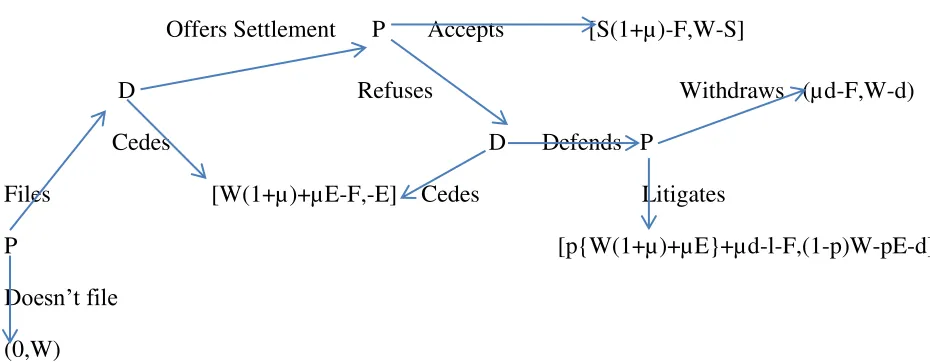
Figure 1: The model
Offers Settlement P Accepts [S(1+µ)-F,W-S]
D Refuses Withdraws (µd-F,W-d)
Cedes D Defends P
Files [W(1+µ)+µE-F,-E] Cedes Litigates
P [p{W(1+µ)+µE}+µd-l-F,(1-p)W-pE-d]
Doesn’t file
(0,W)
Figure 1 above illustrates the payoffs of the plaintiff and defendant at each possible terminal
node. The first payoff in all of the brackets represents the plaintiff’s payoff, while the second
represents the defendant’s. These payoffs can be understood if we recall that the plaintiff obtains
malice utility whenever the defendant suffers. In the diagram above, the plaintiff’s malice utility
is served either when (i) the defendant cedes, giving up W and suffering a non-monetary loss of
E, (ii) the defendant settles, as the plaintiff derives extra pleasure from the fact that the defendant
is forced to give up S, (iii) the plaintiff withdraws after forcing the defendant to spend d on
putting up a defense, and (iv) the plaintiff litigates, obtaining malice utility from forcing the
defendant to spend on his defense, and in the event of victory, also from forcing the defendant to
give up W and suffer a cost of E. The payoffs at the litigation node are expected payoffs from
litigation, given that the plaintiff’s probability of winning is p.
A1: d<(1-p)(W+E)
This assumption ensures that the defendant prefers to go to trial rather than cede.
The plaintiff’s option of “withdrawal” in the model could simply denote “not proceeding to trial”; this denotes the ease with which plaintiffs may simply choose to sit on a case without proceeding to trial, while defendants might have to go through multiple rounds of litigation
[image:9.612.70.535.126.307.2]We introduce some notation below. Let
𝜇1 =𝑝(𝑊 + 𝐸)𝑙 − 𝑝𝑊
𝜇2 = 𝐹𝑑
𝜇3 =𝑝(𝑊 + 𝐸) + 𝑑𝑙 − 𝑝𝑊 + 𝐹
Note that 𝜇3 must lie between 𝜇1 and 𝜇2. A comparison of the plaintiff’s payoffs in the events of
withdrawal and litigation gives us Observation 1.
Observation 1. The plaintiff has a higher expected payoff from litigation than from withdrawal,
if and only if µ>𝜇1. The plaintiff gets a positive payoff from withdrawal if and only if µ>𝜇2.
Finally, the plaintiff’s expected litigation payoff is positive if and only if µ>𝜇3.
Note that 𝜇1 is negative only for PEV (positive expected value) cases, where pW>l. However,
for cases of low legal merit, p is small, and hence 𝜇1 is positive. Thus, the plaintiff could well
prefer withdrawal to litigation over a non-empty parameter range.
Observation 2. Denoting the plaintiff and the defendant’s outside options in the event of not
reaching settlement by x*and 𝑥̅ respectively, we have
𝑆 = 𝛼(𝑊 − 𝑥̅) +1−𝛼1+µ(𝐹 + 𝑥∗) (1)
(1) follows from standard Nash bargaining.
We now investigate how the introduction of malice into the model affects litigation and
settlement. The way we have modeled malice has two advantages. First, it allows for a direct
comparison with the no-malice case simply by setting µ = 0 for the latter. Secondly, it allows us
to explore the incremental effect of an increase in the malice parameter, µ, on the outcome of the
game in Figure 1. Proposition 1 below explores how the introduction of malice, and a change in
settlement (inclusive of filing costs and malice utility), and (ii) the probability of filing lawsuits
in the first place. We then discuss the case of two-sided malice, where the defendant derives
satisfaction when the plaintiff incurs litigation costs (as this harms the plaintiff in monetary
terms). (Proposition 2 shows how two-sided malice affects the ratio of litigation to settlement, as
well as the frequency of filing).
Proposition 1: Malicious plaintiffs are more likely to file lawsuits, and obtain larger settlement payoffs if they do file, relative to non-malicious plaintiffs. Both the settlement payoff and the
probability of filing monotonically increase in the malice parameter.
Proof: We distinguish two parameter zones, (a) µ1 < µ2, and (b) µ1 > µ2.
First, consider zone (a), and consider 𝜇 < 𝜇1 < 𝜇2. [Note that non-malicious plaintiffs, for whom
µ=0, can be in this range for NEV non-malicious suits, for which 𝜇1 is positive.] As 𝜇 < 𝜇1, the
plaintiff would choose to withdraw rather than litigate if the defendant chose to defend. The
defendant, in turn, would clearly prefer defending to ceding, by A1. Thus, in the event of failing
to reach settlement, the two parties’ outside options are x* = µd-F, and 𝑥̅ = 𝑊 − 𝑑. Plugging these into (1), we have
𝑆 = 𝑑 [𝛼 + (1 − 𝛼)1+µµ ] = 𝑆1 (2)
We see that the settlement amount is an increasing function of the malice parameter, µ.
Settlement occurs provided 𝑆1(1 + µ) − 𝐹>0, that is, provided
(µ + 𝛼)𝑑 > 𝐹 (3)
For non-malicious plaintiffs, condition (3) above simplifies to α>µ2. If their bargaining
power is sufficiently low, the amount of settlement they expect to extract does not justify their
filing cost, and they do not file. [As their settlement payoff dominates their payoffs from both
withdrawal and litigation, it is not worth their while to file and then either withdraw or litigate,
either]. It is clear that a positive µ increases the likelihood of (3) holding, and hence the
probability of filing: moreover, the settlement payoff is increasing in the magnitude of µ.
Now consider µ1 < µ < µ2. (This range does not accommodate non-malicious NEV
it also includes malicious plaintiffs with positive µ). Since µ>µ1, the outside option in the event
of no settlement is litigation, not withdrawal. This is the plaintiff’s preferred option in case the
defendant defends; knowing this, the defendant prefers to defend rather than cede. Making the
appropriate substitutions in (1), we obtain
𝑆 = 𝛼[𝑝(𝑊 + 𝐸) + 𝑑] +1−𝛼1+µ[µ𝑑 + 𝑝{𝑊(1 + µ) + µ𝐸} − 𝑙] = 𝑆2 (4)
From (4), the plaintiff’s payoff in the event of a settlement is 𝑆2(1 + µ) − 𝐹
= (𝛼 + µ)(𝑑 + 𝑝𝐸) + (1 + µ)𝑝𝑊 − (1 − 𝛼)𝑙 − 𝐹 (5)
It is easy to see that (5) is increasing in the malice parameter, µ. There is a threshold µ* such that
(5) is positive for all µ above this threshold. As long as the threshold is less than or equal to
Max[0, µ1], plaintiffs always file in the relevant range. If not, they only file suits in cases where
µ exceeds the threshold. Again, an increase in µ increases both the probability that a suit is filed
and the plaintiff’s settlement payoff. Note that if µ≥µ3, the plaintiff always files. This is because
in this event, the plaintiff’s outside option, his expected litigation payoff, is positive; his
settlement payoff is greater than this.9
If µ exceeds both µ1 and µ2, the outside option is, again, litigation, and the plaintiff
extracts 𝑆2. As in the previous case, his payoff is increasing in µ. He always files, as µ>µ3.
Next, consider zone (b), where µ1 > µ2. If µ is below both µ1 and µ2, then the outcome is
identical to the similar case for zone (a). If, however, µ2 < µ < µ1, we find that the outside
option is withdrawal, as µ < µ1; moreover, since µ>µ2, withdrawal would give the plaintiff a
strictly positive payoff (note that this rules out non-malicious cases). In this event, the settlement
amount is 𝑆1, which is increasing in µ; moreover, plaintiffs would always file as their settlement
payoff exceeds their payoff from their outside option (withdrawal), which, as we have seen, is
positive. If µ exceeds both µ1 and µ2, the outcome is identical to the similar case for zone (a).
QED
9The plaintiff’s settlement payoff equals his outside option when the defendant has full bargaining power, and
Proposition 1 shows that one-sided malice, on the plaintiff’s part, increases his likelihood
of filing even a non-meritorious suit, and also increases his settlement payoffs. 10
2.2 Two-Sided Malice
Since we examine complete information models throughout, and settlement failure is associated
with asymmetric information11, it is interesting to see that introducing double-sided malice into a
complete information model creates a positive probability of settlement failure, and increases the
ratio of cases that go to trial relative to those that get settled. At the same time, however, it
weakly decreases the number of cases filed.
Now, in addition to the plaintiff being malicious, the defendant obtains a malice utility of
κ per unit of litigation expense that the plaintiff incurs; thus, if the case goes to trial, the
defendant now (in addition to his earlier expected payoff) gets an additional payoff of κl.
It is clear that this does not make any difference to our analysis for µ<µ1; in this range,
the plaintiff would always prefer withdrawal to litigation, so the defendant’s malice utility,
which obtains when the case goes to trial, is not a factor.
Proposition 2: Suppose µ>µ1, and that the defendant gets a malice utility of κ per unit of
litigation expense incurred by the plaintiff.
(i) The probability that settlement fails depends positively on (a) the plaintiff’s malice,
(b) the defendant’s malice, and (c) litigation costs. Moreover, settlement always fails
if the defendant is sufficiently malicious, ie, if 𝜅 >𝑝𝐸+𝑑
𝑙 + 1 = 𝜅∗.
(ii) Within the settlement failure zone, cases proceed to trial if µ>µ3. Thus the ratio of
litigation to settlement increases from zero (in the case of one-sided malice or in full
information models without malice) to a positive number.
10
The special case where the defendant has full bargaining power (can make a take it or leave it offer) has α = 0. Here, plaintiffs file only if µ>µ2. Their settlement payoff is increasing in µ.
11
See Kaplow and Shavell (2002), which explains settlement failure either in terms of differences in plaintiffs’ and
(iii) If µ1 < µ < µ2, and settlement fails, plaintiffs do not file in the range 𝜇1 < 𝜇 < 𝜇3.12
Thus the number of cases filed weakly decreases under two-sided malice.
Proof: (i) From (1), the settlement amount is a weighted average of (𝑊 − 𝑥̅) and 𝐹+𝑥∗
1+µ.
Moreover, the former quantity is the maximum possible settlement amount (obtained when the
plaintiff has all the bargaining power and reduces the defendant down to his outside option)
while the latter quantity is the minimum possible settlement amount (offered when the defendant
has all the bargaining power, reducing the plaintiff to his outside option). In the one-sided malice
case, it can be easily verified that the second quantity is always smaller than the first, so that
there is a feasible interval within which settlement can take place. With two-sided malice, this
may no longer happen. Since µ>µ1, the outside option is litigation. The condition for the second
quantity to exceed the first reduces to
𝑝𝑊 +µ[𝑝𝐸 + 𝑑] − 𝑙1 + µ > 𝑝𝑊 + 𝑝𝐸 + 𝑑 − 𝜅𝑙
Or
[𝜅(1 + µ) − 1]𝑙 > 𝑝𝐸 + 𝑑 (6)
If (6) holds, settlement fails because the minimum settlement amount acceptable to the
plaintiff exceeds the maximum amount that the defendant would be willing to offer. The
LHS of (6) is increasing in the plaintiff’s malice µ, the defendant’s malice κ, and litigation costs l. Moreover, we can verify that if κ>𝜅∗, (6) holds for all possible µ, so that settlement
always fails. This proves the first part of the Proposition.
(ii) Consider the zone within which (6) holds. Then, settlements fail. With perfect
information, plaintiffs know in advance that they will not be able to extract an acceptable
settlement. However, they still file if µ>µ3, as then, the expected payoff from litigation is
positive; but these cases go to trial instead of being settled. Note that if µ1 > µ2, µ>µ1 > µ3,
so that all plaintiffs with µ>µ1 would proceed to trial.
12 Note that this range is empty if µ
(iii)If µ1 < µ < µ2, and (6) holds, there is a non-empty range where 𝜇1 < 𝜇 < 𝜇3. Within this
range, potential plaintiffs know that while they will not be able to extract settlement, they will
not obtain a positive expected payoff from litigation, either. (Their payoff from withdrawal is
even lower). Thus, they have no incentive to file. QED
Intuitively, when the defendant is also malicious, he is less eager to settle as he obtains
malice utility when the plaintiff spends money on a trial. Thus, it is possible for the maximum
settlement he is willing to offer to be smaller than the minimum acceptable to the plaintiff.
2.3 Discussion
We saw that, compared to a model without malice, one with malicious plaintiffs results in (a)
higher probability of filing, and (b) higher settlement payoffs. As this is a complete information
model, all cases that are filed are settled, without proceeding to trial. However, this changes
when we allow the defendant to be malicious, too. Settlement may fail. A positive number of
cases that are filed proceed to trial: the ratio of litigation to settlement increases. However, filing
is also deterred within a specific parameter range, compared to the one-sided malice case.
Are fewer cases filed under two-sided malice than in a model where neither plaintiffs nor
defendants are malicious? The answer is ambiguous. However, Observation 3 offers an example
where fewer cases would be filed if non-malicious plaintiffs and defendants were replaced by
malicious ones.
Observation 3. Suppose µ1 < 0, 𝛼(𝑑 + 𝑝𝐸) + 𝑝𝑊 − (1 − 𝛼)𝑙 − 𝐹 > 0, and κ>𝜅∗. Then, fewer cases are filed under two-sided malice compared to the case where neither plaintiffs nor
defendants are malicious.
Proof: First, consider the case where neither plaintiffs nor defendants are malicious. So µ=0. As
µ1 < 0, µ>µ1, so the outside option is litigation rather than withdrawal. Moreover, from (5), if
𝛼(𝑑 + 𝑝𝐸) + 𝑝𝑊 − (1 − 𝛼)𝑙 − 𝐹 > 0, a non-malicious plaintiff can obtain a positive settlement payoff, and therefore files with probability one. (There is no possibility of settlement failure as
defendants are not malicious). Next, consider the case where non-malicious plaintiffs and
defendants have been replaced by malicious counterparts. Settlement fails as κ>𝜅∗, and from
Two-sided malice represents an interesting possibility, because in real life, if malice is a
product of the history between two parties, it is feasible that both parties may bear each other
malice. My model shows that the effect of this is nuanced. On one hand, knowledge of the
defendant’s malice can actually deter malicious plaintiffs from filing by eliminating the
probability of obtaining an acceptable settlement. On the other, suits that are not deterred (those
initiated by very malicious plaintiffs) are not resolved through settlement within the relevant
range, but proceed to trial. Whether overall court costs increase or decrease will depend on the
distribution of plaintiffs’ malice, as well as the relative costs of litigation to obtaining a
settlement.
2.4 Deterring Malicious Lawsuits
In this sub-section, we look at ways to deter malicious litigation. While doing so, we compare
our results to Rosenberg and Shavell’s (RS) 2006 results on nuisance suits. “Nuisance suits” are
different from malicious litigation in that the plaintiffs in nuisance suits do not obtain malice
utility. However, these lawsuits have low legal merit (low p, in terms of our model). RS’s main
result was that an optional settlement bar – giving the defendant the option to request the court to
ignore settlements – would suffice to deter nuisance suits. We wish to see if this is so for
malicious suits, and if not, to suggest additional instruments that would dampen malicious
litigation.
To maintain comparability with RS, we modify our model of malicious litigation slightly.
First, like RS, we now allow the plaintiff to have full bargaining power (α=1). It is now the
plaintiff, who, if he decides to file, can simultaneously make a settlement demand. The defendant
can either agree to this take-it-or-leave-it offer, cede, or defend. The game ends if the defendant
chooses either of the two former options; if he defends, then, as before, the plaintiff can either
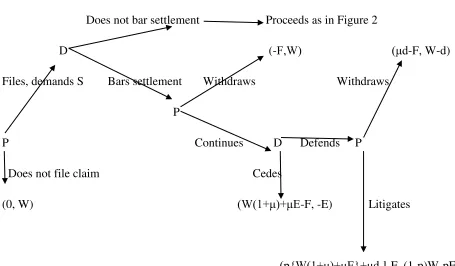
withdraw or litigate. The order of moves is shown in Figure 2 below.
How would an optional settlement bar change the structure of this game? Now, if the
plaintiff files a claim and demands settlement, the defendant has the option of calling for a
the same terminal payoffs. Figure 3 concentrates on the sequence of moves in case the defendant
[image:17.612.67.537.150.348.2]does exercise his option to call for a settlement bar.
Figure 2: Plaintiff has bargaining power, no optional settlement bar
(W(1+μ)+μE-F, -E)
Cedes Settles (S(1+μ)-F, W-S)
D Defends (μd-F, W-d)
Files, demands S P Withdraws
P
Does not file claim Litigates (p{W(1+μ)+μE}+μd-l-F, (1-p)W-pE-d)
[image:17.612.66.538.151.667.2](0, W)
Figure 3: The Game with an optional settlement bar
Does not bar settlement Proceeds as in Figure 2
D (-F,W) (μd-F, W-d)
Files, demands S Bars settlement Withdraws Withdraws
P
P Continues D Defends P
Does not file claim Cedes
(0, W) (W(1+μ)+μE-F, -E) Litigates
(p{W(1+μ)+μE}+μd-l-F, (1-p)W-pE-d)
Figure 3 shows that if the defendant does exercise the option to bar settlement, the plaintiff
[image:17.612.70.525.387.653.2]gain anything, as the defendant has not been forced to spend anything), or continue. If the
plaintiff continues, the defendant may cede the claim or put up a defense.
Proposition 3. An optional settlement bar alone is effective at deterring malicious lawsuits, if
(i) 𝜇 < min [𝜇1, 𝜇2], or
(ii) 𝜇1 < 𝜇 < 𝜇3.
Proof: (i) First, consider case (i), so that 𝜇 < min [𝜇1, 𝜇2]. As μ< 𝜇1, the plaintiff would choose to withdraw rather than litigate if the defendant were to defend. Now, consider the
scenario where the defendant does not have the option to bar settlement. He knows that the
plaintiff will withdraw if he chooses to defend. Nonetheless, he would prefer to defend rather
than to cede his claim, as his payoff from doing so, W-d, exceeds his payoff from ceding (-E),
given d < (1-p)(W+E) < W+E. Thus, the plaintiff realizes that if he demands a settlement
exceeding d, the defendant would refuse and would choose to put up a defense instead. However,
any settlement demand up to d would be accepted. Therefore, if the plaintiff demands d in
settlement, this is accepted and the plaintiff obtains a payoff of d(1+μ) – F. Assuming this is
positive, the plaintiff files and forces a settlement at S = d. Note that the plaintiff unambiguously
prefers this to demanding a higher settlement, having his demand refused, and then withdrawing,
which gives him a payoff of µd-F.
However, if the defendant has the option to bar settlements, and does so, then as μ< 𝜇2,
we have μd < F, so the plaintiff would prefer not to file a case at all to filing a case, encountering
a settlement bar, and withdrawing.13 Moreover, note that if 𝜇 < min [𝜇1, 𝜇2], then μ< 𝜇3, so that
the plaintiff would obtain a negative expected payoff from going to trial. He would therefore
prefer not to file a case at all to filing one, encountering a settlement bar, and litigating. Thus, the
settlement bar gets rid of all motives to file a case. We can check that the defendant’s threat to
bar settlement if the plaintiff does file is a credible threat. If he does not exercise the bar, there is
a settlement and the defendant loses S = d, while if he does exercise the bar after the plaintiff
13
files a claim, then the defendant also loses d, as the plaintiff would withdraw after forcing the
defendant to put up a defense. Therefore, the threat is costless and credible.
(ii)We now consider 𝜇1 < 𝜇 < 𝜇3. As μ > 𝜇1, the plaintiff would prefer litigation to withdrawal.
However now, as μ< 𝜇3, the plaintiff’s expected payoff from litigation is negative, even though
litigation is still better than withdrawal. If there were no option to bar settlements, the plaintiff
would still have an incentive to file a claim in order to extract a settlement. The defendant knows
that if he refused to settle, the plaintiff would prefer to litigate rather than withdraw, giving the
defendant an expected payoff of (1-p)W-pE-d, which exceeds his payoff from ceding (-E), given
d < (1-p)(W+E). Thus, if the defendant refused to settle, he would defend rather than cede. The
plaintiff therefore knows that a settlement demand exceeding p(W+E)+d will be refused (as the
defendant would prefer that the case go to trial), while a demand of S* = p(W+E)+d will be
accepted, giving the plaintiff a payoff of S*(1+μ)-F. This therefore gives plaintiffs a motive to
file.
However, if there were an option to bar settlements, and if the defendant exercised this
option, then as the plaintiff’s expected payoff from going to trial is negative, he would strictly
prefer not to file a claim than to file a claim, encounter the settlement bar, and litigate. Moreover,
the payoff from filing a claim, encountering the bar, and withdrawing is even lower, so the
settlement bar gets rid of all his motives for filing a claim14. Finally, we can check, as in part (i),
that the defendant’s threat to exercise the bar is credible. If he did not, his losses in the form of
settlement would be no lower than his expected losses from litigation in case he did exercise the
bar after the plaintiff filed a claim (as the plaintiff’s preferred option in that event would be to
litigate). QED
Intuitively, case (i) corresponds to cases where the plaintiff’s malice utility from making the defendant pay d is not enough to make it worth his while to simply withdraw after filing a
case. Moreover, as with nuisance suits, it is not worth his while to actually proceed to trial. Case
(ii) corresponds to a case where the plaintiff would have preferred to go to trial rather than
14
withdraw; however, neither gives him a positive expected value, so in the absence of an ability to
extract a settlement, he does not file.
Example 1. Consider W = 1000, E = 100, p = .05, F = 20, l = d = 200. We can then calculate the
values of 𝜇1, 𝜇2, and 𝜇3, as 2.73, .1, and .667, respectively. Then, an optional settlement bar
alone is effective at deterring malicious plaintiffs for whom μ < .1. This corresponds to case (i)
of Proposition1.
Example 2. Consider p = .2, F = 50, l = 250, and the same values of W, E, and d as in Example 1.
Now, we can calculate the values of 𝜇1, 𝜇2, and 𝜇3, as .227, .25, and .238, respectively. Then, an
optional settlement bar alone is effective at deterring malicious plaintiffs for μ in the range
[.227<μ< .238].
Observation 4. Giving defendants the option to bar settlements fails to deter malicious suits whenever µ > µ2.
Proof. Suppose, to the contrary, that this option is effective, and that defendants exercise this
option, barring settlements. However, a plaintiff can always obtain a positive payoff of µd-F
(positive given µ > µ2) by continuing after the defendant bars settlements, and withdrawing after
the defendant puts up a defense. But this means that the bar is ineffective at deterring malicious
plaintiffs, a contradiction. QED
Intuitively, Observation 4 highlights a major difference between nuisance suits and
malicious suits. In contrast with the nuisance suit case, a significantly malicious plaintiff actually
benefits by filing a case and then withdrawing. By forcing the defendant to undertake a costly
defense, the plaintiff feels happy as his malice is served. Therefore, even if reaching a settlement
is ruled out as an option, the plaintiff still strictly prefers to file a case to not filing.
2.4.1 When is the parameter range in Proposition 3 large?
There may, however, be cases when the parameter range to which Proposition 3 applies is a
broad one. Suppose that µ<1, so that the plaintiff’s malice utility from the defendant’s expenses
is smaller than the actual magnitude of the expenses. In addition, suppose that, instead of paying
all of their defense costs upfront, defendants are required to pay only a small amount f<d before
µf-F. If f<F (so that the small amount the defendant needs to pay before the trial is even smaller
than the filing cost), then given that µ<1, we would have µ<µ2 =𝐹
𝑓> 1. For sufficiently small
p, we could also have µ1 > 1, so that we have 𝜇 < min [𝜇1, 𝜇2]; Proposition 3 applies and a
settlement bar alone suffices to deter malicious suits.
2.4.2 Alternative instruments: an optional settlement bar and a commitment requirement
In this sub-section, we explore an alternative instrument, a combination of an optional settlement
bar and a “commitment requirement” committing the plaintiff to go to trial if the defendant
refuses to cede or settle and puts up a defense.
How is a commitment requirement to be implemented in practice? A necessary feature
would be a ban on withdrawal, so that the plaintiff is barred from filing a case and then
withdrawing it. This in itself does not suffice, however, to deter pro-se litigation, in which the
plaintiff files a case, and if settlement is not reached, simply sits back without proceeding to trial;
doing so would, in practice, give the plaintiff exactly the same payoffs as the withdrawal option
does; he would incur only the filing cost and obtain malice utility from having forced the
defendant to incur expenses. Therefore, besides a withdrawal ban, a system needs to be put in
place requiring plaintiffs to pay their lawyers legal fees upfront whenever the defendant chooses
to put up a defense.
As shown in Proposition 4 below, there is a parameter range over which a settlement bar
in itself would be ineffective, while this alternative combination works in deterring malicious
lawsuits.
Proposition 4. An optional settlement bar alone is ineffective at deterring malicious lawsuits, whereas a combination of an optional settlement bar and a commitment requirement for plaintiffs
is an effective deterrent, if 𝜇2 < 𝜇 < 𝜇3.
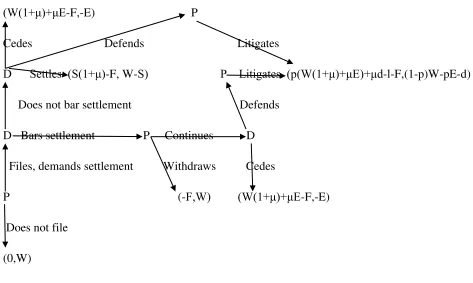
Proof: Observation 4 tells us that an optional settlement bar alone is ineffective at deterring malicious suits as µ > µ2. Next, consider the combination of an optional settlement bar and a
the defendant chooses to defend (Figure 4). Therefore, if the settlement bar were exercised, the
plaintiff would either have to withdraw immediately15, or litigate, as withdrawal after the
defendant chooses to defend, and settlement, are both ruled out, and as the defendant never
cedes. Immediate withdrawal would yield a negative payoff as the plaintiff would merely lose
his filing cost without gaining anything. As μ< 𝜇3, the plaintiff’s expected payoff from filing the
claim and litigating is negative; therefore, the plaintiff would always choose not to file the claim
if the defendant threatened to exercise the bar in the event that he did file. All that remains is to
check that it is a credible threat for the defendant to exercise the bar in case the plaintiff is not
deterred and does file.
If the defendant does not exercise the bar, then given that he will never choose to cede, he
would defend if he refused the plaintiff’s settlement offer. Given the commitment requirement,
the plaintiff would litigate if the defendant chose to defend, and the defendant would incur
expected losses of p(W+E)+d. Therefore, the plaintiff would extract a settlement of S* =
p(W+E)+d by demanding exactly this amount (a higher demand would be refused). Note that, as
μ< 𝜇3, the plaintiff does not actually wish to go to trial (his expected payoffs from doing so are negative), so he always prefers to obtain a settlement in this manner. This settlement therefore
represents the defendant’s loss from not exercising the bar. If he does exercise the bar, there are
two possibilities. First, if the plaintiff obtains more from going to trial rather than withdrawing as
soon as the defendant bars settlement (i.e if 𝑝[𝑊(1 + 𝜇) + 𝜇𝐸] + 𝜇𝑑 − 𝑙 > 0)16, then the
defendant would expect to lose p(W+E)+d, which is no more than what he expects to lose if he
did exercise the bar. Secondly, if the plaintiff gains more from immediate withdrawal than from
litigation (i.e if 𝑝[𝑊(1 + 𝜇) + 𝜇𝐸] + 𝜇𝑑 − 𝑙 < 0), then the defendant does not expect to lose
anything at all from exercising the bar, and therefore strictly prefers to exercise the bar. Hence,
exercising the bar is a credible threat and serves to keep the plaintiff from filing. QED
15
Note that withdrawing immediately after a settlement bar is announced is permitted, and parallels a similar choice in Figure 3. Withdrawal after the defendant incurs the costs of a defense is, however, ruled out by the commitment requirement.
16Subtracting F from both sides of the bracketed expression gives us the plaintiff’s expected payoffs from litigating
Intuitively, the combination of an optional settlement bar with a commitment requirement
committing plaintiffs to go to trial if the defendant chooses to defend does not affect the
plaintiff’s expected payoffs from litigation. However, it has an effect whenever the plaintiff would prefer to withdraw rather than go to trial. With a bar on settlement, both withdrawal and
settlement are ruled out as options for a malicious plaintiff, and for the parameters specified,
filing a claim and going to trial is less attractive than not filing a claim at all. Moreover,
defendants can credibly threaten to exercise the bar if the plaintiff does file, serving as an
effective deterrent in the range considered in Proposition 4.
Example 3. Let all parameters be as in Example 1. Then, a combination of an optional settlement
bar and a commitment requirement deters malicious litigation, while a settlement bar alone is
[image:23.612.69.542.345.628.2]ineffective, for the range [.1< μ < .667].
Figure 4: An Optional Settlement Bar with a Commitment Requirement
(W(1+μ)+μE-F,-E) P
Cedes Defends Litigates
D Settles (S(1+μ)-F, W-S) P Litigates (p(W(1+μ)+μE)+μd-l-F,(1-p)W-pE-d)
Does not bar settlement Defends
D Bars settlement P Continues D
Files, demands settlement Withdraws Cedes
P (-F,W) (W(1+μ)+μE-F,-E)
Does not file
(0,W)
2.4.3 Non-malicious PEV cases
The rationale underlying Remark 1 is as follows. For a non-malicious PEV case, the plaintiff
would always prefer litigation (which gives him a positive expected value) over withdrawal
(whereby he gains nothing and merely loses F). Therefore, a requirement that plaintiffs not
withdraw when the defendant chooses to defend is completely unnecessary and has no effect. If
the defendant were to bar settlement, the plaintiff would still prefer to file a claim and go to trial,
since this is a PEV case; thus litigation would not be deterred. In this event, the defendant would
expect to lose p(W+E)+d. If he did not bar settlement, the plaintiff would be able to extract a
settlement of exactly this amount from him; therefore, he would not bother to bar settlement.
Moreover, the plaintiff’s settlement payoff would be S*-F = p(W+E)+d-F > pW–l-F > 0, since
the case is a PEV case. Therefore, regardless of whether the defendant barred settlement or not,
the plaintiff would always have the incentive to file.
2.4.4 Discussion
The preceding results cover two possibilities. First, if µ2 < µ1, we necessarily have µ3 in
between them; the results now tell us that an optional settlement bar alone would deter lawsuits
when the malice parameter is between 0 and µ2, corresponding to case (i) of Proposition 3, while
a combination of an optional settlement bar and a withdrawal commitment would work for a
range [𝜇2, 𝜇3]. Secondly, if, instead, µ2 > µ1, we again necessarily have µ3 in between. In this
case, a settlement bar in itself works to deter malicious lawsuits when the malice parameter is
below µ3, with the ranges (0, µ1) and (µ1, µ3) corresponding to cases (i) and (ii) of Proposition 3
respectively.
From the RS results, we know that nuisance suits are deterred by an optional settlement
bar. In general, all non-malicious NEV (negative expected value) suits are deterred by this
option. Therefore, the welfare implications of using our instruments depend on whether we
believe that non-malicious NEV suits are all nuisance suits. If so, then we can never lose by
implementing this combination of instruments, because as proved in Remark 1, non-malicious
PEV suits are never deterred by this combination, while only malicious suits (in the range 𝜇 <
𝜇3) and nuisance suits are deterred by them.
However, what if we believe that some NEV suits are not nuisance suits but are
assuming that all NEV suits are nuisance suits.) These suits would be discouraged by the
combination of instruments. Whether the instruments decrease the proportion of undesirable suits
(defined as malicious suits and nuisance suits) to desirable ones (defined as non-malicious PEV
suits and small-stakes NEV suits) then depends on the proportions of different types of cases.
3. Conclusion
While legal systems through the ages have acknowledged the importance of dealing with
malicious litigants, the law and economics underlying malicious lawsuits have not, to my
knowledge, been previously modeled in the literature. I construct a simple model of malicious
litigation, allowing plaintiffs to derive malice utility whenever defendants incur losses. I find that
malicious plaintiffs are more likely to file cases, ceteris paribus, and are able to extract a larger
settlement payoff, relative to non-malicious ones; filing probability and settlement payoff both
increase monotonically in the plaintiff’s malice. If the defendant is also malicious, deriving some
utility when the plaintiff has to pay litigation expenses, settlement may fail. This is more likely if
both parties are sufficiently malicious, and the plaintiff’s litigation costs are high; however,
settlement will always fail if the defendant is very malicious. By affecting plaintiffs’ ability to
extract a settlement, two-sided malice deters malicious suits within a certain range; on the other
hand, it also implies that suits that are not deterred proceed to trial, rather than getting resolved
through settlement, thus increasing the ratio of litigation to settlement. I distinguish malicious
lawsuits from nuisance suits, showing that giving the defendant the option to bar settlements is
less effective in deterring malicious lawsuits (relative to nuisance suits). However, combining an
optional settlement bar with a “commitment requirement” binding plaintiffs to proceed to trial if
the defendant puts up a defense, works better.
References
Abbink, K and B. Herrmann (2011) “The Moral Costs of Nastiness”, Economic Inquiry 49: 631-633.
Abbink, K and A Sadrieh (2008) “The Pleasure of Being Nasty”, Economics Letters 105: 306-308.
Albert, M and V Mertins (2008) “Participation and decision making: a three-person power-to-take experiment”. Joint Discussion Paper Series in Economics Working Paper No 05-2008.
Bebchuk, L. (1996) “A new theory concerning the Credibility and Success of Threats to Sue”, Journal of Legal Studies 25: 1-26.
Bebchuk, L. and A. Clement (2012) “Negative-Expected-Value Suits” in Procedural Law and Economics, Vol 8, Encyclopedia of Law and Economics.Ed C.W. Sanchirico. Edward Elgar Publishing Ltd, UK, USA.
Beckman, S.R, J.P Formby, W. James Smith and B. Zheng (2002) “Envy, malice and Pareto efficiency: an
experimental examination”, Social Choice and Welfare 19: 349-367.
Bosman, R and F. van Winden (2002) “Emotional hazard in a power-to-take experiment”, Economic Journal 112: 146-169.
Bosman, R., H. Hennig-Schmidt and F. van Winden (2006) “Exploring group decision-making in a power-to-take
experiment”, Experimental Economics 9: 35-51.
Campbell, W. (1979) “Groudless Litigation and the Malicious Prosecution Debate: a Historical Analysis” Yale Law Journal 88: 1218-1237.
Chen, Z. (2006) “Nuisance Suits and Contingent Attorney Fees”, Review of Law and Economics 2: 363-370.
Guha, B. (2011) “Preferences, Prisoners and Private Information: Was Socrates Rational at His Trial?” European Journal of Law and Economics 31: 249-264.
Guha, B. (2014a) “Reinterpreting King Solomon’s Problem: Malice and Mechanism Design”, Journal of Economic Behavior and Organization 98: 125-132.
Guha, B. (2014b) “Testing for Malice in King Solomon’s Problem”, working paper, Singapore Management
University.
Hansen, M.H. (1991): The Athenian Democracy in the Age of Demosthenes: Structure, Principles and Ideology.
Oxford, UK and Cambridge, USA: Blackwell.
Kaplow, L. and S. Shavell (2002) “Economic Analysis of Law”, Handbook of Public Economics 3:1661-1784.
Katz, A. (1990) “The Effect of Frivolous Lawsuits on the Settlement of Litigation”, International Review of Law and Economics 10: 3-27.
Klement, A. (2003) “Threats to Sue and Cost Divisibility Under Asymmetric Information”, International Review of Law and Economics 23: 261-272.
Miceli, T.J (1993) “Optimal Deterrence of Nuisance Suits by Repeat Defendants”, International Review of Law and Economics 13: 135-144.
Pollock, F. and F. Maitland (1898) :The History of English Law Before the Time of Edward I. Second Edition.Reissued 1968 by the Cambridge University Press.
Rosenberg, D. and S. Shavell (1985) “A model in which Lawsuits are brought for their Nuisance Value”, International Review of Law and Economics 5: 3-13.
Rosenberg, D. and S. Shavell (2006) “A solution to the problem of Nuisance Suits: the Option to have the Court Bar
Settlement”, International Review of Law and Economics 26: 42-51.
Sanbar, S.S (2007): Legal Medicine. Elsevier Health Sciences.
Schwartz, W.F and A.L Wickelgren (2009) “Advantage Defendant: Why Sinking Litigation Costs Makes Negative -Expected-Value Defenses but not Negative-Expected-Value Suits Credible”, Journal of Legal Studies 38: 235-253.