The Chinese Aspect Generation Based on Aspect Selection Functions
Guowen Yang The Institute of linguistics
Chinese Academy of Social Sciences 5 Jianguomennei Dajie, 100732 Beijing
P.R.China
John A. Bateman
FB10, Sprach und Literaturwissenschaften Bremen University
28334 Germany
[email protected] [email protected]
Abstract
This paper describes our system for generating Chinese aspect expressions. In the system, the semantics of different aspects is characterized by specific temporal and conceptual features. The semantic applicability conditions of each individual aspect are theoretically represented by an aspect selection function (ASF). The generation is realized by evaluating implemented inquiries which formally define the ASFs, traversing the grammatical network, and making aspect selections.
1 Introduction
Aspect is one of the most controversial topics among linguists and philosophers. Unlike the function of tense, which relates the time of situation to a deictic center, aspects are different ways of viewing the states of a situation with respect to the situation’s internal temporal constituency (Yang, 2007). This paper describes our system for generating Chinese aspect expressions. The aspect forms covered in the present research were derived from a corpus analysis. The main task of the aspect research from a computational perspective is to implement computationally both the semantic interpretations and the grammatical realizations of aspects as formulated in theoretical work. The theoretical principle of this is, to a large extent, based on Montague’s intensional logic (Montague, 1970; Dowty, 1979; Bestougeff and Ligozat, 1992, Portner and Partee, 2002). It is held that the goal of semantics is to present the truth conditions for each well formed sentence.
In previous studies there are some fruitful experiments on computationally processing temporal information in Chinese, e.g. Lee and Hsu’s Chinese to English machine translation
system (1990), Li, Wong, and Yuan’s temporal information-extraction system (2001), Xue’s machine learning system (2008), and Xue, Zhong & Chen’s tense annotation system (2008). However, a systematic investigation, including the implementation of the semantics of aspects, has rarely been carried out before and is one of the main contributions of the present research.
Aspects are determined by both situation types, which build specific situation structures, and particular viewpoints that construct specific temporal relations between the viewing points and the internal temporal constituencies of situations. These two kinds of factors, which influence aspect selections, can be characterized by aspectual features. This makes it possible for us to use a function which takes relevant time points and concepts as its parameters and “calculates” the truth value of the semantic applicability conditions of a specific aspect in order to make a corresponding aspect selection in language generation. We term this function the Aspect Selection Function (ASF). The ASFs are used for the theoretical descriptions of the aspects and, at the same time, they are the basis for our computational implementation of the semantics of the aspects.
Our system has been implemented as a grammar for the KPML multilingual generator (Bateman, 1997a, 1997b) which is equipped with a large systemic grammar and all the technical components required in generation, including an input component, a traversal component, a realization component, and so on. This brings direct benefits for us in both theoretical and implementational respects since we could then focus on the linguistic treatment of the Chinese aspects.
The paper is organized into five sections. In the next three sections the semantic features of the aspects, the aspect selection functions, and the detailed description of the generation of the
aspects will be given. Finally in Section 5, we make a brief conclusion.
2 The semantic features of the aspects
One of the methods adopted in aspect studies is to use semantic features to characterize different situations (cf. Comrie, 1976; Smith, 1991, 1997; Olsen, 1997; and Dai, 1997). This is also taken as the basic principle in the present research. For the purpose of characterizing the semantics of an aspect, the features needed are not only those reflecting the properties of situation types, but also those reflecting the temporal relations between the viewing points and the internal temporal constituencies of the situations. When we establish a system of aspects, we say that the features used are necessary and sufficient if different aspects included can be distinguished from each other by means of these features. Consequently, the more aspect expressions are involved, the more aspectual features are needed.
Two kinds of aspectual features are proposed in the present research. One kind of aspectual feature can be directly represented in terms of relations holding over time points. These are termed features of temporal relations (FTR). For example, the feature durative, which is used for situations extended in time, can be represented with the temporal relation t1<t2 where t1 and t2 denote two time points bounding the situation. Similarly, the feature punctual (momentary), which is used for situations theoretically taking a moment, can be formally represented by the temporal relation t1=t2.
There is then a further kind of aspectual feature which cannot be directly represented by temporal relations, although they may also concern temporal properties of situations. This kind of feature can only be represented by parameters which serve to provide a conceptual classification of the situations involved; therefore, they are termed features of conceptual type (FCP), such as dynamic and repeatable.
In addition, there is a special kind of aspectual feature which reflects qualitative properties of temporal relations: far-precede and
shortly-precede. These two features indicate qualitative
distances between time points; the former means that one time point is linearly much before another time point on the time axis; the latter means that one time point is only a little before another time point. In specific context, these kinds of qualitative properties are reflected
relatively in comparative or inclusive relations between temporal and spatial scopes of situations.
Aspectual features are the basic elements to be used for aspect descriptions. The range of aspectual features is not held to be cross-linguistically valid. In the present research, the following aspectual features are used to describe Chinese aspects. The states of relational type formed by the verbs like 是 (shì, be), 有(yǒu, have), 等于(děngyú, equal) etc. are associated with relational processes (Halliday, 1985) and therefore not included in the features listed. In the following feature definitions, ti refers to the initial time of a situation, tt the terminating time of a situation, and tr the reference time of an aspect. In the present research, we define the reference time as the time from which the state of a situation with respect to the situation’s internal temporal constituency is contextually examined.
(1) durative (FTR): describes situations which take time. It is represented by the temporal relation ti<tt.
(2) punctual (FTR): describes situations which theoretically take only a moment of time. It is formally represented by the temporal relation ti=tt.
(3) realized (FTR): describes situations which have occurred, have existed, or have shown the property of reality by some specific time. It is represented by the temporal relation tt≤tr.
(4) dynamic-state (FCP): describes a durative changing situation.
(5) stative-state (FCP): describes a durative unchanging situation associated with the activity meaning of an activity verb. (6) change-of-state (FCP): indicates either
the inception or termination of a situation.
(7) event (FCP): describes a dynamic situation viewed as a complete whole (Comrie, 1976, p.13) and is aspectually associated with the occurrence, taking place, or completion of the situation. (8) repeatable (FCP): describes situations
which can occur repeatedly.
(9) specific (FCP): when a time point is specific, it has a particular position on the time axis which can be determined from context.
(11) far-precede (FCP): indicates a qualitative distance, one end point of which is linearly much before another end point.
(12) shortly-precede (FCP): indicates a qualitative distance, one end point of which is linearly a little before another end point.
(13) excluded (FCP): when one of the end points of a time interval has the feature
excluded, the time interval is open at
that point.
(14) included (FCP): when one of the end points of a time interval has the feature
included, the time interval is closed at
that point.
Concerning the opening and closure of a time interval at its end points, two principles are proposed by the present research. The opening and closure of a time interval at its end points can be determined according to the following principles, which we term exclusiveness principles (ELPs):
ELP (1) For the initial time ti: when the initial time ti of the situation is specific, then the time interval at the initial time ti is considered closed; when the initial time ti of the situation is unspecific, then the time interval at the initial time ti is considered open.
ELP (2) For the terminating time tt: when the situation does not hold at the terminating time tt, the time interval is considered closed at the terminating time; when the situation still holds at the terminating time tt, the time interval is considered open at the terminating time. As far as the temporal structures of aspects are concerned, there is an extreme case: when the terminating time tt precedes the reference time tr, in which case the time period of the situation is definitely closed at the terminating time tt.
The semantic feature telicity indicating that the situation referred to has an internal end point (cf. Vendler, 1967; Comrie, 1976) is not used in the present research for the Chinese aspect descriptions. The feature telicity is not an effective feature for characterizing Chinese aspects from a language generation point of view because there is no single aspect of the
present aspect system that absolutely requires that the situations expressed be telic or atelic.
3 The aspect selection functions
Specific features of temporal relations and the conceptual features together build semantic applicability conditions for each individual aspect. The semantic applicability conditions are represented by the aspect selection function (ASF) of the aspect. The ASF of a specific aspect assumed by the present research is, therefore, principally composed of two sets of predicates: one set of predicates for testing temporal relations (Allen, 1984; Yang & Bateman, 2002), another for testing the values, i.e. conceptual features, of parameters associated with the aspect. All the predicates are connected with conjunctions at the top level. At the lower levels, the logical relations among the predicates can be a conjunction and, a disjunction or and a negation not. To evaluate the truth condition of the ASF for a specific aspect, the values of all relevant temporal relations and parameters are evaluated. When all the predicates are true, i.e., all of the required conditions are met, the value of the ASF is true; otherwise, the value of the ASF is false.
In the predicates of the ASFs, there are two kinds of parameters: temporal parameters associated with the time points involved in the temporal structures of the aspects and conceptual parameters associated with the specific conceptual features of the aspects. The conceptual features will be taken as values of the corresponding parameters and represented by EQUAL(p, c), in which ‘p’ refers to a parameter and ‘c’ refers to the conceptual feature associated with that parameter. Some of the parameters are given as follows:
(1) STATE-ACTION-PROPERTYp (SAPp): this parameter indicates whether the property of the situation is
dynamic-state, stative-dynamic-state, dynamic-state, or event. The
subscript p denotes Process.
(2) CHANGEABILITYp (CBp): this parameter indicates whether the situation has the feature change-of-state. (3) REPEATABILITYp: this parameter indicates whether the situation is
repeatable.
(4) RETRIEVALt (RTt): this parameter indicates whether the time point t is
(5) POSITIONt1-t2: this parameter indicates whether the time point t1, which precedes another time point t2, is much before (far-precede) or a little before (shortly-precede) time point t2.
(6) EXCLUSIVENESSt (EXLt): this parameter indicates whether the time point t, which is one of the end points of a time interval, has the feature excluded or included.
We now take the unmarked-realized (URE) aspect V+了 (V+le) as an example to illustrate the structure of the ASF. The URE aspect V+了 (V+le) is one of the perfective aspects, serving to indicate that the occurrence, development, or change of the situation is realized (not necessarily complete) by some specific time. The temporal structure of the aspect is shown in Figure 1.
ti tt=tr
Figure 1 The temporal structure of the URE aspect V+了(V+le):
{ti, tt}, (ti<tt or ti=tt), tt=tr, RTtr=specific
The temporal structure in Figure 1 is explained as follows: The situations expressed in the URE aspect can be either punctual, i.e. ti=tt, or durative, i.e. ti<tt. The time interval of the situation defined by “{ti, tt}” is either closed or open at its ends. The feature realized is represented by specifying that the terminating time equals the reference time, i.e. tt=tr, rather than that the terminating time either equals or precedes the reference time, i.e. tt≤tr ― the latter is the general condition for all perfective aspects. In Figure 1, the case of a punctual situation, i.e. ti=tt, is theoretically taken as a very short time period and not explicitly represented. RTtr indicates that the reference time tr is a specific time point.
In addition to the temporal relations explained above, the URE aspect V+了 (V+le) has prominently three characteristics associated with the situation properties. When the URE aspect V+了(V+le) expresses a durative situation, the situation can be either a state or an event. When the process is of relational type, a change of state should be emphasized. When a change of state is involved in the situation, the URE aspect V+了 (V+le) focuses on the realization of the event, rather than the resultative state, unless current
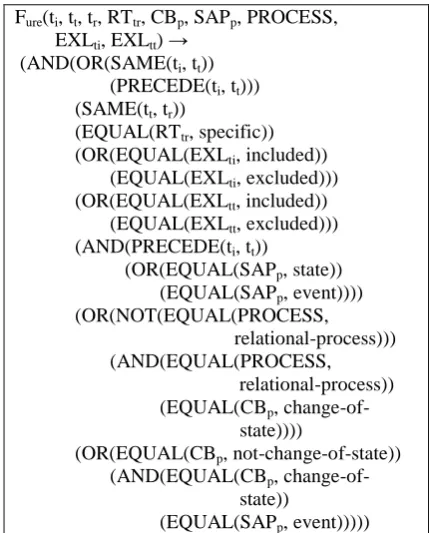
relevance is indicated in context. These three characteristics can be respectively represented by corresponding conceptual features associated with the parameters SAPp, CBp, and PROCESS involved in the predicates of the ASF of the URE aspect as shown in Figure 2. The ASFs are used for the purpose of theoretical descriptions, but also, as we shall see in the next section, give the basis for the implementation of the semantics of the aspects.
Fure(ti, tt, tr, RTtr, CBp, SAPp, PROCESS, EXLti, EXLtt) →
(AND(OR(SAME(ti, tt)) (PRECEDE(ti, tt))) (SAME(tt, tr))
(EQUAL(RTtr, specific)) (OR(EQUAL(EXLti, included)) (EQUAL(EXLti, excluded))) (OR(EQUAL(EXLtt, included)) (EQUAL(EXLtt, excluded))) (AND(PRECEDE(ti, tt))
(OR(EQUAL(SAPp, state)) (EQUAL(SAPp, event)))) (OR(NOT(EQUAL(PROCESS, relational-process))) (AND(EQUAL(PROCESS,
relational-process)) (EQUAL(CBp, change-of- state))))
(OR(EQUAL(CBp, not-change-of-state)) (AND(EQUAL(CBp, change-of- state))
[image:4.595.307.522.209.476.2](EQUAL(SAPp, event)))))
Figure 2 The ASF of the URE aspect V+了(V+le)
4 The generation of the aspect expressions
4.1 Inquiries, choosers, and the input specifi- cations
leading to the creation of that expression. The system is guided by the joint actions of the inquiries and choosers of the system (Fawcett, 1987; Matthiessen and Bateman, 1991; Bateman, 2000; Yang & Bateman, 2002). “A chooser is straightforwardly represented as a ‘decision tree’ with a particular kind of inquiry, called a
branching inquiry, forming the decision points”
(Bateman 1997c, p.20). Inquiries are responsible for finding the answers required by choosers by accessing semantic information represented in input specifications, written in the form of the Sentence Plan Language (SPL) (Kasper, 1989; Bateman, 1997a), and in the knowledge base of the system.
The semantics of an aspect associated with a sentence to be generated is represented in the input specification. The time points involved in the temporal structure of the aspect to be generated, i.e. the initial time, the terminating time, and the reference time(s), are presented with specific time values in the input specification. The speaking time has a default value corresponding to the present moment. All the parameters characterizing the conceptual features of the aspect to be generated are also included in the input specification.
The implemented inquiries, written in LISP, play a crucial role in the generation of the aspect expressions. The implemented inquiries associated with different types of aspects formally define the semantic applicability conditions represented by the ASFs of the aspects. Each implemented inquiry has a set of parameters with specific values to represent temporal relations and conceptual features of a specific aspect. The inquiry is composed of a set of predicates which will have the value T when the conditions defined are satisfied. The truth condition of an inquiry will be met only when all the predicates involved have the value T. Hence, evaluating an implemented inquiry refers to the process of testing the truth conditions of all the predicates involved in the inquiry according to
the semantic information represented in the corresponding input specification.
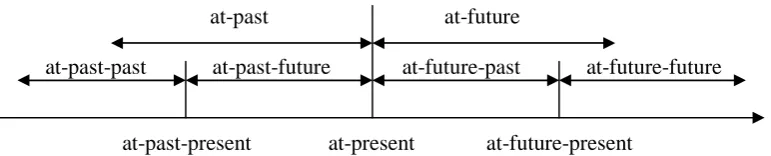
In the implemented inquiries, two basic predicates PRECEDE(t1, t2) and SAME(t1, t2) are used to test temporal relations involved in the semantic applicability conditions of different aspects. In the generation, the parameters t1 and t2, are replaced with the values of the initial time ti, the terminating time tt, or the reference time tr, which are given in the input specifications. Logically, given a specific context, the precedence of two points can be determined in terms of concepts PAST, PRESENT, and FUTURE with reference to a relative deictic center. To evaluate the precedence between two time points, nine different time values are defined on the time axis as shown in Figure 3. In Figure 3, the values at-past-present, at-present, and at-future-present correspond to three time points. The other six values correspond to specific intervals on the time axis. The time points within each interval are given a specific time value, as shown below, where “-∞” stands for the infinite past, and “+∞” stands for the infinite future:
(-∞, at-present) = at-past; (at-present, +∞) = at-future; (-∞, at-past-present) = at-past-past;
(at-past-present, at-present) = at-past-future; (at-present, at-future-present) = at-future-past; (at-future-present, +∞) = at-future-future.
The nine qualitative time values defined above build a calculating system for time comparison in the present research. To generate a specific aspect, i.e., from semantics to the surface expression of the aspect, what we need to do is to distribute each time point involved in the temporal structure of the aspect with one of the qualitative time values and to establish appropriate temporal relations between them as to be illustrated in the next section.
at-past at-future
at-past-past at-past-future at-future-past at-future-future
[image:5.595.109.495.651.729.2]at-past-present at-present at-future-present
4.2 An example of generating the aspect expressions
In this section we illustrate the generation process with an example. We focus on the generation of the aspect expressions and ignore the generation process for the other sentence constituents. Because of the limitation of input associated with relevant files in the implementation, we use numbers 1, 2, 3, and 4 to refer to the four tones of Chinese characters in all the realization statements. For instance, wang1,
wang2, wang3, and wang4 refer to wāng, wáng,
wăng, and wàng respectively. The neutral tone is not marked by numbers.
In the present case, the semantics represented in the input specification is set for the situation that “zhe4 sou1 chuan2 jin1tian1 zhuang1yun4 le yi1 liang4 you3 gu4zhang4 de ka3che1” (The ship loaded an inoperative truck today). The situation happened at a specific time today (jin1tian1) and was finished before the speaking time, i.e., the present moment. The situation refers to an event rather than a state. The process of loading the truck took a period of time; and the realization of the situation is focused. Our aim now is to generate an appropriate aspect expression for this particular loading situation by applying the semantic information represented in the input specification.
The aspect-related semantic information in the input specification is as follows. Because the situation was finished before the present moment, we can consider that both the initial time ti and the terminating time tt precede the present moment. Because the situation took a period of time, the initial time ti is regarded as preceding the terminating time tt. Because the realization of the situation is focused, the reference time tr is considered as being located at the terminating time. Representing these temporal relations with our qualitative time values illustrated in Figure 3, we have the following: SPEAKINGTIME has the value at-present which is a default value. REFERENCETIME has the value at-past-future and is a specific time point. INITIALTIME, with respect to other relevant times, has the value
at-past-past, indicating the occurrence time of the
situation. The value of TERMINATINGTIME equals that of REFERENCETIME, i.e.
at-past-future. This means that the state of the situation
indicated by the aspect to be generated is viewed from the terminating time. Theoretically, the reference time of an aspect, i.e., the viewing point of the aspect, establishes specific temporal
relations with the internal temporal constituency of the situation reflecting what the speaker focuses on when s/he views the state of a situation. In our present case, the reference time is placed at the terminating time of the situation, indicating that the speaker’s focus is on the termination or completion of the situation. If REFERENCE-TIME has other values, e.g.,
at-present, which is after the terminating time, it
indicates that the focus of the speaker is on either the recent past or experiential meaning of the situation, rather than on the termination or completion of the situation. Correspondingly, they show temporal structures of different aspects.
In the input specification, several parameters are also used to represent the conceptual features of the aspect. The conceptual features and the corresponding parameters define the space of possible aspect-related semantic variation: this shows precisely which facets of aspectual semantics are grammaticised in the language; the particular grammatical consequences are then distributed over the grammatical choice points defined in the grammatical component. When using this for generation, any given situation to be expressed must be ‘re-conceptualized’ in terms of parameters provided. This should be done by the user interested in investigating the grammatical realizations of distinct temporal relations. The parameter CHANGEABLITY has the value change-of-state, indicating the completion of the situation. The value of the parameter STATE-ACTION-PROPERTY is
event, indicating that the situation is not of type
state and can be viewed as a whole. Both the parameter EXCLUSIVENESS-TI and the parameter EXCLUSIVENESS-TT have the value
included, indicating that the time interval over
which the situation holds is closed at its two end points. This means that the situation occurred at some specific time and finished. The parameter REPEATABILITY has the value irrelevant, indicating not being related to any particular conceptual feature.
Referring to the semantics above, we follow the system traversal to generate an aspect expression by evaluating the relevant inquiries. The traversal starts from the system of WITH-ASPECT-MARKER-TYPE and needs to make a choice among its three options: imperfective,
perfective, and imminent. Corresponding to the
is the way of viewing the states of a situation with respect to its internal temporal constituency from outside the situation structure: the viewing point of the aspect is after or equal to the terminating time, i.e., tt≤tr; imperfective is the way of viewing the states of a situation with respect to its internal temporal constituency inside the situation structure: the viewing point of the aspect ranges from the initial time, including the initial time, to the terminating time of the situation, i.e., ti≤tr<tt; imminent is the way of viewing the occurrence of a situation from outside the situation structure and with the viewing point shortly before the initial time of the situation, i.e., tr<ti and Ptr-ti=shortly-precede. The temporal relations of the perfective, imperfective, and imminent aspects are captured by specifying appropriate values for the inquiries named perfective-q-code, imperfective-q-code, and imminent-q-code respectively. When operating within the context of a full generation system, these values would generally be provided via the results of text planning in the usual manner.
The with-aspect-marker-type chooser, which takes the form of a decision tree as described in section 4.1, is in charge of making the selection by asking relevant inquiries to see what type of aspect has the semantic applicability conditions which match the semantic inputs represented in the input specification. The fine classification and distinct semantic descriptions of different aspects are sufficient to constrain choice regardless of their particular order of application. Therefore, alternative implementations of the choosers, such as specifications of feature vectors, could be envisioned. Possible consequences of such changes for the other components of the generation architecture would then need to be considered, however. Because in the present case both the terminating time tt and the reference time tr have the value at-past-future that meets the temporal condition required by the perfective aspects, the option perfective is chosen and the system of PERFECTIVE-PRIMARY-TYPE is entered.
After entering the system of PERFECTIVE-PRIMARY-TYPE, a selection among three options recent-past (the REP aspect V+(NP)+lai2zhe), experiential (the unexperiential aspect V+guo and the
marked-experiential aspect ceng2jing1+V+(guo)), and
realized (the URE aspect V+le and the perfect
aspect yi3jing+V+(le)) has to be made. The perfective-primary-type chooser is responsible for making this choice. Accordingly, the chooser firstly evaluates the inquiries named recent-past-q-code and experiential-recent-past-q-code respectively. The recent-past (REP) aspect V+(NP)+lai2zhe serves to indicate that a durative situation existed not long ago. The semantic applicability conditions represented by the ASF of the REP aspect V+(NP)+lai2zhe include the following: the situation expressed by the aspect shows the feature durative which can be represented in the temporal relation ti<tt; the terminating time of the situation precedes the reference time, i.e., tt<tr; and the reference time tr is a specific time point. A further condition required is represented by the parameter Ptt-tr with the value shortly-precede, indicating the qualitative distance from tt to tr. The parameter EXL has the value excluded and
included for the initial time ti and the terminating time tt respectively.
After evaluating the inquiry of recent-past-q-code, the perfective-primary-type chooser gives a negative result, indicating that the semantics presented by the input specification does not match the semantic applicability conditions of the REP aspect. One obvious mismatch is reflected in the temporal relation between the terminating time tt and the reference time tr. The condition given by the input specification is tt=tr, while the condition required by the REP aspect is tt<tr.
After failing to select the REP aspect, the perfective-primary-type chooser continues to evaluate the inquiry associated with the experiential aspects. The experiential aspects include the unmarked-experiential (UEX) aspect V+guo and the marked-experiential (MEX) aspect ceng2jing1+V+(guo). Although the two experiential aspects have some differences in usage (cf. Yang, 2007), they have the same aspectual function to indicate that a situation existed at least once in the past and was over, not having current relevance. The semantic applicability conditions shared by the two experiential aspects are: the terminating time tt precedes the reference time tr; the situation referred to has the feature repeatable; the parameter EXLti has the value either excluded or
included; the parameter EXLtt has the value
included.
inquiry of experiential-q-code will also fail because the semantic applicability conditions of the experiential aspects do not meet the semantic information shown in the input specification. Except for the mismatch of the temporal relations, the conceptual feature repeatable required by the experiential aspects is also absent in the input specification.
When both the REP aspect and the experiential aspects have been excluded, the perfective-primary-type chooser selects aspects of realized type, and then the traversal enters the system of REALIZED-TYE, then a further selection between the URE aspect V+le and the PEF aspect yi3jing+V+(le) has to be made. The realized-type chooser is responsible for making this selection. To make the selection, the realized-type chooser firstly evaluates the inquiry unmarked-realized-q-code to check whether the semantic applicability conditions of the URE aspect V+le can be met. The inquiry unmarked-realized-q-code is defined according to the ASF of the URE aspect as shown in Figure 2. The realized-type chooser evaluates the inquiry unmarked-realized-q-code by comparing the input semantics with the semantic applicability conditions of the URE aspect. The evaluation of the unmarked-realized inquiry succeeds because all the predicates of the unmarked-realized-q-code give the value T (Due to the space limit, we will not describe the whole process of evaluation in detail here). Hence, according to the algorithm of the realized-type chooser, the URE aspect V+le should be chosen and the perfect-q-code does not need to be evaluated. The generated sentence, marked up to show its constituency, is then as follows:
((zhe4/这)(sou1/艘)(chuan2/船)) ((jin1tian1/今天)) this CL ship today (zhuang1yun4/装运) (le/了) ((yi1/一) (liang4/辆) load URE one CL ((you3 gu4zhang4/有故障)(de/的))
have problem of (ka3che1/卡车.))
truck
(The ship loaded an inoperative truck today.)
5 Conclusion
With the method elaborated above, a test-bed of forty aspect expressions of the Chinese aspect system has been correctly generated in the forms of both Chinese phonetic alphabet and characters. In the present research the application of the
ASFs provides a formal way to represent semantic applicability conditions of the aspects; the grammatical network built on the basis of systemic functional grammar systematically organizes and distinguishes semantic functions of different aspects. The computational implementation verifies both grammatical organization and semantic descriptions of the Chinese aspects. The complete system files and the sentences generated are available on the website: “http://www.fb10.uni- bremen.de/anglistik/langpro/kpml/ genbank/chinese.htm”.
Acknowledgement
We thank Peter Lang Publisher for allowing us to use the relevant contents of the book (Yang, 2007) in this article. We also thank the anonymous reviewers for their valuable comments and revision suggestions for the manuscript.
References
Allen, J.F. (1984) Towards a General Theory of Action and Time, Artificial Intelligence, 1984, 23, p.123-154
Bateman, J.A. 1997a. Enabling technology for multilingual natural language generation: the KPML development. Natural Language Engineering, 3(1), pp.15-55.
Bateman, J.A. 1997b. KPML Development Environment: multilingual linguistic resource development and sentence generation. (Release 1.1). GMD-Studie Number 304. German National Center for Information Technology (GMD), Sankt Augustin, Germany.
Bateman, J.A. 1997c. Sentence generation and systemic grammar: an introduction. English draft written for: Iwanami Lecture Series: Language Sciences, Volume 8. Tokyo: Iwanami Shoten Publisher (in Japanese).
Bateman, J.A. 2000. Multilinguality and multifunctionality in linguistic description and some possible applications. Sprachtypol. Univ. Forsch. (STUF), Berlin 53 (2000) 2, pp.131-154.
Bestougeff, H. and G. Ligozat. Translator: I.D. Alexander-Craig. 1992. Logical Tools for Temporal Knowledge Representation. Ellis Horwood Limited. England.
Dai, Yaojing. 1997. 《现代汉语时体研究》 (The Study of Chinese Aspect). Zhejiang Education Press.
Dowty, David R. 1979. Word Meaning and Montague Grammar. Dordrecht: Reidel.
Fawcett, R.P. 1987. System networks in the lexical-grammar. In Halliday, M.A.K., and Fawcett, R.P. (eds.) New developments in systemic linguistics Vol 1: Theory and description. London: Pinter.
Halliday, M.A.K. 1994 (second edition of 1985). An Introduction to Functional Grammar (second edition). London: Edward Arnold.
Kasper, Robert T. 1989. A flexible interface for linking applications to PENMAN’s sentence generator. In Proceedings of the DARPA Workshop on Speech and Natural Languages. Available from USC/Information Sciences Institute, Marina del Rey, CA.
Lee, Hsi-Jian and Hsu, Ren-Rong. 1990. An ERS model for tense and aspect information in Chinese sentences. In Proceedings of ROCLING III, R.O.C. Computational Linguistics Conference III. Taipei: Tsing Hua University. pp.213-234.
Li, Wenjie, Kam-Fai Wong, and Chunfa Yuan. 2001. A model for processing temporal references in Chinese. In Proceedings of ACL’2001 Workshop on Temporal and Spatial Information Processing, Toulouse, France. pp.33-40.
Matthiessen, M.I.M. and Bateman, J.A. 1991. Text generation and Systemic-Functional Linguistics, Experiences from English and Japanese. Pinter Publishers, London.
Montague, R. 1970. English as a formal language. In Richmond H. Thomason (ed.) 1974. Formal Philosophy, Selected Paper of Richard Montague. Yale University Press. New Haven and London. pp.188-221.
Olsen, Mari B. 1997. A Semantic and Pragmatic Model of Lexical and Grammatical Aspect. Garland Publishing, Inc.
Portner, P. and B.H. Partee. 2002. Formal Semantics. Blackwell Publishers Ltd.
Smith, C.S. 1997 (second edition of 1991). The Parameter of Aspect. Kluwer Academic Publishers.
Vendler, Zeno. 1967. Linguistics in Philosophy. Ithaca: Cornell University Press.
Xue, Nianwen. 2008. Automatic inference of the temporal location of situations in Chinese text. In Proceedings of EMNLP-2008. Waikiki, Honolulu, Hawaii.
Xue, Nianwen, Hua Zhong, and Kai-Yun Chen. 2008. Annotating “tense” in a tense-less language. In Proceedings of LREC 2008. Marrakesh. Morocco.
Yang, Guowen and J.A. Bateman. 2002. The Chinese aspect system and its semantic interpretation. In Shu-Chuan Tseng (ed.) Proceedings of the 19th International Conference on Computational Linguistics (COLING-2002). August 26-30, Taipei. ISBN 1-55860-894-X, Morgan Kaufmann Publishers, Vol. 2, pp. 1128-1134.