Topological Ordering of Function Words
in Hierarchical Phrase-based Translation
Hendra Setiawan1 and Min-Yen Kan2 and Haizhou Li3 and Philip Resnik1 1University of Maryland Institute for Advanced Computer Studies
2School of Computing, National University of Singapore
3Human Language Technology, Institute for Infocomm Research, Singapore
{hendra,resnik}@umiacs.umd.edu,
[email protected], [email protected]
Abstract
Hierarchical phrase-based models are at-tractive because they provide a consis-tent framework within which to character-ize both local and long-distance reorder-ings, but they also make it difcult to distinguish many implausible reorderings from those that are linguistically plausi-ble. Rather than appealing to annotation-driven syntactic modeling, we address this problem by observing the inuential role of function words in determining syntac-tic structure, and introducing soft con-straints on function word relationships as part of a standard log-linear hierarchi-cal phrase-based model. Experimentation on Chinese-English and Arabic-English translation demonstrates that the approach yields signicant gains in performance.
1 Introduction
Hierarchical phrase-based models (Chiang, 2005; Chiang, 2007) offer a number of attractive bene-ts in statistical machine translation (SMT), while maintaining the strengths of phrase-based systems (Koehn et al., 2003). The most important of these is the ability to model long-distance reordering ef-ciently. To model such a reordering, a hierar-chical phrase-based system demands no additional parameters, since long and short distance reorder-ings are modeled identically using synchronous context free grammar (SCFG) rules. The same rule, depending on its topological ordering i.e. its position in the hierarchical structure can af-fect both short and long spans of text. Interest-ingly, hierarchical phrase-based models provide this benet without making any linguistic commit-ments beyond the structure of the model.
However, the system's lack of linguistic com-mitment is also responsible for one of its
great-est drawbacks. In the absence of linguistic knowl-edge, the system models linguistic structure using an SCFG that contains only one type of nontermi-nal symbol1. As a result, the system is susceptible to the overgeneration problem: the grammar may suggest more reordering choices than appropriate, and many of those choices lead to ungrammatical translations.
Chiang (2005) hypothesized that incorrect re-ordering choices would often correspond to hier-archical phrases that violate syntactic boundaries in the source language, and he explored the use of a constituent feature intended to reward the application of hierarchical phrases which respect source language syntactic categories. Although this did not yield signicant improvements, Mar-ton and Resnik (2008) and Chiang et al. (2008) extended this approach by introducing soft syn-tactic constraints similar to the constituent feature, but more ne-grained and sensitive to distinctions among syntactic categories; these led to substan-tial improvements in performance. Zollman et al. (2006) took a complementary approach, constrain-ing the application of hierarchical rules to respect syntactic boundaries in the target language syn-tax. Whether the focus is on constraints from the source language or the target language, the main ingredient in both previous approaches is the idea of constraining the spans of hierarchical phrases to respect syntactic boundaries.
In this paper, we pursue a different approach to improving reordering choices in a hierarchical phrase-based model. Instead of biasing the model toward hierarchical phrases whose spans respect syntactic boundaries, we focus on the topologi-cal ordering of phrases in the hierarchitopologi-cal struc-ture. We conjecture that since incorrect reorder-ing choices correspond to incorrect topological or-derings, boosting the probability of correct
topo-1In practice, one additional nonterminal symbol is used in
glue rules. This is not relevant in the present discussion.
logical ordering choices should improve the sys-tem. Although related to previous proposals (cor-rect topological orderings lead to cor(cor-rect spans and vice versa), our proposal incorporates broader context and is structurally more aware, since we look at the topological ordering of a phrase relative to other phrases, rather than modeling additional properties of a phrase in isolation. In addition, our proposal requires no monolingual parsing or lin-guistically informed syntactic modeling for either the source or target language.
The key to our approach is the observation that we can approximate the topological ordering of hierarchical phrases via the topological ordering of function words. We introduce a statistical re-ordering model that we call the pairwise domi-nance model, which characterizes reorderings of phrases around a pair of function words. In mod-eling function words, our model can be viewed as a successor to the function words-centric reorder-ing model (Setiawan et al., 2007), expandreorder-ing on the previous approach by modeling pairs of func-tion words rather than individual funcfunc-tion words in isolation.
The rest of the paper is organized as follows. In Section 2, we briey review hierarchical phrase-based models. In Section 3, we rst describe the overgeneration problem in more detail with a con-crete example, and then motivate our idea of us-ing the topological orderus-ing of function words to address the problem. In Section 4, we develop our idea by introducing the pairwise dominance model, expressing function word relationships in terms of what we call the the dominance predi-cate. In Section 5, we describe an algorithm to es-timate the parameters of the dominance predicate from parallel text. In Sections 6 and 7, we describe our experiments, and in Section 8, we analyze the output of our system and lay out a possible future direction. Section 9 discusses the relation of our approach to prior work and Section 10 wraps up with our conclusions.
2 Hierarchical Phrase-based System Formally, a hierarchical phrase-based SMT sys-tem is based on a weighted synchronous context free grammar (SCFG) with one type of nonter-minal symbol. Synchronous rules in hierarchical phrase-based models take the following form:
X→ hγ, α,∼i (1)
whereX is the nonterminal symbol andγ andα
are strings that contain the combination of lexical items and nonterminals in the source and target languages, respectively. The∼ symbol indicates that nonterminals in γ and α are synchronized
through co-indexation; i.e., nonterminals with the same index are aligned. Nonterminal correspon-dences are strictly one-to-one, and in practice the number of nonterminals on the right hand side is constrained to at most two, which must be sepa-rated by lexical items.
Each rule is associated with a score that is com-puted via the following log linear formula:
w(X→ hγ, α,∼i) =Y
i
fiλi (2)
wherefiis a feature describing one particular as-pect of the rule andλiis the corresponding weight
of that feature. Given e˜ and f˜ as the source and target phrases associated with the rule, typi-cal features used are rule's translation probability
Ptrans( ˜f|˜e) and its inversePtrans(˜e|f˜), the lexi-cal probabilityPlex( ˜f|˜e)and its inversePlex(˜e|f˜). Systems generally also employ a word penalty, a phrase penalty, and target language model feature. (See (Chiang, 2005) for more detailed discussion.) Our pairwise dominance model will be expressed as an additional rule-level feature in the model.
Translation of a source sentence e using hier-archical phrase-based models is formulated as a search for the most probable derivationD∗ whose source side is equal toe:
D∗ =argmaxP(D),where source(D)=e.
D = Xi, i ∈ 1...|D|is a set of rules following a certain topological ordering, indicated here by the use of the superscript.
3 Overgeneration and Topological Ordering of Function Words
The use of only one type of nonterminal allows a exible permutation of the topological ordering of the same set of rules, resulting in a huge number of possible derivations from a given source sentence. In that respect, the overgeneration problem is not new to SMT: Bracketing Transduction Grammar (BTG) (Wu, 1997) uses a single type of nontermi-nal and is subject to overgeneration problems, as well.2
2Note, however, that overgeneration in BTG can be
origi-The problem may be less severe in hierarchi-cal phrase-based MT than in BTG, since lexihierarchi-cal items on the rules' right hand sides often limit the span of nonterminals. Nonetheless overgeneration of reorderings is still problematic, as we illustrate using the hypothetical Chinese-to-English exam-ple in Fig. 1.
Suppose we want to translate the Chinese sen-tence in Fig. 1 into English using the following set of rules:
1. Xa → hdddX1, computers andX1i
2. Xb → hX1dX2, X1areX2i 3. Xc→ hdd, cell phonesi
4. Xd→ hX1ddd, inventions ofX1i 5. Xe → hdddd, the last centuryi
Co-indexation of nonterminals on the right hand side is indicated by subscripts, and for our ex-amples the label of the nonterminal on the left hand side is used as the rule's unique identier. To correctly translate the sentence, a hierarchical phrase-based system needs to model the subject noun phrase, object noun phrase and copula con-structions; these are captured by rulesXa,Xdand
Xb respectively, so this set of rules represents a
hierarchical phrase-based system that can be used to correctly translate the Chinese sentence. Note that the Chinese word order is correctly preserved in the subject (Xa) as well as copula constructions (Xb), and correctly inverted in the object construc-tion (Xd).
However, although it can generate the correct translation in Fig. 2, the grammar has no mech-anism to prevent the generation of an incorrect translation like the one illustrated in Fig. 3. If we contrast the topological ordering of the rules in Fig. 2 and Fig. 3, we observe that the difference is small but quite signicant. Using precede sym-bol (≺) to indicate the rst operand immediately dominates the second operand in the hierarchical structure, the topological orderings in Fig. 2 and Fig. 3 are Xa ≺ Xb ≺ Xc ≺ Xd ≺ Xe and
Xd ≺ Xa ≺ Xb ≺ Xc ≺ Xe, respectively. The only difference is the topological ordering ofXd:
in Fig. 2, it appears below most of the other hier-archical phrases, while in Fig. 3, it appears above all the other hierarchical phrases.
nally introduced for bilingual analysis rather than generation of translations.
Modeling the topological ordering of hierarchi-cal phrases is computationally prohibitive, since there are literally millions of hierarchical rules in the system's automatically-learned grammar and millions of possible ways to order their applica-tion. To avoid this computational problem and still model the topological ordering, we propose to use the topological ordering of function words as a practical approximation. This is motivated by the fact that function words tend to carry crucial syntactic information in sentences, serving as the glue for content-bearing phrases. Moreover, the positional relationships between function words and content phrases tends to be xed (e.g., in En-glish, prepositions invariably precede their object noun phrase), at least for the languages we have worked with thus far.
In the Chinese sentence above, there are three function words involved: the conjunctiond(and), the copula d (are), and the noun phrase marker
d(of).3Using the function words as approximate
representations of the rules in which they appear, the topological ordering of hierarchical phrases in Fig. 2 is d(and)≺ d(are) ≺ d(of), while that
in Fig. 3 is d(of) ≺ d(and) ≺ d(are).4 We can distinguish the correct and incorrect reorder-ing choices by lookreorder-ing at this simple information. In the correct reordering choice,d(of) appears at the lower level of the hierarchy while in the incor-rect one,d(of) appears at the highest level of the
hierarchy.
4 Pairwise Dominance Model
Our example suggests that we may be able to im-prove the translation model's sensitivity to correct versus incorrect reordering choices by modeling the topological ordering of function words. We do so by introducing a predicate capturing the domi-nance relationship in a derivation between pairs of neighboring function words.5
Let us dene a predicate d(Y0, Y00) that takes two function words as input and outputs one of
3We use the term noun phrase marker here in a general
sense, meaning that in this example it helps tell us that the phrase is part of an NP, not as a technical linguistic term. It serves in other grammatical roles, as well. Disambiguating the syntactic roles of function words might be a particularly useful thing to do in the model we are proposing; this is a question for future research.
4Note that for expository purposes, we designed our
sim-ple grammar to ensure that these function words appear in separate rules.
5Two function words are considered neighbors iff no other
dd d dd d dddd d dd
? XXXX»»Xz»
» » 9 ?
? ? ?
are
[image:4.595.163.441.66.114.2]computers and cell phones inventions of the last century
Figure 1: A running example of Chinese-to-English translation.
Xa⇒hdddXb,computers andXbi
⇒hdddXcdXd,computers andXcareXdi
⇒hddddddXd,computers and cell phones areXdi
⇒hddddddXeddd,computers and cell phones are inventions ofXei
⇒hddddddddddddd,computers and cell phones are inventions of the last centuryi
Figure 2: The derivation that leads to the correct translation
Xd⇒hXaddd,inventions ofXai
⇒hdddXbddd,inventions of computers andXbi
⇒hdddXcdXeddd,inventions of computers andXcareXei
⇒hddddddXeddd,inventions of computers and cell phones areXei
⇒hddddddddddddd,inventions of computers and cell phones are the last centuryi
Figure 3: The derivation that leads to the incorrect translation
four values: {leftFirst, rightFirst, dontCare, nei-ther}, where Y0 appears to the left of Y00 in the source sentence. The value leftFirst indicates that in the derivation's topological ordering, Y0 pre-cedes Y00(i.e. Y0 dominatesY00in the hierarchi-cal structure), while rightFirst indicates that Y00 dominates Y0. In Fig. 2, d(Y0, Y00) = leftFirst forY0 =the copulad (are) andY00 =the noun phrase markerd(of).
The dontCare and neither values capture two additional relationships: dontCare indicates that the topological ordering of the function words is exible, and neither indicates that the topologi-cal ordering of the function words is disjoint. The former is useful in cases where the hierarchical phrases suggest the same kind of reordering, and therefore restricting their topological ordering is not necessary. This is illustrated in Fig. 2 by the paird(and) and the copula d(are), where putting either one above the other does not change the -nal word order. The latter is useful in cases where the two function words do not share a same parent. Formally, this model requires several changes in the design of the hierarchical phrase-based system.
1. To facilitate topological ordering of function words, the hierarchical phrases must be sub-categorized with function words. TakingXb
in Fig. 2 as a case in point, subcategorization
using function words would yield:6
Xb(d≺d)→XcdXd(d) (3)
The subcategorization (indicated by the information in parentheses following the nonterminal) propagates the function word d(are) ofXbto the higher level structure
to-gether with the function wordd(of) of Xd. This propagation process generalizes to other rules by maintaining the ordering of the func-tion words according to their appearance in the source sentence. Note that the subcate-gorized nonterminals often resemble genuine syntactic categories, for instance X(d) can frequently be interpreted as a noun phrase. 2. To facilitate the computation of the
domi-nance relationship, the coindexing in syn-chronized rules (indicated by the ∼symbol in Eq. 1) must be expanded to include infor-mation not only about the nonterminal corre-spondences but also about the alignment of the lexical items. For example, adding lexi-cal alignment information to ruleXd would yield:
Xd→ hX1d2dd3, inventions3of2X1i
(4)
The computation of the dominance relation-ship using this alignment information will be discussed in detail in the next section.
Again takingXbin Fig. 2 as a case in point, the
dominance feature takes the following form:
fdom(Xb)≈dom(d(d,d)|d,d)) (5)
dom(d(YL, YR)|YL, YR)) (6)
where the probability ofd≺dis estimated ac-cording to the probability ofd(d,d).
In practice, both d(are) and d(of) may
ap-pear together in one same rule. In such a case, a dominance score is not calculated since the topo-logical ordering of the two function words is un-ambiguous. Hence, in our implementation, a dominance score is only calculated at the points where the topological ordering of the hierarchical phrases needs to be resolved, i.e. the two function words always come from two different hierarchi-cal phrases.
5 Parameter Estimation
Learning the dominance model involves extract-ing d values for every pair of neighborextract-ing func-tion words in the training bitext. Such statistics are not directly observable in parallel corpora, so estimation is needed. Our estimation method is based on two facts: (1) the topological ordering of hierarchical phrases is tightly coupled with the span of the hierarchical phrases, and (2) the span of a hierarchical phrase at a higher level is al-ways a superset of the span of all other hierarchical phrases at the lower level of its substructure. Thus, to establish soft estimates of dominance counts, we utilize alignment information available in the rule together with the consistent alignment heuris-tic (Och and Ney, 2004) traditionally used to guess phrase alignments.
Specically, we dene the span of a function word as a maximal, consistent alignment in the source language that either starts from or ends with the function word. (Requiring that spans be maximal ensures their uniqueness.) We will re-fer to such spans as Maximal Consistent Align-ments (MCA). Note that each function word has two such Maximal Consistent Alignments: one that ends with the function word (MCAR)and an-other that starts from the function word (MCAL).
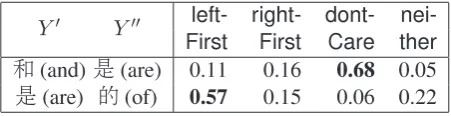
Y0 Y00 left- right- dont-
nei-First First Care ther
d(and)d(are) 0.11 0.16 0.68 0.05
[image:5.595.307.533.62.120.2]d(are) d(of) 0.57 0.15 0.06 0.22
Table 1: The distribution of the dominance values of the function words involved in Fig. 1. The value with the highest probability is in bold.
Given two function words Y0 andY00, withY0 precedingY00, we dene the value of d by exam-ining the MCAs of the two function words.
d(Y0, Y00) =
leftFirst, Y06∈MCAR(Y00)∧Y00∈MCAL(Y0) rightFirst, Y0∈MCAR(Y00)∧Y006∈MCAL(Y0) dontCare, Y0∈MCAR(Y00)∧Y00∈MCAL(Y0) neither, Y06∈MCAR(Y00)∧Y006∈MCAL(Y0) (6)
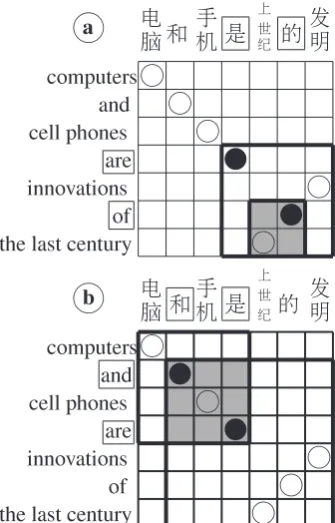
Fig. 4a illustrates the leftFirst dominance value where the intersection of the MCAs contains only the second function word (d(of)). Fig. 4b illus-trates the dontCare value, where the intersection contains both function words. Similarly, rightFirst and neither are represented by an intersection that contains onlyY0, or by an empty intersection, re-spectively. Once all the d values are counted, the pairwise dominance model of neighboring func-tion words can be estimated simply from counts using maximum likelihood. Table 1 illustrates es-timated dominance values that correctly resolve the topological ordering for our running example. 6 Experimental Setup
We tested the effect of introducing the pairwise dominance model into hierarchical phrase-based translation on Chinese-to-English and Arabic-to-English translation tasks, thus studying its effect in two languages where the use of function words differs signicantly. Following Setiawan et al. (2007), we identify function words as theN most
frequent words in the corpus, rather than identify-ing them accordidentify-ing to lidentify-inguistic criteria; this ap-proximation removes the need for any additional language-specic resources. We report results for N = 32,64,128,256,512,1024,2048.7 For
7We observe that evenN = 2048represents less than
n a
n b
j j
j z
j z j the last centuryof
innovationsare cell phonesand computers
d
dd
d
d d
d d
d d
d
d
j z
j z
j j j the last centuryof
innovationsare cell phonesand computers
d
d d
d
d d
d d
dd
d
[image:6.595.97.265.68.330.2]d
Figure 4: Illustrations for: a) the leftFirst value, and b) the dontCare value. Thickly bordered boxes are MCAs of the function words while solid circles are the alignment points of the function words. The gray boxes are the intersections of the two MCAs.
all experiments, we report performance using the BLEU score (Papineni et al., 2002), and we assess statistical signicance using the standard boot-strapping approach introduced by (Koehn, 2004).
Chinese-to-English experiments. We trained the system on the NIST MT06 Eval corpus ex-cluding the UN data (approximately 900K sen-tence pairs). For the language model, we used a 5-gram model with modied Kneser-Ney smoothing (Kneser and Ney, 1995) trained on the English side of our training data as well as portions of the Giga-word v2 English corpus. We used the NIST MT03 test set as the development set for optimizing inter-polation weights using minimum error rate train-ing (MERT; (Och and Ney, 2002)). We carried out evaluation of the systems on the NIST 2006 eval-uation test (MT06) and the NIST 2008 evaleval-uation test (MT08). We segmented Chinese as a prepro-cessing step using the Harbin segmenter (Zhao et al., 2001).
Arabic-to-English experiments. We trained the system on a subset of 950K sentence pairs from the NIST MT08 training data, selected by
subsampling from the full training data using a method proposed by Kishore Papineni (personal communication). The subsampling algorithm se-lects sentence pairs from the training data in a way that seeks reasonable representation for alln
-grams appearing in the test set. For the language model, we used a 5-gram model trained on the En-glish portion of the whole training data plus por-tions of the Gigaword v2 corpus. We used the NIST MT03 test set as the development set for optimizing the interpolation weights using MERT. We carried out the evaluation of the systems on the NIST 2006 evaluation set (MT06) and the NIST 2008 evaluation set (MT08). Arabic source text was preprocessed by separating clitics, the de-niteness marker, and the future tense marker from their stems.
7 Experimental Results
Chinese-to-English experiments. Table 2 sum-marizes the results of our Chinese-to-English ex-periments. These results conrm that the pairwise dominance model can signicantly increase per-formance as measured by the BLEU score, with a consistent pattern of results across the MT06 and MT08 test sets. ModelingN = 32drops the per-formance marginally below baseline, suggesting that perhaps there are not enough words for the pairwise dominance model to work with. Dou-bling the number of words (N = 64) produces
a small gain, and dening the pairwise dominance model usingN = 128most frequent words pro-duces a statistically signicant 1-point gain over the baseline (p < 0.01). Larger values of N
yield statistically signicant performance above the baseline, but without further improvements overN = 128.
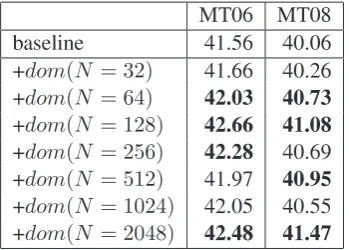
Arabic-to-English experiments. Table 3 sum-marizes the results of our Arabic-to-English ex-periments. This set of experiments shows a pat-tern consistent with what we observed in Chinese-to-English translation, again generally consistent across MT06 and MT08 test sets although mod-eling a small number of lexical items (N = 32)
brings a marginal improvement over the baseline. In addition, we again nd that the pairwise dom-inance model with N = 128 produces the most
signicant gain over the baseline in the MT06, although, interestingly, modeling a much larger number of lexical items (N = 2048) yields the
MT06 MT08 baseline 30.58 24.08 +dom(N = 32) 30.43 23.91
+dom(N = 64) 30.96 24.45
+dom(N = 128) 31.59 24.91 +dom(N = 256) 31.24 24.26 +dom(N = 512) 31.33 24.39
+dom(N = 1024) 31.22 24.79 +dom(N = 2048) 30.75 23.92
Table 2: Experimental results on Chinese-to-English translation with the pairwise dominance model (dom) of different N. The baseline (the rst line) is the original hierarchical phrase-based system. Statistically signicant results (p <0.01)
over the baseline are in bold.
MT06 MT08 baseline 41.56 40.06 +dom(N = 32) 41.66 40.26 +dom(N = 64) 42.03 40.73
+dom(N = 128) 42.66 41.08 +dom(N = 256) 42.28 40.69 +dom(N = 512) 41.97 40.95
+dom(N = 1024) 42.05 40.55 +dom(N = 2048) 42.48 41.47
Table 3: Experimental results on Arabic-to-English translation with the pairwise dominance model (dom) of different N. The baseline (the rst line) is the original hierarchical phrase-based system. Statistically signicant results over the baseline (p <0.01) are in bold.
8 Discussion and Future Work
The results in both sets of experiments show con-sistently that we have achieved a signicant gains by modeling the topological ordering of function words. When we visually inspect and compare the outputs of our system with those of the base-line, we observe that improved BLEU score often corresponds to visible improvements in the sub-jective translation quality. For example, the trans-lations for the Chinese sentence dd1 dd2 :3
dd4 d5 dd6 dd7 d8 d9 d10 d11 d12
?13, taken from Chinese MT06 test set, are as follows (co-indexing subscripts represent recon-structed word alignments):
• baseline: military1 intelligence2 un-der observation8 in5 u.s.6 air raids7 :3 iran4
to9how11long12?13
• +dom(N=128): military1survey2 :3how11 long12 iran4 under8 air strikes7 of the u.s6 can9hold out10?13
In addition to some lexical translation errors (e.g. dd6 should be translated to U.S. Army), the baseline system also makes mistakes in re-ordering. The most obvious, perhaps, is its fail-ure to captfail-ure thewh-movement involving the in-terrogative word d11 (how); this should move to the beginning of the translated clause, consis-tent with Englishwh-fronting as opposed to Chi-nese whin situ. The pairwise dominance model
helps, since the dominance value between the in-terrogative word and its previous function word, the modal verbd9(can) in the baseline system's output, is neither, rather than rightFirst as in the better translation.
The fact that performance tends to be best us-ing a frequency threshold of N = 128 strikes us as intuitively sensible, given what we know about word frequency rankings.8 In English, for example, the most frequent 128 words in-clude virtually all common conjunctions, deter-miners, prepositions, auxiliaries, and comple-mentizers the crucial elements of syntactic glue that characterize the types of linguistic phrases and the ordering relationships between them and a very small proportion of con-tent words. Using Adam Kilgarriff's lemma-tized frequency list from the British National Cor-pus, http://www.kilgarriff.co.uk/bnc-readme.html, the most frequent 128 words in English are heav-ily dominated by determiners, functional ad-verbs like not and when, particle adad-verbs like up, prepositions, pronouns, and conjunctions, with some arguably functional auxiliary and light verbs like be, have, do, give, make, take. Con-tent words are generally limited to a small number of frequent verbs like think and want and a very small handful of frequent nouns. In contrast, ranks 129-256 are heavily dominated by the traditional content-word categories, i.e. nouns, verbs, adjec-tives and adverbs, with a small number of left-over function words such as less frequent conjunctions while, when, and although.
Consistent with these observations for English, the empirical results for Chinese suggest that our
8In fact, we initially simply choseN = 128for our
[image:7.595.95.271.62.187.2] [image:7.595.95.270.290.415.2]approximation of function words using word fre-quency is reasonable. Using a list of approxi-mately 900 linguistically identied function words in Chinese extracted from (Howard, 2002), we ob-serve that that the performance drops when in-creasingN above 128 corresponds to a large in-crease in the number of non-function words used in the model. For example, withN = 2048, the
proportion of non-function words is 88%, com-pared to 60% whenN = 128.9
One natural extension of this work, therefore, would be to tighten up our characterization of function words, whether statistically, distribution-ally, or simply using manually created resources that exist for many languages. As a rst step, we did a version of the Chinese-English experiment using the list of approximately 900 genuine func-tion words, testing on the Chinese MT06 set. Per-haps surprisingly, translation performance, 30.90 BLEU, was around the level we obtained when using frequency to approximate function words at
N = 64. However, we observe that many of the words in the linguistically motivated function word list are quite infrequent; this suggests that data sparseness may be an additional factor worth investigating.
Finally, although we believe there are strong motivations for focusing on the role of function words in reordering, there may well be value in extending the dominance model to include content categories. Verbs and many nouns have subcat-egorization properties that may inuence phrase ordering, for example, and this may turn out to ex-plain the increase in Arabic-English performance forN = 2048using the MT08 test set. More
gen-erally, the approach we are taking can be viewed as a way of selectively lexicalizing the automati-cally extracted grammar, and there is a large range of potentially interesting choices in how such lex-icalization could be done.
9 Related Work
In the introduction, we discussed Chiang's (2005) constituency feature, related ideas explored by Marton and Resnik (2008) and Chiang et al. (2008), and the target-side variation investigated by Zollman et al. (2006). These methods differ from each other mainly in terms of the specic
lin-9We plan to do corresponding experimentation and
anal-ysis for Arabic once we identify a suitable list of manually identied function words.
guistic knowledge being used and on which side the constraints are applied.
Shen et al. (2008) proposed to use lin-guistic knowledge expressed in terms of a de-pendency grammar, instead of a syntactic con-stituency grammar. Villar et al. (2008) attempted to use syntactic constituency on both the source and target languages in the same spirit as the con-stituency feature, along with some simple pattern-based heuristics an approach also investigated by Iglesias et al. (2009). Aiming at improving the se-lection of derivations, Zhou et al. (2008) proposed prior derivation models utilizing syntactic annota-tion of the source language, which can be seen as smoothing the probabilities of hierarchical phrase features.
A key point is that the model we have intro-duced in this paper does not require the linguistic supervision needed in most of this prior work. We estimate the parameters of our model from parallel text without any linguistic annotation. That said, we would emphasize that our approach is, in fact, motivated in linguistic terms by the role of func-tion words in natural language syntax.
10 Conclusion
We have presented a pairwise dominance model to address reordering issues that are not handled particularly well by standard hierarchical phrase-based modeling. In particular, the minimal lin-guistic commitment in hierarchical phrase-based models renders them susceptible to overgenera-tion of reordering choices. Our proposal han-dles the overgeneration problem by identifying hierarchical phrases with function words and by using function word relationships to incorporate soft constraints on topological orderings. Our experimental results demonstrate that introducing the pairwise dominance model into hierarchical phrase-based modeling improves performance sig-nicantly in large-scale Chinese-to-English and Arabic-to-English translation tasks.
Acknowledgments
References
David Chiang, Yuval Marton, and Philip Resnik. 2008. Online large-margin training of syntactic and struc-tural translation features. In Proceedings of the 2008 Conference on Empirical Methods in Natu-ral Language Processing, pages 224233, Honolulu, Hawaii, October.
David Chiang. 2005. A hierarchical phrase-based model for statistical machine translation. In Pro-ceedings of the 43rd Annual Meeting of the Associa-tion for ComputaAssocia-tional Linguistics (ACL'05), pages 263270, Ann Arbor, Michigan, June. Association for Computational Linguistics.
David Chiang. 2007. Hierarchical phrase-based trans-lation. Computational Linguistics, 33(2):201228.
Jiaying Howard. 2002. A Student Handbook for Chi-nese Function Words. The ChiChi-nese University Press.
Gonzalo Iglesias, Adria de Gispert, Eduardo R. Banga, and William Byrne. 2009. Rule ltering by pattern for efcient hierarchical translation. In Proceedings of the 12th Conference of the European Chapter of the Association of Computational Linguistics (to ap-pear).
R. Kneser and H. Ney. 1995. Improved backing-off for m-gram language modeling. In Proceed-ings of IEEE International Conference on Acoustics, Speech, and Signal Processing95, pages 181184, Detroit, MI, May.
Philipp Koehn, Franz J. Och, and Daniel Marcu. 2003. Statistical phrase-based translation. In Proceedings of the 2003 Human Language Technology Confer-ence of the North American Chapter of the Associa-tion for ComputaAssocia-tional Linguistics, pages 127133, Edmonton, Alberta, Canada, May. Association for Computational Linguistics.
Philipp Koehn. 2004. Statistical signicance tests for machine translation evaluation. In Proceedings of EMNLP 2004, pages 388395, Barcelona, Spain, July.
Yuval Marton and Philip Resnik. 2008. Soft syntac-tic constraints for hierarchical phrased-based trans-lation. In Proceedings of The 46th Annual Meet-ing of the Association for Computational LMeet-inguis- Linguis-tics: Human Language Technologies, pages 1003 1011, Columbus, Ohio, June.
Franz Josef Och and Hermann Ney. 2002. Discrim-inative training and maximum entropy models for statistical machine translation. In Proceedings of 40th Annual Meeting of the Association for Com-putational Linguistics, pages 295302, Philadelphia, Pennsylvania, USA, July.
Franz Josef Och and Hermann Ney. 2004. The align-ment template approach to statistical machine trans-lation. Computational Linguistics, 30(4):417449.
Kishore Papineni, Salim Roukos, Todd Ward, and Wei-Jing Zhu. 2002. Bleu: a method for automatic evaluation of machine translation. In Proceedings of 40th Annual Meeting of the Association for Com-putational Linguistics, pages 311318, Philadelphia, Pennsylvania, USA, July.
Hendra Setiawan, Min-Yen Kan, and Haizhou Li. 2007. Ordering phrases with function words. In Proceedings of the 45th Annual Meeting of the As-sociation of Computational Linguistics, pages 712 719, Prague, Czech Republic, June.
Libin Shen, Jinxi Xu, and Ralph Weischedel. 2008. A new string-to-dependency machine translation al-gorithm with a target dependency language model. In Proceedings of The 46th Annual Meeting of the Association for Computational Linguistics: Human Language Technologies, pages 577585, Columbus, Ohio, June.
David Vilar, Daniel Stein, and Hermann Ney. 2008. Analysing soft syntax features and heuristics for hi-erarchical phrase based machine translation. Inter-national Workshop on Spoken Language Translation 2008, pages 190197, October.
Dekai Wu. 1997. Stochastic inversion transduction grammars and bilingual parsing of parallel corpora. Computational Linguistics, 23(3):377404, Sep. Tiejun Zhao, Yajuan Lv, Jianmin Yao, Hao Yu, Muyun
Yang, and Fang Liu. 2001. Increasing accuracy of chinese segmentation with strategy of multi-step processing. Journal of Chinese Information Pro-cessing (Chinese Version), 1:1318.
Bowen Zhou, Bing Xiang, Xiaodan Zhu, and Yuqing Gao. 2008. Prior derivation models for formally syntax-based translation using linguistically syntac-tic parsing and tree kernels. In Proceedings of the ACL-08: HLT Second Workshop on Syntax and Structure in Statistical Translation (SSST-2), pages 1927, Columbus, Ohio, June.