Summarization Through Submodularity and Dispersion
Anirban Dasgupta Yahoo! Labs Sunnyvale, CA 95054 [email protected]
Ravi Kumar Google
Mountain View, CA 94043 [email protected]
Sujith Ravi Google
Mountain View, CA 94043 [email protected]
Abstract
We propose a new optimization frame-work for summarization by generalizing the submodular framework of (Lin and Bilmes, 2011). In our framework the sum-marization desideratum is expressed as a sum of a submodular function and a non-submodular function, which we call dis-persion; the latter uses inter-sentence dis-similarities in different ways in order to ensure non-redundancy of the summary. We consider three natural dispersion func-tions and show that a greedy algorithm can obtain an approximately optimal sum-mary in all three cases. We conduct ex-periments on two corpora—DUC 2004 and user comments on news articles—and show that the performance of our algo-rithm outperforms those that rely only on submodularity.
1 Introduction
Summarization is a classic text processing prob-lem. Broadly speaking, given one or more doc-uments, the goal is to obtain a concise piece of text that contains the most salient points in the given document(s). Thanks to the om-nipresent information overload facing all of us, the importance of summarization is gaining; semi-automatically summarized content is increasingly becoming user-facing: many newspapers equip editors with automated tools to aid them in choos-ing a subset of user comments to show. Summa-rization has been studied for the past in various settings—a large single document, multiple docu-ments on the same topic, and user-generated con-tent.
Each domain throws up its own set of idiosyn-crasies and challenges for the summarization task. On one hand, in the multi-document case (say, dif-ferent news reports on the same event), the text is
often very long and detailed. The precision/recall requirements are higher in this domain and a se-mantic representation of the text might be needed to avoid redundancy. On the other hand, in the case of user-generated content (say, comments on a news article), even though the text is short, one is faced with a different set of problems: volume (popular articles generate more than 10,000 com-ments), noise (most comments are vacuous, lin-guistically deficient, and tangential to the article), and redundancy (similar views are expressed by multiple commenters). In both cases, there is a delicate balance between choosing the salient, rel-evant, popular, and diverse points (e.g., sentences) versus minimizing syntactic and semantic redun-dancy.
While there have been many approaches to au-tomatic summarization (see Section 2), our work is directly inspired by the recent elegant frame-work of (Lin and Bilmes, 2011). They employed the powerful theory of submodular functions for summarization: submodularity embodies the “di-minishing returns” property and hence is a natural vocabulary to express the summarization desider-ata. In this framework, each of the constraints (rel-evance, redundancy, etc.) is captured as a submod-ular function and the objective is to maximize their sum. A simple greedy algorithm is guaranteed to produce an approximately optimal summary. They used this framework to obtain the best results on the DUC 2004 corpus.
Even though the submodularity framework is quite general, it has limitations in its expressiv-ity. In particular, it cannot capture redundancy constraints that depend on pairwise dissimilarities between sentences. For example, a natural con-straint on the summary is that the sum or the mini-mum of pairwise dissimilarities between sentences chosen in the summary should be maximized; this, unfortunately, is not a submodular function. We call functions that depend on inter-sentence
wise dissimilarities in the summary asdispersion
functions. Our focus in this work is on signif-icantly furthering the submodularity-based sum-marization framework to incorporate such disper-sion functions.
We propose a very general graph-based sum-marization framework that combines a submod-ular function with a non-submodsubmod-ular dispersion function. We consider three natural dispersion functions on the sentences in a summary: sum of all-pair sentence dissimilarities, the weight of the minimum spanning tree on the sentences, and the minimum of all-pair sentence dissimilarities. These three functions represent three different ways of using the sentence dissimilarities. We then show that a greedy algorithm can obtain ap-proximately optimal summary in each of the three cases; the proof exploits some nice combinatorial properties satisfied by the three dispersion func-tions. We then conduct experiments on two cor-pora: the DUC 2004 corpus and a corpus of user comments on news articles. On DUC 2004, we obtain performance that matches (Lin and Bilmes, 2011), without any serious parameter tuning; note that their framework does not have the dispersion function. On the comment corpus, we outperform their method, demonstrating that value of disper-sion functions. As part of our methodology, we also use a new structured representation for sum-maries.
2 Related Work
Automatic summarization is a well-studied prob-lem in the literature. Several methods have been proposed for single- and multi-document summa-rization (Carbonell and Goldstein, 1998; Con-roy and O’Leary, 2001; Takamura and Okumura, 2009; Shen and Li, 2010).
Related concepts have also been used in several other scenarios such as query-focused summariza-tion in informasummariza-tion retrieval (Daum´e and Marcu, 2006), microblog summarization (Sharifi et al., 2010), event summarization (Filatova, 2004), and others (Riedhammer et al., 2010; Qazvinian et al., 2010; Yatani et al., 2011).
Graph-based methods have been used for sum-marization (Ganesan et al., 2010), but in a dif-ferent context—using paths in graphs to produce very short abstractive summaries. For a detailed survey on existing automatic summarization tech-niques and other related topics, see (Kim et al.,
2011; Nenkova and McKeown, 2012). 3 Framework
In this section we present the summarization framework. We start by describing a generic ob-jective function that can be widely applied to sev-eral summarization scenarios. This objective func-tion is the sum of a monotone submodular cov-erage function and a non-submodulardispersion
function. We then describe a simple greedy algo-rithm for optimizing this objective function with provable approximation guarantees for three natu-ral dispersion functions.
3.1 Preliminaries
LetC be a collection of texts. Depending on the
summarization application,C can refer to the set
of documents (e.g., newswire) related to a partic-ular topic as in standard summarization; in other scenarios (e.g., user-generated content), it is a col-lection of comments associated with a news article or a blog post, etc. For each document c ∈ C, let S(c) denote the set of sentences in c. Let U = ∪c∈CS(c) be the universe of all sentences; without loss of generality, we assume each sen-tence is unique to a document. For a sensen-tence
u ∈ U, letC(u) be the document corresponding
tou.
Eachu ∈ U is associated with aweightw(u),
which might indicate, for instance, how similaru
is to the main article (and/or the query, in query-dependent settings). Each pair u, v ∈ U is
as-sociated with a similarity s(u, v) ∈ [0,1]. This
similarity can then be used to define an inter-sentence distanced(·,·)as follows: letd0(u, v) = 1−s(u, v) and define d(u, v) to be the shortest
path distance fromu tov in the graph where the weight of each edge(u, v) isd0(u, v). Note that d(·,·)is a metric unliked0(·,·), which may not be
a metric. (In addition to being intuitive,d(·,·)
be-ing a metric helps us obtain guarantees on the al-gorithm’s output.) For a setS, and a pointu6∈S,
defined(u, S) = minv∈Sd(u, v).
Letk >0be fixed. AsummaryofU is a subset S⊆U,|S|=k. Our aim is to find a summary that
maximizes
f(S) =g(S) +δh(S), (1)
where g(S) is thecoverage function that is
non-negative, monotone, and submodular1, h(S) is a
1A function f : U
dispersionfunction, andδ ≥0is a parameter that can be used to scale the range ofh(·) to be
com-parable to that ofg(·).
For two sets S and T, letP be the set of un-ordered pairs{u, v}whereu∈Sandv∈T. Our
focus is on the following dispersion functions: the
sum measure hs(S, T) = P{u,v}∈Pd(u, v), the
spanning treemeasureht(S, T)given by the cost of the minimum spanning tree of the setS∪T, and
theminmeasurehm(S, T) = min{u,v}∈Pd(u, v). Note that these functions span from consider-ing the entire set of distances in S to
consider-ing only the minimum distance in S; also it is
easy to construct examples to show that none of these functions is submodular. Defineh?(u, S) =
h?({u}, S)andh?(S) =h?(S, S).
Let O be the optimal solution of the function f. A summaryS˜is aγ-approximationiff( ˜S) ≥ γf(O).
3.2 Algorithm
Maximizing (1) is NP-hard even if δ = 0 or if
g(·) = 0 (Chandra and Halld´orsson, 2001). For
the special caseδ = 0, since g(·) is submodular,
a classical greedy algorithm obtains a(1−1/e) -approximation (Nemhauser et al., 1978). But if
δ > 0, since the dispersion function h(·) is not
submodular, the combined objective f(·) is not submodular as well. Despite this, we show that a simple greedy algorithm achieves a provable ap-proximation factor for (1). This is possible due to some nice structural properties of the dispersion functions we consider.
Algorithm 2Greedy algorithm, parametrized by the dispersion functionh; here,U, k, g, δare fixed.
S0 ← ∅;i←0
fori= 0, . . . , k−1do
v←arg maxu∈U\Sig(Si+u) +δh(Si+u)
Si+1 ←Si∪ {v} end for
3.3 Analysis
In this section we obtain a provable approximation for the greedy algorithm. First, we show that a greedy choice is well-behaved with respect to the dispersion functionh·(·).
Lemma 1. LetObe any set with|O|=k. IfSis such that|S|=` < k, then
(i)Pu∈O\Shs(u, S)≥ |O\S|k`h(ks(−O1));
A, B⊆U, we havef(A) +f(B)≥f(A∪B) +f(A∩B).
(ii)Pu∈O\Sd(u, S)≥ 21ht(O)−ht(S); and
(iii) there existsu ∈ O\Ssuch thathm(u, S) ≥
hm(O)/2.
Proof. The proof for (i) follows directly from Lemma 1 in (Borodin et al., 2012).
To prove (ii) letTbe the tree obtained by adding
all points ofO\Sdirectly to their respective
clos-est points on the minimum spanning tree ofS. T
is a spanning tree, and hence a Steiner tree, for the points in setS∪O. Hence,cost(T) = ht(S) + P
u∈O\Sd(u, S). Letsmt(S) denote the cost of a minimum Steiner tree of S. Thus, cost(T) ≥
smt(O∪S). Since a Steiner tree ofO∪Sis also
a Steiner tree ofO,smt(O∪S)≥smt(O). Since
this is a metric space,smt(O)≥ 1
2ht(O)(see, for example, (Cieslik, 2001)). Thus,
ht(S) + X
u∈O\S
d(u, S)≥ 1 2ht(O)
⇒ X
u∈O\S
d(u, S)≥ 1
2ht(O)−ht(S).
To prove (iii), let O = {u1, . . . , uk}. By def-inition, for every i 6= j, d(ui, uj) ≥ hm(O). Consider the (open) ball Bi of radius hm(O)/2 around each elementui. By construction for each
i, Bi ∩ O = {ui} and for each pair i 6= j,
Bi∩Bj =∅. Since|S|< k, and there arekballs
Bi, there existsk−`ballsBisuch thatS∩Bi =∅, proving (iii).
We next show that the tree created by the greedy algorithm forh=htis not far from the optimum. Lemma 2. Letu1, . . . , ukbe a sequence of points
and let Si = {uj, j ≤ i}. Then, ht(Sk) ≥
1/logkP
2≤j≤kd(uj, Sj−1).
Proof. The proof follows by noting that we get a spanning tree by connecting eachui to its closest point in Si−1. The cost of this spanning tree is P
2≤j≤kd(uj, Sj−1) and this tree is also the re-sult of the greedy algorithm run in an online fash-ion on the input sequence{u1, . . . , uk}. Using the result of (Imase and Waxman, 1991), the compet-itive ratio of this algorithm islogk, and hence the
proof.
Theorem 3. Fork >1, there is a polynomial-time algorithm that obtains aγ-approximation tof(S), whereγ = 1/2forh = hs, γ = 1/4 forh = hm,
andγ =1/3 logkforh=ht.
Proof. For hs and ht, we run Algorithm 1 using a new dispersion function h0, which is a slightly modified version of h. In particular, for h = hs, we use h0(S) = 2hs(S). For h = ht, we abuse notation and defineh0 to be a function over an ordered set S = {u1, . . . , uk} as follows:
h0(S) = Pj≤|S|d(uj, Sj−1), where Sj−1 =
{u1, . . . , uj−1}. Letf0(S) =g(S) +δh0(S). Consider the ith iteration of the algorithm. By
the submodularity ofg(·), X
u∈O\Si
g(Si∪ {u})−g(Si) (2)
≥ g(O∪Si)−g(Si)≥g(O)−g(Sk),
where we use monotonicity ofg(·)to inferg(O∪
Si)≥g(O)andg(Si)≤g(Sk).
For h = hs, the proof follows by Lemma 1(i) and by Theorem 1 in (Borodin et al., 2012).
For ht, using the above argument of submodu-larity and monotonicity of g, and the result from
Lemma 1(ii), we have
X
u∈O\Si
g(Si∪u)−g(Si) +δd(u, Si)
≥ g(O)−g(Si) +δ(ht(O)/2−ht(Si)) ≥ (g(O) +δht(O)/2)−(g(Si) +δht(Si))
≥ f(O)/2−(g(Si) +δht(Si)).
Also, ht(Si) ≤ 2 smt(Si) since this is a met-ric space. Using the monotonicity of the Steiner tree cost,smt(Si) ≤smt(Sk) ≤ht(Sk). Hence,
ht(Si)≤2ht(Sk). Thus,
X
u∈O\Si
g(Si∪u)−g(Si) +δd(u, Si)
≥ f(O)/2−(g(Si) +δht(Si))
≥ f(O)/2−(g(Sk) + 2δht(Sk))
≥ f(O)/2−2f(Sk). (3) By the greedy choice ofui+1,
f0(Si∪ui+1)−f0(Si)
= g(Si∪ui+1)−g(Si) +δd(ui+1, Si) ≥ (f(O)/2−2f(Sk))/|O\Si|
≥ 1k(f(O)/2−2f(Sk)).
Summing over alli∈[1, k−1],
f0(Sk)≥(k−1)/k(f(O)/2−2f(Sk)). (4) Using Lemma 2 we obtain
f(Sk) =g(Sk) +δht(Sk)≥
f0(Sk)
logk
≥ 1log−1k/k(f(O)/2−2f(Sk)).
By simplifying, we obtainf(Sk)≥f(O)/3 logk. Finally forhm, we run Algorithm 1 twice: once with g as given and h ≡ 0, and the second
time with g ≡ 0 and h ≡ hm. Let Sg and
Sh be the solutions in the two cases. Let Og and Oh be the corresponding optimal solutions. By the submodularity and monotonicity of g(·), g(Sg) ≥ (1−1/e)g(Og) ≥ g(Og)/2. Similarly, using Lemma 1(iii), hm(Sh) ≥ hm(Oh)/2 since in any iteration i < k we can choose an
ele-ment ui+1 such that hm(ui+1, Si) ≥ hm(Oh)/2.
LetS = arg maxX∈{Sg,Sh}f(X). Using an av-eraging argument, since g and hm are both non-negative,
f(X)≥(f(Sg)+f(Sh))/2≥(g(Og)+δhm(Oh))/4.
Since by definitiong(Og)≥g(O)andhm(Oh)≥
hm(O), we have a1/4-approximation.
3.4 A universal constant-factor approximation
Using the above algorithm that we used for hm, it is possible to give a universal algorithm that gives a constant-factor approximation to each of the above objectives. By running the Algorithm 1 once for g ≡ 0 and next for h ≡ 0 and taking
the best of the two solutions, we can argue that the resulting set gives a constant factor approximation tof. We do not use this algorithm in our
exper-iments, as it is oblivious of the actual dispersion functions used.
4 Using the Framework
generate a graph and instantiate our summariza-tion objective funcsummariza-tion with specific components that capture the desiderata of a given summariza-tion task.
4.1 Structured representation for sentences In order to instantiate the summarization graph (nodes and edges), we first need to model each sentence (in multi-document summarization) or comment (i.e., set of sentences) as nodes in the graph. Sentences have been typically modeled using standard ngrams (unigrams or bigrams) in previous summarization work. Instead, we model sentences using a structured representation, i.e., its syntax structure using dependency parse trees. We first use a dependency parser (de Marneffe et al., 2006) to parse each sentence and extract the set of dependency relations associated with the sen-tence. For example, the sentence “I adore tennis” is represented by the dependency relations (nsubj: adore, I) and (dobj: adore, tennis).
Each sentence represents a single node u in
the graph (unless otherwise specified) and is com-prised of a set of dependency relations (or ngrams) present in the sentence. Furthermore, the edge weights s(u, v) represent pairwise similarity
tween sentences or comments (e.g., similarity be-tween views expressed in different comments). The edge weights are then used to define the inter-sentence distance metric d(u, v)for the
dif-ferent dispersion functions. We identify lar views/opinions by computing semantic simi-larity rather than using standard simisimi-larity mea-sures (such as cosine similarity based on ex-act lexical matches between different nodes in the graph). For each pair of nodes (u, v) in
the graph, we compute the semantic similarity score (using WordNet) between every pair of dependency relation (rel: a, b) in u and v as:
s(u, v) = X reli∈u,relj∈v
reli=relj
WN(ai, aj)×WN(bi, bj),
where rel is a relation type (e.g., nsubj) anda, b
are the two arguments present in the dependency relation (b does not exist for some relations).
WN(wi, wj) is defined as the WordNet similar-ity score between words wi and wj.2 The edge weights are then normalized across all edges in the 2There exists various semantic relatedness measures
based on WordNet (Patwardhan and Pedersen, 2006). In our experiments, forWNwe pick one that is based on the path length between the two words in the WordNet graph.
graph.
This allows us to perform approximate match-ing of syntactic treelets obtained from the depen-dency parses using semantic (WordNet) similar-ity. For example, the sentences “I adore tennis” and “Everyone likes tennis” convey the same view and should be assigned a higher similarity score as opposed to “I hate tennis”. Using the syntac-tic structure along with semansyntac-tic similarity helps us identify useful (valid) nuggets of information within comments (or documents), avoid redun-dancies, and identify similar views in a semantic space.
4.2 Components of the coverage function Our coverage function is a linear combination of the following.
(i)Popularity.One of the requirements for a good summary (especially, for user-generated content) is that it should include (or rather not miss) the popular views or opinions expressed by several users across multiple documents or comments. We model this property in our objective function as follows.
For each node u, we define w(u) as the
num-ber of documents|Curel ⊆C|from the collection
such that at least one of the dependency relations
rel ∈ uappeared in a sentence within some
doc-umentc ∈ Curel. The popularity scores are then
normalized across all nodes in the graph. We then add this component to our objective function as
w(S) =Pu∈Sw(u).
(ii) Cluster contribution. This term captures the fact that we do not intend to include multiple sen-tences from the same comment (or document). DefineB to be the clustering induced by the sen-tence to comment relation, i.e., two sensen-tences in the same comment belong to the same cluster. The corresponding contribution to the objective func-tion isPB∈B|S∩B|1/2.
(iii)Content contribution.This term promotes the diversification of content. We look at the graph of sentences where the weight of each edge iss(u, v).
This graph is then partitioned based on a local random walk based method to give us clusters D={D1, . . . , Dn}. The corresponding contribu-tion to the objective funccontribu-tion isPD∈D|S∩D|1/2. (iv) Cover contribution. We also measure the cover of the set S as follows: for each element s in U first define cover of an element u by a
cover value of the set S is defined as cov(S) = P
u∈Smin(cov(u, S),0.25cov(u, U)).3
Thus, the final coverage function is: g(S) = w(S) + αPB∈B|S ∩ B|1/2 + βPD∈D|S ∩ D|1/2+λcov(S),whereα, β, λare non-negative
constants. By using the monotone submodularity of each of the component functions, and the fact that addition preserves submodularity, the follow-ing is immediate.
Fact 4. g(S) is a monotone, non-negative, sub-modular function.
We then apply Algorithm 1 to optimize (1). 5 Experiments
5.1 Data
Multi-document summarization. We use the DUC 2004 corpus4that comprises 50 clusters (i.e., 50 different summarization tasks) with 10 docu-ments per cluster on average. Each document con-tains multiple sentences and the goal is to produce a summary of all the documents for a given cluster. Comments summarization. We extracted a set of news articles and corresponding user comments from Yahoo! News website. Our corpus contains a set of 34 articles and each article is associated with anywhere from 100–500 comments. Each com-ment contains more than three sentences and 36 words per sentence on average.
5.2 Evaluation
For each summarization task, we compare the system output (i.e., summaries automatically pro-duced by the algorithm) against the human-generated summaries and evaluate the perfor-mance in terms of ROUGE score (Lin, 2004), a standard recall-based evaluation measure used in summarization. A system that produces higher ROUGE scores generates better quality summary and vice versa.
We use the following evaluation settings in our experiments for each summarization task:
(1) For multi-document summarization, we compute the ROUGE-15scores that was the main evaluation criterion for DUC 2004 evaluations.
3The choice of the value 0.25 in the cover component is
inspired by the observations made by (Lin and Bilmes, 2011) for theαvalue used in their cover function.
4http://duc.nist.gov/duc2004/tasks.html
5ROUGE v1.5.5 with options: -a -c 95 -b 665 -m -n 4 -w
1.2
(2) For comment summarization, the collection of user comments associated with a given arti-cle is typically much larger. Additionally, indi-vidual comments are noisy, wordy, diverse, and informally written. Hence for this task, we use a slightly different evaluation criterion that is in-spired from the DUC 2005-2007 summarization evaluation tasks.
We represent the content within each comment
c (i.e., all sentences S(c) comprising the
com-ment) as a single node in the graph. We then run our summarization algorithm on the instantiated graph to produce a summary for each news article. In addition, each news article and corresponding set of comments were presented to three human annotators. They were asked to select a subset of comments (at most 20 comments) that best rep-resented a summary capturing the most popular as well as diverse set of views and opinions ex-pressed by different users that are relevant to the given news article. We then compare the auto-matically generated comment summaries against the human-generated summaries and compute the ROUGE-1 and ROUGE-2 scores.6
This summarization task is particularly hard for even human annotators since user-generated com-ments are typically noisy and there are several hundreds of comments per article. Similar to ex-isting work in the literature (Sekine and Nobata, 2003), we computed inter-annotator agreement for the humans by comparing their summaries against each other on a small held-out set of articles. The average ROUGE-1 F-scores observed for humans was much higher (59.7) than that of automatic sys-tems measured against the human-generated sum-maries (our best system achieved a score of 28.9 ROUGE-1 on the same dataset). This shows that even though this is a new type of summariza-tion task, humans tend to generate more consistent summaries and hence their annotations are reliable for evaluation purposes as in multi-document sum-marization.
5.3 Results
Multi-document summarization. (1) Table 1 compares the performance of our system with the previous best reported system that partici-pated in the DUC 2004 competition. We also in-clude for comparison another baseline—a version 6ROUGE v1.5.5 with options: -a -n 2 -x -m -2 4 -u -c 95
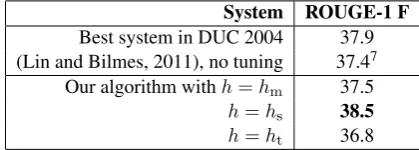
of our system that approximates the submodular objective function proposed by (Lin and Bilmes, 2011).7 As shown in the results, our best system8 which uses the hs dispersion function achieves a better ROUGE-1 F-score than all other systems. (2)We observe that thehmandhtdispersion func-tions produce slightly lower scores thanhs, which may be a characteristic of this particular summa-rization task. We believe that the empirical results achieved by different dispersion functions depend on the nature of the summarization tasks and there are task settings under which hm or ht perform better thanhs. For example, we show later how us-ing thehtdispersion function yields the best per-formance on the comments summarization task. Regardless, the theoretical guarantees presented in this paper cover all these cases.
(3) We also analyze the contributions of individ-ual components of the new objective function to-wards summarization performance by selectively setting certain parameters to 0. Table 2 illustrates these results. We clearly see that each component (popularity, cluster contribution, dispersion) indi-vidually yields a reasonable summarization per-formance but the best result is achieved by the combined system (row 5 in the table). We also contrast the performance of the full system with and without the dispersion component (row 4 ver-sus row 5). The results show that optimizing for dispersion yields an improvement in summariza-tion performance.
(4)To understand the effect of utilizing syntactic structure and semantic similarity for constructing the summarization graph, we ran the experiments using just the unigrams and bigrams; we obtained a ROUGE-1 F-score of 37.1. Thus, modeling the syntactic structure (using relations extracted
7Note that Lin & Bilmes (2011) report a slightly higher
ROUGE-1 score (F-score38.90) on DUC 2004. This is be-cause their system was tuned for the particular summarization task using the DUC 2003 corpus. On the other hand, even without any parameter tuning our method yields good perfor-mance, as evidenced by results on the two different summa-rization tasks. However, since individual components within our objective function are parametrized it is easy to tune them for a specific task or genre.
8For the full system, we weight certain parameters
per-taining to cluster contributions and dispersion higher (α =
β = δ = 5) compared to the rest of the objective function
(λ = 1). Lin & Bilmes (2011) also observed a similar
find-ing (albeit via parameter tunfind-ing) where weightfind-ing the cluster contribution component higher yielded better performance. If the maximum number of sentences/comments chosen were k, we brought bothhsandhtto the same approximate scale ashmby dividinghsbyk(k−1)/2andhtbyk−1.
from dependency parse tree) along with comput-ing similarity in semantic spaces (uscomput-ing WordNet) clearly produces an improvement in the summa-rization quality (+1.4 improvement in ROUGE-1 F-score). However, while the structured represen-tation is beneficial, we observed that dispersion (and other individual components) contribute sim-ilar performance gains even when using ngrams alone. So the improvements obtained from the structured representation and dispersion are com-plementary.
System ROUGE-1 F Best system in DUC 2004 37.9 (Lin and Bilmes, 2011), no tuning 37.47 Our algorithm withh=hm 37.5
h=hs 38.5
[image:7.595.311.521.224.299.2]h=ht 36.8
Table 1: Performance on DUC 2004. Comments summarization. (1) Table 3 com-pares the performance of our system against a baseline system that is constructed by picking comments in order of decreasing length, i.e., we first pick the longest comment (comprising the most number of characters), then the next longest comment and so on, to create an ordered set of comments. The intuition behind this baseline is that longer comments contain more content and possibly cover more topics than short ones.
From the table, we observe that the new sys-tem (using either dispersion function) outperforms the baseline by a huge margin (+44% relative improvement in ROUGE-1 and much bigger im-provements in ROUGE-2 scores). One reason be-hind the lower ROUGE-2 scores for the baseline might be that while long comments provide more content (in terms of size), they also add noise and irrelevant information to the generated summaries. Our system models sentences using the syntactic structure and semantics and jointly optimizes for multiple summarization criteria (including disper-sion) which helps weed out the noise and identify relevant, useful information within the comments thereby producing better quality summaries. The 95% confidence interval scores for the best system on this task is [36.5–46.9].
Objective function components ROUGE-1 F
α=β=λ=δ= 0 35.7
w(S) =β=λ=δ= 0 35.1
h=hs, w(S) =α=β=λ= 0 37.1
δ= 0 37.4
[image:8.595.80.285.62.138.2]w(S), α, β, λ, δ >0 38.5
Table 2: Performance with different parameters (DUC).
on the summarization task and that the dispersion functions proposed in this paper have a wider va-riety of use cases.
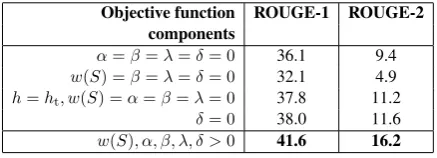
(3)Results showing contributions from individual components of the new summarization objective function are listed in Table 4. We observe a sim-ilar pattern as with multi-document summariza-tion. The full system using all components out-perform all other parameter settings, achieving the best ROUGE-1 and ROUGE-2 scores. The table also shows that incorporating dispersion into the objective function yields an improvement in sum-marization quality (row 4 versus row 5).
System ROUGE-1 ROUGE-2 Baseline (decreasing length) 28.9 2.9
Our algorithm withh=hm 39.2 13.2
h=hs 40.9 15.0
[image:8.595.74.294.372.433.2]h=ht 41.6 16.2
Table 3: Performance on comments summariza-tion.
Objective function ROUGE-1 ROUGE-2 components
α=β=λ=δ= 0 36.1 9.4
w(S) =β=λ=δ= 0 32.1 4.9 h=ht, w(S) =α=β=λ= 0 37.8 11.2
δ= 0 38.0 11.6 w(S), α, β, λ, δ >0 41.6 16.2
Table 4: Performance with different parameters (comments).
6 Conclusions
We introduced a new general-purpose graph-based summarization framework that combines a sub-modular coverage function with a non-subsub-modular dispersion function. We presented three natural dispersion functions that represent three different ways of ensuring non-redundancy (using sentence dissimilarities) for summarization and proved that a simple greedy algorithm can obtain an approxi-mately optimal summary in all these cases. Exper-iments on two different summarization tasks show
that our algorithm outperforms algorithms that rely only on submodularity. Finally, we demon-strated that using a structured representation to model sentences in the graph improves summa-rization quality.
For future work, it would be interesting to in-vestigate other related developments in this area and perhaps combine them with our approach to see if further improvements are possible. Firstly, it would interesting to see if dispersion offers sim-ilar improvements over a tuned version of the sub-modular framework of Lin and Bilmes (2011). In a very recent work, Lin and Bilmes (2012) demon-strate a further improvement in performance for document summarization by using mixtures of submodular shells. This is an interesting exten-sion of their previous submodular framework and while the new formulation permits more complex functions, the resulting function is still submodu-lar and hence can be combined with the dispersion measures proposed in this paper. A different body of work uses determinantal point processes (DPP) to model subset selection problems and adapt it for document summarization (Kulesza and Taskar, 2011). Note that DPPs use similarity kernels for performing inference whereas our measures are combinatorial and not kernel-representable. While approximation guarantees for DPPs are open, it would be interesting to investigate the empiri-cal gains by combining DPPs with dispersion-like functions.
Acknowledgments
We thank the anonymous reviewers for their many useful comments.
References
Allan Borodin, Hyun Chul Lee, and Yuli Ye. 2012. Max-sum diversification, monotone submodular functions and dynamic updates. In Proc. PODS, pages 155–166.
Jaime Carbonell and Jade Goldstein. 1998. The use of MMR, diversity-based reranking for reordering doc-uments and producing summaries. InProc. SIGIR, pages 335–336.
Barun Chandra and Magn´us Halld´orsson. 2001. Facil-ity dispersion and remote subgraphs. J. Algorithms, 38(2):438–465.
[image:8.595.73.292.481.560.2]John M. Conroy and Dianne P. O’Leary. 2001. Text summarization via hidden Markov models. InProc.
SIGIR, pages 406–407.
Hal Daum´e, III and Daniel Marcu. 2006. Bayesian query-focused summarization. In Proc.
COL-ING/ACL, pages 305–312.
Marie-Catherine de Marneffe, Bill Maccartney, and Christopher D. Manning. 2006. Generating typed dependency parses from phrase structure parses. In
Proc. LREC, pages 449–454.
Elena Filatova. 2004. Event-based extractive summa-rization. InProc. ACL Workshop on Summarization, pages 104–111.
Kavita Ganesan, ChengXiang Zhai, and Jiawei Han. 2010. Opinosis: A graph based approach to abstrac-tive summarization of highly redundant opinions. In
Proc. COLING.
Makoto Imase and Bernard M. Waxman. 1991. Dy-namic Steiner tree problem. SIAM J. Discrete Math-ematics, 4(3):369–384.
Hyun Duk Kim, Kavita Ganesan, Parikshit Sondhi, and ChengXiang Zhai. 2011. Comprehensive review of opinion summarization. Technical report, Univer-sity of Illinois at Urbana-Champaign.
Alex Kulesza and Ben Taskar. 2011. Learning deter-minantal point processes. InProc. UAI, pages 419– 427.
Hui Lin and Jeff Bilmes. 2011. A class of submodu-lar functions for document summarization. InProc. ACL, pages 510–520.
Hui Lin and Jeff Bilmes. 2012. Learning mixtures of submodular shells with application to document summarization. InProc. UAI, pages 479–490.
Chin-Yew Lin. 2004. ROUGE: A package for auto-matic evaluation of summaries. InWorkshop on Text Summarization Branches Out: Proc. ACL Work-shop, pages 74–81.
G. L. Nemhauser, L. A. Wolsey, and M. L. Fisher. 1978. An analysis of approximations for maximiz-ing submodular set functions I. Mathematical
Pro-gramming, 14(1):265–294.
Ani Nenkova and Kathleen McKeown. 2012. A survey of text summarization techniques. In Charu C. Ag-garwal and ChengXiang Zhai, editors, Mining Text Data, pages 43–76. Springer.
Siddharth Patwardhan and Ted Pedersen. 2006. Us-ing WordNet-based context vectors to estimate the semantic relatedness of concepts. In Proc. EACL Workshop on Making Sense of Sense: Bringing Computational Linguistics and Psycholinguistics Together, pages 1–8.
Vahed Qazvinian, Dragomir R. Radev, and Arzucan ¨Ozg¨ur. 2010. Citation summarization through keyphrase extraction. InProc. COLING, pages 895– 903.
Korbinian Riedhammer, Benoit Favre, and Dilek Hakkani-T¨ur. 2010. Long story short—Global unsupervised models for keyphrase based meeting summarization.Speech Commun., 52(10):801–815.
Satoshi Sekine and Chikashi Nobata. 2003. A survey for multi-document summarization. InProc.
HLT-NAACL Workshop on Text Summarization, pages
65–72.
Beaux Sharifi, Mark-Anthony Hutton, and Jugal Kalita. 2010. Summarizing microblogs automatically. In
Proc. HLT/NAACL, pages 685–688.
Chao Shen and Tao Li. 2010. Multi-document summa-rization via the minimum dominating set. InProc.
COLING, pages 984–992.
Hiroya Takamura and Manabu Okumura. 2009. Text summarization model based on maximum coverage problem and its variant. InProc. EACL, pages 781– 789.