Enlisting the Ghost: Modeling Empty Categories for Machine Translation
Bing Xiang
IBM T. J. Watson Research Center 1101 Kitchawan Rd
Yorktown Heights, NY 10598
Xiaoqiang Luo *
Google Inc. 111 8th Ave New York, NY 10011
Bowen Zhou
IBM T. J. Watson Research Center 1101 Kitchawan Rd
Yorktown Heights, NY 10598
Abstract
Empty categories (EC) are artificial ele-ments in Penn Treebanks motivated by the government-binding (GB) theory to ex-plain certain language phenomena such as pro-drop. ECs are ubiquitous in languages like Chinese, but they are tacitly ignored in most machine translation (MT) work because of their elusive nature. In this paper we present a comprehensive treat-ment of ECs by first recovering them with a structured MaxEnt model with a rich set of syntactic and lexical features, and then incorporating the predicted ECs into a Chinese-to-English machine translation task through multiple approaches, includ-ing the extraction of EC-specific sparse features. We show that the recovered empty categories not only improve the word alignment quality, but also lead to significant improvements in a large-scale state-of-the-art syntactic MT system.
1 Introduction
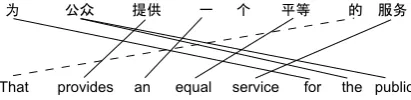
One of the key challenges in statistical machine translation (SMT) is to effectively model inher-ent differences between the source and the target language. Take the Chinese-English SMT as an example: it is non-trivial to produce correct nouns on the target side when the source-side pro-noun is missing. In addition, the pro-drop prob-lem can also degrade the word alignment qual-ity in the training data. A sentence pair observed in the real data is shown in Figure 1 along with the word alignment obtained from an automatic word aligner, where the English subject pronoun
* This work was done when the author was with IBM.
[image:1.595.313.519.370.420.2]“that” is missing on the Chinese side. Conse-quently, “that” is incorrectly aligned to the second to the last Chinese word “De”, due to their high co-occurrence frequency in the training data. If the dropped pronoun were recovered, “that” would have been aligned with the dropped-pro (cf. Fig-ure 3), which is a much more sensible alignment.
Figure 1: Example of incorrect word alignment due to missing pronouns on the Chinese side.
In order to account for certain language phe-nomena such as pro-drop and wh-movement, a set of special tokens, called empty categories (EC), are used in Penn Treebanks (Marcus et al., 1993; Bies and Maamouri, 2003; Xue et al., 2005). Since empty categories do not exist in the surface form of a language, they are often deemed elusive and recovering ECs is even figuratively called “chas-ing the ghost” (Yang and Xue, 2010).
In this work we demonstrate that, with the avail-ability of large-scale EC annotations, it is feasi-ble to predict and recover ECs with high accu-racy. More importantly, with various approaches of modeling the recovered ECs in SMT, we are able to achieve significant improvements1.
The contributions of this paper include the fol-lowing:
• Propose a novel structured approach to EC prediction, including the exact word-level
lo-1
Hence “Enlisting the ghost” in the title of this paper.
cation and EC labels. Our results are sig-nificantly higher in accuracy than that of the state-of-the-art;
• Measure the effect of ECs on automatic word alignment for machine translation after inte-grating recovered ECs into the MT data;
• Design EC-specific features for phrases and syntactic tree-to-string rules in translation grammar;
• Show significant improvement on top of the state-of-the-art large-scale hierarchical and syntactic machine translation systems.
The rest of the paper is organized as follows. In Section 2, we present a structured approach to EC prediction. In Section 3, we describe the integra-tion of Chinese ECs in MT. The experimental re-sults for both EC prediction and SMT are reported in Section 4. A survey on the related work is con-ducted in Section 5, and Section 6 summarizes the work and introduces some future work.
2 Chinese Empty Category Prediction
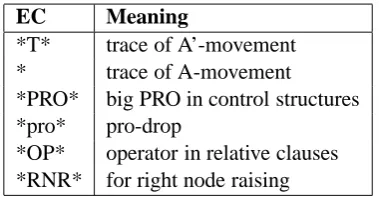
The empty categories in the Chinese Treebank (CTB) include trace markers for A’- and A-movement, dropped pronoun, big PRO etc. A complete list of categories used in CTB is shown in Table 1 along with their intended usages. Read-ers are referred to the documentation (Xue et al., 2005) of CTB for detailed discussions about the characterization of empty categories.
EC Meaning
*T* trace of A’-movement * trace of A-movement
*PRO* big PRO in control structures *pro* pro-drop
[image:2.595.87.277.509.608.2]*OP* operator in relative clauses *RNR* for right node raising
Table 1: List of empty categories in the CTB.
In this section, we tackle the problem of recov-ering Chinese ECs. The problem has been studied before in the literature. For instance, Yang and Xue (2010) attempted to predict the existence of an EC before a word; Luo and Zhao (2011) pre-dicted ECs on parse trees, but the position infor-mation of some ECs is partially lost in their repre-sentation. Furthermore, Luo and Zhao (2011) con-ducted experiments on gold parse trees only. In
our opinion, recovering ECs from machine parse trees is more meaningful since that is what one would encounter when developing a downstream application such as machine translation. In this paper, we aim to have a more comprehensive treat-ment of the problem: all EC types along with their locations are predicted, and we will report the results on both human parse trees and machine-generated parse trees.
2.1 Representation of Empty Categories
Our effort of recovering ECs is a two-step process: first, at training time, ECs in the Chinese Treebank are moved and preserved in the portion of the tree structures pertaining to surface words only. Origi-nal ECs and their subtrees are then deleted without loss of information; second, a model is trained on transformed trees to predict and recover ECs.
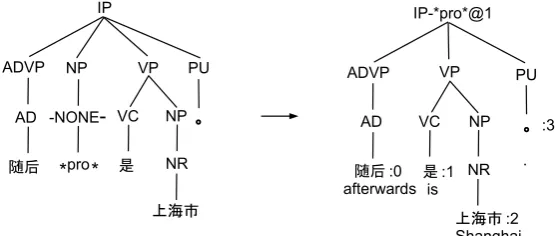
Empty categories heavily depend on syntac-tic tree structure. For this reason, we choose to project them onto a parse tree node. To facili-tate presentation, we first distinguish a solid vs. an empty non-terminal node. A non-terminal node is solid if and only if it contains at least one child node that spans one or more surface words (as op-posed to an EC); accordingly, an empty node is a non-terminal node that spans only ECs. In the left half of Figure 2, theNPnode that is the immediate child ofIPhas only one child node spanning an EC – (-NONE- *pro*), and is thus an empty node; while all other non-terminal nodes have at least one surface word as their child and are thus all solid nodes.
syn-Figure 2: Example of tree transformation on training data to encode an empty category and its position information.
tactic tree, as opposed to simply attaching it to a neighboring word, as was done in (Yang and Xue, 2010). We believe this is one of the reasons why our model has better accuracy than that of (Yang and Xue, 2010) (cf. Table 7).
In summary, a projected tag consists of an EC type (such as *pro*) and the EC’s position in-formation. The problem of predicting ECs is then cast into predicting an EC tag at each non-terminal node. Notice that the input to such a predictor is a syntactic tree without ECs, e.g., the parse tree on the right hand of Figure 2 without the EC tag *pro*@1is such an example.
2.2 A Structured Empty Category Model
We propose a structured MaxEnt model for pre-dicting ECs. Specially, given a syntactic tree, T, whose ECs have been projected onto solid nodes with the procedure described in Section 2.1, we traverse it in post-order (i.e., child nodes are ited recursively first before the current node is vis-ited). Let T = t1t2· · ·tn be the sequence of nodes produced by the post-order traversal, and
ei(i= 1,2,· · · , n)be the EC tag associated with
ti. The probabilistic model is then:
P(en1|T) = n
Y
i=1
P(ei|T, ei1−1)
= n
Y
i=1
exp Pkλkfk(ei1−1, T, ei)
Z(ei1−1, T) (1)
Eq. (1) is the familiar log linear (or MaxEnt) model, where fk(ei1−1, T, ei) is the feature func-tion and
Z(ei1−1, T) =Pe∈Eexp Pkλkfk(ei1−1, T, e)
is the normalization factor.Eis the set of ECs to be predicted. In the CTB 7.0 processed by the proce-dure in Section 2.1, the set consists of 32 EC tags
plus a specialNULLsymbol, obtained by modulat-ing the list of ECs in Table 1 with their positions (e.g.,*pro*@1in Figure 2).
Once the model is chosen, the next step is to de-cide a set of features {fk(ei1−1, T, ei)} to be used in the model. One advantage of having the rep-resentation in Section 2.1 is that it is very easy to compute features from tree structures. Indeed, all features used in our system are computed from the syntactic trees, including lexical features.
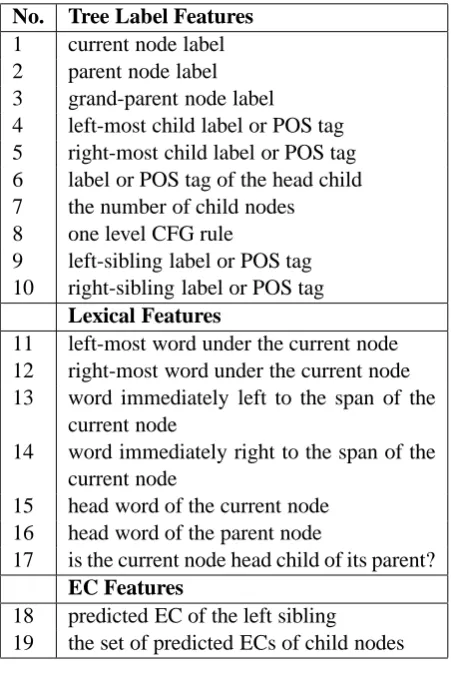
There are 3 categories of features used in the model: (1) tree label features; (2) lexical features; (3) EC features, and we list them in Table 2. In the feature description column, all node positions (e.g., “left”, “right”) are relative to the current node being predicted.
Feature 1 to 10 are computed directly from parse trees, and are straightforward. We include up to 2 siblings when computing feature 9 and 10. Feature 11 to 17 are lexical features. Note that we use words at the edge of the current node: fea-ture 11 and 12 are words at the internal boundary of the current node, while feature 13 and 14 are the immediately neighboring word external to the current node. Feature 15 and 17 are from head word information of the current node and the par-ent node. Feature 18 and 19 are computed from predicted ECs in the past – that’s why the model in Eq. (1) conditions onei1−1.
[image:3.595.161.439.74.192.2]No. Tree Label Features 1 current node label 2 parent node label 3 grand-parent node label
4 left-most child label or POS tag 5 right-most child label or POS tag 6 label or POS tag of the head child 7 the number of child nodes 8 one level CFG rule
9 left-sibling label or POS tag 10 right-sibling label or POS tag
Lexical Features
11 left-most word under the current node 12 right-most word under the current node 13 word immediately left to the span of the
current node
14 word immediately right to the span of the current node
15 head word of the current node 16 head word of the parent node
17 is the current node head child of its parent? EC Features
18 predicted EC of the left sibling
[image:4.595.72.298.62.402.2]19 the set of predicted ECs of child nodes
Table 2: List of features.
3 Integrating Empty Categories in Machine Translation
In this section, we explore multiple approaches of utilizing recovered ECs in machine translation.
3.1 Explicit Recovery of ECs in MT
We conducted some initial error analysis on our MT system output and found that most of the er-rors that are related to ECs are due to the missing *pro* and *PRO*. This is also consistent with the findings in (Chung and Gildea, 2010). One of the other frequent ECs,*OP*, appears in the nese relative clauses, which usually have a Chi-nese word “De” aligned to the target side “that” or “which”. And the trace, *T*, exists in both Chinese and English sides. For MT we want to fo-cus on the places where there exist mismatches be-tween the source and target languages. A straight-forward way of utilizing the recovered*pro*and
*PRO*is to pre-process the MT training and test data by inserting ECs into the original source text (i.e. Chinese in this case). As mentioned in the previous section, the output of our EC predictor is a new parse tree with the labels and positions
encoded in the tags. Based on the positional in-formation in the tags, we can move the predicted ECs down to the surface level and insert them be-tween original source words. The same prediction and “pull-down” procedure can be conducted con-sistently cross the MT training and test data.
3.2 Grammar Extraction on Augmented Data
With the pre-processed MT training corpus, an un-supervised word aligner, such as GIZA++, can be used to generate automatic word alignment, as the first step of a system training pipeline. The ef-fect of inserting ECs is two-fold: first, it can im-pact the automatic word alignment since now it al-lows the target-side words, especially the function words, to align to the inserted ECs and fix some errors in the original word alignment; second, new phrases and rules can be extracted from the pre-processed training data. For example, for a hier-archical MT system, some phrase pairs and Hiero (Chiang, 2005) rules can be extracted with recov-ered*pro*and*PRO*at the Chinese side.
In this work we also take advantages of the aug-mented Chinese parse trees (with ECs projected to the surface) and extract tree-to-string grammar (Liu et al., 2006) for a tree-to-string MT system. Due to the recovered ECs in the source parse trees, the tree-to-string grammar extracted from such trees can be more discriminative, with an in-creased capability of distinguishing different con-text. An example of an augmented Chinese parse tree aligned to an English string is shown in Figure 3, in which the incorrect alignment in Figure 1 is fixed. A few examples of the extracted Hiero rules and tree-to-string rules are also listed, which we would not have been able to extract from the orig-inal incorrect word alignment when the *pro* was missing.
3.3 Soft Recovery: EC-Specific Sparse Features
Figure 3: Fixed word alignment and examples of extracted Hiero rules and tree-to-string rules.
aligns to any other target words so the model can choose to penalize them based on a tuning set. Similar features can fire for *PRO*. The feature weights can be tuned on a tuning set in a log-linear model along with other usual features/costs, in-cluding language model scores, bi-direction trans-lation probabilities, etc. The motivation for such sparse features is to reward those phrase pairs and rules that have highly confident lexical pairs specifically related to ECs, and penalize those who don’t have such lexical pairs.
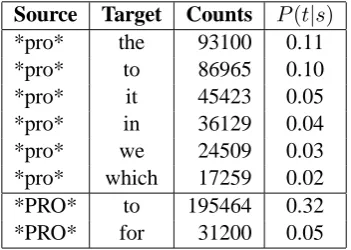
Table 3 listed some of the most frequent English words aligned to*pro*or*PRO*in a Chinese-English parallel corpus with 2M sentence pairs. Their co-occurrence counts and the lexical trans-lation probabilities are also shown in the table. In total we use 15 sparse features for frequent lexical pairs, including 13 for*pro*and 2 for*PRO*, and two more features for any other target words that align to*pro*or*PRO*.
Source Target Counts P(t|s) *pro* the 93100 0.11 *pro* to 86965 0.10 *pro* it 45423 0.05 *pro* in 36129 0.04 *pro* we 24509 0.03 *pro* which 17259 0.02 *PRO* to 195464 0.32 *PRO* for 31200 0.05
Table 3: Example of frequent word pairs used for sparse features.
4 Experimental Results
4.1 Empty Category Prediction
We use Chinese Treebank (CTB) v7.0 to train and test the EC prediction model. We partition the data into training, development and test sets. The training set includes 32925 sentences from CTB files 0001-0325, 0400-0454, 0500-0542, 0600-0840, 0590-0596, 1001-1120, 2000-3000, cctv, cnn, msnbc, and phoenix 00-06. The development set has 3033 sentences, from files 0549-0554, 0900-0931, 1136-1151, 3076-3145, and phoenix 10-11. The test set contains 3297 sentences, from files 0543-0548, 0841-0885, 1121-1135, 3001-3075, and phoenix 07-09.
To measure the accuracy of EC prediction, we project the predicted tags from the upper level nodes in the parse trees down to the surface level based on the position information encoded in the tags. The position index for each inserted EC, counted at the surface level, is attached for scor-ing purpose. The same operation is applied on both the reference and the system output trees. Such projection is necessary, especially when the two trees differ in structure (e.g. gold trees vs. machine-generated trees). We compute the pre-cision, recall and F1 scores for each EC on the test set, and collect their counts in the reference and system output. The results are shown in Ta-ble 4, where the LDC gold parse trees are used to extract syntactic features for the model. The first row in the table shows the accuracy for the places where no EC should be inserted. The predictor achieves 99.5% F1 score for this category, with limited number of missing or false positives. The F1 scores for majority of the ECs are above 70%, except for “*”, which is relatively rare in the data. For the two categories that are interesting to MT, *pro*and*PRO*, the predictor achieves 74.3% and 81.5% in F1 scores, respectively.
[image:5.595.94.270.585.710.2]dif-Tag Ref Sys P R F1 NULL 75159 75508 99.3 99.7 99.5
[image:6.595.327.505.62.120.2]*pro* 1692 1442 80.8 68.9 74.3 *PRO* 1410 1282 85.6 77.8 81.5 *T* 1851 1845 82.8 82.5 82.7 *OP* 1721 1853 90.9 97.9 94.2 *RNR* 51 39 87.2 66.7 75.6 * 156 96 63.5 39.1 48.4
Table 4: Prediction accuracy with gold parse trees, where NULL represents the cases where no ECs should be produced.
ferent types. Such performance drop is expected since the system relies heavily on syntactic struc-ture, and parsing errors create an inherent mis-matching condition between the training and test-ing time. The smallest drop among all types is on NULL, at about 1.6%. The largest drop occurs for
*OP*, at 27.1%, largely due to the parsing errors on the CPnodes. The F1 scores for*pro* and *PRO* when using system-generated parse trees are between 50% to 60%.
Tag Precision Recall F1 NULL 97.6 98.2 97.9
*pro* 51.1 50.1 50.6 *PRO* 66.4 50.5 57.3
*T* 68.2 59.9 63.8
*OP* 66.8 67.3 67.1 *RNR* 70.0 54.9 61.5
[image:6.595.72.291.62.174.2]* 60.9 35.9 45.2
Table 5: Prediction accuracy with system-generated parse trees.
To show the effect of ECs other than *pro* and*PRO*, we remove all ECs in the training data except *pro* and *PRO*. So the model only predictsNULL,*pro*or*PRO*. The results on the test set are listed in Table 6. There is 0.8% and 0.5% increase onNULLand*pro*, respectively. The F1 score for*PRO*drops by 0.2% slightly.
As mentioned earlier, for MT we focus on re-covering *pro* and *PRO* only. The model generating the results in Table 6 is the one we ap-plied in our MT experiments reported later.
In order to compare to the state-of-the-art mod-els to see where our model stands, we switch our training, development and test data to those used in the work of (Yang and Xue, 2010) and (Cai et
Tag Precision Recall F1 NULL 98.5 98.9 98.7
*pro* 51.0 51.1 51.1 *PRO* 66.0 50.4 57.1
Table 6: Prediction accuracy with system-generated parse trees, modeling *pro* and *PRO*only.
al., 2011), for the purpose of a direct comparison. The training set includes CTB files 0081 through 0900. The development set includes files 0041 to 0080, and the test set contains files 0001-0040 and 0901-0931. We merge all empty categories into a single type in the training data before training our EC prediction model. To compare the perfor-mance on system-generated parse trees, we also train a Berkeley parser on the same training data and parse the test set. The prediction accuracy for such single type on the test set with gold or system-generated parse trees is shown in Table 7, compared to the numbers reported in (Yang and Xue, 2010) and (Cai et al., 2011). The model we proposed achieves 6% higher F1 score than that in (Yang and Xue, 2010) and 2.6% higher than that in (Cai et al., 2011), which is significant. This shows the effectiveness of our structured approach.
Model T P R F1
(Yang and Xue, 2010) G 95.9 83.0 89.0 Structured (this work) G 96.5 93.6 95.0 (Yang and Xue, 2010) S 80.3 52.1 63.2 (Cai et al., 2011) S 74.0 61.3 67.0 Structured (this work) S 74.9 65.1 69.6
Table 7: Comparison with the previous results, us-ing the same trainus-ing and test data. T: parse trees. G: gold parse trees. S: system-generated parse trees. P: precision. R: recall.
4.2 MT Results
In the Chinese-to-English MT experiments, we test two state-of-the-art MT systems. One is an re-implementation of Hiero (Chiang, 2005), and the other is a hybrid syntax-based tree-to-string sys-tem (Zhao and Al-onaizan, 2008), where normal phrase pairs and Hiero rules are used as a backoff for tree-to-string rules.
[image:6.595.93.269.393.506.2]LDC over the years, with the data from United Nations and Hong Kong excluded 2. The Chi-nese text is segmented with a segmenter trained on the CTB data using conditional random field (CRF), followed by the longest-substring match segmentation in a second pass. Our language model (LM) training data consists of about 10 bil-lion English words, which includes Gigaword and other newswire and web data released by LDC, as well as the English side of the parallel train-ing corpus. We train a 6-gram LM with modi-fied Kneser-Ney smoothing (Chen and Goodman, 1998). Our tuning set for MT contains 1275 sen-tences from LDC2010E30. We test our system on the NIST MT08 Newswire (691 sentences) and Weblog (666 sentences) sets. Both tuning and test sets have 4 sets of references for each sentence. The MT systems are optimized with pairwise ranking optimization (Hopkins and May, 2011) to maximize BLEU (Papineni et al., 2002).
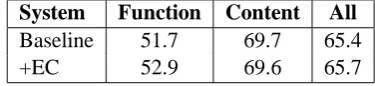
We first predict *pro* and *PRO* with our annotation model for all Chinese sentences in the parallel training data, with*pro*and*PRO* in-serted between the original Chinese words. Then we run GIZA++ (Och and Ney, 2000) to generate the word alignment for each direction and apply grow-diagonal-final (Koehn et al., 2003), same as in the baseline. We want to measure the impact on the word alignment, which is an important step for the system building. We append a 300-sentence set, which we have human hand alignment avail-able as reference, to the 2M training sentence pairs before running GIZA++. The alignment accuracy measured on this alignment test set, with or with-out *pro* and *PRO* inserted before running GIZA++, is shown in Table 8. To make a fair comparison with the baseline alignment, any tar-get words aligned to ECs are deemed as unaligned during scoring. We observe 1.2% improvement on function word related links, and almost the same accuracy on content words. This is understand-able since*pro*and*PRO*are mostly aligned to the function words at the target side. The pre-cision and recall for function words are shown in Table 9. We can see higher accuracy in both pre-cision and recall when ECs (*pro*and*PRO*) are recovered in the Chinese side. Especially, the precision is improved by 2% absolute.
2The training corpora include LDC2003E07,
LDC2003E08, LDC2005T10, LDC2006E26, LDC2006G05, LDC2007E103, LDC2008G05, LDC2009G01, and LDC2009G02.
System Function Content All Baseline 51.7 69.7 65.4
[image:7.595.321.509.63.106.2]+EC 52.9 69.6 65.7
Table 8: Word alignment F1 scores with or without *pro*and*PRO*.
System Precision Recall F1 Baseline 54.1 49.5 51.7
[image:7.595.329.507.156.201.2]+EC 56.0 50.1 52.9
Table 9: Word alignment accuracy for function words only.
Next we extract phrase pairs, Hiero rules and tree-to-string rules from the original word align-ment and the improved word alignalign-ment, and tune all the feature weights on the tuning set. The weights include those for usual costs and also the sparse features proposed in this work specifically for ECs. We test all the systems on the MT08 Newswire and Weblog sets.
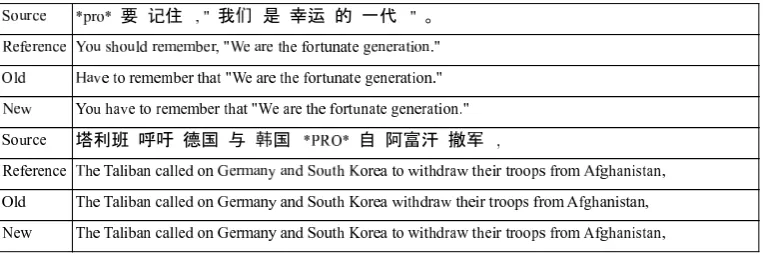
The BLEU scores from different systems are shown in Table 10 and Table 11, respectively. We measure the incremental effect of prediction (in-serting *pro*and *PRO*) and sparse features. Pre-processing of the data with ECs inserted im-proves the BLEU scores by about 0.6 for newswire and 0.2 to 0.3 for the weblog data, compared to each baseline separately. On top of that, adding sparse features helps by another 0.3 on newswire and 0.2 to 0.4 on weblog. Overall, the Hiero and tree-to-string systems are improved by about 1 point for newswire and 0.4 to 0.7 for weblog. The smaller gain on the weblog data could be due to the more difficult data to parse, which affects the accuracy of EC prediction. All the results in Table 10 and 11 marked with “*” are statistically signif-icant withp < 0.05using the sign test described in (Collins et al., 2005), compared to the baseline results in each table. Two MT examples are given in Table 12, which show the effectiveness of the recovered ECs in MT.
System MT08-nw MT08-wb
Hiero 33.99 25.40
+prediction 34.62* 25.63 +prediction+sparse 34.95* 25.80*
System MT08-nw MT08-wb T2S+Hiero 34.53 25.80 +prediction 35.17* 26.08 +prediction+sparse 35.51* 26.53*
Table 11: BLEU scores in the tree-to-string system with Hiero rules as backoff.
5 Related Work
Empty categories have been studied in recent years for several languages, mostly in the con-text of reference resolution and syntactic process-ing for English, such as in (Johnson, 2002; Di-enes and Dubey, 2003; Gabbard et al., 2006). More recently, EC recovery for Chinese started emerging in literature. In (Guo et al., 2007), non-local dependencies are migrated from En-glish to Chinese for generating proper predicate-argument-modifier structures from surface context free phrase structure trees. In (Zhao and Ng, 2007), a decision tree learning algorithm is pre-sented to identify and resolve Chinese anaphoric zero pronouns. and achieves a performance com-parable to a heuristic rule-based approach. Similar to the work in (Dienes and Dubey, 2003), empty detection is formulated as a tagging problem in (Yang and Xue, 2010), where each word in the sentence receives a tag indicating whether there is an EC before it. A maximum entropy model is utilized to predict the tags, but different types of ECs are not distinguished. In (Cai et al., 2011), a language-independent method was proposed to integrate the recovery of empty elements into syn-tactic parsing. As shown in the previous section, our model outperforms the model in (Yang and Xue, 2010) and (Cai et al., 2011) significantly us-ing the same trainus-ing and test data. (Luo and Zhao, 2011) also tries to predict the existence of an EC
in Chinese sentences, but the ECs in the middle of a tree constituent are lumped into a single position and are not uniquely recoverable.
There exists only a handful of previous work on applying ECs explicitly to machine translation so far. One of them is the work reported in (Chung and Gildea, 2010), where three approaches are compared, based on either pattern matching, CRF, or parsing. However, there is no comparison be-tween using gold trees and automatic trees. There also exist a few major differences on the MT part between our work and theirs. First, in ad-dition to the pre-processing of training data and inserting recovered empty categories, we imple-ment sparse features to further boost the perfor-mance, and tune the feature weights directly to-wards maximizing the machine translation met-ric. Second, there is no discussion on the quality of word alignment in (Chung and Gildea, 2010), while we show the alignment improvement on a hand-aligned set. Last, they use a phase-based system trained on only 60K sentences, while we conduct experiments on more advanced Hiero and tree-to-string systems, trained on 2M sentences in a much larger corpus. We directly take advantage of the augmented parse trees in the tree-to-string grammar, which could have larger impact on the MT system performance.
6 Conclusions and Future Work
base-lines, i.e. a hierarchical phase-based system and a tree-to-string syntax-based system. More work remain to be done next to further take advantages of ECs. For example, the recovered ECs can be encoded in a forest as the input to the MT decoder and allow the decoder to pick the best MT output based on various features in addition to the sparse features we proposed in this work. Many promis-ing approaches can be explored in the future.
Acknowledgments
We would like to acknowledge the support of DARPA under Grant HR0011-12-C-0015 for funding part of this work. The views, opin-ions, and/or findings contained in this arti-cle/presentation are those of the author/presenter and should not be interpreted as representing the official views or policies, either expressed or im-plied, of the Defense Advanced Research Projects Agency or the Department of Defense.
References
Ann Bies and Mohamed Maamouri. 2003.
Penn Arabic treebank guidelines. In
http://www.ircs.upenn.edu/arabic/Jan03release/ guidelines-TB-1-28-03.pdf.
Shu Cai, David Chiang, and Yoav Goldberg. 2011. Language-independent parsing with empty ele-ments. In Proceedings of the 49th Annual
Meet-ing of the Association for Computational LMeet-inguis- Linguis-tics:short papers, pages 212–216.
Stanley F. Chen and Joshua Goodman. 1998. An em-pirical study of smoothing techniques for language modeling. In Technical Report TR-10-98, Computer
Science Group, Harvard University.
David Chiang. 2005. A hierarchical phrase-based model for statistical machine translation. In
Pro-ceedings of the 43rd Annual Meeting of the Associa-tion for ComputaAssocia-tional Linguistics, pages 263–270,
Ann Arbor, Michigan, June.
Tagyoung Chung and Daniel Gildea. 2010. Effects of empty categories on machine translation. In
Pro-ceedings of the 2010 Conference on Empirical Meth-ods in Natural Language Processing, pages 636–
645.
Michael Collins, Philipp Koehn, and Ivona Kuˇcerov´a. 2005. Clause restructuring for statistical machine translation. In Proceedings of the 43rd Annual
Meeting of the Association for Computational Lin-guistics, pages 531–540.
Peter Dienes and Amit Dubey. 2003. Deep syntactic processing by combining shallow methods. In
Pro-ceedings of the 41st Annual Meeting of the Associa-tion for ComputaAssocia-tional Linguistics.
Ryan Gabbard, Seth Kulick, and Mitchell Marcus. 2006. Fully parsing the penn treebank. In
Pro-ceedings of the Human Language Technology Con-ference of the North American Chapter of the ACL.
Yuqing Guo, Haifeng Wang, and Josef van Genabith. 2007. Recovering non-local dependencies for Chi-nese. In Proceedings of the 2007 Joint
Confer-ence on Empirical Methods in Natural Language Processing and Computational Natural Language Learning (EMNLP-CoNLL).
Mark Hopkins and Jonathan May. 2011. Tuning as ranking. In Proceedings of the 2011 Conference on
Empirical Methods in Natural Language Process-ing, pages 1352–1362.
Mark Johnson. 2002. A simple pattern-matching al-gorithm for recovering empty nodes and their an-tecedents. In Proceedings of the 40th Annual
Meet-ing of the Association for Computational LMeet-inguis- Linguis-tics.
Philipp Koehn, Franz Och, and Daniel Marcu. 2003. Statistical phrase-based translation. In Proceedings
of HLT-NAACL, pages 48–54.
Yang Liu, Qun Liu, and Shouxun Lin. 2006. Tree-to-string alignment template for statistical machine translation. In Proceedings of the 21st International
Conference on Computational Linguistics and 44th Annual Meeting of the Association for Computa-tional Linguistics, pages 609–616.
Xiaoqiang Luo and Bing Zhao. 2011. A statistical tree annotator and its applications. In Proceedings
of the 49th Annual Meeting of the Association for Computational Linguistics: Human Language Tech-nologies, pages 1230–1238.
Mitchell P. Marcus, Beatrice Santorini, and Mary Ann Marcinkiewicz. 1993. Building a large annotated corpus of English: The Penn Treebank. In
Compu-tational Linguistics, volume 19(2), pages 313–330.
Franz Josef Och and Hermann Ney. 2000. Improved statistical alignment models. In Proceedings of the
38th Annual Meeting of the Association for Com-putational Linguistics, pages 440–447, Hong Kong,
China, October.
Kishore Papineni, Salim Roukos, Todd Ward, and Wei-Jing Zhu. 2002. BLEU: a method for automatic evaluation of machine translation. In Proceedings of
the 40th Annual Meeting of the Association for Com-putational Linguistics, pages 311–318, Philadelphia,
PA.
Methods in Natural Language Processing, pages 1–
10.
Nianwen Xue, Fei Xia, Fu dong Chiou, and Martha Palmer. 2005. The Penn Chinese Treebank: Phrase structure annotation of a large corpus. In Natural
Language Engineering, volume 11(2), pages 207–
238.
Yaqin Yang and Nianwen Xue. 2010. Chasing the ghost: Recovering empty categories in the Chi-nese Treebank. In Proceedings of the 23rd
Inter-national Conference on Computational Linguistics,
pages 1382–1390, Beijing, China, August.
Bing Zhao and Yaser Al-onaizan. 2008. Generaliz-ing local and non-local word-reorderGeneraliz-ing patterns for syntax-based machine translation. In Proceedings of
the 2008 Conference on Empirical Methods in Nat-ural Language Processing, pages 572–581.
Shanheng Zhao and Hwee Tou Ng. 2007. Identifica-tion and resoluIdentifica-tion of Chinese zero pronouns: A ma-chine learning approach. In Proceedings of the 2007