Post-Retrieval Clustering Using Third-Order Similarity Measures
Jos´e G. Moreno
Normandie University UNICAEN, GREYC CNRS
F-14032 Caen, France [email protected]
Ga¨el Dias
Normandie University UNICAEN, GREYC CNRS
F-14032 Caen, France [email protected]
Guillaume Cleuziou
University of Orl´eans LIFO
F-45067 Orl´eans, France [email protected]
Abstract
Post-retrieval clustering is the task of clus-tering Web search results. Within this context, we propose a new methodology that adapts the classical K-means
algo-rithm to a third-order similarity measure initially developed for NLP tasks. Results obtained with the definition of a new stop-ping criterion over the ODP-239 and the MORESQUE gold standard datasets evi-dence that our proposal outperforms all re-ported text-based approaches.
1 Introduction
Post-retrieval clustering (PRC), also known as search results clustering or ephemeral clustering, is the task of clustering Web search results. For a given query, the retrieved Web snippets are au-tomatically clustered and presented to the user with meaningful labels in order to minimize the information search process. This technique can be particularly useful for polysemous queries but it is hard to implement efficiently and effectively (Carpineto et al., 2009). Indeed, as opposed to classical text clustering, PRC must deal with small collections of short text fragments (Web snippets) and be processed in run-time.
As a consequence, most of the successful methodologies follow a monothetic approach (Za-mir and Etzioni, 1998; Ferragina and Gulli, 2008; Carpineto and Romano, 2010; Navigli and Crisa-fulli, 2010; Scaiella et al., 2012). The underlying idea is to discover the most discriminant topical words in the collection and group together Web snippets containing these relevant terms. On the other hand, the polythetic approach which main idea is to represent Web snippets as word feature vectors has received less attention, the only rele-vant work being (Osinski and Weiss, 2005). The main reasons for this situation are that (1) word
feature vectors are hard to define in small collec-tions of short text fragments (Timonen, 2013), (2) existing second-order similarity measures such as the cosine are unadapted to capture the seman-tic similarity between small texts, (3) Latent Se-mantic Analysis has evidenced inconclusive re-sults (Osinski and Weiss, 2005) and (4) the la-beling process is a surprisingly hard extra task (Carpineto et al., 2009).
This paper is motivated by the fact that the poly-thetic approach should lead to improved results if correctly applied to small collections of short text fragments. For that purpose, we propose a new methodology that adapts the classical K-means
algorithm to a third-order similarity measure ini-tially developed for Topic Segmentation (Dias et al., 2007). Moreover, the adaptedK-means
algo-rithm allows to label each cluster directly from its centroids thus avoiding the abovementioned extra task. Finally, the evolution of the objective func-tion of the adaptedK-means is modeled to
auto-matically define the “best” number of clusters. Finally, we propose different experiments over the ODP-239 (Carpineto and Romano, 2010) and MORESQUE (Navigli and Crisafulli, 2010) datasets against the most competitive text-based PRC algorithms: STC (Zamir and Etzioni, 1998), LINGO (Osinski and Weiss, 2005), OPTIMSRC (Carpineto and Romano, 2010) and the classical bisecting incremental K-means (which may be
seen as a baseline for the polythetic paradigm)1.
A new evaluation measure called the b-cubedF
-measure (Fb3) and defined in (Amig´o et al., 2009)
is then calculated to evaluate both cluster homo-geneity and completeness. Results evidence that our proposal outperforms all state-of-the-art ap-proaches with a maximumFb3 = 0.452for
ODP-239 andFb3 = 0.490for MORESQUE.
1The TOPICAL algorithm proposed by (Scaiella et al., 2012) is a knowledge-driven methodology based on Wikipedia.
2 Polythetic Post-Retrieval Clustering
TheK-means is a geometric clustering algorithm
(Lloyd, 1982). Given a set of ndata points, the
algorithm uses a local search approach to partition the points intoK clusters. A set ofKinitial
clus-ter cenclus-ters is chosen. Each point is then assigned to the center closest to it and the centers are recom-puted as centers of mass of their assigned points. The process is repeated until convergence. To as-sure convergence, an objective function Q is
de-fined which decreases at each processing step. The classical objective function is defined in Equation (1) where πk is a cluster labeled k, xi ∈ πk is an object in the cluster,mπk is the centroid of the
clusterπkandE(., .)is the Euclidean distance.
Q= K
X
k=1
X
xi∈πk
E(xi, mπk)
2. (1)
Within the context of PRC, the K-means
algo-rithm needs to be adapted to integrate third-order similarity measures (Mihalcea et al., 2006; Dias et al., 2007). Third-order similarity measures, also called weighted second-order similarity mea-sures, do not rely on exact matches of word fea-tures as classical second-order similarity measures (e.g. the cosine metric), but rather evaluate simi-larity based on related matches. In this paper, we propose to use the third-order similarity measure called InfoSimba introduced in (Dias et al., 2007) for Topic Segmentation and implement its simpli-fied versionSs3in Equation 2.
S3s(Xi, Xj) = 1
p2 p
X
k=1 p
X
l=1
Xik∗Xjl∗S(Wik, Wjl). (2)
Given two Web snippetsXi andXj, their sim-ilarity is evaluated by the simsim-ilarity of its con-stituents based on any symmetric similarity mea-sureS(., .)whereWik(resp. Wjl) corresponds to the word at thekth(resp.lth) position in the vector Xi(resp.Xj) andXik(resp.Xjl) is the weight of wordWik (resp. Wjl) in the set of retrieved Web snippets. A direct consequence of the change in similarity measure is the definition of a new ob-jective functionQS3
s to ensure convergence. This
function is defined in Equation (3) and must be maximized2.
2A maximization process can easily be transformed into a minimization one
QS3 s =
K
X
k=1
X
xi∈πk
Ss3(xi, mπk). (3)
A cluster centroidmπkis defined by a vector of pwords(wπk
1 , . . . , wpπk). As a consequence, each cluster centroid must be instantiated in such a way thatQS3
s increases at each step of the clustering
process. The choice of the best p words
repre-senting each cluster is a way of assuring conver-gence. For that purpose, we define a procedure which consists in selecting the bestpwords from
the global vocabulary V in such a way that QS3 s
increases. The global vocabulary is the set of all words which appear in any context vector.
So, for each word w ∈ V and any
symmet-ric similarity measure S(., .), its interestingness
λk(w)is computed as regards to clusterπ k. This operation is defined in Equation (4) wheresi ∈πk is any Web snippet from clusterπk. Finally, thep words with higherλk(w)are selected to construct the cluster centroid. In such a way, we can easily prove that QS3
s is maximized. Note that a word
which is not part of clusterπkmay be part of the centroidmπk.
λk(w) = 1
p
X
si∈πk X
wi q∈si
S(wiq, w). (4)
Finally, we propose to rely on a modified ver-sion of theK-means algorithm called Global K
-means (Likasa et al., 2003), which has proved to lead to improved results. To solve a clustering problem with M clusters, all intermediate
prob-lems with1,2, ..., M−1clusters are sequentially
solved. The underlying idea is that an optimal so-lution for a clustering problem with M clusters
can be obtained using a series of local searches us-ing theK-means algorithm. At each local search, the M − 1 cluster centers are always initially
placed at their optimal positions corresponding to the clustering problem withM −1clusters. The remainingMthcluster center is initially placed at
several positions within the data space. In addi-tion to effectiveness, the method is deterministic and does not depend on any initial conditions or empirically adjustable parameters. Moreover, its adaptation to PRC is straightforward.
3 Stopping Criterion
For that purpose, numerous procedures have been proposed (Milligan and Cooper, 1985). However, none of the listed methods were effective or adapt-able to our specific problem. So, we proposed a procedure based on the definition of a ratio-nal function which models the quality criterion
QS3
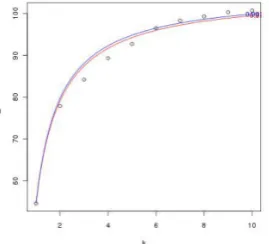
s. To better understand the behaviour of QS3s
at each step of the adaptedGK-means algorithm,
[image:3.595.113.248.213.335.2]we present its values forK= 10in Figure 1.
Figure 1:QS3
s and its modelisation.
QS3
s can be modelled as in Equation (5) which
converges to a limitαwhenKincreases and starts
fromQ1S3
s (i.e. QSs3 at K = 1). The underlying
idea is that the best number of clusters is given by theβ value which maximizes the difference with the average βmean. So, α, β and γ need to be
expressed independently of unknown variables.
∀K, f(K) =α− γ
Kβ. (5)
As α can theoretically or operationally be
de-fined and it can easily be proved thatγ =α−Q1S3 s, β needs to be defined based on γ orα. This can
also be easily proved and the given result is ex-pressed in Equation (6).
β=log(α−Q 1 S3
s)−log(α−Q
K S3
s)
log(K) . (6)
Now, the value of α which best approximates
the limit of the rational function must be defined. For that purpose, we computed its maximum theo-retical and experimental values as well as its ap-proximated maximum experimental value based on the δ2-Aitken (Aitken, 1926) procedure to
ac-celerate convergence as explained in (Kuroda et al., 2008). Best results were obtained with the maximum experimental value which is defined as building the cluster centroid mπk for each Web
snippet individually. Finally, the best number of clusters is defined as in Algorithm (1) and each one receives its label based on thep words with
greater interestingness of its centroidmπk.
Algorithm 1The bestKselection procedure.
1. CalculateβKfor eachK
2. Evaluate the mean of allβK i.e.βmean
3. SelectβKwhich maximizesβK−βmean 4. ReturnKas the best number of partitions
This situation is illustrated in Figure (1) where the red line corresponds to the rational functional for βmean and the blue line models the best β value (i.e. the one which maximizes the difference withβmean). In this case, the best number would
correspond to β6 and as a consequence, the best
number of clusters would be 6. In order to illus-trate the soundness of the procedure, we present the different values forβ at eachK iteration and
the differences between consecutive values ofβat
each iteration in Figure 2. We clearly see that the highest inclination of the curve is between clus-ter 5 and 6 which also corresponds to the highest difference between two consecutive values ofβ.
Figure 2: Values ofβ(on the left) and differences
between consecutive values ofβ (on the right).
4 Evaluation
[image:3.595.308.525.430.524.2]Fb3 K Stop Criterion
2 3 4 5 6 7 8 9 10 Fb3 Avg.K
SCP p
2 0.387 0.396 0.398 0.396 0.391 0.386 0.382 0.378 0.374 0.395 4.799 3 0.400 0.411 0.412 0.409 0.406 0.400 0.397 0.391 0.388 0.411 4.690 4 0.405 0.416 0.423 0.425 0.423 0.420 0.416 0.414 0.411 0.441 4.766 5 0.408 0.422 0.431 0.431 0.429 0.429 0.423 0.422 0.421 0.452 4.778
P M I p
[image:4.595.112.488.62.144.2]2 0.391 0.399 0.397 0.393 0.388 0.383 0.377 0.373 0.366 0.393 4.778 3 0.408 0.418 0.422 0.418 0.414 0.410 0.405 0.398 0.392 0.416 4.879 4 0.420 0.434 0.439 0.439 0.435 0.430 0.425 0.420 0.412 0.436 4.874 5 0.423 0.444 0.451 0.451 0.451 0.445 0.441 0.434 0.429 0.450 4.778
Table 1:Fb3forSCP andP M Ifor the global search and the stopping criterion for the ODP-239 dataset.
AdapatedGK-means
STC LINGO BIK OPTIMSRC SCP P M I
ODP-239
p p
2 3 4 5 2 3 4 5
F1 0.312 0.341 0.352 0.366 0.332 0.358 0.378 0.390 0.324 0.273 0.200 0.313
F2 0.363 0.393 0.404 0.416 0.363 0.395 0.421 0.435 0.319 0.167 0.173 0.341
F5 0.411 0.441 0.453 0.462 0.390 0.430 0.459 0.476 0.322 0.153 0.165 0.380
Fb3 0.395 0.411 0.441 0.452 0.393 0.416 0.436 0,450 0.403 0.346 0.307 N/A
MORESQUE
F1 0.627 0.649 0.665 0.664 0.615 0.551 0.543 0.571 0.455 0.326 0.317 N/A
F2 0.685 0.733 0.767 0.770 0.644 0.548 0.521 0.551 0.392 0.260 0.269 N/A
F5 0.747 0.817 0.865 0.872 0.679 0.563 0.519 0.553 0.370 0.237 0.255 N/A
Fb3 0.482 0.482 0.473 0.464 0.490 0.465 0.462 0.485 0.460 0.399 0.315 N/A
Table 2: PRC comparative results forFβandFb3 over the ODP-239 and MORESQUE datasets.
redundancy of the subtopics in the result list of clusters. So, in order to evaluate our methodol-ogy, we propose two different evaluations. First, we want to evidence the quality of the stopping criterion when compared to an exhaustive search over all tunable parameters. Second, we propose a comparative evaluation with existing state-of-the-art algorithms over gold standard datasets and re-cent clustering evaluation metrics.
4.1 Text Processing
Before the clustering process takes place, Web snippets are represented as word feature vectors. In order to define the set of word features, the Web service proposed in (Machado et al., 2009) is used3. In particular, it assigns a relevance score to
any token present in the set of retrieved Web snip-pets based on the analysis of left and right token contexts. A specific threshold is then applied to withdraw irrelevant tokens and the remaining ones form the vocabularyV. Then, each Web snippet is
represented by the set of its p most relevant
to-kens in the sense of the W(.) value proposed in
(Machado et al., 2009). Note that within the pro-posed Web service, multiword units are also iden-tified. They are exclusively composed of relevant individual tokens and their weight is given by the arithmetic mean of their constituents scores.
3Access to this Web service is available upon request.
4.2 Intrinsic Evaluation
The first set of experiments focuses on understand-ing the behaviour of our methodology within a greedy search strategy for different tunable param-eters defined as a tuple< p, K, S(Wik, Wjl) >. In particular,pis the size of the word feature vec-tors representing both Web snippets and centroids (p = 2..5), K is the number of clusters to be
found (K = 2..10) and S(Wik, Wjl) is the col-location measure integrated in the InfoSimba sim-ilarity measure. In these experiments, two asso-ciation measures which are known to have dif-ferent behaviours (Pecina and Schlesinger, 2006) are tested. We implement the Symmetric Condi-tional Probability (Silva et al., 1999) in Equation (7) which tends to give more credits to frequent as-sociations and the Pointwise Mutual Information (Church and Hanks, 1990) in Equation (8) which over-estimates infrequent associations. Then, best
< p, K, S(Wik, Wjl) >configurations are com-pared to our stopping criterion.
SCP(Wik, Wjl) =
P(Wik, Wjl)2
P(Wik)×P(Wjl). (7)
P M I(Wik, Wjl) =log2 P(Wik, Wjl)
P(Wik)×P(Wjl). (8)
In order to perform this task, we evaluate per-formance based on the Fb3 measure defined in
[image:4.595.81.517.179.278.2]2010). In particular, (Amig´o et al., 2009) indi-cate that common metrics such as theFβ-measure are good to assign higher scores to clusters with high homogeneity, but fail to evaluate cluster com-pleteness. First results are provided in Table 1 and evidence that the best configurations for different
< p, K, S(Wik, Wjl) > tuples are obtained for high values of p, K ranging from 4 to 6 clusters
and P M I steadily improving over SCP.
How-ever, such a fuzzy configuration is not satisfac-tory. As such, we proposed a new stopping cri-terion which evidences coherent results as it (1) does not depend on the used association measure (FbSCP3 = 0.452andFbP M I3 = 0.450), (2)
discov-ers similar numbdiscov-ers of clustdiscov-ers independently of the length of thep-context vector and (3) increases
performance with high values ofp.
4.3 Comparative Evaluation
The second evaluation aims to compare our methodology to current state-of-the-art text-based PRC algorithms. We propose comparative exper-iments over two gold standard datasets (ODP-239 (Carpineto and Romano, 2010) and MORESQUE (Di Marco and Navigli, 2013)) for STC (Za-mir and Etzioni, 1998), LINGO (Osinski and Weiss, 2005), OPTIMSRC (Carpineto and Ro-mano, 2010) and the Bisecting Incremental K -means (BIK) which may be seen as a baseline for the polythetic paradigm. A brief description of each PRC algorithm is given as follows.
STC: (Zamir and Etzioni, 1998) defined the Suffix Tree Clustering algorithm which is still a difficult standard to beat in the field. In partic-ular, they propose a monothetic clustering tech-nique which merges base clusters with high string overlap. Indeed, instead of using the classical Vec-tor Space Model (VSM) representation, they pro-pose to represent Web snippets as compact tries.
LINGO: (Osinski and Weiss, 2005) proposed a polythetic solution called LINGO which takes into account the string representation proposed by (Za-mir and Etzioni, 1998). They first extract frequent phrases based on suffix-arrays. Then, they reduce the term-document matrix (defined as a VSM) us-ing Sus-ingle Value Decomposition to discover latent structures. Finally, they match group descriptions with the extracted topics and assign relevant doc-uments to them.
OPTIMSRC: (Carpineto and Romano, 2010) showed that the characteristics of the outputs re-turned by PRC algorithms suggest the adoption of a meta clustering approach. As such, they intro-duce a novel criterion to measure the concordance of two partitions of objects into different clusters based on the information content associated to the series of decisions made by the partitions on single pairs of objects. Then, the meta clustering phase is casted to an optimization problem of the concor-dance between the clustering combination and the given set of clusterings.
With respect to implementation, we used the Carrot2 APIs4which are freely available for STC,
LINGO and the classical BIK. It is worth notic-ing that all implementations in Carrot2 are tuned to extract exactly 10 clusters. For OPTIMSRC, we reproduced the results presented in the paper of (Carpineto and Romano, 2010) as no imple-mentation is freely available. The results are il-lustrated in Table 2 including both Fβ-measure and Fb3. They evidence clear improvements of
our methodology when compared to state-of-the-art text-based PRC algorithms, over both datasets and all evaluation metrics. But more important, even when thep-context vector is small (p = 3),
the adaptedGK-means outperforms all other
ex-isting text-based PRC which is particularly impor-tant as they need to perform in real-time.
5 Conclusions
In this paper, we proposed a new PRC ap-proach which (1) is based on the adaptation of the K-means algorithm to third-order
similar-ity measures and (2) proposes a coherent stop-ping criterion. Results evidenced clear improve-ments over the evaluated state-of-the-art text-based approaches for two gold standard datasets. Moreover, our best F1-measure over ODP-239
(0.390) approximates the highest ever-reachedF1
-measure (0.413) by the TOPICAL knowledge-driven algorithm proposed in (Scaiella et al., 2012)5. These results are promising and in future
works, we propose to define new knowledge-based third-order similarity measures based on studies in entity-linking (Ferragina and Scaiella, 2010).
4http://search.carrot2.org/stable/search [Last access: 15/05/2013].
5Notice that the authors only propose theF
References
A.C. Aitken. 1926. On bernoulli’s numerical solution of algebraic equations. Research Society Edinburgh, 46:289–305.
E. Amig´o, J. Gonzalo, J. Artiles, and F. Verdejo. 2009. A comparison of extrinsic clustering evaluation met-rics based on formal constraints. Information Re-trieval, 12(4):461–486.
C. Carpineto and G. Romano. 2010. Optimal meta search results clustering. In33rd International ACM SIGIR Conference on Research and Development in Information Retrieval (SIGIR), pages 170–177.
C. Carpineto, S. Osinski, G. Romano, and D. Weiss. 2009. A survey of web clustering engines. ACM Computer Survey, 41(3):1–38.
K. Church and P. Hanks. 1990. Word association norms mutual information and lexicography. Com-putational Linguistics, 16(1):23–29.
A. Di Marco and R. Navigli. 2013. Clustering and diversifying web search results with graph-based word sense induction. Computational Linguistics, 39(4):1–43.
G. Dias, E. Alves, and J.G.P. Lopes. 2007. Topic segmentation algorithms for text summarization and passage retrieval: An exhaustive evaluation. In Pro-ceedings of 22nd Conference on Artificial Intelli-gence (AAAI), pages 1334–1339.
P. Ferragina and A. Gulli. 2008. A personalized search engine based on web-snippet hierarchical clustering.
Software: Practice and Experience, 38(2):189–225.
P. Ferragina and U. Scaiella. 2010. Tagme: On-the-fly annotation of short text fragments (by wikipedia entities). In Proceedings of the 19th ACM Inter-national Conference on Information and Knowledge Management (CIKM), pages 1625–1628.
M. Kuroda, M. Sakakihara, and Z. Geng. 2008. Ac-celeration of the em and ecm algorithms using the aitken δ2 method for log-linear models with
par-tially classified data. Statistics & Probability Let-ters, 78(15):2332–2338.
A. Likasa, Vlassis. N., and J. Verbeek. 2003. The global k-means clustering algorithm. Pattern Recognition, 36:451–461.
S.P. Lloyd. 1982. Least squares quantization in pcm. IEEE Transactions on Information Theory, 28(2):129–137.
D. Machado, T. Barbosa, S. Pais, B. Martins, and G. Dias. 2009. Universal mobile information re-trieval. InProceedings of the 5th International Con-ference on Universal Access in Human-Computer Interaction (HCI), pages 345–354.
R. Mihalcea, C. Corley, and C. Strapparava. 2006. Corpus-based and knowledge-based measures of text semantic similarity. In Proceedings of the 21st National Conference on Artificial Intelligence (AAAI), pages 775–780.
G.W. Milligan and M.C. Cooper. 1985. An exami-nation of procedures for determining the number of clusters in a data set. Psychometrika, 50(2):159– 179.
R. Navigli and G. Crisafulli. 2010. Inducing word senses to improve web search result clustering. In Proceedings of the 2010 Conference on Em-pirical Methods in Natural Language Processing (EMNLP), pages 116–126.
S. Osinski and D. Weiss. 2005. A concept-driven algo-rithm for clustering search results. IEEE Intelligent Systems, 20(3):48–54.
P. Pecina and P. Schlesinger. 2006. Combining as-sociation measures for collocation extraction. In
Proceedings of the Joint Conference of the Inter-national Committee on Computational Linguistics and the Association for Computational Linguistics (COLING/ACL), pages 651–658.
U. Scaiella, P. Ferragina, A. Marino, and M. Ciaramita. 2012. Topical clustering of search results. In Pro-ceedings of the 5th ACM International Conference on Web Search and Data Mining (WSDM), pages 223–232.
J. Silva, G. Dias, S. Guillor´e, and J.G.P. Lopes. 1999. Using localmaxs algorithm for the extraction of con-tiguous and non-concon-tiguous multiword lexical units. InProceedings of 9th Portuguese Conference in Ar-tificial Intelligence (EPIA), pages 113–132.
M. Timonen. 2013. Term Weighting in Short Docu-ments for Document Categorization, Keyword Ex-traction and Query Expansion. Ph.D. thesis, Uni-versity of Helsinki, Finland.