Semantic Neighborhoods as Hypergraphs
Chris Quirk and Pallavi Choudhury Microsoft Research
One Microsoft Way Redmond, WA 98052, USA
{chrisq,pallavic}@microsoft.com
Abstract
Ambiguity preserving representations such as lattices are very useful in a num-ber of NLP tasks, including paraphrase generation, paraphrase recognition, and machine translation evaluation. Lattices compactly represent lexical variation, but word order variation leads to a combina-torial explosion of states. We advocate hypergraphs as compact representations for sets of utterances describing the same event or object. We present a method to construct hypergraphs from sets of utterances, and evaluate this method on a simple recognition task. Given a set of utterances that describe a single object or event, we construct such a hypergraph, and demonstrate that it can recognize novel descriptions of the same event with high accuracy.
1 Introduction
Humans can construct a broad range of descrip-tions for almost any object or event. In this paper, we will refer to such objects or events as ground-ings, in the sense of grounded semantics. Exam-ples of groundings include pictures (Rashtchian et al., 2010), videos (Chen and Dolan, 2011), transla-tions of a sentence from another language (Dreyer and Marcu, 2012), or even paraphrases of the same sentence (Barzilay and Lee, 2003).
One crucial problem is recognizing whether novel utterances are relevant descriptions of those groundings. In the case of machine translation, this is the evaluation problem; for images and videos, this is recognition and retrieval. Generat-ing descriptions of events is also often an interest-ing task: we might like to find a novel paraphrase for a given sentence, or generate a description of a grounding that meets certain criteria (e.g., brevity, use of a restricted vocabulary).
Much prior work has used lattices to compactly represent a range of lexical choices (Pang et al., 2003). However, lattices cannot compactly repre-sent alternate word orders, a common occurrence in linguistic descriptions. Consider the following excerpts from a video description corpus (Chen and Dolan, 2011):
• A man is sliding a cat on the floor. • A boy is cleaning the floor with the cat.
• A cat is being pushed across the floor by a
man.
Ideally we would like to recognize that the fol-lowing utterance is also a valid description of that event: A cat is being pushed across the floor by a boy.That is difficult with lattice representations.
Consider the following context free grammar: S → X0X1
| X2X3
X0 → a man |a boy X1 → is slidingX2onX4
| is cleaningX4withX2 X2 → a cat |the cat
X3 → is being pushed acrossX4 byX0 X4 → the floor
This grammar compactly captures many lexical and syntactic variants of the input set. Note how the labels act as a kind of multiple-sequence-alignment allowing reordering: spans of tokens covered by the same label are, in a sense, aligned. This hypergraph or grammar represents a seman-tic neighborhood: a set of utterances that describe the same entity in a semantic space.
Semantic neighborhoods are defined in terms of a grounding. Two utterances are neighbors with respect to some grounding (semantic event) if they are both descriptions of that grounding. Para-phrases, in contrast, may be defined over all pos-sible groundings. That is, two words or phrases
are considered paraphrases if there exists some grounding that they both describe. The para-phrase relation is more permissive than the seman-tic neighbor relation in that regard. We believe that it is much easier to define and evaluate semantic neighbors. Human annotators may have difficulty separating paraphrases from unrelated or merely related utterances, and this line may not be con-sistent between judges. Annotating whether an ut-terance clearly describes a grounding is a much easier task.
This paper describes a simple method for con-structing hypergraph-shaped Semantic Neighbor-hoods from sets of expressions describing the same grounding. The method is evaluated in a paraphrase recognition task, inspired by a CAPTCHA task (Von Ahn et al., 2003).
2 Inducing neighborhoods
Constructing a hypergraph to capture a set of utter-ances is a variant of grammar induction. Given a sample of positive examples, we infer a compact and accurate description of the underlying lan-guage. Conventional grammar induction attempts to define the set of grammatical sentences in the language. Here, we search for a grammar over the fluent and adequate descriptions of a particular in-put. Many of the same techniques still apply.
Rather than starting from scratch, we bootstrap from an existing English parser. We begin by pars-ing the set of input utterances. This parsed set of utterances acts as a sort of treebank. Reading off a grammar from this treebank produces a grammar that can generate not only the seed sentences, but also a broad range of nearby sentences. In the case above withcat, man, and boy, we would be able to generate cases legitimate variants where man
was replaced byboyas well as undesired variants wheremanis replaced bycatorfloor. This initial grammar captures a large neighborhood of nearby utterances including many such undesirable ones. Therefore, we refine the grammar.
Refinements have been in common use in syn-tactic parsing for years now. Inspired by the re-sult that manual annotations of Treebank cate-gories can substantially increase parser accuracy (Klein and Manning, 2003), several approaches have been introduced to automatically induce la-tent symbols on existing trees. We use the split-merge method commonly used in syntactic pars-ing (Petrov et al., 2006). In its original settpars-ing,
the refinements captured details beyond that of the original Penn Treebank symbols. Here, we cap-ture both syntactic and semantic regularities in the descriptions of a given grounding.
As we perform more rounds of refinement, the grammar becomes tightly constrained to the orig-inal sentences. Indeed, if we iterated to a fixed point, the resulting grammar would parse only the original sentences. This is a common dilemma in paraphrase learning: the safest meaning preserv-ing rewrite is to change nothpreserv-ing. We optimize the number of split-merge rounds for task-accuracy; two or three rounds works well in practice. Fig-ure 1 illustrates the process.
2.1 Split-merge induction
We begin with a set of utterances that describe a specific grounding. They are parsed with a conventional Penn Treebank parser (Quirk et al., 2012) to produce a type of treebank. Unlike con-ventional treebanks which are annotated by human experts, the trees here are automatically created and thus are more likely to contain errors. This treebank is the input to the split-merge process.
Split: Given an input treebank, we propose re-finements of the symbols in hopes of increasing the likelihood of the data. For each original sym-bol in the grammar such as NP, we consider two la-tent refinements: NP0 and NP1. Each binary rule
then produces 8 possible variants, since the par-ent, left child, and right child now have two possi-ble refinements. The parameters of this grammar are then optimized using EM. Although we do not know the correct set of latent annotations, we can search for the parameters that optimize the likeli-hood of the given treebank. We initialize the pa-rameters of this refined grammar with the counts from the original grammar along with a small ran-dom number. This ranran-domness prevents EM from starting on a saddle point by breaking symmetries; Petrov et al. describe this in more detail.
(a) Input:
• the man plays the piano • the guy plays the keyboard
(b) Parses:
•(S (NP (DT the) (NN man)) (VP (VBZ plays)
(NP (DT the) (NN piano))) •(S (NP (DT the) (NN guy))
(VP (VBZ plays)
(NP (DT the) (NN keyboard)))
(c) Parses with latent annotations:
•(S (NP0(DT the) (NN0man))
(VP (VBZ plays)
(NP1(DT the) (NN1piano))) •(S (NP0(DT the) (NN0guy))
(VP (VBZ plays)
(NP1(DT the) (NN1keyboard)))
(d) Refined grammar:
S → NP0VP
NP0 → DT NN0
NP1 → DT NN1
NP → VBZ NP1
DT → the
NN0 → man|guy
NN1 → piano|keyboard
VBZ → plays
Figure 1: Example of hypergraph induction. First a conventional Treebank parser converts input ut-terances (a) into parse trees (b). A grammar could be directly read from this small treebank, but it would conflate all phrases of the same type. In-stead we induce latent refinements of this small treebank (c). The resulting grammar (d) can match and generate novel variants of these inputs, such asthe man plays the keyboard and the buy plays the piano. While this simplified example sug-gests a single hard assignment of latent annota-tions to symbols, in practice we maintain a dis-tribution over these latent annotations and extract a weighted grammar.
Iteration: We run this process in series. First the original grammar is split, then some of the least useful splits are discarded. This refined grammar is then split again, with the least useful splits discarded once again. We repeat for a num-ber of iterations based on task accuracy.
Final grammar estimation: The EM proce-dure used during split and merge assigns fractional countsc(· · ·)to each refined symbolXiand each production Xi → Yj Zk. We estimate the final
grammar using these fractional counts.
P(Xi→Yj Zk) =
c(Xi, Yj, Zk)
c(Xi)
In Petrov et al., these latent refinements are later discarded as the goal is to find the best parse with the original coarse symbols. Here, we retain the latent refinements during parsing, since they dis-tinguish semantically related utterances from un-related utterances. Note in Figure 1 how NN0
and NN1refer to different objects; were we to
ig-nore that distinction, the parser would recognize semantically different utterances such asthe piano plays the piano.
2.2 Pruning and smoothing
For both speed and accuracy, we may also prune the resulting rules. Pruning low probability rules increases the speed of parsing, and tends to in-crease the precision of the matching operation at the cost of recall. Here we only use an absolute threshold; we vary this threshold and inspect the impact on task accuracy. Once the fully refined grammar has been trained, we only retain those rules with a probability above some threshold. By varying this threshold t we can adjust precision
and recall: as the low probability rules are re-moved from the grammar, precision tends to in-crease and recall tends to dein-crease.
Another critical issue, especially in these small grammars, is smoothing. When parsing with a grammar obtained from only 20 to 50 sentences, we are very likely to encounter words that have never been seen before. We may reasonably re-ject such sentences under the assumption that they are describing words not present in the training corpus. However, this may be overly restrictive: we might see additional adjectives, for instance. In this work, we perform a very simple form of smoothing. If the fractional count of a word given a pre-terminal symbol falls below a threshold k,
tends to remove recursion), these approximations would often be tight.
3 Experimental evaluation
We explore a task in description recognition. Given a large set of videos and a number of de-scriptions for each video (Chen and Dolan, 2011), we build a system that can recognize fluent and accurate descriptions of videos. Such a recognizer has a number of uses. One example currently in evaluation is a novel CAPTCHAs: to differentiate a human from a bot, a video is presented, and the response must be a reasonably accurate and fluent description of this video.
We split the above data into training and test. From the training sets, we build a set of recogniz-ers. Then we present these recognizers with a se-ries of inputs, some of which are from the held out set of correct descriptions of this video, and some of which are from descriptions of other videos. Based on discussions with authors of CAPTCHA systems, a ratio of actual users to spammers of 2:1 seemed reasonable, so we selected one negative example for every two positives. This simulates the accuracy of the system when presented with a simple bot that supplies random, well-formed text as CAPTCHA answers.1
[image:4.595.334.498.88.188.2]As a baseline, we compare against a simple tf-idf approach. In this baseline we first pool all the training descriptions of the video into a sin-gle virtual document. We gather term frequen-cies and inverse document frequenfrequen-cies across the whole corpus. An incoming utterance to be classi-fied is scored by computing the dot product of its counted terms with each document; it is assigned to the document with the highest dot product (co-sine similarity).
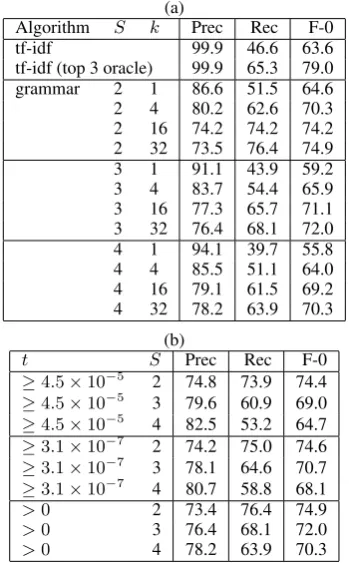
Table 2 demonstrates that a baseline tf-idf ap-proach is a reasonable starting point. An oracle selection from among the top three is the best per-formance – clearly this is a reasonable approach. That said, grammar based approach shows im-provements over the baseline tf-idf, especially in recall. Recall is crucial in a CAPTCHA style task: if we fail to recognize utterances provided by hu-mans, we risk frustration or abandonment of the service protected by the CAPTCHA. The relative importance of false positives versus false negatives 1A bot might perform object recognition on the videos and
supply a stream of object names. We might simulate this by classifying utterances consisting of appropriate object words but without appropriate syntax or function words.
Total videos 2,029 Training descriptions 22,198
types 5,497
tokens 159,963 Testing descriptions 15,934
types 4,075
tokens 114,399
Table 1: Characteristics of the evaluation data. The descriptions from the video description cor-pus are randomly partitioned into training and test.
(a)
Algorithm S k Prec Rec F-0
tf-idf 99.9 46.6 63.6
tf-idf (top 3 oracle) 99.9 65.3 79.0
grammar 2 1 86.6 51.5 64.6
2 4 80.2 62.6 70.3
2 16 74.2 74.2 74.2 2 32 73.5 76.4 74.9
3 1 91.1 43.9 59.2
3 4 83.7 54.4 65.9
3 16 77.3 65.7 71.1 3 32 76.4 68.1 72.0
4 1 94.1 39.7 55.8
4 4 85.5 51.1 64.0
4 16 79.1 61.5 69.2 4 32 78.2 63.9 70.3
(b)
t S Prec Rec F-0
≥4.5×10⁻⁵ 2 74.8 73.9 74.4 ≥4.5×10⁻⁵ 3 79.6 60.9 69.0 ≥4.5×10⁻⁵ 4 82.5 53.2 64.7 ≥3.1×10⁻⁷ 2 74.2 75.0 74.6 ≥3.1×10⁻⁷ 3 78.1 64.6 70.7 ≥3.1×10⁻⁷ 4 80.7 58.8 68.1
>0 2 73.4 76.4 74.9
>0 3 76.4 68.1 72.0
>0 4 78.2 63.9 70.3
Table 2: Experimental results. (a) Comparison of tf-idf baseline against grammar based approach, varying several free parameters. An oracle checks if the correct video is in the top three. For the grammar variants, the number of splitsS and the
smoothing thresholdk are varied. (b) Variations
on the rule pruning threshold t and number of
split-merge roundsS. >0indicates that all rules
are retained. Here the smoothing threshold k is
[image:4.595.329.504.307.589.2](a) Input descriptions:
• A cat pops a bunch of little balloons that are on the groung. • A dog attacks a bunch of balloons.
• A dog is biting balloons and popping them. • A dog is playing balloons.
• A dog is playing with balloons. • A dog is playing with balls.
• A dog is popping balloons with its teeth. • A dog is popping balloons.
• A dog is popping balloons.
• A dog plays with a bunch of balloons. • A small dog is attacking balloons. • The dog enjoyed popping balloons. • The dog popped the balloons.
(b) Top ranked yields from the resulting grammar: +0.085 A dog is popping balloons.
+0.062 A dog is playing with balloons. +0.038 A dog is playing balloons.
0.038 A dog is attacking balloons.
+0.023 A dog plays with a bunch of balloons. +0.023 A dog attacks a bunch of balloons.
0.023 A dog pops a bunch of balloons. 0.023 A dog popped a bunch of balloons. 0.023 A dog enjoyed a bunch of balloons. 0.018 The dog is popping balloons. 0.015 A dog is biting balloons. 0.015 A dog is playing with them. 0.015 A dog is playing with its teeth.
Figure 2: Example yields from a small grammar. The descriptions in (a) were parsed as-is (including the typographical error “groung”), and a refined grammar was trained with 4 splits. The topkyields from
this grammar along with the probability of that derivation are listed in (b). A ‘+’ symbol indicates that the yield was in the training set. No smoothing or pruning was performed on this grammar.
may vary depending on the underlying resource. Adjusting the free parameters of this method al-lows us to achieve different thresholds. We can see that rule pruning does not have a large impact on overall results, though it does allow yet another means of tradiing off precision vs. recall.
4 Conclusions
We have presented a method for automatically constructing compact representations of linguis-tic variation. Although the initial evaluation only explored a simple recognition task, we feel the underlying approach is relevant to many linguis-tic tasks including machine translation evalua-tion, and natural language command and con-trol systems. The induction procedure is rather simple but effective, and addresses some of the reordering limitations associated with prior ap-proaches.(Barzilay and Lee, 2003) In effect, we are performing a multiple sequence alignment that allows reordering operations. The refined symbols of the grammar act as a correspondence between related inputs.
The quality of the input parser is crucial. This method only considers one possible parse of the input. A straightforward extension would be to consider an n-best list or packed forest of input parses, which would allow the method to move past errors in the first input process. Perhaps also this reliance on symbols from the original Tree-bank is not ideal. We could merge away some or all of the original distinctions, or explore different parameterizations of the grammar that allow more flexibility in parsing.
The handling of unseen words is very simple. We are investigating means of including addi-tional paraphrase resources into the training to in-crease the effective lexical knowledge of the sys-tem. It is inefficient to learn each grammar inde-pendently. By sharing parameters across different groundings, we should be able to identify Seman-tic Neighborhoods with fewer training instances.
Acknowledgments
We would like to thank William Dolan and the anonymous reviewers for their valuable feedback.
References
Regina Barzilay and Lillian Lee. 2003. Learn-ing to paraphrase: An unsupervised approach us-ing multiple-sequence alignment. InProceedings of NAACL-HLT.
David Chen and William Dolan. 2011. Collecting highly parallel data for paraphrase evaluation. In
Proceedings of the 49th Annual Meeting of the Asso-ciation for Computational Linguistics: Human Lan-guage Technologies, pages 190–200, Portland, Ore-gon, USA, June. Association for Computational Lin-guistics.
Markus Dreyer and Daniel Marcu. 2012. Hyter: Meaning-equivalent semantics for translation eval-uation. In Proceedings of the 2012 Conference of the North American Chapter of the Association for Computational Linguistics: Human Language Tech-nologies, pages 162–171, Montr´eal, Canada, June. Association for Computational Linguistics.
Japan, July. Association for Computational Linguis-tics.
Mark-Jan Nederhof. 2000. Practical experiments with regular approximation of context-free languages.
Computational Linguistics, 26(1):17–44, March.
Bo Pang, Kevin Knight, and Daniel Marcu. 2003. Syntax-based alignment of multiple translations: Extracting paraphrases and generating new sen-tences.
Slav Petrov, Leon Barrett, Romain Thibaux, and Dan Klein. 2006. Learning accurate, compact, and interpretable tree annotation. In Proceedings of the 21st International Conference on Computational Linguistics and 44th Annual Meeting of the Associa-tion for ComputaAssocia-tional Linguistics, pages 433–440, Sydney, Australia, July. Association for Computa-tional Linguistics.
Chris Quirk, Pallavi Choudhury, Jianfeng Gao, Hisami Suzuki, Kristina Toutanova, Michael Gamon, Wen-tau Yih, Colin Cherry, and Lucy Vanderwende. 2012. Msr splat, a language analysis toolkit. In
Proceedings of the Demonstration Session at the Conference of the North American Chapter of the Association for Computational Linguistics: Human Language Technologies, pages 21–24, Montr´eal, Canada, June. Association for Computational Lin-guistics.
Cyrus Rashtchian, Peter Young, Micah Hodosh, and Julia Hockenmaier. 2010. Collecting image annota-tions using amazon’s mechanical turk. In Proceed-ings of the NAACL HLT 2010 Workshop on Creating Speech and Language Data with Amazon’s Mechan-ical Turk, pages 139–147, Los Angeles, June. Asso-ciation for Computational Linguistics.
Luis Von Ahn, Manuel Blum, Nicholas J. Hopper, and John Langford. 2003. Captcha: Using hard ai prob-lems for security. In Eli Biham, editor,Advances in Cryptology – EUROCRYPT 2003, volume 2656 of