F o r e s t - B a s e d S t a t i s t i c a l S e n t e n c e G e n e r a t i o n
I r e n e L a n g k i l d e
I n f o r m a t i o n Sciences I n s t i t u t e U n i v e r s i t y of S o u t h e r n California
M a r i n a del R e y CA 90292
ilangkil©isi .edu
A b s t r a c t
This paper presents a new approach to sta- tistical sentence generation in which Mterna- tive phrases are represented as packed sets of trees, or forests, and then ranked statistically to choose the best one. This representation offers advantages in compactness and in the ability to represent syntactic information. It also fa- cilitates more efficient statistical ranking than a previous approach to statistical generation. An efficient ranking algorithm is described, to- gether with experimental results showing signif- icant improvements over simple enumeration or a lattice-based approach.
1 I n t r o d u c t i o n
Large textual corpora offer the possibility of a statistical approach to the task of sentence generation. Like any large-scale NLP or AI task, the task of sentence generation requires immense amounts of knowledge. The knowledge needed includes lexicons, grammars, ontologies, collocation lists, and morphological tables. Ac- quiring and applying accurate, detailed knowl- edge of this breadth poses difficult problems.
Knight and Hatzivassiloglou (1995) suggested overcoming the knowledge acquisition bottle- neck in generation by tapping the information inherent in textual corpora. They performed ex- periments showing that automatically-acquired, corpus-based knowledge greatly reduced the need for deep, hand-crafted knowledge. At the same time, this approach to generation im- proved scalability and robustness, offering the potential in the future for higher quality out- put.
In their approach, K ~: H adapted techniques used in speech recognition. Corpus-based sta- tistical knowledge was applied to the generation process after encoding many alternative phras-
ings into a structure called a
lattice
(see Fig- ure 1). A lattice was able to represent large numbers alternative phrases without requiring the large amount of space that an explicitly enu- merated list of individual alternatives would re- quire. The Mternative sentences in the lattice were then ranked according to a statistical lan- guage model, and the most likely sentence was chosen as o u t p u t . Since the number of phrases that needed be considered typically grew ex- ponentially with the length of the phrase, the lattice was usually too large for an exhaustive search, and instead an n-best algorithm was used to heuristically narrow the search.The lattice-based m e t h o d , t h o u g h promising, had several drawbacks that will be discussed shortly. This paper presents a different m e t h o d of statistical generation based on a
forest
struc- ture (a packed set of trees). A forest is more compact than a lattice, and it offers a hierar- chical organization that is conducive to repre- senting syntactic information. Furthermore, it facilitates dramatically more efficient statistical ranking, since constraints can be localized, and the combinatorial explosion of possibilities that need be considered can be reduced. In addition to describing the forest data structure we use, this paper presents a forest-based ranking algo- rithm, and reports experimental results on its efficiency in both time and space. It also favor- ably compares these results to the performance of a lattice-based approach.2 R e p r e s e n t i n g A l t e r n a t i v e P h r a s e s
2.1 E n u m e r a t e d lists and lattices
.g
.~
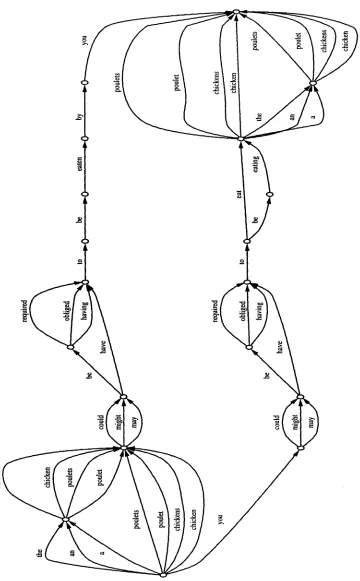
F i g u r e 1: A lattice representing 576 different sen- tences, including "You m a y have to eat chicken",
[image:2.612.103.463.85.666.2]deciding when to insert function words, per- forming morphological inflections, and satis- fying agreement constraints, as well as other tasks.
One way of leveraging corpus-based knowl- edge is to explicitly e n u m e r a t e m a n y alternate possibilities and select the most likely according to a corpus-based statistical model. Since m a n y subphrases and decisions will be c o m m o n across propose d sentences, a lattice is a more efficient way t h a n one-by-one e n u m e r a t i o n to represent them. A lattice is a graph where each arc is la- beled with a word. A complete path from the left-most node to right-most node t h r o u g h the lattice represents a possible sentence. Multiple arcs leaving a particular node represent alter- nate paths. A lattice thus allows structure to be shared between sentences. An example of a lattice is shown in Figure 1. This lattice encodes 576 unique sentences. In practice, a lattice m a y represent m a n y trillions of sentences. W i t h o u t a compact representation for so m a n y sentences, statistical generation would be much less feasi- ble.
The lattice in Figure 1 illustrates several types of decisions t h a t need to be m a d e in gen- eration. For example, there is a choice be- tween the root words "chicken" and "poulet", t h e choice of w h e t h e r to use singular or plural forms of these words, t h e decision w h e t h e r to use an article or not, and if so, which o n e - - definite or indefinite. T h e r e are also other word choice decisions such as w h e t h e r to use the aux- iliary verb "could", "might", or " m a y " , and w h e t h e r to express the m o d e of eating with the predicate "have to", "be obliged to", or "be re- quired to". Finally, there is a choice between active voice ( b o t t o m half of lattice), and pas- sive voice (top half).
Inspection of t h e lattice reveals some un- avoidable duplication, however. For example, t h e word "chicken" occurs four times, while the sublattice for t h e noun phrase contain- ing "chicken" is r e p e a t e d twice. So is the verb phrase h e a d e d by the auxiliaries
"could",
" m i g h t " , and " m a y " . Such repetition is com- m o n in a lattice representation for text genera- tion, and has a negative impact on the efficiency of t h e ranking algorithm because the same set of score calculations end up being m a d e several times. A n o t h e r drawback of t h e duplication is
that the representation consumes m o r e storage space t h a n necessary.
Yet another drawback of the lattice represen- tation is t h a t the independence between m a n y choices cannot be fully exploited. Stolcke et al. (1997) noted t h a t 55% of all word dependencies occur between adjacent words. This means t h a t most choices t h a t must be m a d e in non-adjacent parts of a sentence are independent. For ex- ample, in Figure 1, the choice between " m a y " , "might", or "could" is independent of the choice between "a", "an" or "the" to precede "chicken" or "poulet". Independence reduces the combi- nation of possibilities t h a t must be considered, and allows some decisions to be m a d e with- out taking into account the rest of the context. Even adjacent words are sometimes indepen- dent of each other, such as the words "tail" and "ate" in the sentence " T h e dog with the short tail ate the bone". A lattice does not offer any way of representing which parts of a sentence are independent of each other, and thus can- not take advantage of this independence. This negatively impacts both the a m o u n t of process- ing needed and the quality of the results. In contrast, a forest representation, which we will discuss shortly, does allow t h e independence to be explicitly annotated.
A final difficulty with using lattices is t h a t the search space grows exponentially with the length of the sentence(s), making an exhaustive search for the most likely sentence impractical for long sentences. Heuristic-based searches of- fer only a poor approximation. Any pruning that is done renders the solution theoretically inadmissable, and in practice, frequently ends up pruning the m a t h e m a t i c a l l y optimal solu- tion.
2.2 F o r e s t s
from a semantic input.
With a forest representation, it is quite nat- ural to incorporate syntactic information. Syn- tactic information offers some potentially signif- icant advantages for statistical language model- ing. However, this paper will not discuss statis- tical modeling of syntax beyond making men- tion of it, leaving it instead for future work. In- stead we focus on the nature of the forest repre- sentation itself and describe a general algorithm for ranking alternative trees that can be used with any language model.
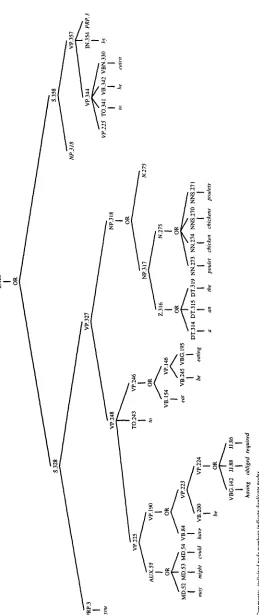
A forest representation corresponding to the lattice in Figure 1 is shown in Figure 3. This forest structure is an AND-OR graph, where the AND nodes represent sequences of phrases, and the OR nodes represent mutually exclusive al- ternate phrasings for a particular relative po- sition in the sentence. For example, at the top level of the forest, node S.469 encodes the choice between active and passive voice versions of the sentence. The active voice version is the left child node, labelled S.328, and the passive voice version is the right child node, S.358. There are eight OR-nodes in the forest, corresponding to the eight distinct decisions mentioned earlier that need to be made in deciding the best sen- tence to output.
The nodes are uniquely numbered, so that re- peated references to the same node can be iden- tified as such. In the forest diagram, only the first (left-most) reference to a node is drawn completely. Subsequent references only show the node name written in italics. This eases readability and clarifies which portions of the forest actually need to have scores computed during the ranking process. Nodes N.275, NP.318, VP.225 and PRP.3 are repeated in the forest of Figure 3.
S.469 ~ S.328
S.469 ==~ S.358
S.328 ~ PRP.3 VP.327
PRP.3 ~ "you"
VP.327 ==ez VP.248 NP.318 S.358 ~ NP.318 VP.357
NP.318 ~ NP.317
NP.318 ~ N.275
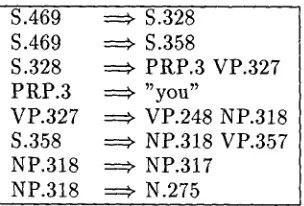
Figure 2: Internal representation of top nodes in forest
Figure 2 illustrates how the forest is repre- sented internally, showing context-free rewrite rules for some of the top nodes in the forest. OR-nodes are indicated by the same label oc- curing more than once on the left-hand side of a rule. This sample of rules includes an example of multiple references to a node, namely node NP.318, which occurs on the right-hand side of two different rules.
A generation forest differs from a parse forest in that a parse forest represents different pos- sible hierarchicM structures that cover a single phrase. Meanwhile a generation forest gener- ally represents one (or only a few) heirarchi- cal structures for a given phrase, but represents many different phrases that generally express the same meaning.
2.3 P r e v i o u s w o r k o n p a c k e d g e n e r a t i o n t r e e s
There has been previous work on developing a representation for a packed generation forest structure. Shemtov (1996) describes extensions to a chart structure for generation originally presented in (Kay, 1996) that is used to gen- erate multiple paraphrases from a semantic in- put. A prominent aspect of the representation is the use of boolean vector expressions to asso- ciate each sub-forest with the portions of the in- put that it covers and to control the unification- based generation process. A primary goM of the representation is to guarantee that each part of the semantic input is expressed once and only once in each possible output phrase.
In contrast, the packed forest in this paper keeps the association between the semantic in- put and nodes in the forest separate from the forest representation itself. (In our system, these mappings are maintained via an external cache mechanism as described in (Langkilde and Knight, 1998)). Once-and-only-once coverage of the semantic input is implicit, and is achieved by the process that maps from the input to a forest.
3 F o r e s t r a n k i n g a l g o r i t h m
[image:4.612.120.272.591.694.2]7
/t 71
\
/ \
,-
tit
.~ ~ = - ~\
/ \ / >
,;-.
}
i g
-
~
}
• ~ - ~
[image:5.612.217.476.80.695.2]- - ~ - ~ .
input sentence, it compares alternate phrases corresponding to the same semantic input.
As in a probabilistic chart parser, the key insight of this algorithm is that the score for each of the phrases represented by a particu- lar node in the forest can be decomposed into a context-independent (internal) score, and a context-dependent (external) score. The inter- nal score, once computed, is stored with the phrase, while the external score is computed in combination with other sibling nodes.
In general, the internal score for a phrase as- sociated with a node p can be defined recur- sively as:
I(p)
= 1-Ij=lJ
I(cj) • E(cjJcontext(cl..Cj_l) )where I stands for the internal score, E the ex- ternal score, and cj for a child node of p. The specific formulation of I and E, and the pre- cise definition of the context depends on the lan- guage model being used. As an example, in a bigram model, I I=1 for leaf nodes, and E can be expressed as:
E = P ( E i r s t W o r d ( e j ) l L a s t W o r d ( c j _ l ) )
Depending on the language model being used, a phrase will have a set of externally-relevant features. These features are the aspects of the phrase that contribute to the context-dependent scores of sibling phrases. In the case of the bi- gram model, the features are the first and last words of the phrase. In a trigram model it is the first and last two words. In more elaborate lan- guage models, features might include elements such as head word, part-of-speech tag, constitu- tent category, etc.
A crucial advantage of the forest-based method is that at each node only the best in- ternally scoring phrase for each unique combi- nation of externally relevant features needs to be maintained. The rest can be pruned with- out sacrificing the guarantee of obtaining the overall optimal solution. This pruning reduces exponentially the total number of phrases that need to be considered. In effect, the ranking
IA bigram model is based on conditional probabil- ities, where the likelihood of each word in a phrase is assumed to depend on only the immediately previous word. The likelihood of a whole phrase is the product of the conditional probabilities of each of the words in the phrase.
VP.344 ~ VP.225 TO.341 VB.342 VBN.330
225: 341: 342: 330:
might have may have could have
might be required may be required could be required might be having may be having could be having might be obliged may be obliged could be obliged
to be eaten
344:
might ... eaten may ... eaten could ... eaten
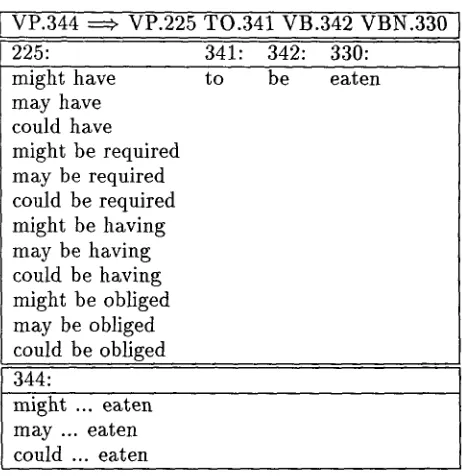
Figure 4: Pruning phrases from a forest node, assuming a bigram model
algorithm exploits the independence that exists between most disjunctions in the forest.
To illustrate this, Figure 4 shows an exam- ple of how phrases in a node are pruned, as- suming a bigram model. The rule for node VP.344 in the forest of Figure 3 is shown, to- gether with the phrases corresponding to each of the child nodes. If every possible com- bination of phrases is considered for the se- quence of nodes on the right-hand side, there are three unique first words, namely "might", "may" and "could", and only one unique final word, "eaten". Given that only the first and last words of a phrase are externally relevant features in a bigram model, only the three best scoring phrases (out of the 12 total) need to be maintained for node VP.344--one for each unique first-word and last-word pair. The other nine phrases can never be ranked higher, no matter what constituents VP.344 later combines with.
[image:6.612.319.550.80.318.2]antees that only the best phrase for each unique set of features values is maintained. The core loop in the algorithm considers the children of the node one-by-one, concatenating and scoring the phrases of the first two children and prun- ing the results, before considering the phrases of the third child, and concatenating them with the intermediate results, and so on. From the pseudocode, it can be seen that the complex- ity of the algorithm is dominated by the num- ber of phrases associated with a node (not the number of rules used to represent the forest, nor the number of children in a an AND node). More specifically, because of the pruning, it de- pends on the number of features associated with the language model, and the average number of unique combinations of feature values that are seen. If f is the number of features, v the av- erage number of unique values seen in a node for each feature, and N the number of N best being maintained for each unique set of fea- ture values (but not a cap on the number of phrases), then the algorithm has the complex- ity
O((vN) 2/)
(assuming t h a t children of AND nodes are concatenated in pairs). Note that f=2 for the bigram model, and f=4 for the trigram model.In comparison, the complexity of an exhaus-
R a n k F o r e s t ( N o d e )
{
if ( L e a f p ( N o d e ) ) LeafScore( Node); f o r j = l t o J {
if ( not(ranked?(Node->e[j]))) RankForest(Node- > c[j]);
}
for m = l to NumberOfPhrasesIn(Node->c[1]) Node->p[m] = (Node->c[1])->p[m]; k=ffpr j = 2 to J {
for m = l to N u m b e r O f P h r a s e s I n ( N o d e ) for n = l to NumberOfPhrasesIn(
Node->c[j])
t e m p [ k + + ] = ConcatAndScore( Node->p[m],
(Node- >c[j])- >Pin]); Prune( temp);
for m = l to N u m b e r O f P h r a s e s I n ( t e m p ) Node->p[m] = (temp[m]);
}
tive search algorithm on a lattice is
O((vN)~),
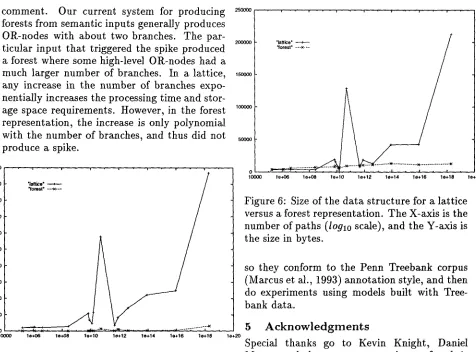
where l is approximately the length of the longest sentence in the lattice. The forest-based algorithm thus offers an exponential reduction in complexity while still guaranteeing an opti- mal solution. A capped N-best heuristic search algorithm on the other hand has complexity O(vN1). However, as mentioned earlier, it typ- ically fails to find the optimal solution with longer sentences.In conclusion, the tables in Figure 5 and Fig- ure 6 show experimental results comparing a forest representation to a lattice in terms of the time and space used to rank sentences. These results were generated from 15 test set inputs, whose average sentence length ranged from 14 to 36 words. They were ranked using a bigram model. The experiments were run on a Sparc Ultra 2 machine. Note that the time results for the lattice are not quite directly comparable to those for a forest because they include overhead costs for loading portions of a hash table. It was not possible to obtain timing measurements for the search algorithm alone. We estimate that roughly 80% of the time used in processing the lattice was used for search alone. Instead, the results in Figure 5 should be interpreted as a comparison between different kinds of systems. In that respect, it can be observed from Ta- ble 5 that the forest ranking program performs at least 3 or 4 seconds faster, and that the time needed does
not
grow linearly with the num- ber of paths being considered as it does with the lattice program. Instead it remains fairly constant. This is consistent with the theoreti- cal result that the forest-based algorithm does not depend on sentence length, but only on the number of different alternatives being consid- ered at each position in the sentence.From Table 6 it can be observed t h a t when there are a relatively moderate number of sen- tences being ranked, the forest and the lattice are fairly comparable in their space consump- tion. The forest has a little extra overhead in representing hierarchical structure. However, the space requirements of a forest do not grow linearly with the number of paths, as do those of the lattice. Thus, with very large numbers of paths, the forest offers significant savings in space.
comment. Our current system for producing 2 s o ~
forests from semantic inputs generally produces OR-nodes with about two branches. The par- 20o00o ticular input that triggered the spike produced a forest where some high-level OR-nodes had a much larger number of branches. In a lattice, 150~o any increase in the number of branches expo- nentially increases the processing time and stor- age space requirements. However, in the forest ,000oo representation, the increase is only polynomial with the number of branches, and thus did not ~ o produce a spike.
I O 0 , • , • , • , • , • ,
90 "latt;,'e"
" f o r e s t " - - - x - - - SO
70 60 5O 4 0
3 O
2O 10
. . . -x 00000 . 10+06 . . . .10+08 . . . . 10+10 10+12 10+14 10+16 l e + 1 8 l o + 2 0
Figure 5: Time required for the ranking pro- cess using a lattice versus a forest representa- tion. The X-axis is the number of paths
(loglo
scale), and the Y-axis is the time in seconds.
4 F u t u r e W o r k
The forest representation and ranking algorithm have been implemented as part of the Nitro- gen generator system. The results shown in the previous section illustrate the time and space advantages of the forest representation which make calculating the mathematically op- timal sentence in the forest feasible (particularly for longer sentences). However, obtaining the mathematically optimal sentence is only valu- able if the mathematical model itself provides a good fit. Since a forest representation makes it possible to add syntactic information to the mathematical model, the next question to ask is whether such a model can provide a better fit for natural English than the ngram models we have used previously. In future work, we plan to modify the forests our system produces
~ o r e s t " -*-x- --
10000 l e + 0 6 l e + 0 8 l e + 1 0 l e + 1 2 l e + 1 4 I e + 1 6 l e + 1 8 l e + 2 0
Figure 6: Size of the data structure for a lattice versus a forest representation. The X-axis is the number of paths
(log~o
scale), and the Y-axis is the size in bytes.so they conform to the Penn Treebank corpus (Marcus et al., 1993) annotation style, and then do experiments using models built with Tree- bank data.
5 A c k n o w l e d g m e n t s
Special thanks go to Kevin Knight, Daniel Marcu, and the anonymous reviewers for their comments. This research was supported in part by NSF Award 9820291.
R e f e r e n c e s
M. Kay. 1996. Chart generation. In
Proc. ACL.
K. Knight and V. Hatzivassiloglou. 1995. Two- level, many-paths generation. In
Proc. A CL.
I. Langkilde and K. Knight. 1998. Generation that exploits corpus-based statistical knowl- edge. In
Proc. COLING-ACL.
M. Marcus, B. Santorini, and M. Marcinkiewicz. 1993. Building a large a n n o t a t e d corpus of english: the Penn treebank.
Computational
Linguistics,
19(2).H. Shemtov. 1996. Generation of paraphrases from ambiguous logical forms. In