U p h o l d i n g the M a x i m of R e l e v a n c e
during P a t i e n t - C e n t e r e d A c t i v i t i e s
A b i g a i l S . G e r t n e r a n d B o n n i e L . W e b b e r J o h n R . C l a r k eC o m p u t e r ~ I n f o r m a t i o n S c i e n c e U n i v e r s i t y o f P e n n s y l v a n i a P h i l a d e l p h i a P A 1 9 1 0 4 - 6 3 8 9 a g e r t n e r © l i n c , cis. upenn, edu b o n n i e @ c e n t r a l , cis. upenn, edu
A b s t r a c t
This paper addresses "kinds and focuses of relevance" t h a t a language-generating clin- ical decision-support system should adhere to during activities in which a health care provider's attention is on his or her pa- tient and not on a computer screen. Dur- ing such "patient-centered" activities, ut- terances generated by a computer system intrude on patient management. T h e y must be thus seen by HCPs as having immediate clinical relevance, or, like the continual ringing of ICU monitors, they will be ignored. This paper describes how plan recognition and plan evaluation can be used to achieve clinical relevance. The work is being done in the context of the T r a u m A I D project, whose overall goal is to improve the delivery of quality t r a u m a care during the initial definitive phase of patient management. Given an early pilot study that showed that physicians using Traum- AID disliked the continuous presentation of its entire m a n a g e m e n t plan, we decided to explore how T r a u m A I D could restrict com- m e n t a r y to only those situations in which a comment could make a clinically signifi- cant difference to patient management. We took advantage of the fact t h a t actions that involve resources that need to be brought to the t r a u m a bay or that can only be done elsewhere must be ordered. Since or- ders can be rescinded, comments pointing out problems with an order can potentially make a clinically significant difference to patient management. T h e contributions of this paper are (1) pointing out additional
*This work has been supported in part by the Army Research Organization under grant DAAL03-89- C0031PRI, the National Library of Medicine under grant R01 LM05217-01 and the Agency for Health Care Policy and Research under grant RO1 HS06740. The authors would fike to thank Mark Steedman and Jonathan Kaye for their helpful comments on earlier drafts of this paper.
D e p a r t m e n t o f S u r g e r y M e d i c a l C o l l e g e o f P e n n s y l v a n i a
3 3 0 0 H e n r y A v e n u e P h i l a d e l p h i a P A 1 9 1 2 9
j c l a r k e @ g r a d i e n t , cis. upenn, edu *
constraints on language generation raised by the desire to convey information to lis- teners attending to something other than an computer terminal, and (2) pointing out some features of plan inference and evalu- ation raised by multiple goal planning in a complex domain.
1 I n t r o d u c t i o n
Ordinary use of Natural Language adheres to what Grice has called the "cooperative principle of conver- sation" (Grice, 1975). Four categories of "maxims" elaborate this principle. Under the category of Re- lation, Grice places the single m a x i m "Be relevant", noting that this terse formulation conceals a num- ber of unsolved problems, including t h a t of "what different kinds and focuses of relevance there m a y be".
This paper addresses "kinds and focuses of rele- vance" that a language-generating clinical decision- support system should adhere to during patient- centered activities - that is, activities in which a health care provider's (HCP) attention is on his or her patient and not on a computer screen. 1 Such activities include surgery, childbirth, and emer- gency medical care (including the responsibilities of Emergency Medical Technicians). During patient- centered activities, utterances generated by a com- puter system intrude on patient management. T h e y must be seen by HCPs as having immediate clinical relevance, or, like the continual ringing of ICU mon- itors, they will be ignored. Utterances t h a t would
not make a clinically significant difference to patient management must be avoided. This paper describes how plan recognition and plan evaluation can be used to achieve this end.
This work is being done in the context of the T r a u m A I D project (Clarke et al., 1993; Clarke et al., 1994; R y m o n et al., 1993; Webber et al., 1992),
whose overall goal is to improve the delivery of qual- ity t r a u m a care during the initial definitive phase of patient management. Initial definitive management scopes a complex range of diagnostic and therapeu- tic procedures. Resolving often conflicting demands for managing multiple injuries requires global rea- soning t h a t can exceed the restricted locality of rule- based systems. T h e modular architecture of the cur- rent system, T r a u m A I D 2.0, consists of two comple- m e n t a r y processes: (1) a rule-based reasoner able to draw diagnostic conclusions and identify what goals each of them implies; and (2) a planner t h a t takes the set of currently relevant goals and constructs a m a n a g e m e n t plan - a partially-ordered sequence of actions - t h a t is most appropriate at that point in time.
T r a u m A I D 2.0 has been retrospectively validated against actual t r a u m a m a n a g e m e n t plans for 97 non- pregnant adult patients presenting consecutively to the Medical College of Pennsylvania (MCP) T r a u m a Center with penetrating injuries to the chest a n d / o r abdomen. A blinded comparison of m a n a g e m e n t plans was carried out by a panel of three experienced t r a u m a surgeons. T h e y preferred T r a u m A I D 2.0% plans to actual m a n a g e m e n t to a statistically signif- icant extent (Clarke et al., 1993).
A decision support system will not be clinically viable without solving its interface problems. For us, this means (1) getting T r a u m A I D the informa- tion it needs for its reasoning and planning, and (2) getting the results of T r a u m A I D ' s reasoning to the members of the t r a u m a team (in particular, to the chief surgical resident) during the course of care.
To get information into T r a u m A I D , we have de- veloped an electronic version of a standard trauma flow sheet, so t h a t information can be entered by the scribe nurse during the t r a u m a resuscitation. 2 The electronic t r a u m a flow sheet is implemented in Hy- perCard, supported by a FoxPro database. Relevant information entered by the scribe nurse is a u t o m a t - ically passed to T r a u m A I D 2.0.
T h e focus of this paper is the problem of delivering the results of T r a u m A I D ' s deliberations, given an early pilot s t u d y t h a t showed that physicians using T r a u m A I D disliked the continuous presentation of its entire m a n a g e m e n t plan. (Currently, this is dis- played on the nurse's m o n i t o r in a separate window.) T h e reasons for physician dissatisfaction appear to be t h a t (1) much of the time, T r a u m A I D ' s recom-
2One member of the trauma team is a nurse who func- tions as a scribe, documenting all the findings, tests, and treatments in chronological order for the record. The multiple page trauma flow sheet has designated areas for specific information, such as demographics, mechanism of injury, physician response times, trauma score, Glas- gow coma score, vital signs, location of wounds, results of primary assessment, intravenous therapy, diagnostic and therapeutic procedures, medications given, fluid in- take and output, and disposition.
mendation coincided with the physicians' own plans, and (2) having the entire plan presented made it dif- ficult for the physicians to determine what, if any- thing, they should focus on. To put it another way, presenting the entire plan violates Grice's Maxim of Relevance.
We decided to explore how T r a u m A I D could re- strict c o m m e n t a r y to only those situations in which a comment would be clinically relevant in terms of its potential for making a clinically significant differ- ence to patient management. We took advantage of the fact that actions t h a t involve resources t h a t need to be brought to the t r a u m a bay or t h a t can only be done elsewhere must be ordered. Since orders can be rescinded, comments pointing out problems with an order can potentially make a clinically significant difference to patient management. Our p r o t o t y p e interface for T r a u m A I D produces c o m m e n t a r y when an order differs significantly from what T r a u m A I D would recommend. It also generates c o m m e n t a r y when the physician fails to order something that T r a u m A I D thinks should be done within the imme- diate time frame. T h e interface, T r a u m a T I Q (Gert- net, 1994; Gertner, 1994b), uses plan inference and plan evaluation to recognize both such errors of com- mission and errors of omission. In this paper, we de- scribe T r a u m A I D ' s knowledge of m a n a g e m e n t goals and actions t h a t are used in plan inference and eval- uation (Section 2), the plan recognition and evalu- ation strategies that allow T r a u m a T I Q to recognize clinically significant differences in patient manage- ment(Section 3), and the additional problems for plan recognition, plan evaluation and critique gener- ation caused by a planner's ability to optimize plans through what Pollack has called "overloading inten- tions" (Pollack, 1991) (Section 4). We conclude with mention of our planned prospective evaluations of T r a u m A I D and T r a u m a T I Q and a s u m m a r y of our main points (Section 5).
2 T h e R e p r e s e n t a t i o n a l F r a m e w o r k
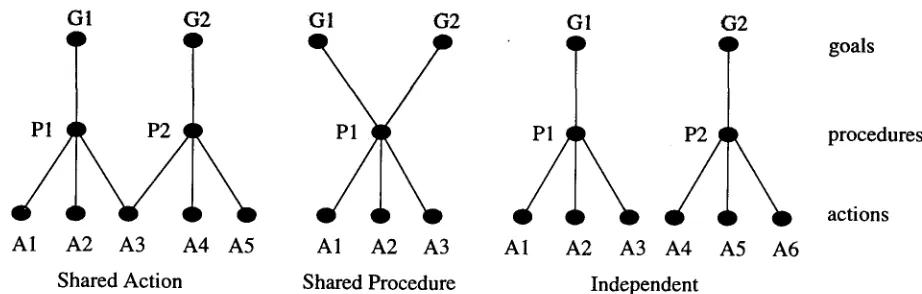
In TraumAID, a plan is a set of procedures, each of which comprises one or more actions. Procedures are used to address diagnostic and therapeutic man- agement goals motivated by what is currently known about the patient. A particular action can partici- pate in more than one procedure, and thus can be used in addressing more t h a n one goal. As noted earlier, T r a u m A I D uses a rule-based reasoner to de- rive a set of relevant goals from the currently avail- able knowledge about the patient and a planner to choose appropriate procedures to address those goals and schedules the actions they involve.
G1 (32 G1 G 2
A1 A2 A3 A4 A5 A1 A2 A3
Shared Action Shared Procedure
Figure h Three possible multiple
G I
q
A1 A2 A3
G 2
A4 A5 A6
Independent
goal-procedure-action configurations
goals
procedures
actions
definitive t r e a t m e n t is not recommended without the results of sufficient evidence from diagnostic tests. 3 These strategies are reflected in the knowledge base by the occurrence of related m a n a g e m e n t goals, such as a goal to diagnose h e m a t u r i a (blood in the urine), which if present, triggers a goal to diagnose bladder injury, which in turn can lead to a goal to treat blad- der injury. Goals that do not participate together in a coherent strategy m a y still be connected by test results. For example, the goal of finding a bullet in the mediastinum leads to doing a lateral chest x-ray. While this might also reveal a fractured sternum, there is no strategic relationship between the goal of finding a bullet in the mediastinum and the goal of treating a fractured sternum.
Once a set of relevant goals has been determined, the planner's choice of how address each goal is based on both local and global considerations. Goals and procedures are linked via a goal-procedure map- ping which lists alternative procedures for address- ing each goal. T h e procedures in a mapping are listed in order of preference so that, all else being equal, the first procedure will be chosen to address the goal. Less preferred procedures m a y be selected if they would result in a globally more optimal (less costly) plan. Figure 1 shows three possible configu- rations for a portion of a plan addressing two goals. (Section 4 discusses the consequences for plan recog- nition, evaluation and critiquing, of the ability to create plans in which actions a n d / o r procedures are shared between goals.)
Actions are scheduled according to both logistical and clinical considerations. Logistical considerations mean that patients are only moved in one direction through the T r a u m a Center - from the emergency center, optionally to the radiology suite, then op- tionally to the operating suite, and finally to the
3The one case where this is not true is when a patient comes in near death, with catastrophic chest wounds. Surgery is recommended immediately, without attempt- ing to diagnose what specific injuries may have been sustained.
t r a u m a unit. Since actions m a y have constraints on where they can be performed, they are scheduled so as to avoid transferring the patient back to a place he has already been.
Clnical considerations have to do with the ur-
gency and priority of each action, which it inher- its from the goals it is being used to address. T h e urgency can be either calastrophic, unstable, or sta- ble, representing the patient's condition and thus the a m o u n t of time available in which to address that goal. Catastrophic goals must be addressed imme- diately. Unstable goals must be addressed before stable goals. Priorities represent standard practices of t r a u m a care: if there are no differences in urgency, problems involving the airway are addressed before those involving breathing, which are addressed be- fore those involving circulation, etc. (the "ABCs of t r a u m a care").
3 I n t e r p r e t i n g a n d R e a c t i n g t o O r d e r s
We have claimed that in patient-centered activities, the effectiveness of a "by-stander" decision-support system depends on focusing its clinical role on the immediate needs of physicians rather than interven- ing with information that, while correct and apro- pos, would not make a significant difference to pa- tient management. In order to achieve this, our approach is largely reactive rather than proactive.
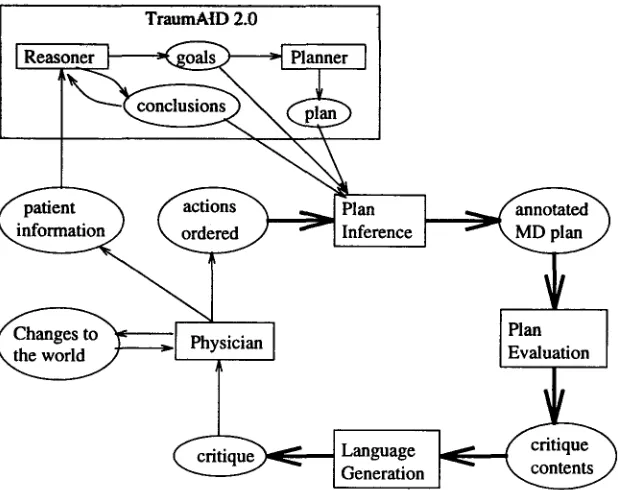
[image:3.612.91.552.72.219.2]T r a u m a T I Q ' s critiquing process is triggered whenever new information is entered by the scribe nurse and delivered to TraumAID. This information can be in the form of (1) bedside findings, (2) di- agnostic test results (indicating both that a diag- nostic action has been performed and what the re- sults of t h a t action were), (3) therapeutic actions performed, or (4) diagnostic or therapeutic actions ordered by the physician. T r a u m a T I Q interprets the physician's orders in a goal-directed manner, using T r a u m A I D ' s representation of goals, procedures and actions, so t h a t the critique can address the likely reasons underlying any discrepancies and can sug- gest alternative means of addressing a particular goal. Figure 2 shows the architecture of T r a u m a - TIQ, comprising plan recognition, plan evaluation,
and critique generation.
3.1 P l a n R e c o g n i t i o n
In order to judge when it is relevant to comment on a physicians orders or lack thereof, it is useful to consider not only what actions have been ordered, but also why. For example, this can allow comments to be withheld if an ordered action that differs from T r a u m A I D ' s choice would nevertheless satisfy perti- nent m a n a g e m e n t goals. T r a u m a T I Q ' s plan recog- nition component aims to infer the underlying goal structure motivating the physician's orders for ac- tions to be performed. Note that this is an example of keyhole recognition, rather than intended recogni- tion (Kautz, 1990). T h e physician does not intend to provide enough information to allow others to infer his plans. Like other members of the t r a u m a team, T r a u m a T I Q must infer the plan incrementally based on what is known about the patient and what has been ordered so far.
T r a u m a m a n a g e m e n t poses particular problems for plan recognition. First, there is no fully pre- set sequence in which actions are ordered and done. Secondly, multiple diagnostic and therapeutic goals m a y simultaneously be active, and a single action can often be used to address several related or un- related goals. In this domain, it would thus be in- correct to simplify search by minimizing the number of top-level goals in the inferred plan, as Kautz and others have proposed (Kautz, 1990). Third, a plan recognition strategy cannot assume t h a t the physi- cian's plan is correct: m a n a g e m e n t of t r a u m a pa- tients must often be done late at night and under time pressure, conditions t h a t can lead to less than optimal decision-making even in trained profession- als. Since the n u m b e r of possible incorrect plans is too large to encode a priori, we must make certain assumptions about physicians' plans:
• T h e head of a t r a u m a team will have expert or near-expert knowledge of t r a u m a , and will usu- ally develop plans t h a t are similar to T r a u m - AID's. Thus, if an action has been ordered t h a t is also in T r a u m A I D ' s plan, T r a u m a T I Q
assumes that it is being done for the same rea- son(s). We call this giving the physician the "benefit of the doubt."
• The physician is more likely to have appropriate goals but be addressing t h e m in a sub-optimal way, than to be pursuing the wrong goals alto- gether.
• While T r a u m A I D follows a conservative strat- egy for pursuing diagnosis and t r e a t m e n t from observations, physicians m a y proceed more rapidly, pursuing a goal that m a y be involved in a current strategy but for which T r a u m A I D does not yet have enough evidence to conclude its relevance. An understanding of the strate- gic relationships between goals should help to recognize examples of this difference.
Reflecting these assumptions, the plan recognition algorithm works as follows:
1. When an action, a, is ordered by the physician, check whether ~ is currently a part of T r a u m - AID's recommended plan as a means of satisfy- ing all or part of goal 7, or all or part of each m e m b e r of a set of goals F.
2. If so, add 3' or F to the representation of the physician's plan.
3. If a is not currently in T r a u m A I D ' s plan, de- termine whether there is a relevant goal t h a t a might address:
(a) If any of the goals t h a t might lead to doing are present in T r a u m A I D ' s current set of active goals, assume t h a t c~ is being done to address t h a t goal or goals.
(b) In the case t h a t there is no relevant goal to explain why the physician is ordering a, check whether any of the possible goals mo- tivating a are part of a currently active di- agnostic strategy (cf. Section 2).
(c) If no relevant goal or strategy is found, leave the goal unspecified and add the in- tention to do a to the representation of the physician's plan with no goal attached. T h e r e is one exception to this rule: (d) If the system only knows of one possible
goal that would lead to performing c~, Trau- m a T I Q assumes t h a t a is being done to address t h a t goal, even though it does not consider the goal to be relevant.
3.2 P l a n E v a l u a t i o n
TraumAtD 2.0
]
(~. patient " ~ ~ l a ( f actions . ~ _ . . ~ n ~
I Generation [ ~ .... ~ /
Figure 2: The TraumaTIQ module
• Omission: A goal that TraumAID considers rel- evant is not being addressed by the physician in a timely manner. This can be further an- alyzed as to whether (1) the goal is not being addressed at all, or (2) the goal is only being partially addressed - some but not
all
the ac- tions in the procedure addressing the goal have been ordered.• C o m m i s s i o n : An action is present in the physi- cian's plan that does not address a relevant goal. If a unique goal can be inferred to explain this discrepancy, that goal can be further catego- rized as to whether (1) it is unwarranted, (2) it is not fully proven, or (3) it has already been addressed.
• Procedure choice: A relevant goal is being ad- dressed, but not using the procedure preferred by TraumAID.
• Scheduling: Actions are not being done in the order recommended by Traumaid, e.g., satisfy- ing urgent goals before non-urgent ones.
TraumaTIQ upholds the Maxim of Relevance by attempting to avoid comments that may later prove irrelevant. Errors of omission are not critiqued until a sufficient period of time has elapsed during which the physician might order the action. The amount of time allowed depends on the urgency of the goal that the action is intended to address - the rule of thumb TraumaTIQ uses is that a comment should be produced after approximately 10% of the time period has passed that is available to address the
goal without significant consequences. Furthermore, comments are only made with respect to goals that cannot be made irrelevant by actions scheduled to be done before those goals are addressed.
Discrepancies of all types are then evaluated in terms of their potential clinical significance. Cur- rently this is only a rough estimate based on ap- proximate cost and whether or not a procedure is invasive. For example, an unnecessary chest x-ray is considered insignificant while an unnecessary (and invasive) laparotomy is considered clinically signif- icant and worth drawing to the physician's atten- tion. We are currently in the process of developing more objective criteria for classifying errors accord- ing to their potential impact on the outcome of the case. Each discrepancy will be classified as either: (1) tolerable, probably harmless, (2) non-critical, but potentially harmful, or (3) critical, potentially fatal. Anything in the second or third category will be con- sidered significant enough to be reported in the cri- tique, while tolerable errors will not be mentioned.
The output of plan evaluation is a set of com- municative goals containing (1) a propositional con- tent (PC) indicating the type of discrepancy and the particular TraumAID concepts involved, and (2) an
illocutionary force (IF), such as URGE, INFOrtM or aEMIND, indicating how the information should be realized linguistically. For example, the goal:
(SUGGEST
(PROCEDURE-CHOICE GET-X-RAY-LAT- ABD
[image:5.612.158.467.73.318.2]P~O-CoMPOUND-FRACTURE-LUMBAR-
VERTESRA))
would be produced in a situation in which the physi- cian has ordered a CT-scan of the abdomen, which T r a u m a T I Q has inferred is intended to address the goal of diagnosing a compound fracture of the lum- bar vertebra, which T r a u m A I D has instead chosen to address with a considerably less costly, less time- consuming lateral abdominal X-ray. T h e illocution- ary force of SUGGEST indicates t h a t this is a non- critical error. Had it been evaluated as a critical error, the illocutionary force would have been URGE.
3.3 C r i t i q u e G e n e r a t i o n
Critique generation serves to organize T r a u m a T I Q ' s communicative goals according to the m a n a g e m e n t goals they address and to translate t h e m into Nat- ural Language utterances. This is currently the least sophisticated part of the process: each I F - P C pair indexes a sentential template with syntactically marked slots to be filled in with the appropriate phrasal translation of a T r a u m A I D concept. For ex- ample, the t e m p l a t e indexed by (SUGGEST, PROCE- DURE CHOICE) is:
" T r a u m A I D suggests (ARG1 GERUN- DIVE) rather t h a n (ARG2 GERUN- DIVE). T h e former is preferred for (ARG3 G E R U N D I V E ) . "
T h e first and second slots are filled in with gerun- dive phrases corresponding to GET-X-RAY-LAW- ABD and GET-CT-SCAN-ABD, while the third slot is filled in with an untensed verb phrase corre- sponding to R,O-COMPOUND-FRACTURE-LUMBAR- VERTEBRA, resulting in the sentence:
" T r a u m A I D suggests getting a lateral X- Ray of the a b d o m e n rather than getting a CT-sean of the abdomen. T h e former is preferred for checking for fracture of the lumbar vertebrae."
Critiques can be delivered directly to the t r a u m a bay through synthesized speech or to the scribe nurse for subsequent delivery to the t r a u m a team.
4
Action Overloading
As mentioned earlier, it is possible for a single action to participate in addressing more than one manage- ment goal. This strategy of doubling-up the use of plan elements is called intention overloading by Pol- lack (Pollack, 1991), who argues t h a t it can simplify the process of computing optimal plans. It can, how- ever, complicate the process of recognizing and eval- uating them. Our strategy in T r a u m a T I Q is to as- sume t h a t overloading occurs in the physician's plan whenever it would be beneficial. In other words, if an action ordered by the physician can be used to ad- dress two or more relevant goals, it is assumed that
that is what the physician intends. This assump- tion makes sense because as long as b o t h goals are being addressed, there is no need to produce a cri- tique, even if the physician did not have b o t h goals in mind.
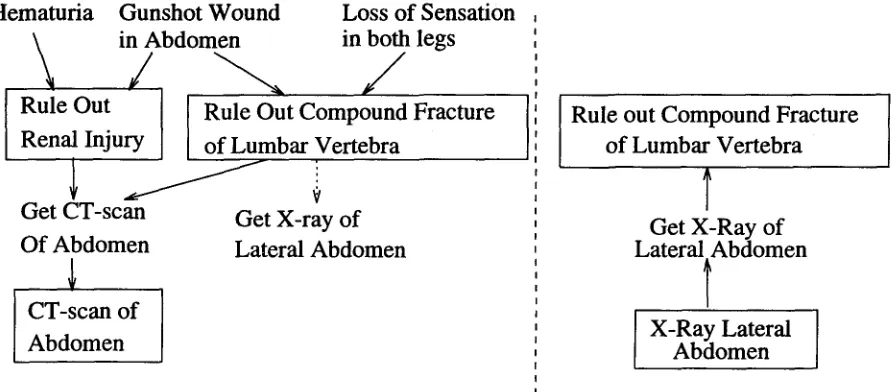
If, on the other hand, there is a possibility for over- loading that the physician does not exploit, it m a y be clinically relevant to mention it. For example, consider a patient with a gunshot wound to the ab- domen, loss of sensation in both legs, and h e m a t u r i a (Figure 3a). From the first two findings, T r a u m A I D derives a goal of diagnosing a c o m p o u n d fracture of the lumbar vertebra, and from the type of wound and the finding of h e m a t u r i a it derives a goal of di-
agnosing
renal injury. Both goals can be addressed by a single abdominal CT-scan.Figure 3b shows the plan t h a t is inferred from the physician's order of a lateral abdominal x-ray, which is appropriate for the goal of diagnosing a fractured vertebra, but not for diagnosing renal injury. In this situation, two points are clinically relevant: (1) the goal of diagnosing renal injury should be addressed, and (2) both goals can be addressed with the single action of an abdominal CT-scan, obviating the need to do an X-ray to address one'of them. In this case a comment such as the following would be produced:
" T r a u m A I D suggests getting an abdominal CT-scan rather t h a n a lateral abdominal X-ray. T h e former can be used b o t h to di- agnose renal injury and to diagnose a com- pound fracture of the lumbar vertebrae."
5
Conclusion
We have presented an approach to information de- livery during patient-centered activities, in which a health care provider's ( H C P ) attention is on his or her patient and not on a computer screen. As well as potential applications to other areas of medical care, the idea of restricting the o u t p u t of a decision- support system to clinically relevant information can be generalized to other task-centered activities, such as repair or construction, in which the person for whom the system o u t p u t is intended is focused on performing a task rather t h a n on the system.
Hematuria Gunshot Wound
Loss of Sensation
in Abdomen
in both
legs
I Rule Out
I
Rule
Out Compound Fracture
Renal Injury
of Lumbar Vertebra
Get CT-scan
Get
X-ray of
Of Abdomen
Lateral Abdomen
CT-scan of
Abdomen
a) TraumAID's plan with overloading
Rule
out Compound Fracture
of Lumbar Vertebra
Get X-Ray of
Lateral Abdomen
X-Ray Lateral
Abdomen
b) Inferred plan after ordering X-ray
Figure 3: Inferring a plan with overloading
Even though this validation has not yet been done, we believe this paper has independent value in (1) pointing out additional constraints on language gen- eration raised by the desire to convey information to listeners attending to something other than an com- puter terminal, and (2) pointing out some features of plan inference and evaluation raised by multiple goal planning in a complex domain.
References
Clarke, J.R., Rymon, R., Webber, B., Hayward, C., Santora, T., Wagner, D. and Ruffin, A. The Im- portance of Planning in the Provision of Medical Care. Medical Decision Making 13(4), October- December 1993, p. 383 (abstract).
Clarke, J.R., Webber, B., Niv, M., Rymon, R., Gert- ner, A. and Kaye, J. The Care of Injured Pa- tients: An architecture of Medical Knowledge.
Der Chirurg (Special issue on surgical decision- making), to appear April 1994.
Gertner, A. Ongoing Critiquing During Trauma Management. Proc. A A A I Spring Symposium on Artificial Intelligence in Medicine: Interpreting Clinical Data, Stanford CA, March 1994.
Gertner, A. Responding to Users' Informational Needs in Time-Critical Situations Proc. 4th Inter- national Conference on User Modeling, Hyannis, MA, August 1994.
Grice, H.P. Logic and Conversation. In H.P. Grice,
Studies in the Way of Words. Cambridge MA: Harvard University Press, 1975. Reprinted in S. David (ed.) Pragmatics: A reader. Oxford: Ox- ford University Press, 1991, pp. 305-315,
Kautz, H. A circumscriptive theory of plan recog- nition. In Jerry Morgan Philip R. Cohen and Martha E. Pollack, editors, Intentions in Com- munication. Bradford Books, 1990.
Langlotz, C. P. and Shortliffe, E. H. Adapting a con- sultation system to critique user plans. Interna- tional Journal of Man-Machine Studies, 19:479- 496, 1983.
Miller, P. L. Expert Critiquing Systems: Practice- Based Medical Consultation by Computer. New York: Springer-Verlag, 1986.
Pollack, M. Overloading Intentions for Efficient Practical Reasoning. N6us XXV(4), 1991, pp. 513- 536.
Rymon, R. Diagnostic Reasoning and Planning in Exploratory-Corrective Domains. PhD Disserta- tion. Dept. Computer & Information Science, U. Pennsylvania, November 1993. (Appears as Tech- nical Report MS-CIS-93-84).
Rymon, R., Webber, B. L. and Clarke, J. R., Progressive Horizon Planning - Planning Exploratory-Corrective Behavior. IEEE Transac- tions on Systems, Man, and Cybernetics 23(6). Special issue on Planning, Scheduling and Con- trol, November 1993.
Sperber, D. and Wilson, D. Relevance: communi- cation and cognition. Harvard University Press, Cambridge, Mass., 1986.
[image:7.612.97.544.75.271.2]