On the Computational Complexity of Dominance Links
in Grammatical Formalisms
Sylvain Schmitz
LSV, ENS Cachan & CNRS, France [email protected]
Abstract
Dominance links were introduced in grammars to model long distance scram-bling phenomena, motivating the defi-nition of multiset-valued linear indexed grammars(MLIGs) by Rambow (1994b), and inspiring quite a few recent for-malisms. It turns out that MLIGs have since been rediscovered and reused in a variety of contexts, and that the complex-ity of their emptiness problem has become the key to several open questions in com-puter science. We survey complexity sults and open issues on MLIGs and re-lated formalisms, and provide new com-plexity bounds for some linguistically mo-tivated restrictions.
1 Introduction
Scrambling constructions, as found in German and other SOV languages (Becker et al., 1991; Ram-bow, 1994a; Lichte, 2007), cause notorious diffi-culties to linguistic modeling in classical grammar formalisms like HPSG or TAG. A well-known il-lustration of this situation is given in the following two German sentences for “that Peter has repaired the fridge today” (Lichte, 2007),
dass [Peter] heute [den K¨uhlschrank] repariert hat that Peternomtoday the fridgeacc repaired has dass [den K¨uhlschrank] heute [Peter] repariert hat that the fridgeacc today Peternomrepaired has with a flexible word order between the two com-plements ofrepariert, namely between the nomi-nativePeterand the accusativeden K¨uhlschrank.
Rambow (1994b) introduced a formalism, un-ordered vector grammars with dominance links (UVG-dls), for modeling such phenomena. These grammars are defined by vectors of context-free productions along with dominance links that
VP
NPnom VP
VP
NPacc VP
VP
V
repariert
Figure 1: A vector of productions for the verb reparierttogether with its two complements.
should be enforced during derivations; for in-stance, Figure 1 shows how a flexible order be-tween the complements of repariert could be ex-pressed in an UVG-dl. Similar dominance mecha-nisms have been employed in various tree descrip-tion formalisms (Rambow et al., 1995; Rambow et al., 2001; Candito and Kahane, 1998; Kallmeyer, 2001; Guillaume and Perrier, 2010) and TAG ex-tensions (Becker et al., 1991; Rambow, 1994a).
However, the prime motivation for this survey is another grammatical formalism defined in the same article:multiset-valued linear indexed gram-mars (Rambow, 1994b, MLIGs), which can be seen as a low-level variant of UVG-dls that uses multisets to emulate unfulfilled dominance links in partial derivations. It is a natural extension of Petri nets, with broader scope than just UVG-dls; indeed, it has been independently rediscovered by de Groote et al. (2004) in the context of linear logic, and by Verma and Goubault-Larrecq (2005) in that of equational theories. Moreover, the decid-ability of its emptiness problem has proved to be quite challenging and is still uncertain, with sev-eral open questions depending on its resolution:
• provability in multiplicative exponential lin-ear logic (de Groote et al., 2004),
• emptiness and membership of abstract cat-egorial grammars (de Groote et al., 2004; Yoshinaka and Kanazawa, 2005),
• emptiness and membership of Stabler (1997)’s minimalist grammars without
shortest move constraint (Salvati, 2010), • satisfiability of first-order logic on data
trees (Boja´nczyk et al., 2009), and of course • emptiness and membership for the various
formalisms that embed UVG-dls.
Unsurprisingly in the light of their importance in different fields, several authors have started in-vestigating the complexity of decisions problems for MLIGs (Demri et al., 2009; Lazi´c, 2010). We survey the current state of affairs, with a particular emphasis on two points:
1. the applicability of complexity results to UVG-dls, which is needed if we are to con-clude anything on related formalisms with dominance links,
2. the effects of two linguistically motivated re-strictions on such formalisms, lexicalization and boundedness/rankedness.
The latter notion is imported from Petri nets, and turns out to offer interesting new complex-ity trade-offs, as we prove thatk-boundedness and
k-rankedness are EXPTIME-complete for MLIGs, and that the emptiness and membership problems are EXPTIME-complete fork-bounded MLIGs but PTIME-complete in thek-ranked case. This also implies an EXPTIME lower bound for emptiness and membership in minimalist grammars with shortest move constraint.
We first define MLIGs formally in Section 2 and review related formalisms in Section 3. We pro-ceed with complexity results in Section 4 before concluding in Section 5.
Notations In the following,Σdenotes a finite al-phabet,Σ∗the set of finite sentences overΣ, andε
the empty string. The length of a stringwis noted |w|, and the number of occurrence of a symbola
inwis noted|w|a. A language is formalized as a
subset ofΣ∗. Let Nn denote the set of vectors of
positive integers of dimensionn. Thei-th compo-nent of a vectorxinNnisx(i),0denotes the null
vector,1the vector with 1 values, andei the
vec-tor with 1 as itsi-th component and0everywhere else. The ordering≤onNnis the componentwise
ordering: x≤yiffx(i) ≤y(i)for all0< i≤n. The size of a vector refers to the size of its binary encoding:|x|=Pni=11 + max(0,blog2x(i)c).
We refer the reader unfamiliar with complex-ity classes and notions such as hardness or LOGSPACEreductions to classical textbooks (e.g. Papadimitriou, 1994).
2 Multiset-Valued Linear Indexed Grammars
Definition 1 (Rambow, 1994b). An n -dimensionalmultiset-valued linear indexed gram-mar (MLIG) is a tuple G = hN,Σ, P,(S,x0)i whereNis a finite set of nonterminal symbols,Σa finite alphabet disjoint fromN,V = (N×Nn)]Σ
the vocabulary, P a finite set of productions in
(N ×Nn)×V∗, and(S,x0) ∈ N ×Nnthe start
symbol. Productions are more easily written as
(A,x)→u0(B1,x1)u1· · ·um(Bm,xm)um+1 (?)
with eachuiinΣ∗ and each(Bi,xi)inN ×Nn.
Thederivationrelation⇒over sequences inV∗
is defined by
δ(A,y)δ0 ⇒δu0(B1,y1)u1· · ·um(Bm,ym)um+1δ0
ifδ andδ0are inV∗, a production of form (?) ap-pears inP,x≤ y, for each1 ≤i ≤ m,xi ≤yi,
andy−x=Pm
i=1yi−xi.
The languageof a MLIG is the set of terminal strings derived from(S,x0), i.e.
L(G) ={w∈Σ∗|(S,x0)⇒∗ w}
and we denote by L(MLIG) the class of MLIG languages.
Example 2. To illustrate this definition, and its relevance for free word order languages, consider the 3-dimensional MLIG with productions
(S,0)→ε|(S,1), (S,e1)→a(S,0),
(S,e2)→b(S,0), (S,e3)→c(S,0)
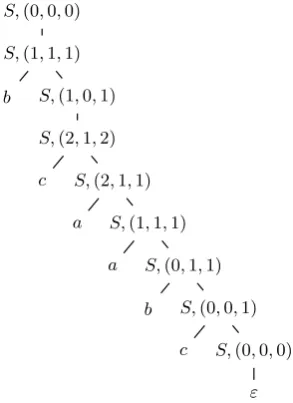
and start symbol(S,0). It generates the MIX lan-guage of all sentences with the same number ofa,
b, andc’s (see Figure 2 for an example derivation):
Lmix={w∈ {a, b, c}∗ | |w|a=|w|b=|w|c}.
Thesize|G|of a MLIGGis essentially the sum of the sizes of each of its productions of form (?):
|x0|+
X
P
m+ 1 +|x|+
m X
i=1 |xi|+
m+1
X
i=0 |ui|
!
.
2.1 Normal Forms
A MLIG is in extended two form(ETF) if all its productions are of form
S,(0,0,0)
S,(1,1,1)
b S,(1,0,1)
S,(2,1,2)
c S,(2,1,1)
a S,(1,1,1)
a S,(0,1,1)
b S,(0,0,1)
c S,(0,0,0)
[image:3.595.107.254.65.267.2]ε
Figure 2: A derivation forbcaabcin the grammar of Example 2.
nonterminal (A,x) → (B1,x1)(B2,x2) or
(A,x)→(B1,x1),
withainΣ,A,B1,B2 inN, andx,x1,x2 inNn.
Using standard constructions, any MLIG can be put into ETF in linear time or logarithmic space.
A MLIG is in restricted index normal form (RINF) if the productions in P are of form
(A,0) → α, (A,0) → (B,ei), or (A,ei) →
(B,0), with A, B in N, 0 < i ≤ n, and α in
(Σ∪(N×{0}))∗. The direct translation into RINF proposed by Rambow (1994a) is exponential if we consider a binary encoding of vectors, but using techniques developed for Petri nets (Dufourd and Finkel, 1999), this blowup can be avoided:
Proposition 3. For any MLIG, one can construct an equivalent MLIG in RINF in logarithmic space.
2.2 Restrictions
Two restrictions on dominance links have been suggested in an attempt to reduce their complex-ity, sometimes in conjunction: lexicalization and
k-boundedness. We provide here characterizations for them in terms of MLIGs. We can combine the two restrictions, thus defining the class of k -bounded lexicalized MLIGs.
Lexicalization Lexicalization in UVG-dls re-flects the strong dependence between syntactic constructions (vectors of productions representing an extended domain of locality) and lexical an-chors. We define here a restriction of MLIGs with similar complexity properties:
Definition 4. A terminal derivationα⇒p wwith w in Σ∗ isc-lexicalized for some c > 0 if p ≤
c·|w|.1 A MLIG islexicalizedif there existscsuch that any terminal derivation starting from(S,x0)is
c-lexicalized, and we denote byL(MLIG`)the set
of lexicalized MLIG languages.
Looking at the grammar of Example 2, any ter-minal derivation(S,0)⇒p wverifiesp= 4·|w|
3 +
1, and the grammar is thus lexicalized.
Boundedness As dominance links model long-distance dependencies, bounding the number of simultaneously pending links can be motivated on competence/performance grounds (Joshi et al., 2000; Kallmeyer and Parmentier, 2008), and on complexity/expressiveness grounds (Søgaard et al., 2007; Kallmeyer and Parmentier, 2008; Chi-ang and Scheffler, 2008). Theshortest move con-straint(SMC) introduced by Stabler (1997) to en-force a strong form of minimality also falls into this category of restrictions.
Definition 5. A MLIG derivation α0 ⇒ α1 ⇒ · · · ⇒αpis ofrankkfor somek≥0if, no vector
with a sum of components larger thankcan appear in anyαj, i.e. for allxinNnsuch that there exist
0 ≤ j ≤ p, δ, δ0 inV∗ and Ain N with αj = δ(A,x)δ0, one hasPni=1x(i)≤k.
A MLIG is k-ranked (noted kr-MLIG) if any derivation starting withα0 = (S,x0)is of rankk. It isrankedif there existsksuch that it isk-ranked.
A 0-ranked MLIG is simply a context-free grammar (CFG), and we have more generally the following:
Lemma 6. Anyn-dimensionalk-ranked MLIGG can be transformed into an equivalent CFGG0 in timeO(|G| ·(n+ 1)k3).
Proof. We assumeGto be in ETF, at the expense of a linear time factor. Each A in N is then mapped to at most(n+ 1)k nonterminals (A,y)
inN0 = N ×Nn withPni=1y(i) ≤ k. Finally, for each production(A,x) → (B1,x1)(B2,x2)of
P, at most(n+ 1)k3 choices are possible for pro-ductions (A,y) → (B1,y1)(B2,y2) with (A,y),
(B1,y1), and(B2,y2)inN0.
A definition quite similar to k-rankedness can be found in the Petri net literature:
1This restriction is slightly stronger than that of
Definition 7. A MLIG derivation α0 ⇒ α1 ⇒ · · · ⇒ αp is k-bounded for some k ≥ 0 if, no
vector with a coordinate larger thankcan appear in anyαj, i.e. for allxinNnsuch that there exist
0 ≤ j ≤ p, δ, δ0 inV∗ and A inN with αj = δ(A,x)δ0, and for all1≤i≤n, one hasx(i)≤k. A MLIG is k-bounded (noted kb-MLIG) if any derivation starting with α0 = (S,x0) is k -bounded. It isbounded if there existsksuch that it isk-bounded.
The SMC in minimalist grammars translates ex-actly into 1-boundedness of the corresponding MLIGs (Salvati, 2010).
Clearly, anyk-ranked MLIG is alsok-bounded, and conversely any n-dimensional k-bounded MLIG is(kn)-ranked, thus a MLIG is ranked iff it is bounded. The counterpart to Lemma 6 is:
Lemma 8. Anyn-dimensional k-bounded MLIG G can be transformed into an equivalent CFGG0 in timeO(|G| ·(k+ 1)n2).
Proof. We assumeGto be in ETF, at the expense of a linear time factor. Each A in N is then mapped to at most(k+ 1)nnonterminals(A,y)in
N0 =N× {0, . . . , k}n. Finally, for each
produc-tion (A,x) → (B1,x1)(B2,x2) of P, each non-terminal(A,y)ofN0 withx≤ y, and each index
0 < i ≤ n, there are at mostk+ 1ways to split
(y(i)−x(i)) ≤ k into y1(i) +y2(i) and span a production(A,y) → (B1,x1+y1)(B2,x2 +y2) ofP0. Overall, each production is mapped to at most(k+ 1)n2 context-free productions.
One can check that the grammar of Example 2 is not bounded (to see this, repeatedly apply produc-tion (S,0) → (S,1)), as expected since MIX is not a context-free language.
2.3 Language Properties
Let us mention a few more results pertaining to MLIG languages:
Proposition 9 (Rambow, 1994b). L(MLIG) is a substitution closed full abstract family of lan-guages.
Proposition 10(Rambow, 1994b). L(MLIG`)is
a subset of the context-sensitive languages.
Natural languages are known for displaying some limited cross-serial dependencies, as wit-nessed in linguistic analyses, e.g. of Swiss-German (Shieber, 1985), Dutch (Kroch and
San-torini, 1991), or Tagalog (Maclachlan and Ram-bow, 2002). This includes the copy language
Lcopy ={ww|w∈ {a, b}∗},
which does not seem to be generated by any MLIG:
Conjecture 11(Rambow, 1994b). Lcopy is not in L(MLIG).
Finally, we obtain the following result as a con-sequence of Lemmas 6 and 8:
Corollary 12. L(kr-MLIG) = L(kb-MLIG) =
L(kb-MLIG`)is the set of context-free languages.
3 Related Formalisms
We review formalisms connected to MLIGs, start-ing in Section 3.1 with Petri nets and two of their extensions, which turn out to be exactly equiva-lent to MLIGs. We then consider various linguis-tic formalisms that employ dominance links (Sec-tion 3.2).
3.1 Petri Nets
Definition 13(Petri, 1962). A marked Petri net2 is a tuple N = hS, T, f,m0i whereS andT are disjoint finite sets of places and transitions, f a flow function from(S ×T)∪(T × S)toN, and
m0 an initial marking inNS. A transitiont ∈ T
can be fired in a marking m in NS if f(p, t) ≥
m(p) for all p ∈ S, and reaches a new marking m0 defined by m0(p) = m(p)−f(p, t) +f(t, p)
for allp ∈ S, writtenm [ti m0. Another view is that place p holds m(p) tokens, f(p, t) of which are first removed when firing t, and then f(t, p)
added back. Firings are extended to sequencesσ
inT∗ by m [εi m, and m [σti m0 if there exists m00withm[σim00[tim0.
AlabeledPetri net with reachability acceptance is endowed with a labeling homomorphism ϕ : T∗ → Σ∗ and a finite acceptance set F ⊆ NS,
defining the language (Peterson, 1981)
L(N, ϕ, F) ={ϕ(σ)∈Σ∗| ∃m∈F,m0 [σim}.
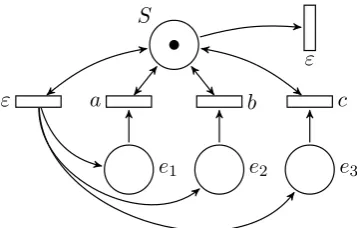
Labeled Petri nets (with acceptance set{0}) are notational variants ofright linearMLIGs, defined as having production in(N×Nn)×(Σ∗∪(Σ∗·(N× Nn))). This is is case of the MLIG of Example 2,
which is given in Petri net form in Figure 3, where
2Petri nets are also equivalent to
S
e1 e2 e3
a b c
ε
[image:5.595.91.270.61.175.2]ε
Figure 3: The labeled Petri net corresponding to the right linear MLIG of Example 2.
circles depict places (representing MLIG nonter-minals and indices) with black dots for initial to-kens (representing the MLIG start symbol), boxes transitions (representing MLIG productions), and arcs the flow values. For instance, production
(S,e3) → c(S,0)is represented by the rightmost,
c-labeled transition, with f(S, t) = f(e3, t) =
f(t, S) = 1andf(e1, t) = f(e2, t) = f(t, e1) =
f(t, e2) =f(t, e3) = 0.
Extensions The subsumption of Petri nets is not innocuous, as it allows to derive lower bounds on the computational complexity of MLIGs. Among several extensions of Petri net with some branch-ing capacity (see e.g. Mayr, 1999; Haddad and Poitrenaud, 2007), two are of singular importance: It turns out that MLIGs in their full generality have since been independently rediscovered under the namesvector addition tree automata(de Groote et al., 2004, VATA) andbranching VASS(Verma and Goubault-Larrecq, 2005, BVASS).
Semilinearity Another interesting consequence of the subsumption of Petri nets by MLIGs is that the former generate some non semilinear lan-guages, i.e. with a Parikh image which is not a semilinear subset ofN|Σ|(Parikh, 1966). Hopcroft
and Pansiot (1979, Lemma 2.8) exhibit an exam-ple of a VASS with a non semilinear reachability set, which we translate as a 2-dimensional right linear MLIG with productions3
(S,e2)→(S,e1), (S,0)→(A,0)|(B,0),
(A,e1)→(A,2e2), (A,0)→a(S,0),
(B,e1)→b(B,0)|b, (B,e2)→b(B,0)|b
3Adding terminal symbolscin each production would
re-sult in a lexicalized grammar, still with a non semilinear lan-guage.
S
ε
S
S S
a S
S
b S
S
c S
Figure 4: An UVG-dl forLmix.
and(S,e2)as start symbol, that generates the non semilinear language
Lnsm ={anbm |0≤n,0< m≤2n}.
Proposition 14 (Hopcroft and Pansiot, 1979).
There exist non semilinear Petri nets languages.
The non semilinearity of MLIGs entails that of all the grammatical formalisms mentioned next in Section 3.2; this answers in particular a conjecture by Kallmeyer (2001) about the semilinearity of V-TAGs.
3.2 Dominance Links
UVG-dl Rambow (1994b) introduced UVG-dls as a formal model for scrambling and tree descrip-tion grammars.
Definition 15 (Rambow, 1994b). An unordered vector grammars with dominance links(UVG-dl) is a tupleG = hN,Σ, W, Si whereN andΣare disjoint finite sets of nonterminals and terminals,
V =N ∪Σis the vocabulary,W is a set of vec-tors of productions with dominance links, i.e. each element ofW is a pair(P, D)where eachP is a multiset of productions inN×V∗ andDis a re-lation from nonterminals in the right parts of pro-ductions in P to nonterminals in their left parts, andSinN is the start symbol.
Aterminal derivationofwinΣ∗in an UVG-dl is a context-free derivation of formS =⇒p1 α1
p2
=⇒
α2· · ·αp−1
pp
=⇒ w such that the control word
p1p2· · ·pp is a permutation of a member of W∗
and the dominance relations ofW hold in the as-sociated derivation tree. The language L(G) of an UVG-dlGis the set of sentenceswwith some terminal derivation. We writeL(UVG-dl)for the class of UVG-dl languages.
S → S in the second vector has to spawn even-tually one occurrence of eachS → aS,S → bS, and S → cS, which corresponds exactly to the MLIG of Example 2.
The ease of translation from the grammar of Figure 4 into a MLIG stems from the impossi-bility of splitting any of its vectors (P, D) into two nonempty ones(P1, D1) and(P2, D2) while preserving the dominance relation, i.e. withP = P1]P2andD=D1]D2. Thisstrictnessproperty can be enforced without loss of generality since we can always add to each vector (P, D) a pro-duction S → S with a dominance link to each production inP. This was performed on the sec-ond vector in Figure 4; remark that the grammar without this addition is anunordered vector gram-mar (Cremers and Mayer, 1974, UVG), and still generatesLmix.
Theorem 16(Rambow, 1994b). Every MLIG can be transformed into an equivalent UVG-dl in log-arithmic space, and conversely.
Proof sketch. One can check that Rambow (1994b)’s proof of L(MLIG) ⊆ L(UVG-dl)
incurs at most a quadratic blowup from a MLIG in RINF, and invoke Proposition 3. More pre-cisely, given a MLIG in RINF, productions of form (A,0) → α with A in N and α in
(Σ ∪ (N × {0}))∗ form singleton vectors, and productions of form (A,0) → (B,ei) with A, B
in N and 0 < i ≤ n need to be paired with a production of form (C,ei) → (D,0) for some C and D in N in order to form a vector with a dominance link betweenBandC.
The converse inclusion and its complexity are immediate when considering strict UVG-dls.
The restrictions to k-ranked and k-bounded grammars find natural counterparts in strict UVG-dls by bounding the (total) number of pending dominance links in any derivation. Lexicaliza-tion has now its usual definiLexicaliza-tion: for every vec-tor({pi,1, . . . , pi,ki}, Di)inW, at least one of the
pi,jshould contain at least one terminal in its right
part—we have thenL(UVG-dl`)⊆ L(MLIG`).
More on Dominance Links Dominance links are quite common in tree description formalisms, where they were already in use in D-theory (Mar-cus et al., 1983) and in quasi-tree semantics for fb-TAGs (Vijay-Shanker, 1992). In particular, D-tree substitution grammars are essentially the same as UVG-dls (Rambow et al., 2001), and quite a few
other tree description formalisms subsume them (Candito and Kahane, 1998; Kallmeyer, 2001; Guillaume and Perrier, 2010). Another class of grammars are vector TAGs (V-TAGs), which ex-tend TAGs and MCTAGs using dominance links (Becker et al., 1991; Rambow, 1994a; Champol-lion, 2007), subsuming again UVG-dls.
4 Computational Complexity
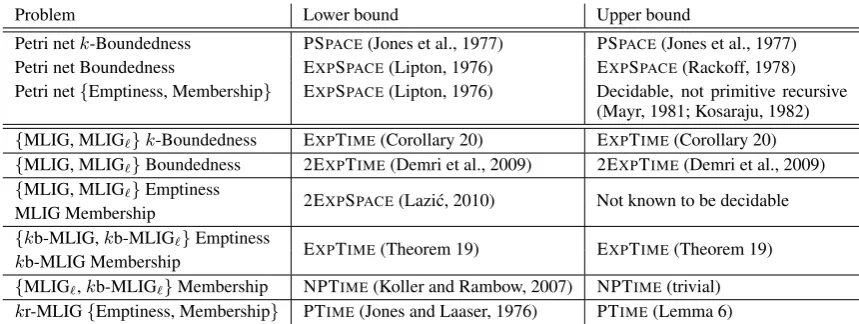
We study in this section the complexity of sev-eral decision problems on MLIGs, prominently of emptiness and membership problems, in the general (Section 4.2), k-bounded (Section 4.3), and lexicalized cases (Section 4.4). Table 1 sums up the known complexity results. Since by The-orem 16 we can translate between MLIGs and UVG-dls in logarithmic space, the complexity re-sults on UVG-dls will be the same.
4.1 Decision Problems
Let us first review some decision problems of interest. In the following, G denotes a MLIG hN,Σ, P,(S,x0)i:
boundedness givenhGi, isG bounded? As seen in Section 2.2, this is equivalent to ranked-ness.
k-boundedness given hG, ki, k in N, is G k
-bounded? As seen in Section 2.2, this is the same as(kn)-rankedness. Here we will dis-tinguish two cases depending on whetherkis encoded in unary or binary.
coverability givenhG, Fi,Gε-free in ETF andF
a finite subset ofN×Nn, does there existα=
(A1,y1)· · ·(Am,ym)in(N×Nn)∗such that
(S,x0) ⇒∗ αand for each0< j ≤mthere exists(Aj,xj)inF withxj ≤yj?
reachability givenhG, Fi,Gε-free in ETF andF
a finite subset of N ×Nn, does there exist α = (A1,y1)· · ·(Am,ym) in F∗ such that
(S,x0)⇒∗ α?
non emptiness givenhGi, isL(G)non empty?
(uniform) membership given hG, wi, w in Σ∗, doeswbelong toL(G)?
analysis one might want to perform on a gram-mar, and is needed for parsing as intersection approaches (Lang, 1994), while membership re-duces to parsing. Note that we only consider uni-form membership, since grammars for natural lan-guages are typically considerably larger than input sentences, and their influence can hardly be ne-glected.
There are several obvious reductions between reachability, emptiness, and membership. Let →log denote LOGSPACE reductions between de-cision problems; we have:
Proposition 17.
coverability→log reachability (1) ↔log non emptiness (2) ↔log membership (3) Proof sketch. For (1), construct a reachability in-stancehG0,{(E,0)}ifrom a coverability instance hG, Fiby adding to Ga fresh nonterminalE and the productions
{(A,x)→(E,0)|(A,x)∈F} ∪ {(E,ei)→(E,0)|0< i≤n}.
For (2), from a reachability instancehG, Fi, re-move all terminal productions fromGand add in-stead the productions{(A,x)→ ε|(A,x) ∈F}; the new grammarG0 has a non empty language iff the reachability instance was positive. Conversely, from a non emptiness instancehGi, put the gram-mar in ETF and defineFto match all terminal pro-ductions, i.e.F ={(A,x) |(A,x) →a∈P, a∈
Σ∪{ε}}, and then remove all terminal productions in order to obtain a reachability instancehG0, Fi.
For (3), from a non emptiness instancehGi, re-place all terminals in G by εto obtain an empty word membership instance hG0, εi. Conversely, from a membership instancehG, wi, construct the intersection grammarG0withL(G0) =L(G)∩{w}
(Bar-Hillel et al., 1961), which serves as non emptiness instancehG0i.
4.2 General Case
Verma and Goubault-Larrecq (2005) were the first to prove that coverability and boundedness were decidable for BVASS, using a covering tree con-struction `a la Karp and Miller (1969), thus of non primitive recursive complexity. Demri et al. (2009, Theorems 7, 17, and 18) recently proved tight complexity bounds for these problems, ex-tending earlier results by Rackoff (1978) and Lip-ton (1976) for Petri nets.
Theorem 18 (Demri et al., 2009). Coverabil-ity and boundedness for MLIGs are 2EXPTIME -complete.
Regarding reachability, emptiness, and mem-bership, decidability is still open. A 2EXPSPACE lower bound was recently found by Lazi´c (2010). If a decision procedure exists, we can expect it to be quite complex, as already in the Petri net case, the complexity of the known decision procedures (Mayr, 1981; Kosaraju, 1982) is not primitive re-cursive (Cardoza et al., 1976, who attribute the idea to Hack).
4.3 k-Bounded andk-Ranked Cases
Since k-bounded MLIGs can be converted into CFGs (Lemma 8), emptiness and membership problems are decidable, albeit at the expense of an exponential blowup. We know from the Petri net literature that coverability and reachability prob-lems are PSPACE-complete for k-bounded right linear MLIGs (Jones et al., 1977) by a reduc-tion fromlinear bounded automaton(LBA) mem-bership. We obtain the following fork-bounded MLIGs, using a similar reduction from member-ship in polynomially space bounded alternating Turing machines(Chandra et al., 1981, ATM):
Theorem 19. Coverability and reachability fork -bounded MLIGs areEXPTIME-complete, even for fixedk≥1.
The lower bound is obtained through an encod-ing of an instance of the membership problem for ATMs working in polynomial space into an in-stance of the coverability problem for1-bounded MLIGs. The upper bound is a direct application of Lemma 8, coverability and reachability being reducible to the emptiness problem for a CFG of exponential size. Theorem 19 also shows the EX -PTIME-hardness of emptiness and membership in minimalist grammars with SMC.
Corollary 20. Let k ≥ 1; k-boundedness for MLIGs isEXPTIME-complete.
Proof. For the lower bound, consider an instance hG, Fi of coverability for a1-bounded MLIG G, which is EXPTIME-hard according to Theorem 19. Add to the MLIGGa fresh nonterminalEand the productions
{(A,x)→(E,x)|(A,x)∈F} ∪ {(E,0)→(E,ei)|0< i≤n},
Problem Lower bound Upper bound
Petri netk-Boundedness PSPACE(Jones et al., 1977) PSPACE(Jones et al., 1977) Petri net Boundedness EXPSPACE(Lipton, 1976) EXPSPACE(Rackoff, 1978) Petri net{Emptiness, Membership} EXPSPACE(Lipton, 1976) Decidable, not primitive recursive
(Mayr, 1981; Kosaraju, 1982) {MLIG, MLIG`}k-Boundedness EXPTIME(Corollary 20) EXPTIME(Corollary 20)
{MLIG, MLIG`}Boundedness 2EXPTIME(Demri et al., 2009) 2EXPTIME(Demri et al., 2009)
{MLIG, MLIG`}Emptiness
2EXPSPACE(Lazi´c, 2010) Not known to be decidable MLIG Membership
{kb-MLIG,kb-MLIG`}Emptiness
EXPTIME(Theorem 19) EXPTIME(Theorem 19) kb-MLIG Membership
{MLIG`,kb-MLIG`}Membership NPTIME(Koller and Rambow, 2007) NPTIME(trivial)
[image:8.595.83.513.61.223.2]kr-MLIG{Emptiness, Membership} PTIME(Jones and Laaser, 1976) PTIME(Lemma 6) Table 1: Summary of complexity results.
For the upper bound, apply Lemma 8 withk0 = k+ 1to construct anO(|G| ·2n2log2(k0+1))-sized
CFG, reduce it in polynomial time, and check whether a nonterminal (A,x) with x(i) = k0 for some0< i≤noccurs in the reduced grammar.
Note that the choice of the encoding ofkis ir-relevant, ask= 1is enough for the lower bound, andkonly logarithmically influences the exponent for the upper bound.
Corollary 20 also implies the EXPTIME -completeness of k-rankedness, k encoded in unary, ifkcan take arbitrary values. On the other hand, ifkis known to be small, for instance log-arithmic in the size of G, then k-rankedness be-comes polynomial by Lemma 6.
Observe finally thatk-rankedness provides the only tractable class of MLIGs for uniform mem-bership, using again Lemma 6 to obtain a CFG of polynomial size—actually exponential in k, but k is assumed to be fixed for this problem. An obvious lower bound is that of membership in CFGs, which is PTIME-complete (Jones and Laaser, 1976).
4.4 Lexicalized Case
Unlike the high complexity lower bounds of the previous two sections, NPTIME-hardness results for uniform membership have been proved for a number of formalisms related to MLIGs, from the commutative CFG viewpoint (Huynh, 1983; Bar-ton, 1985; Esparza, 1995), or from more spe-cialized models (Søgaard et al., 2007; Champol-lion, 2007; Koller and Rambow, 2007). We fo-cus here on this last proof, which reduces from thenormal dominance graph configurability prob-lem (Althaus et al., 2003), as it allows to derive
NPTIME-hardness even in highly restricted gram-mars.
Theorem 21 (Koller and Rambow, 2007). Uni-form membership of hG, wi for G a 1-bounded, lexicalized, UVG-dl with finite language is NPTIME-hard, even for|w|= 1.
Proof sketch. SetSas start symbol and add a pro-ductionS → aAto the sole vector of the gram-marGconstructed by Koller and Rambow (2007) from a normal dominance graph, with dominance links to all the other productions. ThenGbecomes strict, lexicalized, with finite language {a} or ∅, and 1-bounded, such thatabelongs toL(G)iff the normal dominance graph is configurable.
The fact that uniform membership is in NPTIME in the lexicalized case is clear, as we only need to guess nondeterministically a deriva-tion of size linear in|w|and check its correctness. The weakness of lexicalized grammars is how-ever that their emptiness problem is not any eas-ier to solve! The effect of lexicalization is indeed to break the reduction from emptiness to member-ship in Proposition 17, but emptiness is as hard as ever, which means that static checks on the gram-mar might even be undecidable.
5 Conclusion
Conjecture 11 and the decidability of reachabil-ity in MLIGs? A similar question, whether the language Lpal of even 2-letters palindromes was a Petri net language, was indeed solved using the decidability of reachability in Petri nets (Jantzen, 1979), and shown to be strongly related to the lat-ter (Lambert, 1992).
A conclusion with a more immediate linguis-tic value is that MLIGs and UVG-dls hardly qual-ify as formalisms formildly context-sensitive lan-guages, claimed by Joshi (1985) to be adequate for modeling natural languages, and “roughly” de-fined as the extensions of context-free languages that display
1. support for limited cross-serial dependen-cies: seems doubtful, see Conjecture 11,
2. constant growth, a requisite nowadays re-placed by semilinearity: does not hold, as seen with Proposition 14, and
3. polynomial recognition algorithms: holds only for restricted classes of grammars, as seen in Section 4.
Nevertheless, variants such as k-ranked V-TAGs are easily seen to fulfill all the three points above.
Acknowledgements Thanks to Pierre Cham-bart, St´ephane Demri, and Alain Finkel for helpful discussions, and to Sylvain Salvati for pointing out the relation with minimalist grammars.
References
Ernst Althaus, Denys Duchier, Alexander Koller, Kurt Mehlhorn, Joachim Niehren, and Sven Thiel. 2003. An efficient graph algorithm for dominance con-straints. Journal of Algorithms, 48(1):194–219.
Yehoshua Bar-Hillel, Micha Perles, and Eliahu Shamir. 1961. On formal properties of simple phrase struc-ture grammars. Zeitschrift f¨ur Phonetik,
Sprachwis-senschaft und Kommunikationsforschung, 14:143–
172.
G. Edward Barton. 1985. The computational difficulty of ID/LP parsing. In ACL’85, pages 76–81. ACL Press.
Tilman Becker, Aravind K. Joshi, and Owen Rambow. 1991. Long-distance scrambling and tree adjoining grammars. InEACL’91, pages 21–26. ACL Press.
Mikołaj Boja´nczyk, Anca Muscholl, Thomas Schwentick, and Luc Segoufin. 2009. Two-variable logic on data trees and XML reasoning.
Journal of the ACM, 56(3):1–48.
Marie-H´el`ene Candito and Sylvain Kahane. 1998. Defining DTG derivations to get semantic graphs.
InTAG+4, pages 25–28.
E. Cardoza, Richard J. Lipton, and Albert R. Meyer. 1976. Exponential space complete problems for Petri nets and commutative semigroups: Preliminary report. InSTOC’76, pages 50–54. ACM Press.
Lucas Champollion. 2007. Lexicalized non-local MC-TAG with dominance links is NP-complete. InMOL 10.
Ashok K. Chandra, Dexter C. Kozen, and Larry J. Stockmeyer. 1981. Alternation. Journal of the ACM, 28(1):114–133.
David Chiang and Tatjana Scheffler. 2008. Flexible composition and delayed tree-locality. InTAG+9.
Armin B. Cremers and Otto Mayer. 1974. On vec-tor languages.Journal of Computer and System
Sci-ences, 8(2):158–166.
Philippe de Groote, Bruno Guillaume, and Sylvain Sal-vati. 2004. Vector addition tree automata. In
LICS’04, pages 64–73. IEEE Computer Society.
St´ephane Demri, Marcin Jurdzi´nski, Oded Lachish, and Ranko Lazi´c. 2009. The covering and bound-edness problems for branching vector addition sys-tems. In Ravi Kannan and K. Narayan Kumar, edi-tors,FSTTCS’09, volume 4 ofLeibniz International
Proceedings in Informatics, pages 181–192. Schloss
Dagstuhl–Leibniz-Zentrum f¨ur Informatik.
Catherine Dufourd and Alain Finkel. 1999. A polyno-mialλ-bisimilar normalization for reset Petri nets.
Theoretical Computer Science, 222(1–2):187–194.
Javier Esparza. 1995. Petri nets, commutative context-free grammars, and basic parallel processes. In Horst Reichel, editor,FCT’95, volume 965 of
Lec-ture Notes in Computer Science, pages 221–232.
Springer.
Bruno Guillaume and Guy Perrier. 2010. Interaction grammars. Research on Language and Computa-tion. To appear.
Serge Haddad and Denis Poitrenaud. 2007. Recursive Petri nets.Acta Informatica, 44(7–8):463–508.
John Hopcroft and Jean-Jacques Pansiot. 1979. On the reachability problem for 5-dimensional vector addition systems. Theoretical Computer Science, 8(2):135–159.
Dung T. Huynh. 1983. Commutative grammars: the complexity of uniform word problems. Information
and Control, 57(1):21–39.
Matthias Jantzen. 1979. On the hierarchy of Petri net languages. RAIRO Theoretical Informatics and
Neil D. Jones and William T. Laaser. 1976. Complete problems for deterministic polynomial time.
Theo-retical Computer Science, 3(1):105–117.
Neil D. Jones, Lawrence H. Landweber, and Y. Ed-mund Lien. 1977. Complexity of some problems in Petri nets. Theoretical Computer Science, 4(3):277– 299.
Aravind K. Joshi, Tilman Becker, and Owen Rambow. 2000. Complexity of scrambling: A new twist to the competence-performance distinction. In Anne Abeill´e and Owen Rambow, editors, Tree Adjoin-ing Grammars. Formalisms, LAdjoin-inguistic Analysis and
Processing, chapter 6, pages 167–181. CSLI
Publi-cations.
Aravind K. Joshi. 1985. Tree-adjoining grammars: How much context sensitivity is required to provide reasonable structural descriptions? In David R. Dowty, Lauri Karttunen, and Arnold M. Zwicky, editors, Natural Language Parsing: Psychological,
Computational, and Theoretical Perspectives,
chap-ter 6, pages 206–250. Cambridge University Press.
Laura Kallmeyer and Yannick Parmentier. 2008. On the relation between multicomponent tree adjoining grammars with tree tuples (TT-MCTAG) and range concatenation grammars (RCG). In Carlos Mart´ın-Vide, Friedrich Otto, and Henning Fernau, editors,
LATA’08, volume 5196 of Lecture Notes in
Com-puter Science, pages 263–274. Springer.
Laura Kallmeyer. 2001. Local tree description gram-mars. Grammars, 4(2):85–137.
Richard M. Karp and Raymond E. Miller. 1969. Par-allel program schemata. Journal of Computer and
System Sciences, 3(2):147–195.
Alexander Koller and Owen Rambow. 2007. Relating dominance formalisms. InFG’07.
S. Rao Kosaraju. 1982. Decidability of reachability in vector addition systems. InSTOC’82, pages 267– 281. ACM Press.
Anthony S. Kroch and Beatrice Santorini. 1991. The derived constituent structure of the West Germanic verb-raising construction. In Robert Freidin, editor,
Principles and Parameters in Comparative Gram-mar, chapter 10, pages 269–338. MIT Press.
Jean-Luc Lambert. 1992. A structure to decide reach-ability in Petri nets. Theoretical Computer Science, 99(1):79–104.
Bernard Lang. 1994. Recognition can be harder than parsing. Computational Intelligence, 10(4):486– 494.
Ranko Lazi´c. 2010. The reachability problem for branching vector addition systems requires doubly-exponential space. Manuscript.
Timm Lichte. 2007. An MCTAG with tuples for co-herent constructions in German. InFG’07.
Richard Lipton. 1976. The reachability problem re-quires exponential space. Technical Report 62, Yale University.
Anna Maclachlan and Owen Rambow. 2002. Cross-serial dependencies in Tagalog. In TAG+6, pages 100–107.
Mitchell P. Marcus, Donald Hindle, and Margaret M. Fleck. 1983. D-theory: talking about talking about trees. InACL’83, pages 129–136. ACL Press.
Ernst W. Mayr. 1981. An algorithm for the general Petri net reachability problem. InSTOC’81, pages 238–246. ACM Press.
Richard Mayr. 1999. Process rewrite systems.
Infor-mation and Computation, 156(1–2):264–286.
Christos H. Papadimitriou. 1994. Computational
Complexity. Addison-Wesley.
Rohit J. Parikh. 1966. On context-free languages.
Journal of the ACM, 13(4):570–581.
James L. Peterson. 1981. Petri Net Theory and the
Modeling of Systems. Prentice Hall.
Carl A. Petri. 1962. Kommunikation mit Automaten. Ph.D. thesis, University of Bonn.
Charles Rackoff. 1978. The covering and boundedness problems for vector addition systems. Theoretical
Computer Science, 6(2):223–231.
Owen Rambow, K. Vijay-Shanker, and David Weir. 1995. D-tree grammars. InACL’95, pages 151–158. ACL Press.
Owen Rambow, David Weir, and K. Vijay-Shanker. 2001. D-tree substitution grammars.
Computa-tional Linguistics, 27(1):89–121.
Owen Rambow. 1994a. Formal and Computational
Aspects of Natural Language Syntax. Ph.D. thesis,
University of Pennsylvania.
Owen Rambow. 1994b. Multiset-valued linear in-dex grammars: imposing dominance constraints on derivations. InACL’94, pages 263–270. ACL Press.
Sylvain Salvati. 2010. Minimalist grammars in the light of logic. Manuscript.
Stuart M. Shieber. 1985. Evidence against the context-freeness of natural language. Linguistics and
Phi-losophy, 8(3):333–343.
Anders Søgaard, Timm Lichte, and Wolfgang Maier. 2007. The complexity of linguistically moti-vated extensions of tree-adjoining grammar. In
RANLP’07, pages 548–553.
Edward P. Stabler. 1997. Derivational minimalism. In Christian Retor´e, editor,LACL’96, volume 1328 of
Lecture Notes in Computer Science, pages 68–95.
Kumar Neeraj Verma and Jean Goubault-Larrecq. 2005. Karp-Miller trees for a branching extension of VASS. Discrete Mathematics and Theoretical
Com-puter Science, 7(1):217–230.
K. Vijay-Shanker. 1992. Using descriptions of trees in a tree adjoining grammar. Computational Linguis-tics, 18(4):481–517.
Ryo Yoshinaka and Makoto Kanazawa. 2005. The complexity and generative capacity of lexicalized abstract categorial grammars. In Philippe Blache, Edward Stabler, Joan Busquets, and Richard Moot, editors,LACL’05, volume 3492 ofLecture Notes in