Development of Sharp
f
011
gh
211
i
Textured Silver Substrate
for Superconducting Tapes
Zheng-Rong Zhang
*and Kazuyoshi Sekine
Department of Energy and Safety Engineering, Yokohama National University, Yokohama 240-8501, Japan
Texture formation in pure silver was investigated in order to obtain sharply Brassf011gh211itype textured silver sheet that can be used as a substrate for Y-123 superconducting coated tapes without any buffer layers.
The feature of recrystallization texture after the two-step annealing appeared as two peaks close to Gossf011gh100iorientation and Brass f011gh211iorientation respectively with other weak components along-fiber in specimens rolled at room temperature, and only one peak close to Brassf011gh211iorientation with weak components limited to cube orientation, rotated cube orientation and orientation close to Copper f112gh111iorientation in those warm rolled at 150C. By using the improved metallurgical processing, a very sharp Brassf011gh211itype
texture has been successfully realized in specimen, which was cast in vacuum, warm rolled by 92% at 150C and subsequently annealed as
200C–20 min + 800C–180 min in nitrogen. There are some critical conditions on the formation of sharp Brass f011gh211i type
recrystallization texture: a low oxygen content in the starting material, elevated rolling temperature, and the selection of lower primary recrystallization temperature of two-step annealing process.
(Received September 2, 2004; Accepted December 27, 2004)
Keywords: high temperature superconductor, silver substrate, Brass type texture, warm rolling, recrystallization texture, two-step annealing, low stacking fault energy (SFE) face-centered-cubic (f.c.c.) metal.
1. Introduction
Since the discovery of high-temperature superconductivity in cuprate materials, world-wide effects have been focused on research and development of making wires or tapes of HTS (high-temperature superconductor) with highJc(critical
current density). However, two intrinsic material problems,
i.e. weak intragrain pinning and weak intergrain coupling, have slowed down the progress towards fabricating these materials into useful form with acceptable superconducting properties. The origin of weak intragrain pinning is structural in nature and can be overcome by chemical substitution and incorporation of defects. Early studies show that the high-angle grain boundaries acting as Josephson coupled weak links are the origin of degradation in Jc of polycrystalline
material compared to that of single crystal. It is likely that the variation inJcwith grain boundary misorientation is similar
in the mostly studied superconducting compounds such as Tl-1223, Hg-1223 and Y-123. Accordingly, the control of grain boundary misorientation to achieve low-angle boundaries distribution is a very important procedure in fabricating HTS with highJc.
Among the many techniques on overcoming the grain boundary weak link problem, such as IBAD (ion beam-assisted deposition), PLD (pulsed laser deposition) and RABiTS (rolling-assisted—biaxially textured substrates) of thin film route, LPE (liquid phase epitaxy) and spray pyrolysis of thick film route, there is a common issue of how to achieve a sharp silver texture of the correct form considering the basic substrate property requirements as flexibility, texture, similar thermal expansion coefficient to the superconducting phase, lattice-matching, chemical com-patibility, and limited oxidation at processing temperatures.1) Due to its low SFE (stacking fault energy), the particular
characteristic of silver is that its textures, as both deformed and recrystallized states, are quite different from those of regular f.c.c. (face-centered-cubic) metals, such as alumi-num, nickel and copper. Therefore, it is considerably more difficult to get single sharp texture in silver. After Hu’s early study on the texture transition in pure silver, many recent research works have been concentrated mainly on achieving single orientation in the texture of silver substrate.2–10) An
advanced sharply cube-textured silver substrate was success-fully obtained by simple warm rolling and subsequently annealing in our previous work.11)All those endeavors have
promoted the possibility for silver substrate to be used in high-temperature superconductors. Although the cube-tex-turedf001gh100isilver has been widely used in the attempt of making Tl-1223 and Nd-123 films, its drawback of generally giving two biaxial orientations often introduces high-angle grain boundaries acting as weak links in making the most popular high-Tcsuperconducting Y-123 film.12–16)
The present understanding suggests that {011} textured silver is most suitable as a substrate for obtaining the biaxially aligned Y-123 among various textures of silver.9) Rotated Goss f011gh011i type textured silver tape has been successfully used to get biaxially aligned Y-123.17) Brass
f011gh211itype textured silver substrate has also been tried in making Y-123 film, but the texture was neither sharp nor stable.18,19)Suoet al.have proposed an optimized method to
get pure and stable f011gh211i textured silver ribbon with long length and the model on the formation of Brass
f011gh211i texture in silver explained by twinning mecha-nism.7) Following this, Doi et al. reported their work on
making Brassf011gh211itype textured silver tape.13)In our work on warm rolling and subsequent annealing in silver, a very sharp Brassf011gh211itype texture with high intensity in ODF but with trace of other components was obtained. The metallurgical processing will be detailed in this paper. *Graduate Student, Yokohama National University
2. Experimental Procedure
Silver ingots of commercial purity were obtained by casting in vacuum. After homogenization at 600C for 2
hours in nitrogen, pre-rolling in reduction in thickness at about 40% and annealing with 500C–60 min were carried
out to get random samples. Final rolling was conducted at room temperature and 150C. For warm rolling, the silver
sheet was pre-heated to the desired temperature in oil bath before each pass. Hence it is considered that the exact temperature of rolling was likely subjected to some decreas-es. At corresponding reductions in thickness of 80%, 92%, 95% and 99% on rolling, samples were cut off and then annealed in nitrogen for recrystallization, followed by slow cooling.
The X-ray incomplete pole figures of those deformed and annealed specimens were then measured by means of the back reflection method with filtered Cu-K radiation to a
maximum tilt angle¼75. From three measured
incom-plete pole figures ({111}, {100} and {110}), the recalculated pole figures and reliable orientation distribution functions (ODFs) were calculated using the iterative series expansion method, which has been originally proposed by Dahms and Bunge20,21)and modified by Inoueet al.22)
3. Experimental Results and Discussion
3.1 Rolling texture
The deformation texture feature of 150C warm rolled silver sheet was reported in our previous work.11)The warm rolling textures consisted of Brass f011gh211i, Copper
f112gh111i, Sf123gh412iand cubef001gh100icomponents and the shifts from ideal position with the increase of rolling reduction in thickness could be observed. A considerable intensity of cube component was obtained due to the extensive partial recrystallization occurring during rolling at elevated temperature.
The rolling textures commonly obtained in silver sheet rolled at room temperature consist of Brass f011gh211i
orientation and Gossf011gh100iorientation. Figure 1 shows ’2¼0and’2¼45ODF sections and {111} pole figure of
deformation texture of specimen cast in vacuum and rolled at room temperature to 95% reduction in thickness. In this
figure, Bunge’s notation for the Euler angles is employed. It can be seen that the texture isf011gh12;5;5iorientation with weak Gossf011gh100icomponent.
3.2 Recrystallization texture
A strong cube f001gh100i type texture was achieved by warm rolling and subsequent annealing in our previous work.11)It is stable at 700C. However, the texture turned to
strong f011gh533i type with trace of cube f001gh100i
orientation after additional annealing 850C–480 min in
specimen, which was cast in air, warm rolled by 95% at
150C and subsequently annealed as 150C–10 min +
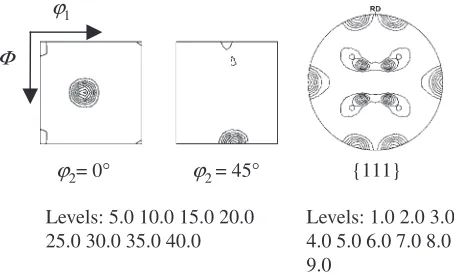
500C–30 min in nitrogen. As presented in Fig. 2 of
’2¼0 and ’2¼45 ODF sections and {111} pole figure
of this recrystallization texture, the maximum intensities in ODF and pole figure are 41.82 and 9.21 respectively. Doiet al.reported a Brassf011gh211itype textured silver tape made by cold rolling and annealing 850C-600 min in argon.13)It
was suggested in the work of Suoet al.that a first stage of fast temperature ramp up to 500C would help the grain growth
in f011gh211i orientation during the second stage of high temperature annealing.7)Therefore, two-step annealing
processes of 500C–30 min + 850C–300 min and 500C–
30 min + 850C–480 min were initially employed on
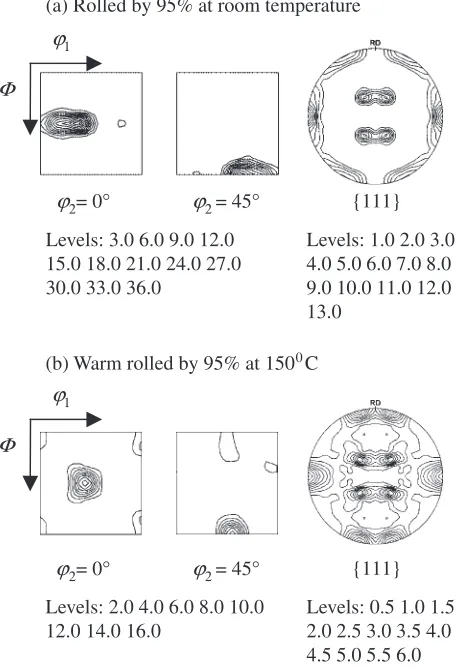
[image:2.595.314.541.76.213.2]speci-mens rolled at room temperature and 150C in this study. Figure 3 shows the ’2¼0 and ’2¼45 ODF sections
and {111} pole figure of recrystallization texture after two-step annealing 500C–30 min + 850C–300 min in
speci-mens cast in vacuum. For the specimen rolled by 95% at room temperature, the texture component is Brassf011gh211i
orientation with weakf011gh499icomponent. For the speci-men warm rolled by 95% at 150C, the texture component is f011gh533i orientation with weak cube f001gh100i,
f029gh092i(WTD-cube orientation rotated around transverse
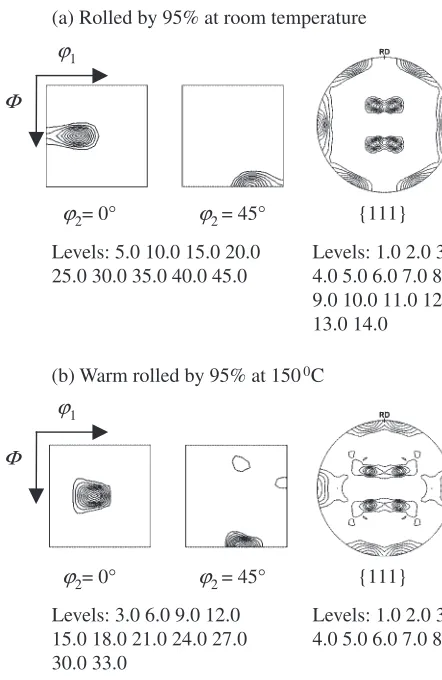
direction) andf5;5;11gh11;11;10icomponents. As indicated in Fig. 4 of the ’2¼0 and ’2 ¼45 ODF sections and
{111} pole figure of recrystallization texture after two-step annealing 500C–30 min + 850C–480 min in specimens
cast in vacuum, where the annealing time of second step was prolonged to 480 minutes, Gossf011gh100icomponent appeared with Brassf011gh211iorientation as majority and
f011gh477i orientation as minority in specimen rolled by
ϕ 2= 0° ϕ 2 = 45° {111}
ϕ 1
Φ
Levels: 2.0 4.0 6.0 8.0 10.0 12.0 14.0 16.0 18.0
Levels: 0.5 1.0 1.5 2.0 2.5 3.0 3.5 4.0 4.5 5.0 5.5
Fig. 1 ’2¼0 and ’2¼45 ODF sections and {111} pole figure of
rolling texture of specimen cast in vacuum and rolled at room temperature to 95% reduction in thickness.
ϕ2= 0° ϕ 2 = 45° {111}
ϕ 1
Φ
Levels: 5.0 10.0 15.0 20.0 25.0 30.0 35.0 40.0
Levels: 1.0 2.0 3.0 4.0 5.0 6.0 7.0 8.0 9.0
Fig. 2 ’2¼0 and ’2¼45 ODF sections and {111} pole figure of
recrystallization texture of specimen cast in air, warm rolled by 95% at 150C and subsequently annealed as 150C–10 min + 500C–30 min +
[image:2.595.55.285.609.747.2]95% at room temperature while texture components were simplified as main component of f011gh533i and minor component off029gh092iin specimen warm rolled by 95% at 150C. It should be pointed out that the intensities in ODFs
and pole figures increased remarkably after extending high temperature annealing.
3.3 Discussion on texture formation
The recrystallization textures in silver shown above were definitely influenced by the impurity content, in particular oxygen content, rolling condition and annealing procedure. Actually, a pretty sharp and pure Y f111gh112i type recrystallization texture, which is often observed in deformed b.c.c. (body-centered-cubic) materials, was obtained in specimen, which was cast in air, warm rolled by 92% at
150C and subsequently annealed as 150C–10 min +
500C–30 min + 850C–480 min (shown in Fig. 5). For the
specimens cast in vacuum, warm rolled and subsequently annealed according to the two-step annealing processes in last section, their recrystallization texture feature of one strong peak close to Brass f011gh211i orientation along -fiber with some weak components was always preserved no matter what kind of reduction in thickness was selected from 80%, 92%, 95% and 99%. An example of 95% warm rolled specimen has been shown in Fig. 3(b) and Fig. 4(b). It can be
suggested that the Brass f011gh211i type texture could be obtained in a wide range of reduction in thickness in warm rolled specimens if the oxygen content was reduced by the utilizing of improved casting method.
Rolling texture has a significant effect on the formation of recrystallization texture. There are two totally different
ϕ 2= 0° ϕ 2 = 45° {111}
ϕ 1
Φ
(a) Rolled by 95% at room temperature
Levels: 3.0 6.0 9.0 12.0 15.0 18.0 21.0 24.0 27.0 30.0 33.0 36.0
Levels: 1.0 2.0 3.0 4.0 5.0 6.0 7.0 8.0 9.0 10.0 11.0 12.0 13.0
ϕ 2= 0° ϕ 2 = 45° {111}
ϕ 1
Φ
(b) Warm rolled by 95% at 150 C0
Levels: 2.0 4.0 6.0 8.0 10.0 12.0 14.0 16.0
Levels: 0.5 1.0 1.5 2.0 2.5 3.0 3.5 4.0 4.5 5.0 5.5 6.0
Fig. 3 ’2¼0 and ’2¼45 ODF sections and {111} pole figure of
recrystallization texture after two-step annealing 500C–30 min + 850C–
300 min in specimens cast in vacuum. (a) rolled by 95% at room temperature, (b) warm rolled by 95% at 150C.
ϕ 2= 0° ϕ 2 = 45° {111}
ϕ 1
Φ
(a) Rolled by 95% at room temperature
Levels: 5.0 10.0 15.0 20.0 25.0 30.0 35.0 40.0 45.0 50.0
Levels: 2.0 4.0 6.0 8.0 10.0 12.0 14.0 16.0
ϕ 2= 0° ϕ 2 = 45° {111}
ϕ 1
Φ
(b) Warm rolled by 95% at 150 C
Levels: 3.0 6.0 9.0 12.0 15.0 18.0 21.0 24.0 27.0 30.0
Levels: 1.0 2.0 3.0 4.0 5.0 6.0 7.0 8.0 9.0
0
Fig. 4 ’2¼0 and ’2¼45 ODF sections and {111} pole figure of
recrystallization texture after two-step annealing 500C–30 min + 850C–
480 min in specimens cast in vacuum. (a) rolled by 95% at room temperature, (b) warm rolled by 95% at 150C.
ϕ 1
Φ
ϕ 2= 0° ϕ 2 = 45° {111}
Levels: 2.0 4.0 6.0 8.0 10.0 12.0 14.0 16.0
Levels: 0.5 1.0 1.5 2.0 2.5 3.0 3.5 4.0 4.5
Fig. 5 ’2¼0 and ’2¼45 ODF sections and {111} pole figure of
recrystallization texture of specimen cast in air, warm rolled by 92% at 150C and subsequently annealed as 150C–10 min + 500C–30 min +
[image:3.595.305.541.73.413.2] [image:3.595.56.284.77.411.2] [image:3.595.313.541.494.637.2]patterns of recrystallization texture that can be detected after the two-step annealing processes of 500C–30 min + 850C–
300 min and 500C–30 min + 850C–480 min in specimens
rolled at room temperature and those warm rolled at 150C.
For the former, the recrystallization texture feature appeared as two peaks close to Gossf011gh100iorientation and Brass
f011gh211iorientation respectively with other weak compo-nents along -fiber. The intensities of these two peaks changed with the reductions in thickness applied, and in some cases the intensity of the peak close to Goss f011gh100i
orientation was even higher than that of the peak close to Brass f011gh211i orientation. For the latter, only one peak close to Brassf011gh211i position can be found under any reduction in thickness, and the weak components were limited to cube orientation, rotated cube orientation and orientation close to Copperf112gh111iposition, all of which
did not belong to -fiber. These results can be partly
attributed to the origin of their rolling textures as shown in Fig. 1 and in our previous work.
4. Improved Metallurgical Processing to Obtain Single
f011gh211iBrass Orientation Texture in Silver Sub-strate
The mechanism of stable {011} recrystallization texture
formation was supposed to be a selective grain growth in which the {011} grains nucleate during the primary recrys-tallization and grow preferentially by consuming other orientated grains due to their preponderant grain boundary mobility.23) In other words, a secondary recrystallization
process is responsible for the formation of strong Brass
f011gh211i orientated grains. Therefore, one of the key procedures for achieving a sharp Brass f011gh211i type texture is the control of the nucleation of {011} grains, which are likely to grow along h211i direction during the high temperature annealing. However, as discussed in the front part no satisfying experimental result of recrystallization texture was obtained after two-step annealing processes of 500C–30 min + 850C–300 min and 500C–30 min +
850C–480 min. It has been pointed out in the work by Huet al. that complete recrystallization has almost fully taken place after annealing at 200C in deformed silver specimen.4)
This has also been confirmed in our previous work on warm rolled and subsequent annealed silver sheet. Therefore, we believe that a lower first step annealing temperature around
200C is more reasonable to be used in the two-step
annealing process to get appropriate secondary recrystalliza-tion nuclei. Accordingly, an improved metallurgical process-ing of two-step annealprocess-ing 200C–20 min + 800C–180 min was suggested in this study.
ϕ 1
Φ
ϕ 2= 0° ϕ 2 = 45° {111}
(a) Rolled by 95% at room temperature
Levels: 5.0 10.0 15.0 20.0 25.0 30.0 35.0 40.0 45.0
Levels: 1.0 2.0 3.0 4.0 5.0 6.0 7.0 8.0 9.0 10.0 11.0 12.0 13.0 14.0
ϕ 1
Φ
ϕ 2= 0° ϕ 2 = 45° {111}
(b) Warm rolled by 95% at 150 C0
Levels: 3.0 6.0 9.0 12.0 15.0 18.0 21.0 24.0 27.0 30.0 33.0
Levels: 1.0 2.0 3.0 4.0 5.0 6.0 7.0 8.0
Fig. 6 ’2¼0 and ’2¼45 ODF sections and {111} pole figure of
recrystallization texture after two-step annealing 200C–20 min + 800C–
180 min in specimens cast in vacuum. (a) rolled by 95% at room temperature, (b) warm rolled by 95% at 150C.
ϕ 1
Φ
ϕ 2= 0° ϕ 2 = 45° {111}
(a) Warm rolled by 80% at 150 C0
Levels: 2.0 4.0 6.0 8.0 10.0 12.0 14.0 16.0 18.0 20.0 22.0 24.0 26.0 28.0
Levels: 1.0 2.0 3.0 4.0 5.0 6.0 7.0 8.0 9.0
ϕ 1
Φ
ϕ 2= 0° ϕ 2 = 45° {111}
(b) Warm rolled by 99% at 150 C0
Levels: 5.0 10.0 15.0 20.0 25.0 30.0 35.0 40.0 45.0 50.0 55.0
Levels: 2.0 4.0 6.0 8.0 10.0 12.0 14.0
Fig. 7 ’2¼0 and ’2¼45 ODF sections and {111} pole figure of
recrystallization texture after two-step annealing 200C-20 min + 800
C-180 min in specimens cast in vacuum. (a) warm rolled by 80% at 150C,
[image:4.595.53.274.70.410.2] [image:4.595.312.542.74.412.2]As shown in Fig. 6 of the ’2¼0 and ’2¼45 ODF
sections and {111} pole figure of recrystallization texture after two-step annealing 200C–20 min + 800C–180 min, f011gh522i orientation in specimen rolled by 95% at room temperature and f011gh533i orientation with weak Copper
f112gh111icomponent in specimen warm rolled by 95% at 150C are obtained respectively. Although only one peak is
obtained in the specimen rolled by 95% at room temperature,
strong -fiber with more than one peak was obtained in
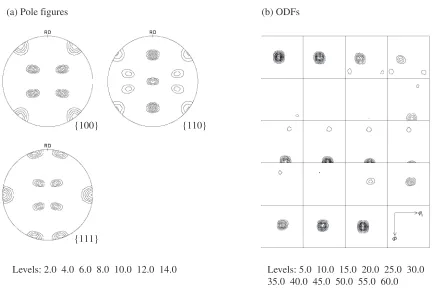
specimens under other rolling reductions in thickness. On the other hand, a main peak close to Brass orientation with weak components limited to TD-rotated cube orientation and orientation close to Copperf112gh111iposition was found in warm rolled specimens under other rolling reductions in thickness. A very sharp f011gh955i texture with maximum intensities of 62.43 in ODFs and 15.22 in pole figure, which is only three degrees rotation around normal direction from exact Brass f011gh211i position, was realized in specimen
cast in vacuum, warm rolled by 92% at 150C and
subsequently annealed as 200C–20 min + 800C–180 min.
These results are demonstrated in Fig. 7 and Fig. 8. Com-pared to the result by Suoet al.,7)the Brassf011gh211itype
recrystallization texture obtained by our improved metal-lurgical processing are much more simple. Only trace of
f2;2;11gh1;10;2iorientation can be detected when the ODF and pole figures are plotted with lower contour levels. It is worth to point out that the fact that the only one strong peak very close to exact Brassf011gh211iposition can be achieved in a wide range of rolling reduction in thickness under improved metallurgical processing indicates the feasibility and reliability of this method of making Brass f011gh211i
type textured silver substrate for superconducting tapes.
5. Conclusions
A practical way of making sharply Brassf011gh211itype textured silver substrate for superconducting tapes by means of warm rolling and subsequent improved two-step annealing has been presented in this study.
It has been confirmed by the experimental facts that the Brassf011gh211itype recrystallization texture development of pure silver was significantly affected by the rolling temperature, impurity content, especially oxygen content, and the selection of primary annealing temperature. By using the improved metallurgical processing, a very sharp Brass type texture has been successfully obtained in a specimen which was cast in vacuum, warm rolled by 92% at 150C and
subsequently annealed for 20 minutes at 200C and for 180 minutes at 800C in nitrogen. As the sharp Brassf011gh211i
type texture can be realized in a wide range of rolling reduction in thickness, this new technology presents a more promising way in developing single Brass f011gh211i type textured metallic substrates which are highly favorable for wires or tapes of high temperature superconductors.
Acknowledgements
The authors would like to acknowledge Professor Kazuhiko Endou of Health Sciences University of Hokkaido for his help on preparing ingots and Mr. Kazuto Okayasu of Department of Metallurgical Engineering, Yokohama Na-tional University for his assistance on rolling performance.
{100} {110}
{111}
(a) Pole figures (b) ODFs
Levels: 2.0 4.0 6.0 8.0 10.0 12.0 14.0 Levels: 5.0 10.0 15.0 20.0 25.0 30.0 35.0 40.0 45.0 50.0 55.0 60.0
Fig. 8 Recalculated pole figures and ODF map of recrystallization texture after two-step annealing 200C–20 min + 800C–180 min in
[image:5.595.81.514.67.366.2]REFERENCES
1) J. L. MacManus-Driscoll: Annu. Rev. Mater. Sci.28(1998) 421–462. 2) H. Hu and R. S. Cline: J. Appl. Phys.32(1961) 760–763.
3) H. Hu, R. S. Cline, and S. R. Goodman: J. Appl. Phys.32(1961) 1392– 1399.
4) H. Hu, R. S. Cline, and S. R. Goodman: Trans. Metall. Soc. AIME224
(1962) 96–105.
5) R. E. Smallman: J. Inst. Metals84(1955) 10–18.
6) H. Suo, J-Y. Genoud, G. Triccone, E. Walker, M. Schindl, R. Passerini, F. Cleton, M. Zhou and R. Flukiger: Supercond. Sci. Technol. 12
(1999) 624–832.
7) H. Suo, J-Y. Genoud, M. Schindl, E. Walker, T. Tybell, F. Cleton, M. Zhou and R. Flukiger: Supercond. Sci. Technol.13(2000) 912–919. 8) J. J. Wells, J. L. MacManus-Driscoll, J.-Y. Genoud, H. L. Suo, E.
Walker and R. Flukiger: Supercond. Sci. Technol.13(2000) 1390– 1398.
9) T. Doi, Y. Hakuraku, N. Kashima and S. Nagaya: Physica C372–376
(2002) 775–778.
10) T. Doi, N. Sugiyama, T. Yuasa, T. Ozawa, K. Higashiyama, S. Kikuchi and K. Osamura; in: H. Hayakawa, Y. Enomoto (Eds.),Advance in Superconductivity VII, (Springer-Verlag, 1996), pp. 903–906. 11) Z.-R. Zhang and K. Sekine: Mater. Trans.45(2004) 2653–2656.
12) T. Doi, Y. Hakuraku, K. Higashiyama, H. Akata, K. Osamura, N. Kashima, S. Nagaya: IEEE Trans. Appl. Supercond.11(2001), 3130– 3133.
13) T. Doi, M. Mori, H. Shimohigashi, Y. Hakuraku, K. Onabe, M. Okada, N. Kashima and S. Nagaya: Physica C378–381(2002) 927–931. 14) N. Sugiyama, Y. Yuasa, T. Ozawa, K. Higashiyama and K. Osamura:
Proc. of the 9th Int. Symp. on Superconductivity ISS’96, Sapporo (Adv in Supercond.), 1997, Vol. 9, pp. 927–930.
15) N. Sugiyama, T. Doi, T. Yuasa, H. Akata, T. Ozawa, K. Higashiyama, S. Kikuchi and K. Osamura: J. Japan Inst. Metals61(1997) 985–991. 16) J. D. Budai, R. T. Young and B. S. Chao: Appl. Phys. Lett.62(1993)
1836–1838.
17) K. Onabe, T. Doi, N. Kashima, S. Nagaya and T. Saitoh: Physica C
378–381(2002) 907–910.
18) R. Wang, Y. Zhou, S. Pan, M. He and Z. Chen: Physics C328(1999) 37–43.
19) M. Zhou, H. Guo, D. M. Liu, T. Y. Zou, L. H. Zhai, Y. L. Zhou, R. P. Wang, S. H. Pan and H. H. Wang: Physics C337(2000) 101–105. 20) M. Dahms and H. J. Bunge: Texture and Microstructures7(1987) 171–
185.