Robust Multilingual Statistical Morphological Generation Models
Ondˇrej Dušek and Filip Jurˇcíˇcek
Charles University in Prague, Faculty of Mathematics and Physics Institute of Formal and Applied Linguistics
Malostranské námˇestí 25, CZ-11800 Praha, Czech Republic {odusek,jurcicek}@ufal.mff.cuni.cz
Abstract
We present a novel method of statisti-cal morphologistatisti-cal generation, i.e. the pre-diction of inflected word forms given lemma, part-of-speech and morphological features, aimed at robustness to unseen in-puts. Our system uses a trainable classifier to predict “edit scripts” that are then used to transform lemmas into inflected word forms. Suffixes of lemmas are included as features to achieve robustness. We evalu-ate our system on 6 languages with a vary-ing degree of morphological richness. The results show that the system is able to learn most morphological phenomena and gen-eralize to unseen inputs, producing sig-nificantly better results than a dictionary-based baseline.
1 Introduction
Surface realization is an integral part of all natu-ral language generation (NLG) systems, albeit of-ten implemented in a very simple manner, such as filling words into ready hand-written templa-tes. More sophisticated methods use hand-written grammars (Gatt and Reiter, 2009), possibly in combination with a statistical reranker (Langkilde and Knight, 1998). Existing NLG systems are very often applied to languages with little mor-phology, such as English, where a small set of hand-written rules or the direct use of word forms in the symbolic representation or templates is usu-ally sufficient, and so the main focus of these sys-tems lies on syntax and word order.
However, this approach poses a problem in lan-guages with a complex morphology. Avoiding inflection, i.e. ensuring that a word lemma will keep its base form at all times, often leads to very unnatural results (see Figure 1). Some gen-erators use a hand-made morphological dictionary
Toto se líbí uživateli Jana Nováková.--- -- ě --é This is liked by user (name)feminine
nominative masculine
dative
word inserted to avoid inflecting the name
name left uninflected (correct form: vocative)
Děkujeme, Jan Novák , vaše hlasování Thank you, (name)nominativeyour poll has been createdbylo vytvořeno.
e u
Figure 1: Unnatural language resulting from tem-plates with no inflection.
The sentences are taken from the Czech translations of Face-book and Doodle, which use simple templates to generate personalized texts. Corrections to make the text fluent are shown in red.
for inflection (Ptáˇcek and Žabokrtský, 2006) or a dictionary learned from automatically tagged data (Toutanova et al., 2008). That gives good results, but reaching sufficient coverage with a hand-made dictionary is a very demanding task and even using extreme amounts of automatically annotated data will not generalize beyond the word forms already encountered in the corpus. Hand-written rules can become overly complex and are not easily adapt-able for a different language.
Therefore, the presented method relies on a sta-tistical approach that learns to predict morpholog-ical inflection from annotated data. As a result, such approach is more robust, i.e. capable of gen-eralizing to unseen inputs, and easily portable to different languages.
An attempt to implement statistical morpholog-ical generation has already been made by Bohnet et al. (2010). However, their morphology tion was only a component of a complex genera-tion system. Therefore, no deep analysis of the ca-pabilities of the methods has been performed. In addition, their method did not attempt to general-ize beyond seen inputs. In this paper, we propose
several improvements and provide a detailed eval-uation of a statistical morphological inflection sys-tem, including more languages into the evaluation and focusing on robustness to unseen inputs.
The paper is structured as follows: first, we explain the problem of morphological generation (Section 2), then give an account of our system (Section 3). Section 4 provides a detailed evalua-tion of the performance of our system in different languages. We then compare our system to related works in Section 5. Section 6 concludes the paper.
2 The Problem of Morphological Realization
The problem of morphological surface realization is inverse to part-of-speech tagging and lemma-tization (or stemming): given a lemma/stem of a word and its part-of-speech and morphological properties, the system should output the correctly inflected form of the word. An example is given in Figure 2. This does not include generating aux-iliary words (such asbe→will be), which are as-sumed to be already generated.
word+NNS words
Wort+NN Wörtern
be +VBZ is
[image:2.595.305.528.60.145.2]ser +Vgen=c,num=s,person=3,mood=indicative,tense=present es Neut,Pl,Dat
Figure 2: The task of morphological generation (examples for English, German, and Spanish).
While this problem can be solved by a set of rules to a great extent for languages with little mor-phology such as English (Minnen et al., 2001), it becomes much more complicated in languages with a complex nominal case system or multiple synthetic verbal inflection patterns, such as Ger-man or Czech. Figure 3 shows an example of am-biguity in these languages.
This research aims to create a system that is easy to train from morphologically annotated data, yet able to infer and apply more general rules and generate forms unseen in the training corpus.
3 Our Morphological Generation Setup
Similarly to Bohnet et al. (2010), our system is based on the prediction of edit scripts (diffs) be-tween the lemma and the target word form (see Section 3.1), which are then used to derive the tar-get word form from the lemma. This allows the
stroj N Gen=I,Cas=7,Num=Sstrojem
(machine)
kost
kostem Gen=F,Cas=3,Num=P
N
(bone)
pán
kůň k
oně
pána Gen=M,Cas=2,Num=S
N
Gen=M,Cas=2,Num=S
N
(horse) (sir)
Teller Teller s Gen,Sg,Masc
NN
(plate)
Oma
Omas
Nom,Pl,Fem
NN
(grandma)
Herr
Herren Nom,Pl,Masc
NN
(sir)
Mann M
änner Nom,Pl,Masc
NN
[image:2.595.97.263.388.448.2](man)
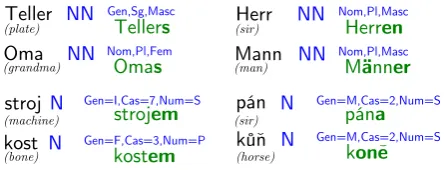
Figure 3: Morphological ambiguity in German and Czech.
The same inflection pattern is used to express multiple mor-phological properties (left) and multiple patterns may express the same property (right).
system to operate even on previously unseen lem-mas. The employed classifier and features are de-scribed in Sections 3.2 and 3.3. Section 3.4 then gives an overview of the whole morphological in-flection process.
3.1 Lemma-Form Edit Scripts
Our system uses lemma-form edit scripts based on the Levenshtein string distance metric (Lev-enshtein, 1966): the dynamic programming algo-rithm used to compute the distance can be adapted to produce diffs on characters, i.e. a mapping from the source string (lemma) to the target string (word form) that indicates which characters were added, replaced or removed.
We use the distance from the end of the word to indicate the position of a particular change, same as Bohnet et al. (2010). We have added several enhancements to this general scenario:
• Our system treats separately changes at the beginning of the word, since they are usually independent of the word length and always occur at the beginning, such as the prefix
ge-for past participles in German orne-for nega-tion in Czech.
• Adjacent changes in the string are joined to-gether to produce a total lower number of more complex changes.
• If the Levenshtein edit script indicates a re-moval of letters from the beginning of the word, we treat the target word form as irreg-ular, i.e. as if the whole word changed.
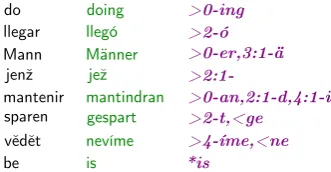
An example of the edit scripts generated by our system is shown in Figure 4.
Mann Männer >0-er,3:1-ä
do doing >0-ing
be is *is
sparen gespart >2-t,<ge llegar llegó >2-ó
vědět nevíme >4-íme,<ne jenž jež
[image:3.595.97.263.99.185.2]>2:1-mantenir mantindran >0-an,2:1-d,4:1-i
Figure 4: Example edit scripts generated by our system.
The changes are separated by commas. “>” denotes a change at the end of the word, “N:” denotes a change at theN-th
character from the end. The number of deleted characters and their replacement follows in both cases. “<” marks ad-ditions to the beginning of a word (regardless of its length). “*” marks irregular forms where the whole word is replaced.
Our diffs are case-insensitive since we believe that letter-casing and morphology are distinct phe-nomena and should be treated separately. Case-insensitivity, along with merging adjacent changes and the possibility to split models, causes a de-crease in the number of different edit scripts, thus simplifying the task for the classifier.
In our preliminary experiments on Czech, we also explored the possibility of using different dis-tance metrics for the edit scripts, such as vari-ous settings of the Needleman-Wunsch algorithm (Needleman and Wunsch, 1970) or the longest common subsequence1 post-edited with regular
expressions to lower the total number of changes. However, this did not have any noticeable impact on the performance of the models.
3.2 Used Statistical Models
We use the multi-class logistic regression classi-fier from the LibLINEAR package2 (Fan et al.,
2008) for the prediction of edit scripts. We use L1-regularization since it yields models that are smaller in size and the resulting trained weights indicate the important features in a straightforward way. This direct influence on features (similar to keyword spotting) allows for a simple interpreta-tion of the learned models. We examined various settings of the regularization cost and the termina-tion criterion (See Sectermina-tion 4.1).
We have also experimented with support vec-tor machines from the LibSVM package (Chang
1We used the Perl implementation of this algorithm from https://metacpan.org/module/String::Diff. 2We use it via the Python wrapper in the Scikit-Learn li-brary (http://scikit-learn.org).
and Lin, 2011), but the logistic regression clas-sifier proved to be better suited to this task, pro-viding a higher edit script accuracy on the devel-opment set for German and Czech (when feature concatenation is used, cf. Section 3.3), while also requiring less CPU time and RAM to train.
3.3 Features
While the complete set of features varies across languages given their specifics, most of the fea-tures are common to all languages:
• lemmaof the word in question,
• coarse and fine-grainedpart-of-speechtag,
• morphological features (e.g. case, gender, tense etc., tagset-dependent), and
• suffixes of the lemmaof up to 4 characters. Since morphological changes usually occur near the end of the word, they mostly depend just on that part of the word and not on e.g. prefixes or previous parts of a compound. Therefore, using suffixes allows the classifier to generalize to un-known words.
In addition, as we use a linear classifier, we have found the concatenation of various morphologi-cal features, such as number, gender, and case in nouns or tense and person in verbs, to be very ben-eficial. We created new features by concatenating all possible subsets of morphological features, as long as all their values were non-empty (to prevent from creating duplicate values). To avoid com-binatorial explosion, we resorted to concatenating only case, number, and gender for Czech and ex-cluding thepostypefeature from concatenation for Spanish and Catalan.
We also employ the properties of adjacent words in the sentence as features in our models for the individual languages (see Section 4). These are used mainly to model congruency (isvs.arein English, different adjectival declension after defi-nite and indefidefi-nite article in German) or article vo-calization (l’vs. elin Catalan). The congruency information could be obtained more reliably from elsewhere in a complete NLG system (e.g. features from the syntactic realizer), which would probably result in a performance gain, but lies beyond the scope of this paper.
3.4 Overall Schema of the Predictor
After an examination of the training data, we de-cided to use a separate model for the changes that occur at the beginning of the word since they tend to be much simpler than and not very dependent on the changes towards the end of the word (e.g. the usages of the Czech negation prefixne-or the Ger-man infinitive prefix zu- are quite self-contained phenomena).
The final word inflection prediction schema looks as follows:
1. Using the statistical model described in Sec-tion 3.2, predict an edit script (cf. SecSec-tion 3.1) for changes at the end or in the middle of the word.3
2. Predict an edit script for the possible addition of a prefix using a separate model.
3. Apply the edit scripts predicted by the pre-vious steps as rules to generate the final in-flected word form.
4 Experimental Evaluation
We evaluate our morphological generation setup on all of the languages included in the CoNLL 2009 Shared Task data sets except Chinese (which, as an isolating language, lacks morphology almost altogether): English, German, Spanish, Catalan, Japanese, and Czech. We use the CoNLL 2009 data sets (Hajiˇc et al., 2009) with gold-standard morphology annotation for all our experiments (see Table 1 for a detailed overview).
We give a discussion of the overall performance of our system in all the languages in Section 4.1. We focus on Czech in the detailed analysis of the generalization power of our system in Section 4.2 since Czech has the most complicated morphology of all these languages. In addition, the morpho-logical annotation provided in the CoNLL 2009 Czech data set is more detailed than in the other languages, which eliminates the need for addi-tional syntactic features (cf. Section 3.3). We also provide a detailed performance overview on En-glish for comparison.
4.1 Overall Performance
The performance of our system in the best set-tings for the individual languages measured on the
3Completely irregular forms (see Section 3.1) are also predicted by this step.
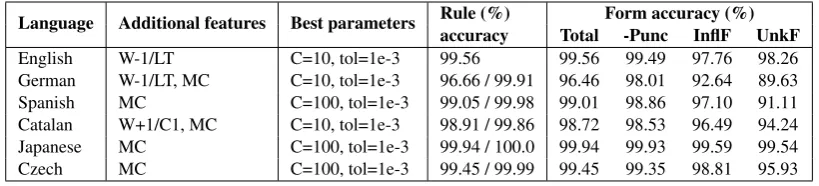
CoNLL 2009 evaluation test sets is shown in Ta-ble 2. We used the classifier and features described in Sections 3.2 and 3.3 (additional features for the individual languages are listed in the table). We used two models as described in Section 3.4 for all languages but English, where no changes at the beginning of the word were found in the training data set and a single model was sufficient. We per-formed a grid search for the best parameters of the first model4and used the same parameters for both
models.5
One can see from the results in Table 2 that the system is able to predict the majority of word forms correctly and performs well even on data unseen in the training set.
When manually inspecting the errors produced by the system, we observed that in some cases the system in fact assigned a form synonymous to the one actually occurring in the test set, such asnot
instead of n’t in English or také instead of taky
(both meaningalso) in Czech. However, most er-rors are caused by the selection of a more frequent rule, even if incorrect given the actual morpholog-ical features. We believe that this could possibly be mitigated by using features combining lemma suffixes and morphological categories, or features from the syntactic context.
The lower score for German is caused partly by the lack of syntactic features for the highly am-biguous adjective inflection and partly by a some-what problematic lemmatization of punctuation (all punctuation has the lemma “_” and the part-of-speech tag only distinguishes terminal, comma-like and other characters).
4.2 Generalization Power
To measure the ability of our system to generalize to previously unseen inputs, we compare it against a baseline that uses a dictionary collected from the same data and leaves unseen forms intact. The per-formance of our system on unseen forms is shown in Table 2 for all languages. A comparison with the dictionary baseline for varying training data sizes in English and Czech is given in Table 3.
It is visible from Table 3 that our approach
4We always used L1-norm and primal form and modi-fied the termination criteriontoland regularization strength
C. The best values found on the development data sets for the individual languages are listed in Table 2.
Language TrainData set sizesDev Eval -PunctIn Eval (%)InflF UnkF
[image:5.595.165.435.61.155.2]English 958,167 33,368 57,676 85.93 15.14 1.80 German 648,677 32,033 31,622 87.24 45.12 8.69 Spanish 427,442 50,368 50,630 85.42 29.96 6.16 Catalan 390,302 53,015 53,355 86.75 31.89 6.28 Japanese 112,555 6,589 13,615 87.34 10.73 6.43 Czech 652,544 87,988 92,663 85.50 42.98 7.68
Table 1: The CoNLL 2009 data sets: Sizes and properties
The data set sizes give the number of words (tokens) in the individual sets. The right column shows the percentage of data in the evaluation set:-Punct= excluding punctuation tokens,InflF= only forms that differ from the lemma (i.e. have a non-empty edit script),UnkF= forms unseen in the training set.
Language Additional features Best parameters Rule (%)accuracy TotalForm accuracy (%)-Punc InflF UnkF
English W-1/LT C=10, tol=1e-3 99.56 99.56 99.49 97.76 98.26
German W-1/LT, MC C=10, tol=1e-3 96.66 / 99.91 96.46 98.01 92.64 89.63
Spanish MC C=100, tol=1e-3 99.05 / 99.98 99.01 98.86 97.10 91.11
Catalan W+1/C1, MC C=10, tol=1e-3 98.91 / 99.86 98.72 98.53 96.49 94.24
Japanese MC C=100, tol=1e-3 99.94 / 100.0 99.94 99.93 99.59 99.54
Czech MC C=100, tol=1e-3 99.45 / 99.99 99.45 99.35 98.81 95.93
Table 2: The overall performance of our system in different languages.
Theadditional featuresinclude: MC= concatenation of morphological features (see Section 3.3),W-1/LT= lemma and part-of-speech tag of the previous word,W+1/C1= first character of the following word.
Rule (edit script) accuracyis given for the prediction of changes at the end or in the middle and at the beginning of the word, respectively.
Theform accuracyfield shows the percentage of correctly predicted (lowercased) target word forms: Total= on the whole evaluation set;-Punct,InflF,UnkF= on subsets as defined in Table 1.
maintains a significantly6 higher accuracy when
compared to the baseline for all training data sizes. It is capable of reaching high performance even with relatively small amounts of training in-stances. The overall performance difference be-comes smaller as the training data grow; how-ever, performance on unseen inputs and relative error reduction show a different trend: the im-provement stays stable. The relative error reduc-tion decreases slightly for English where unknown word forms are more likely to be base forms of unknown lemmas, but keeps increasing for Czech where unknown word forms are more likely to re-quire inflection (the accuracy reached by the base-line method on unknown forms equals the percent-age of base forms among the unknown forms).
Though the number of unseen word forms is de-clining with increasing amounts of training data, which plays in favor of the dictionary method, un-seen inputs will still occur and may become very frequent for out-of-domain data. Our system is therefore beneficial – at least as a back-off for un-seen forms – even if a large-coverage
morpholog-6Significance at the 99% level has been assessed using paired bootstrap resampling (Koehn, 2004).
ical dictionary is available.
We observed upon manual inspection that the suffix features were among the most prominent for the prediction of many edit scripts, which indi-cates their usefulness; e.g.LemmaSuffix1=eis a strong feature (along withPOS_Tag=VBD) for the edit script>0din English.
5 Related Work
[image:5.595.94.504.219.312.2](Žabokrt-Train Czech English
data Unseen Dict. acc. Our sys. acc. Error Unseen Dict acc. Our sys. acc. Error part forms Total UnkF Total UnkF reduct. forms Total UnkF Total UnkF reduct.
0.1 63.94 62.00 41.54 76.92 64.43 39.27 27.77 89.18 78.73 95.02 93.14 53.91 0.5 51.38 66.78 38.65 88.73 78.83 66.08 19.96 91.34 76.33 97.89 95.56 75.64 1 45.36 69.43 36.97 92.23 83.60 74.60 14.69 92.76 73.95 98.28 95.27 76.19 5 31.11 77.29 35.56 96.63 90.36 85.17 6.82 96.21 75.73 99.05 97.13 74.96 10 24.72 80.97 33.88 97.83 92.45 88.61 4.66 97.31 77.13 99.34 97.76 75.44 20 17.35 85.69 32.47 98.72 94.28 91.02 3.10 98.09 78.52 99.46 97.57 71.65 30 14.17 87.92 31.85 98.95 94.56 91.34 2.46 98.40 79.79 99.48 97.63 67.75 50 11.06 90.34 31.62 99.20 95.25 91.69 1.76 98.69 80.53 99.54 98.04 64.81 75 9.01 91.91 31.54 99.34 95.60 91.89 1.35 98.86 82.23 99.55 98.17 60.61 100 7.68 92.88 30.38 99.45 95.93 92.21 1.12 98.94 82.53 99.56 98.26 58.85
Table 3: Comparison of our system with a dictionary baseline on different training data sizes.
All numbers are percentages. The accuracy of both methods is given for the whole evaluation set (Total) and for word forms unseen in the training set (UnkF).Error reduct.shows the relative error reduction of our method in comparison to the baseline on the whole evaluation set.
ský et al., 2008), learnt from data (Toutanova et al., 2008), or a combination thereof (Popel and Žabokrtský, 2009).
The only statistical morphological generator known to us is that of Bohnet et al. (2010), em-ployed as a part of a support-vector-machines-based surface realizer from semantic structures. They apply their system to a subset of CoNLL 2009 data sets and their results (morphological ac-curacy of 97.8% for English, 97.49% for German and 98.48% for Spanish) seem to indicate that our system performs better for English, slightly bet-ter for Spanish and slightly worse for German, but the numbers may not be directly comparable to our results as it is unclear whether the authors use the original data set or the output of the previous steps of their system for evaluation and whether they in-clude punctuation and/or capitalization.
Since the morphological generator of Bohnet et al. (2010) is only a part of a larger system, they do not provide a thorough analysis of the results. While their system also predicts edit scripts de-rived from Levenshtein distance, their edit script representation seems less efficient than ours. They report using about 1500 and 2500 different scripts for English and German, respectively, disregard-ing scripts occurrdisregard-ing only once in the traindisregard-ing data. However, our representation only yields 154 En-glish and 1785 German7edit scripts with no
prun-ing. Along with the independent models for the beginning of the word, this simplifies the task for the classifier. In addition to features used by
7We get this number when counting the edit scripts as atomic; they divide into 1735 changes at the end or in the middle of the words and 18 changes at the beginning.
Bohnet et al. (2010), our system includes the suf-fix features to generalize to unseen inputs.
6 Conclusions and Further Work
We have presented a fully trainable morphologi-cal generation system aimed at robustness to pre-viously unseen inputs, based on logistic regression and Levenshtein distance edit scripts between the lemma and the target word form. The results from the evaluation on six different languages from the CoNLL 2009 data sets indicate that the system is able to learn most morphological rules correctly and is able to cope with previously unseen input, performing significantly better than a dictionary learned from the same amount of data. The sys-tem is freely available for download at:
http://ufal.mff.cuni.cz/~odusek/flect
In future, we plan to integrate our generator into a semantic NLG scenario, as well as a sim-pler template-based system, and evaluate it on further languages. We also consider employ-ing transformation-based learnemploy-ing (Brill, 1995) for prediction to make better use of the possibility of splitting the edit scripts and applying the morpho-logical changes one-by-one.
Acknowledgments
References
G. Angeli, P. Liang, and D. Klein. 2010. A simple domain-independent probabilistic approach to gen-eration. InProceedings of the 2010 Conference on Empirical Methods in Natural Language Process-ing, page 502–512.
J. A. Bateman, I. Kruijff-Korbayová, and G.-J. Krui-jff. 2005. Multilingual resource sharing across both related and unrelated languages: An imple-mented, open-source framework for practical natu-ral language generation. Research on Language and Computation, 3(2-3):191–219.
A. Belz. 2008. Automatic generation of weather forecast texts using comprehensive probabilistic generation-space models. Natural Language Engi-neering, 14(4):431–455.
B. Bohnet, L. Wanner, S. Mille, and A. Burga. 2010. Broad coverage multilingual deep sentence genera-tion with a stochastic multi-level realizer. In Pro-ceedings of the 23rd International Conference on Computational Linguistics, page 98–106.
E. Brill. 1995. Transformation-based error-driven learning and natural language processing: A case study in part-of-speech tagging. Computational lin-guistics, 21(4):543–565.
C. C. Chang and C. J. Lin. 2011. LIBSVM: a library for support vector machines. ACM Transactions on Intelligent Systems and Technology (TIST), 2(3):27.
R. E Fan, K. W Chang, C. J Hsieh, X. R Wang, and C. J Lin. 2008. LIBLINEAR: a library for large lin-ear classification.The Journal of Machine Learning Research, 9:1871–1874.
A. Gatt and E. Reiter. 2009. SimpleNLG: a realisation engine for practical applications. InProceedings of the 12th European Workshop on Natural Language Generation, page 90–93.
J. Hajiˇc, M. Ciaramita, R. Johansson, D. Kawahara, M. A Martí, L. Màrquez, A. Meyers, J. Nivre, S. Padó, J. Štˇepánek, et al. 2009. The CoNLL-2009 shared task: Syntactic and semantic dependencies in multiple languages. InProceedings of the Thir-teenth Conference on Computational Natural Lan-guage Learning: Shared Task, page 1–18.
P. Koehn. 2004. Statistical significance tests for machine translation evaluation. In Proceedings of EMNLP, volume 4, page 388–395.
I. Langkilde and K. Knight. 1998. Generation that exploits corpus-based statistical knowledge. In Pro-ceedings of the 36th Annual Meeting of the Associ-ation for ComputAssoci-ational Linguistics and 17th Inter-national Conference on Computational Linguistics-Volume 1, page 704–710.
I. Langkilde-Geary. 2002. An empirical verification of coverage and correctness for a general-purpose sen-tence generator. InProceedings of the 12th Inter-national Natural Language Generation Workshop, page 17–24.
B. Lavoie and O. Rambow. 1997. A fast and portable realizer for text generation systems. InProceedings of the fifth conference on Applied natural language processing, page 265–268.
V. I. Levenshtein. 1966. Binary codes capable of cor-recting deletions, insertions and reversals. Soviet Physics Doklady, 10(8):707.
F. Mairesse, M. Gaši´c, F. Jurˇcíˇcek, S. Keizer, B. Thom-son, K. Yu, and S. Young. 2010. Phrase-based sta-tistical language generation using graphical models and active learning. InProceedings of the 48th An-nual Meeting of the Association for Computational Linguistics, page 1552–1561.
G. Minnen, J. Carroll, and D. Pearce. 2001. Applied morphological processing of English. Natural Lan-guage Engineering, 7(3):207–223.
S. B. Needleman and C. D. Wunsch. 1970. A general method applicable to the search for similarities in the amino acid sequence of two proteins. Journal of molecular biology, 48(3):443–453.
M. Popel and Z. Žabokrtský. 2009. Improv-ing English-Czech tectogrammatical MT. The Prague Bulletin of Mathematical Linguistics, 92(-1):115–134.
J. Ptáˇcek and Z. Žabokrtský. 2006. Synthesis of Czech sentences from tectogrammatical trees. In Text, Speech and Dialogue.
K. Toutanova, H. Suzuki, and A. Ruopp. 2008. Ap-plying morphology generation models to machine translation. InProc. of ACL, volume 8.