Finding Bursty Topics from Microblogs
Qiming Diao, Jing Jiang, Feida Zhu, Ee-Peng Lim Living Analytics Research Centre
School of Information Systems Singapore Management University
{qiming.diao.2010, jingjiang, fdzhu, eplim}@smu.edu.sg
Abstract
Microblogs such as Twitter reflect the general public’s reactions to major events. Bursty top-ics from microblogs reveal what events have attracted the most online attention. Although bursty event detection from text streams has been studied before, previous work may not be suitable for microblogs because compared with other text streams such as news articles and scientific publications, microblog posts are particularly diverse and noisy. To find top-ics that have bursty patterns on microblogs, we propose a topic model that simultaneous-ly captures two observations: (1) posts pub-lished around the same time are more like-ly to have the same topic, and (2) posts pub-lished by the same user are more likely to have the same topic. The former helps find event-driven posts while the latter helps identify and filter out “personal” posts. Our experiments on a large Twitter dataset show that there are more meaningful and unique bursty topics in the top-ranked results returned by our mod-el than an LDA basmod-eline and two degenerate variations of our model. We also show some case studies that demonstrate the importance of considering both the temporal information and users’ personal interests for bursty topic detection from microblogs.
1 Introduction
With the fast growth of Web 2.0, a vast amount of user-generated content has accumulated on the so-cial Web. In particular, microblogging sites such as Twitter allow users to easily publish short in-stant posts about any topic to be shared with the
general public. The textual content coupled with the temporal patterns of these microblog posts pro-vides important insight into the general public’s in-terest. A sudden increase of topically similar posts usually indicates a burst of interest in some event that has happened offline (such as a product launch or a natural disaster) or online (such as the spread of a viral video). Finding bursty topics from mi-croblogs therefore can help us identify the most pop-ular events that have drawn the public’s attention. In this paper, we study the problem of finding bursty topics from a stream of microblog posts generated by different users. We focus on retrospective detec-tion, where the text stream within a certain period is analyzed in its entirety.
Retrospective bursty event detection from tex-t stex-treams is notex-t new (Kleinberg, 2002; Fung etex-t al., 2005; Wang et al., 2007), but finding bursty topic-s from microblog topic-steamtopic-s hatopic-s not been well topic-studied. In his seminal work, Kleinberg (2002) proposed a s-tate machine to model the arrival times of documents in a stream in order to identify bursts. This model has been widely used. However, this model assumes that documents in the stream are all about a given topic. In contrast, discovering interesting topics that have drawn bursts of interest from a stream of top-ically diverse microblog posts is itself a challenge. To discover topics, we can certainly apply standard topic models such as LDA (Blei et al., 2003), but with standard LDA temporal information is lost dur-ing topic discovery. For microblogs, where posts are short and often event-driven, temporal information can sometimes be critical in determining the topic of a post. For example, typically a post containing the
word “jobs” is likely to be about employment, but right after October 5, 2011, a post containing “jobs” is more likely to be related to Steve Jobs’ death. Es-sentially, we expect that on microblogs, posts pub-lished around the same time have a higher probabil-ity to belong to the same topic.
To capture this intuition, one solution is to assume that posts published within the same short time win-dow follow the same topic distribution. Wang et al. (2007) proposed a PLSA-based topic model that exploits this idea to find correlated bursty patterns across multiple text streams. However, their model is not immediately applicable for our problem. First, their model assumes multiple text streams where word distributions for the same topic are different on different streams. More importantly, their model was applied to news articles and scientific publica-tions, where most documents follow the global top-ical trends. On microblogs, besides talking about global popular events, users also often talk about their daily lives and personal interests. In order to detect global bursty events from microblog posts, it is important to filter out these “personal” posts.
In this paper, we propose a topic model designed for finding bursty topics from microblogs. Our mod-el is based on the following two assumptions: (1) If a post is about a global event, it is likely to follow a global topic distribution that is time-dependent. (2) If a post is about a personal topic, it is likely to follow a personal topic distribution that is more or less stable over time. Separation of “global” and “personal” posts is done in an unsupervised manner through hidden variables. Finally, we apply a state machine to detect bursts from the discovered topics. We evaluate our model on a large Twitter dataset. We find that compared with bursty topics discovered by standard LDA and by two degenerate variations of our model, bursty topics discovered by our model are more accurate and less redundant within the top-ranked results. We also use some example bursty topics to explain the advantages of our model.
2 Related Work
To find bursty patterns from data streams, Kleinberg (2002) proposed a state machine to model the ar-rival times of documents in a stream. Different states generate time gaps according to exponential density
functions with different expected values, and bursty intervals can be discovered from the underlying state sequence. A similar approach by Ihler et al. (2006) models a sequence of count data using Poisson dis-tributions. To apply these methods to find bursty topics, the data stream used must represent a single topic.
Fung et al. (2005) proposed a method that iden-tifies both topics and bursts from document stream-s. The method first finds individual words that have bursty patterns. It then finds groups of words that tend to share bursty periods and co-occur in the same documents to form topics. Weng and Lee (2011) proposed a similar method that first characterizes the temporal patterns of individual words using wavelet-s and then groupwavelet-s wordwavelet-s into topicwavelet-s. A major prob-lem with these methods is that the word clustering step can be expensive when the number of bursty words is large. We find that the method by Fung et al. (2005) cannot be applied to our dataset be-cause their word clustering algorithm does not scale up. Weng and Lee (2011) applied word clustering to only the top bursty words within a single day, and subsequently their topics mostly consist of two or three words. In contrast, our method is scalable and each detected bursty topic is directly associated with a word distribution and a set of tweets (see Table 3), which makes it easier to interpret the topic.
Topic models provide a principled and elegan-t way elegan-to discover hidden elegan-topics from large docu-ment collections. Standard topic models do not con-sider temporal information. A number of temporal topic models have been proposed to consider topic changes over time. Some of these models focus on the change of topic composition, i.e. word distri-butions, which is not relevant to bursty topic detec-tion (Blei and Lafferty, 2006; Nallapati et al., 2007; Wang et al., 2008). Some other work looks at the temporal evolution of topics, but the focus is not on bursty patterns (Wang and McCallum, 2006; Ahmed and Xing, 2008; Masada et al., 2009; Ahmed and X-ing, 2010; Hong et al., 2011).
personal interests in addition to global topical trend-s.
To capture users’ interests, Rosen-Zvi et al. (2004) expand topic distributions from document-level to user-document-level in order to capture users’ specif-ic interests. But on mspecif-icroblogs, posts are short and noisy, so Zhao et al. (2011) further assume that each post is assigned a single topic and some words can be background words. However, these studies do not aim to detect bursty patterns. Our work is novel in that it combines users’ interests and temporal infor-mation to detect bursty topics.
3 Method
3.1 Preliminaries
We first introduce the notation used in this paper and formally formulate our problem. We assume that we have a stream ofD microblog posts, denoted as d1, d2, . . . , dD. Each postdi is generated by a user ui, whereuiis an index between 1 andU, andU is the total number of users. Eachdi is also associat-ed with a discrete timestampti, wheretiis an index
between 1 andT, andT is the total number of time points we consider. Eachdicontains a bag of
word-s, denoted as{wi,1, wi,2, . . . , wi,Ni}, wherewi,j is an index between 1 andV, andV is the vocabulary size.Niis the number of words indi.
We define a bursty topic b as a word distri-bution coupled with a bursty interval, denoted as
(ϕb, tbs, tbe), where ϕb is a multinomial distribution over the vocabulary, andtbsandtbe(1≤tbs≤tbe≤T) are the start and the end timestamps of the bursty in-terval, respectively. Our task is to find meaningful bursty topics from the input text stream.
Our method consists of a topic discovery step and a burst detection step. At the topic discovery step, we propose a topic model that considers both users’ topical interests and the global topic trends. Burst detection is done through a standard state machine method.
3.2 Our Topic Model
We assume that there areC(latent) topics in the text stream, where each topicchas a word distribution ϕc. Note that not every topic has a bursty interval. On the other hand, a topic may have multiple bursty intervals and hence leads to multiple bursty topics.
We also assume a background word distributionϕB that captures common words. All posts are assumed to be generated from some mixture of theseC+ 1
underlying topics.
In standard LDA, a document contains a mixture of topics, represented by a topic distribution, and each word has a hidden topic label. While this is a reasonable assumption for long documents, for short microblog posts, a single post is most likely to be about a single topic. We therefore associate a single hidden variable with each post to indicate its topic. Similar idea of assigning a single topic to a short se-quence of words has been used before (Gruber et al., 2007; Zhao et al., 2011). As we will see very soon, this treatment also allows us to model topic distribu-tions at time window level and user level.
As we have discussed in Section 1, an importan-t observaimportan-tion we have is importan-thaimportan-t when everyimportan-thing else is equal, a pair of posts published around the same time is more likely to be about the same topic than a random pair of posts. To model this observation, we assume that there is a global topic distributionθtfor each time pointt. Presumablyθt has a high prob-ability for a topic that is popular in the microblog-sphere at timet.
Unlike news articles from traditional media, which are mostly about current affairs, an important property of microblog posts is that many posts are about users’ personal encounters and interests rather than global events. Since our focus is to find popular global events, we need to separate out these “person-al” posts. To do this, an intuitive idea is to compare a post with its publisher’s general topical interests observed over a long time. If a post does not match the user’s long term interests, it is more likely re-lated to a global event. We therefore introduce a time-independent topic distributionηu for each
us-er to capture hus-er long tus-erm topical intus-erests.
We assume the following generation process for all the posts in the stream. When userupublishes a post at time point t, she first decides whether to write about a global trendy topic or a personal top-ic. If she chooses the former, she then selects a topic according toθt. Otherwise, she selects a topic
1. Draw ϕB ∼ Dirichlet(β), π ∼ Beta(γ), ρ ∼
Beta(λ)
2. For each time pointt= 1, . . . , T
(a) drawθt∼Dirichlet(α)
3. For each useru= 1, . . . , U
(a) drawηu∼Dirichlet(α)
4. For each topicc= 1, . . . , C, (a) drawϕc∼Dirichlet(β) 5. For each posti= 1, . . . , D,
(a) drawyi ∼Bernoulli(π)
(b) drawzi ∼ Multinomial(ηui)ifyi = 0or
zi∼Multinomial(θti)ifyi = 1
(c) for each wordj= 1, . . . , Ni
i. drawxi,j∼Bernoulli(ρ)
ii. draw wi,j ∼ Multinomial(ϕB) if
xi,j = 0orwi,j ∼ Multinomial(ϕzi)
ifxi,j= 1
Figure 2: The generation process for all posts.
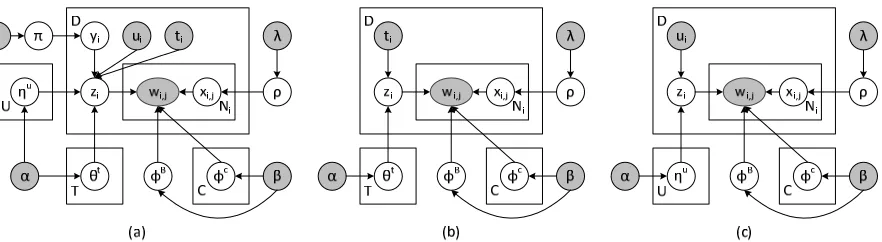
We useπ to denote the probability of choosing to talk about a global topic rather than a personal topic. Formally, the generation process is summarized in Figure 2. The model is also depicted in Figure 1(a).
There are two degenerate variations of our model that we also consider in our experiments. The first one is depicted in Figure 1(b). In this model, we only consider the time-dependent topic distributions that capture the global topical trends. This model can be seen as a direct application of the model by Wang et al. (2007). The second one is depicted in Fig-ure 1(c). In this model, we only consider the users’ personal interests but not the global topical trends, and therefore temporal information is not used. We refer to our complete model asTimeUserLDA, the model in Figure 1(b) asTimeLDAand the model in Figure 1(c) asUserLDA. We also consider a standard LDA model in our experiments, where each word is associated with a hidden topic.
Learning
We use collapsed Gibbs sampling to obtain sam-ples of the hidden variable assignment and to esti-mate the model parameters from these samples. Due to space limit, we only show the derived Gibbs sam-pling formulas as follows.
First, for thei-th post, we know its publisher ui
and timestampti. We can jointly sampleyi and zi
based on the values of all other hidden variables. Let us useyto denote the set of all hidden variablesy and y¬i to denote ally except yi. We use similar symbols for other variables. We then have
p(yi=p, zi=c|z¬i,y¬i,x,w)∝
Mπ
(p)+γ
Mπ
(·)+ 2γ
· M
l
(c)+α
Ml
(·)+Cα
·
∏V
v=1
∏E(v)−1
k=0 (M(cv)+k+β)
∏E(·)−1
k=0 (M
c
(·)+k+V β)
, (1)
wherel = ui when p = 0 and l = ti when p = 1. Here everyM is a counter. M(0)π is the number of posts generated by personal interests, whileM(1)π is the number of posts coming from global topical trends. Mπ
(·) = M0π+M1π. M ui
(c) is the number of
posts by useruiand assigned to topicc, andMui
(·) is
the total number of posts byui. Mti
(c)is the number
of posts assigned to topiccat time pointti, andMti
(·)
is the total number of posts atti.E(v)is the number of times wordvoccurs in thei-th post and is labeled as a topic word, while E(·) is the total number of topic words in thei-th post. Here, topic words refer to words whose latent variablex equals1. M(cv) is the number of times wordv is assigned to topicc, and M(·)c is the total number of words assigned to topic c. All the counters M mentioned above are calculated with thei-th post excluded.
We samplexi,jfor each wordwi,j in thei-th post using
p(xi,j=q|y,z,x¬{i,j},w)
∝ M
ρ
(q)+γ
M(ρ·)+ 2γ· Ml
(wi,j)+β
Ml
(·)+V β
, (2)
wherel = B whenq = 0andl = zi whenq = 1.
M(0)ρ and M(1)ρ are counters to record the numbers of words assigned to the background model and any topic, respectively, andM(·)ρ =M(0)ρ +M(1)ρ .MB
(wi,j) is the number of times wordwi,j occurs as a
back-ground word. Mzi
(wi,j) counts the number of times wordwi,jis assigned to topiczi, andM(·)zi is the
to-tal number of words assigned to topiczi. Again, all
counters are calculated with the current word wi,j
Figure 1: (a) Our topic model for burst detection. (b) A variation of our model where we only consider global topical trends. (c) A variation of our model where we only consider users’ personal topical interests.
3.3 Burst Detection
Just like standard LDA, our topic model itself finds a set of topics represented byϕc but does not directly generate bursty topics. To identify bursty topics, we use the following mechanism, which is based on the idea by Kleinberg (2002) and Ihler et al. (2006). In our experiments, when we compare different mod-els, we also use the same burst detection mechanism for other models.
We assume that after topic modeling, for each dis-covered topic c, we can obtain a series of counts
(mc1, mc2, . . . , mcT)representing the intensity of the topic at different time points. For LDA, these are the numbers of words assigned to topic c. For TimeUserLDA, these are the numbers of posts which are in topiccand generated by the global top-ic distributionθti, i.e whose hidden variabley
iis1.
For other models, these are the numbers of posts in topicc.
We assume that these counts are generated by two Poisson distributions corresponding to a bursty state and a normal state, respectively. Letµ0 denote the expected count for the normal state andµ1 for the bursty state. Letvtdenote the state for time pointt, wherevt = 0indicates the normal state andvt= 1
indicates the bursty state. The probability of observ-ing a count ofmct is as follows:
p(mct|vt=l) =
e−µlµm c t
l
mct! ,
where l is either 0 or 1. The state sequence
(v0, v1, . . . , vT) is a Markov chain with the
follow-ing transition probabilities:
p(vt=l|vt−1=l) =σl,
Method P@5 P@10 P@20 P@30 LDA 0.600 0.800 0.750 N/A TimeLDA 0.800 0.700 0.600 0.633 UserLDA 0.800 0.700 0.850 0.833 TimeUserLDA 1.000 1.000 0.900 0.800
Table 1: Precision atKfor the various models.
[image:5.612.91.532.61.182.2]Method P@5 P@10 P@20 P@30 LDA 0.600 0.800 0.700 N/A TimeLDA 0.400 0.500 0.500 0.567 UserLDA 0.800 0.500 0.500 0.600 TimeUserLDA 1.000 0.900 0.850 0.767
Table 2: Precision atKfor the various models after we remove redundant bursty topics.
wherelis either 0 or 1.
µ0andµ1 are topic specific. In our experiments,
we set µ0 = T1 ∑tmct, that is, µ0 is the average
count over time. We setµ1 = 3µ0. For transition probabilities, we empirically setσ0 = 0.9andσ1 = 0.6for all topics.
We can use dynamic programming to uncover the underlying state sequence for a series of counts. Fi-nally, a burst is marked by a consecutive subse-quence of bursty states.
4 Experiments
4.1 Data Set
Bursty Period Top Words Example Tweets Label
Nov 29 vote, big, awards, (1) why didnt 2ne1 win this time! Mnet Asian bang, mama, win, (2) 2ne1. you deserved that urgh! Music Awards 2ne1, award, won (3) watching mama. whoohoo (MAMA) Oct 5∼Oct 8 steve, jobs, apple, (1) breaking: apple says steve jobs has passed away! Steve Jobs
iphone, rip, world, (2) google founders: steve jobs was an inspiration! death changed, 4s, siri (3) apple 4 life thankyousteve
Nov 1∼Nov 3 reservior, bedok, adlyn, (1) this adelyn totally disgust me. slap her mum? girl slapping slap, found, body, queen of cine? joke please can. mom mom, singapore, steven (2) she slapped her mum and boasted about it on fb
(3) adelyn lives in woodlands , later she slap me how?
Nov 5 reservior, bedok, adlyn, (1) bedok = bodies either drowned or killed. suicide near slap, found, body, (2) another body found, in bedok reservoir? bedok reservoir mom, singapore, steven (3) so many bodies found at bedok reservoir. alamak.
Oct 23 man, arsenal, united, (1) damn you man city! we will get you next time! football game liverpool, chelsea, city, (2) wtf 90min goal!
goal, game, match (3) 6-1 to city. unbelievable.
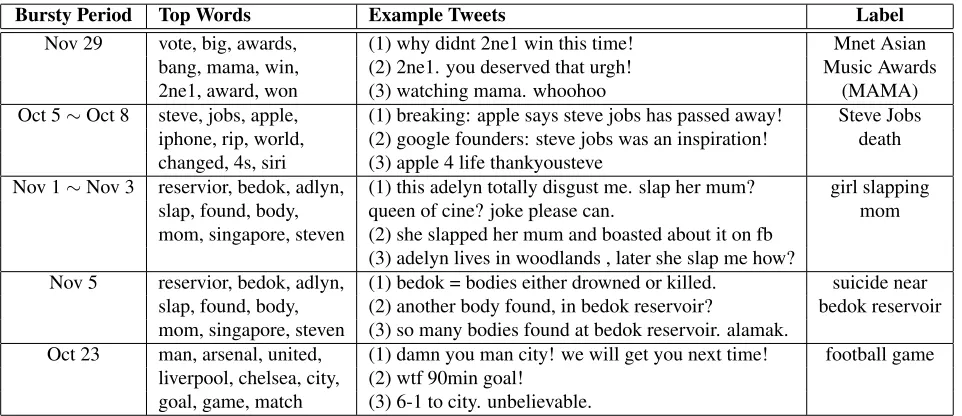
Table 3: Top-5 bursty topics ranked by TimeUserLDA. The labels are manually given. The 3rd and the 4th bursty topics come from the same topic but have different bursty periods.
Rank LDA UserLDA TimeLDA
1 Steve Jobs’ death MAMA MAMA
2 MAMA football game MAMA
3 N/A #zamanprimaryschool MAMA
4 girl slapping mom N/A girl slapping mom
[image:6.612.74.555.63.271.2]5 N/A iphone 4s N/A
Table 4: Top-5 bursty topics ranked by other models. N/A indicates a meaningless burst.
their follower/followee links by two hops. Because this data set is huge, we randomly sampled 2892 users from this data set and extracted their tweets between September 1 and November 30, 2011 (91 days in total). We use one day as our time window. Therefore our timestamps range from 1 to 91. We then removed stop words and words containing non-standard characters. Tweets containing less than 3 words were also discarded. After preprocessing, we obtained the final data set with 3,967,927 tweets and 24,280,638 tokens.
4.2 Ground Truth Generation
To compare our model with other alternative models, we perform both quantitative and qualitative evalua-tion. As we have explained in Section 3, each mod-el gives us time series data for a number of topics, and by applying a Poisson-based state machine, we can obtain a set of bursty topics. For each method, we rank the obtained bursty topics by the number
topics from the ground truth bursty topics.
4.3 Evaluation
In this section, we show the quantitative evalua-tion of the four models we consider, namely, LDA, TimeLDA, UserLDA and TimeUserLDA. For each model, we set the number of topicsCto 80,αto 50C and β to 0.01 after some preliminary experiments. Each model was run for 500 iterations of Gibbs sam-pling. We take 40 samples with a gap of 5 iterations in the last 200 iterations to help us assign values to all the hidden variables.
Table 1 shows the comparison between these models in terms of the precision of the top-K result-s. As we can see, our model outperforms all other models forK <= 20. ForK = 30, the UserLDA model performs the best followed by our model.
As we have pointed out, some of the bursty topics are redundant, i.e. they are about the same bursty event. We therefore also calculated precision atK for unique topics, where for redundant topics the one ranked the highest is scored 1 and the other ones are scored 0. The comparison of the performance is shown in Table 2. As we can see, in this case, our model outperforms other models with allK. We will further discuss redundant bursty topics in the next section.
4.4 Sample Results and Discussions
In this section, we show some sample results from our experiments and discuss some case studies that illustrate the advantages of our model.
First, we show the top-5 bursty topics discovered by the TimeUserLDA model in Table 3. As we can see, all these bursty topics are meaningful. Some of these events are global major events such as Steve Jobs’ death, while some others are related to online events such as the scandal of a girl boasting about slapping her mother on Facebook. For comparison, we also show the top-5 bursty topics discovered by other models in Table 4. As we can see, some of them are not meaningful events while some of them are redundant.
Next, we show two case studies to demonstrate the effectiveness of our model.
Effectiveness of Temporal Models: Both TimeLDA and TimeUserLDA tend to group posts published on the same day into the same topic. We
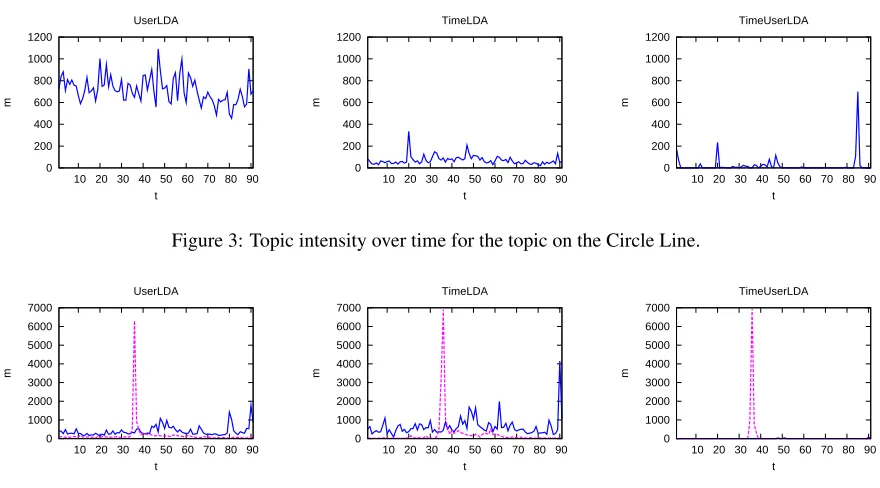
find that this can help separate bursty topics from general ones. An example is the topic on the Circle Line. The Circle Line is one of the subway lines of Singapore’s mass transit system. There were a few incidents of delays or breakdowns during the period between September and November, 2011. We show the time series data of the topic related to the Circle Line of UserLDA, TimeLDA and TimeUserLDA in Figure 3. As we can see, the UserLDA model de-tects a much large volume of tweets related to this topic. A close inspection tells us that the topic under UserLDA is actually related to the subway systems in Singapore in general, which include a few other subway lines, and the Circle Line topic is merged with this general topic. On the other hand, TimeL-DA and TimeUserLTimeL-DA are both able to separate the Circle Line topic from the general subway topic be-cause the Circle Line has several bursts. What is shown in Figure 3 for TimeLDA and TimeUserLDA is only the topic on the Circle Line, therefore the volume is much smaller. We can see that TimeLDA and TimeUserLDA show clearer bursty patterns than UserLDA for this topic. The bursts around day 20, day 44 and day 85 are all real events based on our ground truth.
0 200 400 600 800 1000 1200
10 20 30 40 50 60 70 80 90
m
t UserLDA
0 200 400 600 800 1000 1200
10 20 30 40 50 60 70 80 90
m
t TimeLDA
0 200 400 600 800 1000 1200
10 20 30 40 50 60 70 80 90
m
[image:8.612.88.528.62.306.2]t TimeUserLDA
Figure 3: Topic intensity over time for the topic on the Circle Line.
0 1000 2000 3000 4000 5000 6000 7000
10 20 30 40 50 60 70 80 90
m
t UserLDA
0 1000 2000 3000 4000 5000 6000 7000
10 20 30 40 50 60 70 80 90
m
t TimeLDA
0 1000 2000 3000 4000 5000 6000 7000
10 20 30 40 50 60 70 80 90
m
t TimeUserLDA
Figure 4: Topic intensity over time for the topic about a Korean pop singer. The dotted curves show the topic on Steve Jobs’ death.
Figure 4. For reference, we also show the intensity of the topic on Steve Jobs’ death under each mod-el. We can see that because this topic is related to Korean pop music, it has a burst on day 90 (Novem-ber 29). But if we consider the relative intensity of this burst compared with Steve Jobs’ death, under TimeLDA and UserLDA, this topic is still strong but under TimeUserLDA its intensity can almost be ig-nored. This is why with TimeLDA and UserLDA this topic leads to a redundant burst within the top-30 results but with TimeUserLDA the burst is not ranked high.
5 Conclusions
In this paper, we studied the problem of finding bursty topics from the text streams on microblogs. Because existing work on burst detection from tex-t stex-treams may notex-t be suitex-table for microblogs, we proposed a new topic model that considers both the temporal information of microblog posts and user-s’ personal interests. We then applied a Poisson-based state machine to identify bursty periods from the topics discovered by our model. We compared our model with standard LDA as well as two de-generate variations of our model on a real Twitter dataset. Our quantitative evaluation showed that our
model could more accurately detect unique bursty topics among the top ranked results. We also used two case studies to illustrate the effectiveness of the temporal factor and the user factor of our model.
Our method currently can only detect bursty top-ics in a retrospective and offline manner. A more in-teresting and useful task is to detect realtime bursts in an online fashion. This is one of the directions we plan to study in the future. Another limitation of the current method is that the number of topics is pre-determined. We also plan to look into methods that allow appearance and disappearance of topics along the timeline, such as the model by Ahmed and Xing (2010).
Acknowledgments
This research is supported by the Singapore Nation-al Research Foundation under its InternationNation-al Re-search Centre @ Singapore Funding Initiative and administered by the IDM Programme Office. We thank the reviewers for their valuable comments.
References
restaurant process: with applications to evolutionary clustering. InProceedings of the SIAM International Conference on Data Mining, pages 219–230.
Amr Ahmed and Eric P. Xing. 2010. Timeline: A dy-namic hierarchical Dirichlet process model for recov-ering birth/death and evolution of topics in text stream. InProceedings of the 26th Conference on Uncertainty in Artificial Intelligence, pages 20–29.
David M. Blei and John D. Lafferty. 2006. Dynamic topic models. InProceedings of the 23rd International Conference on Machine Learning.
David M. Blei, Andrew Y. Ng, and Michael I. Jordan. 2003. Latent Dirichlet allocation.Journal of Machine Learning Research, 3:993–1022.
Gabriel Pui Cheong Fung, Jeffrey Xu Yu, Philip S. Yu, and Hongjun Lu. 2005. Parameter free bursty events detection in text streams. InProceedings of the 31st International Conference on Very Large Data Bases, pages 181–192.
Amit Gruber, Michal Rosen-Zvi, and Yair Weiss. 2007. Hidden topic Markov model. InProceedings of the International Conference on Artificial Intelligence and Statistics.
Liangjie Hong, Byron Dom, Siva Gurumurthy, and Kostas Tsioutsiouliklis. 2011. A time-dependent top-ic model for multiple text streams. InProceedings of the 17th ACM SIGKDD International Conference on Knowledge Discovery and Data Mining, pages 832– 840.
Alexander Ihler, Jon Hutchins, and Padhraic Smyth. 2006. Adaptive event detection with time-varying poisson processes. In Proceedings of the 12th ACM SIGKDD International Conference on Knowl-edge Discovery and Data Mining, pages 207–216. Jon Kleinberg. 2002. Bursty and hierarchical structure in
streams. InProceedings of the 8th ACM SIGKDD In-ternational Conference on Knowledge Discovery and Data Mining, pages 91–101.
Tomonari Masada, Daiji Fukagawa, Atsuhiro Takasu, Tsuyoshi Hamada, Yuichiro Shibata, and Kiyoshi Oguri. 2009. Dynamic hyperparameter optimization for bayesian topical trend analysis. InProceedings of the 18th ACM Conference on Information and knowl-edge management, pages 1831–1834.
Ramesh M. Nallapati, Susan Ditmore, John D. Lafferty, and Kin Ung. 2007. Multiscale topic tomography. In Proceedings of the 13th ACM SIGKDD International Conference on Knowledge Discovery and Data Min-ing, pages 520–529.
Michal Rosen-Zvi, Thomas Griffiths, Mark Steyvers, and Padhraic Smyth. 2004. The author-topic model for au-thors and documents. InProceedings of the 20th con-ference on Uncertainty in artificial intelligence, pages 487–494.
Xuerui Wang and Andrew McCallum. 2006. Topics over time: a non-Markov continuous-time model of topical trends. InProceedings of the 12th ACM SIGKDD In-ternational Conference on Knowledge Discovery and Data Mining, pages 424–433.
Xuanhui Wang, ChengXiang Zhai, Xiao Hu, and Richard Sproat. 2007. Mining correlated bursty topic pattern-s from coordinated text pattern-streampattern-s. In Proceedings of the 13th ACM SIGKDD International Conference on Knowledge Discovery and Data Mining, pages 784– 793.
Chong Wang, David M. Blei, and David Heckerman. 2008. Continuous time dynamic topic models. In Pro-ceedings of the 24th Conference on Uncertainty in Ar-tificial Intelligence, pages 579–586.
Jianshu Weng and Francis Lee. 2011. Event detection in Twitter. InProceedings of the 5th International AAAI Conference on Weblogs and Social Media.