A T h e o r y of Parallelism and the Case of V P Ellipsis
J e r r y R . H o b b s a n d A n d r e w K e h l e rA r t i f i c i a l I n t e l l i g e n c e C e n t e r S R I I n t e r n a t i o n a l 333 R a v e n s w o o d A v e n u e
M e n l o P a r k , C A 9 4 0 2 5
{hobbs, kehler}©ai, sri. com
A b s t r a c t
We provide a general account of parallelism in discourse, and apply it to the special case of resolving possible readings for in- stances of VP ellipsis. We show how seyeral problematic examples are accounted for in a natural and straightforward fashion. The generality of the approach makes it directly applicable to a variety of other types of el- lipsis and reference.
1 T h e P r o b l e m o f V P E l l i p s i s
VP ellipsis has received a great deal of atten- tion in theoretical and computational linguistics (Asher, 1993; Crouch, 1995; Dalrymple, Shieber, and Pereira, 1991; Fiengo and May, 1994; Gawron and Peters, 1990; Hardt, 1992; Kehler, 1993; Lappin and McCord, 1990; Priist, 1992; Sag, 1976; Web- bet, 1978; Williams, 1977, inter alia). The area is a tangled thicket of examples in which readings are mysteriously missing and small changes reverse judg- ments. It is a prime example of a phenomenon at the boundary between syntax and pragmatics.
VP ellipsis is exemplified in sentence (1).
(1) John revised his paper before the teacher did. This sentence has two readings, one in which the teacher revised John's paper (the strict reading), and one in which the teacher revised his own paper (the
sloppy reading). Obtaining an adequate account of
strict/sloppy ambiguities has been a major focus of VP ellipsis research. This is challenging because not all examples are as simple as sentence (1). In fact, sentence (1) is the first main clause of one of the more problematic cases in the literature:
(2) John revised his paper before the teacher did, and Bill did too.
Whereas one might expect there to be as many as six readings for this sentence, Dalrymple et ai. (1991, henceforth DSP) note that it has only five readings; the reading is absent in which
(3) John revised John's paper before the teacher revised John's paper, and Bill revised John's paper before the teacher revised Bill's paper. Previous analyses have either generated too few or too many readings, or have required an appeal to additional processes or constraints external to the
actual resolution process itself.
Examples like (2) test the adequacy of an analysis at a fine-grained level of detail. Other examples test the generality of an analysis, in terms of its ability to account for phenomena similar to VP ellipsis and to interact with other interpretation processes that may come into play. For instance, strict/sloppy am- biguities are not restricted to VP ellipsis, but are common to a wide range of constructions that rely on parallelism between two eventualities, some of which are listed in Table 1. Given the ubiquity of strict/sloppy ambiguities, one would expect these to be a by-product of general discourse resolution mechanisms and not mechanisms specific to VP el- lipsis. Any account applying only to the latter would miss an important generalization.
In this paper, we give an account of resolution rooted in a general computational theory of paral- lelism. We demonstrate the depth of our approach by showing that unlike previous approaches, the al- gorithm generates the correct five readings for ex- ample (2) without appeal to additional mechanisms or constraints. We also discuss how other 'missing readings' cases are accounted for. We show the gen- erality of the approach by demonstrating its han- dling of several other examples that prove prob- lematic for past approaches, including a source-of-
ellipsis paradox, so-called extended parallelism cases,
Phenomenon Example 'Do It' Anaphora
'Do So' Anaphora Stripping
Comparative Deletion 'Same As' Reference
'Me Too' Phenomena
' o n e ' Anaphora Lazy Pronouns
Anaphoric Deaccenting
Focus Phenomena
John revised his paper before Bill did it. John revised his paper and Bill did so too. John revised his paper, and Bill too.
John revised his paper more quickly' than Bill. John revised his paper, and Bill did the same. John revised his paper, and the teacher followed suit. A: John revised his paper.
B: Me too./Ditto.
John revised a paper of his, and Bill revised one too. The student who revised his paper did better than the student who handed it in as is.
John said he called his teacher an idiot, and Bill said he i n s u l t e d his teacher too. Only John revised his paper.
Table 1: Phenomena Giving Rise to Sloppy Interpretations
nomena in Table 1, we briefly discuss the algorithm's handling of lazy p r o n o u n cases.
2 A T h e o r y o f P a r a l l e l i s m
T h e T h e o r y A clause conveys a property or even- tuality, or describes a situation, or expresses a proposition. We use the term "property" to cover all of these cases. A property consists of a predi- cate applied to a number of arguments. We make use of a duality between properties having a number of arguments, and arguments having a number of properties. Parallelism is characterized in terms of a co-recursion in which the similarity of properties is defined in terms of the similarity of arguments, and the similarity of arguments is defined in terms of the similarity of properties. 1
Two fragments of discourse stand in a parallel re- lation if they describe similar properties. Two prop- erties are similar if two corresponding properties can be inferred from them in which the predicates are the same and the corresponding pairs of arguments are either coreferential or similar.
S i m i l a r l y ( e l , x 1 , .. •, Zl), p2(e2; x2, . . . , z2)]: p ~ ( e l , x l , . . . , Z x ) ~ p ' ( e l , x l , . . . , z l ) and
I e . . . , . . . ,
P2( 2,X2, Z2) D p ' ( e 2 , x 2 , z2), where C o r e r ( x 1 , . . . , x2 . . . . ) or S i m i l a r [ x 1 , x2],
C o r e r ( z 1 , . . . , z2, . . .) or S i m i l a r [ z 1 , z2]
Two arguments are similar if their other, "inferen- tially independent" properties are similar.
S i m i l a r [ x l , x2]:
S i m i l a r ~ ( . . . , z l , . . .),p~2 ( . . . , x2, . . .)], . . .
S i m i l a r [ q ~ ( . . . , Xl , . . .), q~ ( . . . , x2, . . .)]
1This account is a elaboration of treatments of par- allelism by Hobbs (1979; 1985) and Kehler (1995).
The constructed mapping between pairs of argu- ments must be preserved and remain one-to-one.
There are three ways the recursion can bottom out. w e can run out of new arguments in prop- erties. We can run out of new, inferentially inde- pendent properties of arguments. And we can "bail out" of proving similarity by proving or assuming coreference between the two entities.
Two properties are i n f e r e n t i a l l y i n d e p e n d e n t if neither can be derived from the other. Given a knowledge base K representing the mutual knowl- edge of the participants in the discourse, properties P1 and P2 are inferentially independent if neither K,/)1 I-- P~ nor K, P2 ~- PI. This rules out the case in which, for example, the fact that John and Bill are both persons would be used to establish their similarity when the fact that they are both men has already been used. Inferential independence is generally undecidable, but in practice this is not a problem. In discourse interpretation, all we usually know about an entity is the small set of properties presented explicitly in the text itself. We may take these to be inferentially independent and look for no further properties, once properties inferrable from these have been used in establishing the parallelism. Similarity is a matter of degree. The more corre- sponding pairs of inferentially independent proper- ties that are found, and the more contextually salient those properties are, the stronger the similarity. In a system which assigns different costs to proofs (e.g., Hobbs et al. (1993)), the more costly the proofs re- quired to establish similarity are, the less similar the properties or arguments should seem. Interpreta- tions should seek to maximize similarity.
[image:2.612.135.465.47.203.2]lelism between two clauses, we must begin with the "top-level" properties; this is generally determined by the syntactic s t r u c t u r e of the clause. Then the co-recursion through the arguments and properties normally mirrors the syntactic structure of the sen- tence. However, features of syntax that are not man- ifested in logical form are not taken into account. A n E x a m p l e To illustrate that the theory has applicability well beyond the problem of VP ellip- sis, we present an example of semantic parallelism in discourse. It comes from an elementary physics textbook, and is worked out in essentially the same manner in Hobbs (1979).
(4) A ladder weighs 100 lb with its center of grav- ity 10 ft from the foot, and a 150 lb m a n is 10 ft from the top.
We will assume "the foot" has been identified as the foot of the ladder. Because it is a physics problem, we must reduce the two clauses to statements a b o u t forces acting on objects with magnitudes in a direc- tion at a point in the object:
force(w1, L, dl,
zl);force(w2, y, d2, x2)
In the second clause we do not know t h a t the m a n is standing on the l a d d e r - - h e could be on the r o o f - - and we do not know what "the top" is the top of. These facts fall out of recognizing the parallelism.
T h e procedure for establishing parallelism is il- lustrated in Figure 1, in which parallel elements are placed on the same line. The
force
predicates are the same so there is no need to infer further properties. T h e first pair of arguments, wl and w2 are similar in t h a t b o t h are weights. To make the second pair of arguments similar, we can assume they are corefer- ential; as a by-product, this tells us that the object the m a n ' s weight is acting on is the ladder, and hence t h a t the m a n is on the ladder. The third pair of argu- ments are b o t h downward directions. The final pair of arguments, x~ and x2, are similar if their proper- tiesdistance(x1, f,
20ft) anddistance(x2, t,
10ft) are similar. These will be similar if their previously un- matched pair of arguments f and t are similar. This holds if their propertiesfoot(f, L)
andtop(t, z)
are similar. We inferend(f, L) and end(t, z ),
since feet and tops are ends. Finally, we have to show L and z are similar. We can do this by assuming they are coreferential. This, as a by-product, tells us t h a t the top is the top of the ladder.T h e use of inferences, such as '% foot is an end", means t h a t this theory is parametric on a knowl- edge base. Different sets of beliefs can yield different
bases for parallelism and indeed different judgments about whether parallelism occurs at all.
A crucial piece of our treatment of VP-ellipsis is the explicit representation of coreference relations, denoted with the predicate
Core].
We could use equalities such as y = L, or since equals can be re- placed by equals, simply replace y with L. However, doing this would lose the distinction between y and L under their corresponding descriptions.Consequently, we introduce the relation
Corer(y,
e~, x, el) to express this coreferentiality. This relation says t h a t y under the description as- sociated with e2 is coreferential with x under the description associated with el. From this we can in- fer y = x but not e2 = el, and the coreferentialitycannot be washed out in substitution. A constraint on the arguments of
Corefis
that el and e2 be prop- erties of x and y respectively.T h e phenomenon of parallelism pervades dis- course. In addition to straightforward examples of parallelism like the above, there are also contrasts, exemplifications, and generalizations, which are de- fined in a similar manner. The interpretation of a number of syntactic constructions depends on recog- nizing parallelism, including those cited in Table 1. In brief, our theory of parallelism is not something we have introduced merely for the purpose of han- dling VP ellipsis; it is needed for a wide range of sentential and discourse phenomena.
Other Approaches B a s e d o n P a r a l l e l i s m Our aim in this p a p e r is to present the theory of paral- lelism at an abstract enough level t h a t it can be em- bedded in any sufficiently powerful framework. By "sufficiently powerful" we mean t h a t there must be a formalization of the notion of inference, strength of inference, and inferential independence, and there must be a reasonable knowledge base. In Hobbs and Kehler (forthcoming), we show how our approach can be realized within the "Interpretation as Ab- duction" framework (Hobbs et al., 1993).
There are at least two other treatments in which VP ellipsis is resolved through a more general system of determining discourse parallelism, namely, those of PriJst (1992) and Asher (1993).
f orce(wl , L, dl, xl ) wl : lb(wl, 100) L : ladder(L) dl : D o w n ( d l )
xz : distance(xt, f, 20ft) f : f o o t ( f , L) =~ end(f, L)
L :
force(w2, y, d~., z~.)
w2 : lb(w2,150)y : ~ C o r e f ( y , ..., L, ...) d2 :Down(d2)
x2 : distance(x2, t, 10ft) t : top(t, z) ~ end(t, z)
z : ~ C o r e f ( z , ..., L, ...)
Figure 1: Example of Parallelism Establishment
tic/semantic structures, incorporate both syntactic and semantic information about an utterance. One weakness of this approach is that it appears overly restrictive in the syntactic similarity that it requires.
Asher (1993) also provides an analysis of VP ellip- sis in the context of a theory of discourse structure and coherence, using an extension of Discourse Rep- resentation Theory. The resolution of VP ellipsis is driven by a need to maximize parallelism (or in some cases, contrast) that is very much in the spirit of what we present.
Detailed comparisons with our approach are given with the examples below. In general, however, in neither of these approaches has enough attention been paid to other interacting phenomena to explain the facts at the level of detail that we do.
3 V P E l l i p s i s : A S i m p l e C a s e
We first illustrate our approach on the simple case of VP ellipsis in sentence (1). The representation for the antecedent clause in our "logical form" ~ ap- pears on the left-hand side of Figure 2. Note that a Core] relation links Xl, the variable corresponding to "he" (eventuality e13), to its antecedent j; the entity described by "John" (eventuality ell).
From the second clause we know there is an elided eventuality e22 of unknown type P, the logical sub- ject of which is the teacher t.
P(e22, t)
t : teachert(e21, t)
Because of the ellipsis, e22 must stand in a parallel relation to some previous eventuality; here the only candidate is John's revising his paper (e12). To es- tablish Similar(el2, e22),3 we need to show that their corresponding arguments are similar. John j and the
2The normally controversial term "logical form" is used loosely here, simply to capture the information that the hearer must bear in mind, at least implicitly, in in- terpreting texts such as sentence (1).
3 We cannot establish coreference between the events because their agents are distinct. In other cases, how- ever, the process can bail out immediately in event coref- erence; consider the sentence "John revised his paper,
teacher t are similar by virtue of being persons. The corresponding objects Pl and/>2 are similar if we take p2 to be a paper and to have a P o s s property similar to that of Pl. The latter is true if corresponding to the possessor Xl, there is an x2 that is similar to xl. In constructing the similarity between x2 and xl, we can either take them to be coreferential (case *a) or prove them to be similar by having similar prop- erties, including having similar dependencies estab. lished by Core] (case *b). In the former case, x~ is coreferential with xl which is coreferential with John j, giving us the strict reading. In the latter case, we must preserve the previously-constructed mapping between John j (on which xl is dependent) and the teacher t; thus x2 is similar to xl if taken to be coreferential with t, giving us the sloppy reading. 4
4 A M i s s i n g R e a d i n g s P a r a d o x
Sentence (1) is the antecedent clause for example (2), one of the more problematic examples in the literature. Theoretically, this example could have as many as six readings, paraphrased as follows:
(5) John revised John's paper before the teacher revised John's paper, and Bill revised John's/Bill's paper before the teacher revised John's/Bill's paper.
(6) John revised John's paper before the teacher revised the teacher's paper, and Bill revised John's/Bill's paper before the teacher revised the teacher's paper.
smoking incessantly as he did." A Core] link is estab- lished between the elided and antecedent events in the same way as for pronouns. This symmetry accounts for another problematic case, discussed in Section 6.
before'(el2, e22) revise'(e12, j, Pl)
j : J o h n ' ( e l l , j ) Pl : paper'(els,pl)
Poss'(e14, x l , p l ) xl : he'(e13,xl)
Coref(xl,
el3, j, ell)revise'(e22, t, P2) t : teacher'(e21, t) P2 : papert(e25, P2)
Poss' (e24, x2, P2) x2 : he'(e23,x2)
[Co~ef(z~., e23, xl,
e13) (*a)]
[Corel(z2, e23,
t, e..,~) (*b)]
Figure 2: Representations for Simple Case We follow DSP in claiming that this example has five
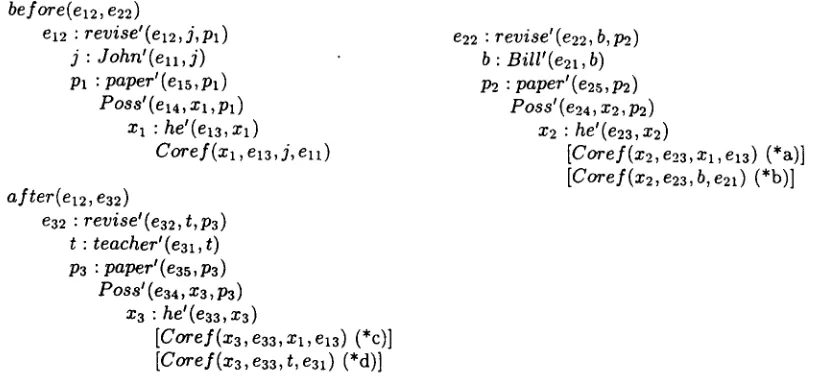
readings, in which the J J J B reading shown in (3) is missing. ~ DSP, who use this case as a benchmark for theories of VP ellipsis, note that the methods of Sag (1976) and Williams (1977) can be seen to derive two readings, namely J J J J and J T B T . An analysis proposed by Gawron and Peters (1990), who first introduced this example, generates three readings (adding J J B B to the above two), as does the analysis of Fiengo and May (1994). A method that Gawron and Peters attribute to Hans Kamp generates either four readings, including the above three and J T J T , or all six readings. DSP's analysis strictly speak- ing generates all six readings; however, they appeal to anaphor/antecedent linking relationships to elim- inate the J J J B reading. However, these linking rela- tionships are not a by-product of the resolution pro- cess itself, but must be generated separately. Our approach derives exactly the correct five readings. 6 The antecedent clause is represented in Figure 2, and the expansion of the final VP ellipsis is shown in Figure 3. In proving similarity, each pronoun can be taken to be coreferential with its parallel element (cases *a, *c and *e), or proven similar to it (cases *b, *d, *f and *g). If choice *a is taken in the sec- ond clause, then the "similarity" choice in the fourth clause must be *f; if *b, then *g. If *a and *c are chosen, the J J J J reading results. If *a, *d, and *e are chosen, the J J B J reading results. If *a, *d, and *f are chosen, the JJBB reading results. If *b and *c are chosen, the J T J T reading results. If *b and *d are chosen, the J T B T reading results. Thus taking all possible choices gives us all acceptable readings.
Now consider what it would take to obtain the * J J J B reading. The variable x3 would have to be 5Each reading for this example contains four descrip- tions of papers that were revised. We use the notation JJJB to represent the reading in which the first three papers are John's and fourth is Bill's, corresponding to reading (3). Other uses of such notation should be un- derstood analogously.
6The approach presented in Kehler (1993) also derives the correct five readings, however, our method has ad- vantages in its being more general and better motivated.
coreferential with John and x4 with Bill. The for- mer requirement forces us to pick case *c. But then case *e makes x4 coreferential with either John or the teacher (depending on how the first ellipsis was resolved). Case *f makes x4 coreferential with John, and case *g makes it coreferential with the teacher. There is no way to get x4 coreferential with Bill once we have set x3 to something other than Bill.
Neither Prtist (1992) nor Asher (1993) discuss this example. In extrapolating from the analyses Pr/ist gives, we find that his analysis generates only two of the five readings. Briefly, if the first ellipsis is resolved to the strict reading, then the J J J J read- ing is possible. If the first ellipsis is resolved to the sloppy reading, then only the J T B T reading is possi- ble. Asher's account, extrapolating from an example he discusses (p. 371), may generate as many as six readings, including the missing reading. This read- ing results from the manner in which the strict read- ing for the first ellipsis is generated--the final clause pronoun is resolved with the entity specified by the subject of the antecedent clause, whereas our algo- rithm creates a dependency between the pronoun and its parallel element in the antecedent clause. Our mechanism is more natural because of the align- ment of parallel elements between clauses when es- tablishing parallelism, and it is this property which results in the underivability of the missing reading.
5
A S o u r c e - o f - E l l i p s i s P a r a d o x
before(e32, e42) r e v i s e ' (e32, b, P3 )
b : Bill'(e31, b) p3 : paper'(e35, P3)
P oss' ( e34 , x 3 , P3 ) x3 : h e ' ( e 3 3 , x 3 )
[(*c)
C,:,'ef(z3, e33, =~,e~3)]
[(*d)
Core.f (z3,e33, b, e31)]
Figure 3: Representations (7) John realizes that he is a fool, but Bill does
not, even though his wife does. (Dahl, 1972) (8) John realizes that John is a fool, but Bill does not realize that Bill is a fool, even though Bill's wife realizes Bill is a fool.
Example (7) contains two ellipses. Reading (8) re- sults from the second clause receiving a sloppy in- terpretation from the first, and the third clause re- . ceiving a strict interpretation from the second. An identity-of-relations analysis, however, predicts that this reading does not exist. Because the second clause will only have the sloppy derivation received from the first, the strict derivation that the third clause requires from the second will not be present. However, in defending their identity-of-relations approach, Gawron and Peters (1990) note that a non-identity account predicts that sentence (9) has the (nonexistent) reading given in (10).
(9) John revised his paper before Bill did, but after the teacher did.
(10) John revised John's paper before Bill revised Bill's paper, but after the teacher revised John's paper.
In this case, the first clause is the antecedent for both ellipses. These two examples create a paradox; apparently neither type of analysis (nor any previous analyses we are aware of) can explain both.
Our analysis accounts for both examples through a mutually-constraining interaction of parallelisms. Example (7) is fairly straightforward, so we focus on example (9). Let us refer to the clauses as clauses 1, 2, and 3. Because clauses 2 and 3 are VP-elliptical, we must establish a parallelism between each of them and clause 1. In addition, the contrast rela- tion signalled by "but" is justified by the contrast- ing predicates "before" and "after", provided their corresponding pairs of arguments are similar. Their first arguments are similar since they are identical-- clause 1. Then we also have to establish the similar- ity of their second arguments--clause 2 and clause 3.
r e v i s e ' ( e42 , t, p4 ) t : teacher'(e41, t) P4 : paper'(e45,P4)
P o s s ' ( e 4 4 , x4, P4)
x4 : he'(e4z, x4)
[Co~e/(z4, e43,
z2, e~3) (*e)]
[Core/(z4, e43, z3, e33)(*f)]
[Co~el(x~, e,3, t,
e,1) (*g)]
for Five Readings Case
Thus, three mutually constraining parallelisms must be established: 1 - 2, 1 - 3, and 2 - 3.
In Figure 4, cases *a and *b arise from the coref- erence and similarity options when establishing the parallelism between clauses 1 and 2, and cases *c and *d from the parallelism between clauses 1 and 3. However, because parallelism is also required be- tween clauses 2 and 3, we cannot choose these op- tions freely. If we choose case *a, then we must choose case *c, giving us the J J J reading. If we choose case *b, then we must choose case *d, giving us the J B T reading. Because of the mutual con- straints of the three parallelisms, no other readings are possible. This is exactly the right result.
Prtist (1992) essentially follows Sag's (1976) treat- ment of strict and sloppy readings, which, like other identity-of-relations analyses, will not generate the reading of the cascaded ellipsis sentence (7) shown in (8). While the approach will correctly predict the l a c k of reading (10) for sentence (9), it does so for the wrong reason. Whereas ellipsis resolution does :not permit such readings in any circumstance in his account, we claim that the lack of such readings for • sentence (9) is due to constraints imposed by multi- ple parallelisms, and not because of the correctness of identity-of-relations analyses.
Asher's (1993) analysis falls into the non-identity class of analyses, a~ld therefore makes the correct predictions for sentence (7). While he does not dis- cuss the contrast between this case and sentence (9), we do not see any reason why his framework could not accommodate our solution.
6 O t h e r E x a m p l e s
M i s s i n g R e a d i n g s w i t h M u l t i p l e P r o n o u n s Dahl (1974) noticed that sentence (11) has only three readings instead of the four one might expect. The reading Bill said that J o h n revised Bill's paper
is missing.
before(el2, e22)
e12 :revise'(e12,j, pl) j : J o h n ' ( e l l , j ) Pl : paper'(e15,P1)
P o s s ' (e14, x l ,
Pl)
2;1 : h e ' ( e 1 3 , x 1 )C o ~ e f ( x l ,
el3, j, e11)
a f t e r ( e l 2 , e32)
e32 : revise'(e32, t,p3) t : teacher'(e31, t) P3 : paper~(e3s,P3)
Poss' (e34, x3, P3) x3 : he'(e33,x3)
[Corer(x3, e33, Zl, el3) (*C)] [Corer(z3, e33, t, e31) (*d)]
e22 : revise' ( e22, b, p2 ) b : Billl(e21, b) P2 : paper' (e25, P2 )
Poss'(e24, x2,
P2)
x2 : he'(e23,x2)[Co~e/(=2,
e23, Zl, e13) (*a)] [Coref(x=, e23, b, e21) (*b)]Figure 4: Representations for the Source-of-Ellipsis Paradox In contrast, t h e similar sentence given in (12) ap-
pears to have all four readings.
(12) John said t h a t his teacher revised his paper, and Bill did too.
The readings derived by our analysis depend on the Core] relations t h a t hold between the corefer- ring noun phrases in the antecedent clauses. For sentence (11), the correct readings result if his is linked to he and he to John; for sentence (12), the correct readings result if b o t h pronouns are linked to John. Other cases in the literature indicate that the situation is more complicated t h a n might initially be evident. Handling these cases requires an account of how such dependencies are established, which we discuss in Hobbs and Kehler (forthcoming).
E x t e n d e d P a r a l l e l i s m In some cases, the ele- ments involved in a sloppy reading may not be con- tained in the minimal clause containing the ellipsis. (13) John told a man that Mary likes him, and
Bill told a boy that Susan does. ~
(14) T h e m a n who gives his paycheck to his wife is wiser t h a n the man who gives it to his mis- tress. (Karttunen, 1969)
the pronoun it does not refer to the first m a n ' s pay- check b u t the second's.
In text, it normally requires an explicit, corefer- ring antecedent. However, the parallelism between the clauses licenses a sloppy reading via the similar- ity option.. T h e real world fact t h a t to give some- thing to someone, you first must have it, leads to a strong preference for the sloppy reading.
It is necessary to have parallelism in order to li- cense the lazy pronoun reading. If we eliminate the possibility of parallelism, as in
(15) John revised his paper, and then Bill handed it in.
the lazy pronoun reading is not available, even though the have-before-give constraint is not satis- fied. To interpret this sentence, we are more likely to assume an unmentioned transfer event between the two explicit events.
S l o p p y R e a d i n g s w i t h E v e n t s Sentence (16) has a "sloppy" reading in which the second main clause means "I will kiss you even if you don't want me to kiss you."
(16) I will help you if you want me to, but I will kiss you even if you don't, s
Deriving this reading requires a Core] relation be- tween the elided event and its antecedent in the first main clause, which is obtained when our al- gorithm bails out in event coreference (see footnote
8Mark Gawron, p.c., attributed to Carl Pollard. Although the antecedent clause for "Susan does"
is "Mary likes him", there is a sloppy reading in which "Bill told a boy t h a t Susan likes Bill". This fact is problematic for accounts of VP ellipsis t h a t operate only within the minimal clauses. These readings are predicted by our account, as John and Bill are parallel in the main clauses.
L a z y P r o n o u n s "Lazy pronouns" can be ac- counted for similarly. In
[image:7.612.88.495.48.236.2]3). Then in expahding the VP ellipsis in the sec- ond main clause, taking the similarity option for the event generates the desired reading.
I n f e r e n t i a l l y - D e t e r m i n e d A n t e c e d e n t s Web- bet (1978) provides several examples in which the antecedent of an ellipsis is derived inferentially:
(17) Mary wants to go to Spain and Fred wants to go to Peru, but because of limited resources, only one of them can.
Our account of parallelism applies twice in han- dling this example, once in creating a complex antecedent from recognizing the parallelism be- tween the first two clauses, and again in resolv- ing the ellipsis against this antecedent. Hobbs and Kehler (forthcoming) describe the analysis of this case as well as others involving quantification. 7 S u m m a r y
We have given a general account of parallelism in discourse and applied it to the special case of resolv- ing possible readings for instances of VP ellipsis. In doing so, we showed how a variety of examples that have been problematic for previous approaches are accounted for in a natural and straightforward fash- ion. Furthermore, the generality of the approach makes it directly applicable to a variety of other types of ellipsis and reference in natural language. A c k n o w l e d g e m e n t s
The authors thank Mark Gawron, David Israel, and three anonymous reviewers for helpful comments. This research was supported by National Science Foundation/Advanced Research Projects Agency G r a n t IRI-9314961.
R e f e r e n c e s
Asher, Nicholas. 1993. Reference to Abstract Ob-
jects inDiscourse. SLAP 50, Dordrecht, Kluwer.
Crouch, Richard. 1995. Ellipsis and quantifica- tion: A substitutional approach. In Proceedings of EACL-95, pages 229-236, Dublin, Ireland, March. Dahl, Osten. 1972. On so-called "sloppy" identity.
Gothenburg Papers in Theoretical Linguistics, 11.
University of GSteborg.
Dahl, Osten. 1974. How to open a sentence: Ab- straction in natural language. In Logical Gram-
mar Reports, No. 12. University of GSteborg.
Dalrymple, Mary, Stuart M. Shieber, and Fernando Pereira. 1991. Ellipsis and higher-order unifica- tion. Linguistics and Philosophy, 14:399-452.
Fiengo, Robert and Robert May. 1994. Indices and
Identity. MIT Press, Cambridge, MA.
Gawron, Mark and Stanley Peters. 1990. Ana- phora and Quantification in Situation Semantics. CSLI/University of Chicago Press, Stanford Uni- versity. CSLI Lecture Notes, Number 19.
Hardt, Daniel. 1992. VP ellipsis and contextual in- terpretation. In Proceedings COLING-92, Nantes. Hobbs, Jerry R.. 1979. Coherence and coreference.
Cognitive Science, 3:67-90.
Hobbs, Jerry R. 1985. On the coherence and struc- ture of discourse. Technical Report CSLI-85-37, Center for the Study of Language and Informa- tion, Stanford University, October.
Hobbs, Jerry R. and Andrew Kehler. Forthcoming. A general theory of parallelism and the special case of VP ellipsis. Technical report, SRI Interna- tional.
Hobbs, Jerry R., Mark E. Stickel, Douglas E. Ap- pelt, and Paul Martin. 1993. Interpretation as abduction. Artificial Intelligence, 63:69-142. Karttunen, Lauri. 1969. Pronouns and variables.
In Papers from the Fifth Regional Meeting of the
Chicago Linguistics Society.
Kehler, Andrew. 1993. A discourse copying algo- rithm for ellipsis andanaphora resolution. In Pro-
ceedings of EACL-93, pages 203-212, Utrecht, the
Netherlands, April.
Kehler, Andrew. 1995. Interpreting Cohesive Forms
in the Context of Discourse Inference. Ph.D. the-
sis, Harvard University.
Lappin, Shalom and Michael McCord. 1990. Ana- phora resolution in slot grammar. Computational
Linguistics, 16:197-212.
Pr/ist, Hub. 1992. On Discourse Structuring, VP
Anaphora, and Gapping. Ph.D. thesis, University
of Amsterdam.
Sag, Ivan. 1976. Deletion and Logical Form. Ph.D. thesis, MIT.
Scha, Remko and Livia Polanyi. 1988. An aug- mented context free grammar for discourse. In
Proceedings of COLING-88, pages 573-577, Bu-
dapest, August.
Webber, Bonnie Lynn. 1978. A Formal Approach to
Discourse Anaphora. Ph.D. thesis, Harvard Uni-
versity.