Dispersion-Flocculation Behavior of Fine Lead Particles in an Organic Solvent
Masami Tsunekawa
1;*1, Yuta Sasaki
1;*2, Yoshiaki Nakamura
1;*2,
Mayumi Ito
1, Naoki Hiroyoshi
1and Kyoung Keun Yoo
21
Graduate School of Engineering, Hokkaido University, Sapporo 060-8628, Japan
2Korea Institute of Geoscience & Mineral Resources, 30 Gajeong-dong, Yuseong, Daejeon 305-350, Korea
Methyl ethyl ketone (MEK) is a good solvent for polyvinyl chloride (PVC) and it has been proposed for use in PVC recycling. In the recycling process, fine particles of 3PbOPbSO4H2O, used as a thermal stabilizer in PVC products, are dispersed and not dissolved in the
solvent. To establish methods for removing of 3PbOPbSO4H2O particles from the solvent, factors affecting the dispersion-flocculation
behavior of the particles in MEK were investigated.
The zeta potential and particle distribution of 3PbOPbSO4H2O particles in MEK solutions containing known amounts of H2O were
measured. Above 5 vol%H2O in MEK solutions, the zeta potential of 3PbOPbSO4H2O particles approached zero and the flocculation of
particles was achieved. In addition, it was found that Pb2þand Claffect the zeta potential of the particles. These results indicate that the dispersion-flocculation behavior of lead particles can be influenced by the concentration of H2O, Pb2þ, and Clin MEK.
[doi:10.2320/matertrans.M-MRA2008822]
(Received December 18, 2007; Accepted June 20, 2008; Published August 13, 2008)
Keywords: polyvinyl chloride (PVC) recycling, fine lead powder, dispersion-flocculation behavior, zeta potential
1. Introduction
A variety of polyvinyl chloride (PVC) products contains
lead in a thermal stabilizer.1) Recently, use of toxic
substances such as lead is regulated strictly. According to RoHS (Restriction of the use of certain Hazardous Sub-stances in electrical and electronic equipment), lead concen-tration in electrical and electronic equipment is needed to be less than 1000 ppm. In other industrial products as well, the demand for PVC without lead is expected to increase. Subsequently, there is a need to develop methods to remove lead from waste PVC products in PVC recycling.
A conventional PVC recycling method can be summarized
as follows:2) The PVC products are first dissolved in an
organic solvent, and then the PVC solution is filtered to remove large particulate impurities. In the next step, PVC and soluble additives are recovered with a deposition method by steam injection. The used organic solvent is recovered by a salting-out method and reused. In this process, removal of lead is difficult because lead is contained in very fine
compounds (average particle size, 1–2mm) and the
com-pounds are not caught by the filtration.
To develop a removal process for this kind of fine particles, an evaluation of the factors influencing the dispersion-flocculation behavior of the particles in organic solvents is
important. This paper describes the effect of the H2O content
and some ion species on the zeta-potential of fine lead particles in an organic solvent.
2. Materials and Methods
2.1 Materials
STABINEX TC3)(3PbOPbSO4H2O, a thermal stabilizer
of PVC products), Mizusawa Industrial Chemicals, Ltd., was used as the sample of lead particles. A scanning electron
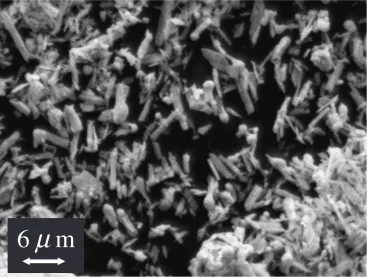
microscope image of this sample is shown in Fig. 1. The
average particle size is about 2mm, and the solubility in
H2O is 2:0106mol/dm3. STABINEX TC has a
hydro-phobic nature because of surface preparation by stearic acid coating.
Methyl ethyl ketone (MEK), tetrahydrofuran, and cyclo-pentanone are known as good solvents for PVC. In this study, MEK (Daishin Chemical Corporation) was chosen as the solvent due to its low toxicity and cost. The viscosities and relative dielectric constants of MEK solutions with various
concentration of H2O are shown in Table 1. The viscosities
were estimated based on the experimental data.4) Relative
dielectric constants were calculated on a volume fraction basis. Lead particles were easily dispersed in MEK because of the hydrophobic surface.
The electrolytes in the MEK reported here were PbCl2
(99.0%, Wako Chemical Co. Ltd., Japan), Pb(NO3)2(99.5%,
Koso Chemical Co. Ltd., Japan), K2SO4 (99.0%, Wako
Chemical Co. Ltd., Japan), Na2SO4(99.5%, Wako Chemical
Co. Ltd., Japan), NaCl (99.5%, Wako Chemical Co. Ltd.,
Japan), and KNO3 (99.5%, Koso Chemical Co. Ltd., Japan).
2.2 Preparation of suspension
First, MEK solutions containing known concentrations of
H2O and electrolytes were prepared by adding H2O and
aqueous electrolyte solution to MEK, respectively. The MEK solutions were homogeneous and depositions of electrolytes or phase separation were not observed.
Lead particles (0.01 g) were suspended in the MEK
solu-tions (100 cm3) and agitated by magnetic stirrer for 24 hours.
2.3 Zeta potential measurement
The suspension was treated ultrasonically for 10 s (VS-25, Velvo-Clear Ltd), and the zeta potential was measured by using Zeta-PALS (Brookhaven Instruments Co., USA)
with Phase Analysis Light Scattering method.5) The
Smoluchowski relationship6) shown in eq. (1) was used to
calculate the zeta potential:
¼
"r"0
ð1Þ
Where, : zeta potential, : electrophoretic mobility, :
viscosity of dispersion medium, "r: relative dielectric con-stant of dispersion medium, and"0: the absolute permittivity. Measurements were repeated ten times and the average was calculated.
2.4 Electric conductivity measurement
Electric conductivity of the MEK solutions containing H2O and electrolytes was measured by a conductance meter (CM-30G, TOA DKK Ltd.) and the conductivity of the filtrate of lead particles suspension, where lead particles are suspended in MEK containing various concentrations of H2O, was measured after filtration with a membrane filter (pore size, 0.2mm).
2.5 Particle size distribution measurement
The particle size distribution of lead particles in the MEK solutions was measured using a particle size analyzer (MT3300SX, Microtrac Inc.) with laser light scattering and diffraction method.
2.6 Microscope observation of the behavior of lead particles
The dispersion-flocculation of lead particles in the MEK solutions was observed under a digital microscope (VH-Z450, Keyence Co. Ltd.). In the dry condition, the dis-persion-flocculation of lead particles was observed under the scanning electron microscope (SS-550, Shimadzu Co. Ltd.)
after filtration with a membrane filter (0.2mm, SEMpore,
Jeol Datum Ltd.).
All experiments were carried out at room temperature.
3. Results and Discussion
3.1 Effect of H2O addition on the zeta potential of lead
particles in MEK
Figure 2 shows the zeta potential of lead particles in MEK solutions containing various concentrations of H2O (without electrolytes). The absolute value of zeta potential of lead
particles decreased with increasing H2O content and reached
about zero with H2O content above about 5%.
Figure 3 shows the electric conductivity of filtrates of lead particles suspension where lead particles are suspended in
MEK solutions containing H2O. The conductivity increased
with increasing H2O content, where H2O is dissolved in MEK up to 26.6 mass% and is dissociated. This may indicate that the ion concentration in MEK solution increased. The
electric double layer thickness (1/) is compressed with the
increase of ion concentration, according to eq. 2.7)
1=¼ "r"0kT
e2Xn
iz2i !1=2
ð2Þ
Where,k: the Boltzmann constant,T: temperature,e: charge
6
m
6
µ
m
[image:2.595.115.485.73.352.2]Fig. 1 SEM image of lead particles.
Table 1 Physical properties of MEK with various concentration of H2O.
H2O content
(vol%)
Viscosity,
/mPas Relative dielectric constant,"r
0 0.42 18.4
1 0.45 19.3
3 0.47 20.2
5 0.51 21.4
[image:2.595.45.293.410.511.2]of electron,n: bulk ion concentration, andz: valence of ion. In general, the absolute value of zeta potential decreases by a compression of the electric double layer thickness. So the decrease in the zeta potential of lead particles may have occurred due to the compression of the electric double layer
thickness caused by H2O addition and the increase in ion
concentration.
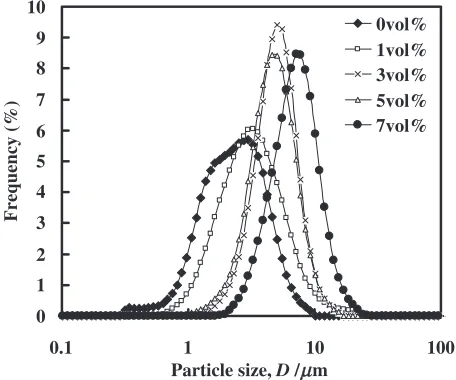
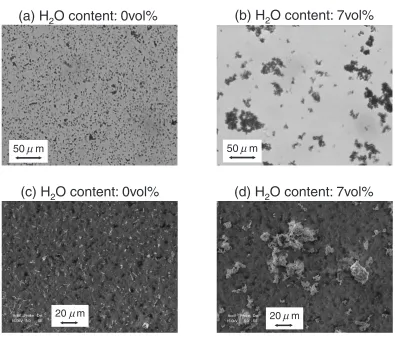
With the decrease in absolute values of zeta potential, the flocculation of particles occurs according to DLVO theory. Figure 4 shows the particle size distribution of lead particles in the MEK solutions containing H2O. With increasing the H2O addition, the distribution shifted to large size. Figure 5 shows the photograph of lead particles in the MEK solutions with H2O content of 0 and 7 vol%. In the case of H2O content of 0 vol%, lead particles were dispersed. On the other hand, with H2O content of 7 vol%, lead particles were flocculated.
3.2 Effect of ion species on the zeta potential of lead particles
Adsorption and desorption of potential determining ions also affects the zeta potential. Since lead particles are
3PbOPbSO4H2O, it is expected that Pb2þ, SO42, OH, and
Hþ may behave as potential determining ions of lead
particles, and this section describes the influences of Pb2þ
and SO42.
The zeta potential of particles may be affected by the concentration of potential determining ions and the com-pression of the electric double layer thickness. Therefore it is necessary to maintain the ionic strengths in the zeta potential measurements to investigate the effects of potential
deter-mining ions. Here, NaCl and KNO3were used as supporting
electrolytes to maintain the ionic strength. Figure 6 shows the electric conductivity of MEK solutions containing 3 vol% H2O and various concentrations of NaCl or KNO3. The conductivity increased with increasing NaCl and KNO3
concentration indicating that NaCl and KNO3 can dissolve
into the MEK solution and can be used as supporting electrolytes to maintain the ionic strength of the solution.
Figure 7 shows the zeta potential of lead particles in MEK solutions containing various concentrations of electrolytes, PbCl2, Pb(NO3)2, Na2SO4, and K2SO4, and a specific amount
of supporting electrolyte, NaCl or KNO3 of 3:0105
mol/dm3. H
2O content of MEK solution was 3 vol%. The
zeta potential of lead particles changed from negative to
positive with increasing Pb(NO3)2 concentration, while the
zeta potentials with PbCl2, K2SO4, and Na2SO4 did not
significantly change.
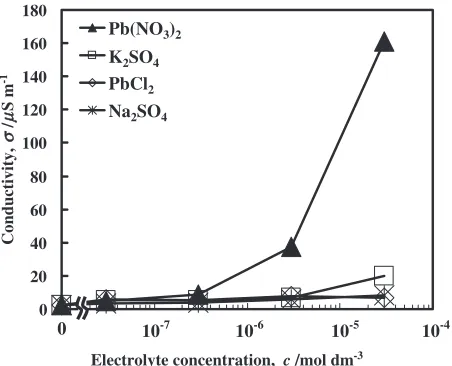
Figure 8 shows the electric conductivity of MEK solution containing various concentrations of electrolytes such as
PbCl2, Pb(NO3)2, Na2SO4 and K2SO4, in the absence of
supporting electrolytes. The electric conductivity increased
with increasing Pb(NO3)2 concentration and increased
slightly with increasing concentration of PbCl2, K2SO4,
and Na2SO4. This suggests that Pb(NO3)2may dissolve and
dissociate in the solution, while PbCl2, K2SO4, and Na2SO4 dissolve as neutral molecules. It is considered that the zeta
-50 -40 -30 -20 -10 0 10
0
H2O content in MEK solution (vol%)
Zeta potential,
ζ
/mV
8 7 6 5 4 3 2 1
Fig. 2 Zeta potential of lead particles in MEK solutions containing various concentration of H2O.
0 5 10 15 20 25
0
H2O content in MEK solution (vol%)
Conductivity,
σ
/
S
m
-1
µ
8 7 6 5 4 3 2 1
Fig. 3 Electric conductivity of filtrates of MEK solutions containing H2O.
Filtrates were prepared by filtration of lead particles suspension, where lead particles are suspended in MEK containing various concentrations of H2O.
0 1 2 3 4 5 6 7 8 9 10
0.1
Particle size, D / mµ
Frequency (%)
0vol% 1vol% 3vol% 5vol% 7vol%
100 10
1
[image:3.595.56.285.71.264.2] [image:3.595.313.541.75.265.2] [image:3.595.56.284.319.511.2]potential of lead particles changed from negative to positive
as Pb(NO3)2 easily dissociated in solution and that the
dissociated Pb2þadsorbed on the lead particles surface as the
adsorption amount increased with increasing Pb(NO3)2 concentration. Results in Fig. 8 show that PbCl2, K2SO4,
and Na2SO4 are present as neutral molecules in MEK. This
may be a reason why these compounds do not affect the zeta potential of lead particles (Fig. 7).
3.3 Effect of chloride ion concentration on the zeta potential of lead particles
It was suggested that Pb2þ behaves as a potential
determining ion of lead particles, and the effect of Pb2þ is
influenced by co-existing anions like NO3and Clbecause
50
µ
m 50µ
mAccV Probe Det 15.0kV 5.0 SE
20µm AccV Probe Det
15.0kV 5.0 SE 20µm
(a) H
2O content: 0vol%
(b) H
2O content: 7vol%
(c) H
2O content: 0vol%
(d) H
2O content: 7vol%
Fig. 5 Photograph of lead particles. (a), (b) Lead particles in the MEK solution with or without H2O under the digital microscope. (c), (d)
Lead particles after filtration of MEK solution with or without H2O under SEM.
0 50 100 150 200 250 300 350 400 450 500
Electrolyte concentration, c /mol dm-3
Conductivity,
σ
/
S
m
-1
µ
NaCl
KNO3
10-7 10-6 10-5 10-4
0
Fig. 6 Electric conductivity of MEK solutions containing various concen-trations of electrolyte (H2O content: 3 vol%).
-30 -20 -10 0 10 20 30
Electrolyte concentration, c /mol dm-3
Zeta potential,
ζ
/mV PbCl2
K2SO4
Na2SO4 Pb(NO3)2
10-7 10-6 10-5 10-4
0
Fig. 7 Zeta potential of lead particles in MEK solutions with various concentrations of PbCl2, Pb(NO3)2, Na2SO4, or K2SO4, under a
support-ing electrolyte concentration of 3:0105mol/dm3 (H
2O content:
3 vol%). KNO3 was used as supporting electrolyte for Pb(NO3)2 and
K2SO4, and NaCl was used as supporting electrolyte for PbCl2 and
[image:4.595.100.495.66.407.2] [image:4.595.312.540.453.638.2] [image:4.595.57.282.454.640.2]the changes of the zeta potential in Pb(NO3)2 solutions were
large and that in PbCl2solutions were small. Since the results
in Fig. 8 show that PbCl2may exist as neutral molecules and
dissociation is difficult, it is expected that Cl in solutions
would adsorb onto the Pb2þsite of lead particles surface and
the zeta potential of lead particles would be changed by Cl.
To verify this possibility, the zeta potential of lead particles in MEK solutions containing various concentrations
of NaCl, with 104mol/dm3 KNO3 as the supporting
electrolyte, was measured and the results are shown in Fig. 9. The zeta potential of lead particles became more
negative and it is confirmed that Claffects the zeta potential
of lead particles. It is assumed that the change in zeta potential is caused by the effect of (1) specific adsorption of
Cl on lead particles surface, or (2) selective desorption of
Pb2þ from lead particles due to the formation of neutral
molecules like PbCl2in the solution.
4. Conclusions
The presence of small amounts of H2O in MEK solutions affects the zeta potential of lead particles and leads to flocculation of lead particles. It is assumed that this is caused by the increase of solution conductivity.
The Pb2þion behaves as one of the potential determining
ions of lead particles in MEK solutions containing Pb(NO3)2,
and the effect of Pb2þis influenced by co-existing anions like
NO3and Cl. The Clion also affects the zeta potential of
lead particles in MEK solutions containing NaCl. Because the zeta potential affects the dispersion-flocculation behavior of fine particles, these results indicate that the dispersion-flocculation behavior of lead particles can be influenced by
the concentration of H2O, Pb2þ, and Clin MEK.
REFERENCES
1) PVC Fact book, chapter 4, (Vinyl Environmental Council, 2005) pp. 53–55.
2) S. A. Solvay: Belgium, 11-310660.
3) Products information of Mizusawa Industrial Chemicals, Ltd. 4) E. M. Kartzmark and A. N. Campbell: J. Chem. Eng., 31 (1986)
241–246.
5) J. F. Miller, K. Scha¨tzel and B. Vincent: J. Colloid and Interface Science
143(1991) pp. 532–554.
6) R. J. Hunter:Zeta Potential in Colloid Science, (Academic Press Inc., London, 1981) pp. 69–71.
7) R. J. Hunter:Zeta Potential in Colloid Science, (Academic Press Inc., London, 1981) pp. 22–30.
0 20 40 60 80 100 120 140 160 180
Electrolyte concentration, c /mol dm-3
Conductivity,
σ
/
S
m
-1
µ
PbCl2 Pb(NO3)2
Na2SO4 K2SO4
10-7 10-6 10-5 10-4
0
Fig. 8 Electric conductivity of MEK solutions containing various concen-trations of PbCl2, Pb(NO3)2, Na2SO4, and K2SO4 without supporting
electrolyte (H2O content: 3 vol%).
-30 -20 -10 0 10 20 30
NaCl concentration, c /mol dm-3
Zeta potential,
ζ
/mV
10-7 10-6 10-5 10-4
0
Fig. 9 Zeta potential of lead particles in MEK solutions containing various concentrations of NaCl under a supporting electrolyte concentration of
104mol/dm3KNO
[image:5.595.57.283.73.256.2] [image:5.595.313.540.74.254.2]