Effect of Sb and Sr Additions on the Microstructural Evolution
of Mg-Sn-Al-Si Based Alloys
D. H. Kang
*, G. T. Bae
*and Nack J. Kim
Center for Advanced Aerospace Materials, Pohang University of Science and Technology, Pohang 790-784, Korea
A study has been made on the effect of Sb and Sr on the microstructure and mechanical properties of Mg-Sn-Al-Si based (TAS) alloy. When Sb is added to TAS alloy, the morphology of second phase particles changes to fine radial shape by the formation of nucleation cores. Refined microstructure of TAS-Sb alloys results in higher yield strength and larger elongation with lower creep resistance than those of TAS alloy. Sr addition induces the formation of large amount of thermally stable second phase particles. Due to the large amount of thermally stable second phase particles, TAS-Sr alloys show superior creep resistance and higher yield strength at both room and high temperatures than those of TAS alloy. [doi:10.2320/matertrans.MC200751]
(Received October 5, 2007; Accepted December 13, 2007; Published February 6, 2008)
Keywords: magnesium alloy, thermal stability, microstructure, mechanical property, creep resistance
1. Introduction
Magnesium alloys have a great potential for high perform-ance structural applications due to their excellent properties such as low density, high specific strength, superior damping capacity, etc.1–6) Since they also have good castability and
machinability, Mg alloys have been mostly used as cast products in aerospace and automobile applications.7,8) The typical alloys are Mg-Al based alloys such as AZ91 and AM60 alloys. They are currently used extensively in automotive components due to their improved corrosion resistance and moderate mechanical properties at room temperature.7–10) In recent years, however, improving the
elevated temperature properties has become a critical issue to extend their applications to powertrain components which are generally used at high temperatures.2,7,11–13) Since the
conventional Mg alloys have shown large decrease in mechanical properties at high temperatures over 100C,
several approaches have been taken to improve the elevated temperature properties of Mg alloys. The most common way of improving the elevated temperature properties is the utilization of thermally stable second phase particles in the microstructure.11–14) In our previous studies, Mg-Sn-Al-Si based (TAS) alloys which have thermally stable particles within matrix as well as along the grain boundaries have shown highly improved elevated temperature properties.15–18) In the present study, the effect of additional alloying elements, Sb and Sr, on the microstructure and mechanical properties of TAS alloys have been investigated. Sb and Sr have been chosen since they are known to form thermally stable second phase particles in Mg alloys.
2. Experimental Procedures
Various TAS alloys with 1, 3, 5 mass% of Sb or Sr were investigated in the present study. Analyzed chemical com-positions are summarized in Table 1. The alloys were melted at 750C under an inert atmosphere of CO2and SF6mixture.
The melt was injected into Cu mold where the cooling water
is circulating to obtain fast cooling rate similar to that of high pressure die casting process. Microstructure of the alloys was characterized using SEM and TEM. Tensile properties were measured by using flat tensile specimens with 12.6 mm gage length, 1 mm gage thickness and 5 mm gage width at a strain rate of 6:4104s1. High temperature creep tests were performed in a horizontal creep tester at 150C in an applied
stress of 50 MPa. Creep specimens were cylindrical ones with gage length of 18 mm and gage diameter of 4 mm.
3. Results
3.1 Microstructure
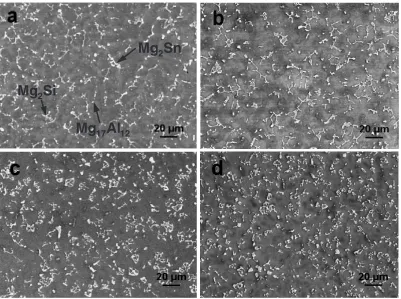
Figure 1 shows the SEM micrographs of TAS alloy and Sb added TAS alloys. It shows that Sb added TAS alloys have a finer grain size than the TAS alloy (20mmvs. 28mm). As can be seen in Fig. 1(a), TAS alloy has shown semi-continuous particles along the grain boundaries. It has been shown that these particles consist of thermally stable Mg2Sn and Mg2Si with a small amount of Mg17Al12 particles.15–18) Although
[image:1.595.307.549.309.421.2]Mg2Si particles generally form as coarse Chinese-script shape in a slow cooling rate, having quite detrimental effect on the tensile properties of the alloys, they form in TAS alloy as a globular shape due to fast cooling rate.12,19) The microstructure of TAS alloy with 1 mass% of Sb is essentially similar to that of TAS alloy (Fig. 1(b)). However, when higher amounts (3 and 5 mass%) of Sb are added in TAS alloy (Figs. 1(c) and (d)), the morphology of second
Table 1 Analyzed chemical compositions of the alloys.
Alloy Mg Sn (mass%)
Al (mass%)
Si (mass%)
Sb (mass%)
Sr (mass%) TAS Bal. 7.79 2.73 0.70 0.54
TAS-1Sb Bal. 7.76 2.60 0.51 0.81 TAS-3Sb Bal. 6.83 2.91 0.57 2.89 TAS-5Sb Bal. 7.06 2.70 0.62 4.44
TAS-1Sr Bal. 8.80 3.34 0.88 0.77 TAS-3Sr Bal. 7.00 2.95 0.67 1.91 TAS-5Sr Bal. 8.12 3.06 0.51 4.77
*Graduate Student, Pohang University of Science and Technology
Special Issue on Platform Science and Technology for Advanced Magnesium Alloys, IV
phase particles gradually changes into radial shape consisting of core, branches and outer parts. It can be seen in Fig. 1(c) that fine cores starts to emerge at the center of large amount of second phase particles in 3 mass% Sb containing TAS alloy. In the TAS alloy with 5 mass% of Sb, all the particles have fine radial shape as shown in Fig. 1(d). Figure 2 shows TEM bright field image, EDS spectra and diffraction patterns from core and outer part of the second phase particles of TAS-5Sb alloy. TEM EDS results show that core part contains Si and Sb, while outer part contains mostly Sn with a small amount of Si. SAD analyses show that core and outer parts have same FCC structure with lattice parameters of 0.670 and 0.645 nm, respectively. It suggests that Mg2Si particles containing Sb form as primary particles during solidification, which then act as nucleation sites for Mg2Sn particles.
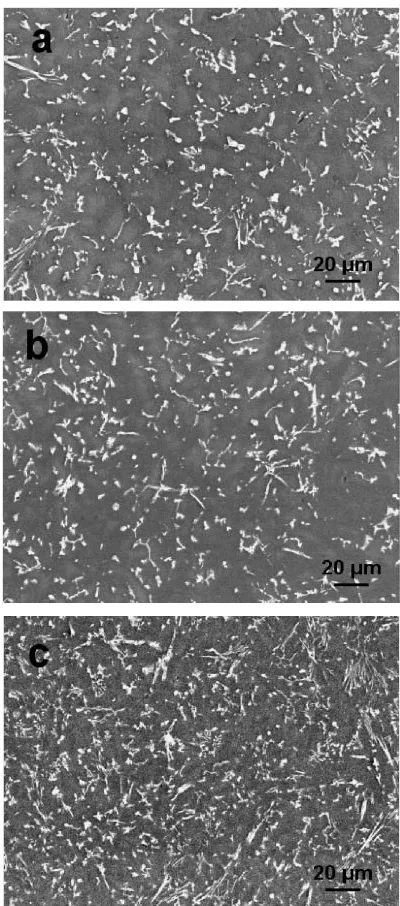
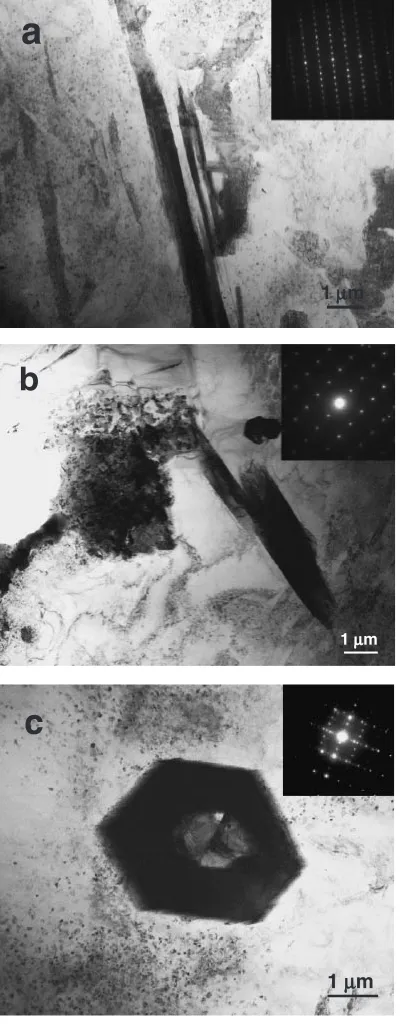
As compared to Sb added TAS alloys, Sr addition has resulted in quite different microstructure as shown in Fig. 3. When 1 mass% of Sr is added to TAS alloy, a large amount of needle-shapes particles form in the microstructure (Fig. 3(a)). As the Sr content increases, needle-shaped particles become more dominant. 5 mass% of Sr addition has generated a fairly large amount of various second phase particles in the microstructure. Since it is well known that Sr can form several kinds of second phases with Al, Mg and Sn,13,20)it is expected that Sr containing TAS alloys would also have various second phase particles in the micro-structure. TEM bright field images and diffraction patterns of some second phase particles are shown in Fig. 4. The phases have been identified as SiSr2 (orthorhombic), MgSi2Sr (orthorhombic), and Sr5Sn3 (BCT), besides Mg2Sn and
Mg2Si. It is quite obvious that these microstructural changes by Sb and Sr addition will affect on the mechanical properties of the alloys. In addition, it is expected that high melting temperatures of second phases might be beneficial to the elevated temperature properties of TAS alloy.
3.2 Tensile and creep properties
Room and elevated temperature tensile properties of the alloys are summarized in Table 2. Properties of AZ91 are also included for comparison purposes. When Sb is added to TAS alloy, there are large increases in ultimate tensile strength and elongation with a small increase in yield strength at room temperature. Higher strengths of Sb added TAS alloys than those of TAS alloy are also maintained at higher temperatures. With the addition of Sr, there are large increases in yield strength at both room and high temper-atures. However, increases in ultimate tensile strength by the addition of Sr are rather small at both room and high temperatures. More importantly, Sr-added TAS alloys show smaller elongation than TAS and Sb added TAS alloys at both room and high temperatures, suggesting that a large volume fraction of second phase particles in Sr-added TAS alloys are detrimental to the ductility of the TAS alloy systems.
Minimum creep rates of the alloys are shown in Table 3. It shows that the addition of Sb results in the increase in the minimum creep rates of the alloys. On the other hand, the addition of Sr has greatly decreased the minimum creep rates of the alloys. Even with the addition of 1 mass% Sr, creep elongation becomes too small to be measured and thus the minimum creep rate could not accurately be calculated.
Mg
2Si
Mg
2Sn
Mg
17Al
12 [image:2.595.99.500.71.370.2]4. Discussion
It has been shown in the present study that the micro-structural changes by Sb and Sr additions have large effects on mechanical properties. The interesting feature of Sb added TAS alloys is the formation of radial shape second phase particles consisting of core Mg2Si phase containing Sb and outer Mg2Sn phase. Since Sb has very low solubility in molten Mg and Mg3Sb2 phase has very high melting temperature, it can be expected that Mg3Sb2 phase might form at the first stage of solidification in the microstructure of Sb added TAS alloy. However, the present study shows that
Mg3Sb2phase dose not exist and core phase is Mg2Si phase containing Sb. It has been reported that two of Mg-Sb phases, -Mg3Sb2 and -Mg3Sb2, have solubility in Mg2Sn and Mg2Si phases and they can make a complete solid solution with these phases.21,22)Thus the formation mechanism of the
microstructure of TAS-Sb alloys can be explained as follows. When the melt is solidified, Mg3Sb2phase forms as primary phase in the melt. These Mg3Sb2 particles then act as nucleation sites for other phases during solidification and Mg2Si phase forms around the Mg3Sb2 nuclei, forming the core part of the second phase particles. At this stage, Mg3Sb2 phase dissolves into the core, which eventually becomes Mg2Si phase containing Sb. This phase continuously grows to the outside along a crystallographic direction forming branches. As the solidification continues, there is an addi-tional precipitation of Mg2Sn at the branch of Mg2Si-rich phase. Detailed TEM SAD analysis indicates that Mg2Sn and
2
µ
m
a
b
c
b
Mg
Sb
Sb
Si
Mg
Sn
Si
Sn
c
Fig. 2 TEM micrographs of TAS-5Sb alloy: (a) TEM bright field image, (b) EDS spectrum and SAD pattern of core, and (c) EDS spectrum and SAD pattern of outer part.
[image:3.595.326.526.70.523.2] [image:3.595.61.277.72.585.2]Mg2Si have the orientation relationship such asð011ÞMg2Sn==
ð013ÞMg2Si, ½100Mg2Sn==½100Mg2Si. It also shows that the
growth directions of branch are [100] and [031] for Mg2Si. Such various growth directions of Mg2Si phase possibly explain the occurrence of Chinese script Mg2Si particles in numerous Mg alloy systems. Since Mg2Sn and Mg2Si phases have the same crystal structure with only a small difference in the lattice parameters, they can form a completely miscible structure.23,24) However, inter-solution of these phases has not been found in the present study. Further study is necessary to understand the exact formation mechanism of these particles. Although the addition of Sb to TAS alloy imparts significant and interesting changes in the
micro-structure as mentioned above, it does not improve the creep resistance of the alloys. Sb has been initially added to the alloy to utilize the high thermal stability of Mg3Sb2 phase, which might have a beneficial effect on creep resistance. However, Mg3Sb2 phase dissolves into Mg2Si, making the microstructure of the alloys basically similar to that of non-Sb containing TAS alloy. Moreover, there is an overall refinement of grain size and particle size with Sb addition. Such microstructural changes induced by Sb addition result in improvement of tensile properties but decrease in the creep resistance of Sb containing alloys as compared to those of TAS alloy. As compared to Sb added alloys, Sr added alloys have much more complex microstructure due to the for-mation of many types of second phase particles such as Mg2Sr, SnSr2, SiSr, Si2Sr, Al4Sr, etc. besides Mg2Si and Mg2Sn. Formation mechanism of these phases in the alloy system could not be understood at this time since there are no thermodynamic data and phase diagram available. However, since all the second phase particles present in the current alloys have higher melting temperatures above 500C, it can
be expected that these phases are thermally stable, improving the creep resistance of TAS-Sr alloys as shown in the present study. However, a large increase in the volume fraction of second phase particles by Sr addition results in a decrease in tensile ductility.
5. Conclusion
When Sb is added to TAS alloy, the microstructure becomes refined and the morphology of second phase particles changes to radial shape particles consisting of Mg2Si phase containing Sb in the core region and Mg2Sn phase in the outer region. Refined microstructure of Sb
1 µm
a
1 µm
b
1 µm
c
[image:4.595.70.270.75.587.2]Fig. 4 TEM bright field images and SAD patterns obtained from the second phase particles: (a) SiSr2, (b) MgSi2Sr and (c) Sr5Sn3phases.
Table 2 Room and elevated temperature tensile properties of the alloys.
Alloy Room temp. 150
C
[image:4.595.306.549.84.209.2]YS(MPa) UTS(MPa) El.% YS(MPa) UTS(MPa) El.% AZ91 104 141 2.4 83 125 12.0 TAS 110 152 3.0 87 138 12.5 TAS-1Sb 111 186 5.5 95 147 10.0 TAS-3Sb 115 194 6.5 102 149 8.6 TAS-5Sb 117 198 5.8 106 148 8.0 TAS-1Sr 146 168 2.1 125 143 4.4 TAS-3Sr 147 165 1.9 123 142 4.4 TAS-5Sr 153 167 1.7 130 145 3.7
Table 3 Minimum creep rates of the alloys. Alloy Min. creep rate (109s1)
AZ91 34.0
TAS 2.2
TAS-1Sb 3.7
TAS-3Sb 3.6
TAS-5Sb 3.4
TAS-1Sr <0:01
TAS-3Sr <0:01
[image:4.595.305.548.250.361.2]containing TAS alloys has resulted in decrease in creep resistance as compared to TAS alloy. On the other hand, Sr addition has induced the formation of a large amount of thermally stable second phase particles in the microstructure, resulting in a large increase in creep resistance as compared to TAS and other commercially available Mg alloys.
Acknowledgement
This study was supported by the National Research Laboratory Program, the Center for Advanced Materials Processing (CAMP) of 21st Century Frontier R&D Program, the Fundamental R&D Program for Core Technology of Materials.
REFERENCES
1) A. Suzuki, N. D. Saddock, J. W. Jones and T. M. Pollock: Acta Mater.
53(2005) 2823–2834.
2) M. Vogel, O. Kraft and E. Arzt: Scripta Mater.48(2003) 985–990. 3) C. D. Lee: Met. Mater.-Int.12(2006) 377–383.
4) B. H. Choi, B. S. You and I. M. Park: Met. Mater.-Int.12(2006) 63–67. 5) S. S. Park, G. T. Bae, D. H. Kang, I. H. Jung, K. S. Shin and N. J. Kim:
Scripta Mater.57(2007) 793–796.
6) S. S. Park, Y. S. Oh, D. H. Kang and N. J. Kim: Mater. Sci. Eng. A449– 451(2006) 352–355.
7) I. A. Anyanwu, Y. Gokan, A. Suzuki, S. Kamado, Y. Kojima, S. Takeda and T. Ishida: Mater. Sci. Eng. A380(2004) 93–99.
8) J. M. Song, T. S. Lui, H. W. Chang and L. H. Chen: Scripta Mater.54
(2006) 399–404.
9) A. Srinivasan, U. T. S. Pillai and B. C. Pai: Metall. Mater. Trans. A36A
(2005) 2235–2243.
10) Y. Chino, H. Iwasaki and M. Mabuchi: Mater. Sci. Eng. A466(2007) 90–95.
11) I. P. Moreno, T. K. Nandy, J. W. Jones, J. E. Allison and T. M. Pollock: Scripta Mater.48(2003) 1029–1034.
12) E. Evangelista, E. Gariboldi, O. Lohne and S. Spigarelli: Mater. Sci. Eng. A387–389(2004) 41–45.
13) Z. Trojanova, R. Kral and A. Chatey: Mater. Sci. Eng. A462(2007) 202–205.
14) N. J. Kim: Mater. Sci. Eng. A449–451(2007) 51–56.
15) D. H. Kang, S. S. Park, Y. S. Oh and N. J. Kim: Mater. Sci. Eng. A449– 451(2007) 318–321.
16) D. H. Kang, S. S. Park and N. J. Kim: Mater. Sci. Eng. A413–414
(2005) 555–560.
17) D. H. Kang, M. S. Yoo, S. S. Park and N. J. Kim: Mater. Sci. Forum
475–479(2005) 521–524.
18) D. H. Kang, M. S. Yoo, S. S. Park and N. J. Kim: Mater. Sci. Forum
488–489(2005) 759–762.
19) J. J. Kim, D. H. Kim, K. S. Shin and N. J. Kim: Scripta Mater.41(1999) 333–340.
20) Y. Zhong, J. O. Sofo, A. A. Luo and Z. Liu: J. Alloys Compd.421
(2006) 172–178.
21) K. A. Bol’shakov, N. A. Bul’onkov, L. N. Rastorguev, Y. S. Umanskii and M. S. Tsirlin: Russ. J. Inorg. Chem.8(1963) 1418–1421. 22) B. Jonsson and J. Agren: Mater. Sci. Technol.2(1986) 913–916. 23) I. H. Jung, D. H. Kang, W. J. Park, N. J. Kim and S. Ahn: Calphad31
(2007) 192–200.