Open-Source Tools for Morphology, Lemmatization, POS Tagging
and Named Entity Recognition
Jana Strakov´a and Milan Straka and Jan Hajiˇc
Charles University in Prague Faculty of Mathematics and Physics Institute of Formal and Applied Linguistics
{strakova,straka,hajic}@ufal.mff.cuni.cz
Abstract
We present two recently released open-source taggers: NameTag is a free soft-ware for named entity recognition (NER) which achieves state-of-the-art perfor-mance on Czech; MorphoDiTa (Morpho-logical Dictionary and Tagger) performs morphological analysis (with lemmatiza-tion), morphological generation, tagging and tokenization with state-of-the-art re-sults for Czech and a throughput around 10-200K words per second. The taggers can be trained for any language for which annotated data exist, but they are specifi-cally designed to be efficient for inflective languages, Both tools are free software under LGPL license and are distributed along with trained linguistic models which are free for non-commercial use under the CC BY-NC-SA license. The releases in-clude standalone tools, C++ libraries with Java, Python and Perl bindings and web services.
1 Introduction
Morphological analysis, part-of-speech tagging and named entity recognition are one of the most important components of computational linguistic applications. They usually represent initial steps of language processing. It is no wonder then that they have received a great deal of attention in the computational linguistics community and in some respect, these tasks can even be considered very close to being “solved”.
However, despite the fact that there is a consid-erable number of POS taggers available for En-glish and other languages with a large number of active users, we lacked a POS tagger and NE rec-ognizer which would
• be well suited and trainable for languages with very rich morphology and thus a large
tagset of possibly several thousand plausible combinations of morphologically related at-tribute values,
• provide excellent, preferably state-of-the-art results for Czech,
• be distributed along with trained linguistic models for Czech,
• allow the user to train custom models for any language,
• be extremely efficient in terms of RAM and disc usage to be used commercially,
• offer a full end-to-end solution for users with little computational linguistics background,
• be distributed as a library without additional dependencies,
• offer API in many programming languages,
• be open-source, free software.
Following these requirements, we have devel-oped a morphological dictionary and tagger soft-ware, which is described and evaluated in Sec-tion 3; and a named entity recognizer, which is de-scribed and evaluated in Section 4. The software performance and resource usage are described in Section 5 and the release and licensing condition information is given in Section 6. We conclude the paper in Section 7.
2 Related Work
2.1 POS Tagging
In English, the task of POS tagging has been in the center of computational linguists’ attention for decades (Kucera and Francis, 1967), with renewed interest after significant improvements achieved by (Collins, 2002). The recent state-of-the-art for English POS supervised tagging without external data for training is by (Shen et al., 2007) and there are many available taggers, such as well-known Brill tagger (Brill, 1992), TnT tagger (Brants, 2000) and many others.
In Czech, the POS tagging research has been carried out mostly by Czech speaking linguistic community and the current state-of-the-art was ported by (Spoustov´a et al., 2009) in Morˇce re-search project1. Based on this project, two taggers were released: Morˇce tagger (released as part of COMPOST2 containing morphological analyzer, tagger and trained models, available to registered users only) and Featurama3(source code only, no trained models publicly available).
2.2 Named Entity Recognition
For English, many NE datasets and shared tasks exist, e.g. CoNLL-2003 (Tjong Kim Sang and De Meulder, 2003), MUC7 (Chinchor, 1998). These shared tasks and the associated freely avail-able NE annotated corpora allowed wide and suc-cessful research in NE recognition in English. For example, the systems which published high scores on the CoNLL-2003 task include (Suzuki and Isozaki, 2008), (Ando and Zhang, 2005) and to our knowledge, the best currently known results on this dataset were published by (Ratinov and Roth, 2009). One should also mention a well-known and widely used Stanford parser (Finkel et al., 2005).
In Czech, the referential corpus for NE recog-nition is called the Czech Named Entity Corpus4 (ˇSevˇc´ıkov´a et al., 2007) and we describe its’ prop-erties further in Section 4.2. The development of the Czech NE recognition research is easy to fol-low: started by a pilot project by (ˇSevˇc´ıkov´a et al., 2007), the results were improved by (Kravalov´a and ˇZabokrtsk´y, 2009), (Konkol and Konop´ık, 2011) and (Konkol and Konop´ık, 2013). The cur-rent state-of-the-art results for CNEC are reported by (Strakov´a et al., 2013). So far, there was no freely available Czech NE recognizer.
3 MorphoDiTa: Morphological Dictionary and Tagger
3.1 Morphological Dictionary Methodology
The morphological dictionary is specially de-signed for inflective languages with large number of suffixes (endings) and we propose an effective method for handling rich morphology.
In inflective languages,5 words take endings 1http://ufal.mff.cuni.cz/morce/index.php
2http://ufal.mff.cuni.cz/compost/
3http://sourceforge.net/projects/featurama/ 4http://ufal.mff.cuni.cz/cnec/
5In the following, we describe features of a core group of inflective languages, such as Slavic languages of all types.
(suffixes) to mark linguistic cases, grammatical number, gender etc. Therefore, many forms may be related to one lemma. For example, the lemma “zelen´y” (“green” in Czech) can appear as “ze-len´y”, “zelenˇejˇs´ı”, “zelen´emu” etc. – there are several tens of forms for this type of adjective. Corpus-wise, there are 168K unique forms and 72K lemmas in a corpus of 2M words (Prague De-pendency Treebank 2.5 (Bejˇcek et al., 2012)) in Czech. It is therefore crucial to handle the end-ings effectively and to reduce the processing costs where regularities are found.
Given a resource with forms, lemmas and tags,6 MorphoDiTa estimates regular patterns based on common form endings and automatically clusters them into morphological “templates” without linguistic knowledge about the language. We now describe the method for template set creation.
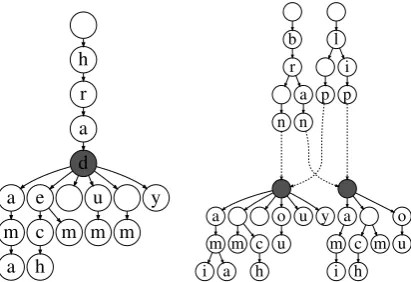
During template set creation, MorphoDiTa takes lemmas one by one. For each lemma, it collects all corresponding forms and builds a trie (De La Briandais, 1959; Knuth, 1997). Trie is a tree structure in which one character corresponds to a node and all descendants of a node share the same prefix. The procedure then finds a suitable common ancestor in the trie (common prefix or stem). The heuristics is “such a node whose sub-tree has depth at mostN and at the same time has the maximal number of ancestors with one child”. Intuitively, this means we want to select a long prefix (stem) – hence “maximal number of ances-tors” but at the same time, the linguistic endings are not too long (at most N). Having selected a common prefix, all the endings (including their corresponding tags) in its subtree define a tem-plate. A rich trie with many subtrees may be split into multiple templates. For example, a simple trie for noun “hrad” (“castle” in Czech) with one tem-plate, and also two lemmas sharing two templates are shown in Fig. 1. When processing the next lemma and its corresponding forms, either new template is created, or the templates are reused if the set of endings is the same. LargerN leads to longer endings and larger number of classes, and smallerNleads to short endings and less classes.7
Sometimes, the word “inflective” is used also for agglutina-tive languages such as Turkish, Hungarian or Finnish; we be-lieve our tools are suitable for these, too, but we have not tested them on this group yet.
6In Czech, the resource used was Morfflex CZ by Jan Hajiˇc:http://ufal.mff.cuni.cz/morfflex.
The number of templates determines the effi-ciency of dictionary encoding. When too few tem-plates are used, many are needed to represent a lemma. When too many are used, the representa-tion of the templates themselves is large.
The morphological dictionary is then saved in binary form and the software offers a higher level access: given a form, morphological analysis lists all possible lemma-tag pairs; given a lemma-tag pair, MorphoDiTa generates the respective form. The analysis function is then used in tagging, which we describe in the next section.
The heuristics described above does not require linguistic knowledge about the language and han-dles linguistic regularities very well. The major advantage is a significant data compression lead-ing to efficient resource usage: in our settlead-ing, the original morphology dictionary, the Czech Morf-flex, contains 120M form-tag pairs derived from
1M unique lemmas, using3 922 different tags, of total size6.7GB.8 Using the proposed heuristics with N = 8, there are 7 080 templates created, such that the whole dictionary is encoded using
3M template instances. The resulting binary form of the dictionary uses2MB, which is 3 000times smaller than the original dictionary.
In order to look up a word form in the dictio-nary, we split it into a prefix and an ending for all ending lengths from 1 to N. We then find templates associated with both the prefix and the ending. For each such template, we return the lemma corresponding to the prefix and the tag cor-responding to the ending. The result is a set of lemma-tag pairs found during this procedure. This algorithm can be implemented efficiently – our implementation performs 500k word form lookups per second in the Czech morphological dictionary.
3.2 POS Tagger Methodology
The POS tagger is an offspring of Morˇce and Fea-turama research projects based on (Spoustov´a et al., 2009). For each form in the text, the mor-phological dictionary suggests all possible lemma-tag candidates and these lemma-lemma-tag pairs are dis-ambiguated by the tagger. The tagger is imple-mented as supervised, rich feature averaged per-ceptron (Collins, 2002) and the classification fea-tures are adopted from (Spoustov´a et al., 2009). lemmas, because the process of minimization cannot capture templates containing word forms (or their prefixes) of multi-ple lemmas.
8Which compresses to454MB usinggzip -9.
h r a d
a e ě u ů y m
a c m h
m m
b r a á
n n
l i í
p p
a á ě o u y m
a i
c m
h u
a á o m
i c m h
[image:3.595.315.521.63.204.2]u
Figure 1: A simple trie for noun “hrad“ (castle in Czech), and two lemmas sharing templates.
Czech language was trained on the training part of the Prague Dependency Treebank 2.5 (Bejˇcek et al., 2012). The English language was trained on the standard training portion (Sections 0-18) of the Wall Street Journal part of the Penn Treebank (Marcus et al., 1993). In both cases, the system was tuned on the development set (Sections 19-21 in PTB/WSJ in English) and tested on the testing section (Sections 22-24 in PTB/WSJ in English).
3.3 POS Tagger Evaluation
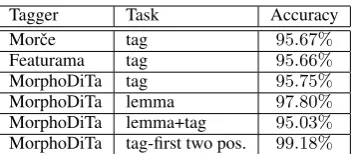
An evaluation of POS taggers, which do not use external data, is shown in Table 1 for Czech and in Table 2 for English. MorphoDiTa reaches art results for Czech and nearly state-of-the-art results for English. The results are very simi-lar for the three Czech systems, Morˇce, Featurama and MorphoDiTa, because in all three cases, they are implementations of (Spoustov´a et al., 2009). However, MorphoDiTa is the first end-to-end ap-plication released under a free license.
Due to rich morphosyntactic complexity of the Czech language and the positional tagging scheme proposed by (Hajiˇc, 2004), there are3 922 plausi-ble tags in Czech (although only1 571unique tags actually appear in training data).
However, in many applications, only the first two tagging positions, which correspond to POS and sub-POS,9are actually needed for further pro-cessing, which greatly reduces the complexity of the task, leaving only 67 possible tags (64 in train-ing data), although some morphological informa-tion, such as case, is lost.
Tagger Task Accuracy
Morˇce tag 95.67%
Featurama tag 95.66%
MorphoDiTa tag 95.75%
MorphoDiTa lemma 97.80%
MorphoDiTa lemma+tag 95.03%
[image:4.595.94.271.60.137.2]MorphoDiTa tag-first two pos. 99.18%
Table 1: Evaluation of Czech POS taggers.
Tagger Accuracy
Morˇce (Spoustov´a et al., 2009) 97.23%
(Shen et al., 2007) 97.33%
[image:4.595.303.530.62.150.2]MorphoDiTa 97.27%
Table 2: Evaluation of the English taggers.
An example of a full 15-position tag and the re-stricted 2-position tag for an adjective “zelen´y” is “AAIS1----1A----” and “AA”, respectively. The first two positions are in fact quite similar to what the Penn-style tags encode (for English). MorphoDiTa therefore also offers models trained on such a restricted tagging scheme. The tag-ger evaluation for the 2-position, restricted tags is given in the last row of Table 1.
4 NameTag: Named Entity Recognizer
4.1 NER Methodology
The NE recognizer is an implementation of a re-search project by (Strakov´a et al., 2013). The rec-ognizer is based on a Maximum Entropy Markov Model. First, maximum entropy model predicts, for each word in a sentence, the full probabil-ity distribution of its classes and positions with respect to an entity. Consequently, a global op-timization via dynamic programming determines the optimal combination of classes and named en-tities chunks (lengths). The classification features utilize morphological analysis, two-stage predic-tion, word clustering and gazetteers and are de-scribed in (Strakov´a et al., 2013).
The recognizer is available either as a run-time implementation with trained linguistic models for Czech, or as a package which allows custom mod-els to be trained using any NE-annotated data.
4.2 Czech Named Entity Corpus
For training the recognizer, Czech Named Entity Corpus(ˇSevˇc´ıkov´a et al., 2007) was used. In this corpus, Czech entities are classified into a two-level hierarchy classification: a fine-grained set of 42 classes or a more coarse classification of 7
System (42 classes)F-measure F-measure(7 classes) (ˇSevˇc´ıkov´a et al., 2007) 62.00 68.00 (Kravalov´a et al., 2009) 68.00 71.00 (Konkol and Konop´ık, 2013) NA 79.00 (Strakov´a et al., 2013) 79.23 82.82
NameTag CNEC 1.1 77.88 81.01
NameTag CNEC 2.0 77.22 80.30
Table 3: Evaluation of the Czech NE recognizers.
Corpus Words / sec RAM Model size
CNEC 1.1 40K 54MB 3MB
CNEC 2.0 45K 65MB 4MB
Table 4: Evaluation of the NE recognizer tagger throughput, RAM and model size.
super-classes. Like other authors, we report the evaluation on both hierarchy levels.
Czech Named Entity Corpus annotation allows ambiguous labels, that is, one entity can be labeled with two classes; however, NameTag predicts ex-actly one label per named entity, just like the pre-vious work does (Strakov´a et al., 2013).
Furthermore, CNEC also allows embedded entities, which is also somewhat problematic. NameTag always predicts only the outer-most en-tity (the embedding enen-tity), although it is penal-ized by the evaluation score which includes cor-rect prediction of the nested entities.
4.3 NER Evaluation
For comparison with previous work, we report re-sults for the first version of the Czech Named En-tity Corpus (CNEC 1.1). The linguistic models released with NameTag are trained on the most current version of the Czech Named Entity Cor-pus (CNEC 2.0), which has been recently released. We report our results for both CNEC 1.1 and CNEC 2.0 in Table 3.
5 Software Performance
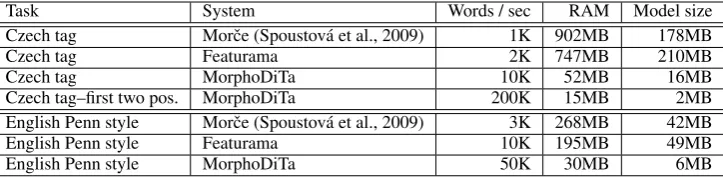
[image:4.595.94.268.175.221.2]Task System Words / sec RAM Model size Czech tag Morˇce (Spoustov´a et al., 2009) 1K 902MB 178MB
Czech tag Featurama 2K 747MB 210MB
Czech tag MorphoDiTa 10K 52MB 16MB
Czech tag–first two pos. MorphoDiTa 200K 15MB 2MB
English Penn style Morˇce (Spoustov´a et al., 2009) 3K 268MB 42MB
English Penn style Featurama 10K 195MB 49MB
[image:5.595.119.481.62.151.2]English Penn style MorphoDiTa 50K 30MB 6MB
Table 5: Evaluation of the POS tagger throughput, RAM and model size.
MorphoDiTa NameTag
Binaries and source code https://github.com/ufal/morphodita https://github.com/ufal/nametag
Project website http://ufal.mff.cuni.cz/morphodita http://ufal.mff.cuni.cz/nametag
Demo http://lindat.mff.cuni.cz/services/morphodita/ http://lindat.mff.cuni.cz/services/nametag/
Web services http://lindat.mff.cuni.cz/services
Language models http://lindat.mff.cuni.cz
Table 6: Web links to MorphoDiTa and NameTag downloads.
6 Release
Both MorphoDiTa and NameTag are free software under LGPL and their respective linguistic models are free for non-commercial use and distributed under CC BY-NC-SA license, although for some models the original data used to create the model may impose additional licensing conditions. Both MorphoDiTa and NameTag can be used as:
• a standalone tool,
• C++ library with Java, Python, Perl bindings,
• a web service, which does not require any in-stallation at the user’s machine whatsoever,
• an on-line demo.
MorphoDiTa and NameTag are platform inde-pendent and do not require any additional libraries. Web services and demo for the Czech and English languages are also available.
Table 6 lists the web links to all resources. The pre-compiled binaries and source code are able on GitHub, the language models are avail-able from the LINDAT/CLARIN infrastructure and the documentation can be found at the respec-tive project websites.
7 Conclusion
We released two efficient, light-weight POS- and NE taggers (especially efficient for inflective lan-guages), which are available to a wide audience as an open-source, free software with rich API and also as an end-to-end application. The tag-gers reach state-of-the-art results for Czech and are distributed with the models. We are currently
working on more language releases (Slovak, Pol-ish and Arabic). We are also aware that the cre-ation of the dictionary relies on the existence of a resource annotated with forms, lemmas and tags, which may not be readily available. Therefore, our future work includes developing a guesser for analyzing previously unseen but valid word forms in inflective languages, using only data annotated with disambiguated POS tags. We hope the release for Czech will prove useful for broad audience, for example for shared tasks which include Czech lan-guage data.
Acknowledgments
This work has been partially supported and has been using language resources developed and/or stored and/or distributed by the LINDAT/CLARIN project of the Ministry of Education of the Czech Republic (project LM2010013). This research was also partially supported by SVV project number 260 104. We are grateful to the reviewers for com-ments which helped us to improve the paper.
References
Rie Kubota Ando and Tong Zhang. 2005. A high-performance semi-supervised learning method for
text chunking. InProceedings of the 43rd Annual
Meeting on Association for Computational Linguis-tics, ACL ’05, pages 1–9. Association for Computa-tional Linguistics.
Martin Kay and Christian Boitet, editors, Proceed-ings of the 24th International Conference on Com-putational Linguistics (Coling 2012), pages 231– 246, Mumbai, India. IIT Bombay, Coling 2012 Or-ganizing Committee.
Thorsten Brants. 2000. TnT: A Statistical
Part-of-speech Tagger. In Proceedings of the Sixth
Con-ference on Applied Natural Language Processing, ANLC ’00, pages 224–231, Stroudsburg, PA, USA. Association for Computational Linguistics.
Eric Brill. 1992. A Simple Rule-based Part of Speech
Tagger. InProceedings of the Third Conference on
Applied Natural Language Processing, ANLC ’92, pages 152–155, Stroudsburg, PA, USA. Association for Computational Linguistics.
Nancy A. Chinchor. 1998. Proceedings of the Sev-enth Message Understanding Conference
(MUC-7) Named Entity Task Definition. In Proceedings
of the Seventh Message Understanding Conference (MUC-7), page 21 pages, April.
Michael Collins. 2002. Discriminative Training Meth-ods for Hidden Markov Models: Theory and
Ex-periments with Perceptron Algorithms. In
Proceed-ings of the 2002 Conference on Empirical Methods in Natural Language Processing, pages 1–8. Asso-ciation for Computational Linguistics, July.
Rene De La Briandais. 1959. File Searching Using
Variable Length Keys. InPapers Presented at the
the March 3-5, 1959, Western Joint Computer Con-ference, IRE-AIEE-ACM ’59 (Western), pages 295– 298, New York, NY, USA. ACM.
Jenny Rose Finkel, Trond Grenager, and Christopher Manning. 2005. Incorporating non-local informa-tion into informainforma-tion extracinforma-tion systems by Gibbs
sampling. InProceedings of the 43rd Annual
Meet-ing on Association for Computational LMeet-inguistics, ACL ’05, pages 363–370. Association for Compu-tational Linguistics.
J. Hajiˇc. 2004. Disambiguation of Rich Inflection:
Computational Morphology of Czech. Karolinum Press.
Donald Knuth, 1997. The Art of Computer
Program-ming, Volume 3: Sorting and Searching, Third Edi-tion, chapter Section 6.3: Digital Searching, pages 492–512. Addison-Wesley.
Michal Konkol and Miloslav Konop´ık. 2011. Maxi-mum Entropy Named Entity Recognition for Czech
Language. In Text, Speech and Dialogue, volume
6836 of Lecture Notes in Computer Science, pages
203–210. Springer Berlin Heidelberg.
Michal Konkol and Miloslav Konop´ık. 2013. CRF-Based Czech Named Entity Recognizer and Consol-idation of Czech NER Research. In Ivan
Haber-nal and Vclav Matouek, editors, Text, Speech, and
Dialogue, volume 8082 of Lecture Notes in Com-puter Science, pages 153–160. Springer Berlin Hei-delberg.
Jana Kravalov´a and Zdenˇek ˇZabokrtsk´y. 2009. Czech named entity corpus and SVM-based recognizer. In
Proceedings of the 2009 Named Entities Workshop: Shared Task on Transliteration, NEWS ’09, pages 194–201. Association for Computational Linguis-tics.
H. Kucera and W. N. Francis. 1967. Computational
analysis of present-day American English. Brown University Press, Providence, RI.
Mitchell P. Marcus, Beatrice Santorini, and Mary Ann Marcinkiewicz. 1993. Building a Large Annotated
Corpus of English: The Penn Treebank.
COMPU-TATIONAL LINGUISTICS, 19(2):313–330.
Lev Ratinov and Dan Roth. 2009. Design challenges and misconceptions in named entity recognition. In
CoNLL ’09: Proceedings of the Thirteenth Confer-ence on Computational Natural Language Learning, pages 147–155. Association for Computational Lin-guistics.
Libin Shen, Giorgio Satta, and Aravind Joshi. 2007. Guided Learning for Bidirectional Sequence
Classi-fication. In Proceedings of the 45th Annual
Meet-ing of the Association of Computational LMeet-inguistics, pages 760–767, Prague, Czech Republic, June. As-sociation for Computational Linguistics.
Drahom´ıra “johanka” Spoustov´a, Jan Hajiˇc, Jan Raab, and Miroslav Spousta. 2009. Semi-Supervised Training for the Averaged Perceptron POS Tagger. InProceedings of the 12th Conference of the Euro-pean Chapter of the ACL (EACL 2009), pages 763– 771, Athens, Greece, March. Association for Com-putational Linguistics.
Jana Strakov´a, Milan Straka, and Jan Hajiˇc. 2013. A New State-of-The-Art Czech Named Entity Recog-nizer. In Ivan Habernal and V´aclav Matouˇsek, edi-tors,Text, Speech and Dialogue: 16th International Conference, TSD 2013. Proceedings, volume 8082 ofLecture Notes in Computer Science, pages 68–75, Berlin / Heidelberg. Z´apadoˇcesk´a univerzita v Plzni, Springer Verlag.
Jun Suzuki and Hideki Isozaki. 2008.
Semi-Supervised Sequential Labeling and Segmentation
using Giga-word Scale Unlabeled Data.
Computa-tional Linguistics, (June):665–673.
Erik F. Tjong Kim Sang and Fien De Meulder. 2003. Introduction to the CoNLL-2003 Shared Task: Language-Independent Named Entity
Recog-nition. InProceedings of CoNLL-2003, pages 142–
147. Edmonton, Canada.
Magda ˇSevˇc´ıkov´a, Zdenˇek ˇZabokrtsk´y, and Oldˇrich Kr˚uza. 2007. Named entities in Czech:
annotat-ing data and developannotat-ing NE tagger. InProceedings