Munich Personal RePEc Archive
Commodity Price Changes and Economic
Growth in Developing Countries
Emara, Noha and Simutowe, Amon and Jamison, Tricia
Rutgers University, Columbia University, Columbia University
2015
Online at
https://mpra.ub.uni-muenchen.de/68678/
and economic growth in developing countries
Noha Emara Amon Simutowe Tricia Jamison
Rutgers University Columbia University Columbia University
[email protected] [email protected] [email protected]
Abstract: Using panel data 43 developing countries over the period 1980-2010, the paper examines the impact of the Commodity Terms of Trade (CTOT) Index on the real GDP per capita growth in developing countries. The study finds that for all countries in the sample, an increase in the CTOT index instantaneously leads to a statistically positive impact on the GDP per capita growth rate. Furthermore, the study finds evidence of resource curse under the Commodity Terms of Trade Index in developing countries. This suggests the need for improved management in the natural resources of developing countries. The energy sector proves to independently account for a resource curse. Better management is needed in the energy sector to counter the resource curse that has been reflected in the regression estimates especially in countries with a low score on the governance index.
Key words: Commodity; Index; Trade; Developing; Governance
JEL codes: C23; F10; O43
1. Introduction
Understanding the relationship between commodity prices economic growth has become increasingly important in light of the most recent decade of booming global commodity demand and continued mixed results on growth in developing countries.
This paper estimates the short-run relationship between commodity prices and economic growth in developing countries from 1980 to 2010. The relationship between GDP per capita and a country-specific Commodity Terms of Trade (CTOT) Index is modelled as a dynamic panel and estimated with the Arellano-Bond Dynamic Panel Difference GMM estimator. To test whether the impact varies by type of commodity, the relationship is further examined using sub-indices by commodity type: Agricultural, Energy, Industrial, Meats, and Metals. Finally, the significance of all impacts are assessed conditional on governance.
The Impact of Commodity Price Changes on Economic Growth in Developing Countries: An Empirical Investigation 1980-‐2010
2
Natural resource abundance has been extensively studied as a determinant of steady state economic growth. Using cross-country regressions, Sachs and Warner (2001) and other studies have found empirical evidence for a “resource curse” – namely, slower economic growth for resource rich countries versus resource poor countries.
Subsequent studies using different measures of resource “richness” and panel data have found either insignificant or positive effects of natural resource abundance (Brunnschweiler and Bulte (2008), Alexeev and Conrad (2009), Haber and Menaldo (2011)). While empirical results are mixed, a key outcome of this literature is that the existence of the resource curse is conditional on country-specific factors such as the quality of institutions and governance, as well as the type of commodity specialization.
This paper intends to bring together strands of research on the resource curse, commodity price volatility, and terms of trade growth impacts. In contrast to much of the empirical terms of trade literature that uses an overall terms of trade measure, this paper will use a Commodity Terms of Trade Index to estimate the commodity-only terms of trade effects on economic growth. Further, the use of a Commodity Terms of Trade Index, instead of a commodity export price index, distinguishes this paper from that of Deaton and Miller (1996) and Collier and Goderis among others (2009). This model should provide a fuller estimation than export price-only models of the extent to which commodity price-related changes in terms of trade impact economic growth.
2. Empirical Specification
The Arellano Bond “Difference GMM” methodology is used to evaluate the impact of commodity terms of trade on economic growth in the short-run. This methodology is a first differences dynamic model that handles endogeneity with instruments that begin with the second lag in levels.
t i k j t i k j t i k
j it
k j t i k j t i t
i gdpcap ctotAll tragdp gdpdef resgdp v
gdpcap , 1 , 5 1 , 4 1 , 3 1 , 2 1 1 , 1
. = Δ + Δ + Δ + Δ + Δ +Δ
Δ
∑
∑
∑
∑
∑
= =
= =
=
− β β β β
β
Where “gdpcap” is the log of per capita GDP, current US$, “ctotAll” is the log of Commodity Terms of Trade Index, “tragdp” is the measure of trade openness or the ratio of total value of exports plus imports to GDP, in current US$, and “gdpdef” is the measure of inflation or the ratio of current GDP to constant GDP (local currency), “resgdp” is the ratio of reserves to GDP, in current US$ and finally the random error term is “
v
i,t.” The above model is expanded to examine the growth3 terms of trade indices – one for agriculture commodities, one for metal commodities, and one for energy commodities.
3. Data
Using panel data on 43 developing countries (roughly 10 Low Income and 33 Middle Income, as defined by World Bank GNI per capita cut-offs in 2010) for the years 1980-2010. Drawing upon previous commodity baskets constructed by Deaton and Miller (1996), Collier and Goderis (2009) and Spatafora and Tytell (2011), a set of 54 commodities have been used to construct an overall Commodity Terms of Trade index series for each country, along with sub-indices for Agricultural, Energy, Industrial, Meat, and Metal commodities. Import and export data for each country were retrieved from the UN Comtrade database for the year 1995. Following Deaton and Miller (1996), data for a single year is used to ensure that changes in the value of the index depend only on relatively exogenous changes in prices, and not due to changes in the composition of a country’s imports or exports. The year 1995 was chosen because it was in the middle of our sample of years. Finally, the quarterly CTOT index for country i at time t incorporates data on j commodities, and is calculated following Spatafora (2011) methodlogy.
4. Estimation Results
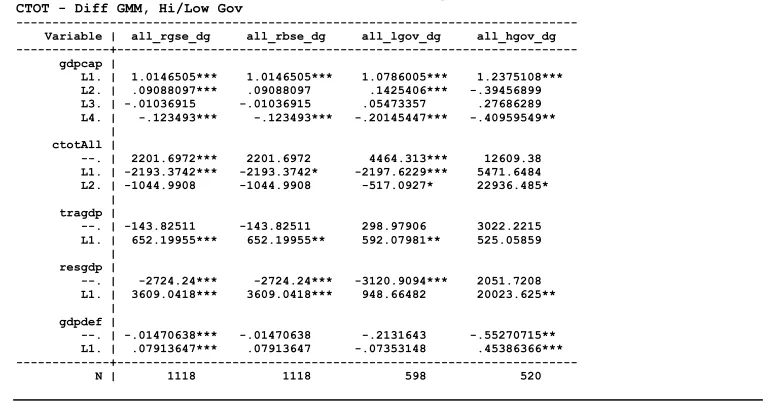
The Difference GMM was used to estimate the model for all the countries and commodities. The results suggest that the lagged GDP per capita is statistically significant for the first two lags at 5% level of significance. The CTOT index, which is the Commodity Terms of Trade Index, is statistically significant at 5% level of significance for both lags. This is because in a year when the commodity terms of trade is high, the exports where higher relative to imports and by implication this would mean a positive impact on both the GDP growth and thus per capita GDP conditional of annual real GDP growing at a faster rate than the annual population growth rate. The coefficient is however not positive in the second lag. This may happen under a resource curse or when the increase in exports may have affected welfare in the domestic economy through for instance poor governance barriers to trade.
The coefficient of trade to GDP ratio is not statistically significant on per capita GDP but its lag is statistically significant at all conventional levels of
significance suggesting a possible lagged impact on GDP. The coefficient on
The Impact of Commodity Price Changes on Economic Growth in Developing Countries: An Empirical Investigation 1980-‐2010
4
[image:5.516.64.449.212.414.2]negative if the increase in inflation affects expectations and becomes detrimental to the planning of managers. The lagged GDP deflator is however positive suggesting that the lagged effect of inflation on GDP per capita is positive. For the estimates in Table (1), below, the first regression is the Difference GMM for all countries – both with a high governance index and a low governance index. The second regression is the Difference GMM for all countries with robust standard errors. The third regression is the Difference GMM for all countries with a low governance index while the fourth regression is the Difference GMM for all countries with high governance Index.
Table 1: The difference GMM Using the Governance Index
CTOT - Diff GMM, Hi/Low Gov
--- Variable | all_rgse_dg all_rbse_dg all_lgov_dg all_hgov_dg ---+--- gdpcap |
L1. | 1.0146505*** 1.0146505*** 1.0786005*** 1.2375108*** L2. | .09088097*** .09088097 .1425406*** -.39456899 L3. | -.01036915 -.01036915 .05473357 .27686289 L4. | -.123493*** -.123493*** -.20145447*** -.40959549** |
ctotAll |
--. | 2201.6972*** 2201.6972 4464.313*** 12609.38 L1. | -2193.3742*** -2193.3742* -2197.6229*** 5471.6484 L2. | -1044.9908 -1044.9908 -517.0927* 22936.485* |
tragdp |
--. | -143.82511 -143.82511 298.97906 3022.2215 L1. | 652.19955*** 652.19955** 592.07981** 525.05859 |
resgdp |
--. | -2724.24*** -2724.24*** -3120.9094*** 2051.7208 L1. | 3609.0418*** 3609.0418*** 948.66482 20023.625** |
gdpdef |
--. | -.01470638*** -.01470638 -.2131643 -.55270715** L1. | .07913647*** .07913647 -.07353148 .45386366*** ---+--- N | 1118 1118 598 520
legend: * p<0.05; ** p<0.01; *** p<0.001
5 One of the most important results of the above table is the impact of on GDP
per capita which was more significant in countries with score low on the governance index. The coefficient on countries, which are poorly managed, was statistically significant while the coefficient on countries which score high on the governance index was not statistically significant. A variety of reasons account for this; First, poor governed countries normally tend to be low-income countries. Low-income countries in turn usually depend on commodities and trade is a significant share of GDP. On the other hand, the share of CTOT in well governed countries which typically tend to be either middle income or developed countries is significantly relatively low compared to GDP reducing its impact on GDP per capita. Further, there is less volatility in CTOT in relatively more developed countries and its smaller share in GDP makes it less impactful on GDP per capita. The coefficient CTOT is also statistically significant on the regression estimate where both countries with a high score and low score on governance index are included.
For further investigation on the CTOT impact on GDP per capita, the regression was expanded to estimate contain three indexes – the energy index, the agriculture index and the metals enough. Under each of the three indexes, countries were divided in either the category under which they scored high on the governance index or low on the governance index and the performance was then evaluated. One of the important results concerns the for the CTOT on Energy Index - for countries with a lower score on the governance index, the coefficient on the instantaneous and lagged variable has a statistically significant impact on GDP per capita. For the countries with a high score on the governance index, this is not the case as all coefficients and lags are not statistically significant suggesting that the Energy Index has a statistically significant impact on growth in countries with a score on governance index.
Regarding the CTOT for the Agriculture Index - for the commodity agriculture index, in countries with a lower score on the governance index, its lag has a statistically significant impact on the GDP per capita growth rate. For THE agriculture index in countries with a high score on the governance index, the impact of the coefficients on the GDP per capita is not statistically significant. Next, the CTOT for the Metals Index - for the commodity metals index, the coefficients in both the sample with countries with a higher score on the governance index and countries with a lower score on the governance index is not statistically significant – suggesting a limited impact on the GDP per capita growth rate.
5. Conclusion
The Impact of Commodity Price Changes on Economic Growth in Developing Countries: An Empirical Investigation 1980-‐2010
6
7
References
Barro, R., and Sala-i-Martin, X., 1995. Economic Growth, McGraw-Hill.
Basu, P., McLeod, D., 1992. “Terms of trade fluctuations and economic growth in developing economies”, Journal of Development Economics 37, 89–110.
Blattman, C., Hwang, J., Williamson, J., 2007. “Winners and losers in the commodity lottery: The impact of terms of trade growth and volatility in the Periphery 1870–1939”, Journal of Development Economics 82, 156 – 179.
Brunnschweiler, C., Bulte, E., 2008. “The resource curse revisited and revised: A tale of paradoxes and red herrings”. Journal of Environmental Economics and Management, 55, 3, 248–264
Caselli, F., Esquivel, G., and Lefort, F, 1996. “Reopening the Convergence Debate: A New Look at Cross-Country Growth Empirics”, Journal of Economic Growth.
Cavalcanti, T., Mohaddes, K., and Raissi, M., 2011. Commodity Price Volatility and the Sources of Growth.
Collier, P., 1999. ‘On the economic consequences of civil war’, Oxford Economic Papers, Vol. 51, pp. 168-83.
Collier, P., and Benedikt, G., 2007. "Commodity Prices and Growth: Reconciling a Conundrum" Working Paper 35, no. 3, 1243-1272.
Deaton, A., and Miller, R., 1996. “International Commodity Prices, Macroeconomic Performance, and Politics in Sub-Saharan Africa”, Journal of African Economies, vol. 5, pp. 99-191.
Eichengreen, B., 1996. Globalizing Capital: a History of the International Monetary System. Princeton University Press, Princeton.
Haber, S., Menaldo, V., 2011. “Do Natural Resources Fuel Authoritarianism? A Reappraisal of the Resource Curse”. American Political Science Review.
IMF Working Paper, Middle East and Central Asia Department. UN Comtrade Database. <http://comtrade.un.org/>.
Mankiw, G., Romer, D., Weil, D., 1992. A Contribution to the Empirics of Economic Growth, The Quarterly Journal of Economics, Vol. 107, No. 2., pp. 407-437.
Mendoza, E., 1997. Terms of trade uncertainty and economic growth. Journal of Development Economics 54, 323 – 356.
Mendoza, E., 1995. “The terms of trade, the real exchange rate, and economic fluctuations,” International Economic Review 36, 101–137.
Pritchett, L., 2000. Understanding patterns of economic growth: searching for hills among plateaus, mountains and plains. World Bank Economic Review 14 (2), 221–250.
Sachs, J., Warner, A., 2001. The curse of natural resources. European Economic Review 45, 827–838 (May).
Spatafora, N. and Tytell, I., 2009. “Commodity terms of trade: The History of booms and busts”, IMF Working Paper 09205, September.
World Development Indicators and Global Development Finance. December 201