Proceedings of the 49th Annual Meeting of the Association for Computational Linguistics, pages 1018–1026,
Recognizing Authority in Dialogue with an Integer Linear Programming
Constrained Model
Elijah Mayfield
Language Technologies Institute Carnegie Mellon University
Pittsburgh, PA 15213 [email protected]
Carolyn Penstein Ros´e
Language Technologies Institute Carnegie Mellon University
Pittsburgh, PA 15213 [email protected]
Abstract
We present a novel computational formula-tion of speaker authorityin discourse. This notion, which focuses on how speakers posi-tion themselves relative to each other in dis-course, is first developed into a reliable cod-ing scheme (0.71 agreement between human annotators). We also provide a computational model for automatically annotating text using this coding scheme, using supervised learning enhanced by constraints implemented with In-teger Linear Programming. We show that this constrained model’s analyses of speaker au-thority correlates very strongly with expert hu-man judgments (r2coefficient of 0.947).
1 Introduction
In this work, we seek to formalize the ways speak-ers position themselves in discourse. We do this in a way that maintains a notion of discourse structure, and which can be aggregated to evaluate a speaker’s overall stance in a dialogue. We define the body of work in positioning to include any attempt to formal-ize the processes by which speakers attempt to influ-ence or give evidinflu-ence of their relations to each other. Constructs such as Initiative and Control (Whittaker and Stenton, 1988), which attempt to operationalize the authority over a discourse’s structure, fall under the umbrella of positioning. As we construe posi-tioning, it also includes work on detecting certainty and confusion in speech (Liscombe et al., 2005), which models a speaker’s understanding of the in-formation in their statements. Work in dialogue act tagging is also relevant, as it seeks to describe the
ac-tions and moves with which speakers display these types of positioning (Stolcke et al., 2000).
To complement these bodies of work, we choose to focus on the question of how speakers position themselves as authoritative in a discourse. This means that we must describe the way speakers intro-duce new topics or discussions into the discourse; the way they position themselves relative to that topic; and how these functions interact with each other. While all of the tasks mentioned above focus on specific problems in the larger rhetorical question of speaker positioning, none explicitly address this framing of authority. Each does have valuable ties to the work that we would like to do, and in section 2, we describe prior work in each of those areas, and elaborate on how each relates to our questions.
We measure this as anauthoritativeness ratio. Of the contentful dialogue moves made by a speaker, in what fraction of those moves is the speaker po-sitioned as the primary authority on that topic? To measure this quantitatively, we introduce the Nego-tiation framework, a construct from the field of sys-temic functional linguistics (SFL), which addresses specifically the concepts that we are interested in. We present a reproducible formulation of this so-ciolinguistics research in section 3, along with our preliminary findings on reliability between human coders, where we observe inter-rater agreement of 0.71. Applying this coding scheme to data, we see strong correlations with important motivational con-structs such as Self-Efficacy (Bandura, 1997) as well as learning gains.
dimensional classification task. One dimension is a set of codes describing the authoritative status of a contribution1. The other dimension is a segmen-tation task. We impose constraints on both of these models based on the structure observed in the work of SFL. These constraints are formulated as boolean statements describing what a correct label sequence looks like, and are imposed on our model using an Integer Linear Programming formulation (Roth and Yih, 2004). In section 5, this model is evaluated on a subset of the MapTask corpus (Anderson et al., 1991) and shows a high correlation with human judgements of authoritativeness (r2= 0.947). After a detailed error analysis, we will conclude the paper in section 6 with a discussion of our future work.
2 Background
The Negotiation framework, as formulated by the SFL community, places a special emphasis on how speakers function in a discourse as sources or recip-ients of information or action. We break down this concept into a set of codes, one code per contribu-tion. Before we break down the coding scheme more concretely in section 3, it is important to understand why we have chosen to introduce a new framework, rather than reusing existing computational work.
Much work has examined the emergence of dis-course structure from the choices speakers make at the linguistic and intentional level (Grosz and Sid-ner, 1986). For instance, when a speaker asks a question, it is expected to be followed with an an-swer. In discourse analysis, this notion is described through dialogue games (Carlson, 1983), while con-versation analysis frames the structure in terms of adjacency pairs (Schegloff, 2007). These expec-tations can be viewed under the umbrella of con-ditional relevance (Levinson, 2000), and the ex-changes can be labelleddiscourse segments.
In prior work, the way that people influence dis-course structure is described through the two tightly-related concepts ofinitiativeandcontrol. A speaker who begins a discourse segment is said to have ini-tiative, while control accounts for which speaker is being addressed in a dialogue (Whittaker and Sten-ton, 1988). As initiative passes back and forth be-tween discourse participants, control over the
con-1
We treat each line in our corpus as a single contribution.
versation similarly transfers from one speaker to an-other (Walker and Whittaker, 1990). This relation is often considered synchronous, though evidence sug-gests that the reality is not straightforward (Jordan and Di Eugenio, 1997).
Research in initiative and control has been ap-plied in the form of mixed-initiative dialogue sys-tems (Smith, 1992). This is a large and ac-tive field, with applications in tutorial dialogues (Core, 2003), human-robot interactions (Peltason and Wrede, 2010), and more general approaches to effective turn-taking (Selfridge and Heeman, 2010). However, that body of work focuses on influenc-ing discourse structure through positioninfluenc-ing. The question that we are asking instead focuses on how speakers view their authority as a source of informa-tion about the topic of the discourse.
In particular, consider questioning in discourse. In mixed-initiative analysis of discourse, asking a question always gives you control of a discourse. There is an expectation that your question will be followed by an answer. A speaker might already know the answer to a question they asked - for instance, when a teacher is verifying a student’s knowledge. However, in most cases asking a ques-tion represents a lack of authority, treating the other speakers as a source for that knowledge. While there have been preliminary attempts to separate out these specific types of positioning in initiative, such as Chu-Carroll and Brown (1998), it has not been stud-ied extensively in a computational setting.
Another similar thread of research is to identify a speaker’s certainty, that is, the confidence of a speaker and how that self-evaluation affects their language (Pon-Barry and Shieber, 2010). Substan-tial work has gone into automatically identifying levels of speaker certainty, for example in Liscombe et al. (2005) and Litman et al. (2009). The major difference between our work and this body of liter-ature is that work on certainty has rarely focused on how state translates into interaction between speak-ers (with some exceptions, such as the application of certainty to tutoring dialogues (Forbes-Riley and Litman, 2009)). Instead, the focus is on the person’s self-evaluation, independent of the influence on the speaker’s positioning within a discourse.
This task involves defining the role of each contri-bution based on its function (Stolcke et al., 2000). We know that there are interesting correlations be-tween these acts and other factors, such as learning gains (Litman and Forbes-Riley, 2006) and the rel-evance of a contribution for summarization (Wrede and Shriberg, 2003). However, adapting dialogue act tags to the question of how speakers position themselves is not straightforward. In particular, the granularity of these tagsets, which is already a highly debated topic (Popescu-Belis, 2008), is not ideal for the task we have set for ourselves. Many dialogue acts can be used in authoritative or non-authoritative ways, based on context, and can posi-tion a speaker as either giver or receiver of informa-tion. Thus these more general tagsets are not specific enough to the role of authority in discourse.
Each of these fields of prior work is highly valu-able. However, none were designed to specifically describe how people present themselves as a source or recipient of knowledge in a discourse. Thus, we have chosen to draw on a different field of soci-olinguistics. Our formalization of that theory is de-scribed in the next section.
3 The Negotiation Framework
We now present the Negotiation framework2, which we use to answer the questions left unanswered in the previous section. Within the field of SFL, this framework has been continually refined over the last three decades (Berry, 1981; Martin, 1992; Martin, 2003). It attempts to describe how speakers use their role as a source of knowledge or action to position themselves relative to others in a discourse.
Applications of the framework include distin-guishing between focus on teacher knowledge and student reasoning (Veel, 1999) and distribution of authority in juvenile trials (Martin et al., 2008). The framework can also be applied to problems similar to those studied through the lens of initiative, such as the distinction between authority over discourse structure and authority over content (Martin, 2000). A challenge of applying this work to language technologies is that it has historically been highly
2
All examples are drawn from the MapTask corpus and in-volve an instruction giver (g) and follower (f). Within examples, discourse segment boundaries are shown by horizontal lines.
qualitative, with little emphasis placed on ducibility. We have formulated a pared-down, repro-ducible version of the framework, presented in Sec-tion 3.1. Evidence of the usefulness of that formu-lation for identifying authority, and of correformu-lations that we can study based on these codes, is presented briefly in Section 3.2.
3.1 Our Formulation of Negotiation
The codes that we can apply to a contribution us-ing the Negotiation framework are comprised of four main codes, K1, K2, A1, and A2, and two additional codes, ch and o. This is a reduction over the many task-specific or highly contextual codes used in the original work. This was done to ensure that a ma-chine learning classification task would not be over-whelmed with many infrequent classes.
The main codes are divided by two questions. First, is the contribution related to exchanging infor-mation, or to exchanging services and actions? If the former, then it is a K move (knowledge); if the latter, then an A move (action). Second, is the contribution acting as a primary actor, or secondary? In the case of knowledge, this often correlates to the difference between assertions (K1) and queries (K2). For in-stance, a statement of fact or opinion is a K1:
g K1 well i’ve got a great viewpoint here just below the east lake
By contrast, asking for someone else’s knowledge or opinion is a K2:
g K2 what have you got underneath the east lake
f K1 rocket launch
In the case of action, the codes usually corre-spond to narrating action (A1) and giving instruc-tions (A2), as below:
g A2 go almost to the edge of the lake
f A1 yeah
A challenge move (ch) is one which directly con-tradicts the content or assertion of the previous line, or makes that previous contribution irrelevant. For instance, consider the exchange below, where an in-struction is rejected because its presuppositions are broken by the challenging statement.
g A2 then head diagonally down to-wards the bottom of the dead tree f ch i have don’t have a dead tree i
All moves that do not fit into one of these cate-gories are classified as other (o). This includes back-channel moves, floor-grabbing moves, false starts, and any other non-contentful contributions.
This theory makes use of discourse segmenta-tion. Research in the SFL community has focused on intra-segment structure, and empirical evidence from this research has shown that exchanges be-tween speakers follow a very specific pattern:
o* X2? o* X1+ o*
That is to say, each segment contains a primary move (a K1 or an A1) and an optional preceding secondary move, with other non-contentful moves interspersed throughout. A single statement of fact would be a K1 move comprising an entire segment, while a single question/answer pair would be a K2 move followed by a K1. Longer exchanges of many lines obviously also occur.
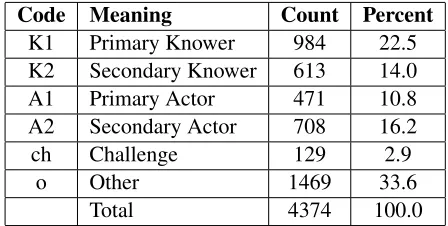
We iteratively developed a coding manual which describes, in a reproducible way, how to apply the codes listed above. The six codes we use, along with their frequency in our corpus, are given in Table 1. In the next section, we evaluate the reliability and utility of hand-coded data, before moving on to au-tomation in section 4.
3.2 Preliminary Evaluation
This coding scheme was evaluated for reliability on two corpora using Cohen’s kappa (Cohen, 1960). Within the social sciences community, a kappa above 0.7 is considered acceptable. Two conversa-tions were each coded by hand by two trained anno-tators. The first conversation was between three stu-dents in a collaborative learning task; inter-rater re-liability kappa for Negotiation labels was 0.78. The second conversation was from the MapTask corpus, and kappa was 0.71. Further data was labelled by hand by one trained annotator.
In our work, we label conversations using the cod-ing scheme above. To determine how well these codes correlate with other interesting factors, we choose to assign a quantitative measure of authori-tativeness to each speaker. This measure can then be compared to other features of a speaker. To do this, we use the coded labels to assign an Authori-tativeness Ratioto each speaker. First, we define a
Code Meaning Count Percent
K1 Primary Knower 984 22.5
K2 Secondary Knower 613 14.0
A1 Primary Actor 471 10.8
A2 Secondary Actor 708 16.2
ch Challenge 129 2.9
o Other 1469 33.6
[image:4.612.314.538.71.184.2]Total 4374 100.0
Table 1: The six codes in our coding scheme, along with their frequency in our corpus of twenty conversations.
functionA(S, c, L)for a speaker, a contribution, and a set of labelsL⊆ {K1, K2, A1, A2, o, ch}as:
A(S, c, L) =
1 cspoken bySwith labell∈L
0 otherwise.
We then define the Authoritativeness ratio
Auth(S) for a speakerS in a dialogue consisting of contributionsc1...cnas:
Auth(S) =
n
X
i=1
A(S, ci,{K1, A2})
n
X
i=1
A(S, ci,{K1, K2, A1, A2})
The intuition behind this ratio is that we are only interested in the four main label types in our analy-sis - at least for an initial description of authority, we do not consider the non-contentfulomoves. Within these four main labels, there are clearly two that ap-pear “dominant” - statements of fact or opinion, and commands or instructions - and two that appear less dominant - questions or requests for information, and narration of an action. We sum these together to reach a single numeric value for each speaker’s projection of authority in the dialogue.
showed that aggressive behavior correlated with au-thoritativeness ratio (p < .05), and that less aggres-sive students became less authoritative in the second day (p < .05, effect size .15σ). The second data set was analyzed for Self-Efficacy - the confidence of each student in their own ability (Bandura, 1997) - as well as actual learning gains based on pre- and post-test scores. We found that the Authoritativeness ratio was a significant predictor of learning gains (r2 =.41,p < .04). Furthermore, in a multiple re-gression, we determined that the Authoritativeness ratio of both students in a group predict the average Self-Efficacy of the pair (r2 =.12,p < .01).
4 Computational Model
We know that our coding scheme is useful for mak-ing predictions about speakers. We now judge whether it can be reproduced fully automatically. Our model must select, for each contributionci in a
dialogue, the most likely classification labellifrom
{K1, K2, A1, A2, o, ch}. We also build in paral-lel a segmentation model to select si from the set
{new, same}. Our baseline approach to both prob-lems is to use a bag-of-words model of the contribu-tion, and use machine learning for classification.
Certain types of interactions, explored in section 4.1, are difficult or impossible to classify without context. We build a contextual feature space, de-scribed in section 4.2, to enhance our baseline bag-of-words model. We can also describe patterns that appear in discourse segments, as detailed in section 3.1. In our coding manual, these instructions are given as rules for how segments should be coded by humans. Our hypothesis is that by enforcing these rules in the output of our automatic classifier, per-formance will increase. In section 4.3 we formalize these constraints using Integer Linear Programming.
4.1 Challenging cases
We want to distinguish between phenomena such as in the following two examples.
f K2 so I’m like on the bank on the bank of the east lake
g K1 yeah
In this case, a one-token contribution is indis-putably a K1 move, answering a yes/no question. However, in the dialogue below, it is equally inar-guable that the same move is an A1:
g A2 go almost to the edge of the lake
f A1 yeah
Without this context, these moves would be indis-tinguishable to a model. With it, they are both easily classified correctly.
We also observed that markers for segmentation of a segment vary between contentful initiations and non-contentful ones. For instance, filler noises can often initiate segments:
g o hmm...
g K2 do you have a farmer’s gate?
f K1 no
Situations such as this are common. This is also a challenge for segmentation, as demonstrated below:
g K1 oh oh it’s on the right-hand side of my great viewpoint
f o okay yeah
g o right eh
g A2 go almost to the edge of the lake
f A1 yeah
A long statement or instruction from one speaker is followed up with a terse response (in the same segment) from the listener. However, after that back-channel move, a short floor-grabbing move is often made to start the next segment. This is a distinc-tion that a bag-of-words model would have difficulty with. This is markedly different from contentful seg-ment initiations:
g A2 come directly down below the stone circle and we come up f ch I don’t have a stone circle g o you don’t have a stone circle
All three of these lines look like statements, which often initiate new segments. However, only the first should be marked as starting a new segment. The other two are topically related, in the second line by contradicting the instruction, and in the third by re-peating the previous person’s statement.
4.2 Contextual Feature Space Additions
over training data). We then add a feature for the predicted label of the previous contribution - after each contribution is classified, the next contribution adds a feature for the automatic label. This requires our model to function as an on-line classifier.
We build two segmentation models, one trained on contributions of less than four tokens, and an-other trained on contributions of four or more to-kens, to distinguish between characteristics of con-tentful and non-concon-tentful contributions. To the short-contribution model, we add two additional fea-tures. The first represents the ratio between the length of the current contribution and the length of the previous contribution. The second represents whether a change in speaker has occurred between the current and previous contribution.
4.3 Constraints using Integer Linear Programming
We formulate our constraints using Integer Linear Programming (ILP). This formulation has an ad-vantage over other sequence labelling formulations, such as Viterbi decoding, in its ability to enforce structure through constraints. We then enhance this classifier by adding constraints, which allow expert knowledge of discourse structure to be enforced in classification. We can use these constraints to elim-inate label options which would violate the rules for a segment outlined in our coding manual.
Each classification decision is made at the contri-bution level, jointly optimizing the Negotiation la-bel and segmentation lala-bel for a single contribution, then treating those labels as given for the next con-tribution classification.
To define our objective function for optimization, for each possible label, we train a one vs. all SVM, and use the resulting regression for each label as a score, giving us six values~li for our Negotiation
label and two values~si for our segmentation label.
Then, subject to the constraints below, we optimize:
arg max
l∈~li,s∈~si
l+s
Thus, at each contribution, if the highest-scoring Negotiation label breaks a constraint, the model can optimize whether to drop to the next-most-likely la-bel, or start a new segment.
Recall from section 3.1 that our discourse seg-ments follow strict rules related to ordering and rep-etition of contributions. Below, we list the con-straints that we used in our model to enforce that pattern, along with a brief explanation of the intu-ition behind each.
∀ci ∈s,(li =K2)⇒
∀j < i, cj ∈t⇒(lj 6=K1)
(1)
∀ci∈s,(li=A2)⇒
∀j < i, cj ∈t⇒(lj 6=A1) (2)
The first constraints enforce the rule that a pri-mary move cannot occur before a secondary move in the same segment. For instance, a question must initiate a new segment if it follows a statement.
∀ci∈s,(li ∈ {A1, A2})⇒
∀j < i, cj ∈s⇒(lj ∈ {/ K1, K2}) (3)
∀ci∈s,(li∈ {K1, K2})⇒
∀j < i, cj ∈s⇒(lj ∈ {/ A1, A2})
(4)
These constraints specify that A moves and K moves cannot cooccur in a segment. An instruc-tion for acinstruc-tion and a quesinstruc-tion requesting informainstruc-tion must be considered separate segments.
∀ci ∈s,(li =A1)⇒((li−1 =A1)∨ ∀j < i, cj ∈s⇒(lj 6=A1))
(5)
∀ci ∈s,(li =K1)⇒((li−1 =K1)∨
∀j < i, cj ∈s⇒(lj 6=K1)) (6)
This pair states that two primary moves cannot oc-cur in the same segment unless they are contiguous, in rapid succession.
∀ci ∈s,(li=A1)⇒
∀j < i, cj ∈s,(lj =A2)⇒(Si6=Sj)
(7)
∀ci ∈s,(li =K1)⇒
∀j < i, cj ∈s,(lj =K2)⇒(Si 6=Sj) (8)
Computationally, an advantage of these con-straints is that they do not extend past the current segment in history. This means that they usually are only enforced over the past few moves, and do not enforce any global constraint over the structure of the whole dialogue. This allows the constraints to be flexible to various conversational styles, and tractable for fast computation independent of the length of the dialogue.
5 Evaluation
We test our models on a twenty conversation sub-set of the MapTask corpus detailed in Table 1. We compare the use of four models in our results.
• Baseline:This model uses a bag-of-words fea-ture space as input to an SVM classifier. No segmentation model is used and no ILP con-straints are enforced.
• Baseline+ILP: This model uses the baseline feature space as input to both classification and segmentation models. ILP constraints are en-forced between these models.
• Contextual: This model uses our enhanced feature space from section 4.2, with no segmen-tation model and no ILP constraints enforced.
• Contextual+ILP: This model uses the en-hanced feature spaces for both Negotiation la-bels and segment boundaries from section 4.2 to enforce ILP constraints.
For segmentation, we evaluate our models using exact-match accuracy. We use multiple evaluation metrics to judge classification. The first and most basic is accuracy - the percentage of accurately cho-sen Negotiation labels. Secondly, we use Cohen’s Kappa (Cohen, 1960) to judge improvement in ac-curacy over chance. The final evaluation is the r2
coefficient computed between predicted and actual Authoritativeness ratios per speaker. This represents how much variance in authoritativeness is accounted for in the predicted ratios. This final metric is the most important for measuring reproducibility of hu-man analyses of speaker authority in conversation.
We use SIDE for feature extraction (Mayfield and Ros´e, 2010), SVM-Light for machine learning
Model Accuracy Kappa r2
Baseline 59.7% 0.465 0.354
Baseline+ILP 61.6% 0.488 0.663
Segmentation 72.3%
Contextual 66.7% 0.565 0.908
Contextual+ILP 68.4% 0.584 0.947
[image:7.612.317.538.71.173.2]Segmentation 74.9%
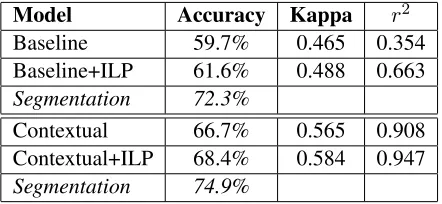
Table 2: Performance evaluation for our models. Each line is significantly improved in both accuracy andr2 er-ror from the previous line (p < .01).
(Joachims, 1999), and Learning-Based Java for ILP inference (Rizzolo and Roth, 2010). Performance is evaluated by 20-fold cross-validation, where each fold is trained on 19 conversations and tested on the remaining one. Statistical significance was calcu-lated using a student’s paired t-test. For accuracy and kappa,n= 20(one data point per conversation) and forr2,n= 40(one data point per speaker).
5.1 Results
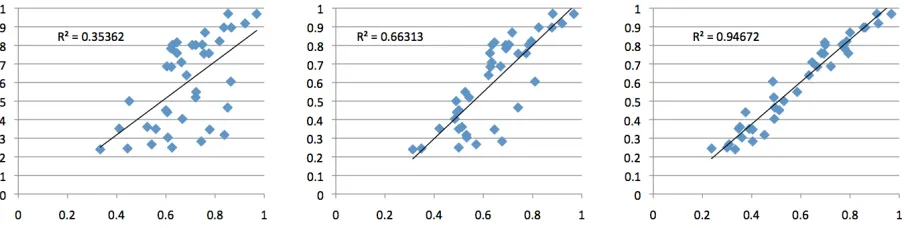
All classification results are given in Table 2 and charts showing correlation between predicted and actual speaker Authoritativeness ratios are shown in Figure 1. We observe that the baseline bag-of-words model performs well above random chance (kappa of 0.465); however, its accuracy is still very low and its ability to predict Authoritativeness ratio of a speaker is not particularly high (r2 of 0.354 with ratios from manually labelled data). We observe a significant improvement when ILP constraints are applied to this model.
The contextual model described in section 4.2 performs better than our baseline constrained model. However, the gains found in the contextual model are somewhat orthogonal to the gains from using ILP constraints, as applying those constraints to the contextual model results in further performance gains (and a highr2coefficient of 0.947).
Our segmentation model was evaluated based on exact matches in boundaries. Switching from base-line to contextual features, we observe an improve-ment in accuracy of 2.6%.
5.2 Error Analysis
Figure 1: Plots of predicted (x axis) and actual (y axis) Authoritativeness ratios for speakers across 20 conversations, for the Baseline (left), Baseline+Constraints (center), and Contextual+Constraints (right) models.
changes in accuracy. Our Authoritativeness ratio does not take into account moves labelled o or
ch. What we find is that the most advanced model still makes many mistakes at determining whether a move should be labelled asoor a core move. This er-ror rate is, however, fairly consistent across the four core move codes. When a move is determined (cor-rectly) to not be anomove, the system is highly ac-curate in distinguishing between the four core labels. The one systematic confusion that continues to appear most frequently in our results is the inabil-ity to distinguish between a segment containing an
A2 move followed by anA1 move, and a segment containing aK1move followed by anomove. The surface structure of these types of exchanges is very similar. Consider the following two exchanges:
g A2 if you come down almost to the bottom of the map that I’ve got
f A1 uh-huh
f K1 but the meadow’s below my bro-ken gate
g o right yes
These two exchanges on a surface level are highly similar. Out of context, making this distinction is very hard even for human coders, so it is not surpris-ing then that this pattern is the most difficult one to recognize in this corpus. It contributes most of the remaining confusion between the four core codes.
6 Conclusions
In this work we have presented one formulation of authority in dialogue. This formulation allows us to describe positioning in discourse in a way that
is complementary to prior work in mixed-initiative dialogue systems and analysis of speaker certainty. Our model includes a simple understanding of dis-course structure while also encoding information about the types of moves used, and the certainty of a speaker as a source of information. This formulation is reproducible by human coders, with an inter-rater reliability of 0.71.
We have then presented a computational model for automatically applying these codes per contribu-tion. In our best model, we see a good 68.4% accu-racy on a six-way individual contribution labelling task. More importantly, this model replicates human analyses of authoritativeness very well, with anr2
coefficient of 0.947.
There is room for improvement in our model in future work. Further use of contextual features will more thoroughly represent the information we want our model to take into account. Our segmentation accuracy is also fairly low, and further examination of segmentation accuracy using a more sophisticated evaluation metric, such as WindowDiff (Pevzner and Hearst, 2002), would be helpful.
In general, however, we now have an automated model that is reliable in reproducing human judg-ments of authoritativeness. We are now interested in how we can apply this to the larger questions of po-sitioning we began this paper by asking, especially in describing speaker positioning at various instants throughout a single discourse. This will be the main thrust of our future work.
Acknowledgements
References
Anne Anderson, Miles Bader, Ellen Bard, Elizabeth Boyle, Gwyneth Doherty, Simon Garrod, et al. 1991. The HCRC Map Task Corpus. In Language and Speech.
Albert Bandura. 1997. Self-efficacy: The Exercise of Control
Margaret Berry. 1981. Towards Layers of Exchange Structure for Directive Exchanges. InNetwork2. Lauri Carlson. 1983. Dialogue Games: An Approach to
Discourse Analysis.
Jennifer Chu-Carroll and Michael Brown. 1998. An Ev-idential Model for Tracking Initiative in Collaborative Dialogue Interactions. In User Modeling and User-Adapted Interaction.
Jacob Cohen. 1960. A Coefficient of Agreement for Nominal Scales. In Educational and Psychological Measurement.
Mark Core and Johanna Moore and Claus Zinn. 2003. The Role of Initiative in Tutorial Dialogue. In Pro-ceedings of EACL.
Kate Forbes-Riley and Diane Litman. 2009. Adapting to Student Uncertainty Improves Tutoring Dialogues. In Proceedings of Artificial Intelligence in Education. Barbara Grosz and Candace Sidner. 1986. Attention,
Intentions, and the Structure of Discourse. In Compu-tational Linguistics.
Iris Howley and Elijah Mayfield and Carolyn Penstein Ros´e. 2011. Missing Something? Authority in Col-laborative Learning. In Proceedings of Computer-Supported Collaborative Learning.
Thorsten Joachims. 1999. Making large-Scale SVM Learning Practical. In Advances in Kernel Methods - Support Vector Learning.
Pamela Jordan and Barbara Di Eugenio. 1997. Control and Initiative in Collaborative Problem Solving Dia-logues. In Proceedings of AAAI Spring Symposium on Computational Models for Mixed Initiative Inter-actions.
Stephen Levinson. 2000.Pragmatics.
Jackson Liscombe, Julia Hirschberg, and Jennifer Ven-ditti. 2005. Detecting Certainness in Spoken Tutorial Dialogues. InProceedings of Interspeech.
Diane Litman and Kate Forbes-Riley. 2006. Correlations betweeen Dialogue Acts and Learning in Spoken Tu-toring Dialogue. InNatural Language Engineering. Diane Litman, Mihai Rotaru, and Greg Nicholas. 2009.
Classifying Turn-Level Uncertainty Using Word-Level Prosody. InProceedings of Interspeech.
James Martin. 1992. English Text: System and Structure. James Martin. 2000. Factoring out Exchange: Types of
Structure. InWorking with Dialogue.
James Martin and David Rose. 2003. Working with Dis-course: Meaning Beyond the Clause.
James Martin, Michele Zappavigna, and Paul Dwyer. 2008. Negotiating Shame: Exchange and Genre Struc-ture in Youth Justice Conferencing. InProceedings of European Systemic Functional Linguistics.
Elijah Mayfield and Carolyn Penstein Ros´e. 2010. An Interactive Tool for Supporting Error Analysis for Text Mining. InProceedings of Demo Session at NAACL. Julia Peltason and Britta Wrede. 2010. Modeling
Human-Robot Interaction Based on Generic Interac-tion Patterns. InAAAI Report on Dialog with Robots. Lev Pevzner and Marti Hearst. 2002. A critique and
improvement of an evaluation metric for text segmen-tation. InComputational Linguistics.
Heather Pon-Barry and Stuart Shieber. 2010. Assessing Self-awareness and Transparency when Classifying a Speakers Level of Certainty. InSpeech Prosody. Andrei Popescu-Belis. 2008. Dimensionality of
Dia-logue Act Tagsets: An Empirical Analysis of Large Corpora. InLanguage Resources and Evaluation. Nick Rizzolo and Dan Roth. 2010. Learning Based Java
for Rapid Development of NLP Systems. InLanguage Resources and Evaluation.
Dan Roth and Wen-Tau Yih. 2004. A Linear Program-ming Formulation for Global Inference in Natural Lan-guage Tasks. InProceedings of CoNLL.
Emanuel Schegloff. 2007. Sequence Organization in In-teraction: A Primer in Conversation Analysis. Ethan Selfridge and Peter Heeman. 2010.
Importance-Driven Turn-Bidding for Spoken Dialogue Systems. InProceedings of ACL.
Ronnie Smith. 1992. A computational model of expectation-driven mixed-initiative dialog processing. Ph.D. Dissertation.
Andreas Stolcke, Klaus Ries, Noah Coccaro, Elizabeth Shriberg, Rebecca Bates, Daniel Jurafsky, et al. 2000. Dialogue Act Modeling for Automatic Tagging and Recognition of Conversational Speech. In Computa-tional Linguistics.
Robert Veel. 1999. Language, Knowledge, and Author-ity in School Mathematics. InPedagogy and the Shap-ing of Consciousness: LShap-inguistics and Social Pro-cesses
Marilyn Walker and Steve Whittaker. 1990. Mixed Ini-tiative in Dialogue: An Investigation into Discourse Structure. InProceedings of ACL.
Steve Whittaker and Phil Stenton. 1988. Cues and Con-trol in Expert-Client Dialogues. In Proceedings of ACL.