Effects of Strain Rate during Multi-Directional Forging on Grain Refinement and
Mechanical Properties of AZ80Mg Alloy
H. Miura
1,*, M. Kobayashi
1and T. Benjanarasuth
21Department of Mechanical Engineering, Toyohashi University of Technology, Toyonaka 441–8580, Japan 2Faculty of Engineering, King Mongkut s Institute of Technology, Ladkrabang, Bangkok 10520, Thailand
Samples of AZ80Mg alloy were multi-directionally forged (MDFed) at various strain rates in the rage from 3.0 × 10⁻³ s−1 to 3.0 × 10⁻¹ s−1
under decreasing temperature conditions. The MDFing pass temperatures employed were 653 K, 605 K and 553 K. These passes, each of 0.5 strain, were applied up to a cumulative strain of ΣΔε = 1.5 at maximum. The average grain size decreased with increasing cumulative strain and depended only weakly on the strain rate. Microstructures with average grain sizes of 0.84 μm, 0.88 μm and 1.2 μm were attained when MDFed at strain rates of 3.0 × 10⁻¹ s−1, 3.0 × 10⁻² s−1 and 3.0 × 10⁻³ s−1. The microstructure evolved at 3.0 × 10⁻¹ s−1 was less homogeneous. This
difference is interpreted as being due to the higher stored energy causing static recrystallization in the latter MDFing condition. As a result, the best balance of the mechanical properties was attained by MDFing at 3.0 × 10⁻² s−1. In this case, ultimate tensile strength (UTS) of 445 MPa
was achieved together with a fracture strain of 22%. By comparison, MDFing at 3.0 × 10⁻¹ s−1 led to lower UTS and ductility of 410 MPa and
15% while the yield stresses were comparable. [doi:10.2320/matertrans.MH201504]
(Received February 29, 2016; Accepted March 15, 2016; Published August 25, 2016)
Keywords: AZ80 magnesium alloy, ultrafine grains, multi-directional forging, mechanical properties, recrystallization
1. Introduction
Grain refinement is one of the most effective methods of improving the mechanical properties of Mg and Mg alloys1–6).
When Mg alloys are fabricated by severe plastic deformation (SPD), notable strengthening is achieved without reducing the ductility. Due to the poor ductility of Mg alloys, however, these SPD processes are mainly carried out at elevated tem-peratures. For examples, Kwak et al.4) and Gzyl et al.5) have
carried out equal channel angular pressing (ECAP) of Mg and of AZ31Mg alloy respectively at elevated temperatures. While they reported improvements in ductility, they did not achieve significant strengthening. This was attributed to the softening associated with their hot ECAP process. Kai et al. subjected a Mg-Al alloy to high pressure torsion (HPT) at 298 K and 423 K6). They produced an ultrafine grained
(UFGed) microstructure in this way, which was associated with higher hardness. The HPT at 298 K was not accom-plished to high strain region due to low ductility. SPD of Mg alloys is, therefore, quite difficult owing to the brittle nature.
Nevertheless, Mg alloys can be subjected successfully to room-temperature SPD processing if they are either pro-cessed under hydrostatic pressure6) or if small pass strains are
employed7). An example of the latter approach involves the
multi-directional forging (MDFing) under decreasing tem-perature conditions. In that work, AZ31Mg alloy produced a uniform microstructure with an average grain size of 300 nm. Their product displayed an excellent balance of strength (UTS = 530 MPa) and ductility (15%) by MDFing to a cumu-lative strain of ΣΔε = 7.2, i.e., using 9 passes of 0.8 strain per MDFing pass3).
More recently, Miura et al. applied MDFing to AZ61Mg alloy and achieved UTS of 440 MPa at a reduced cumulative strain of ΣΔε = 4.0. They then increased the strength still fur-ther by ageing and cold rolling leading to UTS of 550 MPa with 25% ductility8). By carrying out these operations at
ele-vated temperatures, they provoked the occurrence of dynamic recrystallization (DRX), which suppressed the formation and propagation of cracks8,9). The new fine grains also
contribut-ed to improving the ductility at ambient temperature.
There are few reports about the effect of SPD strain rate on grain refinement and mechanical properties. Although it is known that DRX can produce finer grain sizes when higher strain rates are used9), the employment of higher strain rates
can have additional effects due to the suppression of recovery. In the present study, the MDFing of AZ80Mg alloy was there-fore carried out at various strain rates in order to determine the effects of strain rate on the evolved microstructure and mechanical properties.
2. Experimental
Hot-extruded AZ80Mg alloy was annealed at 748 K for 6.3 ks so as to have an initial grain size of 38.4 μm. It was electro-discharge machined into rectangular samples with di-mensions of 32 × 25 × 19 mm3 (aspect ratios of 1.7: 1.3: 1).
These were MDFed in vacuum on an Instron-type mechanical testing machine at true strain rates of 3.0 × 10⁻³ s−1, 3.0 ×
10−2 s−1 and 3.0 × 10⁻¹ s−1. The first forging axis was parallel
to the extrusion axis. MDFing was carried out using pass strains of Δε = 0.5 to cumulative strains of ΣΔε = 1.5 at max-imum. Such cumulative strains are much lower than those employed in previous reports3,8). The pass strains were
re-duced to Δε = 0.5 to avoid the buckling during MDFing at higher strain rates. The temperature of each pass was reduced by 50 K from 653 K to 603 K and then to 553 K. These tem-peratures were determined by prior experiments to produce homogeneous microstructures without cracking.
The procedure employed is illustrated schematically in Fig. 1. The forging axis was changed by 90 degrees pass by pass. After forging, the samples were water quenched within 10 s so as to preserve the deformed microstructures as possi-ble. The latter was then examined on the previously forged plane using optical microscopy and transmission electron
mi-*
Corresponding author, E-mail: [email protected]
croscopy (TEM). The average grain sizes were measured by the line-intercept method using more than five TEM micro-graphs. Vickers micro-hardness tests were carried out on the same plane. Finally, tensile samples with gage dimensions of 2.5 × 5.0 × 0.7 mm3 were electro-discharge machined so that
the tensile direction was perpendicular to the final forging axis of MDFing. These tests were carried out on an In-stron-type mechanical testing machine at ambient tempera-ture at an initial strain rate of 1.0 × 10⁻³ s−1.
3. Results
3.1 MDF flow curves
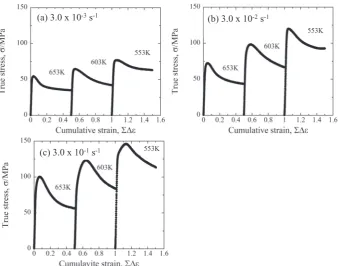
[image:2.595.318.532.259.428.2]Some true stress vs. cumulative strain curves produced during the present MDFing experiments are illustrated in
Fig. 2. The generated flow stress level increased with strain rate and decreasing temperature. The peak stress also in-creased with increasing strain rate. It is evident that all the peaks are followed by notable work softening. This might be associated with the occurrence of extensive DRX. However, almost constant peak strain independent of deformation con-dition suggests that softening is mainly affected by some oth-er mechanisms. It is of intoth-erest that a steady state of flow was not achieved at the highest strain rate, nor did the microstruc-ture attain a homogeneous state.
The dependence of the peak stress on strain rate is depicted in Fig. 3. The peak stress increased with strain rate. It should be noted that the slope at 10−3 s−1 looks quite small even
when MDFed at lower temperatures at higher cumulative
Fig. 2 True stress vs. cumulative strain curves produced by multi-directional forging of AZ80Mg alloy at various true strain rates of (a) 3.0 × 10⁻³ s−1, (b)
3.0 × 10⁻² s−1, (c) 3.0 × 10⁻¹ s−1.
Fig. 3 Dependence of peak stress on cumulative strain and multi-direction-al forging strain rate. Temperature of each pass of forging was decreased pass by pass form 653 K down to 553 K as described in Fig. 2.
[image:2.595.57.277.271.420.2] [image:2.595.129.468.493.759.2]strain regions. This should be due to evolution of UFGed structure, in which grain-boundary sliding is the most domi-nant deformation mechanism at elevated temperatures8).
Grain-boundary sliding is more sensitive to strain rate than dislocation motion. Therefore, the sliding becomes harder with increasing strain rate.
3.2 Microstructures produced by MDFing
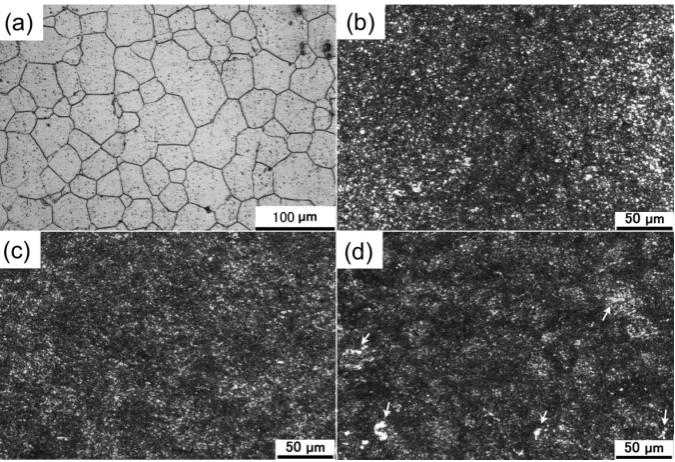
Some typical microstructures produced by MDFing to a cumulative strain of ΣΔε = 1.5 are exhibited in Fig. 4. It can be seen that homogeneous microstructures were developed at all these strain rates. Nevertheless, some coarse grains around 10 μm in diameter were present in the samples deformed at 3 × 10⁻¹ s−1 (Fig. 4 (d)). The reasons responsible for their
formation will be discussed later.
The MDF microstructures were also examined using TEM; some examples are presented in Fig. 5. It can be seen that the dislocation density in the grain interiors increased with strain rate. The average grain sizes estimated from a large number of micrographs were 0.84 μm, 0.88 μm and 1.2 μm in sam-ples deformed at the strain rates of 3.0 × 10⁻¹ s−1, 3.0 ×
10−2 s−1 and 3.0 × 10⁻³ s−1, respectively. Thus, UFGed
mi-crostructures were successfully produced at all the strain rates employed in the present study. The summarized changes in
grain size during MDFing are shown in Fig. 6. Only small differences were observed over the cumulative strain region over ΣΔε = 1.0.
Fig. 4 Optical microstructures of samples (a) before multi-directional forging, and after multi-directional forging to a cumulative strain of ΣΔε = 1.5 at strain rate of (b) 3.0 × 10⁻³ s−1, (c) 3.0 × 10⁻² s−1, (d) 3.0 × 10⁻¹ s−1. Arrow marks in (d) indicate newly developed coarse grains.
Fig. 5 Evolved microstructures after multi-directional forging to a cumulative strain of ΣΔε = 1.5 at strain rate of (a) 3.0 × 10⁻³ s−1, (b) 3.0 × 10⁻² s−1, (c)
3.0 × 10⁻¹ s−1.
[image:3.595.130.468.69.300.2] [image:3.595.127.470.356.449.2] [image:3.595.319.533.499.673.2]3.3 Mechanical properties
The dependence of the microhardness on cumulative strain is illustrated in Fig. 7. It is of interest that the hardness is not sensitive to the flow stress variations depicted in Fig. 2. It can also be seen that the hardness approaches the values produced by MDFing to higher cumulative strains3,8). The higher
pro-portion of β phase present in the AZ80Mg alloy compared with the AZ313) and AZ618) Mg alloys may be conducting to
the high hardness attained here (Fig. 7).
The MDFed samples were tensile tested at room tempera-ture and some typical flow curves of specimens MDFed to ΣΔε = 1.5 are displayed in Fig. 8. It is evident that the tensile behavior depends on the MDFing strain rate. The results of
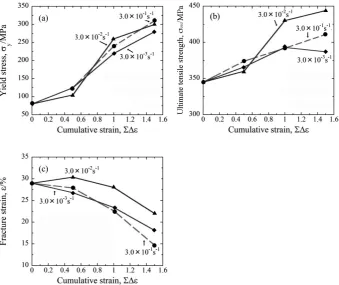
the tensile tests are summarized in Fig. 9. Here it can be seen that MDFing increases the yield stress from 80 MPa to around 300 MPa, regardless of the strain rates employed.
4. Discussion
The effects of strain rate during MDFing under decreasing temperature conditions of AZ80Mg alloy on grain refinement and mechanical properties were systematically investigated. As shown above, the grain size decreased significantly with increasing cumulative strain and this tendency weakly de-pended on strain rate. Still more, the mechanical properties
Fig. 9 Summarized results of tensile tests of (a) yield stress, (b) ultimate tensile strength and (c) fracture strain depending on cumulative strain and multi-di-rectional forging strain rate. Each data point was obtained by one tensile test.
Fig. 8 True stress vs. nominal strain curves obtained by tensile tests of the samples multi-directionally forged to ΣΔε = 1.5 at the three strain rates. Tensile test was carried out at room temperature and at a strain rate of 1.0 × 10⁻³ s−1.
[image:4.595.317.533.237.407.2] [image:4.595.63.276.252.427.2] [image:4.595.128.468.476.761.2]were also affected by strain rate of MDFing. The factors re-sponsible for these frigid dependencies will be considered more in detail below.
4.1 MDFing behavior and the evolved microstructure
Under all conditions, MDFing was successfully carried out to cumulative strains of ΣΔε = 1.5 without any occurrence of cracking. This can be attributed to the occurrence of extensive DRX. Flow stress changed strongly depended on strain rate (Fig. 2). All the flow curves exhibited particularly sharp peaks followed by appreciable work softening almost irrespective of temperature, strain rate and cumulative strain. Such large work softening during hot deformation is known to appear by extensive occurrence of DRX. DRX behavior is, however, de-pends strongly on temperature, strain rate and initial grain size9). The peak strain becomes larger with increasing strain
rate and grain size and with decreasing temperature when DRX is controlled by thermal activated process by diffusion. The peak strains observed in Fig. 2, however, look almost constant irrespective of forging condition. As already shown, the grain size was reduced with increasing MDFing cumula-tive strain (Fig. 4). This indicates that the observed flow soft-ening is not diffusion controlled. In other words, the observed work softening in Fig. 2 is not caused mainly by extensive occurrence of conventional DRX.
Yang et al.10) and Miura et al.8,11) precisely investigated the
mechanisms of work softening during hot deformation of Mg alloys. They also reported almost constant peak strains irre-spective of experimental conditions and attributed the work softening mainly to geometrical softening by crystal rotation and partially to buckling including twinning and kinking. They have also investigated the effect of texture to work soft-ening and revealed that the work softsoft-ening is more significant when deformed either parallel or normal to c-axis of the tex-tured Mg alloys. In such conditions, relatively higher stress is necessary to apply to activate basal and prismatic planes for the plastic deformation. However, lower stress is necessary to activate slip planes after crystal rotation. That is, work soften-ing is affected strongly by the changes of texture and crystal-lographical geometry. In fact, Kim et al. reported absence of peak strain when basal textured Mg alloy was hot deformed to the direction 45 degrees12). After forging to higher strain
region at each forging pass (Fig. 2), the coarser grains were fragmented gradually to form finer microstructure by com-bined mechanisms of DRX, twinning and kinking8,11). It is
also interesting to see in Fig. 2 that the amount of work soft-ening becomes smaller with increasing cumulative strain. Ue-matsu et al. have precisely investigated change in texture with decreasing grain size of AZ61Mg alloy prepared by MDFing and have revealed that texture becomes less significant with deceasing grain size13). Their observation also
semi-qualita-tively supports the work softening observed because weaker texture can induce less work softening.
The flow stress increased with increasing cumulative strain and strain rate. The steady-state flow became more difficult to appear with increasing strain rate. This mechanical behavior is completely the same with those of the other metallic mate-rials9). Although steady state-flow was not achieved at some
conditions in Fig. 2, almost homogeneous microstructure was obtained at each forging pass.
Grain size was gradually reduced with increasing cumula-tive strain during MDFing irrespeccumula-tive of strain rate. Almost homogeneous UFGed structures with average grain size of 0.84 μm, 0.88 μm and 1.2 μm, measured by TEM, were achieved by MDFing to a cumulative strain of ΣΔε = 1.5 at strain rate of 3.0 × 10⁻¹ s−1, 3.0 × 10⁻² s−1 and 3.0 × 10⁻³ s−1,
respectively. Therefore, the average grain size decreased with increasing strain rate. This tendency, where grain size re-duced with increasing strain rate, is in good agreement with expectations based on theory of DRX9).
However, the microstructure evolved by MDFing at 3.0 × 10⁻¹ s−1 looks macroscopically inhomogeneous involving
rather coarser grains up to 10 μm in diameter. The coarser grains observed in Fig. 4 (d) would be probably formed during re-heating up to following MDFing temperature and during cooling procedure after MDFing. Because of high dis-location density and high strain energy should promote local static recrystallization and, therefore, grain coarsening.
Static recrystallization is significantly stimulated with de-creasing grain size14). Furthermore, temperature to onset
stat-ic recrystallization is draststat-ically lowered by UFG evolution by MDFing15). Actually, it is reported that UFGed AZ61Mg
alloy produced by MDFing statically recrystallized and grain coarsening took place even at 423 K where much lower tem-perature than the present MDFing conditions16). These
coars-er grains newly formed during MDFing process and, thcoars-ere- there-fore, microstructural inhomogeneity must affect to the mechanical properties.
The achieved grain size around 1 μm with employing rath-er small pass strains of Δε = 0.5 and cumulative strain of ΣΔε = 1.5 in the present study is almost comparable with the average grain size of 1.2 μm achieved in AZ61Mg alloy MDFed to ΣΔε = 3.2 with employing pass strains of Δε = 0.88). This would be affected by lower stacking fault energy in
AZ80Mg alloy than in AZ61Mg alloy17) to induce higher
den-sity of mechanical twins which contributes to grain refine-ment at lower strains8).
4.2 Mechanical properties of the AZ80Mg alloys MDFed at various strain rates
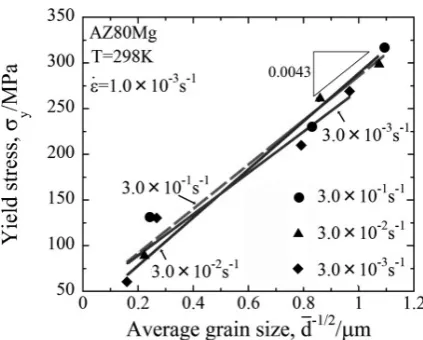
Almost constant hardness over 930 MPa and yield stress around 300 MPa irrespective of MDFing strain rate were at-tained after MDFing to cumulative strain of ΣΔε = 1.5 (Figs. 7, 8, 9). Change in the yield stress was plotted as a function of grain size in Fig. 10. It can be seen in Fig. 10 that all the data can be roughly plotted in straight lines and the difference in the slopes, around 0.004, looks quite small. This indicates that effect of strain rate on the yield stress is negli-gibly small. UTS, however, differed much depending on strain rate (Fig. 9 (b)). UTS when MDFed at 3.0 × 10⁻² s−1
was highest; 445 MPa, while those MDFed at 3.0 × 10⁻¹ s−1
and 3.0 × 10⁻³ s−1 were lower; 410 MPa and 382 MPa,
re-spectively. It is assumed that this difference must be affected by ductility. That is, even while yield stress is comparable, UTS becomes higher when ductility is higher due to larger work hardening region (see Figs. 8, 9 (c)). The reason why the lowest ductility of the sample MDFed at 3.0 × 10⁻¹ s−1
of microstructure leads to deformation inhomogeneity to in-duce strain localization and, therefore, loss of ductility18). The
inhomogeneous microstructure in the sample MDFed at 3.0 × 10⁻¹ s−1, therefore, derived lowest ductility. Then, the sample
MDFed at 3.0 × 10⁻² s−1 exhibited largest ductility and,
therefore, highest UTS because of the homogeneous evolu-tion of UFGs.
Miura et al. have reported that hardness of 990 MPa was achieved by MDFing of AZ61Mg alloy under decreasing temperature conditions to ΣΔε = 4.0 where the average grain size d¯ was 0.8 μm8). Xing et al. have also reported high
hard-ness of 1.05 GPa by MDFing of AZ31Mg alloy to ΣΔε = 4.8 where d¯ = 0.36 μm 3). In the present study, however, almost
comparable hardness of 977 MPa could be attained only at ΣΔε = 1.5.
The MDFed AZ61Mg alloy to ΣΔε = 4.0 exhibited high yield stress of 300 MPa and UTS of 430 MPa8). Xing et al.
reported that superior balance of UFGed AZ31Mg alloy which possessed yield stress of 420 MPa, UTS of 520 MPa and plastic strain to fracture of 10% after MDFing to ΣΔε = 6.4. The results obtained in the present study, i.e., 300 MPa yield stress and 445 MPa UTS, are also again comparable to those of AZ61Mg alloy but lower than those of AZ31 one. However, it should be noted that the applied MDFing cumu-lative strain was only ΣΔε = 1.5 in the present study. The rath-er good mechanical proprath-erties could be achieved by UFG evolution by MDFing of AZ80Mg alloy at higher strain rate when compared with the other MDFing conditions3,8). These
superior properties may be affected also by high fraction of fine β phase particles dispersed in AZ80Mg alloy. Finally, it is concluded that MDFing at suitable strain rate employing DRX can induce more preferable mechanical properties.
5. Summary
AZ80Mg alloy was successfully multi-directionally forged (MDFed) under decreasing temperature conditions at various strain rates. The average grain size decreased gradually with increasing cumulative strain and almost homogeneous ultraf-ine graultraf-ined (UFGed) structure could be attaultraf-ined only at a
cu-mulative strain of ΣΔε = 1.5. The average grain size achieved at ΣΔε = 1.5 was 0.84 μm, 0.88 μm and 1.2 μm at strain rate of 3.0 × 10⁻¹ s−1, 3.0 × 10⁻² s−1 and 3.0 × 10⁻³ s−1,
respec-tively. However, less homogeneous microstructure, which was caused by grain coarsening during re-heating for the next MDFing pass and cooling process after MDFing, was devel-oped when MDFed at 3.0 × 10⁻¹ s−1. Even while the yield
stress and hardness were almost the same independent of strain rate, ultimate tensile strength and ductility were sensi-tively changed depending on MDFing strain rate. Therefore, employment of an adequate strain rate for MDFing is neces-sary to fabricate UFGed structure with superior balance of mechanical properties. The best balance of mechanical prop-erties, i.e., hardness 977 MPa, yield stress 300 MPa, ultimate tensile strength 445 MPa and ductility 22%, was attained when MDFed at 3.0 × 10⁻² s−1.
Acknowledgements
This research was financially supported by Japan Science and Technology Agency (JST) under Industry-Academia Col-laborative R&D Program Heterogeneous Structure Control: Towards Innovative Development of Metallic Structural Ma-terials , Grant-in-Aid for Scientific Research on Innovative Areas Bulk Nanostructured Metals through MEXT, Japan, Grant No. 22102004, 24360303 and the Light Metals Educa-tional Foundation, Japan. One of the authors, H.M. appreci-ates discussion with Prof. J.J. Jonas, McGill University and assistance by Mr. R. Watanabe, UEC Tokyo.
REFERENCES
1) Nanomaterials by severe plastic deformation, ed by Z. Horita, (2005), Trans Tech Publications.
2) N. Tsuji, Y. Ito, Y. Saito and Y. Minamino: Scr. Mater. 47 (2002) 893– 899.
3) J. Xing, X. Yang, H. Miura and T. Sakai: Trans. JIM 46 (2005) 1646– 1650.
4) E.J. Kwak, C.H. Bok, M.H. Seo, T.S. Kim and H.S. Kim: Trans. JIM 49 (2008) 1006–1010.
5) M. Gzyl, A. Rosochwski, R. Pesci, L. Olejnik, E. Yakushina and P. Wood: Metall. Mater. Trans., A Phys. Metall. Mater. Sci. 45 (2014) 1609–1620.
6) M. Kai, Z. Horita and T.G. Langdon: Mater. Sci. Eng. A 488 (2008) 117–124.
7) H. Miura and W. Nakamura: Philos. Mag. Lett. 93 (2013) 601–607. 8) H. Miura, G. Yu and X. Yang: Mater. Sci. Eng. A 528 (2011) 6981–
6992.
9) T. Sakai and J.J. Jonas: Acta Metall. 32 (1984) 189–209.
10) X. Yang, Z.S. Ji, H. Miura and T. Sakai: Trans. Nonferros Met. Soc. China 19 (2009) 55–60.
11) H. Miura, M. Ito, X. Yang and J.J. Jonas: Mater. Sci. Eng. A 538 (2012) 63–68.
12) J. Kim, K. Okayasu and H. Fukutomi: Trans. JIM 53 (2012) 1870– 1875.
13) Y. Uematsu, T. Kakiuchi, H. Miura, T. Nozaki: submitting to Mater. Trans. (2016).
14) W.B. Hutchinson, S. Jonsson and L. Ryde: Scr. Metall. Mater. 23 (1989) 671–676.
15) Y. Nakao, H. Miura and T. Sakai: Mater. Sci. Forum 558–559 (2007) 1329–1334.
16) H. Miura, G. Yu and X. Yang: Mater. Sci. Eng. A 528 (2011) 6981– 6992.
[image:6.595.62.274.67.237.2]17) K. Higashi: J. Jpn. Inst. Light Metals 59 (2009) 576–588. 18) F.P.E. Dunne: Int. J. Plast. 14 (1998) 413–433.