Semantic Parser
Jianpeng Cheng
University of Edinburgh [email protected]Siva Reddy
Stanford University [email protected]Vijay Saraswat
IBM T.J. Watson Research [email protected]
Mirella Lapata
University of Edinburgh [email protected]This article describes a neural semantic parser that maps natural language utterances onto logical forms that can be executed against a task-specific environment, such as a knowledge base or a database, to produce a response. The parser generates tree-structured logical forms with a transition-based approach, combining a generic tree-generation algorithm with domain-general grammar defined by the logical language. The generation process is modeled by structured re-current neural networks, which provide a rich encoding of the sentential context and generation history for making predictions. To tackle mismatches between natural language and logical form tokens, various attention mechanisms are explored. Finally, we consider different training settings for the neural semantic parser, including fully supervised training where annotated logical forms are given, weakly supervised training where denotations are provided, and distant supervision where only unlabeled sentences and a knowledge base are available. Experiments across a wide range of data sets demonstrate the effectiveness of our parser.
1. Introduction
An important task in artificial intelligence is to develop systems that understand natural language and enable interactions between computers and humans. Semantic parsing has emerged as a key technology toward achieving this goal. Semantic parsers specify a mapping between natural language utterances and machine-understandable meaning
Submission received: 6 November 2017; revised version received: 17 July 2018; accepted for publication: 10 August 2018.
Table 1
Examples of questions, corresponding logical forms, and their answers.
Environment:A database of US geography Utterance:What is the longest river in Ohio?
Logical form:longest(and(type.river, location(Ohio)))
Denotation:Ohio River
Environment:Freebase
Utterance:How many daughters does Obama have? Logical form:count(daughterOf(Barack Obama))
Denotation:2
representations, commonly known as logical forms. A logical form can be executed against a real-worldenvironment, such as a knowledge base, to produce a response, often called adenotation. Table 1 shows examples of natural language queries, their cor-responding logical forms, and denotations. The queryWhat is the longest river in Ohio?
is represented by the logical form longest(and(type.river, location(Ohio))), which when executed against a database of US geography returns the answer Ohio
River. In the second example, the logical form count(daughterOf(Barack Obama))
corresponds to the query How many daughters does Obama have? and is executed against the Freebase knowledge base to return the answer2.
In recent years, semantic parsing has attracted a great deal of attention because of its utility in a wide range of applications, such as question answering (Kwiatkowski et al. 2011; Liang, Jordan, and Klein 2011), relation extraction (Krishnamurthy and Mitchell 2012), goal-oriented dialog (Wen et al. 2015), natural language interfaces (Popescu et al. 2004), robot control (Matuszek et al. 2012), and interpreting instructions (Chen and Mooney 2011; Artzi and Zettlemoyer 2013).
Early statistical semantic parsers (Zelle and Mooney 1996; Zettlemoyer and Collins 2005; Wong and Mooney 2006; Kwiatkowksi et al. 2010) mostly require training data in the form of utterances paired with annotated logical forms. More recently, alter-native forms of supervision have been proposed to alleviate the annotation burden— for example, training on utterance-denotation pairs (Clarke et al. 2010; Kwiatkowski et al. 2013; Liang 2016), or using distant supervision (Krishnamurthy and Mitchell 2012; Cai and Yates 2013). Despite different supervision signals, training and inference procedures in conventional semantic parsers rely largely on domain-specific grammars and engineering. A CKY-style chart parsing algorithm is commonly used to parse a sentence in polynomial time.
In this work we propose a neural semantic parsing framework that combines recurrent neural networks and their ability to model long-range dependencies with a transition system to generate well-formed and meaningful logical forms. The transition system combines a generic tree-generation algorithm with a small set of domain-general grammar pertaining to the logical language to guarantee correctness. Our neural parser differs from conventional semantic parsers in two respects. First, it does not require lexicon-level rules to specify the mapping between natural language and logical form tokens. Instead, the parser is designed to handle cases where the lexicon is missing or incomplete thanks to a neural attention layer, which encodes a soft mapping between natural language and logical form tokens. This modeling choice greatly reduces the number of grammar rules used during inference to those only specifying domain-general as-pects. Second, our parser is transition-based rather than based. Although chart-based inference has met with popularity in conventional semantic parsers, it has difficulty in leveraging sentence-level features because the dynamic programming algorithm requires features defined over substructures. In comparison, our linear-time parser allows us to generate parse structures incrementally conditioned on the entire sentence. We perform several experiments in downstream question-answering tasks and demonstrate the effectiveness of our approach across different training scenarios. These includefull supervision with questions paired with annotated logical forms using the GEOQUERY (Zettlemoyer and Collins 2005) data set, weak supervisionwith question-answer pairs using the WEBQUESTIONS (Berant et al. 2013a) and GRAPHQUESTIONS (Su et al. 2016) data sets, anddistant supervisionwithout question-answer pairs, using the SPADES(Bisk et al. 2016) data set. Experimental results show that our neural semantic parser is able to generate high-quality logical forms and answer real-world questions on a wide range of domains.
The remainder of this article is structured as follows. Section 2 provides an overview of related work. Section 3 introduces our neural semantic parsing framework and discusses the various training scenarios to which it can be applied. Our experiments are described in Section 4, together with detailed analysis of system output. Discussion of future work concludes in Section 5.
2. Related Work
The proposed framework has connections to several lines of research, including various formalisms for representing natural language meaning, semantic parsing models, and the training regimes they adopt. We review related work in these areas here.
Semantic Formalism.Logical forms have played an important role in semantic parsing systems since their inception in the 1970s (Winograd 1972; Woods, Kaplan, and Nash-Webber 1972). The literature is rife with semantic formalisms that can be used to define logical forms. Examples include lambda calculus (Montague 1973), which has been used by many semantic parsers (Zettlemoyer and Collins 2005; Kwiatkowksi et al. 2010; Reddy, Lapata, and Steedman 2014) because of its expressiveness and flexibil-ity to construct logical forms of great complexflexibil-ity; Combinatory Categorial Grammar (Steedman 2000); dependency-based compositional semantics (Liang, Jordan, and Klein 2011); frame semantics (Baker, Fillmore, and Lowe 1998); and abstract meaning repre-sentations (Banarescu et al. 2013).
program representations. Although it lacks expressive power, FunQL has a mod-eling advantage for downstream tasks, because it is more natural to describe the manipulation of a simple world as procedural programs. This modeling advantage has been revealed in recent advances of neural programmings: Recurrent neural networks have demonstrated great capability in inducing compositional programs (Neelakantan, Le, and Sutskever 2016; Reed and De Freitas 2016; Cai, Shin, and Song 2017). For ex-ample, they learn to perform grade-school additions, bubble sort, and table comprehen-sion in procedures. Finally, some recent work (Iyer et al. 2017; Yin and Neubig 2017; Zhong, Xiong, and Socher 2017) uses other programming languages, such as the SQL, as the semantic formalism.
Semantic Parsing Model. The problem of learning to map utterances to meaning rep-resentations has been studied extensively in the NLP community. Most data-driven semantic parsers consist of three key components: a grammar, a trainable model, and a parsing algorithm. The grammar defines the space of derivations from sentences to logical forms, and the model together with the parsing algorithm find the most likely derivation. The model—which can take, for example, the form of a support vector machine (Kate and Mooney 2006), a structured perceptron (Zettlemoyer and Collins 2007; Lu et al. 2008; Reddy, Lapata, and Steedman 2014; Reddy et al. 2016), or a log-linear model (Zettlemoyer and Collins 2005; Berant et al. 2013a)—scores the set of candidate derivations generated from the grammar. During inference, a chart-based parsing algo-rithm is commonly used to predict the most likely semantic parse for a sentence.
With recent advances in neural networks and deep learning, there is a trend of reformulating semantic parsing as a machine translation problem. The idea is not novel, because semantic parsing has been previously studied with statistical machine translation approaches in both Wong and Mooney (2006) and Andreas, Vlachos, and Clark (2013). However, the task set-up is important to be revisited since recurrent neural networks have been shown to be extremely useful in context modeling and sequence generation (Bahdanau, Cho, and Bengio 2015). Following this direction, Dong and Lapata (2016) and Jia and Liang (2016) have developed neural semantic parsers that treat semantic parsing as a sequence to a sequence learning problem. Jia and Liang (2016) also introduce a data augmentation approach that bootstraps a synchronous grammar from existing data and generates artificial examples as extra training data. Other related work extends the vanilla sequence-to-sequence model in various ways, such as multi-task learning (Fan et al. 2017), parsing cross-domain queries (Herzig and Berant 2017) and context-dependent queries (Suhr, Iyer, and Artzi 2018), and applying the model to other formalisms such as AMR (Konstas et al. 2017) and SQL (Zhong, Xiong, and Socher 2017).
The fact that logical forms have a syntactic structure has motivated some of the recent work on exploring structured neural decoders to generate tree or graph struc-tures and grammar-constrained decoders to ensure the outputs are meaningful and executable. Related work includes Yin and Neubig (2017), who generate abstract syn-tax trees for source code with a grammar-constrained neural decoder. Krishnamurthy, Dasigi, and Gardner (2017) also introduce a neural semantic parser that decodes rules in a grammar to obtain well-typed logical forms. Rabinovich, Stern, and Klein (2017) propose abstract syntax networks with a modular decoder, whose multiple submodels (one per grammar construct) are composed to generate abstract syntax trees in a top– down manner.
2016). Our semantic parser is a generalization of the model presented in Cheng et al. (2017). Whereas they focus solely on top–down generation using hard attention, the parser presented in this work generates logical forms following either a top–down or bottom–up generation order and introduces additional attention mechanisms (i.e., soft and structured attention) for handling mismatches between natural language and log-ical form tokens. We empirlog-ically compare generation orders and attention variants, elaborate on model details, and formalize how the neural parser can be effectively trained under different types of supervision.
Training Regimes.Various types of supervision have been explored to train semantic parsers, ranging from full supervision with utterance-logical form pairs to unsuper-vised semantic parsing without given utterances. Early work in statistical semantic parsing has mostly used annotated training data consisting of utterances paired with logical forms (Zelle and Mooney 1996; Kate, Wong, and Mooney 2005; Kate and Mooney 2006; Wong and Mooney 2006; Lu et al. 2008; Kwiatkowksi et al. 2010). The same applies to some of the recent work on neural semantic parsing (Dong and Lapata 2016; Jia and Liang 2016). This form of supervision is the most effective to train the parser, but is also expensive to obtain. In order to write down a correct logical form, the annotator not only needs to have expertise in the semantic formalism, but also has to ensure that the logical form matches the utterance semantics and contains no grammatical mistakes. For this reason, fully supervised training applies more to small, close-domain problems, such as querying the US geographical database (Zelle and Mooney 1996).
Over the past few years, developments have been made to train semantic parsers with weak supervision from utterance-denotation pairs (Clarke et al. 2010; Liang, Jordan, and Klein 2011; Berant et al. 2013a; Kwiatkowski et al. 2013; Pasupat and Liang 2015). The approach enables more efficient data collection, since denotations (such as answers to a question, responses to a system) are much easier to obtain via crowdsourcing. For this reason, semantic parsing can be scaled to handle large, complex, and open domain prob-lems. Examples include learning semantic parsers from question-answer pairs on Free-base (Liang, Jordan, and Klein 2011; Berant et al. 2013a; Berant and Liang 2014; Liang et al. 2017; Cheng et al. 2017), from system feedbacks (Clarke et al. 2010; Chen and Mooney 2011; Artzi and Zettlemoyer 2013), from abstract examples (Goldman et al. 2018), and from human feedbacks (Iyer et al. 2017) or statements (Artzi and Zettlemoyer 2011). Some work seeks more clever ways of gathering data and trains semantic parsers with even weaker supervision. In a class of distant supervision methods, the input is solely a knowledge base and a corpus of unlabeled sentences. Artificial training data are generated from the given resources. For example, Cai and Yates (2013) generate utter-ances paired with logical forms. Their approach searches for sentences containing cer-tain entity pairs, and assumes (with some pruning technique) that the sentences express a certain relation from the knowledge base. In Krishnamurthy and Mitchell (2012, 2014), whose authors work with the CCG formalism, an extra source of supervision is added. The semantic parser is trained to produce parses that syntactically agree with depen-dency structures. Reddy, Lapata, and Steedman (2014) generate utterance-denotation pairs by masking entity mentions in declarative sentences from a large corpus. A seman-tic parser is then trained to predict the denotations corresponding to the masked entities.
3. Neural Semantic Parsing Framework
a response. Compared with traditional semantic parsers, our framework reduces the number of manually engineered features and domain-specific rules. As semantic for-malism, we choose the functional query language (FunQL), which is recursive and tree-structured (Section 3.1). A transition-based tree generation algorithm is then defined to generate FunQL logical forms (Sections 3.2–3.4). The process of generating logical forms is modeled by recurrent neural networks—a powerful tool for encoding the context of a sentence and the generation history for making predictions (Section 3.5). We handle mismatches between natural language and the knowledge base through var-ious attention mechanisms (Section 3.7). Finally, we explore different training regimes (Section 3.8), including a fully supervised setting where each utterance is labeled with annotated logical forms, a weakly supervised setting where utterance-denotation pairs are available, and a distant-supervision setting where only a collection of unlabeled sentences and a knowledge base is given.
3.1 FunQL Semantic Representation
As mentioned earlier, we adopt FunQL as our semantic formalism. FunQL is a variable-free recursive meaning representation language that maps simple first-order logical forms to function-argument structures that abstract away from variables and quantifiers (Kate and Mooney 2006). The language is also closely related to lambda DCS (Liang 2013), which makes existential quantifiers implicit. Lambda DCS is more compact in the sense that it can use variables in rare cases to handle anaphora and build composite binary predicates.
The FunQL logical forms we define contain the following primitive functional operators. They overlap with simple lambda DCS (Berant et al. 2013a) but differ slightly in syntax to ease recursive generation of logical forms. Let ldenote a logical form,JlK represent its denotation, andKrefer to a knowledge base.
• Unary base case: Anentitye(e.g.,Barack Obama) is a unary logical form whose denotation is a singleton set containing that entity:
JeK={e} (1)
• Binary base case: Arelationr(e.g.,daughterOf) is a binary logical form with denotation:
JrK={(e1,e2) : (e1,r,e2)∈K} (2)
• A relationrcan be applied to an entitye1(written asr(e1)) and returns as denotation the unary satisfying the relation
Jr(e1)K={e: (e1,e)∈JrK} (3)
For example, the expressiondaughterOf(Barack Obama)corresponds to the question “Who are Barack Obama’s daughters?”.
• countreturns the cardinality of the unary setu:
For example,count(daughterOf(Barack Obama))represents the question
“How many daughters does Barack Obama have?”.
• argmaxorargminreturn a subset of the unary setuwhose specific relation ris maximum or minimum:
Jargmax(u,r)K={e:e∈u∩ ∀e
0∈u,r(e)≥r(e0)} (5)
For example, the expressionargmax(daughterOf(Barack Obama), age) corresponds to the utterance “Who is Barack Obama’s eldest daughter?”.
• filterreturns a subset of the unary setuwhere a comparative constraint (=, !=,>,<,≥,≤) acting on the relationris satisfied:
Jfilter>(u,r,v)K={e:e∈u∩r(e)>v} (6)
For example, the queryfilter> (daughterOf(Barack Obama), age, 5) returns the daughters of Barack Obama who are older than five years.
• andtakes the intersection of two urinary setsu1andu2:
Jand(u1,u2)K=Ju1K∩Ju2K (7)
andortakes their union:
Jor(u1,u2)K=Ju1K∪Ju2K (8)
For example, the expressionand(daughterOf(Barack Obama),
InfluentialTeensByYear(2014))would correspond to the query “Which daughter of Barack Obama was named Most Influential Teens in the year 2014?”.
The operators just defined give rise to compositional logical forms (e.g., count(and (daughterOf(Barack Obama), InfluentialTeensByYear(2014)).
The reason for using FunQL in our framework lies in its recursive nature, which allows us to model the process of generating logical form as a sequence of transition operations that can be decoded by powerful recurrent neural networks. We next de-scribe how our semantic formalism is integrated with a transition-based tree-generation algorithm to produce tree-structured logical forms.
3.2 Tree Generation Algorithm
We introduce a generic tree generation algorithm that recursively generates tree con-stituents with a set of transition operations. The key insight underlying our algorithm is to define acanonicaltraversal or generation order, which generates a tree as atransition sequence. A transition sequence for a tree is a sequence of configuration-transition pairs [(c0,t0), (c1,t1),· · ·, (cm,tm)]. In this work, we consider two commonly used generation orders, namely top–down pre-order and bottom–up post-order.
Thetop–downsystem is specified by the tuplec=(P
,π,σ,N,P) whereP
Table 2
Transitions for the top–down and bottom–up generation system. StackP
is represented as a list with its head to the right (with tailσ), same for stackN(with tailβ).
Top–down Transitions
NT(X) ([σ|X0],X,ε, [β|X0],P(X0))⇒([σ|X0,X],ε,ε, [β|X0,X],P(X))
TER(x) ([σ|X0],ε,x, [β|X0],P(X’))⇒([σ|X0,x],ε,ε, [β|X0,x],P(X0))
RED ([σ|X0,X,x],ε,ε, [β|X0,X],P(X))⇒([σ|X0,X(x)],ε,ε, [β|X0],P(X0))
Bottom–up Transitions
TER(x) (σ,ε,x)⇒([σ|x],ε,ε)
NT-RED(X) ([σ|x],X,ε)⇒([σ|X(x)],ε,ε)
a function indexing the position of a non-terminal pointer. The pointer indicates where subsequent children nodes should be attached (e.g., P(X) means that the pointer is pointing to the non-terminalX). The initial configuration isc0=([],TOP,ε, [],⊥), where TOPstands for the root node of the tree,εrepresents an empty string, and⊥represents an unspecified function. The top–down system uses three transition operations, defined in Table 2:
• NT(X)creates a new subtree non-terminal node denoted byX. The non-terminalXis pushed on top of the stack and written asX(and subsequent tree nodes are generated as children underneathX).
• TER(x)creates a new child node denoted byx. The terminalxis pushed on top of the stack, written asx.
• REDis the reduce operation, which indicates that the current subtree being generated is complete. The non-terminal root of the current subtree is closed and subsequent children nodes will be attached to the predecessor open non-terminal. Stack-wise,REDrecursively pops children (which can be either terminals or completed subtrees) on top until an open non-terminal is encountered. The non-terminal is popped as well, after which a completed subtree is pushed back to the stack as a single closed constituent, written for example asX1(X2,X3).
We define thebottom–upsystem by tuplec=(P
,π,σ) where P
is a stack used to store partially complete tree fragments,πis the token non-terminal to be generated, andσis the token terminal to be generated. We take the initial configuration to bec0= ([],xl,ε), wherexl stands for the leftmost terminal node of the tree, andε represents an empty string. The bottom–up generation uses two transition operations, defined in Table 2:
• NT-RED(X)builds a new subtree by attaching a parent node (denoted byX) to children nodes on top of the stack. The children nodes can be either terminals or smaller subtrees. Similarly toREDin the top–down case, children nodes are first popped from the stack, and subsequently
combined with the parentXto form a subtree. The subtree is pushed back to the stack as a single constituent, written for example asX1(X2,X3). A challenge withNT-RED(X)is to decide how many children should be popped and included in the new subtree. In this work, the number of children is dictated by the number of arguments expected byX, which is in turn constrained by the logical language. For example, from the FunQL grammar it is clear thatcounttakes one argument andargmaxtakes two. The language we use does not contain non-terminal functions with a variable number of arguments.
Top–down traversal is defined by three generic operations, and bottom–up order applies two operations only (since it combines reduce with non-terminal generation). However, the operation predictions required are the same for the two systems. The reason is that the reduce operation in the top–down system is deterministic when the FunQL grammar is used as a constraint (we return to this point in Section 3.4).
3.3 Generating Tree-Structured Logical Forms
To generate tree-structured logical forms, we integrate the generic tree generation oper-ations described earlier with FunQL, whose grammar determines the space of allowed terminal and non-terminal symbols:
• NT(X)includes an operation that generates relationsNT(relation), and other domain-general operators in FunQL:NT(and),NT(or),NT(count), NT(argmax),NT(argmin), andNT(filter). Note thatNT(relation) creates a placeholder for a relation, which is subsequently generated.
• TER(X)includes two operations:TER(relation)for generating relations andTER(entity)for generating entities. Both operations create a placeholder for a relation or an entity, which is subsequently generated.
• NT-RED(X)includesNT-RED(relation),NT-RED(and),NT-RED(or), NT-RED(count),NT-RED(argmax),NT-RED(argmin), andNT-RED(filter). Again,NT-RED(relation)creates a placeholder for a relation, which is subsequently generated.
Table 3 illustrates the sequence of operations used by our parser in order to gen-erate the logical form count(and(daughterOf(Barack Obama), InfluentialTeens-ByYear(2014)) top–down. Table 4 shows how the same logical form is generated bottom–up. Note that the examples are simplified for illustration purposes; the logical form is generatedconditionedon an input utterance, such as “How many daughters of
Barack Obama were named Most Influential Teens in the year 2014?”.
3.4 Constraints
Table 3
Top–down generation of the logical formcount(and(daughterOf(Barack Obama),
InfluentialTeensByYear(2014)). Elements on the stack are separated by||and the top of the stack is on the right.
Operation Logical form token Stack
NT(count) count count(
NT(and) and count(||and(
NT(relation) daughterOf count(||and(||daughterOf
TER(entity) Barack Obama count(||and(||daughterOf(||Barack Obama RED count(||and(||daughterOf(Barack Obama)
NT(relation) InfluentialTeensByYear count(||and(||daughterOf(Barack Obama)||InfluentialTeensByYear(
TER(entity) 2014 count(||and(||daughterOf(Barack Obama)||InfluentialTeensByYear(||2014 RED count(||and(||daughterOf(Barack Obama)||InfluentialTeensByYear(2014)
RED count(||and(daughterOf(Barack Obama),InfluentialTeensByYear(2014))
[image:10.486.50.437.285.349.2]RED count(and(daughterOf(Barack Obama),InfluentialTeensByYear(2014)))
Table 4
Bottom–up generation of the logical formcount(and(daughterOf(Barack Obama),
InfluentialTeensByYear(2014)). Elements on the stack are separated by||and the top of the stack is on the right.
Operation Logical form token Stack
TER(entity) Barack Obama Barack Obama
NT-RED(relation) daughterOf daughterOf(Barack Obama)
TER(entity) 2014 daughterOf(Barack Obama)||2014
NT-RED(relation) InfluentialTeensByYear daughterOf(Barack Obama)||InfluentialTeensByYear(2014)
NT-RED(and) and and(daughterOf(Barack Obama),InfluentialTeensByYear(2014))
NT-RED(count) count count(and(daughterOf(Barack Obama),InfluentialTeensByYear(2014)))
first ones are structural constraints to ensure that the outputs are syntactically valid logical forms. For the top–down system these constraints include:
• The first operation must beNT;
• REDcannot directly followNT;
• The maximum number of open non-terminal symbols allowed on the stack is 10.NTis disabled when the maximum number is reached;
• The maximum number of (open and closed) non-terminal symbols allowed on the stack is 10.NTis disabled when the maximum number is reached.
Tree constraints for the bottom–up system are:
• The first operation must beTER;
• The maximum number of consecutiveTERs allowed is 5;
• The maximum number of terminal symbols allowed on the stack is the number of words in the sentence.TERis disallowed when the maximum number is reached.
The second type of constraints relate to the FunQL-grammar itself, ensuring that the generated logical forms are meaningful for execution:
• The number of arguments expected by each non-terminal symbol must follow the FunQL grammar;
• When the expected number of arguments for a non-terminal symbol is reached, aREDoperation must be called for the top–down system; for the bottom–up system this constraint is built within theNT-REDoperation, since it reduces the expected number of arguments based on a specific non-terminal symbol.
3.5 Neural Network Realizer
We model this logical form generation algorithm with a structured neural network that encodes the utterance and the generation history, and then predicts a sequence of transition operations as well as logical form tokens based on the encoded information. In the following, we present details for each component in the network.
Utterance Encoding.An utterancexis encoded with a bidirectional long short-term mem-ory (LSTM) architecture (Hochreiter and Schmidhuber 1997). A bidirectional LSTM comprises a forward LSTM and a backward LSTM. The forward LSTM processes a variable-length sequencex=(x1,x2,· · ·,xn) by incrementally adding new content into a single memory slot, with gates controlling the extent to which new content should be memorized, old content should be erased, and current content should be exposed. At time stept, the memory~ctand the hidden stateh~tare updated with the following equations:
it
ft
ot ˆ ct
=
σ σ σ tanh
W·[−−→ht−1,xt] (9)
− →
ct =ft −−→ct−1+itcˆt (10)
−→
ht =ottanh(−→ct) (11)
wherei,f, andoare gate activations;Wdenotes the weight matrix. For simplicity, we denote the recurrent computation of the forward LSTM as
−→
ht = −−−→ LSTM(xt,
−−→
ht−1) (12)
After encoding, a list of token representations [−→h1,−→h2,· · ·,−→hn] within the forward context is obtained. Similarly, the backward LSTM computes a list of token representations [←h−1,
←−
h2,· · ·,
←−
hn] within the backward context as
←−
ht= ←−−−−
LSTM(xt, ←−−
Finally, each input tokenxiis represented by the concatenation of its forward and backward LSTM state vectors, denoted byhi=
− →
hi : ←−
hi. The list storing token vectors for the entire utterancex can be considered as a buffer, in analogy to syntactic parsing. A notable difference is that tokens in the buffer will not be removed because its alignment to logical form tokens is not predetermined in the general semantic parsing scenario. We denote the bufferbasb=[h1,· · ·,hk], wherekdenotes the length of the utterance.
Generation History Encoding. The generation history—that is, the partially completed subtrees—is encoded with a variant of stack-LSTM (Dyer et al. 2015). Such an encoder captures not only previously generated tree tokens but also tree structures. We first discuss the stack-based LSTM in the top–down transition system and then present modifications to account for the bottom–up system.
Intop–downtransitions, operationsNTandTERchange the stack-LSTM representa-tionstas in a vanilla LSTM as
st=LSTM(yt,st−1) (14)
whereytdenotes the newly generated non-terminal or terminal token. AREDoperation recursively pops the stack-LSTM states as well as corresponding tree tokens on the output stack. The popping stops when a non-terminal state is reached and popped, after which the stack-LSTM reaches an intermediate statest−1:t.1The representation of the completed subtreeuis then computed as
u=Wu·[pu:cu] (15)
wherepudenotes the parent (non-terminal) embedding of the subtree,cudenotes the av-erage of the children (terminal or completed subtree) embeddings, andWudenotes the weight matrix. Note thatcucan also be computed with more advanced methods, such as a recurrent neural network (Kuncoro et al. 2017). Finally, the subtree embeddingu serves as the input to the LSTM and updatesst−1:ttostas
st=LSTM(u,st−1:t) (16)
Figure 1 provides a graphical view on how the three operations change the configura-tion of a stack-LSTM.
In comparison, the bottom–up transition system uses the same TER operation to update the stack-LSTM representationstwhen a terminalytis newly generated:
st=LSTM(yt,st−1) (17)
Differently, the effects ofNTandREDare merged into aNT-RED(X)operation. When NT-RED(X) is invoked, a non-terminal yt is first predicted and then the stack-LSTM starts popping its states on the stack. The number of pops is decided by the amount of argument expected byyt. After that, a subtree can be obtained by combining the non-terminal yt and the newly popped terminal tokens, while the stack-LSTM reaches an
Figure 1
A stack-LSTM extends a standard LSTM with the addition of a stack pointer (shown as Top in the figure). The example shows how the configuration of the stack changes when the operations
NT,TER, andREDare applied in sequence. The initial stack is presumed empty for illustration purposes. We only show how the stack-LSTM updates its states, not how subsequent predictions are made, which depend not only on the hidden state of the stack-LSTM, but also on the natural language utterance.
intermediate statest−1:t. Similar to the top–down system, we compute the representa-tion of the newly combined subtreeuas
u=Wu·[pu:cu] (18)
wherepu denotes the parent (non-terminal) embedding of the subtree,cu denotes the average of the children (terminal or completed subtree) embeddings, andWu denotes the weight matrix. Finally, the subtree embeddinguserves as the input to the LSTM and updatesst−1:ttostas
st=LSTM(u,st−1:t) (19)
The key difference here is that a non-terminal tree token is never pushed alone to update the stack-LSTM, but rather as part of a completed subtree that does the update.
tokens (see Tables 3 and 4). First, at every time step, the next transition operationot+1is predicted based on utterance encodingband generation historyst:
ot+1∼f(b,st) (20)
wherefis a neural network that computes the parameters of a multinomial distribution over the action space which is restricted by the constraints discussed in Section 3.4.
Next, the logical form token underlying each generation operation must be emit-ted. When the generation operation contains one of the domain-general non-terminals count,argmax,argmin,and,or, andfilter(e.g.,NT(count)), the logical form token is the corresponding non-terminal (e.g.,count). When the generation operation involves one of the placeholders forentityorrelation(e.g.,NT(relation),NT-RED(relation), TER(relation), and TER(entity)), a domain-specific logical form tokenyt+1 (i.e., an entity or a relation) is predicted in a fashion similar to action prediction:
yt+1∼g(b,st) (21)
wheregis a neural network that computes the parameters of a multinomial distribution over the token space.
A remaining challenge lies in designing predictive functionsf (for the next action) andg (for the next logical form token) in the context of semantic parsing. We explore various attention mechanisms that we discuss in the next sections.
3.6 Next Action Prediction
This section explains how we model functionf for predicting the next action. We draw inspiration from previous work on transition-based syntactic parsing and compute a feature vector representing the current state of the generation system (Dyer et al. 2016). This feature vector typically leverages the buffer, which stores unprocessed tokens in the utterance, and the stack, which stores tokens in the partially completed parse tree. A major difference in our semantic parsing context is that the buffer configuration does not change deterministically with respect to the stack because the alignment between natural language tokens and logical-form tokens is not explicitly specified. This gives rise to the challenge of extracting features representing the buffer at different time steps. To this end, we compute at each time step t a single adaptive representation of the buffer ¯btwith a soft attention mechanism:
uit=Vtanh(Wbbi+Wsst) (22)
αit=softmax(uit) (23)
¯ bt=
X
i
αitbi (24)
(Equation (25)) to yield a feature vector for the generation system. Finally, softmax is taken to obtain the parameters of the multinomial distribution over actions:
at+1∼softmax(Woatanh(Wf[¯bt,st])) (25)
whereWoaandWf are weight matrices.
3.7 Next Token Prediction
This section presents various functionsg for predicting the next logical form token (i.e., a specificentityor relation). A hurdle in semantic parsing concerns handling mismatches between natural language and logical tokens in the target knowledge base. For example, both utterances “Where did X graduate from” and “Where did X get his PhD” would trigger the same predicateeducationin Freebase. Traditional semantic parsers map utterances directly to domain-specific logical forms relying exclusively on a set of lexicons either predefined or learned for the target domain with only limited coverage. Recent approaches alleviate this issue by first mapping the utterance to a domain-general logical form that aims to capture language-specific semantic aspects, after which ontology matching is performed to handle mismatches (Kwiatkowski et al. 2013; Reddy, Lapata, and Steedman 2014; Reddy et al. 2016). Beyond efficiency considerations, it remains unclear which domain-general representation is best suited to domain-specific semantic parsing.
Neural networks provide an alternative solution: The matching between natural language and domain-specific predicates is accomplished via an attention layer, which encodes a context-sensitive probabilistic lexicon. This is analogous to the application of the attention mechanism in machine translation (Bahdanau, Cho, and Bengio 2015), which is used as an alternative to conventional phrase tables. In this work, we consider a practical domain-specific semantic parsing scenario where we are given no lexicon. We first introduce the basic form of attention used to predict logical form tokens and then discuss various extensions as shown in Figure 2.
Soft Attention.In the case where no lexicon is provided, we use a soft attention layer similar to action prediction. The parameters of the soft attention layer prior to softmax are shared with those used in action prediction:
uit=Vtanh(Wbbi+Wsst) (26)
αit=softmax(uit) (27)
¯ bt=
X
i
αitbi (28)
utterance:which daughter of Barack Obama was named Most Influential Teens in the year 2014
partially completed logical form:and(daughterOf(Barack Obama),
next logical form token:InfluentialTeensByYear
soft attentionover all utterance tokens: which
which daughterdaughter ofof BarackBarack ObamaObama waswas namednamed MostMost InfluentialInfluential TeensTeens inin thethe YearYear 20142014
hard attentionover a single utterance token:
which daughter of Barack Obama was named as the InfluentialInfluential Teens in the year 2014
structured attentionover a subset of utterance tokens:
which daughter of Barack Obama was named Most Influential Teens in the yearMost Influential Teens in the year 2014
Figure 2
Different attention mechanisms for predicting the next logical form token. The example utterance iswhich daughter of Barack Obama was named Most Influential Teens in the year 2014?and the corresponding logical form to be generated isand(daughterOf(Barack Obama), InfluentialTeensByYear(2014)). The figure shows attention for predicting
InfluentialTeensByYear. Darker shading indicates higher values.
which outputs the parameters of the multinomial distribution over logical form tokens (either predicates or entities). When dealing with extremely large knowledge bases, the output space can be pruned and restricted with an entity linking procedure. This method requires us to identity potential entity candidates in the sentence, and then generate only entities belonging to this subset and the relations linking them.
Structured Soft Attention.We also explored a structured attention layer (Kim et al. 2017; Liu and Lapata 2018) to encourage the model to attend to contiguous natural language phrases when generating a logical token, while still being differentiable.
The structured attention layer we adopt is a linear-chain conditional random field (Lafferty, Mccallum, and Pereira 2001). Assume that at time step teach token in the buffer (e.g., the ith token) is assigned an attention label Ait∈ {0, 1}. The conditional random field definesp(At), the probability of the sequence of attention labels at time steptas
p(At)=
expP
iWf·ψ(Ait−1,Ait,bi,st) P
A1
t,···,Ant exp P
iWf·ψ(Ait−1,Ait,bi,st)
(30)
where P
i sums over all tokens and P
A1
t,···,Ant sums over all possible sequences of attention labels.Wfis a weight vector andψ(Ait−1,Ait,bi,st) a feature vector. In this work the feature vector is defined with three dimensions: the state feature for each token
uit·ait (31)
whereuitis the token-specific attention score computed in Equation (26); the transition feature
and the context-dependent transition feature
uit·Ait−1·Ait (33)
The marginal probabilityp(Ai
t=1) of each token being selected is computed with the forward–backward message passing algorithm (Lafferty, Mccallum, and Pereira 2001). The procedure is shown in Figure 3. To compare with standard soft attention, we denote this procedure as
αit=forward-backward(uit) (34)
The marginal probabilities are used as in standard soft attention to compute an adaptive buffer representation:
¯ bt=
X
i
αitbi (35)
which is then used to compute a distribution of output logical form tokens:
yt+1 ∼softmax(Woytanh(Wf[¯bt,st])) (36)
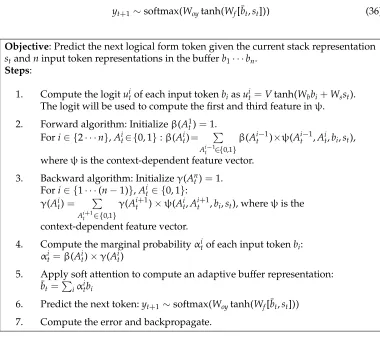
Objective: Predict the next logical form token given the current stack representation standninput token representations in the bufferb1· · ·bn.
Steps:
1. Compute the logituitof each input tokenbiasuit=Vtanh(Wbbi+Wsst). The logit will be used to compute the first and third feature inψ.
2. Forward algorithm: Initializeβ(A1t)=1. Fori∈ {2· · ·n},Ait∈ {0, 1}:β(Ait)=
P
Ait−1∈{0,1}
β(Ait−1)×ψ(Ati−1,Ait,bi,st),
whereψis the context-dependent feature vector.
3. Backward algorithm: Initializeγ(Ant)=1. Fori∈ {1· · ·(n−1)},Ait∈ {0, 1}:
γ(Ai t)=
P
Ait+1∈{0,1}
γ(Ait+1)×ψ(Ai
t,Ait+1,bi,st), whereψis the
context-dependent feature vector.
4. Compute the marginal probabilityαitof each input tokenbi:
αit=β(Ati)×γ(Ait)
5. Apply soft attention to compute an adaptive buffer representation: ¯
bt=Piαitbi
[image:17.486.54.434.301.640.2]6. Predict the next token:yt+1 ∼softmax(Woytanh(Wf[¯bt,st])) 7. Compute the error and backpropagate.
Figure 3
The structured attention layer is soft and fully differentiable and allows us to model attention over phrases because the forward–backward algorithm implicitly sums over an exponentially sized set of substructures through dynamic programming.
Hard Attention. Soft attention learns a complete mapping between natural language and logical tokens with a differentiable neural layer. At every time step, every natural language token in the utterance is assigned the probability of triggering every logical predicate. This offers little in the way of interpretability. In order to render the inner workings of the model more transparent, we explore the use of a hard attention mecha-nism as a means of rationalizing neural predictions.
At each time step, hard attention samples from the attention probability a single natural language tokenxt:
uit=Vtanh(Wbbi+Wsst) (37)
xt∼softmax(uit) (38)
The representation ofxtdenoted bybtis then used to predict the logical tokenyt:
yt+1∼softmax(Woytanh(Wf[bt,st])) (39)
Hard attention is nevertheless optimization-wise challenging; it requires sampling symbols (i.e., non-differentiable representations) inside an end-to-end module that may incur high variance. In practice, we adopt a baseline method to reduce the variance of the predictor, which we discuss in Section 3.8.1.
Binomial Hard Attention. Learning difficulties aside, a limitation of hard attention lies in selecting a single token to attend to at each time step. In practice, a logical form predicate is often triggered by a natural language phrase or a multi-word expression. A way to overcome this limitation is to compute a binomial distribution for every token separately, indicating the probability of the token being selected. Then an attention label is assigned to each token based on this probability (e.g., with threshold 0.5). Let Ait∈ {0, 1}denote the attention label of theith token at time stept. Using the unnormalized attention scoreuitcomputed in Equation (26), we obtain the probabilityp(Ait=1) as
p(Ait=1)=logistic(uit) (40)
where logistic denotes a logistic regression classifier. We compute adaptive buffer rep-resentation as an average of the selected token embeddings:
¯ bt= P1
iAit X
i
Aitbi (41)
which is then used to compute a distribution of the output logical form tokens:
3.8 Model Training
We now discuss how our neural semantic parser can be trained under different con-ditions, that is, with access to utterances annotated with logical forms, when only denotations are provided, and finally, when neither logical forms nor denotations are available (see Table 5).
3.8.1 Learning from Utterance-Logical Form Pairs.The most straightforward training set-up is fully sset-upervised making use of utterance-logical form pairs. Consider utterancex with logical formlwhose structure is determined by a sequence of transition opera-tionsaand a sequence of logical form tokensy. Our ultimate goal is to maximize the conditional likelihood of the logical form given the utterance for all training data:
L= X
(x,l)∈T
logp(l|x) (43)
which can be decomposed into the action likelihood and the token likelihood:
logp(l|x)=logp(a|x)+logp(y|x,a) (44)
Soft Attention.Our objective consists of two terms, one for the action sequence,
La= X
(x,l)∈T
logp(a|x)= X
(x,l)∈T n X
t=1
logp(at|x) (45)
and one for the logical form token sequence,
Ly= X
(x,l)∈T
logp(y|x,a)= X
(x,l)∈T n X
t=1
logp(yt|x,at) (46)
These constitute the training objective for fully differentiable neural semantic parsers, when (basic or structured) soft attention is used.
Table 5
Example data for various semantic parsing training regimes.
Full supervision: utterance-logical form pairs
utterance:which daughter of Barack Obama was named Most Influential Teens in the year 2014? logical form:and(daughterOf(Barack Obama), InfluentialTeensByYear(2014))
Weak supervision:utterance-denotation pairs
utterance:which daughter of Barack Obama was named Most Influential Teens in the year 2014? denotation:Malia Obama
Distant supervision:entity-masked utterances
Hard Attention. When hard attention is used for token prediction, the objective La remains the same butLydiffers. This is because the attention layer is non-differentiable for errors to backpropagate through. We use the alternative REINFORCE-style algo-rithm (Williams 1992) for backpropagation. In this scenario, the neural attention layer is used as a policy predictor to emit an attention choice, while subsequent neural layers are used as the value function to compute a reward—a lower bound of the log likelihood logp(y|x,a). Let ut denote the latent attention choice2 at each time step t; we maximize the expected log likelihood of the logical form token given the overall attention choice for all examples, which by Jensen’s Inequality is the lower bound on the log likelihood logp(y|x,a):
Ly= X
(x,l)∈T X
u
p(u|x,a) logp(y|u,x,a)
≤ X
(x,l)∈T logX
u
p(u|x,a)p(y|u,x,a)
= X
(x,l)∈T
logp(y|x,a)
(47)
The gradient ofLywith respect to model parametersθis given by
∂Ly ∂θ =
X
(x,l)∈T X
u
p(u|x,a)∂logp∂θ(y|u,x,a) +logp(y|u,x,a)∂p(u∂θ|x,a)
= X
(x,l)∈T X
u
p(u|x,a)∂logp∂θ(y|u,x,a) +logp(y|u,x,a)∂log∂θp(u|x,a)p(u|x,a)
= X
(x,l)∈T X
u
p(u|x,a) ∂
logp(y|u,x,a)
∂θ +logp(y|u,x,a)
∂logp(u|x,a) ∂θ
≈ X
(x,l)∈T 1 N
K X
k=1 ∂
logp(y|uk,x,a)
∂θ +logp(y|u
k,x,a)∂logp(uk|x,a)
∂θ
(48)
which is estimated by the Monte Carlo estimator withK samples. This gradient esti-mator incurs high variance because the reward term logp(y|uk,x,a) is dependent on the samples ofuk. An input-dependentbaselineis used to reduce the variance, which adjusts the gradient update as
∂Ly ∂θ =
X
(x,l)∈T 1 N
K X
k=1 ∂
logp(y|uk,x,a)
∂θ +(logp(y|u
k,x,a)−b)∂logp(uk|x,a)
∂θ
(49)
As baseline, we use the soft attention token predictor described earlier. The effect is to encourage attention samples that return a higher reward than standard soft
attention, while discouraging those resulting in a lower reward. For each training case, we approximate the expected gradient with a single sample ofuk.
3.8.2 Learning from Utterance-Denotation Pairs.Unfortunately, training data consisting of utterances and their corresponding logical forms are difficult to obtain at large scale, and as a result limited to a few domains with a small number of logical predicates. An alternative to full supervision is a weakly supervised setting where the semantic parser is trained on utterance-denotation pairs, where logical forms are treated as latent.
In the following we first provide a brief review of conventional weakly supervised semantic parsing systems (Berant et al. 2013a), and then explain the extension of our neural semantic parser to a similar setting. Conventional weakly supervised semantic parsing systems separate the parser from the learner (Liang 2016). A chart-based (non-parametrized) parser will recursively build derivations for each span of an utterance, eventually obtaining a list of candidate derivations mapping the utterance to its logical form. The learner (which is often a log-linear model) defines features useful for scoring and ranking the set of candidate derivations, and is trained based on the correctness of their denotations. As mentioned in Liang (2016), the chart-based parser brings a disadvantage since the system does not support incremental contextual interpretation, because features of a span can only depend on the sub-derivations in that span, as a requirement of dynamic programming.
Different from chart-based parsers, a neural semantic parser is itself a parametrized model and is able to leverage global utterance features (via attention) for decoding. However, training the neural parser directly with utterance-denotation pairs is chal-lenging because the decoder does not have access to gold standard logical forms for backpropagation. Moreover, the neural decoder is a conditional generative model that generates logical forms in a greedy fashion and therefore lacks the ability to make global judgments of logical forms. To this end, we follow the conventional set-up in integrating our neural semantic parser with a log-linear ranker, to cope with the weak supervision signal. The role of the neural parser is to generate a list of candidate logical forms, while the ranker is able to leverage global features of utterance-logical form-denotation triplets to select which candidate to use for execution.
The objective of the log-linear ranker is to maximize the log marginal likelihood of the denotationdvia latent logical formsl:
logp(d|x)=logX l∈L
p(l|x)p(d|x,l) (50)
where L denotes the set of candidate logical forms generated by the neural parser. Note thatp(d|x,l) equals 1 if the logical form executes to the correct denotation and 0 otherwise. For this reason, we can also write this equation as logP
l∈L(c)p(l|x), where L(c) is the set ofconsistentlogical forms that execute to the correct denotation.
Specificallyp(l|x) is computed with a log-linear model:
p(l|x)= P exp(φ(x,l)θ)
l0∈Lexp(φ(x,l0)θ) (51)
Training such a system involves the following steps. Given an input utterance, the neural parser first generates a list of candidate logical forms via beam search. Then these candidate logical forms are executed and those that yield the correct denotation are marked asconsistentlogical forms. The neural parser is then trained to maximize the likelihood of these consistent logical formsP
l∈Lclogp(l|x). Meanwhile, the ranker is trained to maximize the marginal likelihood of denotations logp(d|x).
Clearly, if the parser does not generate any consistent logical forms, no model parameters will be updated. A challenge in this training paradigm is the fact that we rely exclusively on beam search to find good logical forms from an exponential search space. In the beginning of training, neural parameters are far from optimal, and as a result good logical forms are likely to fall outside the beam. We alleviate this problem by performing entity linking, which greatly reduces the search space. We determine the identity of the entities mentioned in the utterance according to the knowledge base and restrict the neural parser to generating logical forms containing only those entities.
3.8.3 Distant Supervision. Despite allowing to scale semantic parsing to large open-domain problems (Kwiatkowski et al. 2013; Berant et al. 2013a; Yao and Van Durme 2014), the creation of utterance-denotation pairs still relies on labor-intensive crowd-sourcing. A promising research direction is to use a sort of distant supervision, where training data (e.g., artificial utterance-denotations pairs) are artificially generated with given resources (e.g., a knowledge base, Wikipedia documents). In this work, we ad-ditionally train the weakly supervised neural semantic parser with a distant supervi-sion approach proposed by Reddy, Lapata, and Steedman (2014). In this setting, the given data is a corpus of entity-recognized sentences and a knowledge base. Utterance-denotation pairs are artificially created by replacing entity mentions in the sentences with variables. Then, the semantic parser is trained to predict the denotation for the variable that includes the mentioned entity. For example, given the declarative sen-tenceNVIDIA was founded by Jen-Hsun Huang and Chris Malachowsky, the distant supervision approach creates the utteranceNVIDIA was founded by Jen-Hsun Huang
and blank paired with the corresponding denotation Chris Malachowsky. In some
cases, even stronger constraints can be applied. For example, if the mention is preceded by the wordthe, then the correct denotation includes exactly one entity. In sum, the approach converts the corpus of entity-recognized sentences into artificial utterance-denotation pairs on which the weakly supervised model described in Section 3.8.2 can be trained. We also aim to evaluate whether this approach is helpful for practical question answering.
4. Experiments
In this section, we present our experimental set-up for assessing the performance of the neural semantic parsing framework. We present the data sets on which our model was trained and tested, discuss implementation details, and finally report and analyze semantic parsing results.
4.1 Data Sets
We evaluated our model on the following data sets, which cover different domains and require different types of supervision.
vocabulary size small (698 entities and 24 relations). Model training on this data set is fully supervised (Section 3.8.1)
WEBQUESTIONS (Berant et al. 2013b) contains 5,810 question-answer pairs. It is based on Freebase and the questions are not very compositional. However, they are real questions asked by people on the Web.
GRAPHQUESTIONS(Su et al. 2016) contains 5,166 question-answer pairs that were created by showing 500 Freebase graph queries to Amazon Mechanical Turk work-ers and asking them to paraphrase them into natural language. Model training on WEBQUESTIONSand GRAPHQUESTIONSis weakly supervised (Section 3.8.2).
SPADES (Bisk et al. 2016) contains 93,319 questions derived from CLUEWEB09 (Gabrilovich, Ringgaard, and Subramanya 2013) sentences. Specifically, the questions were created by randomly removing an entity, thus producing sentence-denotation pairs (Reddy, Lapata, and Steedman 2014). The sentences include two or more entities and although they are not very compositional, they constitute a large-scale data set for neural network training with distant supervision (Section 3.8.3).
4.2 Implementation Details
Shared Parameters.Across training regimes, the dimensions of word vector, logical form token vector, and LSTM hidden state are 50, 50, and 150, respectively. Word embeddings were initialized with GloVe embeddings (Pennington, Socher, and Manning 2014). All other embeddings were randomly initialized. We used one LSTM layer in forward and backward directions. Dropout was used on the combined feature representation of the buffer and the stack (Equation (25)), which computes the softmax activation of the next action or token. The dropout rate was set to 0.5. Finally, momentum SGD (Sutskever et al. 2013) was used as the optimization method to update the parameters of the model.
Entity Resolution.Among the four data sets, only GEOQUERYcontains annotated logical forms that can be used to directly train a neural semantic parser. For the other three data sets, supervision is indirect via consistent logical forms validated on denotations (see Section 3.8.2). As mentioned earlier, we use entity linking to reduce the search space for consistent logical forms. Entity mentions in SPADESare automatically annotated with Freebase entities (Gabrilovich, Ringgaard, and Subramanya 2013). For WEBQUESTIONS and GRAPHQUESTIONS we perform entity linking following the procedure described in Reddy et al. (2016). We identify potential entity spans using seven handcrafted part-of-speech patterns and associate them with Freebase entities obtained from the Freebase/KG API (http://developers.google.com/freebase/). For each candidate entity span, we retrieve the top 10 entities according to the API. We treat each possibility as a candidate entity to construct candidate utterances with beam search of size 500, among which we look for the consistent logical forms.
between the question words and the logical form, the similarity between the question words (e.g., what, who, where, whose, date, which, how many, count) and relations in the logical form, and the similarity between the question words and answer type as indicated by the last word in the Freebase relation (Xu et al. 2016). Finally, we add as a feature the length of the denotation given by the logical form (Berant et al. 2013a).
4.3 Results
In this section, we present the experimental results of our Transition-based Neural Semantic Parser (TNSP). We present various instantiations of our own model as well as comparisons against semantic parsers proposed in the literature.
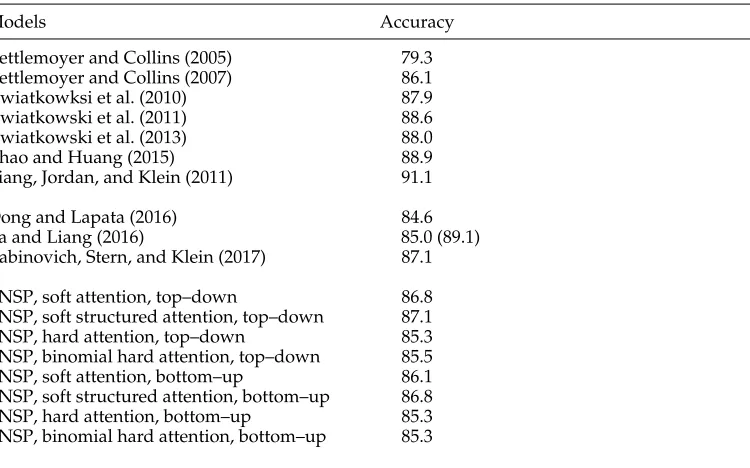
[image:24.486.56.431.433.667.2]Experimental results on GEOQUERY are shown in Table 6. The first block con-tains conventional statistical semantic parsers, previously proposed neural models are presented in the second block, and variants of TNSP are shown in the third block. Specifically, we build various top–down and bottom–up TNSP models using the various types of attention introduced in Section 3.7. We report accuracy, which is defined as the proportion of utterances that correctly parsed to their gold standard logical forms. Among TNSP models, a top–down system with structured (soft) attention performs best. Overall, we observe that differences between top–down and bottom–up systems are small; it is mostly the attention mechanism that affects performance, with hard attention performing worst and soft attention performing best for both top–down and bottom–up systems. TNSP outperforms previously proposed neural semantic parsers that treat semantic parsing as a sequence transduction problem and use LSTMs to map utterances to logical forms (Dong and Lapata 2016; Jia and Liang 2016). TNSP brings
Table 6
Fully supervised experimental results on the GEOQUERYdata set. For Jia and Liang (2016), we include two of their results: one is a standard neural sequence to sequence model; and the other is the same model trained with a data augmentation algorithm on the labeled data (reported in parentheses).
Models Accuracy
Zettlemoyer and Collins (2005) 79.3
Zettlemoyer and Collins (2007) 86.1
Kwiatkowksi et al. (2010) 87.9
Kwiatkowski et al. (2011) 88.6
Kwiatkowski et al. (2013) 88.0
Zhao and Huang (2015) 88.9
Liang, Jordan, and Klein (2011) 91.1
Dong and Lapata (2016) 84.6
Jia and Liang (2016) 85.0 (89.1)
Rabinovich, Stern, and Klein (2017) 87.1
TNSP, soft attention, top–down 86.8
TNSP, soft structured attention, top–down 87.1
TNSP, hard attention, top–down 85.3
TNSP, binomial hard attention, top–down 85.5
TNSP, soft attention, bottom–up 86.1
TNSP, soft structured attention, bottom–up 86.8
TNSP, hard attention, bottom–up 85.3
performance improvements over these systems when using comparable data sources for training. Jia and Liang (2016) achieve better results with synthetic data that expand GEOQUERY; we could adopt their approach to improve model performance, however, we leave this to future work. Our system is on par with the model of Rabinovich, Stern, and Klein (2017), who also output well-formed trees in a top–down manner using a decoder built of many submodels, each associated with a specific construct in the underlying grammar.
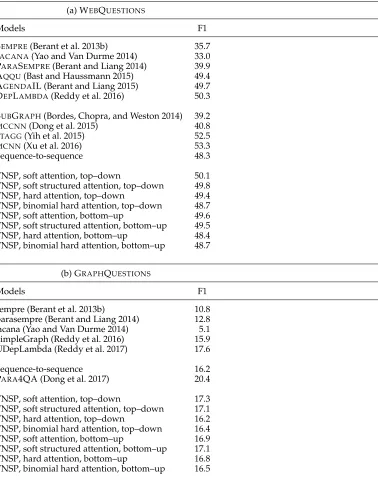
Results for the weakly supervised training scenario are shown in Table 7. For all Freebase-related data sets we use average F1 (Berant et al. 2013a) as our evalua-tion metric. We report results on WEBQUESTIONS (Table 7a) and GRAPHQUESTIONS (Table 7b). The first block in the tables groups conventional statistical semantic parsers, the second block presents related neural models, and the third block variants of TNSP. For fair comparison, we also built a baseline sequence-to-sequence model enhanced with an attention mechanism (Dong and Lapata 2016).
On WEBQUESTIONS, the best performing TNSP system generates logical forms based on top–down pre-order while using soft attention. The same top–down system with structured attention performs closely. Again we observe that bottom–up preorder lags behind. In general, our semantic parser obtains performance on par with the best symbolic systems (see the first block in Table 7a). It is important to note that Bast and Haussmann (2015) develop a question-answering system, which, contrary to ours, cannot produce meaning representations, whereas Berant and Liang (2015) propose a sophisticated agenda-based parser that is trained borrowing ideas from imitation learning. Reddy et al. (2016) learn a semantic parser via intermediate representations that they generate based on the output of a dependency parser. TNSP performs competi-tively despite not having access to linguistically informed syntactic structure. Regarding neural systems (see the second block in Table 7a), our model outperforms the sequence-to-sequence baseline and other related neural architectures using similar resources. Xu et al. (2016) represent the state of the art on WEBQUESTIONS. Their system uses Wikipedia to prune out erroneous candidate answers extracted from Freebase. Our model would also benefit from a similar post-processing.
With respect to GRAPHQUESTIONS, we report F1 for various TNSP models (third block in Table 7), and conventional statistical semantic parsers (first block in Table 7b). The first three systems are presented in Su et al. (2016). Again, we observe that a top– down variant of TNSP with soft attention performs best. It is superior to the sequence-to-sequence baseline and obtains performance comparable to Reddy et al. (2017) without making use of an external syntactic parser. The model of Dong et al. (2017) is state of the art on GRAPHQUESTIONS. Their method is trained end-to-end using question-answer pairs as a supervision signal together with question paraphrases as a means of capturing different ways of expressing the same content. Importantly, their system is optimized with question answering in mind, and does not produce logical forms.
Table 7
Weakly supervised experimental results on two data sets. Results with additional resources are shown in parentheses.
(a) WEBQUESTIONS
Models F1
SEMPRE(Berant et al. 2013b) 35.7 JACANA(Yao and Van Durme 2014) 33.0 PARASEMPRE(Berant and Liang 2014) 39.9
AQQU(Bast and Haussmann 2015) 49.4
AGENDAIL (Berant and Liang 2015) 49.7 DEPLAMBDA(Reddy et al. 2016) 50.3
SUBGRAPH(Bordes, Chopra, and Weston 2014) 39.2
MCCNN(Dong et al. 2015) 40.8
STAGG(Yih et al. 2015) 52.5
MCNN(Xu et al. 2016) 53.3
Sequence-to-sequence 48.3
TNSP, soft attention, top–down 50.1
TNSP, soft structured attention, top–down 49.8
TNSP, hard attention, top–down 49.4
TNSP, binomial hard attention, top–down 48.7
TNSP, soft attention, bottom–up 49.6
TNSP, soft structured attention, bottom–up 49.5
TNSP, hard attention, bottom–up 48.4
TNSP, binomial hard attention, bottom–up 48.7
(b) GRAPHQUESTIONS
Models F1
sempre (Berant et al. 2013b) 10.8
parasempre (Berant and Liang 2014) 12.8
jacana (Yao and Van Durme 2014) 5.1
SimpleGraph (Reddy et al. 2016) 15.9
UDepLambda (Reddy et al. 2017) 17.6
Sequence-to-sequence 16.2
PARA4QA (Dong et al. 2017) 20.4
TNSP, soft attention, top–down 17.3
TNSP, soft structured attention, top–down 17.1
TNSP, hard attention, top–down 16.2
TNSP, binomial hard attention, top–down 16.4
TNSP, soft attention, bottom–up 16.9
TNSP, soft structured attention, bottom–up 17.1
TNSP, hard attention, bottom–up 16.8
TNSP, binomial hard attention, bottom–up 16.5
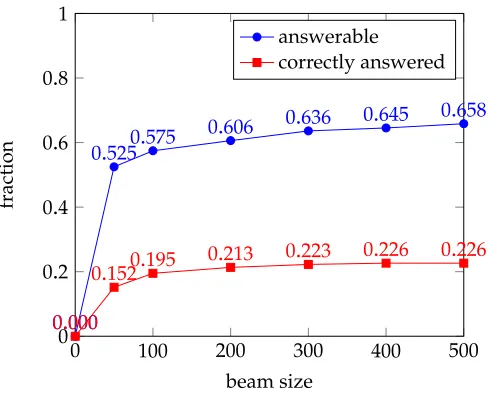
0 100 200 300 400 500 0
0.2 0.4 0.6 0.8 1
0.000
0.5250.575
0.606 0.636 0.645 0.658
0.000
0.1520.195 0
.213 0.223 0.226 0.226
beam size
fraction
[image:27.486.58.302.64.263.2]answerable correctly answered
Figure 4
Fraction of utterances that are answerable versus those correctly predicted with varying beam size on the GRAPHQUESTIONSdevelopment set.
execution: When the beam size is large, there is a higher chance for good logical forms to be included but also for the discriminative ranker to make mistakes.
GRAPHQUESTIONS consists of four types of questions. As shown in Table 8, the first type are relational questions (denoted byrelation). An example of a relational question iswhat periodic table block contains oxygen; the second type contains count questions (denoted by count). An example is how many firefighters does the new
york city fire department have; the third type includes aggregation questions requiring
argmax or argmin (denoted byaggregation). An example is what human stampede injured the most people; the last type are filter questions that require comparisons by>, ≥,<, and≤(denoted byfilter). An example iswhich presidents of the united states
weigh not less than 80.0 kg. Table 8 shows the number of questions broken down by
[image:27.486.51.440.583.661.2]type, as well as the proportion of answerable and correctly answered questions. As the results reveal,relationquestions are the simplest to answer, which is expected since relationquestions are non-compositional and their logical forms are easy to find by beam search. The remaining types of questions are rather difficult to answer: Although the system is able to discover logical forms that lead to the correct denotation during beam search, the ranker is not able to identify the right logical forms to execute. Aside
Table 8
Breakdown of questions answered by type for the GRAPHQUESTIONS.
Question type Number % Answerable % Correctly answered
relation 1,938 0.499 0.213
count 309 0.421 0.032
aggregation 226 0.363 0.075
filter 135 0.459 0.096
Table 9
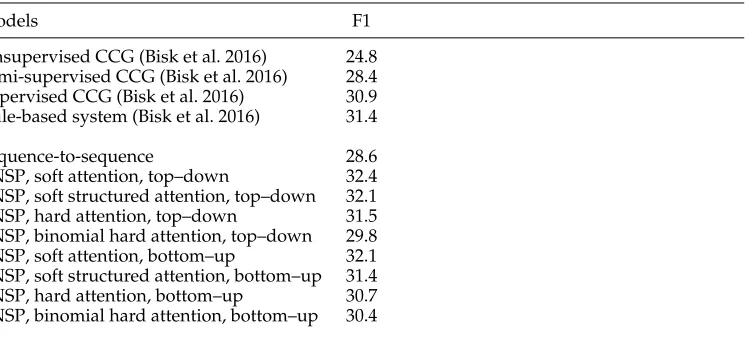
Distantly supervised experimental results on the SPADESdata set.
Models F1
Unsupervised CCG (Bisk et al. 2016) 24.8 Semi-supervised CCG (Bisk et al. 2016) 28.4 Supervised CCG (Bisk et al. 2016) 30.9 Rule-based system (Bisk et al. 2016) 31.4
Sequence-to-sequence 28.6
TNSP, soft attention, top–down 32.4
TNSP, soft structured attention, top–down 32.1
TNSP, hard attention, top–down 31.5
TNSP, binomial hard attention, top–down 29.8
TNSP, soft attention, bottom–up 32.1
TNSP, soft structured attention, bottom–up 31.4
TNSP, hard attention, bottom–up 30.7
TNSP, binomial hard attention, bottom–up 30.4
from the compositional nature of these questions, which makes them hard to answer, another difficulty is that such questions are a minority in the data set, posing a learning challenge for the ranker to identify them. As future work, we plan to train separate rankers for different question types.
Finally, Table 9 presents experimental results on SPADES, which serves as a testbed for our distant supervision setting. Previous work on this data set has used a semantic parsing framework where natural language is converted to an intermediate syntactic representation and then grounded to Freebase. Specifically, Bisk et al. (2016) evaluate the effectiveness of four different CCG parsers on the semantic parsing task when varying the amount of supervision required. As can be seen, TNSP outperforms all CCG vari-ants (from unsupervised to fully supervised) without having access to any manually annotated derivations or lexicons. Again, we observe that a top–down TNSP system with soft attention performs best and is superior to the sequence-to-sequence baseline.
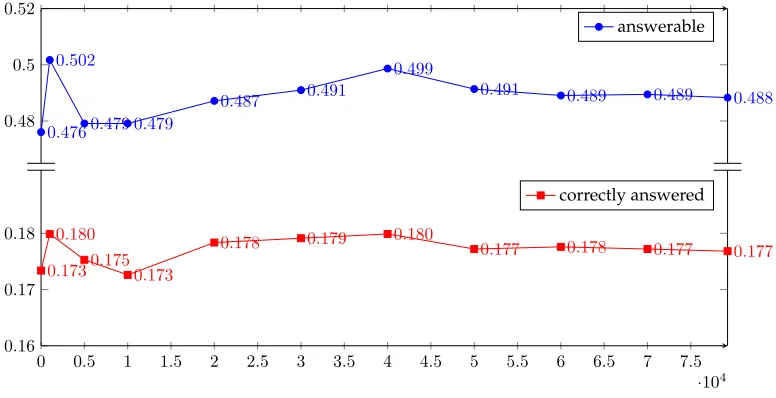
The results on SPADEShold promise for scaling semantic parsing by using distant supervision. In fact, artificial data could potentially help improve weakly supervised question-answering models trained on utterance-denotation pairs. To this end, we use the entity-masked declarative sentences paired with their denotations in SPADESas ad-ditional training data for GRAPHQUESTIONS. We train the neural semantic parser with the combined training data and evaluate on the GRAPHQUESTIONS. We use the top– down, soft-attention TNSP model with a beam search size of 300. During each epoch of training, the model was first trained with a mixture of the additional SPADESdata and the original training data. Figure 5 shows the fraction of answerable and correctly answered questions generated by the neural semantic parser on GRAPHQUESTIONS. Note that the original GRAPHQUESTIONStraining set consists of 1,794 examples and we report numbers when different amounts of SPADEStraining data is used.
Figure 5
Fraction of answerable and correctly answered questions in the GRAPHQUESTIONSwhen different amounts of the SPADESdata is used.
However, we observe that the maximum gain occurs when 1,000 extra training examples are used, a size comparable to the original training set. After that no further improvements are made when more training examples are used. We hypothesize that this is due to the disparities between utterance-denotation pairs created in distant supervision and utterance-denotation pairs gathered from real users. For example, given the declarative sentenceNVIDIA was founded by Jen-Hsun Huang and Chris
Malachowsky, the distant supervision approach creates the utterance NVIDIA was
founded by Jen-Hsun Huang and blank and the corresponding denotation Chris
Malachowsky. However, the actual question users may ask isWho founded NVIDIA
together with Jen-Hsun Huang. This poses a challenge if the neural network is trained
on one type of utterance and tested on another. We observe that the distribution mis-match outweighs the addition of artificial data quickly. Future work will focus on how to alleviate this problem by generating more realistic data with an advanced question generation module.
Another factor limiting performance is that SPADES mainly consists of relational questions without high-level predicates, such as count, filter, and aggregation, which are substantially harder to answer correctly (see Table 8).