Institute for Materials Research, Tohoku University, Sendai 980–8577, Japan 2NETZSCH Japan, Yokohama 221–0022, Japan
3Polytechnic University, Tokyo 187–0035, Japan
We report a novel process to produce metallic titanium from titanium dioxide̶the raw material typically used in the conventional produc-tion of titanium metal̶via a titanium nitride (TiN) intermediate. TiN is more easily reacted than titanium oxides such as titanium monoxide and titanium dioxide, and shows thermodynamic reactivity equivalent to titanium tetrachloride (TiCl4), which is used industrially as an
interme-diate in the conventional metallic titanium manufacturing process. The thermal decomposition temperature of TiN ( 3500 K), determined from a thermodynamic database, is also significantly lower than those of the oxides ( 5300 K) and TiCl4 ( 6200 K); thus, it is suitable for use in the
available temperature range of an electric arc furnace ( 4000 K). Here, we demonstrate the use of TiN as an intermediate for the manufacture of metallic titanium by thermolysis using the arc melting method. [doi:10.2320/matertrans.MK201601]
(Received July 12, 2016; Accepted September 14, 2016; Published October 21, 2016)
Keywords: thermolysis, titanium nitride, Gibbs free energy, nitrogen reaction, titanium
1. Introduction
Titanium and titanium alloys have been applied in the field of industrially manufactured articles, including medical im-plants and aircraft structures, and are used in the construction of marine equipment and power plants. The global market production and demand for titanium have been rapidly in-creasing on an annual basis1). The Kroll method2) is used
in-dustrially to produce high purity sponge titanium; however, it has a number of disadvantages in terms of industrial mass production when compared to other high performance pro-cesses, such as ironmaking. For example, in this process, raw TiO2 ore is converted to TiCl4 in the presence of coke and
chlorine gas. This necessitates the use of metallic magnesium to reduce the TiCl4 intermediate, which is electrochemically
recycled along with the chlorine from magnesium chloride (MgCl2) by electrolysis (and thus requires a large amount of
electricity). Then, a slow vacuum distillation process to re-move the Mg and MgCl2 residues resulted from the reduction
is necessary. Further, the reaction chamber requires prolonged cooling during the titanium reduction process due to the exo-thermic nature of the reaction. In the typical titanium melting, the electrodes to be melted in an arc melting furnace is usual-ly shaped using the sponge titanium, and require a special size and form suitable for melting operation; this form control process prior to melting necessitates difficult technologies.
Chen et al.3) recently reported a novel process for titanium
production based on an electrochemical reaction in molten calcium chloride, resulting in the formation of small metallic titanium particles. Suzuki et al.4,5) reported a similar
electro-chemical reduction process in a molten salt medium, and carefully investigated the thermodynamic relationships un-derlying the reduction process. In addition, other groups6,7)
have developed novel production processes based on the magnesiothermic and calciothermic reductions of TiCl4 and
titanium concentrates using the salts MgCl2 and CaCl2,
re-spectively. Because these reduction processes appear to pro-duce metallic titanium particles, they are not fully or immedi-ately suitable for replacing the conventional industrial pro-cess. Moreover, the chloride employed in these processes re-sults in cracking of the titanium metal8) depending on
in-creasing of its concentration causing by an unsatisfied distil-lation process and an usage environment, and decreases a glass-forming ability of metallic glasses widely amorphous materials9). Consequently, chloride is not suitable for use in
the manufacture process of metallic material including titani-um, especially titanium based-metallic glasses, and by exten-sion, its use in titanium production should also be avoided, if it is possible.
Here we show an experimental investigation of a novel process to produce titanium from titanium dioxide. This method is based on the thermodynamics and avoids the use of chloride, and the electricity-consuming electrochemical pro-cess for the recycling of propro-cess byproducts is unnepro-cessary. It is our anticipation that this processing technique, based on the chemical conversion of TiO2 to TiN and subsequent
ther-mal decomposition of TiN, will be cost-effective and environ-mentally friendly.
2. Theoretical Background
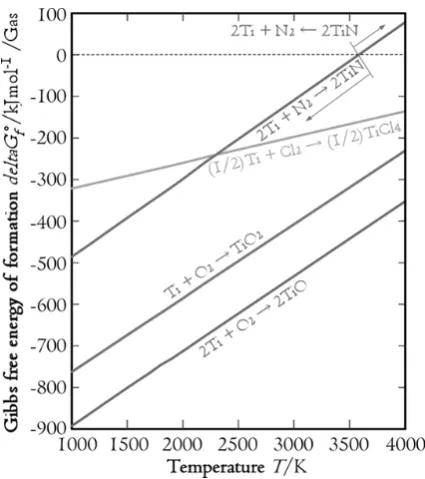
The titanium ore consists mostly of ilmenite, an oxide of iron and titanium, and is usually upgraded to highly purified titanium oxide. The bonding strength of titanium to oxygen and other elements can be commonly compared based on the differences in their Gibbs free energies of formation as a function of temperature. Gibbs free energy changes can gen-erally be found in the thermodynamic data10), and are
depict-ed in Fig. 1 for the systems employdepict-ed herein. Ilmenite (FeO·
TiO2) is a main component of titanium ore, and is commonly
employed in the production of metallic titanium, along with TiCl4. As proposed herein, titanium nitride (TiN) can be also
used as an intermediate in this process; this material is also compared in thermodynamic terms with other intermetallic *
compounds in Fig. 1. TiO and TiO2 are typically highly
sta-ble, as demonstrated by their large negative Gibbs free ener-gies of formation. TiCl4, however, has a less negative Gibbs
free energy of formation, and so it should be more easily re-duced to metallic titanium than either TiO or TiO2. Similarly,
the free energy of formation of TiN is comparable to that of TiCl4, and so a similar reducibility would be expected. In
ad-dition, the sign of the Gibbs free energy of formation of TiN changes at 3500 K, indicating its instability at higher tem-peratures, at which it is thermolytically separated into metal-lic titanium and nitrogen gas. Thus, when TiN is employed as the intermediate material for the production of titanium, me-tallic titanium can be produced thermodynamically by heat-ing TiN to its decomposition temperature without require-ment for a reductant such as metallic magnesium, which is employed in the conventional process. Moreover, because the thermal decomposition does not depend on a rate-determin-ing surface reaction usrate-determin-ing a reductant, such as the reduction of TiCl4 by Mg, the a high reduction rate would also be
ex-pected.
Figure 2 compares the stabilities of TiO (as a highly stable titanium oxide) and TiN based on their Gibbs free energies of formation in both direct and indirect reactions (i.e., indirect reaction means combustion with carbon). Although the major intermetallic component of the initial ore is TiO2, the degree
of oxidation of the titanium changes in turn to Ti4O7, Ti3O5
and TiO as the reduction proceeds. Among these species, TiO is the most stable oxide based on its Gibbs free energy of formation value, and therefore, for comparison purposes, TiO is conveniently considered as a model in Fig. 2. For the direct reaction, TiO is stable between 1000 and 2200 K. For the indirect reaction, the Gibbs free energy of formation varies between positive and negative values depending on the tem-perature, with TiN becoming stable >1000 K. This indirect reaction was studied by White et al.11), who experimentally
confirmed the formation of TiN at 1423 K. Furthermore, the
directions of both reactions are thermodynamically deter-mined by the N2 partial pressure, and are dependent on the
equilibrium constants of the reactions10). For example, upon
heating the direct reaction to 1800 K, the partial pressure of N2 is 1 atm and that of O2 is 2.6 × 10⁻¹² atm; thus, TiN
sta-bilization by control of the atmosphere alone is difficult. In contrast, for the indirect reaction at 1800 K, as the partial pressures of N2 and CO are 0.9998 atm and 1.8 × 10⁻⁴ atm,
respectively, the stabilization of TiN is easily achieved using commercial grade nitrogen gas.
3. Experimental Details
TiO2 powder (reagent grade, Wako Pure Chemical
Indus-tries, Ltd.) was lightly inserted into a carbon crucible and heated to 1910 K in a vertical electric furnace with an alumi-na tube at a rate of 300 Kh−1 (0.08 Ks−1). The final
tempera-ture was maintained for 1 h (3.6 ks) under a flow of nitrogen gas. The crucible was rapidly cooled to 300 K (room tem-perature), and the product formed in the carbon crucible was analyzed by X-ray diffraction.
Next, we carried out the conversion of TiN to metallic Ti by arc melting. Although the TiN powder produced in the above process was suitable for the following stages, the production of large quantities of TiN on laboratory scale was problemat-ic. This was mainly due to the size limitations of the furnace and carbon crucible on laboratory scale, such that preparation of sufficient TiN quantities to use in the next step was diffi-cult. Thus, we employed commercial TiN powder in the pres-ent study. The TiN powder (reagpres-ent grade, Kojundo Chemical Laboratory Co., Ltd.) was subjected to arc melting after its insertion into a die with an inner diameter of 20 mm and com-pression using an oil-hydraulic cylinder. The compressed TiN powder was heated to 3000–4000 K using a common arc melting furnace (DIAVAC Ltd.) under an Ar atmosphere. The
Fig. 1 Variation in the Gibbs free energies of formation of the
titani-um-based intermetallic compounds TiO, TiO2, TiCl4, and TiN. Fig. 2 Variation in the Gibbs free energies of formation of TiN from TiO by both direct and indirect reactions (where the latter also involves the
[image:2.595.62.275.67.307.2] [image:2.595.318.532.67.312.2]As shown in Fig. 3, a yellow product was formed from the white TiO2 inside the carbon crucible. This may suggest the
formation of the yellow TiN.. The X-ray diffraction analysis of the product showed a pattern that was well matched both to the typical pattern for TiN (PDF #11-038-1420, International Centre for Diffraction Data), as shown in Fig. 4, and to that of the TiN powder employed in subsequent experiments.
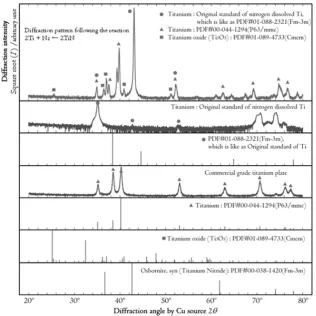
Figures 5 (a)–(d) outline the TiN decomposition process. Figure 5(a) shows the initial state of the compressed TiN powder. Figure 5(b) shows a partially reduced product exhib-iting a lustrous, crystalline, gold-colored surface, which is comparable in appearance to a typical TiN thin film. As the decomposition process progresses, a fully lustrous surface is formed, as shown in Figs. 5 (c), (d). The diffraction pattern of
or by altering the melting method. In addition to these two phases, signals corresponding to a third phase were also ob-served (circles). The diffraction pattern for this phase cor-relates with that of nitrogen-dissolved titanium, which was experimentally manufactured as a standard under dilute nitro-gen gas atmosphere. The nitronitro-gen concentration of this stan-dard is >1 mass%, which is the analytical upper limit of the infrared absorption method. The nitrogen-dissolved titanium and the standard are determined crystallographically to be ei-ther metallic titanium or titanium nitride, which have the Fm-3m crystallographic phase group based on the cubic structure. From the previously reported phase diagram of the titani-um nitride system12), metallic titanium exhibiting a cubic
structure can dissolve nitrogen up to 10 at% (3 mass%) at 2320 K. Consequently, the saturated concentration of nitro-gen is larger than the analytical concentration of the standard. Thus, if the third diffraction pattern in Fig. 5 (d) can be inter-preted as a quenching structure containing significant quanti-ties of nitrogen, the nitrogen concentration of the produced titanium would be expected to be <3 mass%. In addition, TiN is a non-stoichiometric compound with a nitrogen content ranging from 30–50 at% (11–23 mass%) over a wide tem-perature range (1380–2620 K). For the diffraction pattern containing both TiN and the (alpha-phase-stabilized) hexago-nal multiphase metallic titanium, titanium with nitrogen dis-solved at 20–30 at %(7–11 mass%) could be observed in the phase diagram of the titanium nitride system over a wide tem-perature range. Despite the fact that the issue of the nitrogen concentration remains to be unsolved, these results experi-mentally confirm that the conventional metallic titanium manufacturing process can be replaced by two simple steps,
namely synthesis of TiN from TiO2 and thermal
decomposi-tion of TiN.
Fig. 3 Photograph of the yellow product formed by the indirect reaction of TiO2, N2, and C to give TiN.
Fig. 4 X-ray diffraction pattern of the product shown in Fig. 3, formed from the reaction of TiO2 (as initial maternal, TiO2 is reacted via TiO to TiN as the
[image:3.595.63.276.374.547.2] [image:3.595.133.461.597.762.2]5. Discussion
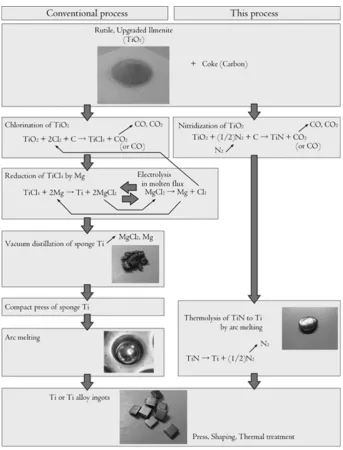
Figure 7 shows a flowchart illustrating the conventional and proposed processes for the manufacture of metallic titani-um. As previously mentioned, the conventional process be-gins with TiO2, and produces sponge-like metallic titanium
via the TiCl4 intermediate. Subsequently, the titanium sponge
is subjected to a range of treatments: (1) the removal of mag-nesium and MgCl2 by distillation, (2) mechanical
compres-sion, and (3) arc melting. In addition, as both the magnesium and chlorine gas employed in the conventional process are electrochemically recycled, large amounts of electricity are required for this process, thus increasing the titanium fabrica-tion costs.
As in the conventional process, TiO2 is used as the starting
material in our new approach; however, in this case, metallic titanium is produced by the thermolysis of TiN using the arc melting process. TiN can be easily produced by the indirect reaction between carbon, nitrogen, and TiO2 in a process
sim-ilar to that used for the production of TiCl4. Our novel route
therefore allows to eliminate a number of high cost steps/processes to be eliminated, including the reduction of TiCl4 using metallic magnesium, the electrochemical
reduc-tion of MgCl2 to regenerate metallic magnesium, the vacuum
distillation process, and the compaction of the titanium sponge.
Based on the diffraction patterns examined, the concentra-tion of dissolved nitrogen in the produced titanium is expect-ed to be 3 or 11 mass% as upper limits of nitrogen in these cases. The dissolved nitrogen concentration can be
deter-Fig. 6 X-ray diffraction patterns of the product shown in panel (d) of deter-Fig. 5, and matched diffraction patterns of a metallic titanium (hexagonal structure, triangles) as the major product, high-nitrogen-dissolved metallic titanium (circle) prepared as an original standard which was annealed under nitrogen gas atmosphere and referred standard materials.
[image:4.595.126.470.72.166.2] [image:4.595.140.457.223.540.2]mined theoretically as expressed below:
1/2N2(gas in atmosphere)=Nin metal
Here, the dissolved nitrogen present in the metallic titanium is dependent only on the partial pressure of the atmospheric nitrogen (N2) as a function of temperature, and so the
follow-ing relationship based on the equilibrium constant K can be expressed:
K=aN/(pN2)1/2=aN2∗/(pN2∗)1/2
Where aN2 is the activity of the dissolved nitrogen (i.e., a
function of concentration) and pN2 is the partial pressure of
nitrogen in the atmosphere. As the atmosphere employed in the arc melting furnace on a laboratory scale cannot be re-placed continuously, the partial pressure of nitrogen increases as the thermal decomposition proceeds, and would be expect-ed to reach 1.0 atm. From the previously reportexpect-ed
thermo-dynamic estimation10), decomposition of TiN takes place
even under a nitrogen partial pressure of 1.0 atm at 3500 K,
which is achieved by heating in the arc melting furnace. Here we assume an ideal solution so that the activity coefficient γ
is unity. As the dissolved nitrogen concentration and the ni-trogen partial pressure are expected to be 10 mass% and 1.0 atm, respectively, the equilibrium constant of the dis-solved reaction can be predicted. Based on the thermodynam-ic relationship, if the partial pressure of nitrogen is 10−5 to
10−6 atm, comparable to that in commercial grade Ar gas, the
dissolved nitrogen concentration would be 0.023 mass% (230 ppm). This indicates that the dissolved nitrogen concen-tration depends on the quality of atmosphere employed, which in turn can be improved by the suitable control of its purity.
Through the experiments conducted for preparation of tita-nium via thermal decomposition of TiN using a laborato-ry-scale arc melting furnace, it was anticipated such that a commercial scale arc melting furnace would be advantageous to the reduction in heat losses because of heating a local spot on the liquid metal surface. The alternative way of reducing
[image:5.595.126.470.65.516.2]nitrogen concentration in the produced titanium is to use a highly purified inert gas to lower the nitrogen partial pressure. The electron beam melting furnace is also able to provide temperature higher than 4000 K and high vacuum to meet the operational conditions for thermal decomposition of TiN, thus may be of practical use, but only if a drastic hardware reconstruction is possible to withdraw considerably large and sound ingots.
6. Conclusions
We experimentally investigated a process for the reduction of titanium dioxide (TiO2) to metallic titanium based on
ther-modynamics. Titanium nitride (TiN) was employed as a suit-able intermediate for this process, as opposed to the titanium tetrachloride (TiCl4) used in the conventional process.
Com-parison of the Gibbs free energies of formation of the two intermediates showed that TiN was easily decomposed at around 3000 K, compared to the decomposition temperature of 6200 K for TiCl4. TiN was easily synthesized in a carbon
crucible under a nitrogen atmosphere at a reasonable tem-perature above 1000 K (carbothermal synthesis), which can be easily achieved in a conventional electric resistance fur-nace. The subsequent decomposition of TiN at 3500 K using an electric arc furnace produced metallic titanium that exhib-ited a lustrous surface. X-ray diffraction studies confirmed the successful synthesis of metallic titanium, as the obtained diffraction pattern was comparable to that of commercial grade material.
If a process can create increasing production quantity, then the possible range of titanium applications should be expand-ed with the reliable and economic supply of this material, similarly to steel. Further work will be oriented to the influ-ence of dissolved nitrogen on the quality of the obtained
me-tallic titanium. The present approach is only preliminary in nature. It suffices to say at this time that from the results pre-sented there is positive evidence of extraction of ductile tita-nium via the proposed method. More extensive instrumenta-tion and many more experiments are necessary for complete clarification of the details on this approach.
Acknowledgements
This work was supported by the Japan Titanium Society (Titanium Research Aid Program of 2014) and the Ministry of Education, Culture, Sports, Science and Technology (MEXT) of Japan ( Research and Development Project on Advanced Materials Development and Integration of Novel Structured Metallic and Inorganic Materials (2010–2016) ).
REFERENCES
1) The Japan Titanium Society, Titanium World (2013) 29–32. 2) W. Kroll: Trans. Electrochem. Soc. 78 (1940) 35–47.
3) G.Z. Chen, D.J. Fray and T.W. Farthing: Nature 407 (2000) 361–364.
4) R.O. Suzuki, K. Teranuma and K. Ono: Metall. Mater. Trans. 34 (2003) 287–295.
5) R.O. Suzuki and S. Fukui: Mater. Trans. 45 (2004) 1665–1671.
6) O. Takeda and T.H. Okabe: Mater. Trans. 47 (2006) 1145–1154.
7) H. Zheng, H. Ito and T.H. Okabe: Mater. Trans. 48 (2007) 2244–2251.
8) T. Haruna, M. Yamamoto and T. Shibata: J. Jpn. Inst. Metals 63 (1999) 1327–1331.
9) Y. Yokoyama, A. Kobayashi, K. Fukaura and A. Inoue: Mater. Trans. 43 (2002) 571–574.
10) M.W. Chase Jr., C.A. Davies, J.R. Downey Jr., D.J. Frurip, R.A. Mc-Donald, A.N. Syverud: JANAF Thermochemical Tables, third ed., (American Institute of Physics Inc., New York, 1985) pp. 626, 628, 878, 1542, 1659, 1681.
11) G.V. White, K.J.D. Mackenzie and J.H. Johnston: J. Mater. Sci. 27 (1992) 4287–4293.