Local Structural Analysis on Decomposition Process of LiAl(ND
2)
4Kazutaka Ikeda
1,+1, Toshiya Otomo
1,2, Hidetoshi Ohshita
1,
Naokatsu Kaneko
1, Masami Tsubota
1,+2, Kentaro Suzuya
3,
Fumika Fujisaki
2,+3, Taisuke Ono
4,+4, Toshiyuki Yamanaka
4,+5,
Keiji Shimoda
5,+6, Takayuki Ichikawa
4,5and Yoshitsugu Kojima
4,51Institute of Materials Structure Science, KEK, Tsukuba 305-0801, Japan
2Department Materials Structure Science, The Graduate University for Advanced Studies, Hayama 240-0193, Japan 3J-PARC Center, Japan Atomic Energy Agency, Naka-gun, Ibaraki 319-1195, Japan
4Graduate School of Advanced Sciences of Matter, Hiroshima University, Higashi-Hiroshima 739-8530, Japan 5Institute for Advanced Materials Research, Hiroshima University, Higashi-Hiroshima 739-8530, Japan
Local structural changes that accompany amorphization during the decomposition of LiAl(ND2)4were investigated by neutron total
scattering measurements. Structure factors before the decomposition were attributed to single-phase LiAl(ND2)4characterized by isolated [ND2]
units. Atomic pair distribution functions after heat treatments at 433 and 673 K showed that LiAl(ND2)4decomposed to amorphous mixed
phases that contain Li3AlN2and AlN. [doi:10.2320/matertrans.MG201406]
(Received February 4, 2014; Accepted March 31, 2014; Published May 16, 2014)
Keywords: neutron total scattering, pair distribution function, hydrogen, amide
1. Introduction
Lithium aluminum amide LiAl(NH2)4 is of interest as a
possible hydrogen storage material because the composite material composed of LiAl(NH2)4and LiH releases hydrogen
gas by 6.1 mass%at temperatures below 400 K.1)A hydrogen
desorption mechanism of the composite has been proposed, but it is still controversial because the decomposition mechanism of LiAl(NH2)4 is not well-understood. The
crystal structure and the thermal decomposition properties of LiAl(NH2)4 have been investigated.24)An X-ray
diffrac-tion study indicated that LiAl(NH2)4 transforms into an
amorphous material upon NH3 desorption. Furthermore, on
the basis of the results of synchrotron X-ray total scattering,
in situ infrared spectroscopy, solid-state nuclear magnetic resonance spectroscopy, and thermogravimetry-mass spec-troscopy studies, the decomposition process of LiAl(NH2)4
was suggested as follows:5)
3LiAlðNH2Þ4!Li3Al3ðNH2Þ122lðNHÞlþlNH3 ð<433 KÞ
!Li3Al3ðNH2Þ4mðNHÞ4mNm
þ ð4þmÞNH3 ð>433 KÞ
! ð1nÞLi3AlN2þ2ð1nÞAlN
þLi3nAl3nN4nþ8NH3 ð>773 KÞ ð1Þ
However, the position of hydrogen before and after the decomposition of LiAl(NH2)4is not clear because hydrogen
atoms are difficult to detect with X-ray diffraction methods, hence, the decomposition process of LiAl(NH2)4 is still
controversial. Our goal in this study is to investigate the detailed structural properties of the decomposition products using neutron total scattering and atomic pair distribution function (PDF) analysis.6)
2. Experimental Procedure
The sample preparation of LiAl(NH2)4 is explained in a
previous publication.7) LiAl(ND
2)4 was similarly prepared
using LiD and ND3instead of LiH and NH3, respectively. For
the purpose of structural characterization of the decomposi-tion products, LiAl(ND2)4 samples heat-treated at 433 and
673 K were prepared using a heating rate of 5 K/min, which was then immediately cooled to room temperature under helium gas flow. LiAl(ND2)4 (60 mg) was examined before
and after the decomposition for an exposure time of 11 h by
ex situ neutron diffraction on the neutron total scattering spectrometer (NOVA) (beamline BL21, with a decoupled liquid hydrogen moderator, an incident flight path of 15 m, and a scatteredflight path of 1.71.9 m and 1.21.3 m at the 45° (4¯Q (=2³/d=4³sinª/)¯500 nm¹1) and 90°
(10¯Q¯820 nm¹1) detector banks, respectively)
con-nected to the 200 kW spallation neutron source at the Japan Proton Accelerator Research Complex (J-PARC). Scattering data were collected over a lattice spacing range of 0.008 1.6 nm for neutron diffractions at room temperature. The consistency of scattering data was confirmed via standard materials such as silicon (NIST SRM 640d) and mica (NIST SRM 675) powder. Averaged crystal structure refinements over a lattice spacing range of 0.050.63 nm for neutron diffraction at a 90° detector bank were performed by Rietveld refinement using the computer program Z-Rietveld,8,9) because the resolutions in a momentum space at the 90° detector bank (0.6(0.50.7)%) are better than that at the 45° detector bank (1.2(0.91.5)%). Local structure refinements over a real spacing range of 0.050.50 nm of atomic PDF,
G(r), for the neutron scattering profiles were performed by +1Corresponding author, E-mail: kikeda@post.j-parc.jp
+2Present address: Physonit Inc., Kaita, Hiroshima 736-0044, Japan +3Graduate Student, The Graduate University for Advanced Studies +4Present address: Sumitomo Chemical Co. Ltd., Niihama 792-0001, Japan +5Present address: Taiheiyo Materials Co. Ltd., Tokyo 135-0064, Japan +6Present address: Office of Society-Academia Collaboration for
Innova-tion, Kyoto University, Uji 611-0011, Japan
Special Issue on Advanced Materials for Hydrogen Energy Applications II
PDF analysis using the computer program PDFgui.10) To suppress the self-term scattering caused by neutron inelastic incoherent scattering of deuterium, the atomic pair distribution function,G(r), were obtained from the structure factor,S(Q), using the 45° detector bank angle of NOVA. Samples were handled in a glove boxfilled with purified argon or helium gas (less than 1 ppm oxygen; dew point less than 180 K).
3. Results and Discussion
The neutron powder diffraction profile of LiAl(ND2)4
before the decomposition was measured at a 90° bank angle of NOVA, as indicated by the circles in Fig. 1. In the plotted profile, the contaminations of background intensities from the sample cell and the spectrometer have been subtracted and the neutron attenuation factors of the sample and sample cell have been calibrated. The Rietveld refinement results from the diffraction profiles of LiAl(ND2)4 for the space group P21/n (no. 14) are indicated by the solid line in Fig. 1, and
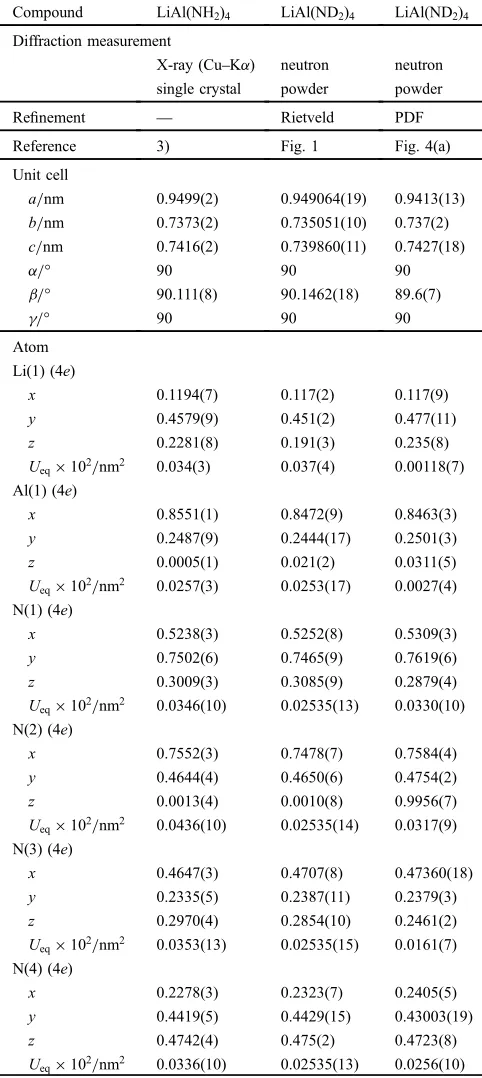
the obtained crystal structural parameters are summarized in Table 1. The structure of LiAl(ND2)4 is characterized by
isolated [ND2] units, as shown in the crystal structure in
Fig. 1. In Table 2, the first-neighbor distances and angles between nitrogen and hydrogen (deuterium) of Li2NH,11)
LiNH2,12)LiAl(NH2)4,3)Li2ND,13)LiND2,14)and LiAl(ND2)4
are summarized. The ND distance in the isolated [ND2]
units of LiAl(ND2)4is 0.09120.1056 nm, which is similar to
the coordination distance for LiND2(0.0967, 0.0978 nm) and
clearly different from the ND distance in the isolated [ND] units of Li2ND (0.0726 nm). Moreover, the DD distance and
the DND angle are 0.15130.1662 nm and 105.1113.9°, respectively; these values are similar to the coordination for LiND2 (0.1533 nm and 104.0°, respectively). These results
confirm that LiAl(ND2)4is composed of isolated [ND2] units
only.
Figure 2 shows S(Q) of LiAl(ND2)4 (a) before and after
[image:2.595.50.289.73.262.2]heat treatment at (b) 433 K and (c) 673 K. The data were
Table 1 Summary of the crystallographic parameters of LiAl(NH2)4/
LiAl(ND2)4(space groupP21/n(no. 14) andZ=4) obtained by Rietveld
refinement using single crystal X-ray and powder neutron diffraction data. The¡and£angles as well as the occupation factors of all the atomic sites were fixed to 90° and 1.0, respectively, in the Rietveld refinement. Numbers in parentheses are estimated standard deviations of the last significant digit.Ueqrepresents the equivalent isotropic atomic
displace-ment parameters calculated from the anisotropic atomic displacedisplace-ment parameters of the X-ray diffraction profile or determined from the refined neutron diffraction profile.Rwp,Re,RB, andRFare statistical reliability
factors based on the observed intensities, the statistical error associated with the observed intensities, the Bragg intensities, and the structure factor, respectively. Values determined by PDF refinement are also reported in the right side of the table.
Compound LiAl(NH2)4 LiAl(ND2)4 LiAl(ND2)4
Diffraction measurement
X-ray (CuK¡) neutron neutron
single crystal powder powder
Refinement ® Rietveld PDF
Reference 3) Fig. 1 Fig. 4(a)
Unit cell
a/nm 0.9499(2) 0.949064(19) 0.9413(13)
b/nm 0.7373(2) 0.735051(10) 0.737(2)
c/nm 0.7416(2) 0.739860(11) 0.7427(18)
¡/° 90 90 90
¢/° 90.111(8) 90.1462(18) 89.6(7)
£/° 90 90 90
Atom Li(1) (4e)
x 0.1194(7) 0.117(2) 0.117(9)
y 0.4579(9) 0.451(2) 0.477(11)
z 0.2281(8) 0.191(3) 0.235(8)
Ueq©102/nm2 0.034(3) 0.037(4) 0.00118(7)
Al(1) (4e)
x 0.8551(1) 0.8472(9) 0.8463(3)
y 0.2487(9) 0.2444(17) 0.2501(3)
z 0.0005(1) 0.021(2) 0.0311(5)
Ueq©102/nm2 0.0257(3) 0.0253(17) 0.0027(4)
N(1) (4e)
x 0.5238(3) 0.5252(8) 0.5309(3)
y 0.7502(6) 0.7465(9) 0.7619(6)
z 0.3009(3) 0.3085(9) 0.2879(4)
Ueq©102/nm2 0.0346(10) 0.02535(13) 0.0330(10)
N(2) (4e)
x 0.7552(3) 0.7478(7) 0.7584(4)
y 0.4644(4) 0.4650(6) 0.4754(2)
z 0.0013(4) 0.0010(8) 0.9956(7)
Ueq©102/nm2 0.0436(10) 0.02535(14) 0.0317(9)
N(3) (4e)
x 0.4647(3) 0.4707(8) 0.47360(18)
y 0.2335(5) 0.2387(11) 0.2379(3)
z 0.2970(4) 0.2854(10) 0.2461(2)
Ueq©102/nm2 0.0353(13) 0.02535(15) 0.0161(7)
N(4) (4e)
x 0.2278(3) 0.2323(7) 0.2405(5)
y 0.4419(5) 0.4429(15) 0.43003(19)
z 0.4742(4) 0.475(2) 0.4723(8)
Ueq©102/nm2 0.0336(10) 0.02535(13) 0.0256(10)
Continued on next page:
Intensity (a.u.)
0.6 0.5
0.4 0.3
0.2 0.1
Lattice spacing, d/nm
100 40 20 14 12 10
Momentum transfer, Q/nm-1
Li Al
N
D
Fig. 1 Neutron diffraction profile of LiAl(ND2)4, which is normalized to
[image:2.595.307.548.216.755.2]obtained from the neutron scattering intensity, which was collected using the 45° detector bank of the NOVA spectrometer. During the heat treatment, the profile drasti-cally changed from sharp diffraction peaks to broad diffuse scattering features, indicating the amorphization of the sample occurred. Figure 3 shows the G(r) functions of LiAl(ND2)4 before and after the heat treatment. The G(r)
[image:3.595.49.296.79.638.2]function can be obtained by the following Fourier trans-formation:
Table 2 Summary offirst-neighbor distances and angles between nitrogen and hydrogen (deuterium) in Li2NH,11)LiNH2,12)LiAl(NH2)4,3)Li2ND,13)
LiND2,14) and LiAl(ND2)4, as obtained from the refinement results
reported in Table 1.
Compound Hydride
Li2NH LiNH2 LiAl(NH2)4
Distance,r/nm
NH 0.0818 0.1022 0.07090.0942
HH ® 0.1143 0.10170.1461
Angle,º/°
HNH ® 106.9 89.1105.4
Reference 11) 12) 3)
Compound Deuteride
Li2ND LiND2 LiAl(ND2)4 LiAl(ND2)4
Distance,r/nm
ND 0.0726 0.0967, 0.0978 0.09120.1056 0.09410.1148
DD ® 0.1533 0.15130.1662 0.14860.1743
Angle,º/°
DND ® 104.0 105.1113.9 94.0113.0
Diffraction measurement
neutron neutron neutron neutron
Refinement Rietveld Rietveld Rietveld PDF
Reference 13) 14) Fig. 1 Fig. 4(a)
Continued:
Compound LiAl(NH2)4 LiAl(ND2)4 LiAl(ND2)4
D/H(1) (4e)
x 0.570(3) 0.5686(14) 0.5729(2)
y 0.738(6) 0.762(2) 0.7616(8)
z 0.201(4) 0.1924(15) 0.1727(4)
Ueq©102/nm2 0.035(9) 0.050(2) 0.212(6)
D/H(2) (4e)
x 0.479(4) 0.464(2) 0.4738(5)
y 0.652(5) 0.6272(10) 0.6359(7)
z 0.306(5) 0.2964(19) 0.2664(17)
Ueq©102/nm2 0.035(10) 0.0508(19) 0.120(5)
D/H(3) (4e)
x 0.682(5) 0.6465(9) 0.6504(3)
y 0.446(7) 0.4495(14) 0.4858(4)
z 0.011(6) 0.9765(14) 0.9496(4)
Ueq©102/nm2 0.0633(12) 0.0508(17) 0.324(16)
D/H(4) (4e)
x 0.759(4) 0.7676(14) 0.7868(3)
y 0.528(7) 0.5403(16) 0.5784(7)
z 0.085(5) 0.1005(15) 0.0780(9)
Ueq©102/nm2 0.0633(12) 0.0508(17) 0.168(7)
D/H(5) (4e)
x 0.542(5) 0.5702(9) 0.5700(2)
y 0.237(9) 0.2627(16) 0.2667(3)
z 0.285(6) 0.3052(14) 0.2473(7)
Ueq©102/nm2 0.0759(12) 0.0508(17) 0.109(5)
D/H(6) (4e)
x 0.458(5) 0.4324(12) 0.4362(4)
y 0.307(8) 0.3061(15) 0.3635(3)
z 0.236(7) 0.1731(13) 0.1680(10)
Ueq©102/nm2 0.0886(12) 0.0508(18) 0.123(7)
D/H(7) (4e)
x 0.267(4) 0.2616(18) 0.2486(7)
y 0.559(5) 0.5664(14) 0.5770(6)
z 0.481(5) 0.4718(17) 0.4812(18)
Ueq©102/nm2 0.037(10) 0.0508(16) 0.072(4)
D/H(8) (4e)
x 0.161(4) 0.1572(18) 0.1744(7)
y 0.439(6) 0.433(3) 0.4177(4)
z 0.559(5) 0.551(3) 0.5681(10)
Ueq©102/nm2 0.047(11) 0.0508(16) 0.166(5)
Reliability factor
Rwp/% ® 2.10 7.75
Re/% ® 0.42 ®
RB/% ® 1.22 ®
RF/% ® 3.05 ®
30
20
10
0
4 5 6 7
10
2 3 4 5 6 7
100
2 3
Momentum transfer, Q/nm-1 30
20
10
0
Structure factor
,
S
(
Q
)
30
20
10
0
1 0.4 0.2 0.1 0.04
Lattice spacing, d/nm
(a)
(b)
(c)
[image:3.595.303.550.114.384.2] [image:3.595.320.535.414.760.2]GðrÞ ¼ ð2=³Þ
ZQmax
0 Q½SðQÞ 1sinðQrÞdQ ð2Þ
In the present analysis, S(Q) in the range of 10¯Q¯
200 nm¹1 was transformed into G(r) using the program developed by the NOVA instrument group. TheG(r) function before the heat treatment indicates the existence of long-range structural order in LiAl(ND2)4. A distinct feature was
observed in the G(r) profile after the heat treatment: a rapid decrease in the profile with increasingr. This feature reflects the amorphous nature of the sample after the heat treatment. In particular, after the heat treatment at 673 K,G(r) shows no significant signal beyond 2 nm, indicating the absence of long-range structural order.
To compare the local structures, the low-rregions of the
G(r) profiles of LiAl(ND2)4 before and after the heat
treatment are shown with simulated patterns of LiAl(ND2)4
(this work), Li3AlN2,15) AlN,16) LiND214) and Li2ND13) in
Fig. 4. The first peak of all G(r) profiles located at 0.1 nm corresponds to ND distance of the isolated [ND2] units of
LiND2 (0.0967, 0.0978 nm). Therefore, an imide phase was
not formed after the heat treatment of LiAl(ND2)4. Next, we
considered that LiAl(ND2)4decomposes to Li3AlN2and AlN,
shown as follows:
ð1xÞLiAlðND2Þ4
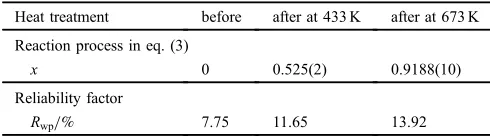
! ð1=3ÞxLi3AlN2þ ð2=3ÞxAlNþ ð8=3ÞxND3 ð3Þ
The PDF refinements of theG(r) profiles were performed in the region of 0.05¯r¯0.50 nm, which includes more than 500 bonding pairs (383 LiAl(ND2)4, 113 Li3AlN2 and 64
AlN). In this work, the initial values of the structural parameters of LiAl(ND2)4were obtained from the results of
the Rietveld refinement and those of Li3AlN215)and AlN16)
were obtained from the literature. Lattice parameters and thermal factors of all three models were refined. Because the imide phase was not detected after the heat treatment and the other phases were restricted for these phases following (3), the phase ratio was fixed to Li3AlN2: AlN¼1 : 2. The refined structural parameters and thefirst-neighbor distances and angles of LiAl(ND2)4 before heat treatment are
summa-rized in Tables 1 and 2, respectively; the results are shown in Fig. 4. The deviations for the lattice parameters and thermal factors of Li3AlN2 and AlN from the initial values were
below 5%. The structural parameters and, first-neighbor distances and angles of LiAl(ND2)4 obtained by PDF
refinement are consistent with the values obtained by Rietveld refinement. In addition, the refined profiles for the mixed phase of LiAl(ND2)4, Li3AlN2, and AlN reproduce G(r) after the heat treatment (Figs. 4(b) and 4(c)). The small shoulder observed at³0.07 nm in Fig. 4(c) is suspected to be thefirst peak (ND) of Li2ND and not of LiAl(ND)2, because
LiAl(ND)2is less stable than Li3AlN2 and AlN; in addition,
the corresponding peak was not detected after heat treatment at 433 K (Fig. 4(b)). Half and almost all of the LiAl(ND2)4 -400
-200 0 200 400
6 5 4 3 2 1 0
Distance, r/nm -400
-200 0 200 400
Atomic pair distribution function,
G
(
r
)/nm
-2
-400 -200 0 200 400
(a)
(b)
(c)
Fig. 3 Atomic PDF,G(r), for the neutron scattering profiles of LiAl(ND2)4
(a) before and after heat treatment at (b) 433 K and (c) 673 K.
-400 -200 0 200 400
0.5 0.4
0.3 0.2
0.1
Distance,r/nm -400
-200 0 200 400
Atomic pair distribution function,
G
(
r
)/nm
-2
-400 -200 0 200 400
(a)
(b)
(c)
(d)
(e)
(f)
(g)
(h)
Fig. 4 Atomic PDF,G(r), for the neutron scattering profiles of LiAl(ND2)4
(a) before and after heat treatment at (b) 433 K and (c) 673 K, and simulation patterns of (d) LiAl(ND2)4 (this work), (e) Li3AlN2,15)
(f ) AlN,16) (g) LiND
214) and (h) Li2ND.13) PDF refinement results:
observed (circles), calculated (line), and residual scattering profiles. First-neighbor distances between nitrogen and hydrogen for [ND2]¹in LiND2
and for [ND]2¹in Li
[image:4.595.64.278.63.381.2] [image:4.595.316.538.65.397.2]decomposed at 433 and 673 K, respectively (Table 3). Therefore, we confirm that LiAl(ND2)4 decomposes to
amorphous mixed phase including Li3AlN2 and AlN.
LiAl(ND)2, which is metastable,4) may be formed during
the decomposition process. This preliminary report on our local structural analysis, which includes the amorphization reaction, provides fundamental information not only for the decomposition process of LiAl(NH2)4but also for the further
study of possible hydrogen storage materials.
4. Conclusions
We have attempted to elucidate the local structural changes that occur during the decomposition process that accom-panies the amorphization of LiAl(ND2)4usingex situneutron
total scattering measurements and PDF analysis. The structure factors of LiAl(ND2)4 before the decomposition
were characterized by isolated [ND2] units. Atomic pair
distribution functions after the heat treatment at 433 and 673 K confirmed that LiAl(ND2)4decomposed to amorphous
mixed phases containing Li3AlN2and AlN.
Acknowledgments
The authors would like to thank Mr. H. Oki and Mr. T. Iwase for their helpful assistance in the neutron scattering
experiments. Work presented here is partially supported by the New Energy and Industrial Technology Development Organization (NEDO) under “Advanced Fundamental Re-search Project on Hydrogen Storage Materials”and “ Feasi-bility Study on Advanced Hydrogen Storage Materials for Automotive Applications (2012)”, JSPS KAKENHI Grant Numbers 23686101, 24241034, and the Neutron Scattering Program Advisory Committee of IMSS, KEK (Proposal No. 2009S06).
REFERENCES
1) R. Janot, J.-B. Eymery and J.-M. Tarascon:J. Phys. Chem. C 111 (2007) 23352340.
2) J. Rouxel and R. Brec: C. R. Acad. Sci. Paris C262(1966) 10711073. 3) H. Jacobs, K. Jänichen, C. Handenfeidt and R. Juza:Z. Anorg. Allg.
Chem.531(1985) 125139.
4) J.-B. Eymery, L. Truflandier, T. Charpentier, J.-N. Chotard, J.-M. Tarascon and R. Janot:J. Alloy. Compd.503(2010) 194203.
5) T. Ono, K. Shimoda, M. Tsubota, S. Kohara, T. Ichikawa, K. Kojima, M. Tansho, T. Shimizu and Y. Kojima:J. Phys. Chem. C115(2011) 1028410291.
6) T. Egami and S. J. L. Billinge:Underneath the Bragg Peaks, Structural Analysis of Complex Materials, (Pergamon, Oxford, 2003).
7) T. Ono, K. Shimoda, M. Tsubota, S. Hino, K. Kojima, T. Ichikawa and Y. Kojima:J. Alloy. Compd.506(2010) 297301.
8) R. Oishi, M. Yonemura, Y. Nishimaki, S. Torii, A. Hoshikawa, T. Ishigaki, T. Morishima, K. Mori and T. Kamiyama:Nucl. Instr. Meth. 600(2009) 9496.
9) R. Oishi-Tomiyasu, M. Yonemura, T. Morishima, A. Hoshikawa, S. Torii, T. Ishigaki and T. Kamiyama:J. Appl. Crystallogr.45(2012) 299308.
10) C. L. Farrow, P. Luhás, J. W. Liu, D. Bryndin, E. S. Božin, J. Bloch, Th. Proffen and S. J. L. Billinge:J. Phys.: Condens. Matter19(2007) 335219.
11) K. Ohoyama, Y. Nakamori, S. Orimo and K. Yamada:J. Phys. Soc. Jpn. 74(2005) 483487.
12) D. B. Grotjahn, P. M. Sheridan, I. Al Jihad and L. M. Ziurys:J. Am. Chem. Soc.123(2001) 54895494.
13) M. P. Balogh, C. Y. Jones, J. F. Herbst, L. G. Hector, Jr. and M. Kundrat:J. Alloy. Compd.420(2006) 326336.
14) M. H. Sørby, Y. Nakamura, H. W. Brinks, T. Ichikawa, S. Hino, H. Fujii and B. C. Hauback:J. Alloy. Compd.428(2007) 297301.
15) R. Juza and F. Hund:Naturwissenschaften33(1946) 121122.
[image:5.595.46.291.134.204.2]16) W. Paszkowicz, S. Podsiadio and R. Minikayev:J. Alloy. Compd.382 (2004) 100106.
Table 3 Summary of the reaction process in eq. (3) and statistical reliability factors obtained by PDF refinement of theG(r) profiles of LiAl(ND2)4 before and after the heat treatment. PDF refinement of the
G(r) profiles of LiAl(ND2)4after the heat treatment was performed for a
mixed phase of LiAl(ND2)4, Li3AlN2, and AlN (the Li3AlN2: AlN ratio
wasfixed to1 : 2).
Heat treatment before after at 433 K after at 673 K
Reaction process in eq. (3)
x 0 0.525(2) 0.9188(10)
Reliability factor