Original citation:
Wang, Jing, Ntarmos, Nikos and Triantafillou, Peter (2016) Indexing query graphs to speed
up graph query processing. In: EDBT : 19th International Conference on Extending Database
Technology, Bordeaux, France , 15-18 Mar 2016. Published in: Advances in database
technology - EDBT 2016 19th International Conference on Extending Database Technology,
Bordeaux, France, March 15-18, 2016 : proceedings pp. 41-52.
Permanent WRAP URL:
http://wrap.warwick.ac.uk/95663
Copyright and reuse:
The Warwick Research Archive Portal (WRAP) makes this work of researchers of the
University of Warwick available open access under the following conditions.
This article is made available under the Attribution-NonCommercial-NoDerivatives 4.0 (CC
BY-NC-ND 4.0) license and may be reused according to the conditions of the license. For
more details see:
http://creativecommons.org/licenses/by-nc-nd/4.0/
A note on versions:
The version presented in WRAP is the published version, or, version of record, and may be
cited as it appears here.
Indexing Query Graphs to Speedup Graph Query
Processing
Jing Wang
School of Computing Science University of Glasgow, UK [email protected]
Nikos Ntarmos
School of Computing ScienceUniversity of Glasgow, UK [email protected]
Peter Triantafillou
School of Computing ScienceUniversity of Glasgow, UK [email protected]
ABSTRACT
Subgraph/supergraph queries although central to graph an-alytics, are costly as they entail the NP-Complete problem of subgraph isomorphism. We present a fresh solution, the novel principle of which is to acquire and utilize knowledge from the results of previously executed queries. Our ap-proach, iGQ, encompasses two component subindexes to identify if a new query is a subgraph/supergraph of pre-viously executed queries and stores related key informa-tion. iGQ comes with novel query processing and index space management algorithms, including graph replacement policies. The end result is a system that leads to signifi-cant reduction in the number of required subgraph isomor-phism tests and speedups in query processing time. iGQ can be incorporated into any sub/supergraph query processing method and help improve performance. In fact, it is the only contribution that can speedup significantly both subgraph and supergraph query processing. We establish the princi-ples ofiGQ and formally prove its correctness. We have im-plementediGQ and have incorporated it within three popu-lar recent state of the art index-based graph query process-ing solutions. We evaluated its performance usprocess-ing real-world and synthetic graph datasets with different characteristics, and a number of query workloads, showcasing its benefits.
Categories and Subject Descriptors
H.2.4 [Systems]: Query processing
General Terms
Design, Performance
Keywords
Graph query processing, indexing, query result caching
1.
INTRODUCTION
Graph structured data are prevalent in many modern big data applications, ranging from chemical, bioinformatics,
©2016, Copyright is with the authors. Published in Proc. 19th Inter-national Conference on Extending Database Technology (EDBT), March 15-18, 2016 - Bordeaux, France: ISBN 978-3-89318-070-7, on OpenPro-ceedings.org. Distribution of this paper is permitted under the terms of the Creative Commons license CC-by-nc-nd 4.0
and other scientific datasets to social networking and social-based applications (such as recommendation systems). In biology, for example, there is a great need to model “struc-tured interaction networks”. These abound when studying species, proteins, drugs, genes, and molecular and chemical compounds, etc. In these graphs, nodes can model species, genes, etc. and edges reflect relationships between them. Molecular compounds, consisting of atoms and their bonds, are naturally modeled as graphs. Ditto for social networks, where nodes refer to people and edges to their relationships. Developing systems and algorithms that can store, man-age, and provide analysis over large numbers of (potentially large) graphs is a formidable challenge. Already, there exist several very large graph datasets. For instance, the Pub-Chem[34] chemical compound dataset contains more than 35 million graphs and ChEBI[11] (Chemical Entities of Bi-ological Interest) dataset contains more than half a million graphs. Further applications extend to software develop-ment and debugging[27] and to similarity searching in med-ical datasets[32]. As a result, a large number of graph data management systems, optimised for handling graph data, have emerged (e.g., Neo4J[4], InifiteGraph[20]). This is in addition to graph management systems designed by big data companies for their own purposes (e.g., Twitter’s FlockDB[38], Google’s Pregel[28]) and the list is continu-ously expanding. Hence, the demand for high performance data analytics in graph data systems is steadily increasing.
Central to graph analytics, is the need to locate patterns in dataset graphs. Informally, given a query graph, the sys-tem is called to identify which of the stored graphs in its dataset contain it (subgraph matching), or are contained in it (supergraph matching). This is a very costly operation as it entails the NP-Complete[14] problem of subgraph iso-morphism and even its most popular solutions [9, 25, 39] are computationally very expensive. This problem is exac-erbated when dealing with datasets storing large numbers of graphs, as the number of required subgraph isomorphism tests grows. Furthermore, performance deteriorates signifi-cantly with increasing graph sizes.
create chemical compound clusters out of similar chemical compounds[34]. Similarly, in protein datasets there is also a hierarchy of queries for aminoacids, proteins, protein mix-tures, proteins of uni-cell bacteria, all the way to those of multi-cell organisms. Finally, typical tools for social net-work analysis (SNA – e.g., Pajek[10]) provide the ability to produce graphs by filtering nodes and/or edges from other graphs. Using such graphs as queries in exploratory interac-tive SNA induces again the previous characteristic. For in-stance, consider the (query) graphs for analyzing friendship networks: such networks within the USA are subgraphs of friendship networks within North America, which in turn are subgraphs of the complete friendship network graph. The conclusion is that, in many applications, any query can itself be a subgraph or supergraph of a previously issued query. Up to now, this natural subgraph/supergraph relationship among queries has not been exploited.
2.
PERSPECTIVES AND RELATED WORK
The problem of subgraph/supergraph query processing has been extensively studied. A prominent paradigm in the literature is thefilter then verifyparadigm. Essentially, this is an index-based class of methods. During indexing, the dataset graphs are reduced to their features (afeaturebeing any substructure of a graph, be it path, tree, cycle, or arbi-trary subgraph), which are inserted into an index structure (e.g., tree, trie, hash table, etc.). Given a query graph g,
g is also decomposed into its features, following the same process as for dataset graphs. Then the index is searched forg’s features; for subgraph queries, the set of graphs that contain all of said features are returned, whereas for super-graph queries the returned set consists of super-graphs all of whose features are contained in g’s features. This set is called the
candidate setand producing it constitutes the filtering stage
of query processing.
All known algorithms guarantee that there will be nofalse
negatives; that is, for subgraph (resp. supergraph) queries,
all graphs in the dataset that can possibly contain (resp. are contained in) the query graph will be included in the candidate set. However, false positives are possible – not all graphs in the candidate set contain (resp. are contained in) the query graph. And herein lies the primary source of problems, since a subgraph subgraph isomorphism test must be performed against each graph in the candidate set, during the verification stage of query processing. The ma-jor focus of related work then is how to reduce the number of false positives, i.e., the number of unnecessary subgraph isomorphism tests.
Approaches in the literature can be classified along two dimensions: whether they employ (frequent) mining tech-niques or an exhaustive enumeration for the production of features, and based on the type of features of the dataset graphs they index (e.g., paths, trees, subgraphs). Note that exhaustive enumeration can yield huge indices and may take a prohibitively long time to do so. For this reason, all ex-haustive enumeration approaches limit the size of features to a typically fairly small number of edges (i.e., 10 or less). Mining-based approaches, both for supergraph queries ([5, 51, 46, 6, 52]) and subgraph queries (e.g., [41, 7, 52]) uti-lize techniques to mine for frequent (or discriminating, in [6]) (sub)graphs among the dataset graphs that are then indexed. Other mining-based approaches, like Tree+∆[49] and TreePi[45] mine for and index frequent trees. Last,
Lin-dex[43] and LWindex[44] utilize the frequent mining algo-rithms of previous approaches, and are thus able to index and query several feature types. Typically such approaches tend to mine for more complex structures, which presents a trade-off between the complexity and time required for the indexing process vis-a-vis the potential for higher pruning power during query processing. However, numerous related performance studies [21, 12, 15, 17, 22] have shown that feature-mining approaches tend to be comparatively worse performers.
On the other hand, SING[12], GraphGrep[16] and Graph-GrepSX[3] perform exhaustive enumeration, listing all paths of dataset graphs up to a certain path length. Similarly, CT-Index[22] indexes trees and cycles, whereas Grapes[15] indexes paths along with location information.
A different approach, which does not index features as above, is presented in gCode[53]. For each graphG in the graph dataset, gCode computes a signature per vertex ofG
(essentially reflecting the vertex’s neighbourhood) and then computes a signature forGitself. The latter is a tree struc-ture combining the signastruc-tures of all its vertices.
With respect to the verification stage, approaches also dif-fer on how this is performed. In some works, verification is performed by applying any (exact) subgraph isomorphism algorithm of choice (see [25] for a detailed insightful com-parative evaluation) after the filtering stage. Indeed, this can be the default choice for all approaches and there is a large variety of subgraph isomorphism algorithms available. Most such algorithms are influenced by Ullman’s early work [39]. Arguably, the algorithm that is now the most widely used is the VF2[9] algorithm. Last, several approaches store and utilize location information in their index to achieve further filtering ([45, 12, 15]).
Recent performance studies [17, 21] have shown that CT-Index[22] and Grapes[15] are high performing approaches. CT-Index[22] is based on deriving canonical forms for the (tree, cycle) features of a graphG, to the fact that for trees and cycles finding string-based canonical forms can be done in linear time (unlike general graphs). These string represen-tations of a graph’s features are then hashed into a bitmap structure per graphG. Checking whether a query graph g
can possibly be a subgraph of a graphG, can be done with simple bitwise operators between the bitmap ofgand that of
G(as supergraphs must contain all features of a subgraph). Last, its verification stage is then based on VF2.
Grapes[15] is designed to exploit parallelism available in multi-core machines. It exhaustively enumerates all paths (up to a maximum length), which are then inserted into a trie with their location information. This operation is per-formed in parallel by several threads, each of which works on a portion of the graph, producing its own trie, and subse-quently all tries are merged together to form the path index of a graph. Grapes then computes (typically) small con-nected components of graphs in the candidate set, on which the verification (subgraph isomorphism test) is performed.
pro-vides a concise overview of related approaches.
On a related note, recent work also deals with graph query-ing against historical graphs, identifyquery-ing subgraphs endurquery-ing graph mutations over time [35], which can be viewed as a variation whereby graph snapshots in time can be viewed as different graphs. Also, the research community has recently started looking into subgraph queries against a single, very large graph consisting of possibly billions of nodes[36]. To accelerate the query processing, SPath[48] proposes a path-at-a-time fashion, which proves to be more efficient than tra-ditional vertex-at-a-time methods, whereas [36] makes use of a memory cloud and [33, 1, 24] exploit MapReduce. In this subgraph querying problem for the single large graph set-ting, the goal is to expedite the subgraph isomorphism itself, whereas in the setting with many dataset graphs, the target of subgraph querying problem is to minimize the number of isomorphism tests that need to be performed. Our work focuses on the latter setting and leaves for future work the application of our ideas to the former setting.
There has also been considerable work on approximate graph pattern matching. Relevant techniques (e.g., [22, 18, 37, 40, 42, 47, 50, 33, 13]) perform subgraph matching with support for wildcards and/or approximate matches. These solutions are not directly related to our work, as we expedite exact index-based subgraph/supergraph query processing.
Caching of the results of path/tree queries has been ex-plored in XML databases[26, 2, 29]. The problem we focus on is considerably different, as the queries we deal with are in the form of graphs (not just paths/trees), thus entailing the NP-Complete problem of subgraph isomorphism. Fur-thermore, in our setting queries retrieve stored graphs that contain the query graph (subgraph queries) or are contained in it (supergraph queries), and we exploit both supergraph and subgraph relationships among queries themselves, as op-posed to only subsumption (i.e., supergraph) relationships. Moreover, our graph replacement policy also takes into ac-count the subgraph isomorphism costs, as opposed to just the size or popularity of cached queries.
Last, [23] presents a cache for targeted historical queries against a large social graph. In this case, each query is centered around a uniquely identified node in the social graph, and the objective is to avoid maintaining and/or reconstructing complete snapshots of the social graph, but to instead use a set of static “views” – i.e., snapshots of neighborhoods of nodes – to rewrite incoming queries. [23] does not deal with subgraph/supergraph query processing; rather, the nature of the queries means that containment can be decided by simply measuring the distance of the central query node to the center of each view, while also taking into account the diameter of these two graphs. Furthermore, the authors do not provide a cache replacement strategy, but rather an algorithm to compute the optimal cache contents given a set of queries. iGQ could well be used to both gen-eralise and expedite query processing in [23].
2.1
The iGQ Perspective
In this work we offer a new perspective and a strategy for improving subgraph/supergraph query processing per-formance and scalability. Our approach rests on the follow-ing three observations: First, in related works there exists an implicit assumption that graph queries will be similarly structured to the dataset graphs. In general this is not guar-anteed to hold (e.g., in exploratory analytics), and when
query graphs have no match in the dataset graphs, query processing cannot benefit at all from indexes that are solely constructed on dataset graphs. Second, even when query graphs have matches against dataset graphs, the system per-forms expensive computations during query processing and simply throws away all (painstakingly and laboriously) de-rived knowledge (i.e.,previous querying result). Third, the success of known approaches depends on and exploits the fact that dataset graphs share features (e.g., when mining for frequent features) and/or that dataset graph features contain or are contained in other graph features (e.g., when using tries to index dataset graph features). However, they completely fail to investigate and exploit such similarities between query graphs.
As mentioned, it is natural in many applications for new queries to bear subgraph/supergraph relationships with pre-viously issued queries. Our efforts in this work centre on exploiting this characteristic to further improve the per-formance of query processing. Therefore, instead of “min-ing” only the stored graphs and creating relevant indexes on them, we also “mine”query graphsand accumulate the knowledge produced by the system when running queries, creating aquery indexin addition to thedataset index. Our insights identify which is the relevant accumulated knowl-edge and how to exploit it during query processing in order to further reduce the number of subgraph isomorphism tests.
iGQ can accommodate any proposed index for sub or super-graph query processing and help expedite both query types.
2.2
Contributions
The contributions of this work are that we:
• Provide a new perspective to the problem of subgraph/ supergraph query processing, with insights as to how the work performed by the system when executing queries can be appropriately managed to improve the performance of future queries.
• Detail theiGQ approach, based on a query index struc-ture and associated query processing algorithms, which can reduce the number of isomorphism tests performed during query processing.
• Present theiGQ framework, showing how to incorpo-rateiGQ within existing approaches, and the twoiGQ components: a subgraph query index and a supergraph query index. The subgraph index ofiGQ can be based on any existing subgraph index (over query graphs, not dataset graphs). The supergraph index on the other hand is a new index to swiftly determine supergraph status between new and previous queries.
• Address the issue of index space management, provid-ing mechanisms for index updates and a graph replace-ment policy, deciding contents of query index.
• Implement iGQ, incorporate it within three popular approaches for graph query processing, and provide experimental results using real-world datasets and a number of query workloads, showcasingiGQ’s benefits against competitive state of the art methods.
3.
PROBLEM FORMULATION
We consider undirected labeled graphs. For simplicity, we assume that only vertices have labels; all our results straight-forwardly generalize to graphs with edge labels.
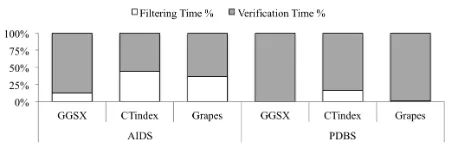
Figure 1: Dominance of the Verification Time on the Overall Query Processing Time of Three Subgraph Querying Algo-rithms on Two Different Real-world Graph Datasets
a set of vertices V(G)and edgesE(G) ={(u, v), u∈V, v∈
V}, and a function l : V → U, whereU is the label set,
defining the domain of labels of vertices.
A sequence of vertices (v0, . . . , vn) s.t. ∃(vi, vi+1) ∈ E, constitutes a path of lengthn. A simple path is a path where no vertices are repeated. A cycle is a path of lengthn >1, where v0 =vn. A simple cycle is a cycle with no repeated vertices (other than v0 and vn). A connected graph is one where there exists a path between any pair of its vertices.
Definition 2. A graph Gi= (Vi, Ei, li) is
subgraph-iso-morphic to a graphGj= (Vj, Ej, lj), (by abuse of notation)
denoted byGi⊆Gj, when there exists an injectionφ:Vi→
Vj, such that ∀(u, v) ∈ Ei, u, v ∈ Vi,⇒ (φ(u), φ(v)) ∈ Ej
and∀u∈Vi, li(u) =lj(φ(u)).
Informally, there is a subgraph isomorphismGi⊆GjifGj contains a subgraph that is isomorphic toGi. In this case, we say that Gi is a subgraph of (or contained in) Gj, or inversely thatGjis a supergraph of (contains)Gi(denoted byGj⊇Gi).
Definition 3. The subgraph querying problem entails a
set D = {G1, . . . , Gn} containing n graphs, and a query
graphg, and determines all graphsGi∈Dsuch thatg⊆Gi.
Definition 4. The supergraph querying problem entails
a set D ={G1, . . . , Gn} containing n graphs, and a query
graphg, and determines all graphsGi∈Dsuch thatg⊇Gi.
TheiGQ index,I, will be called to index the features of
query graphs; then we shall say that query graphgis indexed byiGQ and (by abuse of notation) denote it byg∈I. We
denote withIsub(g) all query graphs currently contained inI
that are supergraphs ofg(answers tog, ifgwas a subgraph query); i.e.,Isub(g) = {G|G∈I∧g⊆G}. Similarly, we
denote withIsuper(g) all query graphs currently contained in
Ithat are subgraphs ofg(answers tog, ifgwas a supergraph
query); i.e.,Isuper(g) = {G|G∈I∧g⊇G}.
4.
iGQ PRINCIPLES
We firstly discuss our findings from experiments we ran regarding the major performance obstacles we need to over-come if we are to bring about further query processing time reductions. Subsequently, we present the iGQ framework, followed by an explanation of how the components of iGQ are utilized for further performance improvements, and lated formal proofs of correctness. As mentioned, so far re-lated work has not considered benefiting from the execution of previous queries. Thus, despite devoting a lot of resources to such queries, the results derived cannot be put to good use to improve performance of future subgraph queries.
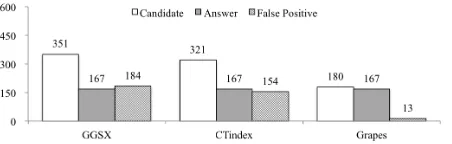
Figure 2: Average Number of Candidates, Answer Set Size, and False Positives in the AIDS Dataset
4.1
Insights
We report on the fundamentals of the performance of three state of the art approaches, GraphGrepSX[3] (GGSX), Grapes[15], and CT-Index[22], over three real datasets and one synthetic dataset with different characteristics. These characteristics will be presented in detail in the experimen-tal evaluation section. Briefly, AIDS represents a graph DB consisting of 40,000 very small, sparse graphs, while PDBS is a graph dataset containing 600 large graphs. Please note that the way the queries were generated is standard among related work [15, 22].
Subgraph Query Performance: Where Does Time Go?
There are two key components of the overall query process-ing time: filterprocess-ing time (to process the index and produce the candidate set) and verification time (to perform the ver-ification of all candidate graphs). Fig. 1 shows what per-centage of the total query processing time is attributed to each component.
The dominance of the verification step is clear. This holds across the three different approaches that employ different indexing methods and utilize different strategies for cutting down the cost of subgraph isomorphism. Recall that sub-graph isomorphism performance is highly sensitive to the size of both the input graph and the stored graph. Hence, we would expect that for smaller stored graphs (as in the AIDS dataset) the verification step would be much faster. Notably, however, even when graphs are very small, the verification step is the biggest performance inhibitor and as graphs become larger (e.g., PDBS) the verification step becomes increasingly responsible for nearly the total query processing time. Of course, given the NP-Completeness of subgraph isomorphism, one would expect that verification would dominate, especially for large graphs. But the fact that even with very small graphs this holds is noteworthy.
Filtering Power: Is It Good Enough?
The second fundamental point pertains to how one can re-duce the verification cost. Related works highlight that their approaches prove to be very powerful in terms of filtering out the vast majority of DB graphs. In Figures 2 and 3 we show our results with respect to the average size of candidate sets and of the answer set, as well as the average number of false positives for the AIDS and PDBS datasets.
[image:5.595.51.279.90.162.2]Figure 3: Average Number of Candidates, Answer Set Size, and False Positives in the PDBS Dataset
that is required. The above two combined imply that even the best algorithm will suffer from a large number of unnec-essary subgraph isomorphism tests under some datasets.
Turning our attention to Figure 3 we see that for DBs with medium to small number of graphs, the high filtering power can indeed result in requiring only a relatively small number of subgraph isomorphism tests. However, considerable per-centages of false positives can appear in the candidate sets of even top-performing algorithms; e.g., CT-Index, which ex-hibited the best filtering in the AIDS dataset, has an almost 50% false positive ratio in the PDBS dataset. Furthermore, not all subgraph isomorphism tests for the graphs in the candidate set are equally costly. As the cost of subgraph isomorphism testing depends on the size of the graph, the larger graphs in the candidate set contribute a much greater proportion of the total cost of the verification step. Note that, naturally, false positive graphs tend to be the largest graphs in the DB, since these have a higher probability to contain all features of query graphs.
Note that we placed emphasis on the number of unneces-sary subgraph isomorphism tests (i.e., the false positives), as we can improve filtering further by reducing this number. However, this is not the only source of possible improve-ments. As we shall show later, iGQ can improve on the number of subgraph isomorphism tests even beyond this, by exploiting knowledge gathered during query execution.
The insights that can be drawn are as follows:
• Despite the fact that state of the art techniques (based on indexing features of DB graphs) can enjoy high fil-tering capacity, there is still large room for improve-ment, as even the best approaches may perform large numbers of unnecessary subgraph isomorphism tests.
• Improving further the filtering power of approaches can significantly improve query processing time, as this will reduce the number of subgraph isomorphism tests, which dominates the overall querying time.
• Even approaches that are purported to enjoy great fil-tering powers, can behave much more poorly under different datasets.
• Unnecessary subgraph isomorphism tests are not solely caused by false positives; even graphs in the candidate set that are true positives can be unnecessarily tested if the system fails to exploit this knowledge (accrued by previous query executions).
4.2
The iGQ Framework
iGQ aims to augment the functionality and benefits of-fered by any one of the subgraph and/or supergraph index-ing methods in the literature. Let us call the chosen method
M. TheiGQ framework consists of methodMand the two
components ofI,IsubandIsuper. For the sake of simplicity, we shall first describe the operation of iGQ when M is a
method for subgraph query processing (denotedMsub). Ini-tially, method Msub builds its graph dataset index as per usual. TheiGQ index,I, starts off empty; it is then
popu-lated as queries arrive and are executed byMsub.
Upon the arrival of a queryg, the query processing process is parallelized. One thread uses methodMsub’s algorithms and indexing structure to breakdown the query graph into its features, and uses its index to produce a candidate set of graphs,CS(g), as usual. Additionally,Iwill obtain as many
of the intermediate and final results from methodM’s
execu-tion as possible; e.g., it will obtain the features of the query graph, to be compared to those stored inI(from
previously-executed queries). At this point, two separate threads will be created: one will check whether the query graph is a subgraph of previous query graphs and the other will check whether it is a supergraph of previous query graphs. These cases yield different opportunities for optimization and are discussed separately below.
In the following we proceed to describe the function of each component of the iGQ framework and how it is all brought together. For the formal proofs of correctness that follow, for simplicity, we make the following assumptions.
Assumptions.
TheiGQ index components,IsubandIsuper work correctly. That is:G∈Isub(g)⇒g⊆G (1)
and
G∈Isuper(g)⇒g⊇G (2)
We will prove that these assumptions hold in sections 6.1 and 6.2.
4.2.1
The Subgraph Case:
IsubThis case occurs when a new query gis a subgraph of a previous queryG. WhenGwas executed by the system, the
Isub component ofiGQ indexedG’s features. Additionally,
iGQ stored the results computed byMsubforG.
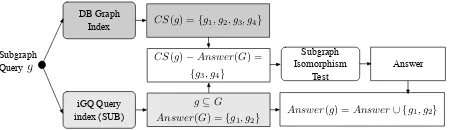
Fig. 4 depicts an example for the subgraph case ofiGQ. A new querygis “sent” to methodMsub’s graph index, pro-ducing a candidate set,CS(g), which in this case contains the four graphs{g1, g2, g3, g4}. Similarly, gis “sent” to the iGQ subgraph component,Isub, from where it is determined that there exists a previous queryG, such thatg⊆G. iGQ then retrieves the answer set,Answer(G) (previously pro-duced by methodMsub and indexed byIsub); in this case,
Answer(G) = {g1, g2}. The reasoning then proceeds as follows. Consider graphg1 ∈CS(g). Since fromIsub it has been concluded thatg⊆Gand from the answer set ofGwe know thatG⊆g1, it necessarily follows thatg⊆g1. Simi-larly, we conclude thatg⊆g2. Hence, there is no point in testinggfor subgraph isomorphism againstg1 org2, as the answer is already known. Therefore, one can safely subtract graphs g1, g2 from Msub’s candidate set, and test only the remaining graphs (reducing the number of subgraph isomor-phism tests in this example by 50%). After the verification stage,g1, g2are added to the final answer set.
DB Graph
Index CS(g) ={g1, g2, g3, g4}
iGQ Query index (SUB)
Subgraph Isomorphism
Test Subgraph
Queryg
Answer(G) ={g1, g2} CS(g) Answer(G) =
{g3, g4}
Answer(g) =Answer[ {g1, g2} g✓G
[image:7.595.318.541.88.157.2]Answer
Figure 4: iGQ Processing of a Subgraph Query in the Sub-graph Case
iGQ for subgraph isomorphism testing is given by:
CSsub(g) =CS(g) \ [
Gi∈Isub(g)
Answer(Gi) (3)
Finally, ifAnswersub(g) is the subset of graphs inCSsub(g) verified to be containing g through subgraph isomorphism testing, the final answer set for querygwill be:
Answer(g) =Answersub(g)∪ [
Gi∈Isub(g)
Answer(Gi) (4)
Lemma 1. TheiGQ answer in the subgraph case does not contain false positives.
Proof. Assume that a false positive was produced by
iGQ; particularly, consider the first ever false positive pro-duced by Isub, i.e., for some queryg, ∃GF P such thatg *
GF P andGF P ∈Answer(g). Note thatGF P cannot be in
Answersub(g), as the latter contains only those graphs from
CSsub(g) that have been verified to be supergraphs ofg af-ter passing the subgraph subgraph isomorphism test, and hence g * GF P ⇒ GF P 6∈ Answersub(g). Therefore, by formula (4),GF P ∈Answer(g)⇒ ∃Gsuch thatG∈Isub(g) and GF P ∈Answer(G). But (by formula (1))G∈Isub(g)
⇒ g ⊆ G, and GF P ∈ Answer(G) ⇒ G ⊆ GF P. Thus
g⊆GF P (a contradiction).
Lemma 2. iGQ in the subgraph case does not introduce false negatives.
Proof. Assume that a false negative was produced by
iGQ; particularly, consider the first ever false negative pro-duced by Isub, i.e., for some queryg, ∃GF N such thatg⊆
GF N andGF N ∈/Answer(g). As methodMsubis assumed to be correct, it cannot produce any false negatives when processing query g, hence g ⊆ GF N ⇒ GF N ∈ CS(g). Then, the only possibility for error is thatGF Nwas removed using formula (3); i.e.,GF N ∈/CSsub(g). That implies that
∃G such that G ∈ Isub(g) and GF N ∈ Answer(G). But then, by formula (4), GF N will be added to Answersub(g) and thusGF N ∈Answer(g) (a contradiction).
Theorem 1. The iGQ answer in the subgraph case of query processing is correct.
Proof. There are only two possibilities for error; iGQ can produce false negatives or false positives. The theorem then follows straightforwardly from Lemmas 1 and 2.
4.2.2
The Supergraph Case:
IsuperThis case occurs when a new queryg is a supergraph of a previous query G. Fig. 5 depicts an example for the su-pergraph case ofiGQ. Again, the subgraph query processing methodMsubproduces a candidate set,CS(g) that, say, con-tains four graphs{g1, g2, g3, g4}. RunninggthroughIsuper,
DB Graph
Index CS(g) ={g1, g2, g3, g4}
iGQ Query
index (SUPER) Answer(G) ={g1, g20} CS(g)\Answer(G) =
{g1}
Subgraph Isomorphism
Test
Answer(g)
Subgraph Queryg
[image:7.595.54.279.89.154.2]G✓g
Figure 5: iGQ Processing of a Subgraph Query in the Su-pergraph Case
it is determined that there exists a previous query graphG
such thatG⊆g. AlsoIsuper supplies the stored answer set forG,Answer(G) ={g1, g20}.
The reasoning then proceeds as follows. Consider graph
g2 ∈ CS(g). We know fromIsuper that g2 ∈/ Answer(G). Now, ifg⊆g2 were to indeed be true, sinceG⊆g, then it must also hold thatG⊆g2; that is,Answer(G) would have to containg2 as well, which is a contradiction. Therefore, it is safe to conclude thatg*g2 and thusg2 can be safely removed fromCS(g). Similarly, we can also safely remove graphsg3, g4 fromCS(g), reducing in this case the number of required subgraph isomorphism tests by 75%. Thus, only
g1needs to be isomorphism-tested in this example. In the general case, g may be a supergraph of multiple previous query graphsGiinIsuper. By the above reasoning, only those graphs appearing in the answer sets of all queries
Gimay actually be supergraphs ofg; thus the set of graphs submitted byiGQ for subgraph isomorphism testing is:
CSsuper(g) =CS(g) ∩ \
Gi∈Isuper(g)
Answer(Gi) (5)
The final answer produced for querygbyiGQ,Answer(g), will be the subset of graphs in CSsuper(g) that have been verified by the subgraph isomorphism test.
Lemma 3. The iGQ answer in the supergraph case does not contain false positives.
Proof. This trivially follows by construction as all graphs inAnswer(g) have passed through subgraph isomorphism testing at the final stage of processing.
Lemma 4. The iGQ answer in the supergraph case does not introduce false negatives.
Proof. Assume false negatives are possible and consider the first ever false negative produced byIsuper; i.e., for some queryg,∃GF N such thatg⊆GF N andGF N∈/Answer(g). MethodMsubdoes not produce in its candidate set any false negatives (as will be formally proven shortly), henceGF N∈
CS(g). Then, the only possibility for error is for iGQ to have removed graphGF N fromCSsuper(g) with formula (5). This implies that∃Gsuch that G∈ Isuper(g) andGF N ∈/
Answer(G). But sinceG∈Isuper(g), by equation (2),G⊆
g, and theng⊆GF N ⇒G⊆GF N ⇒GF N ∈Answer(G) (a contradiction).
Theorem 2. The iGQ answer in the supergraph case of query processing is correct.
4.3
iGQ and Optimal Performance
There are two special cases that warrant further emphasis, since they introduce the greatest possible benefits.
First, note thatiGQ can easily recognize the case where a new query,g, is exactly the same as a previous query con-tained in I. Specifically, this holds when ∃G∈I such that
g ⊆G or g ⊇ G, and g and G have the same number of nodes and edges. When this holds, since I stores the
re-sult forG, we can return directly and completely avoid the subgraph isomorphism testing as the actual result for g is known! As the subgraph isomorphism test dominates the query execution time, this is expected to be a large perfor-mance improvement.
Second, consider the supergraph part of iGQ. If ∃G ∈ Isuper(g) such thatG⊆gandAnswer(G) =∅, then we can completely omit the verification stage again: If there were a dataset graphG0 such that g⊆G0, sinceG⊆gwe would conclude thatG⊆G0, which necessarily implies thatG0 ∈
Answer(G), which contradicts the fact that Answer(G) =
∅. Thus, no such graphG0 can exist and it is safe to stop query processing at this stage.
4.4
iGQ and Supergraph Query Processing
As mentioned earlier, iGQ can expedite both subgraph
and supergraph query processing. In the latter case, the components of iGQ (Isub, Isuper) remain unchanged, but the handling of the return answer sets is the exact inverse of what happens for subgraph queries. Briefly, given a su-pergraph query processing methodMsuperand a supergraph queryg, the union of the answer sets of graphs inIsuper(g) are removed fromCSsuper(g) and added toAnswersuper(g) to produce the final answer, and the graphs not appearing in the intersection of the answer sets of graphs inIsub(g) are completely subtracted fromCSsub(g). Also, the first mal case mentioned above still holds, but the second opti-mal case is inversed with the processing terminating when
∃G∈Isub(g) such thatAnswer(G) =∅. The intuition be-hind this design and the proof of correctness of iGQ for supergraph query processing, follow the same reasoning as above and are omitted for space reasons. The elegance af-forded by the double use ofiGQ is unique.
5.
iGQ INDEX SPACE MANAGEMENT
As queries arrive continuously and the space to storeIis finite,iGQ requires methods for (i) efficiently handling this space and (ii) ensuring that it is best utilized, keeping those query graphs that increase its performance impact.
5.1
iGQ Graph Replacement Policy
Our replacement policy differs fundamentally from stan-dard replacement policies: Unlike traditional cache replace-ment, whereby replacing a page or a file block saves one IO, different graphs inIbring about different benefits, as is shown below. We identify three key principles.
Increase the use of iGQ index.Ishould contain popular
graphs; this is typical of all replacement algorithms. We define the popularity of a graph gas P(g) = MH((gg)), where
H(g) is the number of times a graph g∈I has been found
to be a subgraph or supergraph of query graphs (hit), and
M(g) is the total number of all queries processed sincegwas added to theiGQ index. In essence, this models the fraction of queries affected over time bygbeing inI.
Reduce the number of subgraph isomorphism tests. Ideal graphs for I are graphs that bring about the
great-est possible reductions in the number of executed subgraph isomorphism tests. LetR(g) be the total number of graphs removed from the candidate sets of incoming queries because ofgbeing inI. Then this component is computed as RH((gg)) – the per-hitaverage number of subgraph isomorphism tests alleviated byg.
Reduce the cost of each subgraph isomorphism test.
A graph g∈I is more desirable if it helps avoid subgraph
isomorphism tests on the biggest graphs fromM’sCS. This
is so since we also wish to remove from CS graphs with expensive subgraph isomorphism tests. We denote byC(g) the total cost of the subgraph subgraph isomorphism tests alleviated as a result ofgbeing inI. In order to estimate this
value, we extend the asymptotic complexity analysis of [8] to the case of subgraph isomorphism. Specifically, given graphs with L labels, graph g0 with n nodes, and graph Gi with
Ni≥nnodes, the costc(g0, Gi) of subgraph isomorphism of
g0 againstGiis given by:
c(g0, Gi) = Ln+1N×i×(NNii!−n)!
C(g) is then computed as the sum over allc(g0, Gi), for all
g0 whoseCS(g0) was reduced by removingGias a result of
gbeing inI, and CR((gg)) gives the average cost reduction per alleviated test.
Ideal graphs forIare those that could help future queries
as much as possible. To quantify such a contribution, we introduce the notion of graphutility,U(g), defined as:
U(g) = MH((gg))×R(g)
H(g)×
C(g)
R(g) =
C(g)
M(g)
That is, the utility of a graph g iniGQ is equal to the probability ofgbeing used for an incoming query (i.e., be-ing hit), times the average savings in number of subgraph isomorphism tests per such hit, times the average cost for a single subgraph isomorphism test. The replacement policy is then based on this, with the graph with the smallestU(g) being evicted.
5.2
iGQ Index Maintenance Policy
For all graphs inI we maintain the metadata mentioned above (i.e.,C(g), M(g)). Additionally, we store the actual query graphs that are indexed byIin a separate store coined Igraphs. To facilitate index updates without interfering with query processing performance, we employ the concepts of
query window size, W, and cache size,C, with W ≤ C. As new graph queries arrive, they are processed as outlined above, update the metadata for graphs inI, and are inserted
into a temporary storageItemp. WhenW new queries have been processed, we consult the metadata to locate the W
graphs inI with the lowest utility values. The graph data
for those graphs is removed fromIgraphsand replaced by the graphs inItemp. The latter is then emptied, and a “shadow” index, Ishadow, is built over graphs in Igraphs. Incoming queries keep being served byI and updating its metadata.
When the shadow indexing is over,Ishadow replacesI(with
a pointer swap). Finally, metadata for graphs removed from
Iis also removed from the metadata store (C(g), M(g)).
6.
iGQ ALGORITHMS AND STRUCTURES
Algorithm 1The Supergraph Index in iGQ 1: Input: SetQof (previous) queriesg1, g2, . . . , gn 2: Output: Supergraph index of previous queriesIsuper 3:
4: InitializeIsuper to an emptytrie
5: for allgi∈Qdo
6: Extract all features ofgiand insert them in setF(gi) 7: N F[gi] =|F(gi)|
8: for all featuresf∈F(gi)do
9: o= number of occurrences off ingi 10: Isuper.insert(f,{gi, o})
11: end for
12: end for
13: return Isuper
6.1
Finding Supergraphs in
IsubThis case represents a microcosm of our original problem, where instead of indexing and querying dataset graphs, we index and query previous query graphs. Hence, any ap-proach from the related works can be adapted for this pur-pose. Actually, as iGQ can complement any existing ap-proach, Msub, we can utilize Msub’s method for subgraph query processing for the subgraph case ofiGQ, or any other method appropriate for iGQ’s special characteristics (i.e., relatively small set of small graphs). Note that the assumed correct methodMsubprecludes false negatives and subgraph isomorphism testing of all candidates precludes false posi-tives. Hence, formula (1)’s assumption is trivially satisfied.
6.2
Finding Subgraphs in
IsuperThe problem of supergraph query processing has also re-ceived some attention (e.g., in [5, 44, 46, 6, 51]). In principle, any of these algorithms can be utilized for the task at hand withiniGQ. However, we choose to propose a new approach, which is efficient yet simple and avoids the complexities and overheads involved in the above general approaches. The point is that we want a method for supergraph query pro-cessing that can easily fit within the framework ofiGQ and perform both subgraph and supergraph query indexing and processing. Algorithm 1 shows howIsuperis created. Briefly,
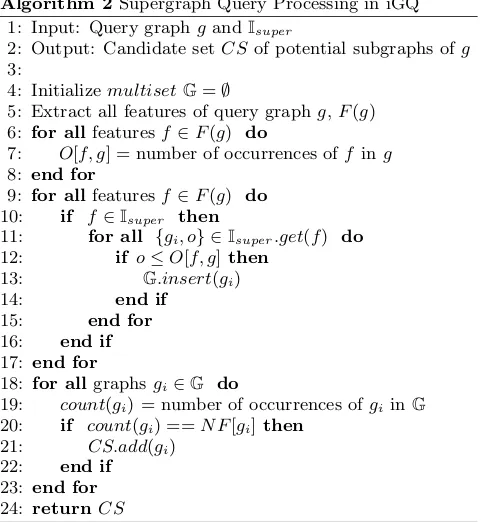
Isuperis a trie, storing features of queries. For each featuref it stores a pair{gi, o}for each graphgiin whichf appears, whereois its number of occurrences ingi. For eachgiit also stores the number of distinct features (N F[gi]) it contains.
Algorithm 2 illustrates howIsuperidentifies candidatesCS that are potential subgraphs of query g. The idea is to find those graphs that containonlyfeatures included in the query graphg(lines 19–22; the check for count(gi) on line 20, ensures that all individual features of gi are contained ing), and where for each such graph gi a feature f occurs at most as many times asf occurs ing(line 12). Last, the graphs inCSare isomorphically tested to verify thatgi⊆g. It is straightforward to see that no false negatives can exist inCS. Assume there is a false negativegi such thatgi⊆g and gi ∈/ CS. Sincegi ⊆g, any feature f ingi appears no more times thanfappears ing, thusgiwould be added toG
on every execution of line 12. Asgi⊆g, all ofgi’s features must appear in g. Thus,giwould pass the if-clause at line 20 and be added toCS(contradiction). Moreover, subgraph isomorphism testing of all members of CS precludes false positives. Hence, formula (2)’s assumption holds.
Algorithm 2Supergraph Query Processing in iGQ 1: Input: Query graphgandIsuper
2: Output: Candidate setCS of potential subgraphs ofg
3:
4: InitializemultisetG=∅
5: Extract all features of query graphg,F(g) 6: for allfeaturesf∈F(g) do
7: O[f, g] = number of occurrences off ing
8: end for
9: for allfeaturesf∈F(g) do
10: if f∈Isuper then
11: for all {gi, o} ∈Isuper.get(f) do 12: if o≤O[f, g]then
13: G.insert(gi)
14: end if
15: end for
16: end if
17: end for
18: for allgraphsgi∈G do
19: count(gi) = number of occurrences ofgiinG
20: if count(gi) ==N F[gi]then 21: CS.add(gi)
22: end if
23: end for
24: return CS
[image:9.595.308.552.92.353.2]6.3
iGQ System Operation
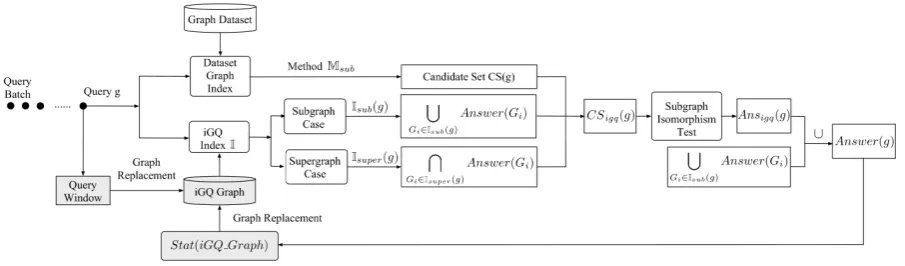
Fig. 6 depicts the complete iGQ system operation when used to expedite a subgraph query processing methodMsub. Please keep in mind, though, thatiGQ can be integrated with any subgraph and/or supergraph querying method. Given a new subgraph queryg:
1. The query is sent to three separate processing threads in parallel and also stored in the querywindow. 2. In the first thread,Msubuses itsDataset Graph Index
to filter the dataset graphs and produce the candidate setCS(g), as usual.
3. The remaining two threads perform filtering along the subgraph (section 4.2.1) and supergraph path (section 4.2.2). Their results are combined to prune CS(g), based on formulae (3) and (5).
4. The resulting candidate set,CSigq(g), undergoes sub-graph isomorphism testing to produceAnsigq(g). 5. Since this is for a subgraph query, the graphs pruned
during processing along the subgraph path in step 3 are added to Ansigq(g) to produce the final answer set,Answer(g) (see formula (4)).
6. Metadata maintained throughout the processing ofg, including Answer(g) and its subgraphs/supergraphs detected during step 3, are added to the metadata store,Stat(iGQ Graph).
7. If the query window is full, the system uses the above metadata to select appropriate cached graphs to evict. Said graphs are replaced by the graphs in the window. 8. Finally, theiGQ index is updated to reflect the new contents of the cache (section 5.2 details the mainte-nance of theiGQ index).
7.
PERFORMANCE EVALUATION
Figure 6: Operation ofiGQ on Top of a Subgraph Query Processing MethodMsub
subgraph query processing time (supergraph query process-ing time is omitted for space reason) and on the number of subgraph isomorphism tests.
7.1
Experimental Setup
Experiments were run on a Dell R920 system (4 Intel Xeon(R) CPUs (15 cores each), 512GB RAM, 1TB disk), and on a cluster of four Dell R720’s (each with 2 Intel Xeon(R) CPUs (8 cores each), 64GB RAM, 1TB disk).
Algorithms. In addition to our implementation ofiGQ query processing, we also secured access to implementations of three recent high performing subgraph query processing methods, GraphGrepSX[3] (GGSX), Grapes[15], and CT-Index[22]. In addition to their competitive performance, these three methods represent interesting design decisions. GGSX indexes paths (up to a certain maximum length, equal to 4 in these experiments) and uses the VF2 subgraph isomorphism algorithm for its verification stage. Grapes, like GGSX, also indexes paths (of up to length of 4), but utilizes location information in the filtering stage to expe-dite the verification stage, essentially focusing only on con-nected components of the dataset graphs that may contain the query graph. CT-Index indexes trees (of maximum size 6), and cycles (of maximum size 8) in hash-based bitmap structures (4096-bit wide), and uses a modified VF2 for its verification stage.
The implementations for Grapes and GGSX were obtained from the corresponding project web sites[15, 3]. For Grapes, we present two alternatives, Grapes and Grapes(6), which use 1 and 6 threads respectively. For fairness, we altered the code of Grapes so to stop query processing when the first match was found, instead of looking for all matches of a query within each stored graph. For CT-Index we ob-tained the JAR file from one of the authors, which we then reverse-engineered to derive its code in Java. Subsequently, we integrated the iGQ algorithms of Section 4.2.1 within Grapes, CT-Index, and GGSX, yielding three different ver-sions ofiGQ, denoted asiGQ Grapes,iGQ CT-Index, and
iGQ GGSX. In this way, (i) we validate our claim thatiGQ can be incorporated into existing approaches, and (ii) we show that it can introduce significant performance gains dur-ing subgraph query processdur-ing of any of these approaches.
Datasets. We have employed three real-world datasets and one synthetic dataset with different characteristics, out-lined in Table 1. AIDS is the Antiviral Screen Dataset of the National Cancer Institute, containing topological struc-tures of molecules [30]. PDBS[19] is a dataset of graphs representing DNA, RNA and proteins. As AIDS and PDBS contain typical but relatively sparse graphs, we have
per-dataset
unique graphs average num. nodes per graph num. edges per graph
vertex in node
labels dataset degree avg std.dev max avg std.dev max
AIDS 62 40,000 2.09 45 22 245 47 23 250
PDBS 10 600 2.13 2,939 3,217 16,431 3,064 3,264 16,781
PPI 46 20 9.23 4,943 2,717 10,186 26,667 26,361 89,674
Synthetic 20 1,000 19.52 892 417 7,135 7,991 5 8,007
Table 1: Characteristics of Datasets
formed further experiments on dense datasets, including the PPI dataset and a synthetic dataset. PPI[15] models large and dense protein interaction networks and consists of 20 graphs. We also used the generator provided by [7] to cre-ate a much larger number (1,000) of much denser graphs.
Query Workloads. Unfortunately, despite the availabil-ity of graph datasets, the communavailabil-ity does not enjoy well es-tablished benchmarks and/or real-world query logs for these datasets. So all related works synthesize queries derived from components of the dataset graphs. We follow this es-tablished principle for generating our workloads, whereby queries are generated from the original dataset graphs as follows. There are 3 key probability distributions to con-sider here. The first governs how a graph is selected from the dataset graphs. The second governs how a node is se-lected within this graph. Given these, we produce 4 query workloads:uni−uni,uni−zipf,zipf−uni, andzipf−zipf, with, e.g.,zipf−unidenoting that dataset graphs have a popularity (probability of being selected) following a Zipf distribution, while nodes within the selected graph have a popularity drawn from a uniform distribution. The proba-bility density function of the Zipf distribution is given by:
p(x) = xζ−(αα), whereζis the Riemann Zeta function[31]. The default value forαwas 1.4 – we have also usedα= 1.1 rep-resenting a much smaller skew and α= 2.0 representing a stronger skew (as a reference point, web page popularities follow a Zipf withα= 2.4 [31]). The third governs the size of each graph query: query sizes are uniformly at random selected from 4, 8, 12, 16, 20 edges. Once a graph and a node within this graph have been selected, we then perform a BFS traversal of the latter’s neighborhood, with unvis-ited edges of each traversed node included in the generated graph, until the desired query size is reached.
[image:10.595.309.544.236.287.2]Figure 7: Speedup in Number of Subgraph Isomorphism Tests for AIDS
Figure 8: Speedup in Number of Subgraph Isomorphism Tests for PDBS
further testediGQ against PPI and the synthetic dataset, in order to examine its performance under larger and denser graphs. In these cases, queries take 1-2 orders of magnitude more time to execute, hence for practical reasons we reduced the query workload to 500 queries. The batch window (and warm-up set) size were set to W = 20 queries, with cache sizes ofC= 100,200,300 and Zipf skewα= 1.4,2.0,2.4.
We report the speedup (reduction) achieved byiGQ, de-fined as the ratio of the average performance of the tradi-tional methodMover the average performance of iGQM,
for the number of subgraph isomorphism tests and the query processing time.
7.2
Filtering Power Speedup
We first examine thefiltering power, reflecting the speedup in the number of subgraph isomorphism tests performed. This metric facilitates a qualitative analysis of performance, independent of implementation and system details. Fig. 7 and 8 depict results for the AIDS and PDBS datasets respec-tively, across all four query workloads. The reduction in the number of subgraph isomorphism tests is evident (speedups of 5×to 11×). Fig. 9 shows how Zipf skewαaffects this met-ric for the PDBS dataset, using one of the fastest methods (Grapes(6)). Results for the AIDS dataset and the other algorithms are similar and omitted for space reasons. As expected, with more skewness come increased benefits by
iGQ.
Fig. 10 focuses on speedup across queries grouped by size (e.g., Q4 groups queries with 4 edges). As iGQ does not maintain separate caches per query size, the various query groups compete for the same space. Thus, some of them may seem to exhibit a lower speedup for larger cache sizes (e.g., the speedup of Q16 drops slightly when going fromC=200 to 300); however, the speedup for the whole workload exhibited a steady rise (2.18, 2.45 and 2.53 for C= 100, 200 and 300 respectively; figure omitted due to space reasons). Last, Fig. 11 depicts the results for the synthetic dataset.
7.3
Query Processing Speedup
Fig. 12 and 13 show the query processing time speedup for the AIDS/PDBS datasets. Interestingly, juxtaposing Fig. 12 against Fig. 7 (and Fig. 13 against Fig. 8) we see that reductions in the number of subgraph isomorphism tests do not directly translate into equal gains in query processing
Figure 9: Speedup in Number of Subgraph Isomorphism Tests for PDBS/Grapes(6) vs Zipf Skewα
Figure 10: Speedup in Number of Subgraph Isomorphism Tests for PPI/Grapes(6)/zipf − zipf(α = 1.4)/Query Groups
Figure 11: Speedup in Number of Subgraph Isomorphism Tests for Synthetic/Grapes(6)/zipf−zipf(α= 2.4)/Query Groups
Figure 12: Speedup in Query Processing Time for AIDS
Figure 13: Speedup in Query Processing Time for PDBS
times. This is due to some large graphs in the candidate sets not being pruned away by the current index contents. We would expect this to be ameliorated as cache sizes increase. Indeed Fig. 14 shows this for Grapes(6) as cache size varies from 500 to 1,000 and 1,500 queries. Results for other cases are similar and omitted for space reasons.
Figure 14: Speedup in Query Processing Time for PDBS/Grapes(6) vs Cache Size
Figure 15: Speedup in Query Processing Time for PDBS/Grapes(6) vs Zipf Skewα
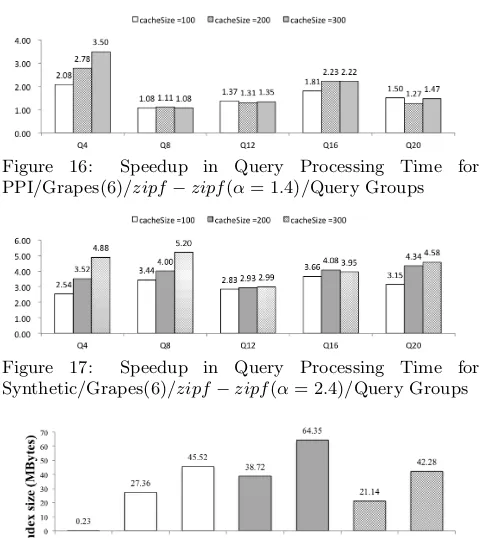
query graphs g with the higher utility; i.e., which help to avoid expensive subgraph isomorphism tests against graphs in the candidate sets. Fig. 16 and Fig. 17 show the speedup for the query processing time, corresponding to Fig. 10 and Fig. 11, respectively.
Last, Fig. 18 plots the index size foriGQ forC=500 graph queries, versus that of the three algorithms we’ve considered so far, for the AIDS dataset. In the default configurations,
iGQ adds a negligible space overhead on top of the base indexes (less than 1%). In addition to the default config-urations for said algorithms, Fig. 18 also plots the index sizes for the immediately larger configurations (i.e., for max path length of 5 for Grapes and GGSX, and for trees of size 7, cycles of size 9, and 8192 bits per bitmap for CT-Index). Note that this minimal increase in the feature size results in almost double the space requirements for the base indexes. On the other hand, these larger indexes bring a per-formance improvement of less than 10% in all cases (figure omitted due to space reasons), which is virtually negligible when compared to the gains provided byiGQ.
Overall,iGQ is shown to introduce significant to impres-sive performance gains, against the state of the art methods in the literature. We have actually conducted a detailed per-formance evaluation of most related algorithms[21] and se-lected GGSX, Grapes(1), Grapes(6), and CT-Index as those showing the best performance. Regardless of the method, when incorporating iGQ with it, large performance gains ensue. These gains are robust and are manifested in all four different query workloads we have presented and, most im-portantly, with a minimal space overhead.
8.
CONCLUSIONS
We have presented a novel perspective and solution to the graph querying problem, departing from related work in three ways: First, it constructs query indexes, as op-posed to simply relying on dataset graph indexes. Second, it maintains the knowledge the system produced when exe-cuting previous queries. Third, it can be used to expedite both subgraph and supergraph queries. We showed how these can help improve the performance of future queries and provided formal proof of correctness. The proposediGQ framework consists of (i) a subgraph index, (ii) a supergraph index, (iii) a method for efficiently maintaining the index,
Figure 16: Speedup in Query Processing Time for PPI/Grapes(6)/zipf−zipf(α= 1.4)/Query Groups
Figure 17: Speedup in Query Processing Time for Synthetic/Grapes(6)/zipf−zipf(α= 2.4)/Query Groups
Figure 18: Absolute Index Sizes (in MBytes) for AIDS
including a graph replacement policy, and (iv) any popular method for indexing and processing subgraph or supergraph queries. We incorporated iGQ within 3 popular methods from related work, showcasing its wide applicability. Last, our performance evaluation on both real-world and synthetic datasets with various query workloads showediGQ’s signif-icant performance gains and negligible space overhead.
9.
REFERENCES
[1] F. N. Afrati, D. Fotakis, and J. D. Ullman.
Enumerating subgraph instances using Map-Reduce.
InProc. IEEE ICDE, pages 62–73, 2013.
[2] A. Balmin, F. Ozcan, S. K. Beyer, J. R. Cochrane, and H. Pirahesh. A framework for using materialized XPath views in XML query processing. InProc. VLDB, pages 60–71, 2004.
[3] V. Bonnici, et al. Enhancing graph database indexing by suffix tree structure. InProc. IAPR PRIB, 2010.
http://cs.nyu.edu/shasha/papers/graphgrep/. [4] R. V. Bruggen.Learning Neo4j. O’Reilly Media, 2013. [5] C. Chen, X. Yan, P. S. Yu, J. Han, D.-Q. Zhang, and
X. Gu. Towards graph containment search and indexing. InProc. VLDB, 2007.
[6] J. Cheng, Y. Ke, A. W.-C. Fu, and J. X. Yu. Fast graph query processing with a low-cost index.VLDBJ, 20(4):521–539, 2010.
[7] J. Cheng, Y. Ke, W. Ng, and A. Lu. FG-index: towards verification-free query processing on graph databases. InProc. ACM SIGMOD, 2007.
[8] L. Cordella, P. Foggia, C. Sansone, and M. Vento. Performance evaluation of the VF graph matching algorithm. InProc. ICIAP, 1999.
[image:12.595.307.548.86.355.2]A (sub) graph isomorphism algorithm for matching large graphs.IEEE TPAMI, 26(10):1367–1372, 2004. [10] W. de Nooy, A. Mrvar, and V. Batagelj.Exploratory
Social Network Analysis with Pajek. Cambridge
University Press, 2005.
[11] K. Degtyarenko, J. Hastings, P. de Matos, and M. Ennis. Chebi: An open bioinformatics and cheminformatics resource.Curr. Protoc.
Bioinformatics, 14(26):1–20, 2009.
[12] R. Di Natale, A. Ferro, R. Giugno, M. Mongiov`ı, A. Pulvirenti, and D. Shasha. Sing: Subgraph search in non-homogeneous graphs.BMC bioinformatics, 11(1):96, 2010.
[13] M. Elseidy, E. Abdelhamid, S. Skiadopoulos, and P. Kalnis. GRAMI: Frequent subgraph and pattern mining in a single large graph.PVLDB, 7(7), 2014. [14] M. Garey and D. Johnson.Computers and
Intractability: A Guide to the Theory of
NP-Completeness. W.H. Freeman, 1979.
[15] R. Giugno, V. Bonnici, N. Bombieri, A. Pulvirenti, A. Ferro, and D. Shasha. Grapes: A software for parallel searching on biological graphs targeting multi-core architectures.PloS One, 8(10):e76911, 2013.http://ferrolab.dmi.unict.it/GRAPES/. [16] R. Giugno and D. Shasha. GraphGrep: A fast and
universal method for querying graphs. InProc. IEEE ICPR, 2002.
[17] W.-S. Han, J. Lee, M.-D. Pham, and J. X. Yu. iGraph: A framework for comparisons of disk-based graph indexing techniques.PVLDB, 3(1-2):449–459, 2010. [18] H. He and A. K. Singh. Closure-tree: An index
structure for graph queries. InProc. IEEE ICDE, 2006.
[19] Y. He, et al. Structure of decay-accelerating factor bound to echovirus 7: a virus-receptor complex.
PNAS, 99:10325–10329, 2002. [20] InfiniteGraph.
http://www.objectivity.com/infinitegraph. [21] F. Katsarou, N. Ntarmos, and P. Triantafillou.
Performance and scalability of indexed subgraph query processing methods.PVLDB, 8(12), 2015. [22] K. Klein, N. Kriege, and P. Mutzel. CT-index:
Fingerprint-based graph indexing combining cycles and trees. InProc. IEEE ICDE, 2011.
[23] G. Koloniari and E. Pitoura. Partial view selection for evolving social graphs. InProc. GRADES, 2013. [24] L. Lai, L. Qin, X. Lin, and L. Chang. Scalable
subgraph enumeration in MapReduce.PVLDB, 2015. [25] J. Lee, W.-S. Han, R. Kasperovics, and J.-H. Lee. An
in-depth comparison of subgraph isomorphism algorithms in graph databases.PVLDB, 6(2):133–144, 2012.
[26] K. Lillis and E. Pitoura. Cooperative XPath caching.
SIGMOD’08, pages 327–338, 2008.
[27] C. Liu, X. Yan, L. Fei, J. Han, and S. P. Midkiff. Sober: Statistical model-based bug localization. In
Proc. ESEC/FSE, 2005.
[28] G.Malewicz, et al. Pregel: a system for large-scale graph processing. InProc. ACM PODC, 2009. [29] B. Mandhani and D. Suciu. Query caching and view
selection for XML databases. InProc. VLDB, pages
469–480, 2005.
[30] NCI - DTP AIDS antiviral screen dataset.http: //dtp.nci.nih.gov/docs/aids/aids_data.html. [31] M. Newman. Power laws, Pareto distributions and
Zipf’s law.Contemporary Physics, 46:323–351, 2005. [32] E. Petras and C. Faloutsos. Similarity searching in
medical image databases.IEEE TKDE, 9(3), 1997. [33] T. Plantenga. Inexact subgraph isomorphism in
MapReduce.J. Parallel Distrib. Comput., 73:164–175, 2013.
[34] PubChem.https://pubchem.ncbi.nlm.nih.gov/. [35] K. Semertzidis and E. Pitoura. Durable graph pattern
queries on historical graphs. InProc. IEEE ICDE, 2016 (to appear).
[36] Z. Sun, H. Wang, H. Wang, B. Shao, and J. Li. Efficient subgraph matching on billion node graphs.
PVLDB, 5(9):788–799, 2012.
[37] Y. Tian and J. M. Patel. Tale: A tool for approximate large graph matching. InProc. IEEE ICDE, 2008. [38] Twitter FlockDB.
https://github.com/twitter/flockdb. [39] J. R. Ullmann. An algorithm for subgraph
isomorphism.J. ACM, 23(1):31–42, 1976. [40] D. W. Williams, J. Huan, and W. Wang. Graph
database indexing using structured graph decomposition. InProc. IEEE ICDE, 2007. [41] X. Yan, P. S. Yu, and J. Han. Graph indexing: a
frequent structure-based approach. InProc. ACM
SIGMOD, 2004.
[42] X. Yan, F. Zhu, P. S. Yu, and J. Han. Feature-based similarity search in graph structures.ACM TODS, 31(4):1418–1453, 2006.
[43] D. Yuan and P. Mitra. Lindex: a lattice-based index for graph databases.VLDBJ, 22(2):229–252, 2013. [44] D. Yuan, P. Mitra, and C. L. Giles. Mining and
indexing graphs for supergraph search.PVLDB, 6(10), 2013.
[45] S. Zhang, M. Hu, and J. Yang. TreePi: A Novel Graph Indexing Method. InProc. IEEE ICDE, 2007.
[46] S. Zhang, J. Li, H. Gao, and Z. Zou. A novel approach for efficient supergraph query processing on graph databases. InProc. EDBT, 2009.
[47] S. Zhang, J. Yang, and W. Jin. Sapper: subgraph indexing and approximate matching in large graphs.
PVLDB, 3(1-2):1185–1194, 2010.
[48] P. Zhao and J. Han. On graph query optimization in large networks.PVLDB, 2010.
[49] P. Zhao, J. X. Yu, and P. S. Yu. Graph indexing: tree + delta>= graph. InProc. VLDB, 2007.
[50] X. Zhao, et al. Efficient processing of graph similarity queries with edit distance constraints.VLDBJ, 22(6):727–752, Dec 2013.
[51] G. Zhu, X. Lin, W. Zhang, W. Wang, and H. Shang. Prefindex : An efficient supergraph containment search technique. InProc. SSDBM, 2010. [52] Y. Zhu, J. Yu, and L. Qin. Leveraging graph
dimensions in online graph search.PVLDB, 8(1), 2014. [53] L. Zou, L. Chen, J. Yu, and Y. Lu. A novel spectral