Original citation:
Bilton, Chris (2012) Happenstance report. Coventry, UK: Centre for Cultural Policy Studies, University of Warwick..
Permanent WRAP url:
http://wrap.warwick.ac.uk/60702
Copyright and reuse:
The Warwick Research Archive Portal (WRAP) makes this work of researchers of the University of Warwick available open access under the following conditions. Copyright © and all moral rights to the version of the paper presented here belong to the individual author(s) and/or other copyright owners. To the extent reasonable and practicable the material made available in WRAP has been checked for eligibility before being made available.
Copies of full items can be used for personal research or study, educational, or not-for-profit purposes without prior permission or charge. Provided that the authors, title and full bibliographic details are credited, a hyperlink and/or URL is given for the original metadata page and the content is not changed in any way.
A note on versions:
The version presented in WRAP is the published version or, version of record, and may be cited as it appears here.
Digital R&D Fund
for the
Arts
HAPPENSTANCE
REPORT
Chris Bilton
Centre for Cultural Policy Studies
University of Warwick
HAPPENSTANCE REPORT
Chris Bilton
Centre for Cultural Policy Studies University of Warwick
Coventry CV4 7AL [email protected]
Contents
Executive Summary ... 3
Introduction ... 7
i What is Happenstance? ... 7
ii Research aims ... 8
iii Research Process ... 9
iv Research methods ... 10
v Overview of the residencies ... 10
vi Limitations and parameters of the research ... 12
PART 1: the Innovation Process – using agile principles to bridge experimentation and adaptation ... 14
1.1. Introducing Agile ... 16
1.2 Beyond Agile: managing the innovation process ... 24
PART 2: Embedding Innovation – from one-off initiative to long-term impact ... 29
2.1 Embedding innovation: a three-phase process ... 31
2.2 Pre-Production ... 33
2.3 Post-Production ... 37
2.4 Closing the loop: an iterative process ... 42
Conclusion: Happenstance as a model for digital innovation in the arts? ... 45
Appedix: Evernote Tags ... 47
References ... 48
List of Figures
Figure 1: The Happenstance Project participants ... 8Figure 2: The Happenstance model of digital innovation in the arts ... 15
Figure 3: Happenstance: zone of irrelevance, zone of predictability ... 25
Figure 4: Happenstance – the innovation cycle ... 30
Figure 5: Embedding innovation: a three-phase process ... 31
Executive Summary
The Happenstance Project consisted of a series of creative technology residencies, placing three pairs of creative technologists into three arts organisations. The primary aim of the project was to consider how digital technology and creative uses of technology can become ‘embedded’ in arts organisations. The project was one of eight schemes selected for the pilot Digital R&D Fund for Arts and Culture, launched by Nesta, Arts Council England and the Arts and Humanities Research Council (AHRC) in autumn 2011.
The project took place over approximately 12 weeks from March 2012 to May 2012 at Site Gallery in Sheffield, at Lighthouse in Brighton and at Spike Island at Bristol. The six residents were given an open brief, required to initiate innovative digital projects in response to the challenges and opportunities they identified in each organisation.
The research aims of Happenstance can be summarised as follows:
Identify the cultural conditions which support or prevent short-term digital innovation becoming ‘embedded’ in the ongoing practice of an arts organisation.
Identify differing attitudes, expectations and practices towards digital innovation between creative technologists and arts organisations (particularly attitudes to risk and failure, differing processes and methods).
Identify a distinctive approach to innovation (R&D) in arts organisations.
Identify outputs and outcomes of the residencies and evaluate the success of the project.
Part One of the report examines the innovation process, describing a model for digital innovation in arts organisations we observed during the residencies. This model is based on a combination of a product-based manufacturing approach to innovation, and a more flexible, user-oriented approach typically applied in service industries. The Happenstance residencies connected these two approaches using ‘agile’ principles to bridge experimental product-based innovation by residents and a more adaptive approach to innovation by the arts organisations.
The report’s key findings about innovation process are:
‘Agile’ principles, adapted from software development, provided a useful framework for
managing digital innovation in arts organisations. The approach provided space for an open-ended, experimental approach to digital technology combined with a pragmatic, adaptive approach to project outcomes. This combination was essential to the Happenstance Project, encompassing the two criteria of ‘novelty’ and ‘fitness for purpose’ necessary for innovative outcomes.
Agile principles and short time frames also encouraged technologists and arts
The Happenstance Project encouraged participants (arts organisations and technologists) to reflect on the innovation process and to share ideas at a formative stage, using communication technologies to make these ideas visible and available.
Regular face-to-face interaction was a good stimulus for developing and capitalising on
innovative ideas. Because they draw upon specialist and individual skills, technology development and arts organisations both depend upon collaboration and networking.
Technologists are good at solving the ‘how’ questions – finding more efficient, effective ways of solving problems. Arts organisations are good as answering and asking the ‘why’ questions – considering the value and purpose of an innovative idea. The Happenstance project combined these approaches through dialogue and mutual learning.
Innovative outcomes can be triggered at one remove from the point of intervention. This ‘oblique innovation’ effect depended upon an open-minded, adaptive approach from the arts organisation, and a willingness to surrender or redirect creative impulses from the technologist.
Despite an appearance of serendipity, Happenstance relied upon deliberate
management of the innovation process. Arts organisations had to be prepared to sacrifice their strategic objectives, technologists had to recognise that novel solutions were not necessarily valuable. This mutual adjustment was needed to avoid charges of irrelevant gimmickry on the one hand or predictable micro-management on the other, and depended upon mutual trust. Building mutual trust and managing expectations was a critical management task. This role was fulfilled largely by Caper and by senior staff in the organisations, creating the conditions for innovation to occur. These conditions are considered in the second half of the report.
Part Two of the report describes the organisational interventions which lie behind the innovation process and which allow one-off experimentation to become embedded into longer-term organisational change. These are considered under two headings, ‘pre-production’ and ‘post-‘pre-production’.
‘Pre-production’ describes the organisational assets which needed to be in place prior to the Happenstance Project, providing a ‘hidden’ base for innovative ideas to take root or take flight.
‘Post-production’ describes the organisational legacy of Happenstance for the organisation, from changes in behaviour and attitudes to the possibility of second generation innovations initiated by the organisation, in response to or adapted from the residencies.
At pre-production stage, the following ‘organisational assets’ were identified as critical to the success of the Happenstance Project:
‘Visible leadership’: senior managers who bought into the project at the start were able to involve and enthuse staff and build trust and consensus with the residents. This sometimes required a longer lead time, particularly for larger and more complex organisations.
‘Digital curiosity’: an openness to the possibilities of digital technology was more important than digital literacy (which tended to be unevenly distributed between and within the organisations).
Managing expectations: the residencies had to be kept at arm’s length from the organisation’s strategic objectives and expectations of other stakeholders in order to avoid pre-empting the innovation process.
Recruitment – residents needed to be ‘organisationally literate’ and attuned to the organisation’s needs. This was at least as important as their technical expertise. ‘Casting’ the right technologists to the right organisation was a specialist task, managed in this instance by Caper.
At the post-production phase, the following approaches were applied to ‘embed’ innovation within the organisation:
‘Selective retention’ of innovative ideas – ensuring that novel ideas connect with the purposes and values of the organisation, based on an assessment of anticipated future needs and potential as well as current priorities.
‘Glanceable’ technologies – technological solutions which can be understood ‘at a glance’ and so easily absorbed into the organisation’s operations. These ‘glanceable’ innovations would sometimes trigger changes in organisational behaviour beyond the original point of intervention.
Digital literacy and confidence – the legacy of Happenstance was as much to do with changes in attitude and capability as technological innovations. All of the participating organisations felt better prepared to initiate and tackle future technological challenges as a result of the residencies.
Outcomes (effects on behaviour and attitudes, sometimes referred to as ‘hidden innovation’) were at least as important to the legacy of Happenstance as outputs (quantifiable outputs including intellectual property).
The pre-production and post-production phases of Happenstance point to an iterative model of innovation within arts organisations through which externally initiated innovations (technological or otherwise) can become embedded in the organisation’s underlying culture and ethos, providing a basis for a second round of innovation beyond the initial stimulus. Whilst it is early to predict these future outcomes, there were sufficient indications of this oblique innovation effect during and immediately after Happenstance for us to conclude that the project was successful in its overall aim of ‘embedding’ digital innovation in arts organisations, not least in changing attitudes and behaviour.
From a cultural policy perspective, Happenstance demonstrated that the interaction between arts organisations and digital technologists can instigate cultural change, opening up new ways of collaborating and communicating within teams and new approaches to project management. This interaction is more likely to be productive if both sides are primed to adapt to the other, from senior management downwards, and if the pressure to produce quick results is balanced by a more open-ended expectation of incremental change on both sides. Some of the principles of Happenstance – short, focused residencies, an open brief to engage creatively with the organisation, focus on communication and collaboration – could be applied to any residency, not only to one involving digital technology.
Introduction
i
What is Happenstance?
The Happenstance1 Project consisted of a series of creative technology residencies, placing three pairs of creative technologists into three arts organisations for approximately twelve weeks from March 2012 to June 2012. The project was conceived by Rachel Coldicutt at Caper, a digital agency with experience of running ‘hack days’, managing digital projects and devising digital strategies, and by Laura Sillars, co-director of Site Gallery in Sheffield.
The primary aim of the project was to consider how digital technology and creative uses of technology can become ‘embedded’ in arts organisations. The project was one of eight schemes selected for the pilot Digital R&D Fund for Arts and Culture, launched by Nesta, Arts Council England and the Arts and Humanities Research Council (AHRC) in autumn 2011. The Fund supports arts and cultural organisations to work with digital technology partners on research and development projects using digital technology to enhance audience reach and/or explore new business models. The funders recognised the contribution external researchers could make to understanding digital innovation in the arts, and as a result each pilot project was also paired with a research team.
Alongside Site Gallery, Lighthouse in Brighton was identified as a second arts organisation, and worked closely with Caper and Site during the project planning phase. The third arts organisation, Spike Island, was recruited in November 2011. The Warwick research team2 also joined the project in November 2011.
The Happenstance methodology was influenced by Australia’s ‘Geek in Residence’3
programme supported by the Australia Council, which invited technologists (and ‘technologically confident artists’) to pursue innovative projects with arts organisations. The main difference was that the Happenstance residencies placed a greater emphasis on open-ended organisational change rather than on self-contained projects and specified outcomes.
Following some initial scoping of the aims of the project, Caper began to search for suitable technology residents and candidates were interviewed at Nesta’s offices in London in January 2012. The technologists included designers, developers, programmers, user experience designers, and combinations thereof; a few pairs applied jointly but most applied as individuals, and the three pairs eventually selected for Happenstance had not worked together previously. An induction day was held for the six selected ‘residents’ at their respective ‘host’ organisations in March 2012. Both the selection and induction process were conducted as ‘sandpit’ events, with rapid exchanges of ideas driving fast prototypes. This ‘agile’ approach to innovation was established by Caper as a working model for the project as a whole and will be discussed in Part 2 of this report. Whilst most of the residents were familiar with some of the principles of ‘agile’ innovation, the recruitment day was the first exposure to this approach for the arts organisation staff.
The residencies began the week after the induction, with residents expected to spend two to three days per week with their hosts. Each residency was broken into two five-week
1 The name ‘Happenstance’ was devised by Ruth Leary at an initial project planning meeting in November 2011. 2 The Warwick research team consists of Chris Bilton, Ruth Leary and Katherine Jewkes.
3 http://www.australiacouncil.gov.au/grants/2013/geek-in-residence - Australia Council continues to support the Geek in Residence
‘sprints’, the first running 19th March to 20th April, the second running 23rd April to 25th May. The original intention was that the first sprint should be more ‘organisation-led’ and the second more ‘resident-led’. In practice the two sprints merged into one and the residents and organisations were allowed to develop their own method of collaboration over the ten week duration. Each ‘sprint’ ended with an open house session, inviting local arts organisations, digital enthusiasts and friends of the organisation to hear about work in progress on the Happenstance Project. The residencies also generated much discussion on the purpose and value of digital technology in arts organisations through postings on the Happenstance blog as well as regular conversations between residents and staff members. A final debrief with Caper took place approximately two months after the residencies finished.
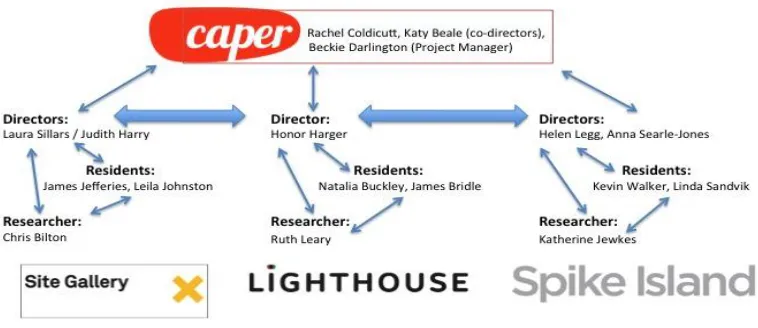
[image:10.595.120.499.372.536.2]The residents were: James Jefferies and Leila Johnston (Site): James Bridle and Natalia Buckley (Lighthouse); Kevin Walker and Linda Sandvik (Spike Island). The University of Warwick research team attached to the project consisted of Chris Bilton, Ruth Leary and Katherine Jewkes. For data collection purposes, each researcher took a lead role with one of the three arts organisations – Site Gallery (Bilton), Lighthouse (Leary) and Spike Island (Jewkes) – whilst also maintaining regular contact with each other and with Caper.
Figure 1 The Happenstance Project participants
ii
Research aims
residency were left deliberately open-ended in order to allow different outcomes and objectives to emerge collaboratively through the duration of the project. Emphasis was placed on practical tasks and interventions, not on strategic orientation.
Happenstance was from the outset research-led, with the academic research team invited to follow through on some broad research aims built into the project design by Caper and the arts organisations. Research aims can be summarised as follows:
Identify the cultural conditions which support or prevent short-term digital innovation becoming ‘embedded’ in the ongoing practice of an arts organisation.
Identify differing attitudes, expectations and practices towards digital innovation between creative technologists and arts organisations (particularly attitudes to risk and failure, differing processes and methods).
Identify a distinctive approach to innovation (R&D) in arts organisations.
Identify outputs and outcomes of the residencies and evaluate the success of the project.
In relation to the objectives of the funders, these broad research aims related to the funders’ interest in ‘new business models’ (in particular the organisational structures, cultures and processes through which any business model must be developed and applied) and to an improved understanding of the processes of ‘R&D’ employed by digital technologists and the arts.
To summarise the Happenstance project focuses on two key issues which are relevant to any interaction between arts organisations and digital R&D. These are documented in the two main parts of this report. In the first part we examine a distinctive approach to innovation which we believe combines the capabilities and cultures of arts organisations and of digital technologists. In the second part of our report we examine the organisational mechanisms and behaviours which allow this distinctive approach to innovation to occur. We believe these two themes are of particular relevance to the Digital R&D Fund, and more broadly to processes of innovation and technology adoption in arts organisations.
iii
Research Process
The research project was divided into three phases, which correlate to the research aims noted above.
Phase One was an initial comparison of the three arts organisations, aiming to establish the starting point for the residencies in terms of expectations and initial conditions. This part of the research identified similarities and differences across the organisations in terms of organisational structure, attitudes to risk, attitudes to technology, and indications of commitment or resistance to the Happenstance Project among staff. These observations are incorporated into the second part of this report, where we identify the organisational conditions for innovation and highlight some key requirements for other organisations wishing to replicate or build upon the Happenstance experiment.
understanding of the distinctive methods, attitudes and processes underpinning innovation among arts organisations and technologists respectively. These observations are incorporated into the first part of the report where we describe a model for digital innovation in arts organisations based on the Happenstance Project.
Phase Three of our research was an attempt to summarise the outputs and outcomes of Happenstance, drawing on interviews and reflections at the end of the residencies, and connecting these to broader reflections on implications and adaptations for future projects. A distinction was made between outputs (the achievements and results of each residency) and outcomes (the uses to which these outputs were directed). Outcomes also extended to cover secondary changes in the organisation, including changes in behaviour, culture or attitude. Rather than list these separately, we have incorporated project outcomes into the ‘post-production’ discussion in the final part of this report.
iv
Research methods
Research was conducted through regular visits (roughly once per week) to each arts organisation by members of the research team, supplemented by occasional Skype or phone conversations if participants were not available on the day. One member of the research team was allocated to each arts organisation: Site Gallery (Chris Bilton); Lighthouse (Ruth Leary); Spike Island (Katherine Jewkes).
At each visit the researchers spoke to the residents and to the lead contact in the arts organisation (Judith Harry at Site, Honor Harger at Lighthouse, Anna Searle Jones at Spike Island). They also spoke to other members of staff outside the senior management team to gain a different perspective on the project. Additional interviews were conducted with the organisation’s funders and board members and with the local mentors attached to the project, as well as with Caper (Rachel Coldicutt, Katie Beale, Beckie Darlington).
All notes and observations were collated through Evernote, a shared online notebook compatible with laptops and mobile devices, and were tagged using a series of hash tags agreed by the research team. This allowed researchers to cluster observations thematically from across all three arts organisations. Further details including the hash tags can be found in Appendix A.
v
Overview of the residencies
This report does not aim to provide a detailed listing of all the activities undertaken in each of the Happenstance residencies. Before proceeding to consider Happenstance as a model for digital innovation in the arts, a brief overview of the principal activities and achievements as well as the organisational context is provided here:
staff members when not working in the gallery or shop downstairs. The first two weeks of the residency were largely consumed by initial meetings and developing potential ideas, buying in equipment (Arduino kits) and trouble-shooting some technological problems for the organisation following the recent departure of their technical support manager. The principal achievement in the first ‘sprint’ was the development of two thermal receipt printers (similar to those on a cash till), nicknamed ‘Cathy’ and ‘Heathcliff’. These were connected up to email, twitter and a phone line (with voicemail) allowing staff and visitors to interact with them and providing a mechanism for logging online interactions via the Site blog or twitter feed. The residents were invited to present work in progress at TedX in Sheffield and also spoke about Happenstance together with other residents at the Future Everything conference in Sheffield. The second sprint was more pragmatically focused on the organisation, with residents contributing to a branding workshop with external consultants, helping to redesign Site’s website and discussing potential applications of technology in the gallery, including a possible ‘curator app’ in discussion with Site’s artistic director.
Lighthouse Media: Lighthouse is a digital culture agency in Brighton with a gallery space, studios and office space. Lighthouse is heavily involved in promoting digital media culture in the Brighton area and was busy hosting the BFI Shorts film competition during the residency and planning its involvement in the Brighton Festival. The first project in the residency was ‘Offbot’, a virtual office gossip, which allowed staff to share ideas and projects and which then aggregated this material and made emerging ideas and hidden activities available across the organisation. Unlike more formal reporting mechanisms, Offbot captured spontaneous and immediate reflections on work in progress and cut across organisational hierarchies. In the second sprint the two residents, James Bridle and Natalia Buckley, developed some of these themes separately. James Bridle’s next project was ‘This Is a Working Shop’, an attempt to explore the ‘craft’ of coding, making the rules, constraints and processes behind code more visible / tangible and foregrounding the unseen creative work behind websites and applications, a set of processes and products which we routinely take for granted. Meanwhile Natalia Buckley ran open lunchtime workshops on coding for staff and other users of the building and also introduced some ‘agile’ principles to office work such as stand-up meetings, and a temporary ban on email communication. The residents continued to work together on Offbot which emerged as a significant output from Happenstance with potential value for future projects.
Harbourside and was the largest and most dispersed of the three arts organisations, with around 500 users coming through the building every day. Spike Island was also the last arts organisation to join Happenstance, approximately three months after the other two. The two residents, Kevin Walker and Linda Sandvik, initially had trouble knowing where to locate themselves in the building and began by attempting to work in a ‘public’ space where they could interact with the diverse users of the building. However, it proved difficult to engage with the whole organisation in this way and by the time the second sprint started they had moved into the main open plan office. Kevin worked on a gallery project implanting digital information into artists’ postcards, allowing users to access information and contacts with artists based in the building. Linda’s first project was to invite users of the building to share photographs via email or Twitter using the hashtag #myspikeisland which were then fed into a small Polaroid printer working over Bluetooth. The residents continued to work on separate projects through the second sprint, with Kevin introducing digital skills and tools to the core staff team through a combination of workshops and one to one ‘coaching’ sessions, whilst Linda invited local designers and developers to a ‘design jam’ responding to the challenge ‘how can we make a visit to an art gallery more compelling and rewarding?’
vi
Limitations and parameters of the research
Our research aims to document the long-term effects of digital innovation on an arts organisation, as well as the underlying long-term causes which allow one-off digital innovation to become organisationally ‘embedded’. In a research project spanning approximately six months, it was difficult to provide robust primary evidence of long-term causes and effects of innovation. We are therefore dependent on our assessment of future outcomes, supported by the observations and opinions of the participants in the projects. In documenting the Happenstance Project we have tried to capture the processes and behaviours before and after an innovative project occurs, rather than listing a series of outcomes. This is not because we regard the one as more important than the other, but because we want to understand the connections between them. Through this report we will argue that adoption of ‘digital thinking’ in an arts organisation or of more positive attitudes to technology are directly connected to successful project outcomes (and vice versa).
The three arts organisations featured in this report are not typical or representative, and this report does not claim to establish a template for other organisations to follow. The Happenstance Project was the consequence of a series of choices and actions which framed a series of innovative residencies. The residencies were carefully managed by Caper to avoid conflict and frustration and to ‘embed’ digital innovation in each arts organisation. We have attempted to capture these aspects of the project, and to show how planning and adaptation are a necessary part of the innovation process. The model of innovation presented in this report is therefore not perfect; it depends on a specific set of circumstances and would need to be adapted according to the unique character, scale, history and structure of each organisation. Nevertheless we believe that the Happenstance model represents a distinctive approach to managing innovation which can, with some adjustments, be effective in arts organisations.
PART 1: The Innovation Process – using agile principles to bridge experimentation
and adaptation
The first part of our report describes a model for digital innovation in arts organisations, based on our observations of the Happenstance residencies over a twelve week period. The second part of our report considers how the resulting innovation can become ‘embedded’ in the organisation, through a combination of project design and organisational adaptation.
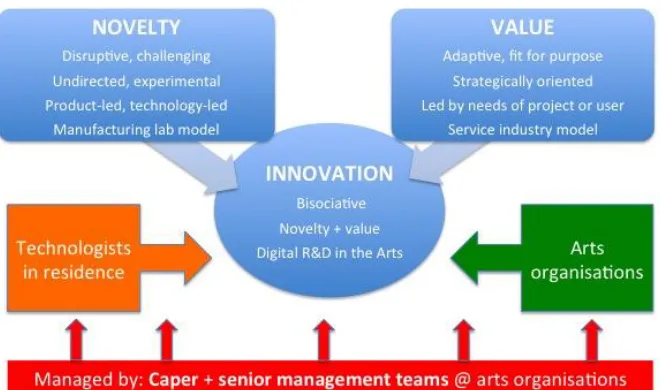
Understanding how R&D works in arts organisations was a key concern for the funders of our project (Bakhshi and Throsby 2010, p. 11 – 13). Happenstance provides an opportunity to formulate an approach to innovation or ‘R&D’ in arts organisations, combining the input-driven approach of manufacturing industry with the more user-led approach of service industry innovation. Manufacturing industry invests in research as a core activity and there is a correlation between a systematic investment in R&D (dedicated staff time, physical infrastructure such as a research laboratories or product development units) and innovative outcomes. In service industries innovation is more often a response to users’ needs or the requirements of a specific project and is not confined to a separate R&D unit or laboratory. Innovative outcomes in a service industry setting thus result from project-based, sporadic problem-solving, and are often co-created with users, employees and partners (Bessant 2003, Sundbo 1998, Toivonen 2010).
Like a service industry company, the arts organisation’s approach to innovation is shaped by their relationship with users. Maintaining and nurturing relationships with audiences, artists and other stakeholders (including funders, other organisations in the sector) was a critical priority for the directors of Site Gallery, Lighthouse and Spike Island. In some instances, this could be voiced as anxiety or resistance over the value or purpose of new technology (this will be discussed further in Part 2 of this report). All of the managers had a keen sense of the needs of their users and sought to orient innovation towards valuable outcomes for particular projects or users. The technologists in residence had no such sense of responsibility; indeed the design of the Happenstance model deliberately distanced them from these pragmatic concerns.
Figure 2 The Happenstance model of digital innovation in the arts
The innovation process in Happenstance can also be understood as a tension between experimental risk-taking (research) and organisational adaptation (development). This ‘R&D’ dualism correlates to processes of ideation or experimentation on the one hand and the application or adaptation of these ideas on the other (Kirton 1984). As Kirton indicates, the combination of these elements in innovation processes requires a social interaction between different competences and personality types.
A note of caution is needed here – any innovation process worthy of the name will of course combine both sides of this equation. Indeed the combination of ‘novelty’ and ‘value’ is fundamental to theories of creativity as a bisociative, multifunctional process (Bilton 2007; Boden 1994 75 – 76; Bilton and Cummings 2010). Arts organisations are certainly capable of disruptive, input-driven innovation. Indeed the part played in Happenstance by the technologists in residence would in other circumstances more typically be played by artists. Artists, like technologists, frequently come up with innovative ideas which jar against strategic and operational priorities of adaptive innovation in the organisation. Complaints about ‘gimmicky’ or ‘pointless’ technology are not dissimilar to complaints against ‘self-indulgent’ artists. The occasional friction we observed between technologists and arts organisations during Happenstance is inherent in the innovation process and managing these tensions is an essential task in any creative organisation.
project within clear parameters (project duration, number of residents, recruitment, rules of engagement, methodology) – whilst leaving the outcomes open-ended. But it also required mutual adjustment from both technologists and arts organisations throughout the residencies – this project management function at times implicated members of the research team who continued to be in regular contact with the residents and organisations. We will consider how the innovation process was managed by Caper in the second part of the report. First we will examine the process of idea generation during the residencies, relating this to principles of ‘agile’ software development.
1.1. Introducing Agile
Happenstance’s distinctive solution to the tensions between ‘experimentation’ and ‘adaptation’ was to introduce a set of principles governing the innovation process. At the start of Happenstance, Caper introduced the idea of ‘agile’ development, a flexible approach to software development which emphasises collaborative, adaptive teamwork practices, efficient software engineering and quick design cycles through self-organising, explorative work (Aoyama 1998; Schwaber 2002) in an environment of mutual trust and respect (Agile Manifesto 2001). The key principles are flexible people, processes and technologies (Gunasekaran & Yusuf 2002) with a focus on ‘collaborative work, concrete results, delivering value and minimising waste’ (Shore 2007). This style of working allows for rapid prototyping and ‘shipping’ (Godin, 2010) and continuous development of outcomes and team interaction.
In the event, it was decided not to adopt a formal ‘agile’ process for the residencies. The arts organisations were uneasy with an unfamiliar methodology and the residents argued that the approach could not be transferred wholesale from software development to arts organisations. Nevertheless some of the principles behind an ‘agile’ philosophy remained. For example, the daily meetings (‘stand-ups’ or ‘scrums’) used to manage agile software development were difficult to apply in practice due to unavailability of senior managers; perhaps too the arts organisations were more familiar with lengthy staff meetings than with the short sharp ‘agile’ format and balked at this additional commitment. Despite this, the principle of capturing and reflecting on progress was retained, as was an emphasis on ‘face-to-face conversation’.
The Agile Manifesto (sort of) on display at Lighthouse during Happenstance (Photo: Natalia Buckley)
Innovate first, plan later
“Responding to change over following a plan” (Agile Manifesto).
In order to allow scope for the residents to step outside organisational routines and encourage an open-ended approach to innovation, Happenstance did not provide a defined brief to the residents. Instead each arts organisation identified a number of challenges and issues and allowed the residents autonomy in choosing how to respond to them. Many of the issues centred on concerns about communication, both internally (capturing and reflecting on ideas and resources within the organisation) and externally (communicating with audiences, organisational identity).
Although it had been emphasised that the residencies should not be tied to specific targets and outputs, anxieties over a lack of identifiable targets recurred throughout the project, both for the organisations and the residents. This tension between process and product reflects a two phase theory of innovation and the creative process, in which an initial phase of ideation and experimentation is followed by a phase of adaptation and application (Figure 2 above). Happenstance aimed to combine both these phases, protecting a space for innovation which is not constrained by organisational priorities, but then allowing the results of these innovations to be adopted selectively and incorporated into organisational resources, systems and processes. To put it bluntly: ‘innovate first, plan later’.
separately from the organisation in order to generate ideas, then bring these back into the organisation. A third method was to require residents to continually make projects and ideas which could then be simultaneously adopted, adapted or rejected by the organisation.
In the end this parallel processing approach, combining experimentation and adaptation, was in our view the most successful – and the most ‘agile’. Splitting the residency between ‘experimental’ and ‘applied’ phases tended to provoke mutual frustration, reinforcing a perception that the former was self-indulgent and irrelevant to the organisation, and that the latter was unimaginative and irrelevant to the aims of Happenstance (and a waste of the residents’ special skills). The day release allowing residents to work off site was useful in allowing them some thinking time, but it also was sometimes seen to disconnect the residents from the organisation, reducing the already limited contact time available. The parallel processing approach followed the ‘agile’ principle of valuing ‘individuals and interactions over processes and tools’ – it depended on trust and conversations, and it valued ‘responding to change over following a plan’.
Agile principles also introduced a different attitude to risk and failure. Technologists are used to ‘fast failing’, indeed there has been much discussion of the fetishisation of failure among technologists who regard failure as a learning opportunity. This is manifest in the building of low-cost experimental prototypes to find out what works, not as an end in itself but in order to learn for the next version. The arts organisations’ attitude to risk tended to be constrained by resources and by relationships with external stakeholders. Commissioning an exhibition, for example, involves a substantial investment of time, money and reputation; such projects carry substantial risks which also implicate the organisation’s relationships with funders, artists and audiences. In these circumstances failure is not an option – and fear of failure – both within the organisation and among its stakeholders – can have a chilling effect on innovation.
The ‘agile’ solution to this problem is to break projects down into smaller components and address each operational challenge as it occurs, rather than attempting to pre-empt anxieties about ‘success’ or ‘failure’ through strategic planning. In an agile methodology, success and failure are only relative terms – progress may be blocked on one part of the project, but outright failure is almost impossible. There is almost always another potential direction or solution available. Provided the organisation is not too heavily invested (literally and metaphorically) in one particular pathway, it should be possible to learn from difficulties, address them and move rapidly on to another solution. This is the principle behind the daily ‘scrum’ meeting, and whilst not all of the organisations adopted this methodology, some of the underlying ‘digital attitude’ was apparent – fast prototyping, trying and discarding methods until something works, adapting quickly to setbacks and working around them. In the words of one resident, ‘just because you don’t know how to do something doesn’t mean it’s difficult’.
(an active process) rather than as a noun (a blueprint to be followed), and objectives were continually recalibrated and reordered in response to progress.
Reflecting on progress
“At regular intervals, the team reflects on how to become more effective, then tunes and adjusts its behavior accordingly.” (Agile Manifesto).
The approach to planning described above requires an ability to reflect on progress. One of the emergent themes of Happenstance was a desire to make internal processes visible or transparent, both to the members of the organisation and to users and visitors. Both the arts organisations and the residents were required to reflect regularly on the process of innovation, not just on the outcomes. The residents contributed to a weekly Happenstance blog and met regularly both with the research team and with external mentors. The arts organisations were in regular contact with each other and with Caper via telephone, Skype and email. The reporting requirements on the residents especially were onerous and occasionally frustrating – residents expressed anxiety that they seemed to be spending more time talking about the work than on the residencies themselves.
However, the time spent on reflection was in the end no less productive than the time spent on making things. Simply by their presence in the building (apart from the first few weeks at Spike Island, all the residents were in a shared office space with core staff) there was a continual cross-fertilisation of ideas between residents and organisations. Staff in the organisation were able to witness not only project outcomes and solutions, but the process through which problems were solved. This was an important opportunity for learning and familiarisation. Similarly the residents were able to pick up on concerns and attitudes among the staff. Some of the most innovative projects to come out of the residencies emerged from these mutual observations in the open plan office. For the arts organisations, familiarisation and conversation resulted in an increasingly confident attitude towards technology, not just a transfer of skills.
The slow percolation of confidence, skills and knowledge within each organisation was difficult to evaluate but in the words of the director of Lighthouse, the residencies had been ‘more effective than a year’s worth of conferences and seminars’. This was especially valuable for Lighthouse as it sought to inhabit its role as a digital culture agency.
The residencies were also an opportunity to reflect on internal processes within each organisation. One consequence was to strengthen collaborative partnerships between the organisations, but also to rethink attitudes to risk and failure. As one of the directors pointed out, Happenstance provided them with a safe mechanism for talking about failure as, “We’re very bad at doing this – it’s perceived as a threat to our relationships with stakeholders.” In the words of one resident, “They have become a more reflexive organisation. They are thinking more about how they do stuff.” Directors found themselves conducting lengthy conference calls on their experiences and concerns, and the mere presence of the technologists forced the organisations to become more articulate and aware about their internal systems.
technologies; some of the projects they took on were based on ideas that the organisation had already floated but had been unable to capitalise on, and the residents had the tools to put these speculative ideas into practice. Similarly some of the technologies introduced by the residents were not in themselves innovative (using Kinect motion sensors to capture physical movement, for example) but became innovative as they took on a fresh purpose in the arts organisation. In an agile methodology, rather than simply beta testing ideas and approving or rejecting them, it is possible to accumulate a range of products and tools which can be retrieved for a variety of current and future projects. Some residents were explicit in their desire to leave behind a legacy of ideas and methods which the organisation could then tap into for future purposes. This accumulation of possibilities is very different from a straightforward problem-solving approach.
The communication technologies discussed in the next section of this report provided a mechanism for capturing and sharing fragments of ideas between projects and individuals and filling gaps in the institutional memory. Digital technologies make collecting and storing data for future retrieval relatively straightforward. By contrast the project-based nature of arts organisations makes them more likely to discard half-formed ideas which are not immediately fit for purpose. Some staff members commented that arts organisations are not always good at capturing and exploiting intangible assets. The residents were able to demonstrate how agile communication and data capture tools can address this deficiency.
Communication and visibility
“Business people and developers must work together daily throughout the project… […]…The most efficient and effective method of conveying information to and within a development team is face-to-face conversation.” (Agile Manifesto).
Reflective practice depends upon a further agile principle, the importance of regular communication, preferably face-to-face. A theme cutting across several projects was the potential for digital technologies to capture and communicate intangible processes and half-formed ideas. This had applications both for internal efficiencies and for engagement of audiences. For audiences digital tools can enrich the user experience by capturing the ideas and interactions before and behind an exhibit and making these available. At Spike Island, the technologists were able to connect static objects to the artists who made them by embedding digital information in postcards. The same principles could also be used to enrich and extend internal communication. At Lighthouse the residents piloted ‘Offbot’, a virtual office robot who invited staff to talk about their current activity, and made visible the collective patterns which emerged from their individual voices. The project encouraged staff members to revisit and re-evaluate apparently trivial or disposable information, extending beyond the more cursory, goal-oriented communication of email and more formal reporting of activities.
were not only technological but social. Rather than applying agile principles directly to project management, the resident in this example took a more oblique approach, borrowing from the principles in order to change the way the team interacted with each other. Whilst the residents did introduce some new communication technologies into the arts organisations, their real transformative effect may have been to encourage a more reflexive approach to internal communication.
Communication was also a way of making digital technologies more visible, tangible – and accessible. At Lighthouse, one of the residents introduced a project called ‘This Is A Working Shop’ which involved him sitting in a public space in the building, writing computer code, with the code projected on screen as he wrote it. The idea was to make visible the practical, tangible elements of writing code and to promote the idea of coding as a craft. Normally coding, like electricity, is invisible. The process behind the product is rarely acknowledged or understood. ‘This Is A Working Shop’ made observers recognise the everyday practice behind digital technology and the craft behind the coder’s art. Alongside ‘This Is A Working Shop’, the other Lighthouse resident began a lunchtime coding workshop in the main office. The two residents worked in tandem, steering the Lighthouse staff and other users of the building towards a different way of thinking about digital technology, making it less mysterious, more visible, tangible and accessible.
Many of the innovations introduced through Happenstance were essentially concerned with communication technology, using digital tools to capture informal conversations and make them visible (Offbot at Lighthouse), building a conversation between artists and gallery visitors (the Spike Island digital postcard project) or aggregating digital chatter and relaying that back into the organisation (using the networked thermal printers at Site Gallery). Yet as with many other aspects of ‘agile’ innovation in Happenstance, ‘agile communication’ was as much about introducing social processes as it was about introducing digital tools. Regular communication between the residents and the organisations not only laid the basis for other Happenstance projects but also fostered a greater internal awareness and reflexivity within and between the arts organisations. This reinforced a further principle of agile working that innovation should be ‘co-creative’, allowing clients, users and other staff members access to the innovation process.
People over process: networking
“Individuals and interactions over processes and tools.” (Agile Manifesto)
The Agile Manifesto prioritises the social interactions which drive technology over the technology itself. In the context of Happenstance, building trust and confidence between technologists and organisations took precedence over building hardware and software – in the sense that the former needed to be in place to facilitate the latter. The agile faith in the power of interaction translated into a faith in human potential. In the words of one of the arts organisation directors, ‘if you put brilliant people together, brilliant things will happen’. This trust in an open-ended process was one of the preconditions for Happenstance which will be discussed in Part 2 of this report. For now we can make two observations about the innovation process.
and tune out’ office conversations. Several of the projects already highlighted in this report – Offbot, the lunchtime coding sessions at Lighthouse, thermal receipt printers at Site Gallery, digital postcards at Spike Island – were both a product and reflection of office conversations. The residents were most effective when they were located in the main workspace. At Spike Island it was initially difficult to identify a suitable location for the residents because the building lacks an obvious focal point (there are several different entrances and several different constituencies and communities occupying different parts of the building); only during the second ‘sprint’ was this problem solved by moving the residents into the main office. Not surprisingly the residents were most effective when embedded in everyday routines, visibly present in the organisation and joining in the daily life of the organisation (including socialising in the café or pub). At Site Gallery one resident even relocated from London to Sheffield as a result of her involvement in Happenstance. But other residents demonstrated that it was also possible to build a routine intimacy even when commuting from a different city, provided there was sufficient engagement and buy-in to the life of the organisation.
The other significant interaction was between residents and a wider network including the local ‘digital community’ and personal contacts scattered across the UK. The technologists in residence were intuitively collaborative. When one of them hit a technical problem or simply needed a new suggestion, their first instinct was to get in touch with a colleague or contact. This networking was partly pragmatic – in order to share ideas and resources or to learn new skills – but also tapped into the arts organisations’ strategic aim to build profile and credibility in the digital sphere, locally and nationally.
The residents’ tendency to consult colleagues and share ideas demonstrated an ‘open innovation’ approach where expertise and ideas could be freely exchanged internally and externally. All of the software the residents developed, and much of the software they drew upon was open source. This collaborative approach was not in itself new to arts organisations; what was new was the realisation that this collaborative, social approach to innovation could be applied to technology development in their organisation. One organisation in particular had previously experienced the polar opposite of open source technology, employing an IT specialist who jealously guarded technological expertise and resources, even locking other staff members out of some parts of the website. Seeing the residents exchanging ideas, calling up friends for advice and sharing their knowledge with staff members was little short of revelatory. When the new technology manager was appointed midway through the residency, she enthusiastically embraced this more open style, working alongside the residents, learning from them, and working collaboratively with colleagues, so that technology became an extension of everyday problem-solving, not a separate specialism.
The collaborative process of project development demonstrated by the residents highlighted the possibilities for ‘open innovation’ through collaboration with others, especially with technology providers; the legacy of contacts and networks they instigated provided a mechanism for putting this model into practice.
Keep it simple
“Simplicity – the art of maximizing the amount of work not done – is essential.” (Agile Manifesto).
The residents were continually looking for smarter, faster ways of working. Software development has a culture of ‘fast failing’ – breaking projects down into small steps which if unsuccessful can be retraced and redirected. As noted above, this ‘agile’ approach to risk management provides an alternative way of tackling the large-scale risky projects which characterised many of the arts organisations. The experimental attitude of the technologists was inherent in their ‘hacker’ mentality, a DIY culture which saw them playing around with old bits of kit (thermal printers, Kinect sensors) and adapting them to the needs of the moment. The attitude was ‘build it fast and build it cheap’ – and if it doesn’t work try something different.
As will be discussed in the next part of this report, the ‘just do it’ mentality of the hacker is not necessarily going to be applicable or appropriate in arts organisations. As with the ‘open innovation’ model alluded to above, experimentation and ‘fast failing’ are not the exclusive property of technologists; many artists work in much the same way and this approach was not unfamiliar to those curating exhibitions or working with artists. Again what was refreshing and challenging here was the realisation that technology could be quick and pragmatic, and that strategic thinking need not precede or delay an innovative idea. Seeing the residents working in this way had a particularly galvanising effect on the administrative and technical staff, those working in the shop or in technical support roles, and on ‘non-artistic’ tasks such as overhauling the website or running a staff meeting.
Agile principles focus on the ‘how’ of innovation rather than the ‘why’. There is a satisfaction in designing a slicker, faster or more efficient process regardless of the outcome. This could also be a limitation of agile methodology as will be discussed below. But ‘simplicity’ in processes was a useful principle, allowing the residents to be highly productive in a limited time and providing a stimulus, not so much for artistic innovation as for improvements in organisational efficiency and everyday tasks.
Trust: no pressure to be innovative
“Build projects around motivated individuals. Give them the environment and support they need, and trust them to get the job done.” (Agile Manifesto).
would be measured. The residents and organisations needed to embrace change, accept failure and weave together unexpected outputs and outcomes into an ongoing project.
The regular reporting mechanisms including blog posts, open house meetings and ‘show and tell’ sessions within each organisation, meetings with mentors, and researchers were highlighted earlier in this report. The project generated interest among the digital community and in the press, and residents were aware of being publicly exposed to external scrutiny by their peers as well as subtle competitive pressures from each other every time one of them unveiled a new technology or project. For some of the residents the opportunity to work outside their more regulated employment created its own self-imposed pressure and performance anxiety. In this context, it required a certain amount of courage and mutual trust to simply allow the mutual learning between technologists and arts organisations to unfold at its own pace.
A long-term legacy of resources, digital tools and changing attitudes is harder to evaluate than some clever, eye-catching innovations in the gallery or workspace. Finding an approach to evaluation which does not overburden the participants and protects an open-ended process was a key challenge for this project and for any similar projects in the future. Part of the problem was an understandable anxiety amongst the residents, fuelled by a feeling that they needed to make the best of a rare opportunity, despite the best efforts of the arts organisations and Caper to play down the ‘monitoring and evaluation’ aspect of the open house meetings and other interactions. Apart from reassuring the residents as to the value of incremental change and intangible outcomes, it was necessary to remind residents that they were not required to deliver specific, measurable outputs and that a legacy of changed attitudes and capabilities might be more valuable than a new digital tool or bespoke technology. This reassurance required a collective effort from senior management teams, and from Caper and the project mentors, to manage expectations and provide clear guidance on the project aims whilst preserving autonomy around process. The management of innovation, as opposed to the process of innovation, will be considered further below, and in the second half of this report.
1.2 Beyond Agile: managing the innovation process
‘Agile’ development is an approach geared to software development. Its principles and methods are adapted primarily to manufacturing industry. The methodology is comparable to ‘kaizen’ principles pioneered by Toyota in the Japanese car industry, or ‘lean’ manufacturing principles used in the construction industry. The aim of ‘agile’ development is to maintain a steady flow of innovative products at a sustainable pace.
This was not the primary aim of the Happenstance. Happenstance was after all not a software development project. The primary aim of Happenstance was to ‘embed’ digital innovation in arts organisations. As noted previously Happenstance was an attempt to combine a product-led manufacturing approach to innovation (using some ‘agile’ principles) with a more adaptive, user-oriented approach closer to service-based innovation. This combination of some agile principles with a more adaptive, strategic approach to innovation is, we argue, especially resonant to arts organisations. Achieving the right balance between experimentation and adaptation remained a fundamental challenge throughout the project.
would occur. Arts organisations had to be open and flexible in their response – an idea which initially seemed inappropriate might contain future possibilities. Arts organisations had to be ‘digitally curious’ if not digitally literate. Similarly, technologists had to be organisationally literate, or at least sensitive and curious about the organisations they were adapted to.
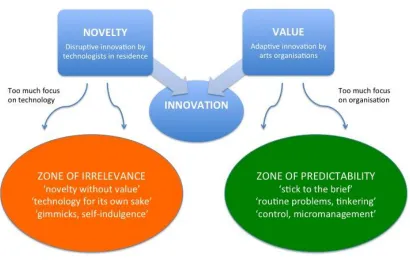
[image:27.595.93.503.284.544.2]When this process of mutual adjustment went wrong, problems started to occur with the residencies. The digital technologists in residence might become too enthused by the possibilities of the technology to observe the organisational context in which they were working. Organisations might become too preoccupied with the strategic end game to allow space for unexpected interventions and alternatives.
Figure 3 Happenstance: zone of irrelevance, zone of predictability
When the technologists dipped into the ‘zone of irrelevance’, it was often because they had become enthusiastic about a new piece of software of hardware. Their enthusiasm could be overpowering. One arts manager confided that arts organisations are ‘almost allergic’ to ‘technology without a purpose’ and complained of an occasional tendency for residents to resort to ‘gimmickry’ without asking themselves the critical question, ‘how is this going to impact the organisation?’
Such tensions are of course not limited to digital technology projects. Many of the complaints being directed at ‘self-indulgent’ or ‘pointless’ digital innovation could equally be directed at work by artists. Managing such tensions is fundamental to the expertise of arts managers. It was also a fundamental aspect of the Happenstance process. In order for Happenstance to succeed, it was critical that digital innovation was actively managed, firstly by Caper and secondly by the arts managers themselves. In an innovation process, coming up with ideas is not enough. Any theory of innovation will also encompass some notion of applying or directing innovative ideas towards organisational purposes and solutions. Coming up with too many undirected ideas may cause more problems than solutions. Managing the innovation process on Happenstance meant directing energies towards the centre (see Figure 3 above) rather than allowing them to spin off into a ‘zone of irrelevance’ or ‘zone of predictability’.
Thermal printer prototype connected to Arduino at Site Gallery (Photo: Chris Bilton)
At the other extreme, Site’s residents later introduced another technology, a ‘polargraph’ – a robotic arm which could draw in response to codes transmitted from a remote location. In the end it was not possible to identify a purpose or application for the organisation. Rather than pursue the project into the ‘zone of irrelevance’ the project was shelved. Here we saw the residents adapting in a different way, recognising that just because something was technically innovative did not mean it was organisationally useful.
PART 2: Embedding Innovation – from one-off initiative to long-term impact
The second part of this report examines the transition between relatively short-term, experimental innovations and solutions and longer-term effects on organisational strategy, processes and culture. These cultural effects represent a form of ‘hidden’ innovation in the creative industries, encompassing the kind of changes in organisational structure, management and strategy noted by Miles and Green (2008, 72). The capacity for an organisation to absorb and respond to interventions and initiatives also represents a form of structural ‘capital’ in each organisation, which precedes one-off innovation, reflecting the time, resources and expertise invested by the arts organisations in the Happenstance Project. Collectively this cluster of organisational assets both precede and follow the moment of innovation; assets are both invested in the residencies, and are accumulated as a result.
In this section of the report we will therefore consider the intangible assets the organisations invested in the project as well as the intangible benefits which they accrued. Because these assets and benefits are intangible (leadership, culture, attitude), they cannot be measured with any precision. Nevertheless in this part of the report we plan to demonstrate three important aspects of the Happenstance project:
Firstly, for an innovation process to work effectively, certain assets need to be in place (including for example trust, leadership, and commitment). These organisational assets provide the hidden base for innovative ideas to take root or take flight.
Secondly, one-off innovations trigger secondary innovations in organisational behaviour, culture and attitude which may amount to significant assets for the organisation and lay the groundwork for a second round of innovations in the future.
Thirdly, innovation is an iterative process in which experimental interventions and organisational change are mutually supportive.
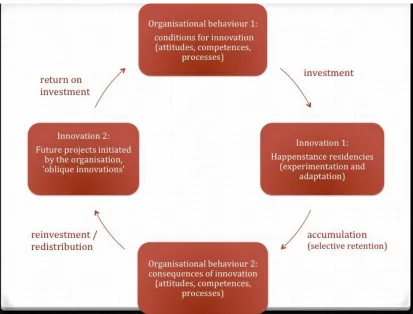
We are therefore focusing here on the organisational behaviours which both precede and follow the ‘innovation process’ described in the first part of this report. These can be described as ‘cultural conditions’ necessary for the residencies to be successful, and ‘cultural consequences’ resulting from the residencies. We have also highlighted examples of the reciprocal action between ‘experimental innovation’ and ‘organisational change’ alluded to in the first part of this report.
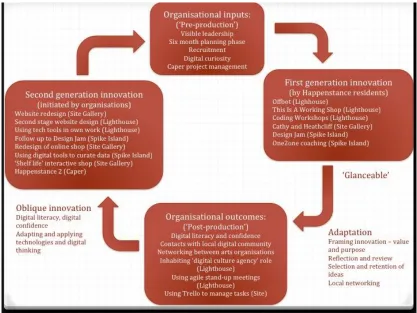
Figure 4 Happenstance – the innovation cycle
The innovation cycle described here was observable within the residencies, as one-off projects triggered longer-term cultural changes in the organisation. We termed this effect ‘oblique innovation’ where an innovation in one part of the organisation (for example a new piece of hardware or software) triggers other innovations elsewhere (for example a different way of working or communicating). These oblique effects were often unplanned or unintended.
Likewise as the projects progressed the reciprocal effect operated in the other direction too. As the organisation became more familiar with the people and the technologies involved in the residencies, it became easier for the residents to initiate new ideas and to gain support for them. They were thus able to add to their stock of ‘structural capital’ through the residencies and trigger the next round of innovations. Some of the residents made explicit reference to a ‘legacy’ effect, empowering the organisation to initiate new projects beyond the lifetime of the Happenstance residencies.
2.1 Embedding innovation: a three-phase process
We can conceptualise the relationship between digital innovation and organisational adaptation through the Happenstance Project as a three-phase process. In the first phase, the three arts organisations and Caper invested time and resources in planning and designing the project; we describe this as a ‘pre-production’ phase, establishing the ‘structural capital’ which would allow the residencies to operate effectively. The second phase, ‘production’ refers to the residencies themselves, encompassing the innovation process outlined in the first part of this report. The final phase, ‘post-production’, refers to the aftermath of the residencies through which the organisations absorb and respond to the innovation process, translating innovative inputs into longer-term competencies and assets for the organisation, and thereby completing the innovation cycle (Figure 4).
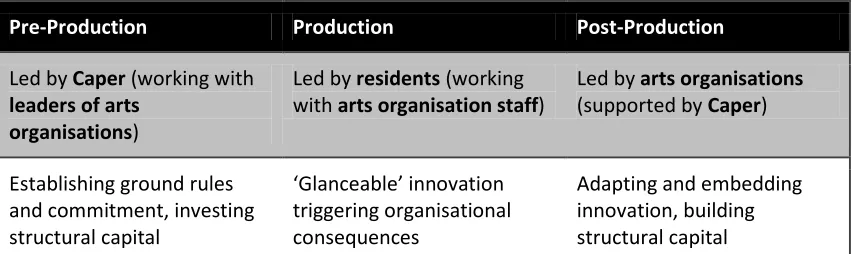
Each phase of this process raised some different challenges which were managed by one of the three principal participants in the Happenstance Project (Figure 5). During the pre-production phase, Caper was the lead partner, establishing the ground rules for the residencies, identifying and recruiting the residents, building trust between residents and organisations and managing expectations. In the production phase the residents took the lead, although as described in the first part of this report, they were also working closely with the arts organisations. In the post-production phase, the baton passes to senior management in the arts organisations, as they processed the outcomes of the residencies and identified new sources of value and laid the groundwork for the next round of innovation in their respective organisations.
Pre-Production Production Post-Production
Led by Caper (working with
leaders of arts organisations)
Led by residents (working with arts organisation staff)
Led by arts organisations
(supported by Caper)
Establishing ground rules and commitment, investing structural capital
‘Glanceable’ innovation triggering organisational consequences
[image:33.595.86.512.423.550.2]Adapting and embedding innovation, building structural capital Figure 5 Embedding innovation: a three-phase process