warwick.ac.uk/lib-publications
Original citation:
Sampson, Stephanie, Hosalli, Prakash, Furtado, Vivek and Davis, John M.. (2016) Risperidone
(depot) for schizophrenia. Cochrane Database of Systematic Reviews (4). CD004161.
Permanent WRAP URL:
http://wrap.warwick.ac.uk/78615
Copyright and reuse:
The Warwick Research Archive Portal (WRAP) makes this work by researchers of the
University of Warwick available open access under the following conditions. Copyright ©
and all moral rights to the version of the paper presented here belong to the individual
author(s) and/or other copyright owners. To the extent reasonable and practicable the
material made available in WRAP has been checked for eligibility before being made
available.
Copies of full items can be used for personal research or study, educational, or not-for-profit
purposes without prior permission or charge. Provided that the authors, title and full
bibliographic details are credited, a hyperlink and/or URL is given for the original metadata
page and the content is not changed in any way.
Publisher’s statement:
‘This review is published as a Cochrane Review in the Cochrane Database of Systematic
Reviews 2016, Issue 4. Cochrane Reviews are regularly updated as new evidence emerges
and in response to comments and criticisms, and the Cochrane Database of Systematic
Reviews should be consulted for the most recent version of the Review.’
http://dx.doi.org/10.1002/14651858.CD004161.pub2
A note on versions:
The version presented in WRAP is the published version or, version of record, and may be
cited as it appears here.
Risperidone (depot) for schizophrenia (Review)
Sampson S, Hosalli P, Furtado VA, Davis JM
Sampson S, Hosalli P, Furtado VA, Davis JM.
Risperidone (depot) for schizophrenia.
Cochrane Database of Systematic Reviews2016, Issue 4. Art. No.: CD004161. DOI: 10.1002/14651858.CD004161.pub2.
www.cochranelibrary.com
Risperidone (depot) for schizophrenia (Review)
1 HEADER . . . .
1
ABSTRACT . . . .
3
PLAIN LANGUAGE SUMMARY . . . .
4
SUMMARY OF FINDINGS FOR THE MAIN COMPARISON . . . .
6
BACKGROUND . . . .
6
OBJECTIVES . . . .
6 METHODS . . . .
13 RESULTS . . . .
Figure 1. . . 15
Figure 2. . . 20
Figure 3. . . 21
30
ADDITIONAL SUMMARY OF FINDINGS . . . .
50
DISCUSSION . . . .
56
AUTHORS’ CONCLUSIONS . . . .
57
ACKNOWLEDGEMENTS . . . .
58 REFERENCES . . . .
64
CHARACTERISTICS OF STUDIES . . . .
89 DATA AND ANALYSES . . . .
Analysis 1.1. Comparison 1 RISPERIDONE DEPOT vs PLACEBO, Outcome 1 Mental state: 1. Change (exacerbation)
in specific symptoms. . . 104
Analysis 1.2. Comparison 1 RISPERIDONE DEPOT vs PLACEBO, Outcome 2 Leaving the study early: 1. Any reason
(by time period). . . 105
Analysis 1.3. Comparison 1 RISPERIDONE DEPOT vs PLACEBO, Outcome 3 Leaving the study early: 2. Any reason
(by doses). . . 106
Analysis 1.4. Comparison 1 RISPERIDONE DEPOT vs PLACEBO, Outcome 4 Leaving the study early: 3. Because of
insufficient response (by doses). . . 107
Analysis 1.5. Comparison 1 RISPERIDONE DEPOT vs PLACEBO, Outcome 5 Adverse events: 1. General: a. Death. 108 Analysis 1.6. Comparison 1 RISPERIDONE DEPOT vs PLACEBO, Outcome 6 Adverse events: 1. General: b. Severe
adverse event (by doses). . . 109
Analysis 1.7. Comparison 1 RISPERIDONE DEPOT vs PLACEBO, Outcome 7 Adverse events: 1. General: c. Adverse event necessitating withdrawal from study (by doses). . . 110 Analysis 1.8. Comparison 1 RISPERIDONE DEPOT vs PLACEBO, Outcome 8 Adverse events: 2. Specific: a.
Cardiovascular. . . 111
Analysis 1.9. Comparison 1 RISPERIDONE DEPOT vs PLACEBO, Outcome 9 Adverse events: 2. Specific: b.
Gastrointestinal. . . 112
Analysis 1.10. Comparison 1 RISPERIDONE DEPOT vs PLACEBO, Outcome 10 Adverse events: 2. Specific: c.
Movement disorders: a. Extrapyramidal disorder - spontaneously reported (by doses). . . 113 Analysis 1.11. Comparison 1 RISPERIDONE DEPOT vs PLACEBO, Outcome 11 Adverse events: 2. Specific: d.
Movement disorders: b. Hyperkinesia (by doses). . . 114
Analysis 1.12. Comparison 1 RISPERIDONE DEPOT vs PLACEBO, Outcome 12 Adverse events: 2. Specific: e.
Movement disorders: c. Hypertonia (by doses). . . 115
Analysis 1.13. Comparison 1 RISPERIDONE DEPOT vs PLACEBO, Outcome 13 Adverse events: 2. Specific: f. Pain. 116 Analysis 1.14. Comparison 1 RISPERIDONE DEPOT vs PLACEBO, Outcome 14 Adverse events: 2. Specific: g.
Salivation. . . 117
Analysis 1.15. Comparison 1 RISPERIDONE DEPOT vs PLACEBO, Outcome 15 Adverse events: 2. Specific: h. Sleep
disturbances. . . 118
Analysis 1.16. Comparison 1 RISPERIDONE DEPOT vs PLACEBO, Outcome 16 Adverse events: 2. Specific: i. Weight
gain. . . 119
Analysis 1.17. Comparison 1 RISPERIDONE DEPOT vs PLACEBO, Outcome 17 Adverse events: 2. Specific: j.
Others. . . 120
i Risperidone (depot) for schizophrenia (Review)
Analysis 2.2. Comparison 2 RISPERIDONE DEPOT vs GENERAL ORAL ANTIPSYCHOTICS, Outcome 2 Global state: 2. Needing use of benzodiazepine or sedative drugs. . . 122 Analysis 2.3. Comparison 2 RISPERIDONE DEPOT vs GENERAL ORAL ANTIPSYCHOTICS, Outcome 3 Service
utilisation: 1. Hospitalisation. . . 123
Analysis 2.5. Comparison 2 RISPERIDONE DEPOT vs GENERAL ORAL ANTIPSYCHOTICS, Outcome 5 Not
receiving allocated study medication. . . 124
Analysis 2.6. Comparison 2 RISPERIDONE DEPOT vs GENERAL ORAL ANTIPSYCHOTICS, Outcome 6 Leaving
the study early: 1. Any reason. . . 124
Analysis 2.7. Comparison 2 RISPERIDONE DEPOT vs GENERAL ORAL ANTIPSYCHOTICS, Outcome 7 Leaving
the study early: 2. Specific. . . 125
Analysis 2.8. Comparison 2 RISPERIDONE DEPOT vs GENERAL ORAL ANTIPSYCHOTICS, Outcome 8 Adverse
events: 1. General: a. Death. . . 126
Analysis 2.9. Comparison 2 RISPERIDONE DEPOT vs GENERAL ORAL ANTIPSYCHOTICS, Outcome 9 Adverse
events: 2. Specific. . . 127
Analysis 2.10. Comparison 2 RISPERIDONE DEPOT vs GENERAL ORAL ANTIPSYCHOTICS, Outcome 10 Adverse
events: Nervous system disorders (inc. EPS). . . 129
Analysis 3.1. Comparison 3 RISPERIDONE DEPOT vs ORAL RISPERIDONE, Outcome 1 Global state: 1. Moderate to severely ill at end of study period (CGI rating). . . 129 Analysis 3.2. Comparison 3 RISPERIDONE DEPOT vs ORAL RISPERIDONE, Outcome 2 Global state: 2. Mean
change from baseline (CGI-S, high score = worse). . . 130
Analysis 3.3. Comparison 3 RISPERIDONE DEPOT vs ORAL RISPERIDONE, Outcome 3 Global state: 3. Mean (SD)
GAF score change to endpoint. . . 130
Analysis 3.4. Comparison 3 RISPERIDONE DEPOT vs ORAL RISPERIDONE, Outcome 4 Global state: 4. Needing
use of benzodiazepine or sedative drugs. . . 131
Analysis 3.5. Comparison 3 RISPERIDONE DEPOT vs ORAL RISPERIDONE, Outcome 5 Mental state: 1. Average
change/endpoint scores (PANSS, high score = worse). . . 132
Analysis 3.6. Comparison 3 RISPERIDONE DEPOT vs ORAL RISPERIDONE, Outcome 6 Leaving the study early: 1.
Any reason. . . 133
Analysis 3.7. Comparison 3 RISPERIDONE DEPOT vs ORAL RISPERIDONE, Outcome 7 Leaving the study early: 2.
Specific. . . 134
Analysis 3.8. Comparison 3 RISPERIDONE DEPOT vs ORAL RISPERIDONE, Outcome 8 Quality of life: Mean (SD) SF-36 score change/endpoint (high score = better). . . 135 Analysis 3.9. Comparison 3 RISPERIDONE DEPOT vs ORAL RISPERIDONE, Outcome 9 Adverse events: 1.
General. . . 137
Analysis 3.10. Comparison 3 RISPERIDONE DEPOT vs ORAL RISPERIDONE, Outcome 10 Adverse events: 1.
General: UKU average change score (high = worse). . . 138
Analysis 3.11. Comparison 3 RISPERIDONE DEPOT vs ORAL RISPERIDONE, Outcome 11 Adverse events: 2.
Specific. . . 139
Analysis 3.12. Comparison 3 RISPERIDONE DEPOT vs ORAL RISPERIDONE, Outcome 12 Adverse events: 2.
Specific: Mean (SD) weight increase in kg. . . 141
Analysis 3.13. Comparison 3 RISPERIDONE DEPOT vs ORAL RISPERIDONE, Outcome 13 Adverse events: 3.
Movement disorder. . . 142
Analysis 3.14. Comparison 3 RISPERIDONE DEPOT vs ORAL RISPERIDONE, Outcome 14 Adverse events: Mean
(SD) change in movement disorder rating scales. . . 143
Analysis 4.1. Comparison 4 RISPERIDONE DEPOT vs ORAL QUETIAPINE, Outcome 1 Leaving the study early: 1.
Any reason. . . 144
Analysis 4.2. Comparison 4 RISPERIDONE DEPOT vs ORAL QUETIAPINE, Outcome 2 Leaving the study early: 2.
Specific. . . 144
Analysis 4.3. Comparison 4 RISPERIDONE DEPOT vs ORAL QUETIAPINE, Outcome 3 Adverse events: 1.
General. . . 145
Analysis 4.4. Comparison 4 RISPERIDONE DEPOT vs ORAL QUETIAPINE, Outcome 4 Adverse events: 2. Specifc. 146
ii Risperidone (depot) for schizophrenia (Review)
Analysis 4.6. Comparison 4 RISPERIDONE DEPOT vs ORAL QUETIAPINE, Outcome 6 Adverse events: 3. Movement
disorder. . . 148
Analysis 5.1. Comparison 5 RISPERIDONE DEPOT vs ORAL ARIPIPRAZOLE, Outcome 1 Global state: 1. Relapse
(any reason). . . 149
Analysis 5.2. Comparison 5 RISPERIDONE DEPOT vs ORAL ARIPIPRAZOLE, Outcome 2 Global state: 3. Mean time
in remission (days). . . 150
Analysis 5.3. Comparison 5 RISPERIDONE DEPOT vs ORAL ARIPIPRAZOLE, Outcome 3 Mental state: 1. Average
change scores (PANSS, high score = worse). . . 150
Analysis 5.4. Comparison 5 RISPERIDONE DEPOT vs ORAL ARIPIPRAZOLE, Outcome 4 Leaving the study early: 1.
Any reason. . . 151
Analysis 5.5. Comparison 5 RISPERIDONE DEPOT vs ORAL ARIPIPRAZOLE, Outcome 5 Leaving the study early: 2.
Specific. . . 152
Analysis 5.6. Comparison 5 RISPERIDONE DEPOT vs ORAL ARIPIPRAZOLE, Outcome 6 Adverse events: 1.
General. . . 153
Analysis 5.7. Comparison 5 RISPERIDONE DEPOT vs ORAL ARIPIPRAZOLE, Outcome 7 Adverse events: 2.
Specific. . . 154
Analysis 5.8. Comparison 5 RISPERIDONE DEPOT vs ORAL ARIPIPRAZOLE, Outcome 8 Adverse events: 2. Specific
12. Mean (SD) weight increase in kg. . . 157
Analysis 5.9. Comparison 5 RISPERIDONE DEPOT vs ORAL ARIPIPRAZOLE, Outcome 9 Adverse events: 3.
Movement disorder. . . 158
Analysis 6.1. Comparison 6 RISPERIDONE DEPOT vs ORAL OLANZAPINE, Outcome 1 Mental state: 1. Average
change scores (PANNS, high score = worse). . . 159
Analysis 6.2. Comparison 6 RISPERIDONE DEPOT vs ORAL OLANZAPINE, Outcome 2 Leaving the study early: 1.
Any reason. . . 160
Analysis 6.3. Comparison 6 RISPERIDONE DEPOT vs ORAL OLANZAPINE, Outcome 3 Leaving the study early: 2.
Specific. . . 161
Analysis 6.4. Comparison 6 RISPERIDONE DEPOT vs ORAL OLANZAPINE, Outcome 4 Adverse events: 1.
General. . . 162
Analysis 6.5. Comparison 6 RISPERIDONE DEPOT vs ORAL OLANZAPINE, Outcome 5 Adverse events: 2.
Specific. . . 163
Analysis 6.6. Comparison 6 RISPERIDONE DEPOT vs ORAL OLANZAPINE, Outcome 6 Adverse events: 3. Movement
disorder. . . 166
Analysis 7.1. Comparison 7 RISPERIDONE DEPOT vs ALL ORAL ANTIPSYCHOTICS (PRIMARY OUTCOMES),
Outcome 1 Global state: 1. Relapse (any reason). . . 167
Analysis 7.2. Comparison 7 RISPERIDONE DEPOT vs ALL ORAL ANTIPSYCHOTICS (PRIMARY OUTCOMES), Outcome 2 Mental state: 1. Average change scores (PANSS, high score = worse) 1. total. . . 168 Analysis 7.3. Comparison 7 RISPERIDONE DEPOT vs ALL ORAL ANTIPSYCHOTICS (PRIMARY OUTCOMES),
Outcome 3 Leaving the study early: 1. Any reason. . . 169
Analysis 7.4. Comparison 7 RISPERIDONE DEPOT vs ALL ORAL ANTIPSYCHOTICS (PRIMARY OUTCOMES),
Outcome 4 Adverse events: 1. Death. . . 170
Analysis 7.5. Comparison 7 RISPERIDONE DEPOT vs ALL ORAL ANTIPSYCHOTICS (PRIMARY OUTCOMES),
Outcome 5 Adverse events: 1. General: a. any. . . 172
Analysis 7.6. Comparison 7 RISPERIDONE DEPOT vs ALL ORAL ANTIPSYCHOTICS (PRIMARY OUTCOMES),
Outcome 6 Adverse events: 1. General: b. serious. . . 173
Analysis 7.7. Comparison 7 RISPERIDONE DEPOT vs ALL ORAL ANTIPSYCHOTICS (PRIMARY OUTCOMES), Outcome 7 Adverse events: 2. Movement disorder: a. any extra pyramidal symptoms. . . 174 Analysis 8.1. Comparison 8 RISPERIDONE DEPOT vs ATYPICAL DEPOT ANTIPSYCHOTICS (PALIPERIDONE
PALMITATE), Outcome 1 Global State: 1. CGI-S mean change from baseline (high score = worse). . . 175 Analysis 8.2. Comparison 8 RISPERIDONE DEPOT vs ATYPICAL DEPOT ANTIPSYCHOTICS (PALIPERIDONE
PALMITATE), Outcome 2 Global state: 2. Schedule for Deficit Syndrome (SDS) scale (mean change from baseline,
high score = worse). . . 175
iii Risperidone (depot) for schizophrenia (Review)
Analysis 8.4. Comparison 8 RISPERIDONE DEPOT vs ATYPICAL DEPOT ANTIPSYCHOTICS (PALIPERIDONE PALMITATE), Outcome 4 Mental state: 2. Improved by 30% in total PANSS score (ITT data). . . 177 Analysis 8.5. Comparison 8 RISPERIDONE DEPOT vs ATYPICAL DEPOT ANTIPSYCHOTICS (PALIPERIDONE
PALMITATE), Outcome 5 General functioning: Personal and Social Performance (PSP) scale (high score = better). 178 Analysis 8.6. Comparison 8 RISPERIDONE DEPOT vs ATYPICAL DEPOT ANTIPSYCHOTICS (PALIPERIDONE
PALMITATE), Outcome 6 Leaving the study early: 1. Any reason. . . 179
Analysis 8.7. Comparison 8 RISPERIDONE DEPOT vs ATYPICAL DEPOT ANTIPSYCHOTICS (PALIPERIDONE
PALMITATE), Outcome 7 Adverse events: 1. General. . . 182
Analysis 8.8. Comparison 8 RISPERIDONE DEPOT vs ATYPICAL DEPOT ANTIPSYCHOTICS (PALIPERIDONE
PALMITATE), Outcome 8 Adverse events: 2. Specific. . . 183
Analysis 8.9. Comparison 8 RISPERIDONE DEPOT vs ATYPICAL DEPOT ANTIPSYCHOTICS (PALIPERIDONE
PALMITATE), Outcome 9 Adverse events: 3. Prolactin related. . . 186
Analysis 8.10. Comparison 8 RISPERIDONE DEPOT vs ATYPICAL DEPOT ANTIPSYCHOTICS (PALIPERIDONE
PALMITATE), Outcome 10 Adverse events: 4. Movement disorder. . . 188
Analysis 8.11. Comparison 8 RISPERIDONE DEPOT vs ATYPICAL DEPOT ANTIPSYCHOTICS (PALIPERIDONE PALMITATE), Outcome 11 Adverse events: 5. Body weight (mean increase). . . 190 Analysis 8.12. Comparison 8 RISPERIDONE DEPOT vs ATYPICAL DEPOT ANTIPSYCHOTICS (PALIPERIDONE
PALMITATE), Outcome 12 Adverse events: 6. Mean prolactin level increase (ng/mL). . . 191 Analysis 8.13. Comparison 8 RISPERIDONE DEPOT vs ATYPICAL DEPOT ANTIPSYCHOTICS (PALIPERIDONE
PALMITATE), Outcome 13 Adverse events: 7. Glucose related. . . 192
Analysis 8.14. Comparison 8 RISPERIDONE DEPOT vs ATYPICAL DEPOT ANTIPSYCHOTICS (PALIPERIDONE PALMITATE), Outcome 14 Adverse events: 8. Injection site pain (mean (sd) Visual Analogue Scale score
(0-100mm)). . . 194
Analysis 9.1. Comparison 9 RISPERIDONE DEPOT vs TYPICAL DEPOT ANTIPSYCHOTICS, Outcome 1 Mental state: 1. Total endpoint scores (PANNS, high score = worse). . . 195 Analysis 9.2. Comparison 9 RISPERIDONE DEPOT vs TYPICAL DEPOT ANTIPSYCHOTICS, Outcome 2 Leaving
the study early. . . 196
Analysis 9.3. Comparison 9 RISPERIDONE DEPOT vs TYPICAL DEPOT ANTIPSYCHOTICS, Outcome 3
Hospitalisation by 6 months. . . 197
Analysis 9.5. Comparison 9 RISPERIDONE DEPOT vs TYPICAL DEPOT ANTIPSYCHOTICS, Outcome 5 Adverse events: 2. Sexual experiencesm, total endpoint (ASEX, high score = worse). . . 199
199 ADDITIONAL TABLES . . . .
200
APPENDICES . . . .
207 FEEDBACK . . . .
212 WHAT’S NEW . . . .
212 HISTORY . . . .
213
CONTRIBUTIONS OF AUTHORS . . . .
213 DECLARATIONS OF INTEREST . . . .
213 SOURCES OF SUPPORT . . . .
214
INDEX TERMS . . . .
iv Risperidone (depot) for schizophrenia (Review)
Risperidone (depot) for schizophrenia
Stephanie Sampson1, Prakash Hosalli2, Vivek A Furtado3, John M Davis4
1The University of Nottingham, Nottingham, UK.2The Newsam Centre, Seacroft Hospital, Leeds, UK.3Division of Mental Health
and Wellbeing, Warwick Medical School, University of Warwick, Coventry, UK.4University of Illinois at Chicago, Chicago, USA
Contact address: Stephanie Sampson, The University of Nottingham, Institute of Mental Health, University of Nottingham Innovation Park, Jubilee Campus, Nottingham, NG7 2TU, [email protected].
Editorial group:Cochrane Schizophrenia Group.
Publication status and date:New search for studies and content updated (conclusions changed), published in Issue 4, 2016.
Review content assessed as up-to-date: 28 October 2015.
Citation: Sampson S, Hosalli P, Furtado VA, Davis JM. Risperidone (depot) for schizophrenia.Cochrane Database of Systematic Reviews
2016, Issue 4. Art. No.: CD004161. DOI: 10.1002/14651858.CD004161.pub2.
Copyright © 2016 The Cochrane Collaboration. Published by John Wiley & Sons, Ltd.
A B S T R A C T
Background
Risperidone is the first new generation antipsychotic drug made available in a long-acting injection formulation.
Objectives
To examine the effects of depot risperidone for treatment of schizophrenia or related psychoses in comparison with placebo, no treatment or other antipsychotic medication.
To critically appraise and summarise current evidence on the resource use, cost and cost-effectiveness of risperidone (depot) for schizophrenia.
Search methods
We searched the Cochrane Schizophrenia Group’s Register (December 2002, 2012, and October 28, 2015). We also checked the references of all included studies, and contacted industry and authors of included studies.
Selection criteria
Randomised clinical trials comparing depot risperidone with other treatments for people with schizophrenia and/or schizophrenia-like psychoses.
Data collection and analysis
Two review authors independently selected trials, assessed trial quality and extracted data. For dichotomous data, we calculated the risk ratio (RR), with 95% confidence interval (CI). For continuous data, we calculated mean differences (MD). We assessed risk of bias for included studies and created ’Summary of findings’ tables using GRADE.
Main results
Twelve studies, with a total of 5723 participants were randomised to the following comparison treatments:
Risperidone depot versus placebo
Outcomes of relapse and improvement in mental state were neither measured or reported. In terms of other primary outcomes, more people receiving placebo left the study early by 12 weeks (1 RCT, n=400, RR 0.74 95% CI 0.63 to 0.88,very low quality evidence),
1 Risperidone (depot) for schizophrenia (Review)
Risperidone depot versus general oral antipsychotics
The outcome of improvement in mental state was not presented due to high levels of attrition, nor were levels of severe adverse events explicitly reported. Most primary outcomes of interest showed no difference between treatment groups. However, more people receiving depot risperidone experienced nervous system disorders (long-term:1 RCT, n=369, RR 1.34 95% CI 1.13 to 1.58,very-low quality evidence).
Risperidone depot versus oral risperidone
Data for relapse and severe adverse events were not reported. All outcomes of interest were rated asmoderate quality evidence. Main results showed no differences between treatment groups with equivocal data for change in mental state, numbers leaving the study early, any extrapyramidal symptoms, weight increase and prolactin-related adverse events.
Risperidone depot versus oral quetiapine
Relapse rates and improvement in mental state were not reported. Fewer people receiving risperidone depot left the study early (long-term: 1 RCT, n=666, RR 0.84 95% CI 0.74 to 0.95,moderate quality evidence). Experience of serious adverse events was similar between groups (low quality evidence), but more people receiving depot risperidone experienced EPS (1 RCT, n=666, RR 1.83 95% CI 1.07 to 3.15,low quality evidence), had greater weight gain (1 RCT, n=666, RR 1.25 95% CI 0.25 to 2.25,low quality evidence) and more prolactin-related adverse events (1 RCT, n=666, RR 3.07 95% CI 1.13 to 8.36, very low quality evidence).
Risperidone depot versus oral aripiprazole
Relapse rates, mental state using PANSS, leaving the study early, serious adverse events and weight increase were similar between groups. However more people receiving depot risperidone experienced prolactin-related adverse events compared to those receiving oral aripiprazole (2 RCTs, n=729, RR 9.91 95% CI 2.78 to 35.29,very low quality of evidence).
Risperidone depot versus oral olanzapine
Relapse rates were not reported in any of the included studies for this comparison. Improvement in mental state using PANSS and instances of severe adverse events were similar between groups. More people receiving depot risperidone left the study early than those receiving oral olanzapine (1 RCT, n=618, RR 1.32 95% CI 1.10 to 1.58,low quality evidence) with those receiving risperidone depot also experiencing more extrapyramidal symptoms (1 RCT, n=547, RR 1.67 95% CI 1.19 to 2.36,low quality evidence). However, more people receiving oral olanzapine experienced weight increase (1 RCT, n=547, RR 0.56 95% CI 0.42 to 0.75,low quality evidence).
Risperidone depot versus atypical depot antipsychotics (specifically paliperidone palmitate)
Relapse rates were not reported and rates of response using PANSS, weight increase, prolactin-related adverse events and glucose-related adverse events were similar between groups. Fewer people left the study early due to lack of efficacy from the risperidone depot group (long term: 1 RCT, n=749, RR 0.60 95% CI 0.45 to 0.81,low quality evidence), but more people receiving depot risperidone required use of EPS-medication (2 RCTs, n=1666, RR 1.46 95% CI 1.18 to 1.8,moderate quality evidence).
Risperidone depot versus typical depot antipsychotics
Outcomes of relapse, severe adverse events or movement disorders were not reported. Outcomes relating to improvement in mental state demonstrated no difference between groups (low quality evidence). However, more people receiving depot risperidone compared to other typical depots left the study early (long-term:1 RCT, n=62, RR 3.05 95% CI 1.12 to 8.31,low quality evidence).
Authors’ conclusions
Depot risperidone may be more acceptable than placebo injection but it is hard to know if it is any more effective in controlling the symptoms of schizophrenia. The active drug, especially higher doses, may be associated with more movement disorders than placebo. People already stabilised on oral risperidone may continue to maintain benefit if treated with depot risperidone and avoid the need to take tablets, at least in the short term. In people who are happy to take oral medication the depot risperidone is approximately equal to oral risperidone. It is possible that the depot formulation, however, can bring a second-generation antipsychotic to people who do not reliably adhere to treatment. People with schizophrenia who have difficulty adhering to treatment, however, are unlikely to volunteer for a clinical trial. Such people may gain benefit from the depot risperidone with no increased risk of extrapyramidal side effects.
2 Risperidone (depot) for schizophrenia (Review)
Review question
Risperidone is a newer antipsychotic drug that was the first available as a long-lasting injection (a depot injection). The review examines the clinical effects of depot risperidone for people with schizophrenia.
Background
People with schizophrenia often hear voices and see things (hallucinations) and have strange beliefs (delusions). People can also become withdrawn, socially isolated, tired and apathetic. The main treatment for these symptoms of schizophrenia is antipsychotic drugs. However, these drugs can have serious side effects, such as weight gain, uncontrollable shaking, tremors, spasms and tiredness. These side effects often mean that people stop taking their medication (non- compliance), which may lead to relapse.
Study characteristics
The review was updated in 2015 and includes 12 studies with 5723 people who received risperidone depot or a range of other treatments (placebo, general oral antipsychotics, oral risperidone, oral quetiapine, oral aripiprazole, oral olanzapine, atypical/newer depot antipsychotics, older depot antipsychotics).
Key results
It is difficult to know from the results of this review if depot risperidone is any more effective in treating the symptoms of schizophrenia than placebo or other treatments. For people who are happy to take oral medication, depot risperidone is about equal to oral risperidone. People on oral risperidone may continue to benefit if treated with depot risperidone, without the need to take tablets. However, in high doses, depot risperidone can have serious side effects, particularly movement disorders, uncontrollable shaking, spasms and tremors. Depot risperidone may bring this new antipsychotic to people who stop taking their tablets, so helping reduce relapse and with little increased risk of side effects.
Quality of the evidence
The quality of evidence presented is, in the main, low and at best moderate. There is the need for large, long-term and well reported trials on depot risperidone for people with schizophrenia. Depot injections are often used on people who refuse treatment. Such people are difficult to include in studies.
Written by a consumer, Ben Gray, Senior Peer Researcher, McPin Foundation.http://mcpin.org/
3 Risperidone (depot) for schizophrenia (Review)
RISPERIDONE DEPOT compared with PLACEBO for schizophrenia
Patient or population:patients with schizophrenia Settings:
Intervention:RISPERIDONE DEPOT Comparison:PLACEBO
Outcomes Illustrative comparative risks* (95% CI) Relative effect (95% CI)
No of Participants (studies)
Quality of the evidence (GRADE)
Comments
Assumed risk Corresponding risk
PLACEBO RISPERIDONE DEPOT
Global state: Relapse -long term - not m ea-sured
See com m ent See com m ent Not estim able - See com m ent No study reported this outcom e.
M ental state: clini-cally significant im-provement in mental state - long term1- not
reported
See com m ent See com m ent Not estim able1 - See com m ent Study reported PANSS
responder rate, but un-usable due to high attri-tion
Leaving the study early: Any reason - all doses risperidone de-pot - short term
694 per 1000 513 per 1000 (437 to 611)
RR 0.74 (0.63 to 0.88)
400 (1 study)
⊕
very low2,3
Adverse events: Gen-eral: Severe adverse event - any dose risperidone depot -short term
Spontaneous reporting by study participants
235 per 10004 138 per 1000
(89 to 218)
RR 0.59 (0.38 to 0.93)
400 (1 study)
⊕
very low2,5
Adverse events: Spe-cific: Weight gain - all doses of depot risperi-done - short term Spontaneous reporting by study participants
20 per 1000 43 per 1000 (10 to 187)
RR 2.11 (0.48 to 9.18)
400 (1 study)
⊕
very low2,6
* The basis f or theassumed risk(e.g. the m edian control group risk across studies) is provided in f ootnotes. Thecorresponding risk(and its 95% conf idence interval) is based on the assum ed risk in the com parison group and therelative effectof the intervention (and its 95% CI).
CI:Conf idence interval;RR:Risk ratio;
GRADE Working Group grades of evidence
High quality:Further research is very unlikely to change our conf idence in the estim ate of ef f ect.
M oderate quality:Further research is likely to have an im portant im pact on our conf idence in the estim ate of ef f ect and m ay change the estim ate. Low quality:Further research is very likely to have an im portant im pact on our conf idence in the estim ate of ef f ect and is likely to change the estim ate. Very low quality:We are very uncertain about the estim ate.
1Not reported: only included study (Kane 2002*) reported PANSS responder rate, but these data were unusable due to high
levels of attrition.
2Risk of bias: ’very serious’ - high attrition in one included study (Kane 2002*) of greater than 50% overall. Research supported
by J ohnson and J ohnson/ J anssen, producers of depot risperidone.
3Im precision: ’serious’ - only one sm all study reported data f or this com parison. 4Control risk: m ean baseline presented f or one individual study.
5Im precision: ’serious’ - adverse events were reported spontaneously by participants, rather than system atically assessed
by the researchers. This could ef f ect the precision of the results as there is only one study (Kane 2002*) addressing this com parison.
6Im precision: ’serious’- the m ethod of m easuring weight gain and threshold f or reporting it were not described. This could
ef f ect the precision of the results as there is only one study (Kane 2002*) addressing this com parison.
Description of the condition
Schizophrenia is a major, often chronic, psychiatric disease that close to seven people in every 1000 will be affected by at some point during their lifetime (McGrath 2008). Antipsychotic drugs are effective for treating acute episodes and for preventing relapse (Davis 1977;Davis 1986). These drugs are usually given orally, but compliance is poor and ranges from 20% to 89% with an average of 50% (Fenton 1997;Young 1986). This means that, on average, half the patients treated with these drugs will not comply with prescribed medication. This is probably due to a combination of various factors such as the erosion of insight that accompanies psychotic illnesses, adverse effects and human nature.
Description of the intervention
Long-acting depot antipsychotics, given by injection into the mus-cle, should be helpful in increasing compliance with medication. In studies comparing one depot with another, attrition rates are markedly lower than in studies comparing oral preparations, but in trials comparing an oral with a depot preparation, there are no differences in the attrition rates between groups (Adams 2001). This is likely to be due to a limitation in the design of the relevant studies, as people participating in randomised trials are more likely to be compliant. This is an area where ’real world’ or ’pragmatic’ randomised trials are indicated.
The newer generation of antipsychotics, often called atypical, seem to cause less of the movement disorders associated with older drugs. This group of compounds may be equally clinically effective (Small 1997), and be more acceptable to people with schizophre-nia, than older drugs such as haloperidol (Leucht 1999;Marder 1994;Tollefson 1997) although this is disputed (Geddes 2000). Atypical drugs have gained popularity amongst clinicians but, along with their cost, a lack of a depot preparation has been cited as a significant obstacle to their frequent use (Sarfati 1999). Risperidone is an atypical antipsychotic, first made available for the care of those with schizophrenia in 1986. Since then clinical trials have been conducted to evaluate its efficacy and safety and studies have indicated that it may be superior to older drugs (Marder 1994). When oral risperidone is compared with haloperidol, it appears to have marginal benefits in terms of clinical improvement and is less likely to cause movement disorders (Hunter 2003). Risperidone is the first newer drug to be available in a long-acting injection formulation.
How the intervention might work
Risperidone is one of the new or second-generation “atypical” antipsychotics, developed in the late 1980s. It is known to block
alpha2 adrenoceptors, H1 receptors and has no effect on beta adrenoceptors, muscarinic cholinoceptors or peptidergic receptors (Janssen 1988).
The depot formulation of risperidone has unmodified risperidone encapsulated in biodegradable polymer microspheres, which are then suspended in an aqueous solution. Once the microspheres are injected into the muscle, the polymers begin to degrade and the drug is released at a set rate. This takes place over the course of several weeks, with the highest plasma concentration occurring approximately one month after injection (Ramstack 2003).
Why it is important to do this review
In terms of the costs of schizophrenia, this was estimated at about £6.7 billion in England in 2004/05, of which the direct costs were £2 million while the indirect costs accounted for the rest (Mangalore 2007). The cost of risperidone (depot) itself is expen-sive compared to other typical antipsychotics, at £142.76 for a 50 mg vial. The maximum monthly dose of risperidone (depot) is 100 mg per month, which costs £285.52 per month (BNF 2012). These newer, atypical antipsychotics in comparison are more ex-pensive than typical antipsychotics, with olanzapine available at £13.11 for 28 x 5 mg tablets, and clozapine (Clozaril) at £21.56 for 28 x 100 mg tablets.
It is important to complement the clinical effectiveness of risperi-done (depot) with its cost-effectiveness. Davies et al. (Davies 2007) conducted a study on cost-effectiveness of first-generation an-tipsychotics (i.e. flupentixol, trifluoperazine, chlorpromazine) and the second-generation antipsychotics (i.e. risperidone, olanzapine, amisulpiride). The study findings argue that there is no evidence to suggest that atypical (second-generation) antipsychotics are more cost-effective than typical (first-generation) antipsychotics.
O B J E C T I V E S
To examine the effects of depot risperidone for treatment of schizophrenia or related psychoses in comparison with placebo, no treatment or other antipsychotic medication.
If possible, to critically appraise and summarise current evidence on the resource use, cost and cost-effectiveness of risperidone (de-pot) for schizophrenia.
M E T H O D S
Criteria for considering studies for this review
6 Risperidone (depot) for schizophrenia (Review)
described as ’double-blind’ but it was implied that the study was randomised, these trials were included in a sensitivity analysis. If there was no substantive difference within primary outcomes (see
Types of outcome measures) when these ’implied randomisation’ studies were added, then they were included in the final analysis. If there was a substantive difference, only clearly randomised trials were utilised and the results of the sensitivity analysis described in the text. We excluded quasi-randomised studies, such as those allocating by using alternate days of the week.
Types of participants
People with schizophrenia and schizophrenia-like disorders such as schizophreniform disorder, delusional disorder or schizoaffective disorder, diagnosed by any criteria. People with ’serious/chronic mental illness’ or ’psychotic illness’ were also included. Where possible, people with dementia, depression and problems primarily associated with substance misuse were excluded.
Types of interventions
1. Risperidone
Administered by long-acting intramuscular injection, any dose.
2. Placebo or no treatment
3. Other antipsychotic drugs (depot)
Any dose, administered in depot form.
4. Other antipsychotic drugs (oral)
Any dose, administered in oral form. Oral drugs were divided into two subgroups; typical and atypical. For the purposes of this review atypicals were amisulpiride, aripiprazole, clozapine, cloth-iapine, loxapine, molindone, risperidone, olanzapine, quetcloth-iapine, sulpiride, zotepine, ziprasidone.
Types of outcome measures
All outcomes were reported for the short term (up to 12 weeks), medium term (13-26 weeks), and long term (more than 26 weeks).
Primary outcomes
1. Global state
1.1 Relapse
Secondary outcomes
1. Death - suicide and natural causes
2. Global state
2.1 Time to relapse
2.2 Clinically important change in global state 2.3 Any change in global state
2.4 Average endpoint global state score 2.5 Average change in global state scores
3. Service outcomes
3.1 Hospitalisation 3.2 Time to hospitalisation 3.3 Duration of stay in hospital
4. Mental state
4.1 Change in general mental state
4.2 Average endpoint general mental state score 4.3 Average change in general mental state scores 4.4 Clinically important change in specific symptoms 4.5 Change in specific symptoms
4.6 Average endpoint specific symptom score 4.7 Average change in specific symptom scores
5. Leaving the study early
5.1 For specific reasons 5.2 For general reasons
6. General functioning
6.1 Clinically important change in general functioning 6.2 Any change in general functioning
6.3 Average endpoint general functioning score 6.4 Average change in general functioning scores
6.5 Clinically important change in specific aspects of functioning, such as social or life skills
6.6 Any change in specific aspects of functioning, such as social or life skills
6.7 Average endpoint specific aspects of functioning, such as social or life skills
6.8 Average change in specific aspects of functioning, such as social or life skills
7 Risperidone (depot) for schizophrenia (Review)
7.2 Any change in general behaviour 7.3 Average endpoint general behaviour score 7.4 Average change in general behaviour scores
7.5 Clinically important change in specific aspects of behaviour 7.6 Any change in specific aspects of behaviour
7.7 Average endpoint specific aspects of behaviour 7.8 Average change in specific aspects of behaviour
8. Adverse effects
8.1 Clinically important general adverse effects 8.2 Any general adverse effects
8.3 Average endpoint general adverse effect score 8.4 Average change in general adverse effect scores 8.5 Clinically important change in specific adverse effects 8.6 Any change in specific adverse effects
8.7 Average endpoint specific adverse effects 8.8 Average change in specific adverse effects
9. Engagement with services
9.1 Clinically important engagement 9.2 Any engagement
9.3 Average endpoint engagement score 9.4 Average change in engagement scores
10. Satisfaction with treatment
10.1 Recipient of care not satisfied with treatment 10.2 Recipient of care average satisfaction score
10.3 Recipient of care average change in satisfaction scores 10.4 Carer not satisfied with treatment
10.5 Carer average satisfaction score
10.6 Carer average change in satisfaction scores
11. Quality of life
11.1 Clinically important change in quality of life 11.2 Any change in quality of life
11.3 Average endpoint quality of life score 11.4 Average change in quality of life scores
11.5 Clinically important change in specific aspects of quality of life
11.6 Any change in specific aspects of quality of life 11.7 Average endpoint specific aspects of quality of life 11.8 Average change in specific aspects of quality of life
12. Economic outcomes
12.1 Average change in total cost of medical and mental health care
12.2 Total indirect and direct costs
atrist, psychologists, psychiatric nurse, counsellor, social worker) 12.3.2 Hospitalisation (taking battery of tests, patients’ physical, psychiatric and psychological profile and psychological assessment, number of days, relapse)
12.3.3 Medication (different types of antipsychotics to include dose and frequency, treatment of side effects)
12.3.4 Psychological therapies (different types of psychological therapies to include session numbers and frequency)
12.3.5 Other resources (day centres, night shelter) and transporta-tion for medical care visits
12.4 Indirect resource use:
12.4.1 Family, relatives’ and friends’ resources 12.4.2 Police, criminal justice system 12.4.3 Benefits paid, social security payments
12.4.4 Employment agency workers, absence from work, loss of productivity
12.5 Cost-effectiveness ratios represented by incremental cost-ef-fectiveness (ICER)
12.6 Cost-utilities represented by incremental costs per quality-adjusted life year (QALY) or disability-quality-adjusted life year (DALY) 12.7 Cost benefit represented by net Benefit Ratio, others.
13. ’Summary of findings’ table
We used the GRADE approach to interpret findings (Schünemann 2008) and used GRADE profiler (GRADEPRO) to import data from RevMan 5 (Review Manager) to create ’Summary of findings’ tables. These tables provide outcome-specific information con-cerning the overall quality of evidence from each included study in the comparison, the magnitude of effect of the interventions examined, and the sum of available data on all outcomes we rated as important to patient-care and decision making. We selected the following main outcomes for inclusion in the ’Summary of find-ings’ table.
1. Relapse - long term.
2. Clinically significant improvement in mental state - long term. 3. Leaving the study early for any reason - medium/long term. 4. Severe adverse effects - medium/long term.
5. Adverse events related to movement disorder, weight gain, pro-lactin levels and glucose metabolism - medium/long term.
Search methods for identification of studies
Electronic searches
Cochrane Schizophrenia Group’s Trials Register
8 Risperidone (depot) for schizophrenia (Review)
ister of Trials using the following search strategy:
(*Risperidone* AND *Injection*) in Intervention Field of STUDY
In such a study-based register, searching the major concept re-trieves all the synonym keywords and relevant studies because all the studies have already been organised based on their interven-tions and linked to the relevant topics.
The Cochrane Schizophrenia Group’s Register of Trials is com-piled by systematic searches of major resources (including AMED, BIOSIS, CINAHL, EMBASE, MEDLINE, PsycINFO, PubMed, and registries of clinical trials) and their monthly updates, hand-searches, grey literature, and conference proceedings (seeGroup’s Module). There is no language, date, document type, or publica-tion status limitapublica-tions for inclusion of records into the register. For previous searches, please seeAppendix 1.
Searching other resources
1. Reference searching
The review authors inspected references of all identified studies for more studies.
2. Personal contact
The review authors attempted to contact the first author of each study considered for inclusion in the review for more information regarding unpublished trials or any available data.
3. Drug companies
The review authors contacted Janssen-Cilag Limited for further data.
Data collection and analysis
For details of previous data collection and analysis methods see
Appendix 2.
Selection of studies
For this update, review author PH and TN (see
Acknowledgements) independently inspected citations from the searches and identified relevant abstracts. A random 20% sample was independently re-inspected by SS to ensure reliability. Where disputes arose, the full-text report was acquired for more detailed scrutiny. If citations met inclusion criteria, we obtained full-text reports for more detailed inspection. Again, a random 20% of re-ports were re-inspected by SS in order to ensure reliable selection. Where it was not possible to resolve disagreement by discussion,
With regards to selecting studies for economic evaluations, review authors (SS and VF) categorised studies as per the following:
Type A - Full economic evaluation (within the framework of
RCT): studies that focus on cost-effectiveness analysis, cost-utility analysis and cost-benefit analysis.
Type B- Partial economic evaluation (within the framework of
RCT): studies that focus on cost-analysis and cost-minimisation studies of Risperidone (depot).
Type C- Randomised trials that reported limited information,
such as estimates of resources use or costs associated with Risperi-done (depot).
Data extraction and management
1. Extraction
For this update PH, and TN extracted data from all included stud-ies. In addition, to ensure reliability, SS independently extracted data from a random sample of these studies, comprising 10% of the total. Again, any disagreement was discussed, decisions doc-umented and, if necessary, authors of studies contacted for clar-ification. With any remaining problems, we contacted editorial team (CEA) to help clarify issues and these final decisions were documented. Data presented only in graphs and figures were ex-tracted whenever possible, but included only if two review authors independently had the same result. We attempted to contact au-thors through an open-ended request in order to obtain missing information or for clarification whenever necessary.
For the economic analysis had VF and SS found Type A and B stud-ies (seeTypes of studies), they would have investigated whether appraisal had already been undertaken byNHS EEDusing their search tool derived for this purpose. If appraisal had not been undertaken, VF and SS would have applied theNHS EEDtool to the data. In this current review, should there only be Type C studies available, we would extract outcome data directly from the already-included effectiveness studies. We recognise that much in-formation would be lacking to get results that are both valid and reliable.
2. Management
2.1 Forms
We extracted data onto standard, simple forms.
9 Risperidone (depot) for schizophrenia (Review)
a. the psychometric properties of the measuring instrument have been described in a peer-reviewed journal (Marshall 2000); and b. the measuring instrument has not been written or modified by one of the trialists for that particular trial.
Ideally, the measuring instrument should either be i. a self-report or ii. completed by an independent rater or relative (not the ther-apist). We realise that this is not often reported clearly, and we noted inDescription of studieswhether or not this was the case.
2.3 Endpoint versus change data
There are advantages of both endpoint and change data. Change data can remove a component of between-person variability from the analysis. On the other hand, calculation of change needs two assessments (baseline and endpoint), which can be difficult in unstable and difficult to measure conditions such as schizophrenia. We decided primarily to use endpoint data, and only use change data if the former were not available. We combined endpoint and change data in the analysis as we used mean differences (MD) rather than standardised mean differences (SMD) throughout (
Higgins 2011, Chapter 9.4.5.2).
2.4 Skewed data
Continuous data on clinical and social outcomes are often not normally distributed. To avoid the pitfall of applying parametric tests to non-parametric data, we aimed to apply the following standards to relevant data before inclusion:
a) standard deviations (SDs) and means are reported in the paper or obtainable from the authors;
b) when a scale starts from the finite number zero, the SD, when multiplied by two, is less than the mean, as otherwise the mean is unlikely to be an appropriate measure of the centre of the distri-bution, (Altman 1996);
c) if a scale started from a positive value (such as the Positive and Negative Syndrome Scale (PANSS) (Kay 1986), which can have values from 30 to 210), the calculation described above was modified to take the scale starting point into account. In these cases skew is present if 2 SD > (S-S min), where S is the mean score and S min is the minimum score.
Endpoint scores on scales often have a finite start and end point and these rules can be applied. We entered skewed endpoint data from studies of less than 200 participants in additional tables rather than into an analysis. However, skewed data pose less of a problem when looking at mean if the sample size is large, we therefore, entered skewed endpoint data from studies with over 200 participants into syntheses.When continuous data are presented on a scale that includes a possibility of negative values (such as change data), it is difficult to tell whether data are skewed or not and we entered skewed change data into analysis.
variables that can be reported in different metrics, such as days in hospital (mean days per year, per week or per month) to a common metric (e.g. mean days per month).
2.6 Conversion of continuous to binary
Where possible, we made efforts to convert outcome measures to dichotomous data. This can be done by identifying cut-off points on rating scales and dividing participants accordingly into ’clinically improved’ or ’not clinically improved’. It is generally assumed that if there is a 50% reduction in a scale-derived score such as the Brief Psychiatric Rating Scale (BPRS,Overall 1962) or the Positive and Negative Syndrome Scale (PANSS,Kay 1986), this could be considered as a clinically significant response (Leucht 2005;Leucht 2005a). If data based on these thresholds were not available, we used the primary cut-off presented by the original authors.
2.7 Direction of graphs
Where possible, we entered data in such a way that the area to the left of the line of no effect indicated a favourable outcome for risperidone depot. Where keeping to this made it impossible to avoid outcome titles with clumsy double-negatives (e.g. ’Not un-improved’), we reported data where the left of the line indicates an unfavourable outcome. This was noted in the relevant graphs.
Assessment of risk of bias in included studies
For this update, PH and TN worked independently by using cri-teria described in theCochrane Handbook for Systematic Reviews of Interventions(Higgins 2011) to assess trial quality. This new set of criteria is based on evidence of associations between overestimate of effect and high risk of bias of the article such as sequence gener-ation, allocation concealment, blinding, incomplete outcome data and selective reporting.
Where inadequate details of randomisation and other characteris-tics of trials were provided, we contacted authors of the studies in order to obtain additional information.
We have noted the level of risk of bias in both the text of the review and in theSummary of findings for the main comparison.
Measures of treatment effect
1. Binary data
For binary outcomes, we calculated a standard estimation of the risk ratio (RR) and its 95% confidence interval (CI)*. It has been shown that RR is more intuitive (Boissel 1999) than odds ratios (ORs) and that ORs tend to be interpreted as RR by clinicians (Deeks 2000). We did not calculate the Number Needed to Treat/
10 Risperidone (depot) for schizophrenia (Review)
culation in meta-analyses and interpretation (Hutton 2009). For binary data presented in the ’Summary of findings’ tables, where possible, we calculated illustrative comparative risks.
2. Continuous data
For continuous outcomes, we estimated mean difference (MD) between groups. We prefer not to calculate effect size measures (standardised mean difference SMD). However, if scales of very considerable similarity were used, we presumed there was a small difference in measurement, and we would have calculated effect size and transformed the effect back to the units of one or more of the specific instruments.
Unit of analysis issues
1. Cluster trials
Studies increasingly employ ’cluster randomisation’ (such as ran-domisation by clinician or practice) but analysis and pooling of clustered data poses problems. Firstly, authors often fail to account for intra-class correlation in clustered studies, leading to a ’unit of analysis’ error (Divine 1992), whereby P values are spuriously low, confidence intervals unduly narrow and statistical significance overestimated. This causes type I errors (Bland 1997;Gulliford 1999).
Where clustering was not accounted for in primary studies, we presented data in a table, with a (*) symbol to indicate the pres-ence of a probable unit of analysis error. In subsequent versions of this review, we will seek to contact first authors of studies to obtain intra-class correlation coefficients (ICCs) for their clustered data and to adjust for this by using accepted methods (Gulliford 1999). Where clustering has been incorporated into the analysis of primary studies, we presented these data as if from a non-cluster randomised study, but adjusted for the clustering effect. We have sought statistical advice and have been advised that the binary data as presented in a report should be divided by a ’design effect’. This is calculated using the mean number of participants per cluster (m) and the ICC [Design effect = 1+(m-1)*ICC] (
Donner 2002). If the ICC was not reported it was assumed to be 0.1 (Ukoumunne 1999).
If cluster studies have been appropriately analysed taking into ac-count ICCs and relevant data documented in the report, synthe-sis with other studies would have been possible using the generic inverse variance technique.
2. Cross-over trials
A major concern of cross-over trials is the carry-over effect. It oc-curs if an effect (e.g. pharmacological, physiological or psycho-logical) of the treatment in the first phase is carried over to the
a wash-out phase. For the same reason cross-over trials are not ap-propriate if the condition of interest is unstable (Elbourne 2002). As both effects are very likely in severe mental illness, if we had included cross-over trials, we planned only to use the data from the first phase of cross-over studies.
3. Studies with multiple treatment groups
Where a study involves more than two treatment arms, if rele-vant, the additional treatment arms were presented in compar-isons. Where the additional treatment arms were not relevant, we did not reproduce these data.
Dealing with missing data
1. Overall loss of credibility
At some degree of loss of follow-up, data must lose credibility (Xia 2009). We chose that, for any particular outcome, should more than 50% of data be unaccounted for, we did not reproduce these data or use them within analyses, except for the outcomes of leaving the study early and adverse events. If, however, more than 50% of those in one arm of a study were lost, but the total loss was less than 50%, we marked such data with (*) to indicate that such a result may well be prone to bias. This was the case for three studies (Gaebel 2010*;Kane 2002* Quinn 2012*).
2. Binary
In the case where attrition for a binary outcome was between 0% and 50%, and where these data were not clearly described, we presented data on a ’once-randomised-always-analyse’ basis (an intention-to-treat analysis). Those leaving the study early were all assumed to have the same rates of negative outcome as those who completed, with the exception of the outcome of death and adverse effects. For these outcomes, the rate of those who stayed in the study - in that particular arm of the trial - were used for those who did not. We undertook a sensitivity analysis to test how prone the primary outcomes were to change when data only from people who completed the study to that point were compared to the intention-to-treat analysis using the above assumptions.
3. Continuous
3.1 Attrition
In the case where attrition for a continuous outcome was between 0% and 50%, and data only from people who completed the study to that point were reported, we presented and used these data.
11 Risperidone (depot) for schizophrenia (Review)
obtain the missing values from the authors. If not available, where there are missing measures of variance for continuous data, but an exact standard error (SE) and confidence intervals available for group means, and either a P value or T value available for differ-ences in mean, we can calculate them according to the rules de-scribed in theCochrane Handbook for Systematic reviews of Interven-tions(Higgins 2011): When only the SE is reported, SDs are cal-culated by the formula SD = SE * square root (n). Chapters 7.7.3 and 16.1.3 of theCochrane Handbook for Systematic reviews of In-terventions(Higgins 2011) present detailed formulae for estimat-ing SDs from P values, T or F values, confidence intervals, ranges or other statistics. If these formulae do not apply, we can calcu-late the SDs according to a validated imputation method which is based on the SDs of the other included studies (Furukawa 2006). Although some of these imputation strategies can introduce error, the alternative would be to exclude a given study’s outcome and thus to lose information. However, we did not impute any data in this review.
3.3 Last observation carried forward
We anticipated that in some studies the method of last observation carried forward (LOCF) would be employed within the study report. As with all methods of imputation to deal with missing data, LOCF introduces uncertainty about the reliability of the results (Leucht 2007). Therefore, where LOCF data had been used in the trial, if less than 50% of the data had been assumed, we reproduced these data and indicated that they are the product of LOCF assumptions.
Assessment of heterogeneity
1. Clinical heterogeneity
We considered all included studies initially, without seeing com-parison data, to judge clinical heterogeneity. We simply inspected all studies for clearly outlying people or situations which we had not predicted would arise. When such situations or participant groups arose, these were fully discussed.
2. Methodological heterogeneity
We considered all included studies initially, without seeing com-parison data, to judge methodological heterogeneity. We simply inspected all studies for clearly outlying methods which we had not predicted would arise. When such methodological outliers arise these were fully discussed.
3.1 Visual inspection
We visually inspected graphs to investigate the possibility of sta-tistical heterogeneity.
3.2 Employing the I2statistic
Heterogeneity between studies was investigated by considering the I2method alongside the Chi2’P’ value. The I2provides an
estimate of the percentage of inconsistency thought to be due to chance (Higgins 2003). The importance of the observed value of an I2 depends on i. magnitude and direction of effects and ii. strength of evidence for heterogeneity (e.g. ’P’ value from Chi2
test, or a confidence interval for I2). An I2estimate greater than
or equal to around 70% accompanied by a statistically significant Chi2statistic, was interpreted as evidence of substantial levels of heterogeneity (Section 9.5.2 -Higgins 2011). When substantial levels of heterogeneity were found in the primary outcome, we explored reasons for the heterogeneity (Subgroup analysis and investigation of heterogeneity).
Assessment of reporting biases
Reporting biases arise when the dissemination of research findings is influenced by the nature and direction of results (Egger 1997). These are described in Section 10 of theCochrane Handbook for Systematic Reviews of Interventions(Higgins 2011). We are aware that funnel plots may be useful in investigating reporting biases but are of limited power to detect small-study effects. We planned not to use funnel plots for outcomes where there were less than 10studies in each analysis, or where all studies were of similar sizes. If funnel plots had been possible, we planned to seek statistical advice in their interpretation.
Data synthesis
We understand that there is no closed argument for preference for use of fixed-effect or random-effects models. The random-effects method incorporates an assumption that the different studies are estimating different, yet related, intervention effects. This often seems to be true to us and the random-effects model takes into account differences between studies even if there is no statistically significant heterogeneity. There is, however, a disadvantage to the random-effects model. It puts added weight onto small studies, which often are the most biased ones. Depending on the direction of effect these studies can either inflate or deflate the effect size. We chose the random-effects model for all analyses.
12 Risperidone (depot) for schizophrenia (Review)
1. Subgroup analyses - only primary outcomes
1.1 Clinical state, stage or problem
We proposed to undertake this review and provide an overview of the effects of risperidone depot for people with schizophrenia in general. In addition, however, we tried to report data on subgroups of people in the same clinical state, stage and with similar problems.
2. Investigation of heterogeneity
If inconsistency was high, this was reported. First, we investigated whether data had been entered correctly. Second, if data were cor-rect, we visually inspected the graph and removed outlying studies to see if heterogeneity was restored. For this review, we decided that should this occur with data contributing to the summary finding of no more than around 10% of the total weighting, data were presented. If not, data were not pooled and issues discussed. We know of no supporting research for this 10% cut-off but are investigating use of prediction intervals as an alternative to this unsatisfactory state.
When unanticipated clinical or methodological heterogeneity were obvious, we simply stated hypotheses regarding these for fu-ture reviews or versions of this review. We did not anticipate un-dertaking analyses relating to these.
Sensitivity analysis
1. Implication of randomisation
We aimed to include trials in a sensitivity analysis if they were described in some way as to imply randomisation. For the primary outcomes, we included these studies and if there was no substantive difference when the implied randomised studies were added to those with a better description of randomisation, then all data were used from these studies.
2. Assumptions for lost binary data
Where assumptions had to be made regarding people lost to follow-up (seeDealing with missing data), we compared the findings of the primary outcomes when we used our assumption compared with completer data only. If there was a substantial difference, we reported results and discussed them, but continued to employ our assumption.
Where assumptions had to be made regarding missing SDs data (see Dealing with missing data), we compared the findings on primary outcomes when we used our assumption compared with complete data only. A sensitivity analysis was undertaken to test how prone results were to change when ’completer’ data only were
them, but continued to employ our assumption.
3. Risk of bias
We analysed the effects of excluding trials that were judged to be at high risk of bias across one or more of the domains of randomi-sation (implied as randomised with no further details available) allocation concealment, blinding and outcome reporting for the meta-analysis of the primary outcome. If the exclusion of trials at high risk of bias did not substantially alter the direction of effect or the precision of the effect estimates, then we included data from these trials in the analysis
4. Imputed values
Had we included cluster-randomised trials, we planned to under-take a sensitivity analysis to assess the effects of including data from trials where we used imputed values for ICC in calculating the design effect in such trials.
If substantial differences were noted in the direction or precision of effect estimates in any of the sensitivity analyses listed above, we did not pool data from the excluded trials with the other trials contributing to the outcome, but presented them separately.
5. Fixed-effect and random-effects
All data were synthesised using a random-effects , however, we also synthesised data for the primary outcome using a fixed-effect model to evaluate whether the greater weights assigned to larger trials with greater event rates, altered the significance of the results compared to the more evenly distributed weights in the fixed-effect model.
R E S U L T S
Description of studies
Salient features of the included and excluded studies are given in the tables (Characteristics of included studies;Characteristics of excluded studies).
Results of the search
1. Overall
The original published version of this review (Hosalli 2003) in-cluded two studies and exin-cluded 11, with two studies awaiting
13 Risperidone (depot) for schizophrenia (Review)
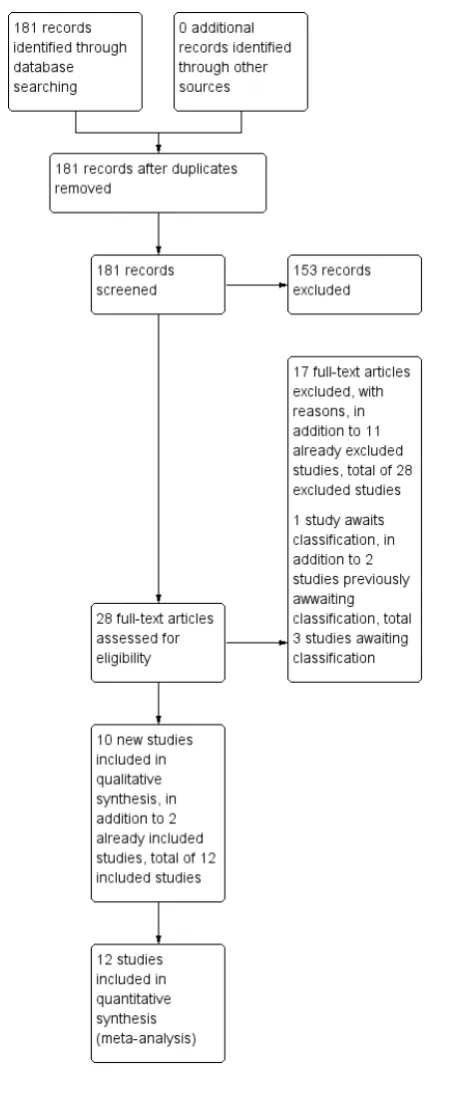
other sources. No duplicates were found. We screened 181 records. Twenty-eight potentially relevant full-text reports were obtained and scrutinised, and 17 of these reports did not meet the inclusion criteria (seeCharacteristics of excluded studies), and were added to the excluded studies. Ten studies were added to included studies and one study was added to awaiting classification (Figure 1).
14 Risperidone (depot) for schizophrenia (Review)
15 Risperidone (depot) for schizophrenia (Review)
[image:21.595.199.427.96.649.2]Twelve studies, reported as 15 conference presentations and 13 full-text papers met the selection criteria and are included in this update.
1. Study design
All 12 included studies were randomised and eight featured some form of blinding - ranging from blinding of raters in other-wise open-label studies to blinding of all participants and in-vestigators; four studies were expressly or implied as ’open-label’ but employed blinded raters (Bai 2006;Covell 2012; Li 2011;
MacFadden 2010). Study duration also varied considerably; three studies were short term at 12 to 13 weeks (Bai 2006;Chue 2002;
Pandina 2011);Covell 2012was medium term, while seven fol-lowed up participants for two years (Fleischhacker 2011;Gaebel 2010*;Kane 2002*;Li 2011;MacFadden 2010;Quinn 2012*;
Rosenheck 2011). One study (Keks 2007), combined short- and medium-term outcomes, with analyses at 12 weeks and one-year of follow-up. The majority of studies took place in the community, and were well-represented internationally, with studies conducted in Taiwan (Bai 2006) and the remaining as multi-centre studies, conducted within the USA (Covell 2012;Kane 2002*;Rosenheck 2011), Canada (Quinn 2012*), China (Li 2011), Europe (Gaebel 2010*;Keks 2007); and international multi-centre studies (Chue 2002;Fleischhacker 2011;MacFadden 2010;Pandina 2011).
2. Participants
A total of n = 5723 participants who received the intervention were included, with the majority of studies providing data as to male and female participants; a total of n = 3140 male and n = 2112 female participants were included, with a mean age of around 40 years. All studies used the Diagnostic and Statistical Mannual ver-sion 1V (DSM-IV) (APA 2000) to define schizophrenia; so for at least six continuous months a participant must have shown some evidence of schizophrenia, and for at least one month must have shown at least two symptoms of frank psychosis. These symptoms would have included delusions, hallucinations, incoherent speech, disorganised or catatonic behaviour, or flat affect. To meet DSM IV criteria, the symptoms must be disabling in such a way that social and occupational functioning is impaired; these symptoms should not be the direct result of a physical disorder or of substance misuse. Most studies randomised people who had been experienc-ing schizophrenia for some years; often specifyexperienc-ing that they need to have had schizophrenia for at least one year before diagnosis. Further criteria for selecting participants varied from study to study, depending on exactly what was being investigated, but
gen-tempts were not permitted to take part. Nor were those with active DSM-IV diagnosed substance dependence or general ill health, including serious psychiatric problems other than schizophrenia. Tolerance to risperidone was an important factor that all studies addressed; most potential participants underwent a screening pe-riod at the start of their trial to establish that they could tolerate risperidone; this was sometimes waived if they had already demon-strated this (i.e. they were currently treated with the drug).
3. Interventions
The prescribing of depot risperidone was consistent across the board; 25, 37.5 and 50 mg injections every two weeks were the most common dosages, with participants typically initiated on 25 mg/two weeks, which was then stepped up in 12.5 mg increments if their symptoms worsened. Three earlier studies (Chue 2002;
Kane 2002*;Keks 2007) included depot risperidone up to 75 mg, but such high doses were not used by the most recent studies. Because it can take several weeks for therapeutic plasma levels of the drug to build-up, oral supplementation, either with oral risperidone or the participant’s previous oral antipsychotic, was typically used for the initial two to four weeks.
The trials involving oral antipsychotics either compared depot risperidone versus another specific single antipsychotic or to more than one antipsychotic. Only one study compared depot risperi-done with placebo (Kane 2002*). Of the studies comparing de-pot risperidone with another single antipsychotic, two used oral risperidone at 2 mg to 6 mg per day (Bai 2006;Chue 2002); one study investigated5 mg to 20 mg/day oral olanzapine (Keks 2007), and one compared depot risperidone against 5 mg to 30 mg/day oral aripiprazole (MacFadden 2010).Covell 2012compared ei-ther haloperidol decanoate or fluphenazine (no doses prescribed, but used at ’clinician’s judgement’;Gaebel 2010*was mainly con-cerned with quetiapine at up to 750 mg/day, but also featured a smaller aripiprazole arm of 10 mg to 30 mg per day. The remaining three studies randomised patients to receive depot risperidone or to remain on their current oral antipsychotic; in the case ofQuinn 2012*, only second-generation “atypical” drugs were used, specif-ically risperidone, olanzapine and quetiapine; Rosenheck 2011
provides no details of which drugs were used.
Paliperidone palmitate (PP) is the active metabolite of risperidone, but features a different administration schedule and dosages to de-pot risperidone; PP doses can be given either in milligrams (mg), for the overall volume injected, or in milligram equivalents (mg eq), which refers to the fraction of the drug that is actually phar-macologically active. So 39 mg of PP is given as 25 mg eq, 78 mg is 50 mg eq, etc. The injection schedule of this drug only requires
16 Risperidone (depot) for schizophrenia (Review)