BACHELOR THESIS
A Process Evaluation of the
Positive Educative Programme:
Perceptions on Observing Pupils’
Well-being and Engagement
V.J. Roorda (S1710877)
POSITIVE PSYCHOLOGY AND TECHNOLOGY
Faculty of Behavioural, Management and Social sciences (BMS)
First supervisor: T.R. Elfrink MSc
Second supervisor: M.P.J. Sommers - Spijkerman PhD
1
Abstract
Introduction – Keeping track of well-being and engagement is seen as important, since,
according to the Positive Educative Programme (PEP), these are the indicators of a child’s
positive functioning and positively influences of the child’s learning achievements. Therefore,
the aim of this study is to explore the experiences of teachers with observing well-being and
engagement among their pupils during PEP.
Methods – An interview design was used at a primary elementary school in the Netherlands
which was in the first year of PEP. Seven teachers of this school were interviewed in
semi-structured interviews to get more information about observing well-being and engagement. The
process evaluation is done based on the Nielsen and Randall model (2013), which includes the
implementation process, the mental models of the participants of the intervention and the
contextual factors.
Results – The results showed that teachers were already observing the children multiple times
a day before the introduction of PEP. However, observations according to the PEP methods
were not performed by the teachers. Despite this, the teachers act based on the level of the pupil’s well-being and engagement and they have learned a lot from the introduction of PEP. The teachers’ perceptions to PEP are mostly positive, since it is perceived as a program that fits
to the school system. Some teachers also expressed some critics about PEP, since the idea
behind it felt a bit idealistic. The context of the school was also mostly stimulating the
acceptance of PEP, for example the mentality of the school is to actively approach new
developments and PEP had to offer the school something (giving them guidelines for
continuation), but also showed some barriers. As other developments going on in the school
with a higher priority and the fact that teachers has to change their way of teaching due to the
introduction of PEP.
Conclusion – Overall, the teachers perceived that PEP had an positive influence on their own way of observing the children’s well-being and engagement. It made the teachers more
conscious about the children’s well-being and engagement during class. So, while observing
the children the teachers are automatically more focused on the indicators of the positive
functioning of a child, which made them want to stimulate children’s well-being and
2
Content
1. Introduction ... 3
2. Methods ... 5
2.1 Design ... 5
2.2 Participants ... 5
2.3 Implementation of PEP ... 6
2.4 Research instruments ... 6
2.5 Procedure ... 7
2.6 Analyses ... 7
3. Results ... 10
3.1 Implementation ... 10
3.1.1 Applying ... 10
3.1.2 How to handle observations / follow-up actions ... 11
3.1.3 Learned matters ... 12
3.2 Mental models ... 13
3.2.1 Perception on well-being and engagement ... 13
3.2.2 Perception on intervention activities ... 14
3.3.1 Facilitating factors ... 15
3.3.2 Hindering factors ... 17
4. Discussion and conclusion ... 17
4.1 Key findings ... 17
4.2 Strengths and limitations ... 19
4.3 Directions for future research ... 20
4.4 Directions for future practice ... 21
4.5 Conclusion ... 21
5. References ... 23
6. Appendix ... 25
6.1 Observation form ... 25
3
1.
Introduction
Positive education is seen as promising for the child’s development and learning process
(Seligman, Ernst, Gillham, Reivich & Linkens, 2009), but the teachers’ experiences of positive
education are still not exactly known. Positive psychology, with its focus on the qualities of a
client (Magyar-Moe, 2009), is increasingly applied in school, also referred as positive education
(Seligman et al., 2009). Positive education is defined as “education for both traditional skills and for happiness” (Seligman et al., 2009, p. 293). The school’s first goal is to educate children
on academic (traditional) skills, which is seen as a basis for learning a trade or continue
studying. Next to that, schools also have a pedagogical function: the need for personal
development, citizenship education and learning to be part of the school system (Pels, 2011).
Schools mostly practice the pedagogical function by educating pupils on problems that can
occur in life, like alcohol and drug programs and anti-bullying programs (Boiler, Walburg,
Boerefijn, 2013). To prepare children on a meaningful, pleasant and productive life, it is
important to focus on well-being and the strengths of the children as well (Seligman et al.,
2009). So, this includes the happiness conceptof the definition of positive education.
The value of positive education is to get more out of a child by stimulating the strength’s
and well-being. High well-being does not only decrease the chance to get a depression and
increases the chance for experiencing a higher life satisfaction, it also strengthens the academic skills since it has a positive relationship with the pupils’ learning outcomes (Howell, 2009;
Seligman et al., 2009). Less procrastination and higher grades are linked to a high level of
well-being (Howell, 2009). Besides, positive emotions are important for creative and holistic
thinking, which differ from the normal focus of schools on analytic and critical thinking
(Seligman et al., 2009).
The most optimal way of executing a positive education program, was found out to be
a whole school approach (De Nobile, London & El Baba, 2015). A whole school approach
results in a broader capacity than a single classroom or curriculum focus, by implicating all
groups of interest as parents, teachers, pupils and school management (Weare & Nind, 2011).
De Nobile, London and El Baba (2015) showed that addressing behaviour problems through a
whole school approach is more effective than an isolated classroom approach. Consistently,
Goldberg et al. (2018) showed social and emotional skills interventions using a whole school
approach yield significant improvements on behavioural adjustment, social and emotional
adjustment, and internalising symptoms. A whole school approach was not found to impact the
4 The Positive Educative Programme (PEP) uses a whole school approach for introducing
positive education to primary schools in the Netherlands. The focus of PEP is to enhance the pupils’ well-being and engagement, the two process indicators of PEP, since well-being and
engagement are seen as the indicators for positive functioning of children (Goldberg et al.,
2017). Well-being is seen as feeling emotionally safe, being able to be yourself, show vitality
and to enjoy (Goldberg et al., 2017). Engagement is expressed in the intensity of activity,
concentration, and having pleasure in exploring. It is seen as the intrinsic interest in finding out
how things work (Laevers, 2015). Well-being and engagement can be stimulated by connecting it to the children’s talents or let children discover their own talents and let them build on that.
This will result in an ongoing circle: Children with a higher level of well-being and engagement
will learn better, since it increases the self-confidence, which leads to the increasing of
well-being and engagement, which will improve the school climate, which involves a positive
influence on the well-being and engagement of the teachers and parents (Laevers & Heylen, as cited in Goldberg et al., 2017). For an overview of the PEP’s structure see Figure 1:
Figure 1: The Whole School Approach of PEP (Goldberg et al., 2017)
The use of PEP is becoming more popular in schools in the Netherlands. The
implementation of PEP started in the academic school year of 2014/2015 in two primary
elementary schools in the Netherlands. In January 2019, seven more primary schools started
with PEP together with eleven special education primary schools, and two schools of
intermediate vocational education (In Dutch: MBO) (PEP, n.d.a).
PEP has been evaluated based on the process evaluation of the evidence based model of
5 improved, problem behaviour decreased and teacher got a better insight of the children’s talents
(Elfrink, Goldberg, Schreurs, Bohlmeijer & Clarke, 2017). The “bottom up” approach was
appreciated by the teachers and directors, because it makes the completion of PEP match with
the school climate. Nevertheless, it caused more need for practical support for the teachers and
the teachers noted that lack of time made it hard to fully implement PEP in the school (Elfrink
et al., 2017).
This study focussed on the observations on the pupils made by teachers based on the
process indicators of PEP, well-being and engagement. This study evaluated these experiences
based on the Nielsen & Randall (2013) framework of process evaluation. This process
evaluation model is seen as valuable, since its focus is not only on the implementation of the
intervention, but it also takes the potential side effects into account (the contextual situation and
the mental models of the participants). This led to the following research aim:
To explore teachers’ experience with observing levels of well-being and engagement among
their pupils during PEP.
Sub aims included:
1. To study teachers’ experiences with the applying the observing method on well-being
and engagement.
2. To study the teachers’ perceptions and cognitions on observing pupils’ well-being and
engagement.
3. To identify the stimulating and hindering factors for observing pupils’ well-being and
engagement.
2.
Methods
2.1 Design
An interview design was used to explore the teachers’ experiences with observing levels of
well-being and engagement among their pupils on a primary school in Enschede, the
Netherlands. For this design, ethical approval was obtained by the BMS Ethics Committee of
the University of Twente (190279).
2.2 Participants
The interviewees were teachers from a Dutch elementary school which was in the first-year
implementation of PEP, started in September 2018. The participants consisted of seven teachers
6 The participants could apply if they wanted to participate in the study through a list hanging in the teacher’s area. The group exist of two men and five women. Ages ranged between 22 and
44, with a mean of 31 (SD = 6.8). The average teaching experience of the interviewees was
8.86 years of teaching. The mean years of working on this particular school was 6.29 years.
2.3 Implementation of PEP
As described in the introduction, the goal of PEP is to enhance pupil’s well-being and engagement. Next to that, the school’s way of operating PEP should fit to the school climate.
Therefore, it is important to let the school think about their own values, which will be
formulated in life rules (Goldberg et al., 2017). This is what makes PEP a bottom-up approach.
In the first year of the implementation of PEP the schools will have two workshops, the first
one about the process indicators of well-being and engagement, and the second one about the
values and life rules. During the first workshop the teachers learn what well-being and
engagement are and how they can observe it. For observing the children, the teachers can use a
five-point scale on the subject well-being and engagement (see Appendix 6.1). These
observations are important, since it gives the teachers an indication when their approach needs
to be changed due to scores from three or lower on the scale (Elfrink et al., 2017). The moment
that the school is formulating their life rules is during the second workshop under the guidance
of professionals. In a later stadium of the implementation, in about one year, the focus will be
shifted to the four domains of positive education (strengths, pleasure, positive relationships and
compassion). Strengths is about promoting pupils’ strengths, so the focus is not on prevention
of problems and disturbances. Pleasure as domain is developed from the studies about positive
emotions. Positive relationships are another domain, since having deep and strong relationships
with others is one of the most important aspects of life. The last domain, compassion, is about
handing tools to the pupils for cognitive and emotion regulation (Positief Educatief Programma
[PEP], n.d.b). Before starting to help the school, an overview has to be made to what extent the
school is already paying attention to these domains. From this standpoint there will be worked with matching methods to the schools’ (working) attitude (see Figure 1 in the introduction for
an overview of the structure). Besides the two workshops in the first year of the implementation,
the PEP-team will join once a month the team meetings of the school, also after the first year
(PEP, n.d.b). The central idea behind PEP is to strengthen the vision and values of the school
(Goldberg et al., 2017).
2.4 Research instruments
To collect information from the teachers about observing well-being and engagement of the
7 Nielsen and Randall model (2013) which encompasses aspects about (i) the implementation of
observing well-being and engagement, (ii) mental models of the teachers about the observing part, and (iii) the schools’ context as experienced by the teachers. Questions about the
implementation were asked to find out how making observations of well-being and engagement
got introduced at the school and how the teachers experienced that. Sample questions about the
implementation were, for example: What is your opinion about the observing well-being and
engagement training? What did you learn from it? Thereafter, questions were asked to find out
what the perceptions and appraisals of the interviewees were about making observations of the pupil’s well-being and engagement. Sample questions about the mental models were: How did
you experience observing pupils concerning their well-being and engagement? What is the
added value? How do you recognise a pupil with a high level of well-being? Finally, to get a
better insight about the contextual situation, questions were asked about the school climate and
processes during implementing the intervention, such as: What do you discuss about the pupils’
well-being and engagement with other teachers? How does observing pupils’ well-being and
engagement fit to this school? To obtain concrete situations, probes were used next to the open
fixed questions of the interview. See appendix 6.2 for the complete interview scheme.
2.5 Procedure
The approached interviewees were aware that the interview was about getting more insight
about PEP at their school. The interviews were conducted face-to-face at the school of the
interviewees in a private room. All the interviews took place within a two-week period, starting
from the 8th of April until the 17th of April 2019. All the interviews were held individually. The
interview started with an introduction about the topic of the interview, that there were no right
or wrong answers to the questions and that the interviewer was interested in their opinions and
experiences. They were informed that the interviewer was independent from the PEP program
and that the information was processed anonymously. The interviewee and interviewer signed
an informed consent after the researcher explained what the rights of the interviewee were.
After this procedure, the interview started. In the end of the interview, the interviewee was
asked if they still agreed with the informed consent. The average duration of interviews was
29:05 minutes, ranged between 24:10 and 34:15 minutes.
2.6 Analyses
The interviews were transcribed verbatim and anonymised. To analyse the interviews, the
coding program Atlas-ti was used. The coding scheme was developed after the interviews were
transcribed and was grounded on the three stages/categories of the Nielsen and Randall model
8 times and first were only the parts highlighted that fitted to the categories of the Nielsen and
Randall model. Overlapping things from the categories were put together in a fitting label, from
there on the codes got created. After four interviews were analysed a draft coding scheme was
created. The content of the interviews that came after those four interviews fitted to the draft
coding scheme, so no new codes were developed after coding the first four interviews. In the
end, only one code (Readiness to change) got deleted, since it overlapped with another code
(Perception on the intervention activities) and the difference between them was hard to tell. So,
the interviews had to be recoded, but that was only that Readiness to change had to be
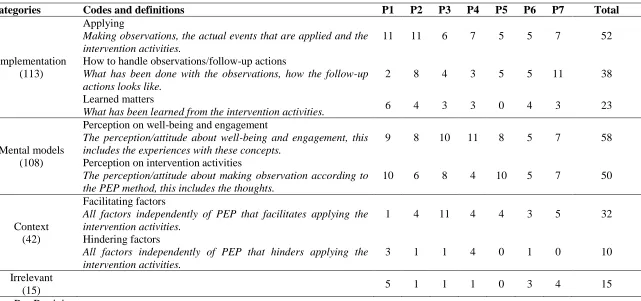
substituted for Perception on intervention activities. For an overview of the categories and
associated codes, see Table 1 on the next page. The codes covered by the category Context were
based on literature (Nielsen & Randall, 2013). One of the two codes of the category Mental
models was also derived from the literature (Nielsen & Randall, 2013), while the other code,
Perception on well-being and engagement, was existed from the data of the interviews. All the
codes of the category Implementation were created from the data. Therefore, the coding process
was a combination of top-down and bottom-up coding. During the coding process is decided to
9 Table 1
Overview of the Code Scheme with coded quotations per participant
Categories Codes and definitions P1 P2 P3 P4 P5 P6 P7 Total
Implementation (113)
Applying
Making observations, the actual events that are applied and the intervention activities.
11 11 6 7 5 5 7 52
How to handle observations/follow-up actions
What has been done with the observations, how the follow-up actions looks like.
2 8 4 3 5 5 11 38
Learned matters
What has been learned from the intervention activities. 6 4 3 3 0 4 3 23
Mental models (108)
Perception on well-being and engagement
The perception/attitude about well-being and engagement, this includes the experiences with these concepts.
9 8 10 11 8 5 7 58
Perception on intervention activities
The perception/attitude about making observation according to the PEP method, this includes the thoughts.
10 6 8 4 10 5 7 50
Context (42)
Facilitating factors
All factors independently of PEP that facilitates applying the intervention activities.
1 4 11 4 4 3 5 32
Hindering factors
All factors independently of PEP that hinders applying the intervention activities.
3 1 1 4 0 1 0 10
Irrelevant
(15) 5 1 1 1 0 3 4 15
10
3.
Results
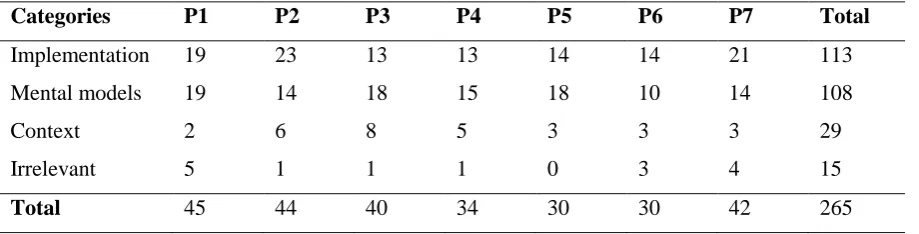
The teachers showed experiences with observing their pupils on three levels: Implementation
(113), Mental models (108), and Context (29). Table 2 gives an overview of the coded
quotations per all of these categories per participant. As can be seen Implementation and Mental
[image:11.595.71.531.235.352.2]models were more discussed topics, then Context.
Table 2
The amount of coded quotations per category per participant
Note. P = Participant
3.1 Implementation
The Implementation section is about the teachers’ experiences with the introduction of the
observing method on well-being and engagement and what the teachers do in the field of
observing pupils on well-being and engagement. This includes the activities they apply, the
follow-up actions of the observations they make and what they have learned from observing children’s well-being and engagement, the three codes of the category Implementation.
3.1.1 Applying
What emerges from the interviews is that observing children is something that the participants
were already doing before PEP. It is something they do daily and throughout the day. Therefore,
keeping track of the children, also on well-being and engagement, is not seen as something new.
“Well, I’ll guess four or five times a day. At least upon arrival and going home, but
you are also observing it every time while the children are working.” (Participant 3)
The way of observing according to PEP is seen as something different than their own way of observing. The ‘PEP observations’ contain performing a scan of all children in the class
(two minutes per child), taking notes about these observations while using the observation form (see appendix 6.1). These ‘PEP observations’ are not performed frequently. Moments of
awareness of PEP and observing well-being and engagement came after the workshops in the
beginning of the implementation of PEP. At the moment, those moments are every time after
Categories P1 P2 P3 P4 P5 P6 P7 Total
Implementation 19 23 13 13 14 14 21 113
Mental models 19 14 18 15 18 10 14 108
Context 2 6 8 5 3 3 3 29
Irrelevant 5 1 1 1 0 3 4 15
11 a monthly meeting with the PEP team. One teacher mentioned to never perform the ‘PEP observations’, only the one time when it was mandatory during an exercise of PEP.
The participants mentioned there are two different ways to observe well-being and
engagement. The first way is during the lessons when the children are working independently.
Secondly, the teachers also film the children and make the observations afterwards. Next to that, multiple resources are supporting the teachers in observing children’s well-being and
engagement. First of all, the training was seen as a big help. According to one teacher it was
very helpful that they made observations during the training and got advice while doing this.
Due to PEP, the teachers also observe in teams as they watch the films back together, which is
seen as a support. The opinion were divided about using the observation form (see appendix
6.1). Some teachers were seeing it as something useful and practical for observing pupils on
well-being and engagement, while others thought the observation form was not very helpful,
since it limited observing well-being and engagement.
“I have to say that I experienced a hard time observing in this way, because you are
really going to delineate it. I did not always think it was a practical framework. That you have
to follow the steps, such as: ‘Okay, he is watching, he is not watching.’ ‘Okay, he is still
watching…’ And then sometimes while you were watching the pupil that you thought: ‘No, he
is totally not engaged when I follow this.’ But actually you are seeing that a child is
continuously discussing with others about the tasks he is doing. So, if you are watching the
child with your own personal experience and skills, you will see that the child is engaged with
what he is doing.” (Participant 5)
Two participants missed the workshop and observation form about well-being.
According to them is only engagement discussed during the implementation of PEP.
What the teachers experienced from applying ‘PEP observations’ is that they see more,
since they scan all the children one by one. In addition, it makes them more critical about
well-being and engagement of the children.
3.1.2 How to handle observations / follow-up actions
The approach to the children and the follow-up actions are formed by the observations the teachers make. The teachers experience this due to the critical look on children’s well-being
and engagement. They come up with suitable follow-up actions to stimulate the children’s
well-being and engagement. Most of the follow-up actions the teachers mentioned are connected to observations on the child’s engagement. The most accessible method is to approach the children
12 materials during the lessons, for example materials to help with mathematics or receptive
reading. One participant mentioned that the school had troubles with receptive reading and due
to the introduction of PEP they came with the idea to increase children’s engagement to let
them bring their own texts for receptive reading. Besides, most of the participants mentioned
that it is the job of the teacher to let the child take a step back when the engagement is getting lower, that is what they experienced with the introduction of ‘PEP observations’.
“I am often trying to work with concrete materials to engage the child and then
especially for success experience. To show that this pupil can do it.” (Participant 3)
Compared to the follow-up actions of engagement, the actions of the teachers’ observations on the child’s well-being are less concrete. For well-being, one participant
mentioned it is important to let the child feel safe at school. Another participant mentioned that
for well-being the help of the parents is needed sometimes, since some children are afraid to
tell the teacher when they do not like something. Besides, parents are not that much involved
in the follow-up actions. All the participants mentioned that they have to discuss some situations
with the parents of the children with a low level of engagement or well-being, but they do not
discuss their observations explicitly.
Some participants mentioned that those follow-up actions were also done by the teachers
without PEP.
3.1.3 Learned matters
The participants mentioned they have learned multiple things from observing the children’s
well-being and engagement since the introduction of PEP. Firstly, almost all participants
mentioned that they have learned to keep an eye on every child in the classroom. PEP made
them observe the children on well-being and engagement in a more conscious way. By scanning
every child during an observation, a better picture of the group as a whole is get and the teachers
have a better eye for the unremarkable children. PEP learned the teachers how the children
behave in the classroom. Next to that, one participant mentioned that due to PEP he/she saw
the facts of neglecting some children who are always working really good, in giving them less
attention. Besides, the more conscious way of observing, the teachers also mentioned that they
have learned that there were a lot of different opinions about well-being and engagement. Those
two terms are seen as person-dependent. Normally, while observing you connect your own
knowledge of the child to the observation. Observing together with other teachers and
discussing those findings results in new insights. One participant also mentioned that they
13 differences influence well-being and engagement of the pupils, for example the difference of
who is teaching at the moment. Lastly, some participants mentioned that they have learned how
to get more out of a child. They learned how to get a child engaged and learned to think about
the reasons why some children are less engaged by default.
“… that when the engagement is low, that you sometimes think: ‘Oh well, it just does
not work with that person.’ Sometimes you have that as a teacher. Due to PEP you are looking
differently at this kind of situations, such as: ‘How can I get this pupil at a higher level of
engagement?’ That the children are more engaged.” (Participant 1)
3.2 Mental models
Mental models are about the perception and attitudes of the teachers according to PEP. It
involves their perception on the concepts well-being and engagement, and on the intervention
activities, namely observing children’s well-being and engagement. For this reason Perception
on well-being and engagement and Perception on intervention activities are the codes belonging
to the category Mental models.
3.2.1 Perception on well-being and engagement
Engagement is seen as something that is perceived during the lessons. For example, if the
children have their attention, if they take initiative and if the teachers are getting response from
the children during class. The teachers mentioned that engagement can be seen during school
work, but also within groups. A high level of engagement is perceived in children who work
hard and when they are not distracted by other children. Having an active attitude, like showing
initiative, and gives supplements to the lesson. A low level of engagement expresses in drop
out quickly, focussing on other things than work, constantly looking around, not participating
in the lessons, but also in games. The teachers linked low engagement to finding the work
difficult and not being good in something. Next to that, teachers experienced a hard time in
finding a low engaged child due to the age of the children.
“… but what you notice is that for some children the engagement decreases really fast
when something happens in the class, even though they really like the exercise and enjoy it.”
(Participant 4)
Well-being is experienced as something that is harder to see than a child’s engagement.
According to the participants well-being is how children feel, if they feel safe at school, if they
feel good about themselves and thereby can learn. Children with a high level of well-being are
children who smile, radiate positive energy, who like to come back to school, hug the teacher
14 It is something that can be seen with the child’s body posture, relaxation and the need to share
something, but it is also personal. A low level of well-being can also be seen on the child’s
body posture, for example having hanging shoulders, facial expression, showing deviant
behaviour and going to school without pleasure. Children with a low level of well-being are
mostly also children who are absent a lot. Overall, all participants mentioned that they have a
class full of children with a high level of well-being.
The participants noticed a connection between well-being and engagement.
“I think that when well-being is optimal, the engagement also will be bigger. And that
this also works the other way around, because if they are really engaged, it goes way easier,
which is good for the self-confidence.” (Participant 4)
The participants see well-being and engagement as conditions for getting the best results
out of the child. For this reason, the teachers think well-being and engagement are really
important for children to have. They mentioned that they were already focussing on both.
Besides, well-being and engagement are also terms the teachers relate to themselves. It is also
important that they are feeling a high level of both, because what you are giving the children is
what you get back.
3.2.2 Perception on intervention activities
What emerged from the interventions is that the teachers adjusted the focus on well-being and engagement and keeping track on every child of the ‘PEP observations’ to their own way of
observing.
“In the meantime I am more aware of it. I am not structurally doing it every week, but
sometimes I am thinking: ‘Well, they are working independently.’ Than this is the moment I
look specifically at a specific group of children, such as: ‘Hey, what are you doing right now?
And what can we do with that?’ So, it is not an official scan, but the approach is the same as
when you would do it officially.” (Participant 6)
The participants’ perceptions of whether the intervention activity fits to the school is
mostly positive. The decision to apply a positive education program was initially an obligation,
but the whole team choose for PEP and not another program. The reason for this decision is
that PEP works as a bottom-up approach, they do not tell the teachers what to do, but they think
along and let the school decide themselves what to do. It is applicable to every school vision.
“That is something I like. Nothing is good, but also nothing is wrong. It is your way of observing
15 Most of the perceptions against PEP are positive and seen it as an investment. PEP
brings discussion, which is normally a miss in observing, since it brings a lot of new insights.
Next to that, the participants also see the observations as something that gives them a better
look on the children, which results in responding to what the children can. It encourages them
to take the time to look critical, something a teacher is already doing, but this time from a
different point of view and with a different goal. PEP pulls you out of your routine. Having a
routine as a teacher makes the children easy going, due to PEP you are more aware of engaging
the children. Well-being and engagement are seen as important concepts, which shows the
concern of the teachers.
Besides of the concern, the participants also stated that observing well-being and
engagement is not something that the school encountered for. The participants perceived the
introduction of observing well-being and engagement by PEP as a confirmation of how the
school is already working. They have the opinion that the school was already developed in this
field, also before PEP. Next to all the positive perceptions on PEP, some participants are less pronounced enthusiastic about ‘PEP observations’ and one participant is showing some critic
about the PEP approach to say it is a bit idealistic.
Lastly, the teachers experienced the level of well-being and engagement as time
dependent. The engagement of the children is higher just after the group instruction than when the children are already working. So, the teachers perceived that with the ‘PEP observations’
they are getting a lot of different measurements.
3.3 Context
Context is about the facilitating and hindering factors that is present at the school, which are
independently of PEP. These factors were already present. So, facilitating and hindering factors
are the codes of the category Context.
3.3.1 Facilitating factors
The participants mentioned some facilitating factors for making sure that pupils are observed
on well-being and engagement. First of all, the school’s atmosphere is stimulating to keep track
of the children, since it is really open and they share a lot with each other, what was mentioned
by all the participants. The school system is to work in ‘units’. This means that teachers are
working close with one or two other teachers, every unit is a couple. They also teach each other’s class, so they know each other’s class very well. This is enhanced by the presence of a
16
“With your close colleague you are sometimes discussing: ‘This pupil stands out. I see
this and this, do you also see that?’ ‘No, I do not see that.’ Or they do see it. So, it is possible
to brainstorm about it and then you also have your own view and someone else’s others view.
Maybe even another one’s view and together you will figure it out. So, that helps.” (Participant
5)
Another part of the school system is that the school does not have rules for the teachers,
which results in having nothing really on paper. That is why the school wanted to visualize
what they are already doing in the field of observing well-being and engagement. PEP is giving
them a framework/guidelines according to most of the participants.
“Precisely because we do not have any rules. We are really observing per child, and then it is important to notice everyone’s well-being and engagement if you want to act
appropriately for everyone. I think it is something that has always been here, but now it is more
conscious. Before, it was like everyone did it in their own way and now it is more in tune. I
think that is the big difference.” (Participant 3)
Besides, the bottom-up idea of PEP is also stimulating the teachers, since they are used
to no rules.
“I think that is what makes PEP valuable, because it has way less guidelines. For
example with PBS you have coins and that is already irritating me. Than you also have to think
how to give coins…” (Participant 5)
The school system has another facilitating factor for the intervention, since the school
offers the teachers some flexibility in moments of teaching. Once in the two weeks the teachers
are scheduled to do other work outside the classroom. So, there is time to observe the children
with the existing school system. Next to that, the school also has supporting staff such as
pedagogical employees/teaching assistants and a retired teacher who volunteered at the school.
This gives room to the teacher to observe the children one by one. An advanced stage
(bovenbouw) teacher also mentioned that he/she has some time during the day, since the
children are older and can work independently. The teacher does not know how other teachers
experience this.
Next to the working school system, the mentality of the teachers is also stimulating the
intervention of observing well-being and engagement. As one participant mentioned is that the
team have a joint responsibility. So, they are all concerned when a child is not doing well.
17
“I think this team is good for it. Everyone is really open for new things and are not
immediately standing the grounds. It is not that we think: ‘Oh it is so much and oh this is extra.’
No that is not the mentality.” (Participant 4)
3.3.2 Hindering factors
The participants also mentioned some hindering factors. Observing children on well-being and
engagement according to PEP takes time and asked the teachers to change their way/schedule
of teaching, which is not stimulating for the intervention activities. In daily practice it is not
very common that a teacher can sit and observe the children one by one. A teacher is always
busy.
As mentioned before, working without rules is seen as a stimulating factor to observe
the children during PEP, since PEP works via a bottom-up approach and is without obligation. Some participants also mention that words as ‘life rules’ does not sound attractive to the school,
because they are not used to work with rules.
Finally, other developments of the school going on are hindering the ‘PEP observations’. Recently, the flexible school hours for pupils (something that the school is
applying) got declined. So, this development was asking a lot of the school and had a high
priority, which gave them less time to focus on PEP.
4.
Discussion and conclusion
PEP is seen as an effective program to introduce positive education to schools in the
Netherlands (Elfrink et al., 2017). Well-being and engagement, the process indicators of PEP,
are important to indicate the positive functioning of children (Goldberg et al., 2017). For this reason, the aim of this study was to explore the teacher’s experience with observation levels of
well-being and engagement among their pupils during PEP.
4.1 Key findings
The results of the interviews showed that the observing method of PEP was generally accepted
by the teachers. The teachers mentioned to not perform the observations as instructed by PEP, the ‘PEP observations’, which contains scanning every child of the class for two minutes per
child and taking notes while using the observation form (see Appendix 6.1). The teachers,
however, did observe the children, daily and multiple times a day, but they did it in their own
way as how they did it before the introduction of PEP. The main reason behind this was that the teachers ‘forget’ about PEP. Despite this, the teachers learnt multiple things due to PEP
18 their own way of observing children because of PEP, the eventual goal of PEP (Goldberg et al.,
2017). Another result was that the school context provided a lot of facilitating factors, as for
example the mentality of the school team and the flexible work hours of the teachers, but also hindering factors, which ensures that the teachers are not applying the ‘PEP observations’.
Firstly, the barriers of PEP will be elaborated. The moments of awareness of the teachers
about PEP were too rarely, only after the workshops or after a PEP meeting. Next to that, there
was a lack of awareness about PEP by the teachers, which resulted that they are not performing ‘PEP observations’, since they simply forget about it. Besides, it was perceived that the school
already paid attention to what PEP encounters, namely observing and focusing on children’s
well-being and engagement. This mental model of the teachers is against the effectiveness of
the intervention. An intervention is seen effective if participants experience problems and that
it is the intervention that tackles those problems. The participants should also feel the need that
those problems should be addressed. This makes participants ready for change (Nytrø, Saksvik,
Mikkelsen, Bohle & Quinlan, 2000). Nytrø et al. (2000) also stated that participants should
perceive that the problem will be effectively approached by the intervention activities. Some of the teachers did not see PEP as a solution for keeping track of the children’s well-being and
engagement, since the approach of PEP felt idealistic and as consisting of loose parts. Besides,
during the implementation of PEP on this school, there were also some other developments
going on in this school. For example the flexible class schedule got declined by the Dutch
government, a process of the school with a higher priority than PEP.
The results nevertheless showed the positive impact of PEP on the teachers way of
observing well-being and engagement. The teachers are not completely against PEP, because
of the value they see in the process indicators being and engagement. They think of
well-being and engagement as the conditions to get the best out of a child. The teachers noticed an
interaction between the two concepts: when the well-being of a child is high, the engagement
is also higher and when the engagement is high, it is easier to learn, which is stimulating the child’s self-confidence. This interaction is comparable with the ongoing cycle of Laevers and
Heylen (as cited in Goldberg et al., 2017). The teachers perceive PEP as a program that fits to
the school context, since it is an bottom-up approach and that is why you can put your own spin
on it. That is also how this school is working without their rules and not in a hierarchical
structure. No rules also resulted in no documentation. PEP is seen as a method that ensures the
things the school was already doing in the field of well-being and engagement. However, good
19 the good base that is already there. For that reason it needs to be on paper, so it can be checked
and looked back.
So, the implementation of PEP in this school got a lot of contradictions in applying the
observing method, mental models of the teachers about the observing method and the context
factors. On the one hand, the teachers are not observing according to the PEP method, but they
also say that it is something they were already doing. That the school was already developed in
keeping track of the children in this way. Besides, the teachers have the impression that PEP is
too loose, but on the other hand they also mention to need moments of awareness and the
trainings to make these conscious observations as how PEP introduced it. The reason behind
this is that they really see the importance of children experiencing a high level of well-being
and engagement.
What also emerged from the interviews is that the teachers had a part in deciding which
intervention/program the school would perform to introduce positive education at the school.
Together as a team they decided that PEP should be the program for this school and all the
school staff thought the same about that. Having an influence on the intervention program has
a positive effect on the intervention’s execution, since participation turned out to have a positive relation with achieving the intervention’s goals (Lines, 2004). Whereas, having nothing or only
partly to say something about the intervention resulted in reacting negative on the intervention
and not willing to change (Aust, Rugulies, Finken, & Jensen, 2010; Lines, 2004).
The idea behind focusing on children’s well-being and engagement is that teachers are
being forced to look at the strengths of children, instead of focusing and preventing the
weaknesses of children (Goldberg et al., 2017) The teachers also look for success experience
of the children, which would make the pupils highly engaged and would increase the level of
well-being. Teachers were doing that by giving children fitting exercises, such as taking a step
back when it was too difficult and engagement decreased, and encouraging pupils that they
could do more and confirming that the students were doing well. Some teachers did not always
have a more positive focus on the child’s development, since they were talking about
emphasizing if children were not doing well. So, in this case the focus of teachers on well-being
and engagement did not led to a more positive approach towards the children.
4.2 Strengths and limitations
This study contained a process evaluation for one primary elementary school in the Netherlands
20 strength for this kind of research is that the interviews were held one-by-one by an interviewer
who was independent of the PEP team. This counteracts the possible feeling of the participants
that they cannot freely answers or express their critics, since the interviewer had nothing to do
with the PEP intervention. So, there was less rick of social desirable answers. The interviewer
was also someone from outside of the school without having any relationships within the school that could influence the participants’ answers. The advantages are that this makes sure that more
knowledge will be released, which can be applied specific for this school, but also for the PEP
program.
Another strength is that after four interviews the coding scheme was complete, which
indicates the achievement of data saturation. This means that after this point no new information
got collected from the interviews and also no new codes existed. Data saturation is important,
since a study with no data saturation has a negative influence on the validity of the study results
(Fusch & Ness, 2015).
A limitation of this study is that the interviews were analysed by only one researcher.
When two or more researchers would have done the coding process, there would have been a
consensus about when to apply which code and the researchers would have been blind-coded
each other for the inter-rater reliability. In this study this process is done by one researcher,
which means that all the codes and coded quotations are based on the knowledge and
considerations of one researcher.
4.3 Directions for future research
For future research, there can be evaluated if the findings of this study resulted due to the
implementation of PEP or not. The results of ‘Learned matters’ are clearly about something that
is learned because of the introduction of observing well-being and engagement according to
PEP. From the follow-up actions, it is not clear whether these actions existed due to PEP or due
to the handling observations the teachers were already doing in the way they said they did. Next
to that, as already seen, the teachers are showing a lot of contradictions in their mental models
about the observing method of PEP. To get more insight about the impact of PEP on the teachers
way of observing and what they do with the observations, a future research could include a
control group. This control group would be interviewed about their way of observing, not about
well-being, engagement and PEP, since they are not applying PEP. Questions could be asked
about how often they observe, what they observe, what kind of notes they make, where they
focus on, how they handle these observations, etc. This would give a more complete view of
21 4.4 Directions for future practice
The findings of this study also include some directions for future practice. Firstly for the school, what emerged from the results is that the teachers see the concern of keeping track of children’s
well-being and engagement, but that their awareness about PEP is not that high. An implication
for the school could be to stir up the awareness of PEP by the teachers to make it a more regular
thing. Especially, since this is already occurring in the first year of the implementation of PEP,
the year that the school is getting the most attention from the PEP team. The team could
encourage observing well-being and engagement by making it a fixed discussion point during
meetings. They could also make their flexible working hours scheduled outside of the classroom
into a moment of observing by watching films of the children back. If this would have been
done once a month, then their awareness of well-being and engagement while teaching would
also be bigger, since it would become more a habit.
Secondly an implication for the PEP team is to include the concept well-being more in
the program of PEP. So, for instance threat the topic in the workshops. The findings now
showed that the teachers are still expecting something as a training on well-being. However this
is not going to happen, since the school already had their workshops belonging to PEP. This is
something that should be done for schools where PEP is going to be implemented in the
future.The teachers also perceived well-being as something that is harder to see than
engagement. This can be seen in the follow-up actions the teachers mentioned, which were not
concrete actions. Besides, the teachers mentioned literally to miss some handles for observing
being and engagement. So, what the PEP team could add to their way of introducing
well-being and engagement is some examples of well-well-being, tips how to observe it and provide them
some concrete follow-up actions. They could look at the children together with the school, to
show them how they would do it. If this is not possible, because maybe well-being is vaguer
than engagement, then the PEP team should clearly communicate this to the school during the
workshops.
4.5 Conclusion
To conclude, making observations according to the PEP method is generally seen as an added
value to the school by the teachers. The teachers experienced to learn a lot from the
implementation of PEP and the corresponding workshops. Despite observing of the children is
something the teachers already did and observing according to PEP is something the teachers
are not used to, the information from PEP influenced their way of making observations. It made
22 This can be seen as the most important perception on observing well-being and engagement of the teachers, since the teachers adjusted their way of observing to tracking pupils’ well-being
and engagement. This means that the PEP intervention succeeds in giving the teachers a base
23
5.
References
Aust, B., Rugulies, R., Finken, A., & Jensen, C. (2010). When workplace interventions lead to
negative effects: Learning from failures. Scandinavian Journal of Public Health, 38,
106–119.
Bolier, L., Walburg, J.A. and Boerefijn, J. (2013), “Positieve psychologie op school”, in
Bohlmeijer, E.T., Bolier, L., Westerhof, G.J. and Walburg, J.A. (Eds), Handboek
Positieve Psychologie, Uitgeverij Boom, Amsterdam, pp. 325-354.
Elfrink, T. R., Goldberg, J. M., Schreurs, K. M., Bohlmeijer, E. T., & Clarke, A. M. (2017).
Positive educative programme: A whole school approach to supporting children’s
well-being and creating a positive school climate: a pilot study. Health
Education, 117(2), 215-230.
Fusch, P.I., Ness, L. R. (2015). Are We There Yet? Data Saturation in Qualitative Research.
The Qualitative Report, 20(9), 1408-1416.
Goldberg, J.M., Blomesath-Prenger, M., Clarke, A.M., Elfrink, T.R., Schreurs, K.M.G. &
Bohlmeijer, E.T. (2017). PEP: Positieve Psychologie als heleschoolbenadering op
basisscholen. Retrieved from https://www.positieve-educatie.nl/onderzoek/
Goldberg, J. M., Sklad, M., Elfrink, T. R., Schreurs, K. M., Bohlmeijer, E. T., & Clarke, A.
M. (2018). Effectiveness of interventions adopting a whole school approach to
enhancing social and emotional development: a meta-analysis. European Journal of
Psychology of Education, 1-28.
Howell, A. J. (2009). Flourishing: Achievement-related correlates of students’ well-being. The
Journal of Positive Psychology, 4(1), 1-13.
Laevers, F. (2015). Making care and education more effective through wellbeing and
involvement. An introduction to Experiential Education. Research Centre for
Experiential Education, University of Leuven: Leauven, Belgium.
Lines, R. (2004). Influence of participation in strategy change: resistance, organizational
commitment and change goal achievement. Journal of Change Management, 4, 193–
215.
Magyar-Moe, J.L. (2009). The Intersection of Positive Psychology and the Practice of
24 Positive Psychological Interventions (pp. 15-42). Academic Press. ISBN
9780123745170
Nielsen, K., & Randall, R. (2013). Opening the black box: Presenting a model for evaluating
organizational-level interventions. European Journal of Work and Organizational
Psychology, 22(5), 601-617.
Nobile, J. de, London, T., & El Baba, M. (2015). Whole school behaviour management and
perceptions of behaviour problems in Australian primary schools. Management in
Education, 15(7), 1-8.
Nytrø, K., Saksvik, P. Ø., Mikkelsen, A., Bohle, P., & Quinlan, M. (2000). An appraisal of key
factors in the implementation of occupational stress interventions. Work & Stress, 14(3),
213-225.
Pels, T. (2011). De pedagogische functie van het onderwijs. Utrecht: Verwey-Jonker Instituut.
Positief Educatie Programma. (n.d.a). Ervaringen. Retrieved from https://www.positieve-
educatie.nl/ervaringen/
Positief Educatie Programma. (n.d.b). Structuur en voorbeeldplanning. Retrieved from
https://www.positieve-educatie.nl/structuur-en-planning/
Seligman, M. E., Ernst, R. M., Gillham, J., Reivich, K., & Linkins, M. (2009). Positive
education: Positive psychology and classroom interventions. Oxford review of
education, 35(3), 293-311.
Weare, K. & Nind, M. (2011). Mental health promotion and problem prevention in schools:
25
6.
Appendix
6.1 Observation form
Engagement – score
1 = rarely attains to actual activity; stares a lot, absent, apathetic; just brief moments of attention;
hard to reach; when active the actions are stereotypical, simple and require minimal effort;
mental activity is minimal; understands little.
2 = mostly interrupted activity.
3 = mostly attains to activity with progress in the actions; is there with his mind, but misses the
engagement signals: often distractible, limited attention span, not really absorbed or touched by
the activity.
4 = the pattern mostly consist of engagement.
5 = concentrated and works continuously most of the time; hard to distract; alert; absorbed and
fascinated; mentally active on a high level; appeals to his full potential; acts on the edge of his
abilities; enjoys exploring.
? = not enough information, very unclear image or not yet determined.
Well-being – score
1 = does not feel good most of the time; lacks enjoyment; often tensed, misses inner peace; lots
of signals of negative experiences; little confidence, low self-esteem; relationships with others
are negatively loaded; mainly: not feeling happy.
2 = in the pattern mostly consists with discontentment.
3 = a neutral or mixed pattern, signals of not feeling good; having fun is transitory and not
intense; relationships with the environment are not optimal, but also not alarming; not happy
nor unhappy.
4 = the pattern mostly consists with well-being.
5 = feels optimal most of the time: enjoys at the highest level; appears to be full of vitality; is
relaxed and experiences inner peace; is open for his environment and adjusts to it rapidly; is
confident and acts in a resilient manner; is happy and content with himself.
26 6.2 Interview scheme (in Dutch)
Inleiding
Ten eerste wil ik u van harte bedanken voor de tijd die u uittrekt voor dit interview.
Ik ben Vonne, derdejaars psychologie student aan de Universiteit Twente. Ik doe onderzoek
naar de uitvoering van PEP met de focus op de ervaringen van leerkrachten met het observeren
van het welbevinden en de betrokkenheid. Ik sta daarbij los van PEP. Met deze ervaringen hoop
ik het PEP-team een goed beeld te kunnen geven over hoe de docenten dit observeren beleven,
daarom is het van belang om uit eigen meningen en ervaringen te spreken. Hierbij zijn geen
foute antwoorden die gegeven kunnen worden.
Tijdens het interview maak ik graag een opname, zodat ik het interview later kan uitwerken om
te analyseren en te vergelijken met de andere interviews. De resultaten van het interview zal ik
anoniem in een verslag verwerken, wat inhoudt dat namen, data en plaatsen worden verwijderd,
en dat het dus niet mogelijk is om onderzoeksgegevens te koppelen aan personen. In het verslag
maak ik graag gebruik van de geanonimiseerde citaten. Het verslag zelf zal door twee
onderzoekers van de Universiteit Twente worden beoordeeld. Zij zullen dus inzicht krijgen in
uw ervaringen.
U kunt op elk moment stoppen met het interview indien u dat wenst.
Tot slot verwacht ik dat het interview ongeveer een half uur tot driekwartier in beslag zal nemen.
Bent u het eens met de zojuist genoemde procedures?
Wilt u dan het toestemmingsformulier tekenen?
Dan wil ik nu graag beginnen met het interview. Het interview zelf zal uit vier onderdelen
bestaan. Het eerste onderdeel zal bestaan uit wat algemene vragen, het volgende onderdeel zal
gaan over de invoering van het observeren van welbevinden en betrokkenheid, dan zullen er
een aantal vragen gaan over hoe u tegen PEP aankijkt en het laatste onderdeel zal gaan over de
27 We beginnen dus met wat algemene vragen.
Algemene vragen
Wat is uw leeftijd?
Hoe lang werkt u al als docent?
Hoe lang bent u al werkzaam op deze school?
Welke klas onderwijst u?
Het tweede onderdeel bestaat uit vragen die gaan over hoe PEP en dan met name het observeren
van welbevinden geïntroduceerd werd bij jullie op school.
Vragen over de Implementatie/invoering van PEP op de school
Wat is volgens u welbevinden en betrokkenheid?
Wat zijn de verschillen?
Kunt u deze verschillen zien tijdens het observeren?
Observeert u de kinderen op het gebied van welbevinden en betrokkenheid?
Hoe vaak doet u dat? / Hoe vaak heeft u dat gedaan?
Wat is de reden dat u het vaak of niet vaak observeert?
Wat vindt u van de training over het observeren van welbevinden en betrokkenheid?
In hoeverre was dit helpend/nuttig?
Wat heeft u hiervan geleerd?
Wat heeft u nodig om het welbevinden en de betrokkenheid van de leerlingen te kunnen
observeren/beoordelen?
Zijn deze middelen aanwezig op de school?
De volgende vragen gaan voornamelijk over uw ervaringen en bevindingen met PEP en dan
specifiek over welbevinden en betrokkenheid. Dus over hoe u tegen PEP aankijkt.
Vragen over de Mentale modellen
Hoe heeft u het observeren van de leerlingen met betrekking tot hun welbevinden en betrokkenheid
ervaren?
Was het observeren van kinderen met betrekking tot hun welbevinden en betrokkenheid nieuw voor
u?
In hoeverre was u klaar voor deze verandering (het observeren)?
28
Waaraan herkent u een kind met hoog welbevinden?
Kunt u een situatie als voorbeeld geven waarin u een kind met hoog welbevinden observeerde?
Waaraan herkent u een kind met een hoge betrokkenheid?
Kunt u een situatie als voorbeeld geven waarin u een kind met hoge betrokkenheid observeerde?
Waaraan herkent u een kind met een laag welbevinden?
Kunt u een situatie als voorbeeld geven waarin u een kind met een laag welbevinden observeerde?
Waaraan herkent u een kind met een lage betrokkenheid?
Kunt u een situatie als voorbeeld geven waarin u een kind met een lage betrokkenheid observeerde?
Wat doet u met deze observaties?
Tot slotte heb ik nog een aantal vragen die gaan over de sfeer op school met betrekking op het
observeren van PEP.
Vragen over de Context
Wat bespreekt u over betrokkenheid en welbevinden van de leerlingen met andere leerkrachten?
Wat is de instelling van het schoolteam met betrekking tot PEP?
En met betrekking tot het observeren van welbevinden en betrokkenheid?
Wordt het observeren van welbevinden en betrokkenheid gestimuleerd?
Wordt er gekeken of nagevraagd of u observeert op welbevinden en betrokkenheid?
Indien ja: Hoe vaak? En hoe wordt dat gedaan?
Hoe past het observeren van kinderen op welbevinden en betrokkenheid bij deze school?
Of hoe past het niet bij de school?
Wordt er ook een terugkoppeling gedaan naar de ouders van de observaties van welbevinden en
betrokkenheid?
Hoe wordt dat gedaan?
En naar de leerlingen?
Dan is dit het einde van het interview. Heeft u nog vragen voor mij? Bent u het nog steeds een
met het formulier dat u vooraf het interview ondertekent heeft?