Integrins constitute a family of glycoproteins
responsible for cell adhesion to the extracellular matrix, vascular endothelium, and to the surface of other cells, including leukocytes and thrombo-cytes. They participate in the processes of leukocyte adhesion and transition through the vascular wall (Doerchuk et al., 1989; Hynes at al., 1992). Integrins are heterodimers consisting of two non-covalently bound subunits: (a) with a molecular weight ranging from 120 kDa to 180 kDa, and (b) with a molecular weight from 90 to 110 kDa. Due to the presence of b chains, adhesins have been divided into two groups, namely: b1 (ITBG1) and b2 (ITBG2) integrins. The ITBG1 fulfil an important function in the interac-tions of leukocytes with proteins of the extracellu-lar matrix and are referred to as very late antigens (VLA) that posses a common b chain denoted as a
CD29 subunit. The ITBG2 referred to as LEUCAM receptors are localized on the cellular membrane of neutrophiles and play a key role in the adhesion processes (Cox, 1997). They are composed of a com-mon b chain referred to as a CD18 subunit and one of the four a chains (Fett et al., 2004; Zecchinon et al., 2004), namely: aL (CD11a), aM (CD11b), aX (CD11c), and aD (CD11d) (Kijas et al., 1999). Mutations of the ITGB2 gene encoding CD18 subu-nit, as the main constituent of a heterodimer as an integrin particle, may induce different phenotypic effects. A functional defect of the leukocytic system in cattle referred to as BLAD (Bovine Leukocyte Adhesion Deficiency) syndrome is manifested by the elimination of animals with a recessive homozy-gote (BL/BL) genotype before they achieve sexual maturity (Shuster et al., 1992b).
Study of an association between SNP 775C>T
within the bovine
ITBG
2 gene and milk
performance traits in Black and White cows
U. Czarnik
1, M. Galiński
1, Ch.S. Pareek
1, T. Zabolewicz
1,
Z. Wielgosz-Groth
21Department of Animal Genetics, University of Warmia and Mazury in Olsztyn, Olsztyn, Poland 2Department of Cattle Breeding, University of Warmia and Mazury in Olsztyn, Olsztyn, Poland
ABSTRACT: The exclusive pre-selective effect of BLAD carriers reproducing in the exposed Holstein-Friesian cattle population prompted to search for the candidate gene variants of high quality of milk performance traits within the bovine ITBG2 gene or loci linked with bovine ITBG2 gene. Theoretical considerations indicated that the “silent mutation” C→T localized at the position of 775 bp of the gene encoding the CD18 subunit might be a
potential QTL marker of high milk productivity. An association study between the polymorphism of SNP 775C>T, and the diversification of milk performance traits was carried out on the progeny of four bulls with genotypes
BL/TL and 775C/T and one bull with genotypes TL/TL and 775C/T. The results documented statistically
sig-nificant differences in the protein content percentage of milk in two half-sib families of bulls with BL/TL and 775C/T genotype and one half-sib family of bull with TL/TL and 775C/T genotype. It was further concluded that the polymorphism of SNP 775C>T was found to be a more efficient QTL marker than that of D128G, since in all the analysed milk performance traits for half-sib families higher values of the F coefficient were obtained for the SNP 775C>T mutation in comparison with D128G.
It may be assumed that a significant factor that af-fects the worldwide penetration of the D128G mu-tation is the occurrence of favourable association between BLAD carrier state and milk performance traits (Czarnik, 2000). In analysing the productive value of the progeny originating from bulls as the carriers of BLAD and those not affected by the D128G mutation, Taralik (1998) observed a posi-tive impact of BL allele on the contents of fat and protein in the period of two subsequent lactations. Investigations carried out in Hungary by Janosa et al. (1999) addressed the effect of heterozygous genotype BL/TL on the productive value of milk cows. It was observed that daughters of the bulls not burdened with the BLAD-inducing mutation had a high yield of milk and fat compared to the cows originating from BLAD carriers. Opposite tendencies were however reported for protein con-tent, as the cows that were the progeny of BLAD carriers demonstrated a higher protein content of milk. The results obtained by Lubieniecki et al. (1999) on a selected group of half-sib progenies demonstrated a positive effect of BLAD carrier state on milk yield and fat yield in milk. A detailed analysis of the impact of D128G mutation on the diversity of milk performance traits in eight half-sib sire families with the BLAD carrier state was car-ried out with the positive effect of BL allele on milk protein content in three half-sib families (Czarnik, 2000). The obtained results indicate that the posi-tive effect of BLAD carrier may be restricted to some individuals. Thus, it is likely that not only the D128G mutation but some other genetic fac-tor, linked with D128G, determines the selective prevalence of BLAD carriers, which prompted a search for markers of high value milk performance traits in the space of CD18 gene or loci linked with CD18. Theoretical considerations indicated that the “silent mutation” C→T localized at the 775 bp
position of the ITGB2 gene (SNP 775C>T) might be a potential marker of high milk yield (Shuster et al., 1992a). The detection of QTL for milk perform-ance traits is still a contentious issue. Investigations carried out to date have demonstrated the presence of QTL markers on all bovine autosomes (Georges et al., 1995; Taylor et al., 1998; Mosig et al., 2001). Based on current knowledge, it may be stated that no candidate genes, responsible for the manifesta-tion of milk performance traits, have been found in BTA1 so far. In contrast, three QTL regions on BTA1 for the milk performance traits were reported (Nadesalingam et al., 2001). The aim of this study
was to validate a hypothesis assuming the possibil-ity of an association between the polymorphism of SNP 775C>T and the diversification of milk per-formance traits in cattle.
MATERIAL AND METHODS
Animals
Experimental materials comprised the first lacta-tion records from 172 half-sib progenies originat-ing from four Black-and-White bulls with BL/TL and 775C/T genotypes, and 106 half-sib progenies originating from one bull with TL/TL and 775C/T genotypes. All investigated animals belonged to one large herd with uniform environmental and feeding conditions.
Laboratory procedure
DNA isolation: DNA of the analysed popula-tion was extracted from the blood and semen us-ing MasterPure™ (Epicentre, USA) and Wizard® (Promega, USA) genomic DNA purification kit. The PCR reactions were carried out in a 25 µl vol-ume containing 50 pmol of each primer set, 10× op- timized buffer containing MgCl2, 2mM each of dNTP, enhancer and 0.2 U of Tfl DNA polymer-ase (Epicentre, USA) and 50 ng of genomic DNA. Touch down DNA amplification protocols (Don et al., 1991) were applied to obtain the respective PCR products to identify the carriers of D128G mutation and SNP 775C>T. The PCR programs started with initial denaturation at 94°C for 4 min followed by 1 min denaturation at 94°C, 1 min an-nealing at started 70°C to a touch down anan-nealing temperature of 60°C and 1 min extension at 72°C, which ended by 30 cycles and a final elongation step at 72°C, for 10 min, using Rapidcycler Idaho Technology, USA.
The primer sequences to amplify the 367 bp fragment (D128G mutation) and 108 bp fragment (SNP 775C>T) of bovine ITBG2 gene were as follows. D128G_F: 5’-AGGTCAGGCAGTTGCCTTCAA-3’ D128G_R: 5’-GGGGAGCACCGTCTTGTCCAC-3’ SNP 775C>T_F: 5’-GAGGAAATCGGCTGG CGCAATG-3’
The obtained PCR products were digested with
Taq1 (Fermentas, Lithuania) and Fnu4 HI re-strictases (BioLabs, UK) and for the identifica-tion of genotypes at D128G mutaidentifica-tion and SNP 775C>T the digests were separated on 3% agarose gel (CortifiedTM Low Range Ultra Agarose, Bio-Rad) with ethidium bromide, and then visualised by a UVP trans-illuminator 7500 system (UK).
Statistics
The milk performance traits were analysed on the basis of 305 days of the first lactation records.
The results of milk performance evaluation were compiled taking into account differences in milk yield as well as fat and protein contents of milk in cows kept in different herds. An association study between SNP 775C>T and the diversity of cor-rected values of milk performance traits was com-puted using the ANOVA procedure (Statistica 6, Statsoft Inc).
RESULTS AND DISCUSSION
[image:3.595.65.535.115.304.2]The results shown in Tables 1, 2, 3, 4 and 5 repre-sent an attempt to prove a hypothesis assuming the Table 1. Relationship between the polymorphism of SNP 775C>T in bovine ITBG2 gene and milk performance traits (–x ± SD) of the first lactation in half-sib sire family 1
Genotypes D128G Genotypes SNP 775C>T
BL/TL
n = 14 TL/TLn = 30 775n = 4T/T 775n = 17C/T 775n = 23C/C Milk yield (kg) 4741 ± 837 4845 ± 944 4514 ± 841 4874 ± 967 4818 ± 893
F 0.125 0.249
Fat yield (kg) 218 ± 40 217 ± 46 215 ± 44 221 ± 42 215 ± 47
F 0.003 0.111
Protein yield (kg) 167 ± 26 165 ± 34 165 ± 7 169 ± 35 164 ± 33
F 0.027 0.108
Fat content (%) 4.60 ± 0.28 4.48 ± 0.41 4.76 ± 0.21 4.54 ± 0.31 4.46 ± 0.42
F 1.012 1.608
Protein content (%) 3.46 ± 0.20 3.42 ± 0.24 3.66 ± 0.29 3.54 ± 0.26 3.40 ± 0.16
F 0.311 3.967x
The values marked with xletter showed a highly significant effect (P ≤ 0.05)
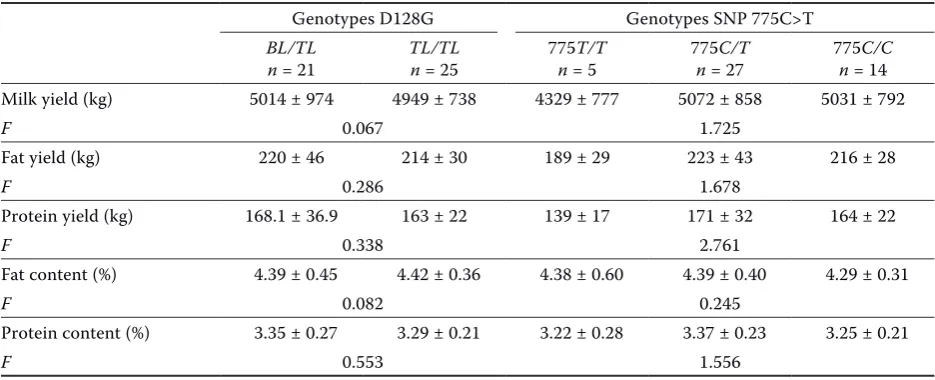
Table 2. Relationship between the polymorphism of SNP 775C>T in the gene encoding bovine ITBG2 and milk performance traits (–x ± SD) of the first lactation in half-sib sire family 2
Genotypes D128G Genotypes SNP 775C>T
BL/TL
n = 21 TL/TLn = 25 775n = 5T/T 775n = 27C/T 775n = 14C/C Milk yield (kg) 5014 ± 974 4949 ± 738 4329 ± 777 5072 ± 858 5031 ± 792
F 0.067 1.725
Fat yield (kg) 220 ± 46 214 ± 30 189 ± 29 223 ± 43 216 ± 28
F 0.286 1.678
Protein yield (kg) 168.1 ± 36.9 163 ± 22 139 ± 17 171 ± 32 164 ± 22
F 0.338 2.761
Fat content (%) 4.39 ± 0.45 4.42 ± 0.36 4.38 ± 0.60 4.39 ± 0.40 4.29 ± 0.31
F 0.082 0.245
Protein content (%) 3.35 ± 0.27 3.29 ± 0.21 3.22 ± 0.28 3.37 ± 0.23 3.25 ± 0.21
[image:3.595.64.532.569.759.2]
possibility of an association between SNP 775C>T and the milk performance traits in cattle. The re-sults cover the progeny of four bulls with D128G BL/TL and 775C/T genotypes and one bull with D128G TL/TL and 775C/T genotypes. An associa-tion study was carried out alternatively, considering the polymorphism of D128G and SNP 775C>T in a coordinate manner.
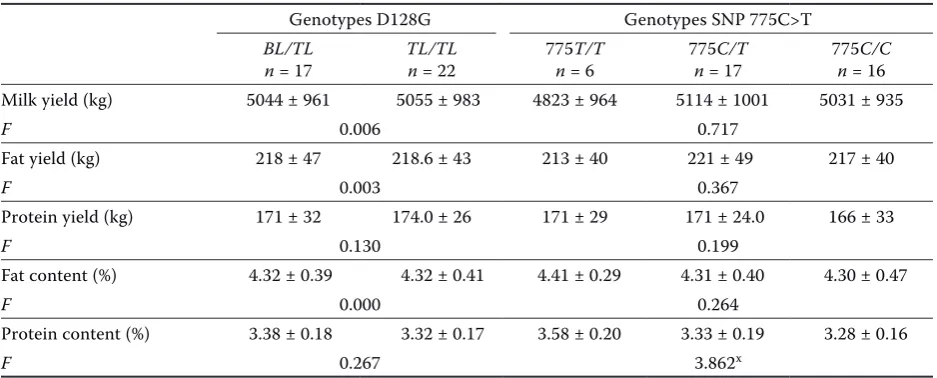
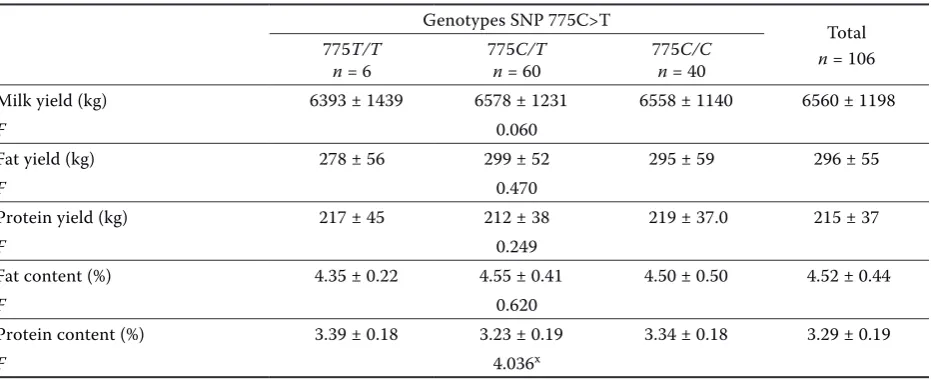
The results of the present study demonstrated a statistically significant association between SNP 775C>T and protein content of milk in three half-sib families (1, 4 and 5). In these analysed half-sib progeny groups, genotype 775T/T had the highest milk protein content value followed by
[image:4.595.64.532.114.303.2]genotypes 775T/C and 775C/C (Tables 1, 4 and 5). In contrast, no statistically significant differences were reported in two half-sib families (2 and 3) for the analysed milk performance traits that would be determined by either D128G genotype or SNP 775C>T (Tables 2 and 3). An interesting part of the results is the conformity of observations indicat-ing the occurrence of an association between SNP 775C>T within the bovine ITBG2 gene and the di-versified content of protein, with a simultaneous lack of associations with other milk performance traits. Comparing the results of ANOVA, it may be speculated that in comparison with the D128G mutation, SNP 775C>T is a more reliable marker Table 3. Relationship between the polymorphism of SNP 775C>T in the gene encoding bovine ITBG2 and milk performance traits (–x ± SD) of the first lactation in half-sib sire family 3
Genotypes D128G Genotypes SNP 775C>T
BL/TL
n = 20 TL/TLn = 22 775n = 4T/T 775n = 26C/T 775n = 12C/C Milk yield (kg) 5244 ± 1154 5250 ± 1376 4722 ± 1327 5342 ± 1268 5217 ± 1285
F 0.000 0.412
Fat yield (kg) 220 ± 59 223 ± 61 205 ± 56 225 ± 64 221 ± 54
F 0.025 0.202
Protein yield (kg) 168 ± 39 166 ± 45 153 ± 43 169 ± 43 168 ± 41
F 0.008 0.249
Fat content (%) 4.20 ± 0.45 4.25 ± 0.40 4.34 ± 0.44 4.22 ± 0.44 4.23 ± 0.40
F 0.117 0.361
Protein content (%) 3.20 ± 0.20 3.17 ± 0.22 3.23 ± 0.12 3.16 ± 0.20 3.23 ± 0.24
F 0.200 0.511
Table 4. Relationship between the polymorphism of SNP 775C>T in the gene encoding bovine ITBG2 and milk performance traits (–x ± SD) of the first lactation in half-sib sire family 4
Genotypes D128G Genotypes SNP 775C>T
BL/TL
n = 17 TL/TLn = 22 775n = 6T/T 775n = 17C/T 775n = 16C/C Milk yield (kg) 5044 ± 961 5055 ± 983 4823 ± 964 5114 ± 1001 5031 ± 935
F 0.006 0.717
Fat yield (kg) 218 ± 47 218.6 ± 43 213 ± 40 221 ± 49 217 ± 40
F 0.003 0.367
Protein yield (kg) 171 ± 32 174.0 ± 26 171 ± 29 171 ± 24.0 166 ± 33
F 0.130 0.199
Fat content (%) 4.32 ± 0.39 4.32 ± 0.41 4.41 ± 0.29 4.31 ± 0.40 4.30 ± 0.47
F 0.000 0.264
Protein content (%) 3.38 ± 0.18 3.32 ± 0.17 3.58 ± 0.20 3.33 ± 0.19 3.28 ± 0.16
F 0.267 3.862x
[image:4.595.64.533.548.737.2]of QTLs for milk protein content, as for all the
analysed traits and all progeny groups the obtained F values were higher for SNP 775C>T than for D128G. In addition, one half-sib family with a bull genotyped as homozygous TL/TL demonstrated the identical tendency for the diversified protein content of milk as the half-sib families originating from heterozygous bulls with BL/TL genotypes.
Investigations into the polymorphism within the bovine ITBG2 gene were dominated by the need for the identification of BLAD carriers. Most papers have eluded the possibility of applying the D128G mutation as a QTL marker. Scant attempts to veri-fy D128G as the QTL marker of milk performance traits were carried out by Taralik (1998), Janosa et al. (1999) and Czarnik (2000); they demonstrated a significant association between the lethal allele BL and higher protein content of milk. Studies by Czarnik (2000) involving a local population of Black-and-White cattle confirmed an interaction between the D128G genotype and environmental factors. The BL allele effect was beneficial if the cows were kept under good conditions, whereas under poor condi-tions it was negative. Analyses of the progeny of bulls – BL carriers demonstrated that the presence of the BL allele induced positive phenotypic effects only in some cases. It was assumed that the search for positive QTL markers of milk performance traits should consider a possibility of the occurrence of a genetic factor other than D128G linked or function-ally bound with the CD18 subunit. In the present study it was assumed that SNP 775C>T within the
bovine ITBG2 gene could be the factor capable of dif-ferentiating the milk performance traits. So far, the polymorphism of this mutation has been explored only in a Polish population of Black-and-White cattle (Czarnik et al., 2004). No other attempts have ever been made to apply this SNP 775C>T mutation as a QTL marker. The final evaluation of the usability of the bovine ITBG2 gene polymorphism as a marker of milk performance traits requires further study. An alternative hypothesis may be considered as well, namely, that SNP 775C>T within the bovine ITBG2 gene is not only a causative agent of the diversified protein content of cow milk but also it is in linkage disequilibrium with a yet unknown causal mutation. Subsequent investigations should be focused on the scanning of chromosome BTA1 and an analysis of the effect of mutations, localized within encoding genes, functionally linked with lactation and syn-thesis of milk components.
REFERENCES
Cox E., Mast J., MacHugh N., Schwenger B., Goddeeris B.M. (1997): Expression of b2 integrins on blood leu-kocytes of cows with or without bovine leukocyte ad-hesion deficiency. Vet. Immunol. Immunopath., 58, 249–263.
[image:5.595.66.532.113.303.2]Czarnik U. (2000): Breeding and genetic population as-pects of the occurrence of BLAD (Bovine Leukocyte Adhesion Deficiency) in Black-and-White cattle. Dis-sertation and Monographs, 32, 1–44. (In Polish) Table 5. Relationship between the polymorphism of SNP 775C>T in the gene encoding bovine ITBG2 and milk performance traits (–x ± SD) of the first lactation in half-sib sire family 5
Genotypes SNP 775C>T Total
n = 106 775T/T
n = 6 775n = 60C/T 775n = 40C/C
Milk yield (kg) 6393 ± 1439 6578 ± 1231 6558 ± 1140 6560 ± 1198
F 0.060
Fat yield (kg) 278 ± 56 299 ± 52 295 ± 59 296 ± 55
F 0.470
Protein yield (kg) 217 ± 45 212 ± 38 219 ± 37.0 215 ± 37
F 0.249
Fat content (%) 4.35 ± 0.22 4.55 ± 0.41 4.50 ± 0.50 4.52 ± 0.44
F 0.620
Protein content (%) 3.39 ± 0.18 3.23 ± 0.19 3.34 ± 0.18 3.29 ± 0.19
F 4.036x
Czarnik U., Zabolewicz T., Galiński M., Pareek C.S., Walawski K. (2004): Silent point mutation polymor-phism of the bovine CD18 encoding gene. J. Appl. Genet., 45, 73–76.
Doerchuk C.M., Winn R.U., Harlan J.M. (1989): Mecha-nisms of neutrophil emigration. In: Springer T.A., Anderson D.C., Rosenthal A.S. et al. (eds.): Structure and Function of Molecules Involved in Leukocyte Ad- hesion. Springer-Verlag, New York, 87–94.
Don R.H., Cox P.T., Wainwright B.T., Beker K., Mattick J.S. (1991): Touchdown PCR to circumvent spurious priming during gene amplification. Nucl. Acids Res., 14, 4008.
Fett T., Zecchinon L., Baise E., Desmecht D. (2004): The bovine (Bos taurus) CD11a-encoding cDNA: molecu-lar cloning, characterization and comparison with the human and murine glycoproteins. Gene, 325, 97– 101.
Georges M., Nielsen D., Mackinnon M., Mishra A., Oki-moto R., Pasquino A.T., Sargeant L.S., Sorensen A., Steele M.R., Zhao X., Womack J.E., Hoeschele I. (1995): Mapping quantitative trait loci controlling milk pro-duction in dairy cattle by exploiting progeny testing. Genetics, 139, 907–920.
Hynes R.O. (1992): Integrins, versality, modulation, and signalling in cell adhesion. Cell, 69, 11–25.
Janosa A., Baranyai B., Dohy J. (1999): Comparison of milk production of the progeny of BLAD-carrier and healthy Holstein bulls in Hungary. Acta Vet. Hung., 47, 283–289.
Kijas J.M.H., Bauer T.R., Gäfvert S., Marklund S., Tro-wald-Wigh G., Johannisson A., Hedhammar Å., Binns M., Juneja R.K., Hickstein D.D., Andersson L. (1999): A missence mutation in the b-2 integrin gene (ITGB2) causes canine leukocyte adhesion deficiency. Geno-mics, 61, 101–107.
Lubieniecki K., Grzybowski G., Łukaszewicz M., Lubie-niecka J. (1999): Association between the presence of
allele BL in the genome of dairy cows and their pro-ductivity. Anim. Sci. Pap. Rep., 17, 189–194.
Mosig M.O., Lipkin E., Khutoreskaya G., Tchourzyna E., Soller M., Friedmann A. (2001): A whole genome scan for quantitative trait loci affecting milk protein per-centage in Israeli-Holstein cattle, by means milk DNA pooling in daughter design, using an adjusted false discovery rate criterion. Genetics, 157, 1683–1698. Nadesalingam J., Plante Y., Gibson J.P. (2001): Detection
of QTL for milk production on Chromosomes 1 and 6 of Holstein cattle. Mam. Genome, 12, 27–31.
Shuster D.E., Bosworth B.T., Kehrli M.E. (1992a): Se-quence of the bovine CD18-encoding cDNA; com-parison with human and murine glycoproteins. Gene, 114, 267–271.
Shuster D.E., Kehrli M.E., Ackermann M.R., Gilbert R.O. (1992b): Identification and prevalence of a genetic de-fect that causes leukocyte adhesion deficiency in Hol-stein cattle. Proc. Natl. Acad. Sci., 89, 9225–9229. Taralik K. (1998): Association between BLAD carrier and
non BLAD carrier Holstein-Friesian bulls and the pro-duction of their daughters. Arch. Tierz., 41, 339–344. Taylor J.F., Eggen A., Aleyasin A., Armitage S.M., Barendse
W., Beever J.E., Bishop M.D., Brenneman R.A., Burns B.M., Davis S.K., Elo K., Harlizius B., Kappes S.M., Keele J.W., Kemp S.J., Kirkpatrick B.W., Lewin H.A., Ma R.Z., McGraw R.A., Pomp D., Stone R.T., Sugimoto Y., Teale A.J., Vaiman D., Vilkki J., Williams J.L., Eh C.C., Zanotti M.C. (1998): Report of the first workshop on the genetic map of bovine chromosome 1. Anim. Genet., 29, 228–235.
Zecchinon L., Fett T., Baise E., Desmecht D. (2004): Mo-lecular cloning and characterization of the CD18 part-ner in ovine (Ovis aries) b2-integrins. Gene, 334, 47–52.
Received: 2006–01–03 Accepted after correction: 2006–11–01
Corresponding Author
dr. hab. Urszula Czarnik, Department of Animal Genetics, University of Warmia and Mazury in Olsztyn, 10 719 Olsztyn, Poland