Bovine milks contain different variants of pro-teins, in many cases characterized by explicit differ-ences in milk production and functional properties (FitzGerald and Hill, 1997).
The polymorphism of cow milk properties started to be monitored in the last fifty years of the last cen-tury mainly from the aspect of population develop-ment, breeding and hybridization. Later, in the last ten to twenty years, with development of new elec-trophoretic, immunochemical and chromatographic methods and techniques, the relationship between genetic polymorphism of milk proteins and chemical composition, milk properties and functional proper-ties has been studied very extensively. In particular, the association of genetic polymorphism with heat stability and cheese-making properties of milk has been investigated (Puhan, 1997).
Genetic variants of milk proteins are often used as subsidiary selective parameters in breeder as-sessment. Most of all is clustered in genetic variants of β-lactoglobulin (β-Lg) and κ-casein (κ-CN) and
their impact on protein content and technological properties of milk with respect to the requirements of dairy industry which gives priority to milk with better technological properties for the production of cheeses (Litwińczuk et al., 2006).
There are not any unequivocal views on the utilization of milk protein polymorphism as an ancillary criterion in milk cow breeding. Partially, it follows from the non-uniform findings of the effect of casein component variants on the final production, content of the main components, physical, chemical and technological parameters of milk.
Chrenek et al. (2003) pointed out the association of the κ-CN BB with a high fat content in imported dairy cows of Brown Swiss breed to Slovakia. The κ-casein genotype was not associated with protein and lactose contents.
The results of most studies show a higher content of crude protein as well as of casein in cows with κ-CN BB genotype (Litwińczuk et al., 2006).
Influence of composite κ-casein and β-lactoglobulin
genotypes on composition, rennetability and heat
stability of milk of cows of Slovak Pied breed
A. Michalcová, Z. Krupová
Faculty of Biotechnology and Food Sciences, Slovak Agricultural University, Nitra, Slovak republic
ABSTRACT: The effect of the phenotypic combination of genetic variants κ-CN/β-Lg on the contents of technologi-cally and nutritionally important components of milk as well as technological properties of milk was investigated in this paper. The samples of milk were collected from 72 cows of Slovak Pied breed in the second lactation coming from three farms, once from the different lactation stage. The genotyping of milk samples was determined by the horizontal electrophoretic separation of milk proteins on starch gel with addition of urea and mercaptoethanol. Statistical analysis was carried out in the programmes Statistica 6.0 and Statgraphic Plus 5.1 by the least-squares method using the GLM. An non-significant association of B allele in the κ-CN/β-Lg phenotypic combination with milk fat, crude protein content and true protein content was found out. A positive significant effect of κ-CN/β-Lg BB/BB on casein content and casein number was confirmed. The value of casein number increased in the follow-ing order: BB/BB > AB/AB > AA/AA (78.43%:77.53%:75.78%). With regard to whey proteins and heat stability, a negative effect of B allele in the phenotypic combination κ-CN/β-Lg was found out.
A positive effect of the κ-CN B allele is also re-flected in casein number (Londes et al., 1996). The casein number (Ng-Kwai-Hang et al., 2002a) to-gether with curd yield are the indicators of milk utilization as a raw material for cheese production (Verdier-Metz et al., 2001).
Associations of the κ-CN B with crude protein content and casein content were repeatedly con-firmed while a dominant effect of the genotype BB > AB > AA is asserted in allele expression (Ng-Kwai-Hang, 1998). Chrenek et al. (1998) and Ng-Kwai-Hang (1998) found out a significantly higher protein content (+0.1–0.2/100g) in the milk of cows with κ-CN BB genotype. Opposite to the above-mentioned authors Çardak (2005) determined a positive effect of κ-CN AA on the content and production of fat as well as protein in the milk of Simmental cows. Dairy cows with κ-CN AA genotype produced daily about 2% more protein and fat compared to cows with κ-CN BB genotype.
The effect of κ-CN B allele on higher protein con-tent was established by Molina et al. (2006a).
Dalgleish (1995) and Horne et al. (1995) con-firmed an increase in casein content, κ-CN ratio in casein micelles and free Ca+ ions because of κ-CN B allele.
A positive effect of κ-CN B and β-Lg B alleles on the protein content was also reported by Ikonen et al. (1999) and Miceikiene et al. (2005). It was proved that A variant of β-Lg compared to B variant had higher protein (Ng-Kwai-Hang, 1998) and fat con-tents. The β-Lg B allele increases the portion of ca-sein in total protein content and decreases whey protein content (Celik, 2003). Ng-Kwai-Hang (1998) did not ascertain any influence between these frac-tions of milk proteins and genetic variants of β-Lg.
The results of Bobe et al. (1999) show that κ-CN and β-Lg genotypes influenced the genotypic and phenotypic variability of milk protein composition, however, they did not affect the concentration of milk proteins significantly. They observed that changed genotype sequences in the κ-CN B and β-Lg A promotor region were closely fixed to the particular genotypes.
Lundén et al. (1997) found an explicit general relationship between the presence of the κ-CN B allele and better quality and curd yield.
A favourable influence of κ-CN BB on cheese-making properties of milk, e.g. shorter rennet- ability and higher curd firmness, was confirmed by several studies (Kubarsepp et al., 2005).
Ng-Kwai-Hang et al. (2002a) claimed that milk with B variant of κ-CN and β-Lg was associated with better coagulation properties, shorter coagula-tion time, faster syneresis, higher curd firmness and higher yield of cheese of better cheese quality compared to A variant. The effect of κ-CN B allele on the shortening of coagulation time (about 10 to 30%) (AA > AB > BB) was reported by Czerniawska-Piatkowska and Kamieniecki (2004).
A shorter total coagulation time (syneresis) of milk at natural pH of milk in cows with κ-CN BB was determined by Horne and Muir (1994a), how-ever, these differences disappeared at lower pH of milk. Both phases, renneting time and syneresis, were influenced by the κ-CN phenotype. On the basis of further research Horne and Muir (1994b) stated that the differences in coagulation proper-ties of milk with different κ-CN phenotype were not predominantly influenced by the content of soluble calcium. The influence of pH compensates the effect of soluble Ca level on milk behaviour during cheese-making.
Controversial results of the effect of κ-CN on heat stability and coagulation propertiew are not noted by Molina et al. (2006b) and FitzGerald and Hill (1997), who refer to the slight decrease in heat stability by centrifugation of concentrated milk in milks with κ-CN B allele, despite the fact that the κ-CN B allele is connected with higher casein con-tent in milk.
The quantitative representation of milk proteins is given by interactions inside the casein block and by interactions between the genotypes for caseins and β-lactoglobulins. For this reason, the latest re-search papers do not concern only with the geno-types for κ-casein and β-lactoglobulin per se, but with the complete genotype for all proteins (Martin et al., 2002).
The aim of our study was to investigate the re-lationship between the combination of κ-CN and β-Lg genetic variants and the content of techno-logically and nutritionally important components of milk, to direct the attention to the protein com-plex and finally to the technological properties of milk aimed at cheese-making properties and milk production.
MATERIAL AND METHODS
farms on the second lactation, once from the differ-ent lactation stage. Genotyping of milk samples was stated in cooperation with SCPV in Nitra, at the Department of the quality of animal products. After centrifugation of milk (a speed 3000 revolutions per minute), a lower layer without fat was taken off and stored at the temperature of –18şC. The analysis of samples was carried out by horizontal electro-phoretic separation of milk proteins on starch gel with addition of urea and mercaptoethanol.
Fat content was stated with Milcoscan FT 120. The crude protein (CP), true protein (TP) and whey protein (WP) contents were stated by Kjeldahl method according to Standard 020-1:2001/ISO
8968-1 and Standard 020-5:2001/ISO 8968-5. Casein content (CN) was calculated by equation (CN = TP (g/100 g) – WP (g/100 g)). Non-protein nitrogen content (NPN) was calculated by equa-tion (NPN = CP (g/100 g) – TP (g/100 g)). The casein number (CNno) was calculated as the ratio of casein to true protein (CN = casein (g/100 g)/TP (g/100 g) × 100.
The calcium (Ca) content was stated by com-plex-metric titration according to Standard 036A:1992.
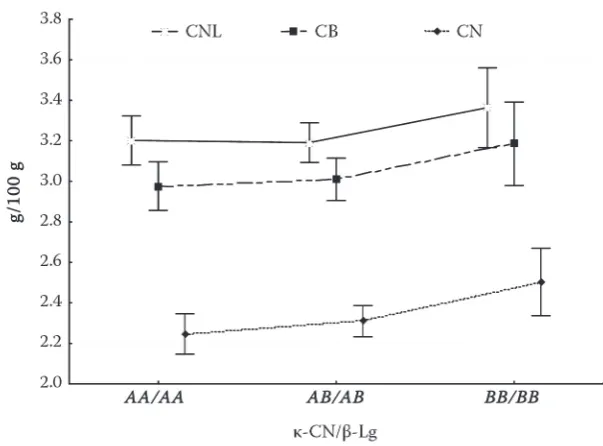
[image:3.595.69.371.82.305.2]The rennetability of milk was ascertained by the trial of rennetability. 20 cm3 of milk was heated up to 35°C in water bath, 1 cm3 of rennet Hannilase Figure 1. Least- squares means and 95% LSD intervals of total protein, true protein and casein in relation to κ-CN/β-Lg variants
Table 1. Milk composition and technological properties in relation to κ-CN/ß-Lg variants
Phenotype combination of genetic variant
κ-CN/ß-Lg AA (n = 26) κ-CN/ß-Lg AB (n = 30) κ-CN/ß-Lg BB (n = 16)
mean ± sx mean ± sx mean ± sx
Fat (g/100 g) 4.05 ± 0.202 3.86 ± 0.135c 4.28 ± 0.153b
CP (g/100 g) 3.20 ± 0.059 3.21 ± 0.048 3.35 ± 0.097
TP (g/100 g) 2.97 ± 0.058 3.03 ± 0.052 3.17 ± 0.101
CN (g/100 g) 2.25 ± 0.048c 2.33 ± 0.040bc 2.45 ± 0.081a
CNno (%) 75.78 ± 0.575ab 77.53 ± 0.318bc 78.43 ± 0.511ca
WP (g/100 g) 0.73 ± 0.021ac 0.67 ± 0.013ba 0.68 ± 0.028
NPN (g/100 g) 0.23 ± 0.018ac 0.21 ± 0.015bc 0.16 ± 0.016
Ca (mg/100 g) 130.86 ± 1.441 126.72 ± 1.838 126.48 ± 3.675 Rennetability (RCT) (s) 182.81 ± 24.553 160.33 ± 18.927 143.12 ± 19.142 Ethanol number (ml) 2.42 ± 0.127 2.20 ± 0.124c 1.92 ± 0.164b
a,b,cmeans the significant difference P < 0.05 between two genotypes marked with the different letter in one column
[image:3.595.67.532.533.721.2]powder (fy Chr. Hansen) with the strength of 1:400 was added, milk was stirred. The time till the crea-tion of first curd flakes was measured.
Heat stability (alcohol number) was determined by the titration with 96% ethanol. Alcohol number expresses an ethanol consumption of given concen-tration for fixed bulk of milk (2 cm3) till protein coagulation under the terms of the method.
Statistical analysis was carried out in program Statistica 6.0 (StatSoft, 2001) and Statgraphics Plus 5.1 (2001) by the method of least squares using the GLM (General Linear Model), which included phenotypic composition of κ-CN and β-Lg (A al-lele κ-CN and β-Lg and B alal-lele κ-CN and β-Lg), fixed effect of herd and residual effects. Differences between genotypes were tested by using Scheffe multiple range tests for all traits studied.
RESULTS AND DISCUSSION
The results of experiments aimed at the evalua-tion of the κ-CN and β-Lg relaevalua-tion to fat content in milk are controversial. An insignificant positive effect of B allele on milkfat reflected in dairy cows with the homozygous phenotypic combination κ-CN/β-Lg BB/BB. In these animals, a significantly higher fat content in milk was found out compared to dairy cows with the phenotypic combination AB/AB κ-CN/β-Lg (Table 1) in accordance with Ng-Kwai-Hang (1998) and Chrenek et al. (2003). Lechniak et al. (2002) and Cardak (2005) reported that cows with the κ-CN AA genotype produced more fat than cows with the κ-CN BB genotype.
[image:4.595.67.377.83.261.2]Most of the reports on their results refer to higher CP content as well as casein content in cows with Figure 2. Casein number in relation to κ-CN/β-Lg variants
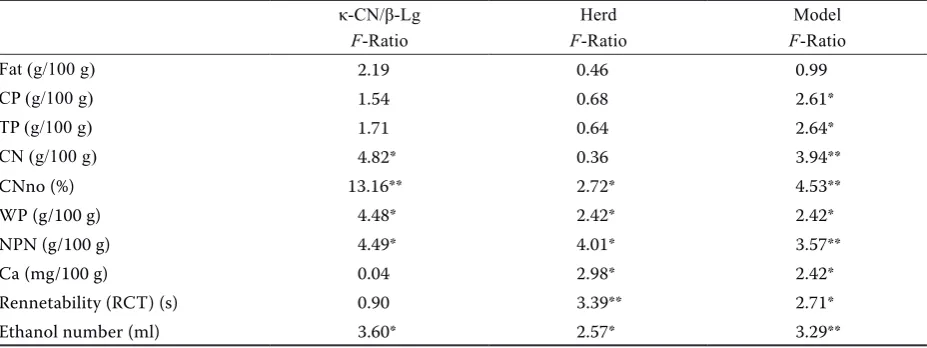
Table 2. The effect of the κ-CN/β-Lg variants and herd on milk composition and technological properties of milk (GLM analysis)
κ-CN/β-Lg
F-Ratio
Herd
F-Ratio
Model
F-Ratio
Fat (g/100 g) 2.19 0.46 0.99
CP (g/100 g) 1.54 0.68 2.61*
TP (g/100 g) 1.71 0.64 2.64*
CN (g/100 g) 4.82* 0.36 3.94**
CNno (%) 13.16** 2.72* 4.53**
WP (g/100 g) 4.48* 2.42* 2.42*
NPN (g/100 g) 4.49* 4.01* 3.57**
Ca (mg/100 g) 0.04 2.98* 2.42*
Rennetability (RCT) (s) 0.90 3.39** 2.71*
Ethanol number (ml) 3.60* 2.57* 3.29**
*P < 0.05; **P < 0.01
[image:4.595.68.532.546.720.2]the κ-CN BB and β-Lg BB genotypes (Chrenek et al., 1998; Ng-Kwai-Hang, 1998; Ikonen et al., 1999; Miceikiene et al., 2005). Our results agree with these conclusions. We determined the high-est CP content, TP and CN contents in the milk of cows with κ-CN/β-Lg BB/BB genotype (Figure 1). However, we confirmed a significant effect of the B allele on CN content (Table 2).
A statistically highly significant effect of the κ-CN/β-Lg phenotypic combination was also proved in CNno (Table 2), whose value signifi-cantly increased in the following order: κ-CN/β-Lg BB/BB > κ-CN/β-Lg AB/AB > κ-CN/β-Lg AA/AA (78.43%:77.53%:75.78%) (Figure 2). These results are comparable with those of Allmere (1997), who found out a positive effect of β-Lg B allele and κ-CN B allele on CNno.
Opposite to the results of Ng-Kwai-Hang et al. (2002b), the effect of the κ-CN/β-Lg phenotypic combination is expressed significantly in WP content (Table 2). Dairy cows with the κ-CN/β-Lg AA/AA phenotypic combination had about 0.05 g/100 g higher WP content compared to dairy cows with the κ-CN/β-Lg BB/BB genotype, and about 0.06 g/100 g higher compared to dairy cows with the κ-CN/β-Lg AB/AB genotype (Table 1). A decrease in WP content in association with the β-Lg B allele was reported by Celik (2003).
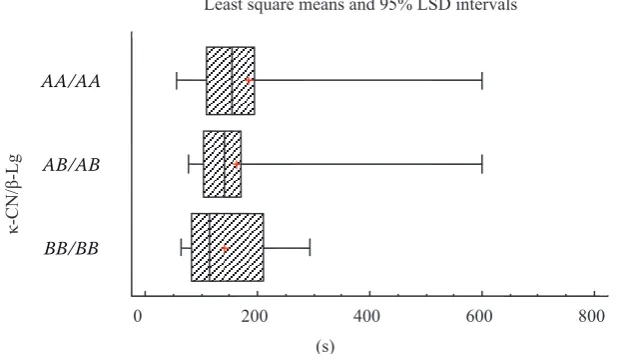
Nevertheless, a significant association of renneta-bility with the phenotypic combination κ-CN/β-Lg was found out, and an insignificant positive ef-fect of the B allele on the shortening of renneting time was observed both in homozygous and het-erozygous genotypes (Figure 3). The same results were obtained by Horne and Muir (1994a), Ng-Kwai-Hang et al. (2002a), Czerniawska-Piatkowska and Kamieniecki (2004). The favourable cheese
properties of milk are connected with the CN content in which a positive effect of the B allele was substantiated. On the other hand, Ca content influences the rennetability of milk considerably, however, the effect of B allele was not confirmed. When investigating the influence of the factors on rennetability by the analysis of variance of compo-nents, we found out that Ca and CN participated by 74% and 25% in the total variance of this milk property.
The expression of B allele in a homozygous domi-nant form of the κ-CN/β-Lg phenotypic combi-nation had a significant negative effect on heat stability (Tables 1 and 2). Pazdera et al. (1994) draw attention to a slight decrease in heat stability of milk with the κ-CN B allele despite the fact that the κ-CN B allele is related to the higher total CN content in milk.
The results of the assay substantiated a positive effect of κ-CN/β-Lg BB/BB on CN content, CNno and a negative effect on WP and heat stability of milk. These results can be applied when milk is used for cheese production; it helps to give prefer-ences of the κ-CN/β-Lg B alleles in the selection of animals for further breeding purposes in conse-quence of what would reach a positive modification of milk capability in cheese production.
CONCLUSION
The positive association between B allele of the phenotypic combination κ-CN/β-Lg and the CP, TP, CN content and CNno and the negative effect on WP and heat stability were confirmed. The re-sults of the analysis could be used as an important source of information for producers as well as for
ț-C
N
/ȕ
-L
g
Least square means and 95% LSD intervals
BB/BB AB/AB AA/AA
0 200 400 600 800
[image:5.595.66.378.87.264.2](s)
Figure 3. Rennetability in relation to κ-CN/β-Lg variants
AA/AA
AB/AB
breeders because of the increasing portion of milk processed into cheeses.
REFERENCES
Allmere T., Andrén A., Björck L. (1997) Interactions be-tween different genetic variants of β-lactoglobulin and κ-casein during heating of skim milk. J. Agric. Food
Chem., 45, 564–569.
Bobe G., Beitz D.C., Freeman A.E., Lindberg G.L. (1999):
Effect of milk protein composition and its genetic pa -rameter estimates. J. Dairy Sci., 82, 2797–2804. Çardak A.D. (2005): Effect of genetic variants in milk
pro-tein on yield and composition of milk from Holspro-tein- Holstein-Friesian and Simmentaler cows. S. Afr. J. Anim. Sci.,
35, 41–47.
Chrenek P., Huba J., Vašíček D., Peškovičová D., Bulla J. (2003): The relation between genetic polymorphism mark-ers and milk yield in Brown Swiss cattle imported to Slo-vakia. Asian-Austral. J. Anim. Sci., 16, 1397–1401.
Celik S. (2003): β-lactoglobulin genetic variants in Brown Swiss breed and its association with compositional prop-erties and rennet clotting time of milk. Int. Dairy J., 13,
727–731.
Czerniawska-Piatkowska E., Kamieniecki H. (2004): Milk
protein polymorphism in cattle. Med. Weter., 60, 692– 694.
Dalgleish D.G. (1995): Technological properties of milk protein variants. In: IDF Seminar on Implications of
Ge-netic Polymorphism of Milk Proteins on Production and
Processing of Milk. IDF, Brussels, Belgium.
FitzGerald R.J., Hill J.P. (1997): The relationship between
milk protein polymorphism and the manufacture and
functionality of dairy product. In: Milk Protein Poly-morphism. Bulletin IDF. IDF, Brussels Belgium: 355–
371.
Horne D.S., Muir D.D. (1994a): Influence of κ-casein
phe-notype on the rennet coagulation time of bovine milk. Milchwissenschaft, 49, 386–388.
Horne D.S., Muir D.D. (1994b): Genetic polymorphism of κ-casein and rennet coagulation time. Effects of serum
phase components. Milchwissenschaft, 49, 446–449.
Horne D.S., Muir D.D., Banks J., et al. (1995): Effects of κ-casein Phenotype on Curd Strength in Rennet Coagu-lated Milks. In: IDF Seminar on Implications of Genetic
Polymorphism of Milk Proteins on Production and
Processing of Milk. IDF, Brussels, Belgium.
Ikonen T., Ojala M., Ruottinen O. (1999): Associations between milk protein polymorphism and first lactation
milk production traits in Finnish Ayrshire cows. Genet. Breed., 82, 1026–1033.
Kűbarsepp I., Henno M., Viinalass H., Sabre D. (2005): Effect of κ-casein and β-lactoglobulin genotypes on the milk rennet coagulation properties. Agr. Res., 1, 55–64.
http://www.edpsciences.org/
Lechniak D., Strabel T., Przybyła D., Machnik G., Świtoński M. (2002): GH and CSN3 gene polymorphisms and their impact on milk traits in cattle. J. Anim. Feed Sci., 11,
39–45.
Litwińczuk Z., Barłowska J., Krol J., Litwińczuk A. (2006):
Milk protein polymorphism as markers of production traits in dairy and meat cattle. Med. Weter., 62, 6–10.
Lodes A., Buchberger J., Krause I., Aumann J., Klostermeyer H. (1996): The influence of genetic variants of milk pro-teins on the composition and technological properties of milk 3. Content of protein, casein, whey protein and casein number. Milchwissenschaft, 51, 3–7.
Lundén A., Nilsson M., Janson L. (1997): Marked effect of β-lactoglobulin polymorphism on the ratio of casein to total protein in milk. J. Dairy Sci., 80, 2996–3005. Martin P., Szymanowska M., Zwierchowski L., Leroux
Ch. (2002): The impact of genetic polymorphisms on the protein composition of ruminant milks. Reprod. Nutr. Dev., 42, 433–459.
Miceikiene I., Peciulaitiene I., Petraskiene N. (2005): Milk genotypes and their association with milk composition traits in the Lithuanian dairy cattle. Med. Weter., 61, 394–397.
Molina L.H., Kramm J., Brito C., Carrillo B., Pinto M., Ferrando A. (2006a): Protein composition of milk from Holstein-Friesian dairy cows and its relationship with the genetic variants A and B of κ-casein and β-lac-toglobulin (Part I.). Int. J. Dairy Technol., 59, 183– 187.
Molina L.H., Benavides T., Brito C., Carrillo B., Molina
I. (2006b): Relationship between A and B variants of
κ-casein and β-lactoglobulin and coagulation properties of milk (Part II.). Int. J. Dairy Technol., 59, 188–191.
Ng-Kwai-Hang K.F. (1998): Genetic polymorphism of
milk proteins: Relationships with traits, milk composi-tion and technological properties. Can. J. Anim. Sci.,
78, 131–147.
Ng-Kwai-Hang K.F., Dodds C., Boland M.J., Auldist M. J. (2002a): The influence of genetic variant of β-lac-toglobulin on speed and firmness of rennet curd.
Milch-wissenschaft, 57, 267–269.
Ng-Kwai-Hang K.F., Otter D.E., Lowe E., Boland M.J., Auldist M.J. (2002b): Influence of genetic variant of β-lactoglobulin on milk composition and size of casein
micelles. Milchwissenschaft, 57, 303–306.
Puhan Z. (1997): Milk protein polymorphism. In: Milk Protein Polymorphism II. Proc. IDF Seminar. IDF
StatSoft (2001): Version 6. StatSoft, Inc. www.statsoft.
com
Standard 020-1:2004/ISO8968-1 (2001): Milk determina-tion of nitrogen content. Part 1: Kjeldahl method. Standard 020-5:2004/ISO8968-5 (2001): Milk
determina-tion of nitrogen content. Part 5: Determinadetermina-tion of pro-tein-nitrogen content.
Corresponding Author
Ing. Anna Michalcová, PhD., Department of Evaluation and Processing of Animal Products, Faculty of Biotechnology and Food Sciences, Slovak Agricultural University, Tr. A. Hlinku 2, P.O. Box 40B, 949 76 Nitra, Slovak Republic Tel. +421 376 414 313, e-mail: [email protected]
Standard 036A:1992 (1992): Milk determination of nitro-gen content. Titrimetric method.
Verdier-Metz I., Coulon J. B., Pradel P. (2001):
Relation-ship between milk fat and protein contents and cheese yield. Anim. Res., 50, 365– 371.