Food appearance (colour, shape or form) influences in a substantial way the customer and thus impacts on the product marketability. The natural and usual appearance gives evidence of the fact that the offered food is most probably not harmful. Not many publications have dealt with the problems of the objective monitoring of the food appearance during its storage.
GEMA et al. (1994) dealt with the maturation character-istics and changes during banana storage. Immature ba-nanas were put into polyethylene bags at temperatures of 1, 5, 8 and 12°C. After storage, the membrane porosity as well as peel and pulp maturity characteristics were inves-tigated. A difference was found in the sensitivity to cold between the pulp and banana peel tissues. The pulp was temperature-sensitive under 8°C.
SHANTA KRISHNAMURTHY (1989) also studied the mat-uration of green bananas. The bananas were harvested at two levels of maturity (115 and 100 days after the fruit birth) and then stored at temperatures of 15 and 20°C for
periods of 1 to 4 weeks; thereafter, they were left to ma-ture under ambient conditions. Theirs softening, peel colour, pulp/peel ratio, tanning agent, total sugar, and residual alcohol in pulp were monitored. A lower de-crease of weight was observed during storage at 15°C than at 20°C. As concerned the quality, the fruits stored for 1 to 4 weeks at 20°C and 3 weeks at 15°C were the best.
KLETTNER (1987) studied the effects of illumination, the type of meat, additives, atmosphere composition, and relative humidity on the colour and the colour retention in sliced sausages during storage in retail display cabinets. Relative humidity had no noticeable effect on colour and the colour retention. High levels of illumination together with other parameters decreased the level of red colour and colour retention.
The articles given above show that the colour and oth-er physical propoth-erties can be appropriate indicators of the food deterioration.
SHORT COMMUNICATION
Testing of Scanner and Colour-Meter for Observation of Changes
during Storage of Two Selected Foods
PAVLA NOVOTNÁ, KAREL KÝHOS, ALEŠ LANDFELD, JAN STROHALM and MILAN HOUŠKA
Food Research Institute Prague, Prague, Czech Republic
Abstract
NOVOTNÁ P., KÝHOS K., LANDFELD A., STROHALM J., HOUŠKA M. (2002): Testing of scanner and colour-meter for observation of changes during storage of two selected foods.Czech J. Food Sci., 20: 203–208.
The test with colour and aroma of Kladno cooked pork loin stored in refrigerator and at the room temperature correspond with its spoilage was done. No change of the L* co-ordinate has been observed during the storage. A strong decrease of a* co-ordinate for red colour after 1-day storage has taken place for samples stored in a room (approx. 25°C). Conversely, an increase of b* co-ordinate for yellow colour has been observed after 1-day storage. A change of the cooked pork loin aroma has also been noticed after 1-day storage using the sensory observation. Further, the possibility has been tested of using a portable scanner for the determination of banana colour changes. It has been found that the optimal storage temperature from the peel colour point of view is 14°C; it is in accordance with recommendations in literature.
Keywords: colour; aroma; brightness; a* co-ordinate for red colour; b* co-ordinate for yellow colour
MATERIAL AND METHODS
Instrumental equipment. colorimeter CR-300 Minolta (light source D65, colour space CIE L*a*b*); desktop colour scanner (Hewlett Packard ScanJet II C) and digital thermometer Therm Pt 100.
Raw materials. The changes in the appearance of ba-nana peel during its maturation have been studied. For this purpose 3 green bananas in one bunch and of the same initial colour were purchased in the supermarket, re-tail chain Albert, Ahold CZ. Further changes of Kladno cooked pork loin colour and aroma has been studied; it was also purchased in the same supermarket. The Kladno cooked pork loin is a typical Czech meat product similar to ham prepared from lean pork meat by cooking and smoking.
Method of the peel colour measurement during ba-nana maturation. Baba-nana peel colour has been measured; the bananas have been stored in darkness and tempera-tures of 6.4°C and 14°C (in a refrigerator) and at 25°C (at the room temperature). Scanning of each sample has been performed once a day from the same sample side using the Deskscan software. Then, the software Scion Image (Scion Corporation, USA) has been used for the sample surface colour analysis. The software is able to determine the proportions of the individual colour tones in the giv-en image. To perform this analysis, the image has to be transformed into 256 tones grey scale. The scanned ba-nana contour has been replaced by abscissas forming a closed polygon. Then the software could process this bounded domain. The average colour value of this bound-ed domain has been evaluatbound-ed using the 0–255 scale (0 cor-responds to white and 255 to black colour). Then, the percentage area change of the image projection has been evaluated. Those parameters have been evaluated depend-ing on the temperature and the storage period.
Kladno cooked pork loin colour and aroma changes: a prediction method. The samples have been cut into
slices 5 mm thick and discs of a diameter of 24 mm have been cut out using a punch. The discs have been put into clean and ethylalcohol-wiped Petri dishes, three discs in each dish. The samples L1, L2 have been stored in a re-frigerator, the samples M1, M2 in a room in darkness, while the M3, M4 on daylight covered by a white filter paper.
The colour of the samples described above has been monitored twice a day using the Minolta colorimeter. The data have been scanned into computer using Spectral C software (Minolta, Japan) and transferred into Microsoft Excel for graphs creation. Each sample has been measured three times and colour co-ordinates average has been calculated – L* brightness, a* red colour co-ordinate, b* yellow colour co-ordinate. The mean values have been evaluated, for the individual colour co-ordinates for the samples M1, M2, M3 and M4, and an appropriate regres-sion exponential function of time has been chosen.
The colour co-ordinates have been subjected to a sta-tistical-conclusive-evidence evaluation of various stor-age modes and of the storstor-age period influence in the framework of a given storage mode. The Student t-test has been used on the statistical significance level of 0.95 (ŠTĚPÁNEK 1975).
Apart from the colour measurement the sample aroma has also been evaluated using sensory assessment twice a day. The stench intensity has been recorded by evalua-tors on the abscissa 100 mm in length (0 – a pleasant scent, 100 – unpleasant scent – stench).
RESULTS AND DISCUSSION
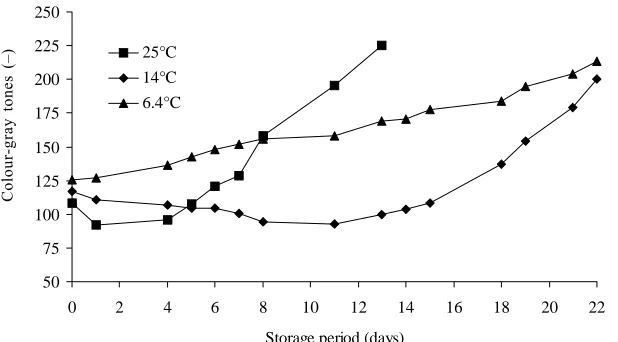
Colour of maturing banana peel. In Figs 1 and 2, the results are given of the colour and shape measurements. Fig. 1 shows the dependence of the banana peel colour on the temperature and the storage period in 256 grey level (colour depth 3 bits). In can be deduced from the curves that the temperature of 14°C is the most suitable;
Fig. 1. Banana colour depending on storage period at various storage tem-peratures
50 75 100 125 150 175 200 225 250
0 2 4 6 8 10 12 14 16 18 20 22
Storage period (days) 25°C
14°C
6.4°C
[image:2.595.71.380.582.753.2]the peel started to grow brown after about 18th days which corresponds to the value 137 grey tone. At the tempera-ture of 25°C, the same value was reached after approx. 7days, and at the temperature of 6.4°C after 4 days, re-spectively. At the temperature of 25°C and 14°C, the orig-inally green colour changed to yellow and subsequently to brown. At the temperature of 6.4°C, the peel colour did not grow yellow but directly brown.
Fig. 2 shows changes (in percents) of the banana pro-jection area in the dependence on temperature and the storage period – the banana shrivelling. It is obvious that at room temperature of 25°C a change of 20% occurred after a period of 13 days which was a consequence of a lower air humidity causing a more intensive loss of water. At the temperature of 14°C, the change was 13%, and at that of 6.4 approx. 8%, respectively. It can be concluded from the figures that the most favourable temperature for the banana storage is 14°C. At this temperature, the ba-nanas had an appearance acceptable for the customer for a period more than 2.5 times longer than during storage at
6.4°C, and 4.5 times longer than during storage at 25°C. This conclusion is in accordance with the banana trans-port and storage temperature as recommended by the ANONYM (1999).
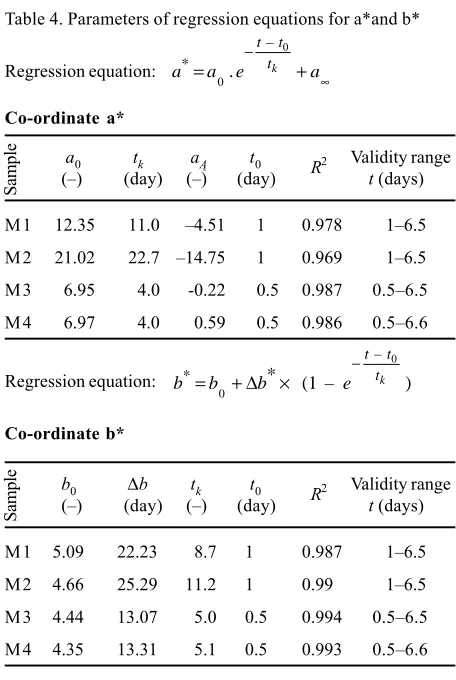
Kladno cooked pork loin colour and aroma. Tables 1 to 3 give the statistical significance evaluation of the mean values of the colour co-ordinates changes from the point of view of both the storage mode (temperature, light) and the storage period. The optimal regression model co-ordi-nates for fitting a* and b* time dependencies are given in Table 4 as well as the corresponding regression equa-tions forms.
[image:3.595.61.526.385.509.2]On the basis of the statistical significance evaluation of the colour co-ordinates changes it could be stated that during the storage there were practically no changes of the brightness co-ordinate L*; a slight decrease of this co-ordinate was observed after 4.5 days (the decrease is not conclusive in the light of the measurement values scatter). Differences of the L* co-ordinate were not sta-tistically conclusive for any storage mode although there
Fig. 2. Banana projection area depend-ing on storage period at various storage temperatures
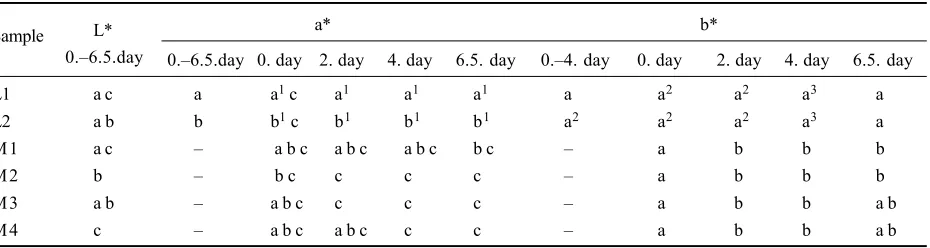
Table 1. Evaluation of the statistical significance of the differences of the measured values of the colour co-ordinates (Student
t-test) – influence of storage mode on the Kladno cooked pork loin samples
Sample L* a* b*
0.–6.5.day 0.–6.5.day 0. day 2. day 4. day 6.5. day 0.–4. day 0. day 2. day 4. day 6.5. day
L1 a c a a1c a1 a1 a1 a a2 a2 a3 a
L2 a b b b1c b1 b1 b1 a2 a2 a2 a3 a
M1 a c – a b c a b c a b c b c – a b b b
M2 b – b c c c c – a b b b
M3 a b – a b c c c c – a b b a b
M4 c – a b c a b c c c – a b b a b
The samples marked by the identical letter (from top to bottom) do not differ in the given colour co-ordinate in the statistical sense on the significance level of 0.95
1for the samples L1 and L2 the data of 0–6.5 day has been used
2 for those samples the data from 0 to 4th day has been compared 3 for those samples the data measured at 4.5 day has been compared
70 75 80 85 90 95 100
0 2 4 6 8 10 12 14 16 18 20 22
Storage period (days)
Projection
area
change
(%)
25°C
14°C
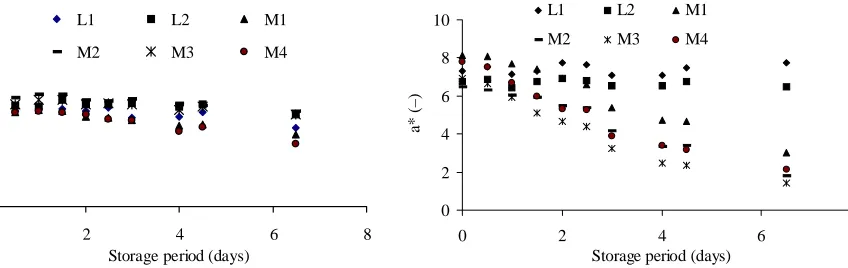
[image:3.595.57.367.612.755.2]were differences between the individual samples (Table 1). The courses of the brightness L* depending on the stor-age period for samples stored under various conditions are plotted in Fig. 3.
Courses of a* co-ordinate are given in Fig. 4. On the basis of Table 1 data it can be stated that there were im-portant differences between the samples L1 and L2, which is a proof of the red colour non-homogeneity of the stud-ied samples. There were statistically significant differenc-es between the individual storage moddifferenc-es; sometimdifferenc-es they were hidden by a great scatter of the data. The most sig-nificant differences were in the samples stored in cold and at room temperature. Thus, the influence of the stor-age mode was proved. The influence of the storstor-age peri-od for the individual storage mperi-odes is shown in Table 2. It is evident that there were no changes in the cooled
[image:4.595.74.539.340.527.2]sam-ples (L1, L2). For the sample M1, no statistically signifi-cant differences were found either which is a consequence of a great scatter of the measured data. For samples M2 to M4, an important decrease of a* co-ordinate was observed (transition from red to grey colour) between the start of the measurement and the 6.5-day measurement period. For shorter measurement periods the differences were sometimes not conclusive because of a greater scatter of the data. From Table 1 it follows that the differences of a* co-ordinate are not statistically significant for samples M1 and M2 and then M3 and M4 (even for M1–M4). That is why we determined the new mean values for sets M1 + M2 and M3 + M4 depending on the storage period. Sta-tistical evaluation of the storage period significance is given in Table 3. It is obvious that the a* co-ordinate depends significantly on the storage period for the M1 +
Table 2. Evaluation of the statistical significance of the differences of the measured values of the colour co-ordinates (Student
t-test) – influence of storage period on the Kladno cooked pork loin different samples
Colour Sample
co-ordinate L1 L2 M1 M2 M3 M4
L* do not differ, the global mean values have been determined
a* 0 day a a a a a a
2 day a a a a b a b
4 day a a a b b c a b
6.5 day a a a c c b
b* 0–4 day a a – – – –
0 day – – a a a a
2 day – – b b a b a b
4 day a b 1 a 1 c c b b
6.5 day b a c d b b
The samples marked by the identical letter (from top to bottom) do not differ in the given colour co-ordinate in the statistical sense on the significance level of 0.95
1for those samples the data measured at 4.5 day has been compared
60 65 70 75 80
0 2 4 6 8
Storage period (days)
L*
(–
)
L1 L2 M1
M2 M3 M4
[image:4.595.106.530.585.719.2]Fig. 3. Relation of brightness L* for the samples L1, L2, M1, M2, M3, M4
Fig. 4. Relation of the a* co-ordinate (red colour indicator) for the samples L1, L2, M1, M2, M3, M4
0 2 4 6 8 10
0 2 4 6 8
Storage period (days)
a*
(–
)
L1 L2 M1
[image:4.595.75.296.588.719.2]M2 samples between 0 and 6.5 days. For M3 + M4 sam-ples, a statistically significant difference occurrs even from the second storage day. This evaluation method gives a greater number of datapieces, a smaller scatter and confi-dence interval, and statistical evaluation is thus more con-clusive.
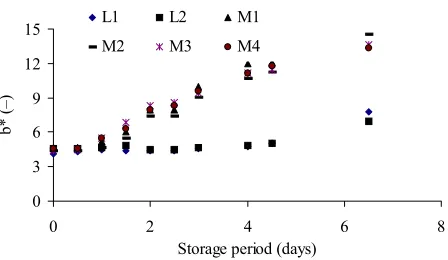
The b* co-ordinate courses for the individual samples are shown in Fig. 5. The b* co-ordinate for yellow colour and samples stored in the refrigerator revealed hardly any change until 4th day; its increase (more yellow colour) occurred only after that period, the final change was by 100%. In the samples stored at room temperature, the change to yellow colour occurred as early as after the first day with a very steep increase – after 6.5 days of storage
nate values took place, however, it became steady more rapidly; thus the differences between 2nd, 4th, and 6.5th
days were statistically insignificant. The statistical clusiveness of the differences was better after data con-solidation for M1 + M2 and M3 + M4 (Table 3). In the case of the M1 + M2 set, a statistically significant in-crease occurred over all the storage period monitored. As to the M3 + M4 set, a more rapid process of stabilisation was proved at the end of storage.
It was found by the sensory evaluation procedure that the samples stored 2 days in refrigerator did not show any change in their aroma. After that period they began to lose the fresh product scent, between the 5th and 6.5th day they started stinking and on the 7th day the reek of spoilage took place.
The samples stored at room temperature in darkness lost theirs original aroma even after the first day, from the 3rd day they stank sub-acidly and unpleasantly, the ex-periment was finished after 6.5 days due to unbearable stink. The samples stored at the room temperature in light had the similar aroma history besides the fact, that the stink was stronger and more pungent than for the sam-ples stored in darkness.
Conclusion
The banana maturation process was monitored at three different temperatures (6.4; 14; 25°C). As concerns colour and shrinking, the storage at 14°C was found to be the best. In the sample stored in a refrigerator, no transition of the peel colour from green to yellow occurred but the colour turned straight black-brown. A banana stored in a room matured very quickly; more over, 20% shrinkage happened after 13 days. These results verified that the table scanner can be used for observation of colour and shape changes of banana.
[image:5.595.301.525.110.240.2]Further, colour and aroma of Kladno cooked pork loin was investigated during storage in a refrigerator and at the room temperature. Brightness co-ordinate L* showed
Table 3. Evaluation of the statistical significance of the differences of the measured values of the colour co-ordinates (Student t-test) after samples combination – influence of storage mode on the Kladno cooked pork loin samples
Colour Combined sample co-ordinate M1 + M2 M3 + M4
a* 0 day a a
2 day a b b
4 day b c c 6.5 day c c
b* 0 day a a
2 day b b
4 day c c 6.5 day d c
The samples marked by the identical letter (from top to bottom) do not differ in the given colour co-ordinate in the statistical sense on the significance level of 0.95
to approx. three times the initial value. It follows from Table 1 that there is no statistical difference in b* values for samples L1 and L2. During storage at room tempera-ture, the b* co-ordinate changed on the second day, yel-low colour progressed and a statistically significant difference of L1 and L2 occurred. The differences of val-ues for storage in darkness (M1 and M2) and in light (M3 and M4) were not important at the room temperature. The influence of the storage period can be seen in Table 2. It shows that during storage in cold no significant differ-ence occurred of the b* co-ordinate for the L2 sample for the period of 6.5 days while for the L1 sample there was a significant difference. In the samples stored at room tem-perature in darkness (M1, M2), significant changes oc-curred starting on the second day of storage and remained significant until 4th to 6.5th day. On the other hand, in
samples M3 and M4 a rapid increase of the b*
co-ordi-0 3 6 9
12
15
0 2 4 6 8
Storage period (days)
b* (–)
L1 L2 M1
M2 M3 M4
[image:5.595.57.283.346.497.2]nearly no changes during storage, a slight decrease oc-curred only after 4.5 days. A considerable decrease of a* co-ordinate for red colour was observed as early as after the 1st storage day for the samples stored in a room
(ap-prox. 25°C). For the b* co-ordinate for yellow colour, an
inverse phenomenon was observed, that is its value in-creased after the 1st day. In the evaluation of the cooked pork loin aroma using sensory observation, a change was registered also after the 1st storage day.
In the samples stored in a refrigerator the colour change was not noticed until after 4.5 days; however, the sensory observation showed a change as early as the end of the second day. The difference between samples stored at room temperature in light and in darkness was insignifi-cant. Despite the fact that this experiment was performed only once (with three parallel samples), one could sup-pose that the aroma change would be registered earlier then the change of colour.
R e f e r e n c e s
ANONYM (1999): Carrier Transicold Company Brochure:
Con-trolled Atmosphere Handbook, 2nd Ed. United Technologies Corp., Syracuse, NY, USA.
GEMMA H., MATSUYAMA Y., HONG GONG WANG (1994): Rip-ening characteristics and chilling injury of banana fruit. I. Effect of storage temperature on respiration, ethylene pro-duction and membrane permeability of peel and pulp tis-sues. Jap. J. Trop. Agric., 38: 216–220.
KLETTNER P.G. (1987): Colour and colour retention in sliced
Bruehwurst sausages in retail display cabinets. Fleisch-wirtschaft, 67: 140, 142–144, 146–147, 190.
SHANTA KRISHNAMURTHY (1989): Storage life and quality of
Robusta banana in relation to their stage of maturity and storage temperature. J. Food Sci. Technol., 26: 87–89.
ŠTĚPÁNEK V. (1975): Matematická statistika v chemii. SNTL,
Praha.
[image:6.595.70.298.95.435.2]Received for publication January 15, 2002 Accepted after corrections June 6, 2002
Table 4. Parameters of regression equations for a*and b*
Regression equation:
Co-ordinate a*
a0 tk aĄ t0 Validity range (–) (day) (–) (day) R
2
t (days)
M1 12.35 11.0 –4.51 1 0.978 1–6.5 M2 21.02 22.7 –14.75 1 0.969 1–6.5 M3 6.95 4.0 -0.22 0.5 0.987 0.5–6.5
M4 6.97 4.0 0.59 0.5 0.986 0.5–6.6
Regression equation:
Co-ordinate b*
b0 ∆b tk t0 Validity range (–) (day) (–) (day) R
2
t (days)
M1 5.09 22.23 8.7 1 0.987 1–6.5 M2 4.66 25.29 11.2 1 0.99 1–6.5 M3 4.44 13.07 5.0 0.5 0.994 0.5–6.5 M4 4.35 13.31 5.1 0.5 0.993 0.5–6.6
Sample
Sample
Souhrn
NOVOTNÁ P., KÝHOS K., LANDFELD A., STROHALM J., HOUŠKA M. (2002):Změny barvy, vůně a tvaru během skladování dvou vybraných potravin.Czech J. Food Sci., 20: 203–208.
Byl proveden test, ve kterém jsme zjišťovali, zda kinetika změn barvy a vůně masného výrobku Kladenská pečeně skladovaného v chladničce a při teplotě místnosti souvisí s jejím kažením. Souřadnice světlosti barvy L* nevykázala významnou změnu během sledovaného období skladování, zatímco souřadnice červené barvy a* vykázala prudký pokles již během prvého dne skladování při teplotě místnosti (asi 25 °C). Naopak souřadnice žluté barvy b* vykázala nárůst během prvého dne skladování. Při senzorickém hodnocení po prvém dni skladování při teplotě místnosti byla zaznamenána změna vůně. Testovali jsme též možnost použít stolní barevný skener k určení změn barvy banánů během skladování. Bylo zjištěno, že optimální teplota skladování banánů
z hlediska změn barvy slupky je 14 °C, což je v souladu s doporučeními získanými z literatury.
Klíčová slova: barva; vůně; jas; souřadnice a* pro červenou barvu; souřadnice b* pro žlutou barvu
Corresponding author:
ING. MILAN HOUŠKA, CSc., Výzkumný ústav potravinářský Praha, Radiová 7, 102 31 Praha 10, Česká republika
tel.: + 420 296 792 306, fax: + 420 272 701 983, e-mail: [email protected]
) –
(1 *
– *
0
k
t t t
e b
b b
0
−
× ∆ + =
∞
+
=a e− a
a tk
t t
.
– *