b
-K
3Fe(MoO
4)
2Mo
2O
7Amira Souilem,* Mohamed Faouzi Zid and Ahmed Driss
Laboratoire de Mate´riaux et Cristallochimie, Faculte´ des Sciences de Tunis, Universite´ de Tunis ElManar, 2092 Manar II Tunis, Tunisia
Correspondence e-mail: [email protected] Received 9 May 2014; accepted 5 June 2014
Key indicators: single-crystal X-ray study;T= 298 K; mean(Fe–O) = 0.005 A˚; disorder in main residue;Rfactor = 0.029;wRfactor = 0.076; data-to-parameter ratio = 13.0.
The title compound, tripotassium iron(III) bis(orthomolyb-date) dimolybdate, was obtained by a solid-state reaction. The main structural building units are one FeO6octahedron, two MoO4tetrahedra and one Mo2O7dimolybdate group, all with point group symmetriesm. These units are linkedvia corner-sharing to form ribbons parallel to [010]. The three K+cations are located between the ribbons on mirror planes and have coordination numbers of 10 and 12. Two O atoms of one of the MoO4 tetrahedra of the dimolybdate group are disordered over two positions in a 0.524 (11):0.476 (11) ratio. The structure of the title compound is compared briefly with that of Rb3FeMo4O15.
Related literature
For properties of related molybdates, see: Zhanget al.(2000); Muessiget al.(2003); Bramniket al.(2003); Soares & Portela (2005); Bowker et al.(2008); Otkoet al.(1978); Kliminet al.
(2003); Jorge et al.(2004); Maczka et al.(2005). The closely related crystal structures of -K3Fe(MoO4)2(Mo2O7) and Rb3Fe(MoO4)2Mo2O7 were determined by Maczka et al.
(2009) and Khal’baeva et al. (2010), respectively. For bond-valence sums, see: Brown & Altermatt (1985).
Experimental
Crystal data
K3Fe(MoO4)2Mo2O7 Mr= 796.91 Monoclinic,C2=m a= 32.873 (2) A˚ b= 5.7137 (7) A˚ c= 7.9177 (9) A˚ = 91.143 (8)
V= 1486.9 (3) A˚3 Z= 4
MoKradiation = 5.15 mm 1 T= 298 K
0.360.220.18 mm
Data collection
Enraf–Nonius CAD-4 diffractometer
Absorption correction: scan (Northet al., 1968) Tmin= 0.286,Tmax= 0.488 3443 measured reflections
1789 independent reflections 1636 reflections withI> 2(I) Rint= 0.028
2 standard reflections every 120 min intensity decay: 1.3%
Refinement
R[F2> 2(F2)] = 0.029 wR(F2) = 0.076 S= 1.06 1789 reflections
138 parameters
max= 1.22 e A˚ 3 min= 1.57 e A˚ 3
Data collection:CAD-4 EXPRESS(Duisenberg, 1992; Macı´cˇek & Yordanov, 1992); cell refinement:CAD-4 EXPRESS; data reduction: XCAD4(Harms & Wocadlo, 1995); program(s) used to solve struc-ture:SHELXS97(Sheldrick, 2008); program(s) used to refine struc-ture:SHELXL97(Sheldrick, 2008); molecular graphics:DIAMOND (Brandenburg & Putz, 1999); software used to prepare material for publication:WinGX(Farrugia, 2012).
Supporting information for this paper is available from the IUCr electronic archives (Reference: WM5025).
References
Bowker, M., Holroyd, R., House, M., Bracey, R., Bamroongwongdee, C., Shannon, M. & Carley, A. (2008).Top. Catal.48, 158–165.
Bramnik, K. G., Muessig, E. & Ehrenberg, H. (2003).J. Solid State Chem.176, 192–197.
Brandenburg, K. & Putz, H. (1999).DIAMOND. Crystal Impact GbR, Bonn, Germany.
Brown, I. D. & Altermatt, D. (1985).Acta Cryst.B41, 244–247. Duisenberg, A. J. M. (1992).J. Appl. Cryst.25, 92–96. Farrugia, L. J. (2012).J. Appl. Cryst.45, 849–854.
Harms, K. & Wocadlo, S. (1995).XCAD4. University of Marburg, Germany. Jorge, G. A., Capan, C., Ronning, F., Jaime, M., Kenzelmann, M., Gasparovic, G., Broholm, C., Shapiro, A. & Demianets, Y. (2004).Physica B,354, 297– 299.
Khal’baeva, K. M., Solodovnikov, S. F., Khaikina, E. G., Kadyrova, Y. M., Solodovnikova, Z. A. & Basovich, O. M. (2010).J. Solid State Chem.183, 712–719.
Klimin, S. A., Popova, M. N., Mavrin, B. N., Van Loosdrecht, P. H. M., Svistov, L. E., Smirnov, A. I., Prozorova, L. A., Krug van Nidda, H. A., Seidov, Z. & Loidl, A. (2003).Phys. Rev.B68, 174408–174412.
Macı´cˇek, J. & Yordanov, A. (1992).J. Appl. Cryst.25, 73–80.
Maczka, M., Pietraszko, A., Paraguassu, W., Souza Filho, A. G., Freire, P. T. C., Mendes Filho, J. & Hanuza, J. (2009).J. Phys. Condens. Matter,21, 095402, 1–8.
Maczka, M., Pietraszko, A., Saraiva, G. D., Souza Filho, A. G., Paraguassu, W., Lemos, V., Perottoni, C. A., Gallas, M. R., Freire, P. T. C., Tomaszewski, P. E., Melo, F. E. A., Mendes Filho, J. & Hanuza, J. (2005).J. Phys. Condens. Matter,17, 6285–6300.
Muessig, E., Bramnik, K. G. & Ehrenberg, H. (2003).Acta Cryst.B59, 611–616. North, A. C. T., Phillips, D. C. & Mathews, F. S. (1968).Acta Cryst.A24, 351–
359.
Otko, A. I., Nesterenko, N. M. & Povstyanyi, L. V. (1978).Phys. Status Solidi A,46, 577–587.
Sheldrick, G. M. (2008).Acta Cryst.A64, 112–122.
Soares, A. P. V. & Portela, M. F. (2005).Catal. Rev.47, 125–174.
Zhang, L. J., Zhou, Y. S., Zuo, J. L., Yu, Z., Fun, H. K., Abdul, I. & You, X. Z. (2000).Inorg. Chem. Commun.3, 697–699.
i38
Souilemet al. doi:10.1107/S1600536814013087 Acta Cryst.(2014). E70, i38Acta Crystallographica Section E
Structure Reports
Online
supporting information
supporting information
Acta Cryst. (2014). E70, i38 [https://doi.org/10.1107/S1600536814013087]
β-K
3Fe(MoO
4)
2Mo
2O
7Amira Souilem, Mohamed Faouzi Zid and Ahmed Driss
S1. Comment
L′étude des composés appartenant à la grande famille des molybdates de fer, métaux alcalins et pseudo-alcalins qui
possèdent des propriétés structurelles, catalytiques, magnétiques et ferroélastiques intéressantes (Zhang et al., 2000;
Muessig et al., 2003; Bramnik et al., 2003; Soares & Portela, 2005; Bowker et al., 2008; Otko et al., 1978; Maczka et al.,
2005; Klimin et al., 2003; Jorge et al., 2004) nous a encouragés à explorer les systèmes molybdates de fer à cations
monovalents. Une étude bibliographique a été effectuée sur la famille de composés de formulation AFe(III)Mo4O15 où A
est un cation monovalent: α-K3Fe(MoO4)2(Mo2O7) (Maczka et al., 2009), Rb3FeMo4O15 (Khal'baeva et al., 2010). En
effet, le présent travail porte sur l′étude structurale d'un molybdate de formulation β-K3Fe(MoO4)2(Mo2O7) obtenu par
voie sèche.
La structure de K3Fe(MoO4)2(Mo2O7) (forme-β) est de formule analogue à une autre phase déjà connue:
K3Fe(MoO4)2(Mo2O7) (forme-α; Maczka et al., 2009). Elles pésentent la même symétrie monoclinique.
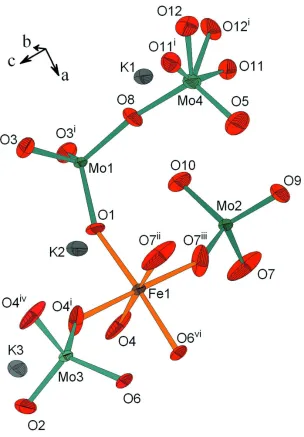
La nouvelle variété β-K3Fe(MoO4)2(Mo2O7) est formée d'un octaèdre FeO6, de deux tétraèdres MoO4 et d'un groupement
dimolybdate Mo2O7 (Fig. 1). Deux unités formulaires centrosymétriques se regroupent par partage de sommets donnant
lieu à un dimère de formulation (FeO6)2(Mo4)4(Mo2O7)2 (Fig. 2a). Ces derniers se connectent moyennant des ponts mixtes
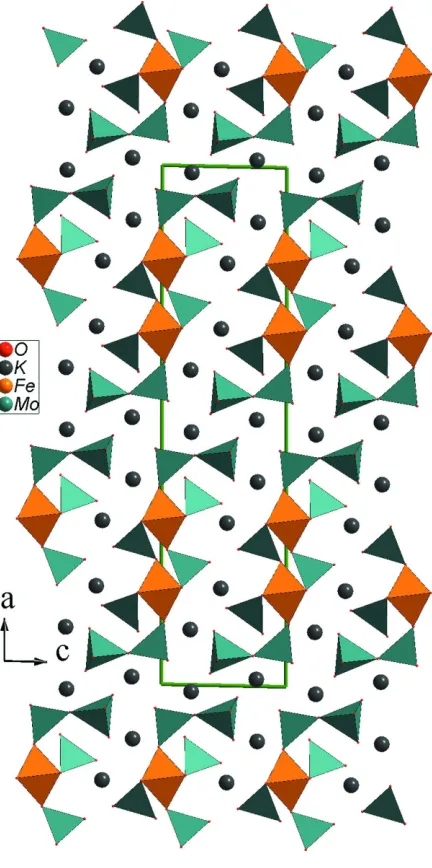
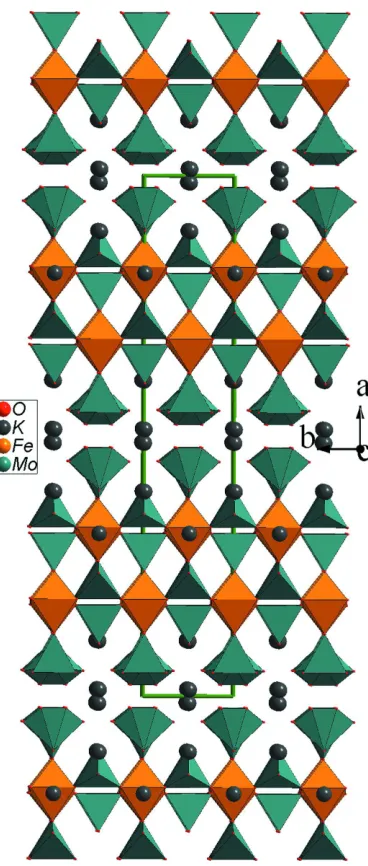
de type Mo–O–Fe pour donner des rubans disposés selon [010] (Fig. 2b). Il en résulte une charpente unidimensionnelle
possédant des espaces inter-rubans où résident les cations monovalents K+ (Figs. 3 et 4).
L'examen des facteurs géométriques dans la structure montre qu'ils sont en bon accord avec ceux rencontrés dans la
littérature (Maczka et al., 2009; Khal'baeva et al., 2010).
D'autre part, le calcul des valences de liaisons (BVS), utilisant la formule empirique de Brown (Brown & Altermatt,
1985), conduit aux valeurs des charges des cations suivants: Fe1 (3,03), Mo1 (6,03), Mo2 (6,13), Mo3 (5,94), Mo4
(6,03), K1 (0,61), K2 (0,71) et K3 (0,59).
sup-2 Acta Cryst. (2014). E70, i38
S2. Experimental
La synthèse de K3FeMo4O15 a été effectuée par réaction à l′état solide, à partir de carbonate de potassium (Prolabo,
60109), de nitrate de fer (Fluka 44949) et de molybdate d'ammonium (Fluka, 69858) dans un rapport molaire K:Fe:Mo
égal à 3:1:6 respectivement. Après un broyage poussé dans un mortier en agate, le mélange est placé dans un creuset en
porcelaine, puis porté dans un premier temps à une température de 673 K pendant 4 heures, en vue d′éliminer les produits
volatils. Un second traitement thermique a été effectué à la température de synthèse, 1126 K pendant 24 heures. Le résidu
final est ensuite ramené à un refroidissement lent de 5 K/12 h jusqu′à 1043 K, suivi d'un autre plus rapide (50 K/24 h)
jusqu′à la température ambiante. Des cristaux de couleur verdâtre sont séparés à l'eau chaude.
S3. Refinement
L'examen de la différence de fourier final à révélé la présence d'un pic proche de la position de l'atome d'oxygène O11.
L'insertion de ce pic O12 et l'affinement des taux d'occupation [0.524 (11) et 0.476 (11) pour respectivement O11 et O12]
conduit à des ellipsoïdes bien définis. De plus, les densités d′électrons maximum et minimum restants dans la
supporting information
Figure 1
La structure de β-K3Fe(MoO4)2Mo2O7. Les éllipsoïdes ont été définis avec 50% de probabilité. [Symmetry codes: (i) x,
sup-4 Acta Cryst. (2014). E70, i38
Figure 2
supporting information
Figure 3
sup-6 Acta Cryst. (2014). E70, i38
Figure 4
supporting information
Figure 5
sup-8 Acta Cryst. (2014). E70, i38
Figure 6
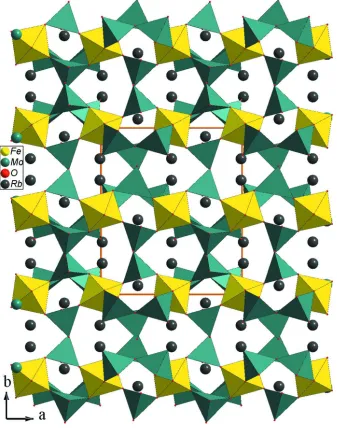
Représentation des rubans mettant en évidence les environnements des octaèdres FeO6 (a): Dans Rb3Fe(MoO4)2Mo2O7;
(b): Dans β-K3Fe(MoO4)2Mo2O7.
Tripotassium iron(III) bis(orthomolybdate) dimolybdate
Crystal data K3Fe(MoO4)2Mo2O7 Mr = 796.91
Monoclinic, C2/m Hall symbol: -C 2y a = 32.873 (2) Å b = 5.7137 (7) Å c = 7.9177 (9) Å β = 91.143 (8)° V = 1486.9 (3) Å3 Z = 4
F(000) = 1484 Dx = 3.560 Mg m−3
Mo Kα radiation, λ = 0.71073 Å Cell parameters from 25 reflections θ = 11–15°
µ = 5.15 mm−1 T = 298 K Prism, green
0.36 × 0.22 × 0.18 mm
Data collection Enraf–Nonius CAD-4
diffractometer
Radiation source: fine-focus sealed tube Graphite monochromator
ω/2θ scans
Absorption correction: ψ scan (North et al., 1968)
Tmin = 0.286, Tmax = 0.488 3443 measured reflections
1789 independent reflections 1636 reflections with I > 2σ(I) Rint = 0.028
θmax = 27.0°, θmin = 2.5° h = −41→41
k = −1→7 l = −10→5
supporting information
Refinement Refinement on F2 Least-squares matrix: full R[F2 > 2σ(F2)] = 0.029 wR(F2) = 0.076 S = 1.06 1789 reflections 138 parameters 0 restraints
Primary atom site location: structure-invariant direct methods
Secondary atom site location: difference Fourier map
w = 1/[σ2(F
o2) + (0.0306P)2 + 20.6944P] where P = (Fo2 + 2Fc2)/3
(Δ/σ)max = 0.001 Δρmax = 1.22 e Å−3 Δρmin = −1.57 e Å−3
Extinction correction: SHELXL97 (Sheldrick, 2008), Fc*=kFc[1+0.001xFc2λ3/sin(2θ)]-1/4 Extinction coefficient: 0.00379 (16)
Special details
Geometry. All e.s.d.'s (except the e.s.d. in the dihedral angle between two l.s. planes) are estimated using the full covariance matrix. The cell e.s.d.'s are taken into account individually in the estimation of e.s.d.'s in distances, angles and torsion angles; correlations between e.s.d.'s in cell parameters are only used when they are defined by crystal symmetry. An approximate (isotropic) treatment of cell e.s.d.'s is used for estimating e.s.d.'s involving l.s. planes.
Refinement. Refinement of F2 against ALL reflections. The weighted R-factor wR and goodness of fit S are based on F2, conventional R-factors R are based on F, with F set to zero for negative F2. The threshold expression of F2 > σ(F2) is used only for calculating R-factors(gt) etc. and is not relevant to the choice of reflections for refinement. R-factors based on F2 are statistically about twice as large as those based on F, and R- factors based on ALL data will be even larger.
Fractional atomic coordinates and isotropic or equivalent isotropic displacement parameters (Å2)
x y z Uiso*/Ueq Occ. (<1)
Mo1 0.568576 (15) 0.5000 −0.03610 (7) 0.01354 (16)
Mo2 0.649834 (16) 0.0000 0.73776 (7) 0.01577 (16)
Mo3 0.718491 (15) 0.0000 0.18432 (7) 0.01355 (16)
Mo4 0.55700 (2) 0.5000 0.49609 (8) 0.0375 (2)
Fe1 0.68040 (3) 0.5000 −0.01846 (11) 0.0118 (2)
K1 0.51309 (5) 0.0000 0.7616 (2) 0.0253 (3)
K2 0.60638 (5) 0.0000 0.2307 (2) 0.0340 (4)
K3 0.68689 (5) 0.5000 0.4756 (2) 0.0361 (5)
O1 0.62085 (14) 0.5000 0.0211 (7) 0.0257 (11)
O2 0.73729 (17) 0.0000 0.3855 (7) 0.0373 (15)
O3 0.54601 (11) 0.7403 (7) 0.0504 (5) 0.0277 (8)
O4 0.68711 (12) 0.7469 (9) 0.1610 (6) 0.0459 (13)
O5 0.60430 (19) 0.5000 0.4216 (9) 0.053 (2)
sup-10 Acta Cryst. (2014). E70, i38
Mo2 0.0111 (3) 0.0210 (3) 0.0151 (3) 0.000 −0.00068 (19) 0.000
Mo3 0.0080 (2) 0.0163 (3) 0.0164 (3) 0.000 −0.00035 (19) 0.000
Mo4 0.0169 (3) 0.0820 (6) 0.0137 (3) 0.000 0.0003 (2) 0.000
Fe1 0.0092 (4) 0.0101 (4) 0.0160 (4) 0.000 −0.0006 (3) 0.000
K1 0.0184 (7) 0.0324 (9) 0.0250 (8) 0.000 −0.0022 (6) 0.000
K2 0.0195 (7) 0.0563 (12) 0.0260 (8) 0.000 −0.0046 (6) 0.000
K3 0.0226 (8) 0.0665 (14) 0.0191 (8) 0.000 −0.0004 (6) 0.000
O1 0.010 (2) 0.042 (3) 0.025 (3) 0.000 −0.0025 (19) 0.000
O2 0.023 (3) 0.065 (4) 0.023 (3) 0.000 −0.008 (2) 0.000
O3 0.0224 (17) 0.0242 (18) 0.037 (2) 0.0016 (16) 0.0069 (15) −0.0049 (17)
O4 0.031 (2) 0.051 (3) 0.058 (3) −0.029 (2) 0.0281 (19) −0.040 (2)
O5 0.027 (3) 0.085 (6) 0.048 (4) 0.000 0.011 (3) 0.000
O6 0.009 (2) 0.032 (3) 0.026 (3) 0.000 0.0045 (18) 0.000
O7 0.038 (2) 0.087 (4) 0.077 (4) −0.036 (3) 0.026 (2) −0.068 (3)
O8 0.035 (3) 0.048 (4) 0.015 (2) 0.000 −0.006 (2) 0.000
O9 0.033 (3) 0.056 (4) 0.015 (2) 0.000 −0.004 (2) 0.000
O10 0.018 (3) 0.056 (4) 0.045 (4) 0.000 0.005 (2) 0.000
O11 0.031 (4) 0.036 (4) 0.025 (4) 0.005 (3) 0.002 (3) −0.002 (3)
O12 0.036 (5) 0.033 (5) 0.031 (4) −0.017 (4) −0.003 (3) −0.015 (4)
Geometric parameters (Å, º)
Mo1—O3 1.710 (4) K1—O3x 2.882 (4)
Mo1—O3i 1.710 (4) K1—O10 2.913 (6)
Mo1—O1 1.768 (5) K1—O3xi 2.916 (4)
Mo1—O8ii 1.849 (5) K1—O3xii 2.916 (4)
Mo2—O9 1.708 (5) K1—O11iii 2.924 (7)
Mo2—O10 1.717 (6) K1—O11 2.924 (7)
Mo2—O7 1.776 (5) K1—O8iv 3.224 (3)
Mo2—O7iii 1.776 (5) K2—O9 2.683 (6)
Mo3—O2 1.697 (5) K2—O11 2.762 (7)
Mo3—O6 1.759 (5) K2—O11iii 2.762 (7)
Mo3—O4iv 1.784 (4) K2—O3iv 2.841 (4)
Mo3—O4i 1.784 (4) K2—O3i 2.841 (4)
Mo4—O12 1.605 (7) K2—O4i 3.082 (5)
Mo4—O12i 1.605 (7) K2—O4iv 3.082 (5)
Mo4—O5 1.674 (6) K2—O5 3.233 (3)
Mo4—O8 1.881 (5) K2—O5iv 3.233 (3)
Mo4—O11 1.940 (8) K2—O10ii 3.317 (7)
Mo4—O11i 1.940 (8) K2—O1iv 3.343 (3)
Fe1—O7ii 1.956 (4) K2—O1 3.343 (3)
Fe1—O7v 1.956 (4) K3—O2xiii 2.704 (6)
Fe1—O1 1.989 (5) K3—O5 2.740 (7)
Fe1—O6vi 2.000 (5) K3—O4i 2.863 (5)
Fe1—O4 2.011 (4) K3—O4 2.863 (5)
Fe1—O4i 2.011 (4) K3—O7i 3.005 (7)
K1—O12vii 2.650 (8) K3—O7 3.005 (7)
supporting information
K1—O11vii 2.789 (8) K3—O9xiv 3.135 (3)
K1—O11viii 2.789 (8) K3—O2xiv 3.386 (3)
K1—O3ix 2.882 (4) K3—O2 3.386 (3)
O3—Mo1—O3i 106.8 (3) O12—Mo4—O11 47.9 (4)
O3—Mo1—O1 108.94 (15) O12i—Mo4—O11 107.1 (4)
O3i—Mo1—O1 108.94 (15) O5—Mo4—O11 93.2 (2)
O3—Mo1—O8ii 108.63 (16) O8—Mo4—O11 100.9 (2)
O3i—Mo1—O8ii 108.63 (16) O12—Mo4—O11i 107.1 (4)
O1—Mo1—O8ii 114.6 (2) O12i—Mo4—O11i 47.9 (4)
O9—Mo2—O10 110.8 (3) O5—Mo4—O11i 93.2 (2)
O9—Mo2—O7 107.9 (2) O8—Mo4—O11i 100.9 (2)
O10—Mo2—O7 109.20 (18) O11—Mo4—O11i 153.4 (4)
O9—Mo2—O7iii 107.9 (2) O7ii—Fe1—O7v 90.2 (4)
O10—Mo2—O7iii 109.20 (18) O7ii—Fe1—O1 92.22 (17)
O7—Mo2—O7iii 111.9 (4) O7v—Fe1—O1 92.22 (17)
O2—Mo3—O6 109.2 (3) O7ii—Fe1—O6vi 90.18 (17)
O2—Mo3—O4iv 107.2 (2) O7v—Fe1—O6vi 90.18 (17)
O6—Mo3—O4iv 112.33 (14) O1—Fe1—O6vi 176.6 (2)
O2—Mo3—O4i 107.2 (2) O7ii—Fe1—O4 178.6 (2)
O6—Mo3—O4i 112.33 (14) O7v—Fe1—O4 90.4 (3)
O4iv—Mo3—O4i 108.3 (3) O1—Fe1—O4 89.03 (15)
O12—Mo4—O12i 59.4 (7) O6vi—Fe1—O4 88.54 (16)
O12—Mo4—O5 118.2 (4) O7ii—Fe1—O4i 90.4 (3)
O12i—Mo4—O5 118.2 (4) O7v—Fe1—O4i 178.6 (2)
O12—Mo4—O8 120.8 (3) O1—Fe1—O4i 89.03 (15)
O12i—Mo4—O8 120.8 (3) O6vi—Fe1—O4i 88.54 (16)
O5—Mo4—O8 110.9 (3) O4—Fe1—O4i 89.1 (3)
![Figure 2(a): Nouvelle unité centrosymétrique. (b): Vue, selon [010], d'un ruban dans β-K3Fe(MoO4)2Mo2O7,](https://thumb-us.123doks.com/thumbv2/123dok_us/470787.545260/5.610.137.474.75.344/figure-nouvelle-unite-centrosymetrique-vue-ruban-fe-moo.webp)